CHAPTER 5 FREE ELECTRON THEORY Free Electron Theory






- Slides: 38
CHAPTER 5 FREE ELECTRON THEORY
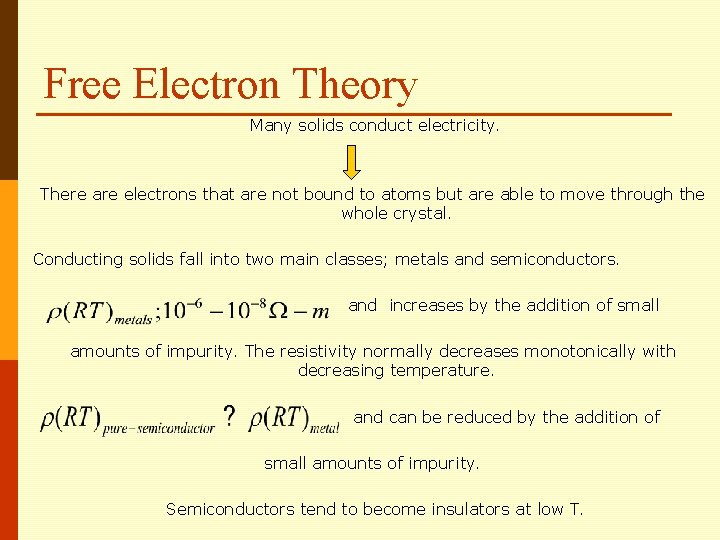
Free Electron Theory Many solids conduct electricity. There are electrons that are not bound to atoms but are able to move through the whole crystal. Conducting solids fall into two main classes; metals and semiconductors. and increases by the addition of small amounts of impurity. The resistivity normally decreases monotonically with decreasing temperature. and can be reduced by the addition of small amounts of impurity. Semiconductors tend to become insulators at low T.
Why mobile electrons appear in some solids and others? When the interactions between electrons are considered this becomes a very difficult question to answer. The common physical properties of metals; • Great physical strength • High density • Good electrical and thermal conductivity, etc. This chapter will calculate these common properties of metals using the assumption that conduction electrons exist and consist of all valence electrons from all the metals; thus metallic Na, Mg and Al will be assumed to have 1, 2 and 3 mobile electrons per atom respectively. A simple theory of ‘ free electron model’ which works remarkably well will be described to explain these properties of metals.
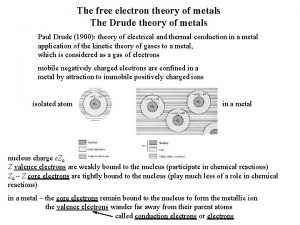
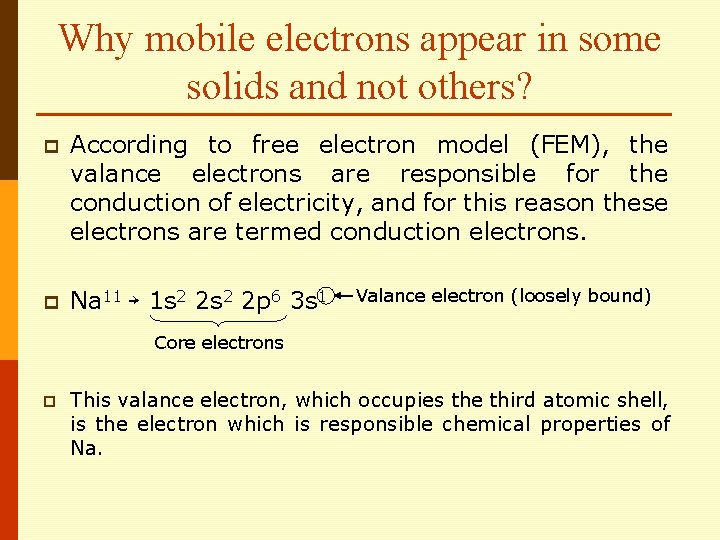
Why mobile electrons appear in some solids and not others? p According to free electron model (FEM), the valance electrons are responsible for the conduction of electricity, and for this reason these electrons are termed conduction electrons. p Na 11 → 1 s 2 2 p 6 3 s 1 Valance electron (loosely bound) Core electrons p This valance electron, which occupies the third atomic shell, is the electron which is responsible chemical properties of Na.
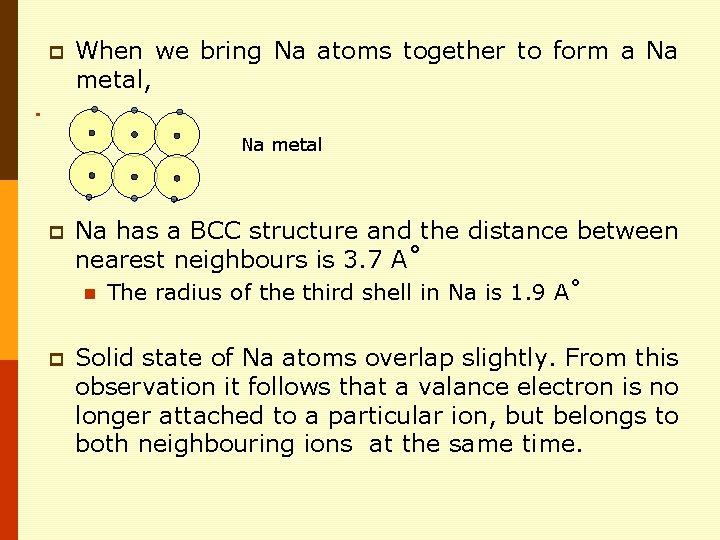
p When we bring Na atoms together to form a Na metal, Na metal p Na has a BCC structure and the distance between nearest neighbours is 3. 7 A˚ n p The radius of the third shell in Na is 1. 9 A˚ Solid state of Na atoms overlap slightly. From this observation it follows that a valance electron is no longer attached to a particular ion, but belongs to both neighbouring ions at the same time.
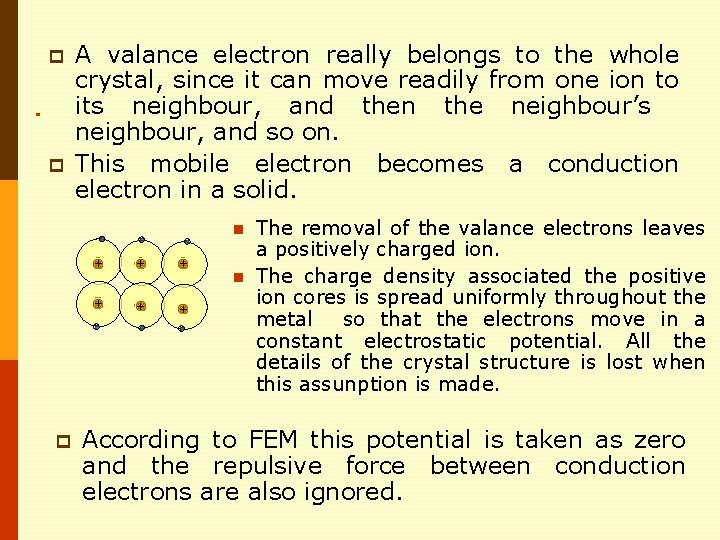
p p A valance electron really belongs to the whole crystal, since it can move readily from one ion to its neighbour, and then the neighbour’s neighbour, and so on. This mobile electron becomes a conduction electron in a solid. n p + + + n The removal of the valance electrons leaves a positively charged ion. The charge density associated the positive ion cores is spread uniformly throughout the metal so that the electrons move in a constant electrostatic potential. All the details of the crystal structure is lost when this assunption is made. According to FEM this potential is taken as zero and the repulsive force between conduction electrons are also ignored.
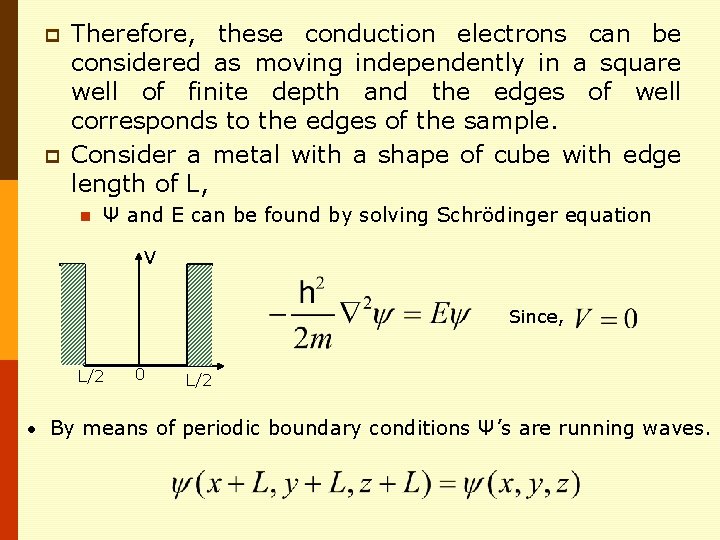
p p Therefore, these conduction electrons can be considered as moving independently in a square well of finite depth and the edges of well corresponds to the edges of the sample. Consider a metal with a shape of cube with edge length of L, n Ψ and E can be found by solving Schrödinger equation V Since, L/2 0 L/2 • By means of periodic boundary conditions Ψ’s are running waves.
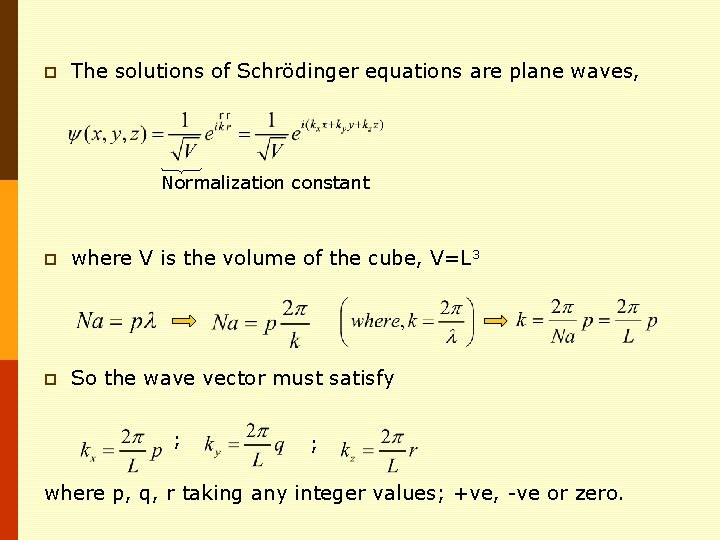
p The solutions of Schrödinger equations are plane waves, Normalization constant p where V is the volume of the cube, V=L 3 p So the wave vector must satisfy ; ; where p, q, r taking any integer values; +ve, -ve or zero.
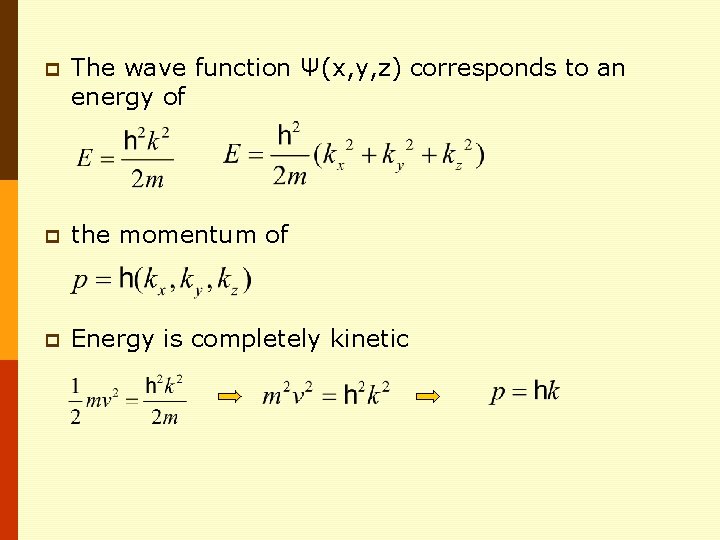
p The wave function Ψ(x, y, z) corresponds to an energy of p the momentum of p Energy is completely kinetic
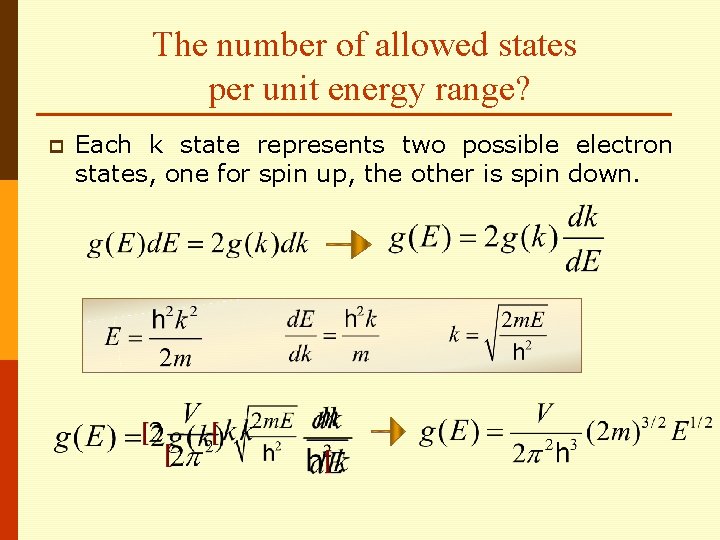
p We know that the number of allowed k values inside a spherical shell of k-space of radius k of n where g(k) is the density of states per unit magnitude of k.
The number of allowed states per unit energy range? p Each k state represents two possible electron states, one for spin up, the other is spin down.
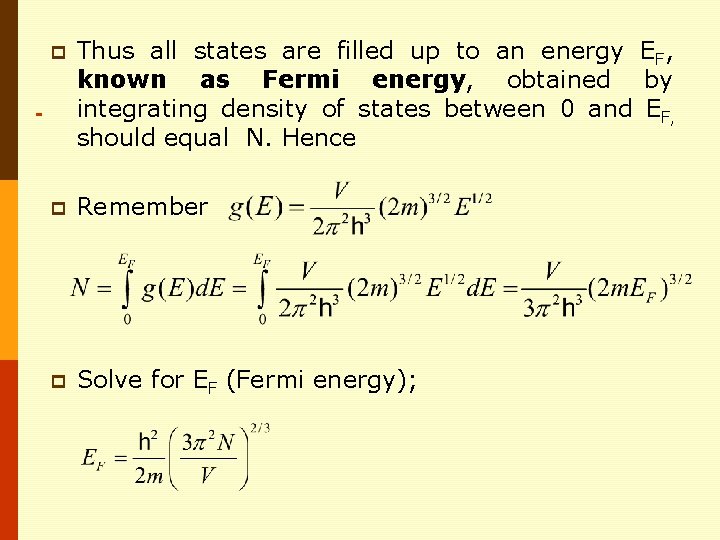
Ground state of the free electron gas p Electrons are fermions (s=± 1/2) and obey Pauli exclusion principle; each state can accommodate only one electron. p The lowest-energy state of N free electrons is therefore obtained by filling the N states of lowest energy.
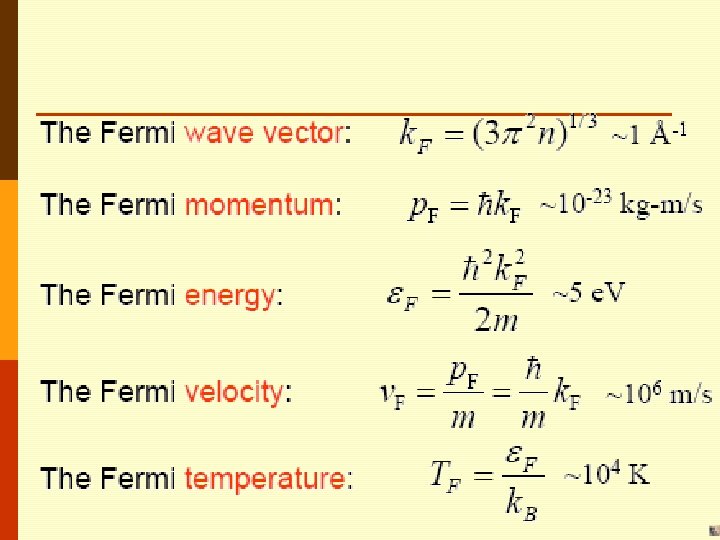
p Thus all states are filled up to an energy EF, known as Fermi energy, obtained by integrating density of states between 0 and EF, should equal N. Hence p Remember p Solve for EF (Fermi energy);
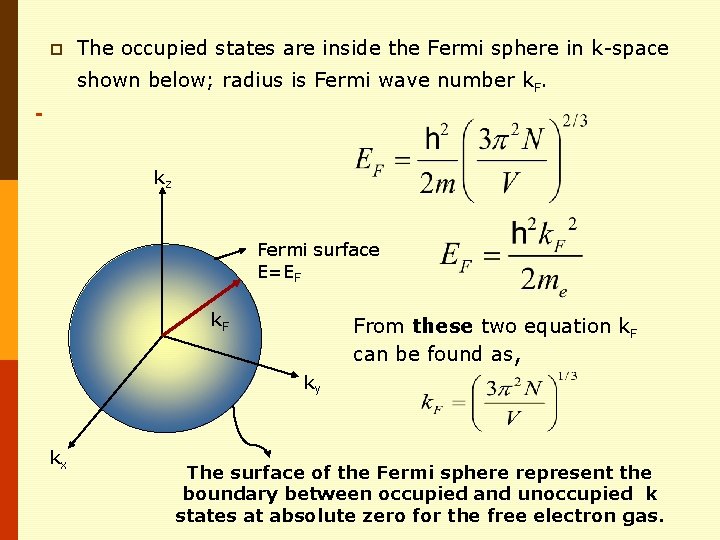
p The occupied states are inside the Fermi sphere in k-space shown below; radius is Fermi wave number k. F. kz Fermi surface E=EF k. F From these two equation k. F can be found as, ky kx The surface of the Fermi sphere represent the boundary between occupied and unoccupied k states at absolute zero for the free electron gas.
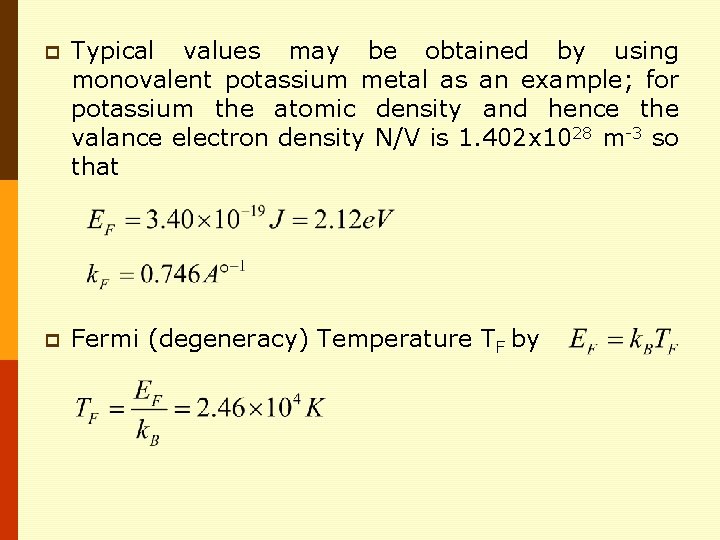
p Typical values may be obtained by using monovalent potassium metal as an example; for potassium the atomic density and hence the valance electron density N/V is 1. 402 x 1028 m-3 so that p Fermi (degeneracy) Temperature TF by
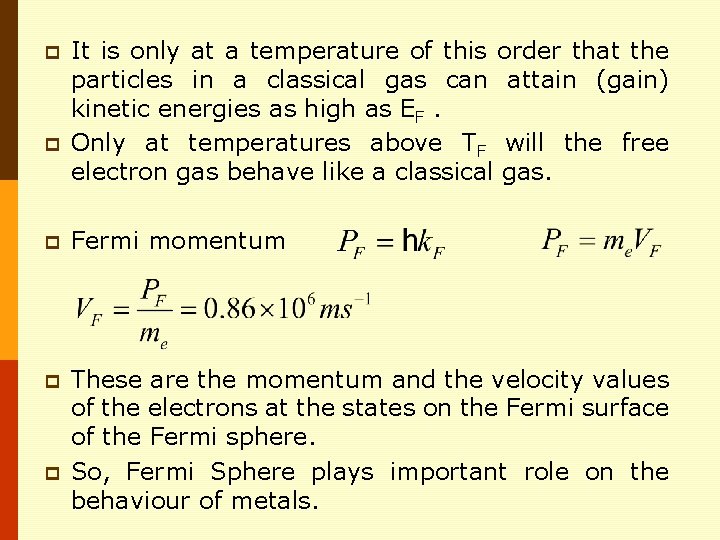
p p It is only at a temperature of this order that the particles in a classical gas can attain (gain) kinetic energies as high as EF. Only at temperatures above TF will the free electron gas behave like a classical gas. p Fermi momentum p These are the momentum and the velocity values of the electrons at the states on the Fermi surface of the Fermi sphere. So, Fermi Sphere plays important role on the behaviour of metals. p
Typical values of monovalent potassium metal;
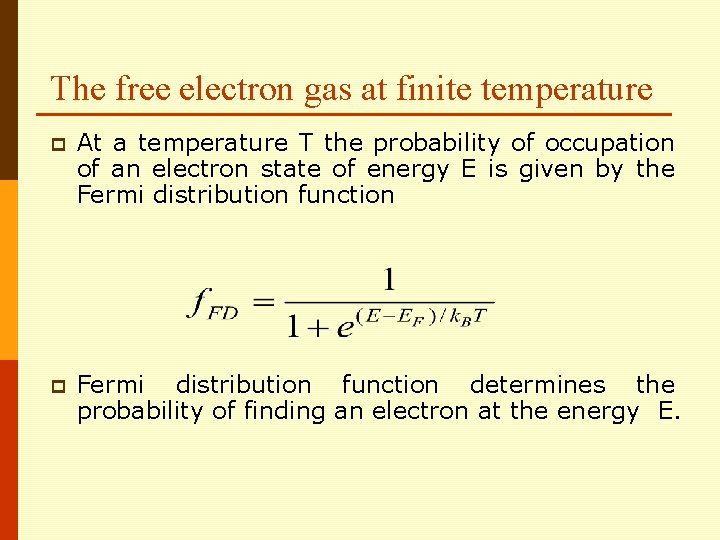
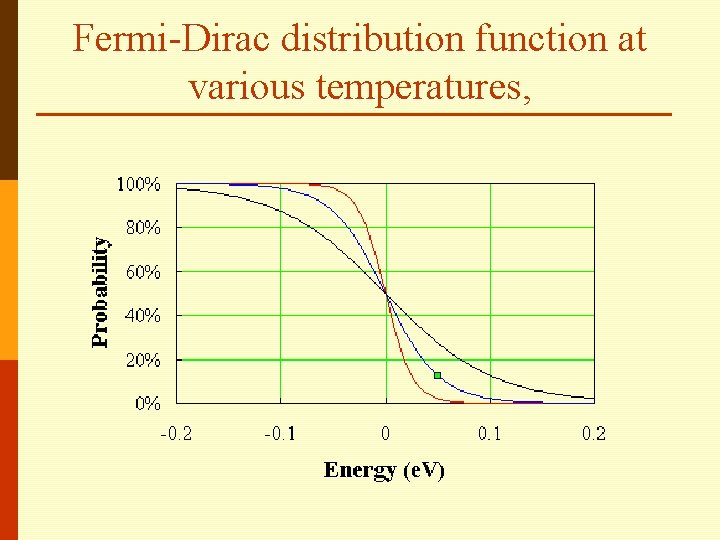
The free electron gas at finite temperature p At a temperature T the probability of occupation of an electron state of energy E is given by the Fermi distribution function p Fermi distribution function determines the probability of finding an electron at the energy E.
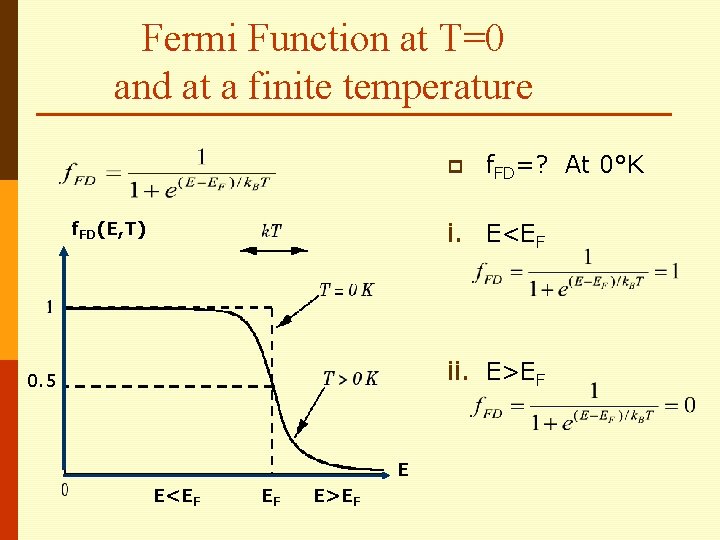
Fermi Function at T=0 and at a finite temperature p f. FD=? At 0°K i. E<EF f. FD(E, T) ii. E>EF 0. 5 E E<EF EF E>EF
Fermi-Dirac distribution function at various temperatures,
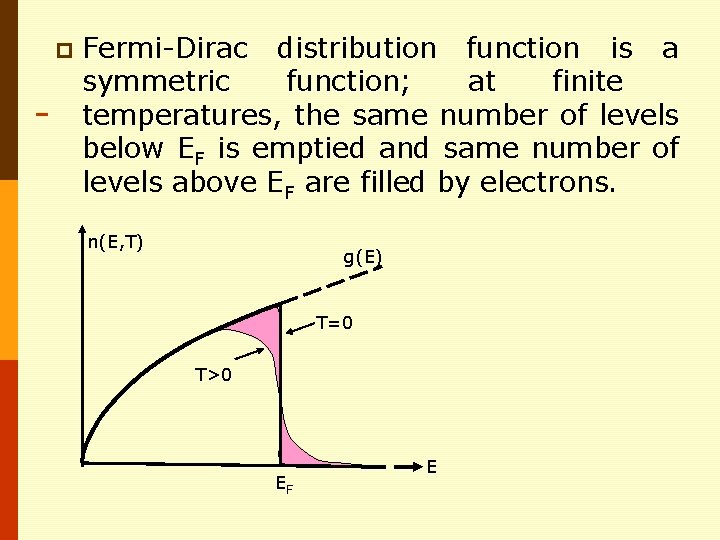
p p Number of electrons per unit energy range according to the free electron model? The shaded area shows the change in distribution between absolute zero and a finite temperature. n(E, T) g(E) p T=0 T>0 EF E n(E, T) number of free electrons per unit energy range is just the area under n(E, T) graph.
p Fermi-Dirac distribution function is a symmetric function; at finite temperatures, the same number of levels below EF is emptied and same number of levels above EF are filled by electrons. n(E, T) g(E) T=0 T>0 EF E
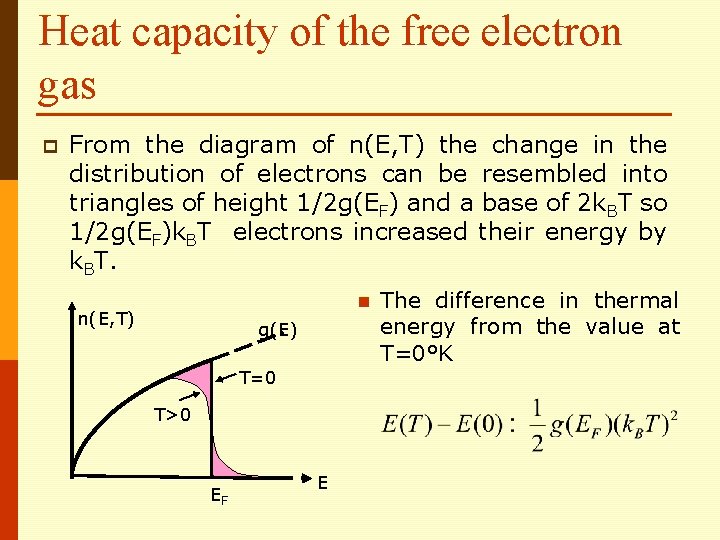
Heat capacity of the free electron gas p From the diagram of n(E, T) the change in the distribution of electrons can be resembled into triangles of height 1/2 g(EF) and a base of 2 k. BT so 1/2 g(EF)k. BT electrons increased their energy by k. BT. n n(E, T) g(E) T=0 T>0 EF E The difference in thermal energy from the value at T=0°K
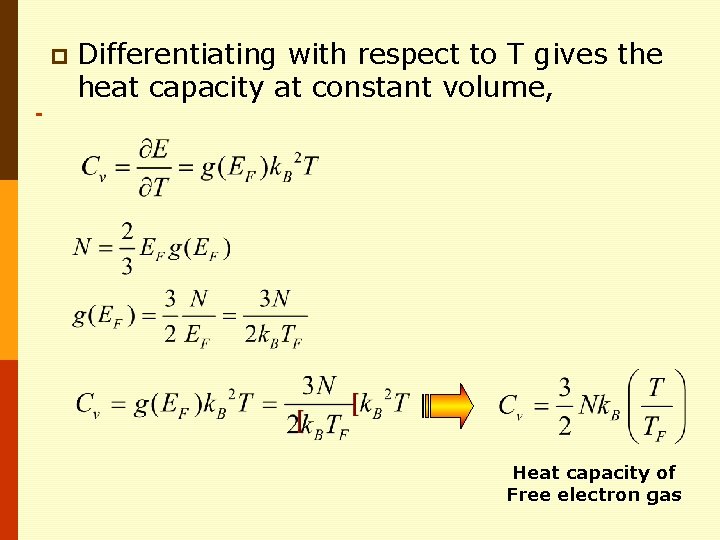
p Differentiating with respect to T gives the heat capacity at constant volume, Heat capacity of Free electron gas
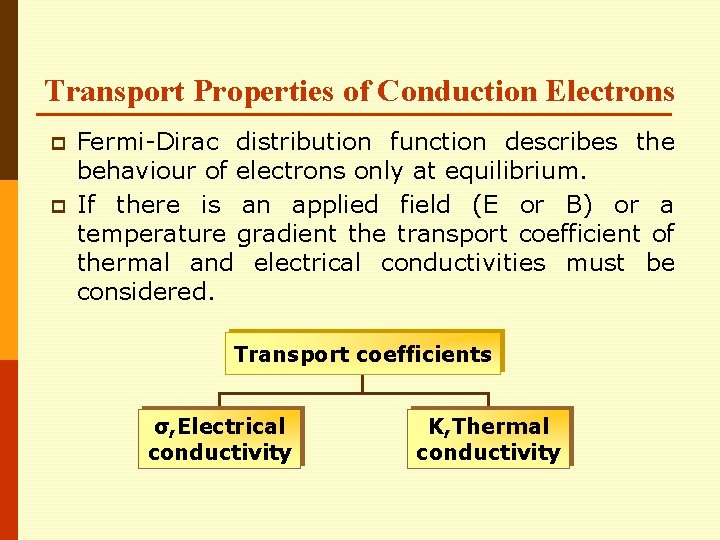
Transport Properties of Conduction Electrons p p Fermi-Dirac distribution function describes the behaviour of electrons only at equilibrium. If there is an applied field (E or B) or a temperature gradient the transport coefficient of thermal and electrical conductivities must be considered. Transport coefficients σ, Electrical conductivity K, Thermal conductivity
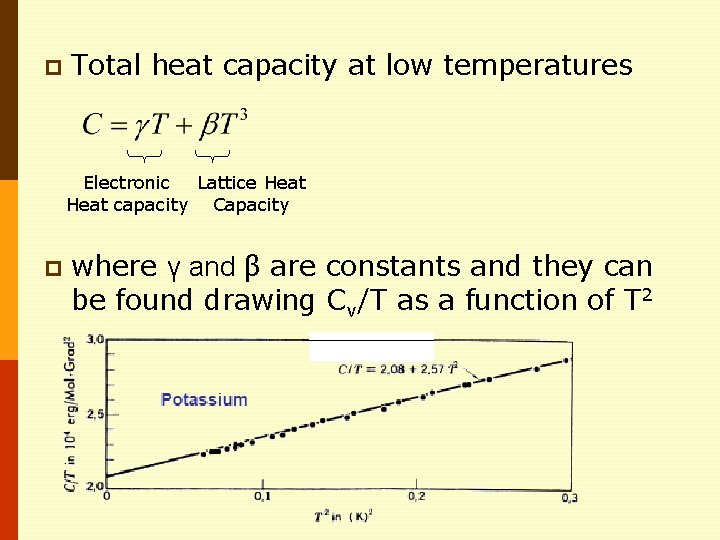
p Total heat capacity at low temperatures Electronic Lattice Heat capacity Capacity p where γ and β are constants and they can be found drawing Cv/T as a function of T 2
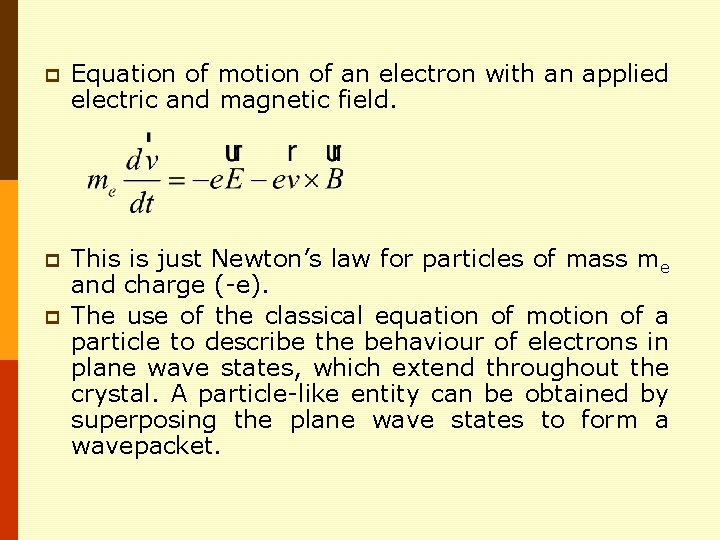
p Equation of motion of an electron with an applied electric and magnetic field. p This is just Newton’s law for particles of mass me and charge (-e). The use of the classical equation of motion of a particle to describe the behaviour of electrons in plane wave states, which extend throughout the crystal. A particle-like entity can be obtained by superposing the plane wave states to form a wavepacket. p
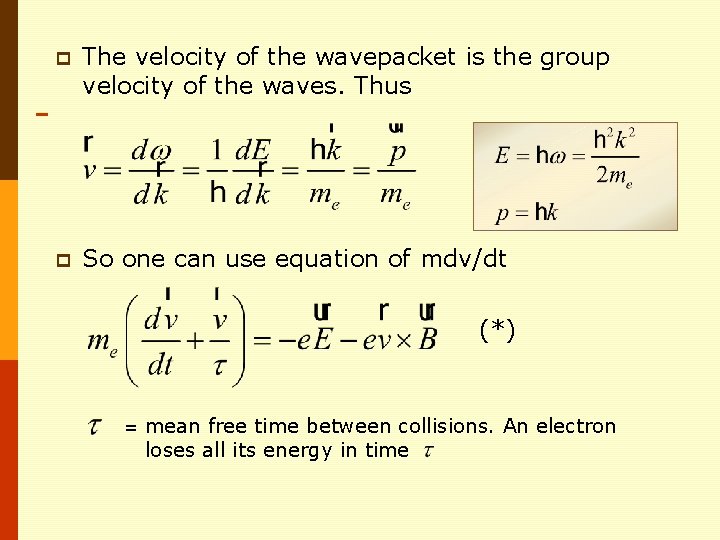
p The velocity of the wavepacket is the group velocity of the waves. Thus p So one can use equation of mdv/dt (*) = mean free time between collisions. An electron loses all its energy in time
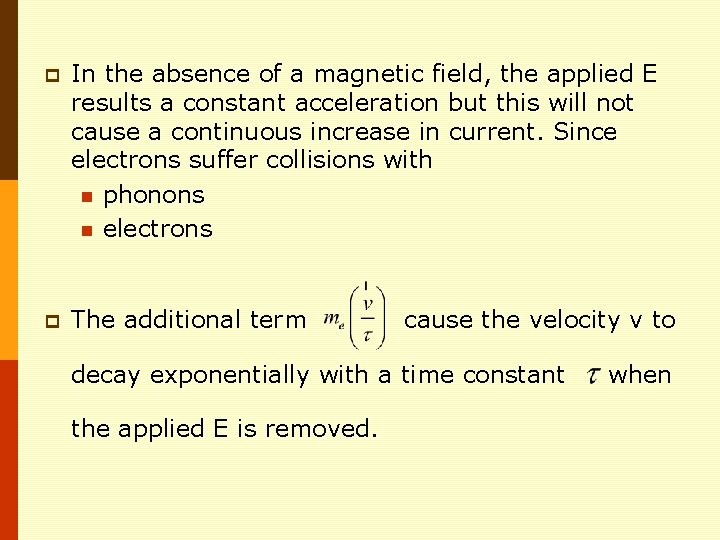
p In the absence of a magnetic field, the applied E results a constant acceleration but this will not cause a continuous increase in current. Since electrons suffer collisions with n phonons n electrons p The additional term cause the velocity v to decay exponentially with a time constant the applied E is removed. when
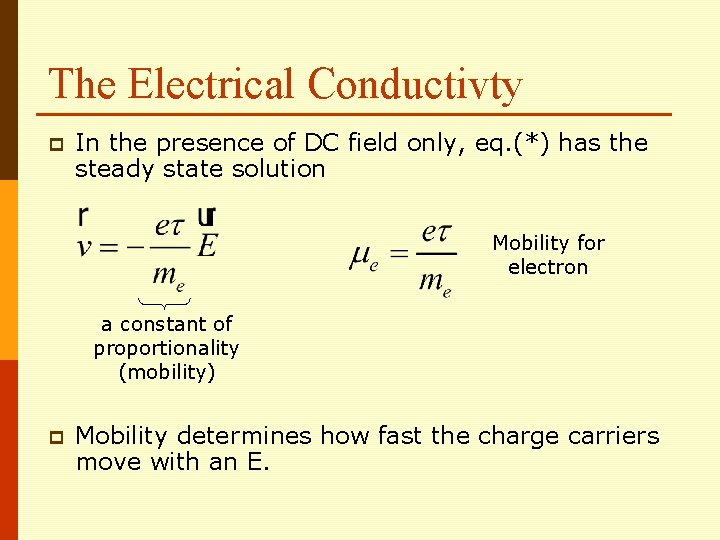
The Electrical Conductivty p In the presence of DC field only, eq. (*) has the steady state solution Mobility for electron a constant of proportionality (mobility) p Mobility determines how fast the charge carriers move with an E.
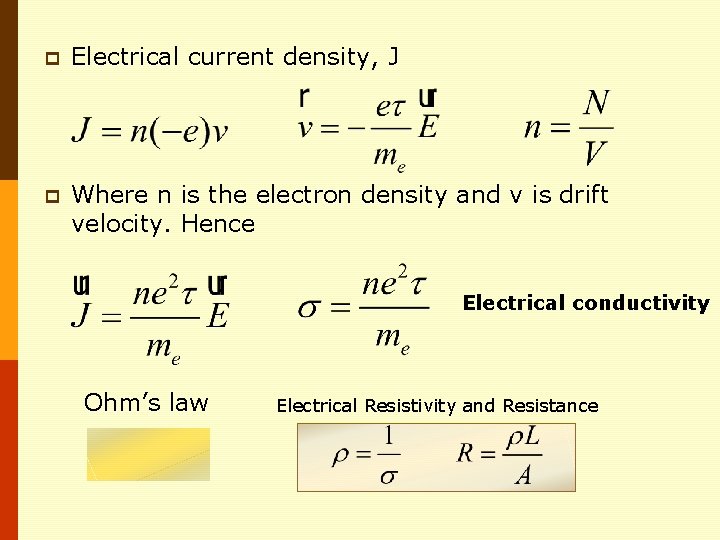
p Electrical current density, J p Where n is the electron density and v is drift velocity. Hence Electrical conductivity Ohm’s law Electrical Resistivity and Resistance
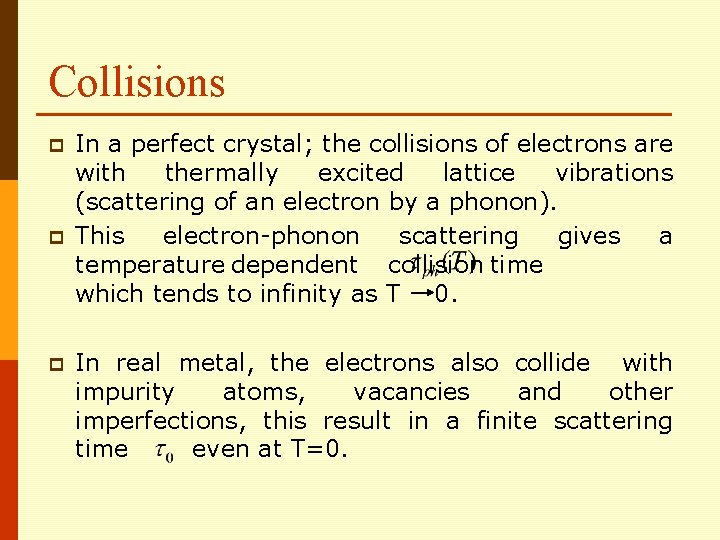
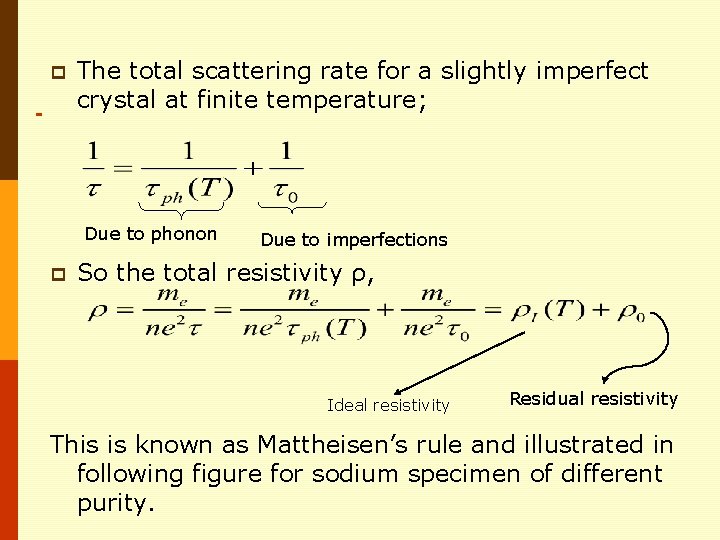
Collisions p p p In a perfect crystal; the collisions of electrons are with thermally excited lattice vibrations (scattering of an electron by a phonon). This electron-phonon scattering gives a temperature dependent collision time which tends to infinity as T 0. In real metal, the electrons also collide with impurity atoms, vacancies and other imperfections, this result in a finite scattering time even at T=0.
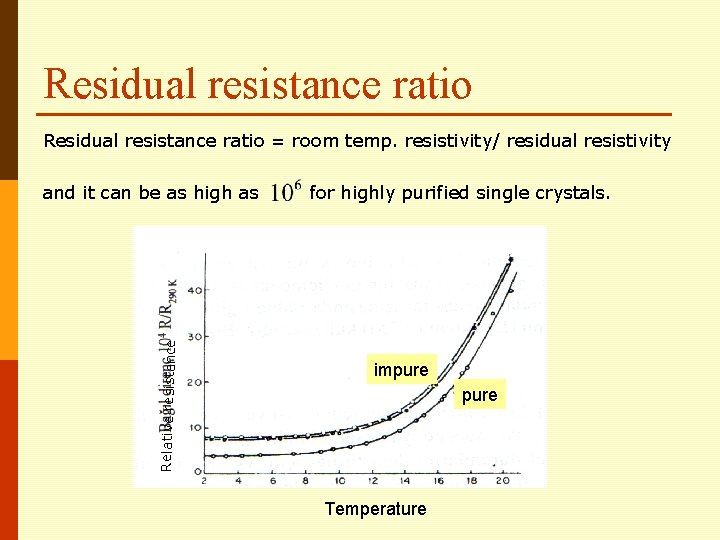
p The total scattering rate for a slightly imperfect crystal at finite temperature; Due to phonon p Due to imperfections So the total resistivity ρ, Ideal resistivity Residual resistivity This is known as Mattheisen’s rule and illustrated in following figure for sodium specimen of different purity.
Residual resistance ratio = room temp. resistivity/ residual resistivity Relative resistance and it can be as high as for highly purified single crystals. impure Temperature
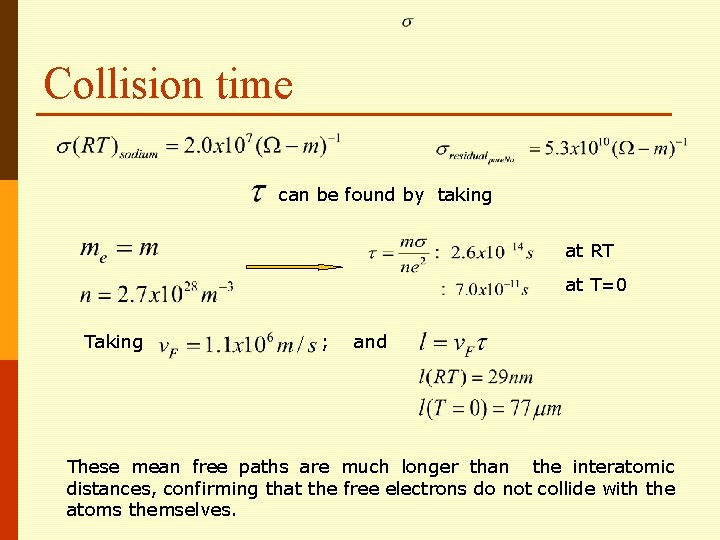
Collision time can be found by taking at RT at T=0 Taking ; and These mean free paths are much longer than the interatomic distances, confirming that the free electrons do not collide with the atoms themselves.
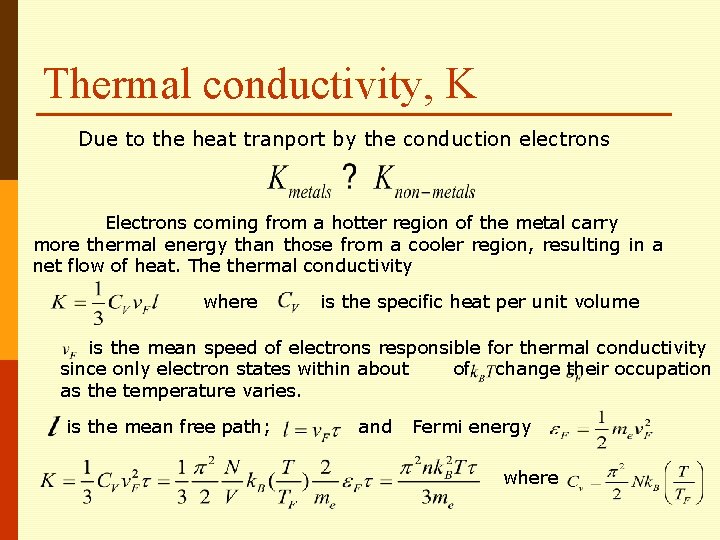
Thermal conductivity, K Due to the heat tranport by the conduction electrons Electrons coming from a hotter region of the metal carry more thermal energy than those from a cooler region, resulting in a net flow of heat. The thermal conductivity where is the specific heat per unit volume is the mean speed of electrons responsible for thermal conductivity since only electron states within about of change their occupation as the temperature varies. is the mean free path; and Fermi energy where
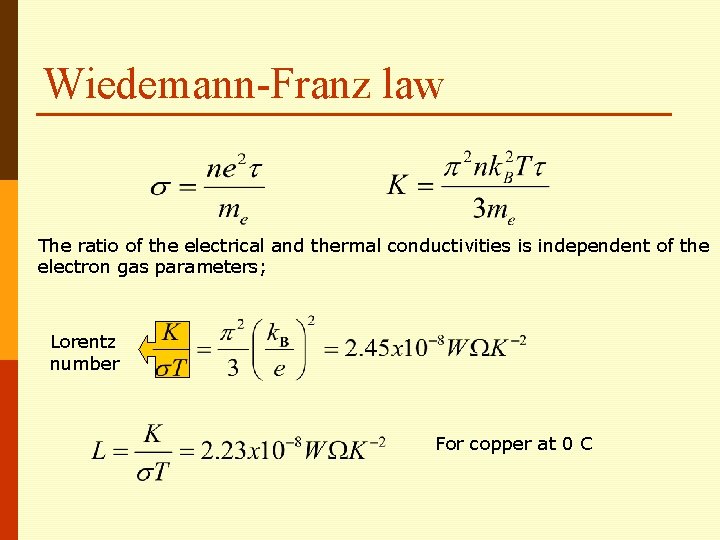
Wiedemann-Franz law The ratio of the electrical and thermal conductivities is independent of the electron gas parameters; Lorentz number For copper at 0 C