CHAPTER 5 ENERGY AND ENERGY RESOURCES Material on

- Slides: 35
CHAPTER 5: ENERGY AND ENERGY RESOURCES Material on Final Exam 1
Essential Questions • What is energy? • What are potential and kinetic energy? • How is energy related to work? • What are different forms of energy? • What is the law of conservation of energy? • How does friction affect energy transformations? • How are different types of energy used? • What are nonrenewable energy resources? • What are renewable energy resources? • Why is it important to conserve energy? 2
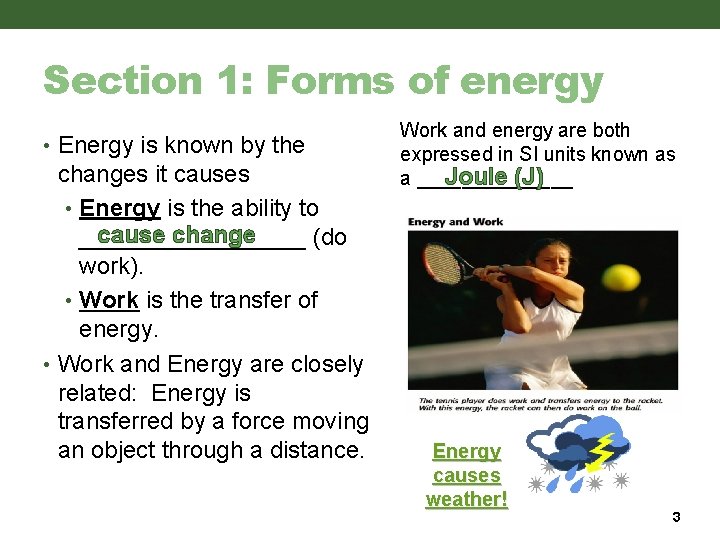
Section 1: Forms of energy • Energy is known by the changes it causes • Energy is the ability to cause change _________ (do work). • Work is the transfer of energy. • Work and Energy are closely related: Energy is transferred by a force moving an object through a distance. Work and energy are both expressed in SI units known as Joule (J) a _______ Energy causes weather! 3
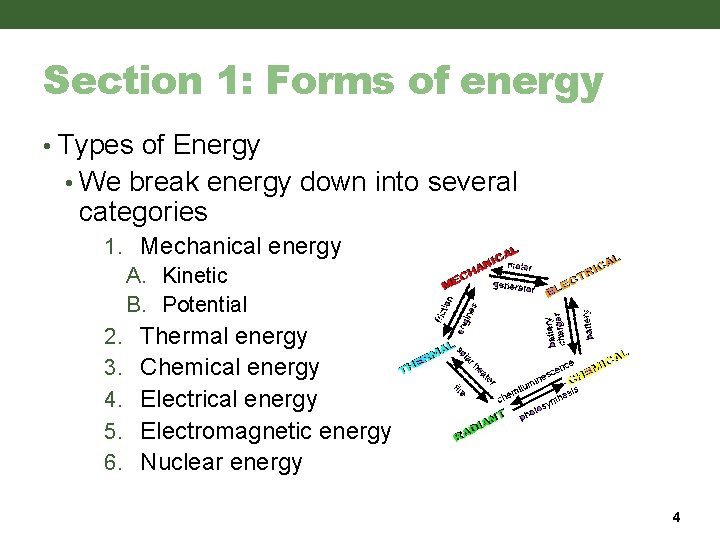
Section 1: Forms of energy • Types of Energy • We break energy down into several categories 1. Mechanical energy A. Kinetic B. Potential 2. Thermal energy 3. Chemical energy 4. Electrical energy 5. Electromagnetic energy 6. Nuclear energy 4
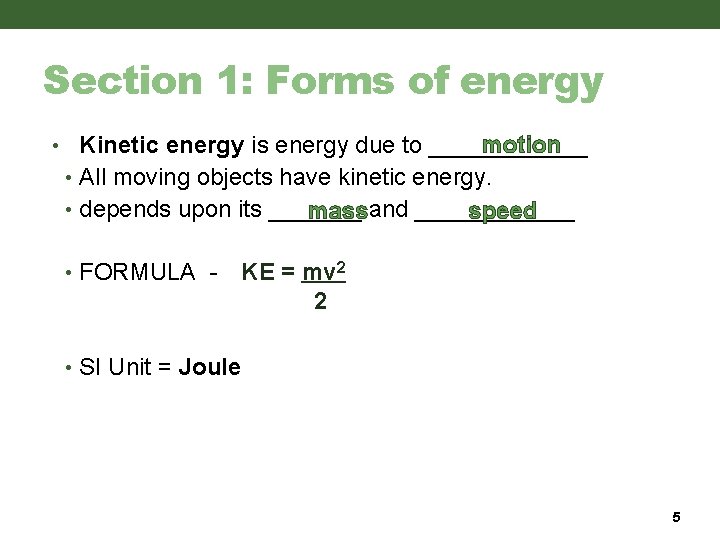
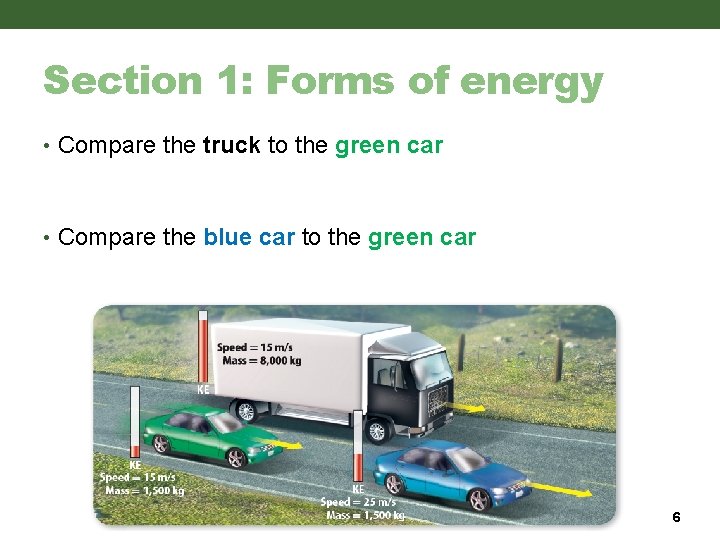
Section 1: Forms of energy motion • Kinetic energy is energy due to ______ • All moving objects have kinetic energy. • depends upon its _______ massand ______ speed • FORMULA - KE = mv 2 2 • SI Unit = Joule 5
Section 1: Forms of energy • Compare the truck to the green car • Compare the blue car to the green car 6
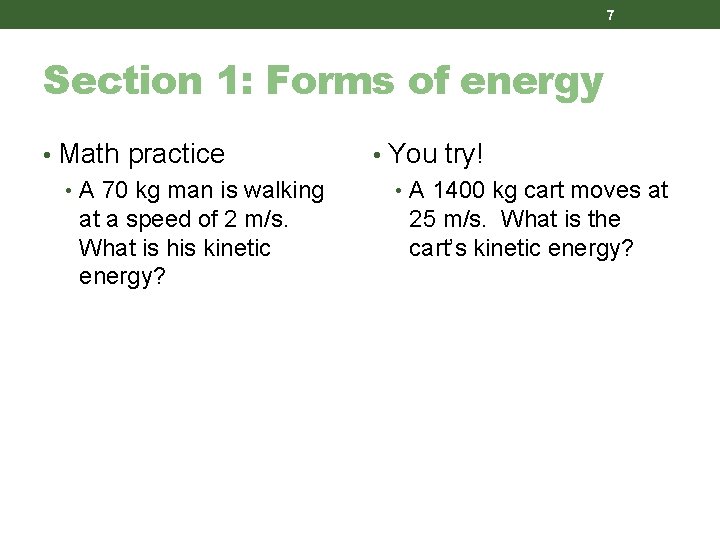
7 Section 1: Forms of energy • Math practice • A 70 kg man is walking at a speed of 2 m/s. What is his kinetic energy? • You try! • A 1400 kg cart moves at 25 m/s. What is the cart’s kinetic energy?
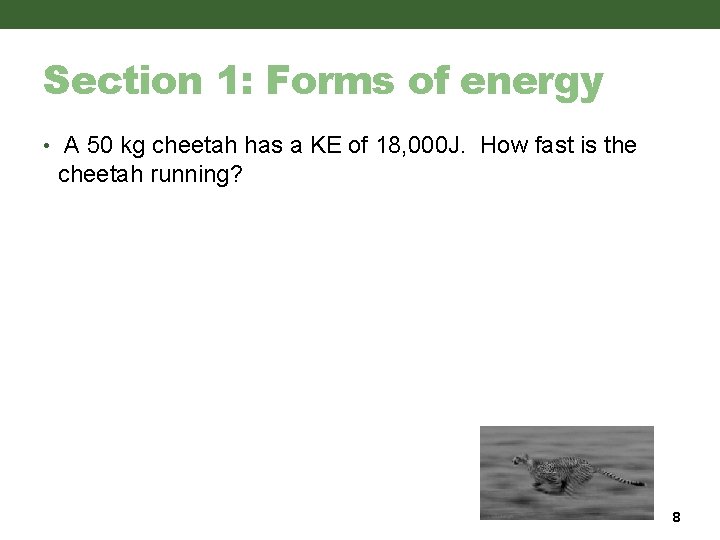
Section 1: Forms of energy • A 50 kg cheetah has a KE of 18, 000 J. How fast is the cheetah running? 8
Writing Prompt #1 (of 3) • Write the answer on your gold sheet. 1. What would you need to do to maximize kinetic energy? What would you need to do to minimize kinetic energy? ANSWER MUST BE 3 LINES OF TEXT FOR FULL CREDIT! 9
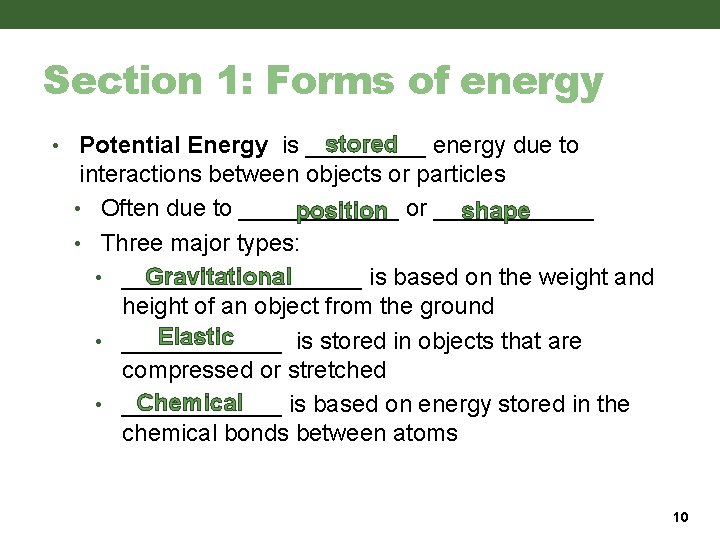
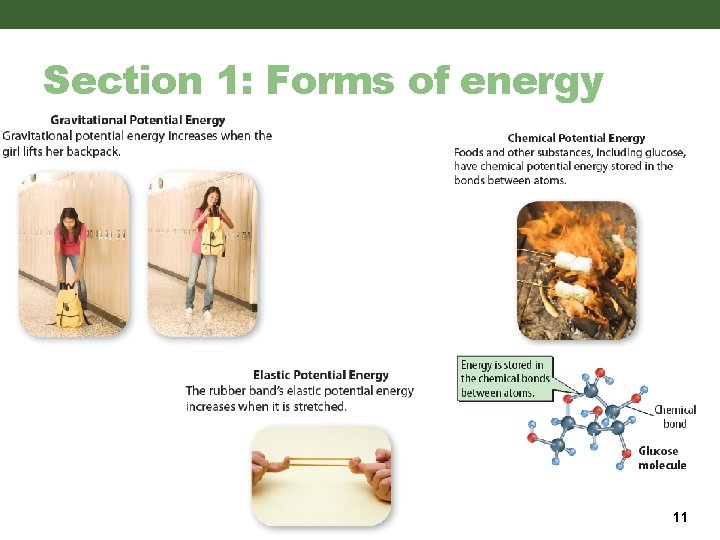
Section 1: Forms of energy stored energy due to • Potential Energy is _____ interactions between objects or particles • Often due to ______ position or ______ shape • Three major types: Gravitational • _________ is based on the weight and height of an object from the ground Elastic • ______ is stored in objects that are compressed or stretched Chemical • ______ is based on energy stored in the chemical bonds between atoms 10
Section 1: Forms of energy 11
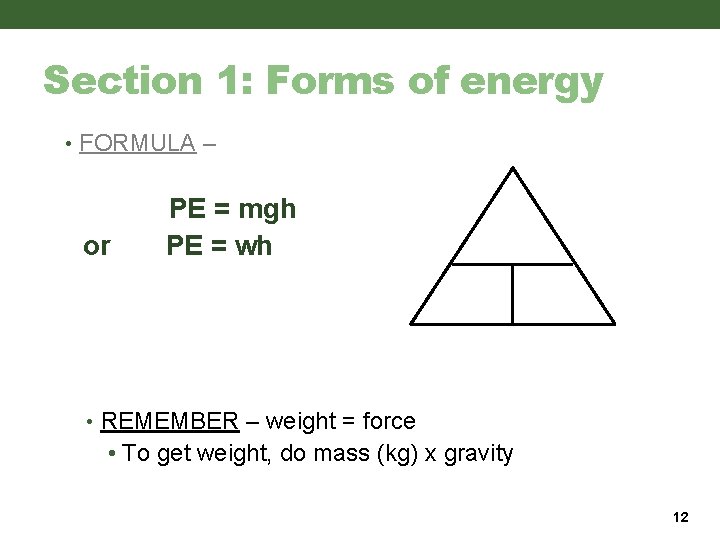
Section 1: Forms of energy • FORMULA – or PE = mgh PE = wh • REMEMBER – weight = force • To get weight, do mass (kg) x gravity 12
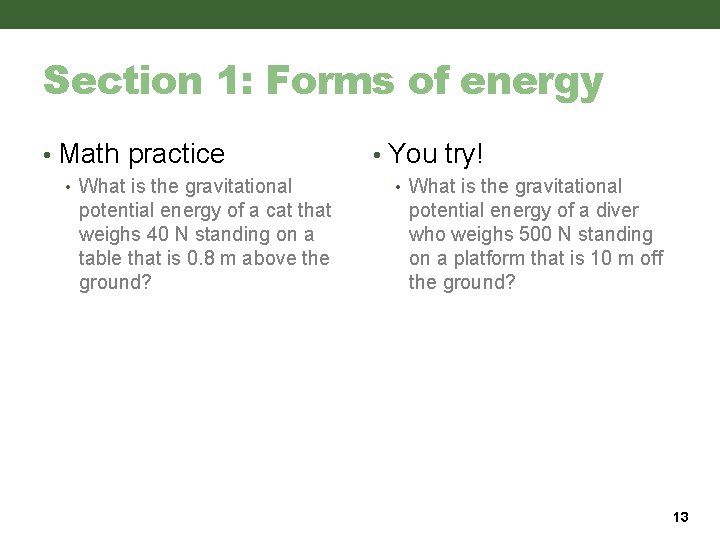
Section 1: Forms of energy • Math practice • What is the gravitational potential energy of a cat that weighs 40 N standing on a table that is 0. 8 m above the ground? • You try! • What is the gravitational potential energy of a diver who weighs 500 N standing on a platform that is 10 m off the ground? 13
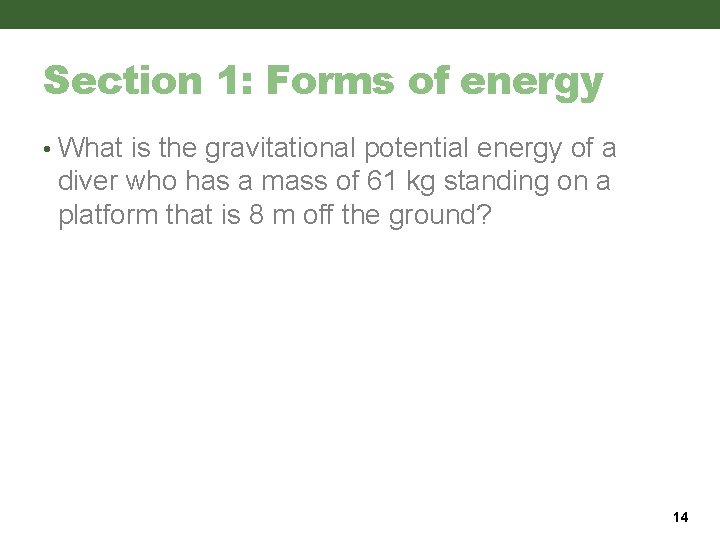
Section 1: Forms of energy • What is the gravitational potential energy of a diver who has a mass of 61 kg standing on a platform that is 8 m off the ground? 14
Writing Prompt #2 (of 3) • Write the answer on your gold sheet. 2. Where would you put an object to maximize its GPE? Where would GPE be zero? ANSWER MUST BE 3 LINES OF TEXT FOR FULL CREDIT! 15
Section 9 -1—What is Energy 16
17
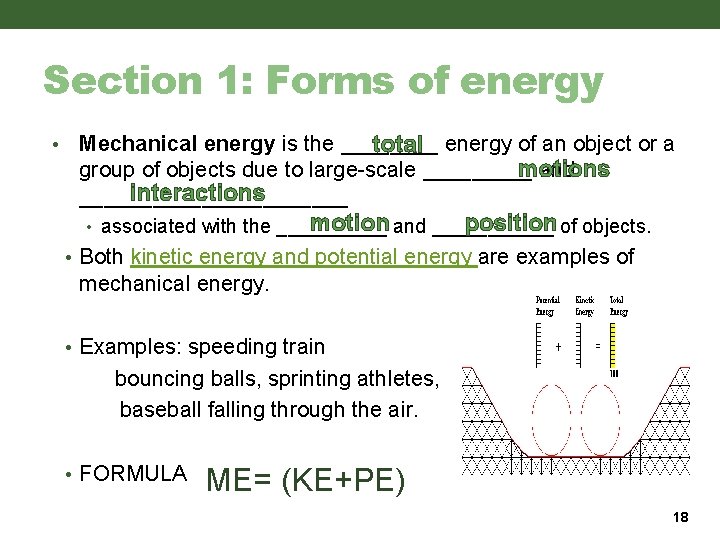
Section 1: Forms of energy • Mechanical energy is the ____ total energy of an object or a motions group of objects due to large-scale _____ and interactions ___________ motion and ______ position of objects. • associated with the _____ • Both kinetic energy and potential energy are examples of mechanical energy. • Examples: speeding train bouncing balls, sprinting athletes, baseball falling through the air. • FORMULA ME= (KE+PE) 18
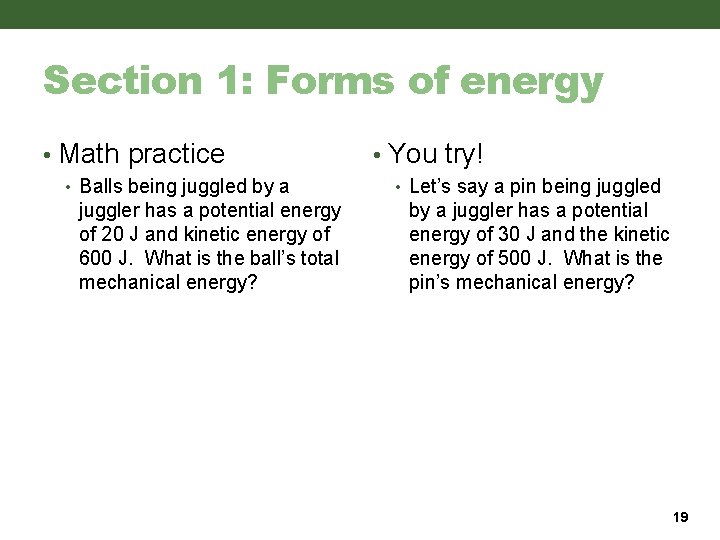
Section 1: Forms of energy • Math practice • Balls being juggled by a juggler has a potential energy of 20 J and kinetic energy of 600 J. What is the ball’s total mechanical energy? • You try! • Let’s say a pin being juggled by a juggler has a potential energy of 30 J and the kinetic energy of 500 J. What is the pin’s mechanical energy? 19
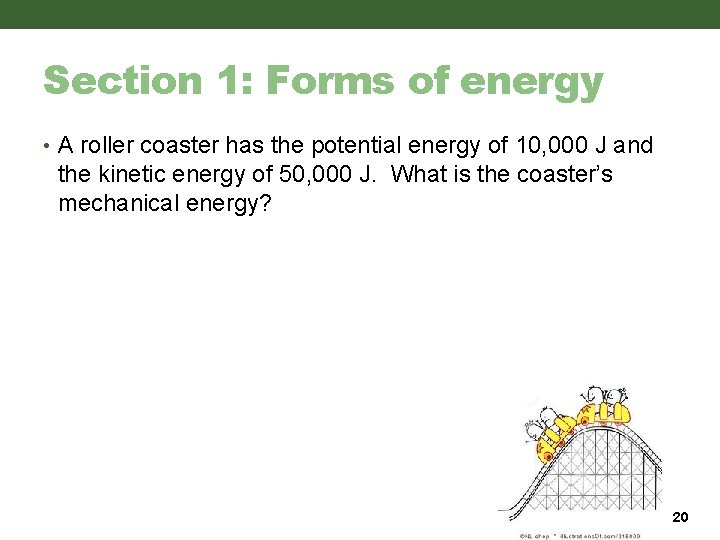
Section 1: Forms of energy • A roller coaster has the potential energy of 10, 000 J and the kinetic energy of 50, 000 J. What is the coaster’s mechanical energy? 20
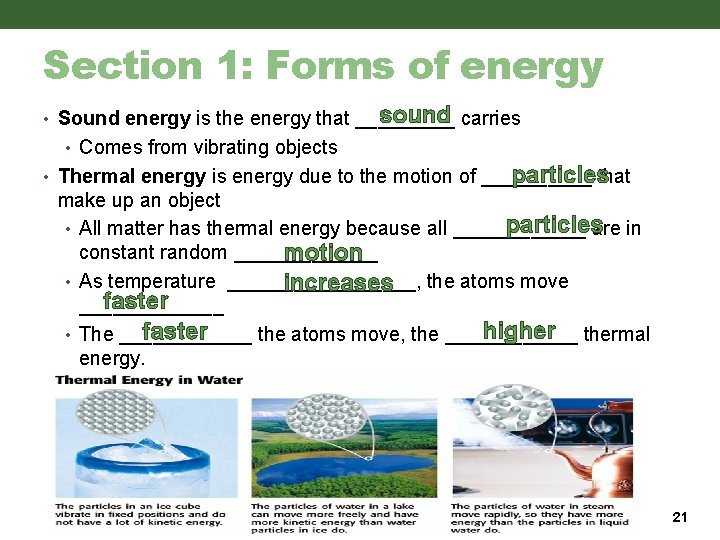
Section 1: Forms of energy sound carries • Sound energy is the energy that _____ • Comes from vibrating objects • Thermal energy is energy due to the motion of _____ that particles make up an object particles • All matter has thermal energy because all ______ are in constant random _______ motion • As temperature _________, increases the atoms move faster _______ higher thermal faster • The ______ the atoms move, the ______ energy. 21
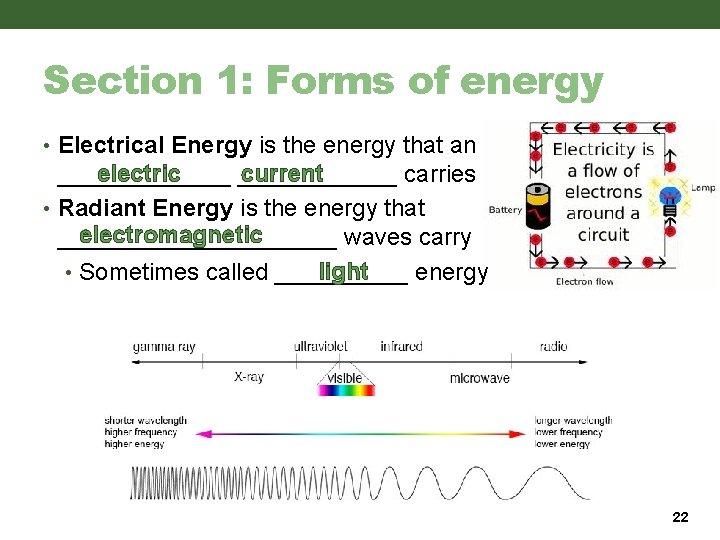
Section 1: Forms of energy • Electrical Energy is the energy that an electric current _______ carries • Radiant Energy is the energy that electromagnetic ___________ waves carry light • Sometimes called _____ energy 22
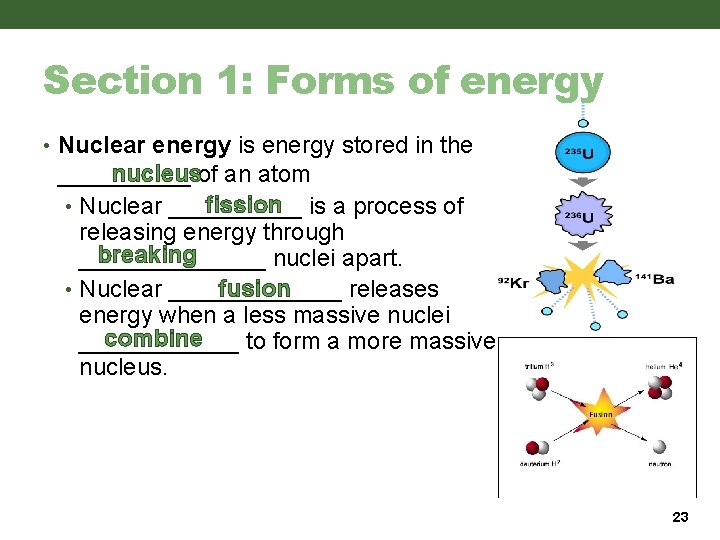
Section 1: Forms of energy • Nuclear energy is energy stored in the nucleusof an atom _____ fission is a process of • Nuclear _____ releasing energy through breaking _______ nuclei apart. fusion • Nuclear _______ releases energy when a less massive nuclei combine ______ to form a more massive nucleus. 23
Section 2: Energy Transformations • Energy transformations are changes of energy from one form to another 24
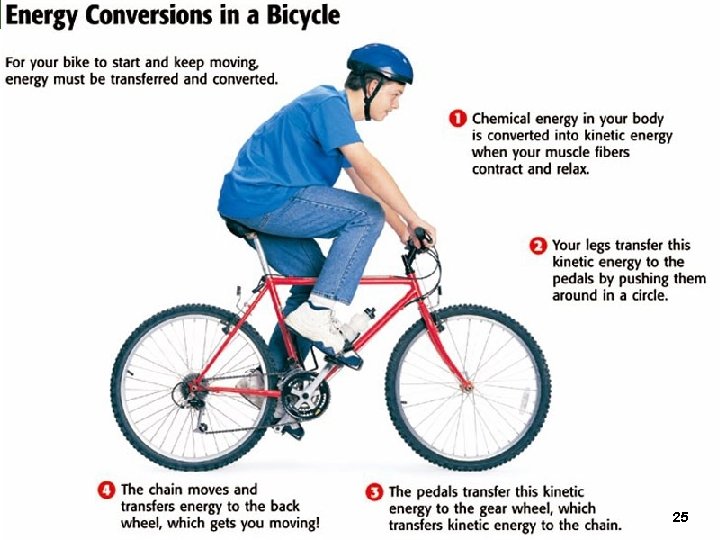
Section 9 -2—Energy Conversions 25
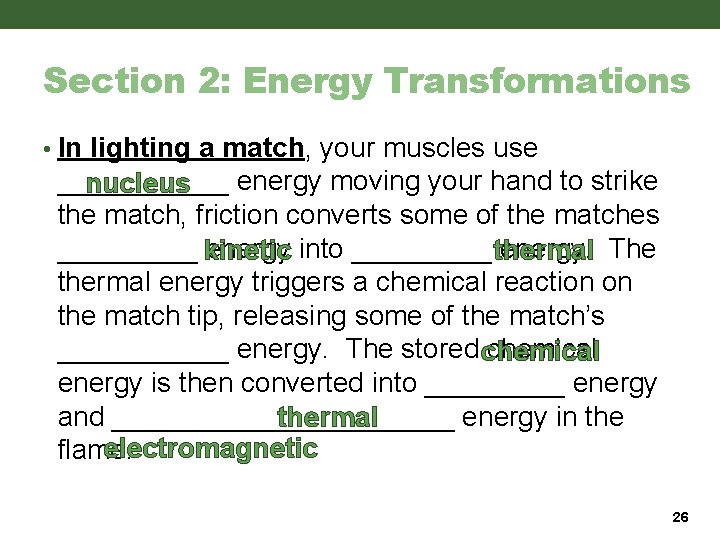
Section 2: Energy Transformations • In lighting a match, your muscles use ______ energy moving your hand to strike nucleus the match, friction converts some of the matches _____ kinetic energy into _____ thermal energy. The thermal energy triggers a chemical reaction on the match tip, releasing some of the match’s ______ energy. The stored chemical energy is then converted into _____ energy and ___________ energy in thermal electromagnetic flame. 26
Writing Prompt #3 (of 3) • Write the answer on your gold sheet. 3. Explain three different energy forms that would be found in the process of burning wood to boil water to make steam. ANSWER MUST BE 3 LINES OF TEXT FOR FULL CREDIT! 27
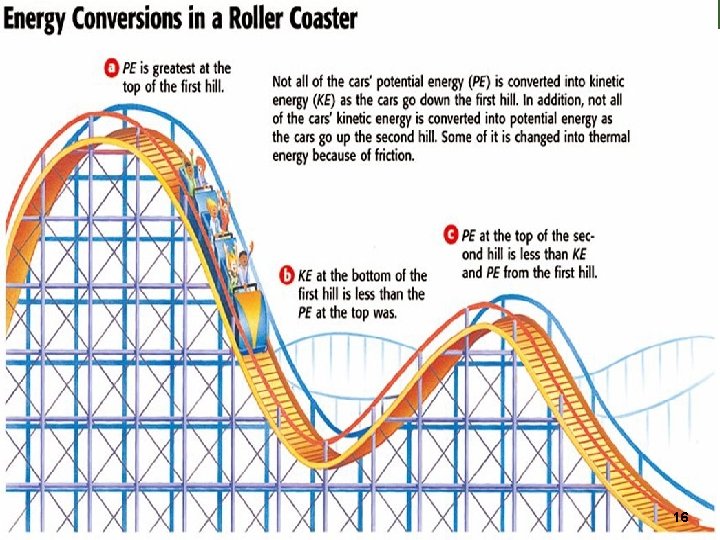
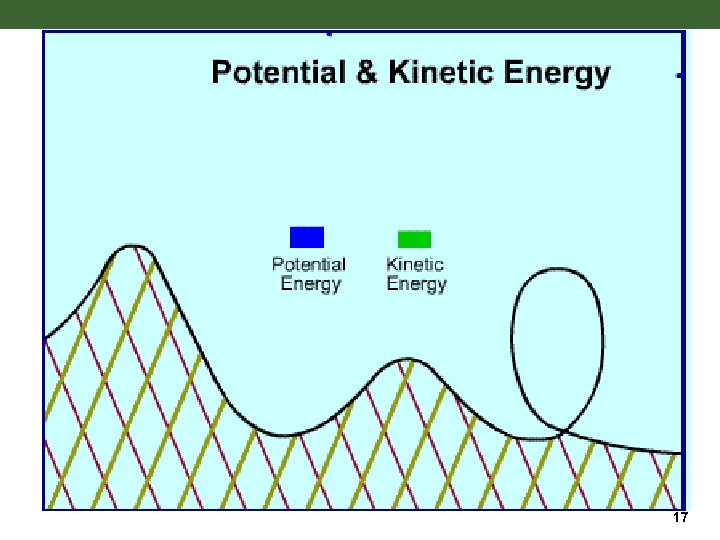
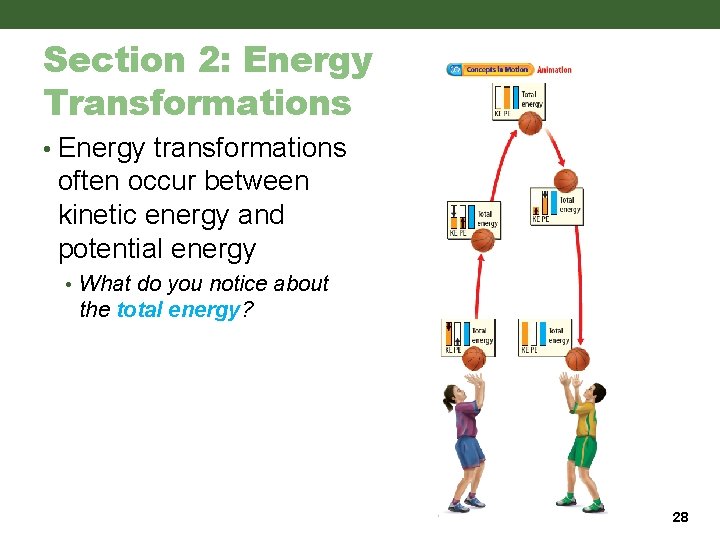
Section 2: Energy Transformations • Energy transformations often occur between kinetic energy and potential energy • What do you notice about the total energy? 28
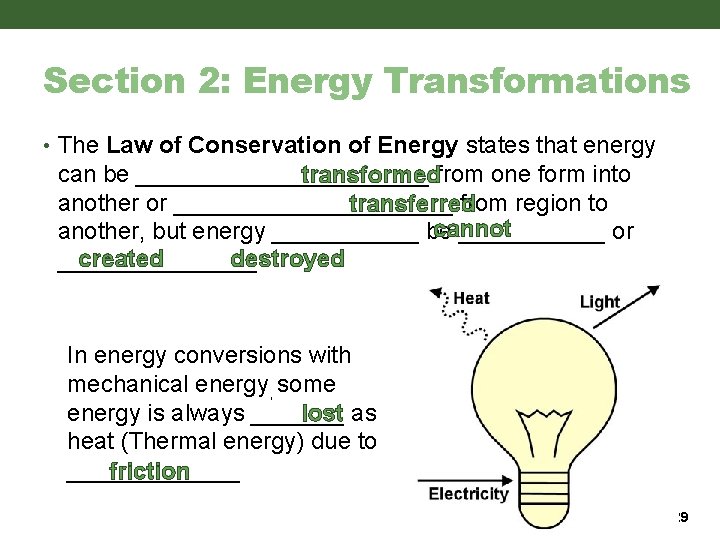
Section 2: Energy Transformations • The Law of Conservation of Energy states that energy can be ___________ transformedfrom one form into another or ___________ from region to transferred cannot another, but energy ______ be ______ or created destroyed ________ In energy conversions with mechanical energy, some energy is always _______ lost as heat (Thermal energy) due to _______ friction 29
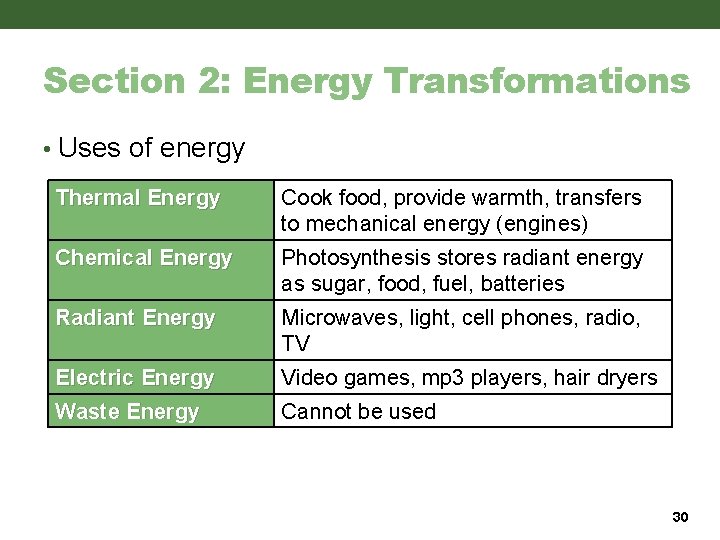
Section 2: Energy Transformations • Uses of energy Thermal Energy Cook food, provide warmth, transfers to mechanical energy (engines) Chemical Energy Photosynthesis stores radiant energy as sugar, food, fuel, batteries Radiant Energy Microwaves, light, cell phones, radio, TV Electric Energy Waste Energy Video games, mp 3 players, hair dryers Cannot be used 30
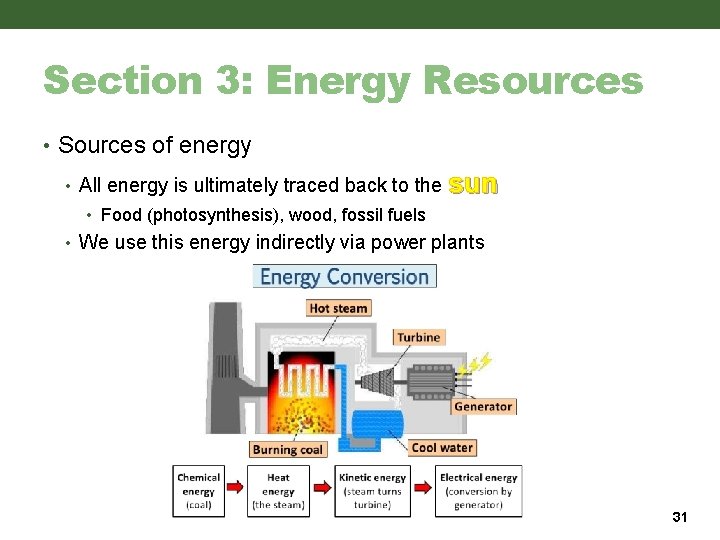
Section 3: Energy Resources • Sources of energy • All energy is ultimately traced back to the sun • Food (photosynthesis), wood, fossil fuels • We use this energy indirectly via power plants 31
Section 3: Energy Resources • Nonrenewable Resources are energy resources that are available in ____ amounts or that is limited ________ than it is replaced in nature used faster • Fossil fuels are the remains of ancient organisms that can be burned as an energy resource • Examples include: ______, and coal ______, natural gas _____ oil • Nuclear energy comes from the decay of _____ Uranium nuclei • The _______ heat from the radioactive decay is what heats the water in the power plant 32
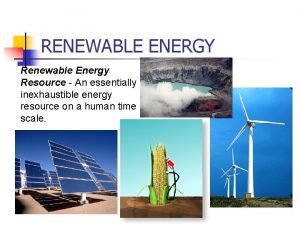
Section 3: Energy Resources • Renewable Resources are energy resources that are _____ as fast as, or faster than they are used replaced • Hydroelectric Power Plants The potential energy of water in a reservoir can be changed into kinetic energy as the water flows through a dam. • Solar Energy Sunlight can be changed into electrical energy through solar cells • Also considered an inexhaustible energy resource because it cannot be used up • Wind Energy The kinetic energy of wind can turn the blades of a windmill or a wind turbine. 33
Section 3: Energy Resources • Renewable Resources are energy resources that are replaced as fast as, or faster than they are used • Wind Energy The kinetic energy of wind can turn the blades of a windmill or a wind turbine. • Biomass Burning of material from plants and animals. • Geothermal Energy The thermal energy deep within the earth 34
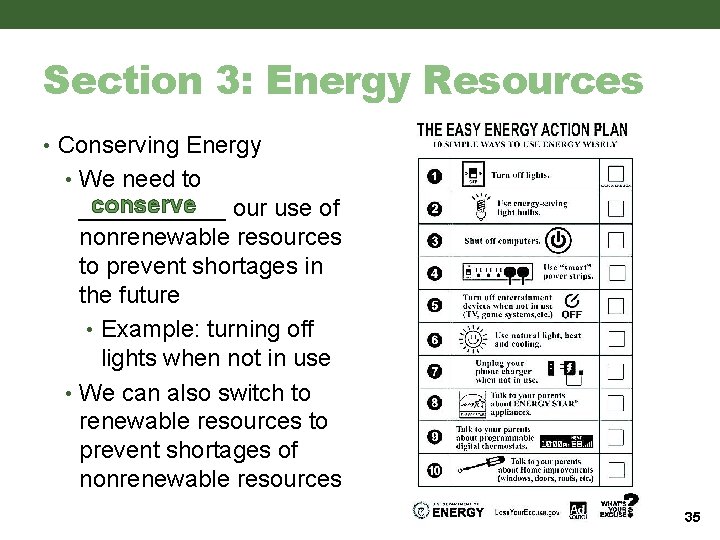
Section 3: Energy Resources • Conserving Energy • We need to conserve ______ our use of nonrenewable resources to prevent shortages in the future • Example: turning off lights when not in use • We can also switch to renewable resources to prevent shortages of nonrenewable resources 35