Chapter 4 Multiplication Multiplication Part 1 Interpretation of

- Slides: 54
Chapter 4. Multiplication
Multiplication – Part 1 • Interpretation of Multiplication • Multiplication by 10 • The Commutative and Associative Properties of Multiplication • Areas of Rectangles, and Volume of Boxes
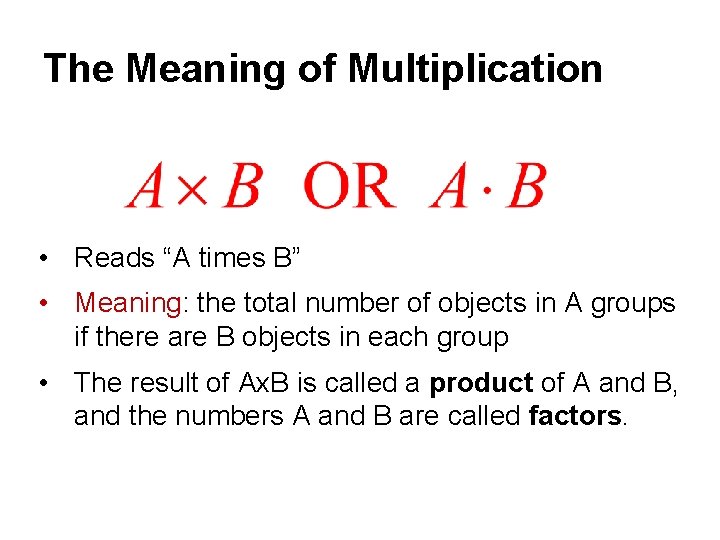
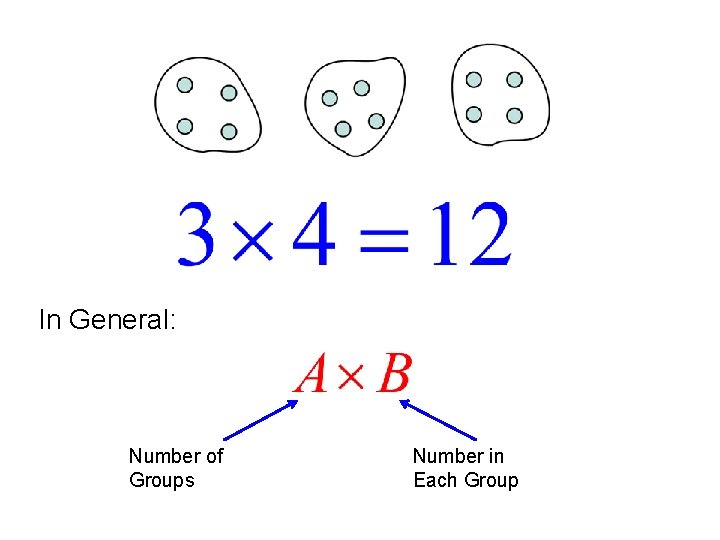
The Meaning of Multiplication • Reads “A times B” • Meaning: the total number of objects in A groups if there are B objects in each group • The result of Ax. B is called a product of A and B, and the numbers A and B are called factors.
In General: Number of Groups Number in Each Group
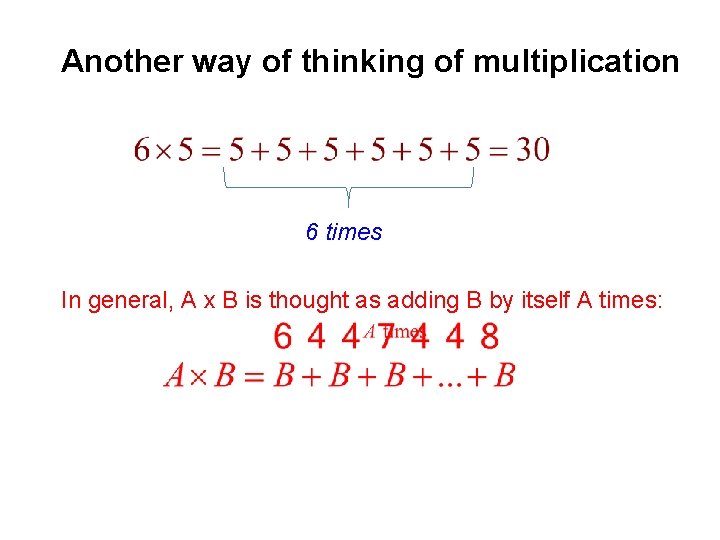
Another way of thinking of multiplication 6 times In general, A x B is thought as adding B by itself A times:
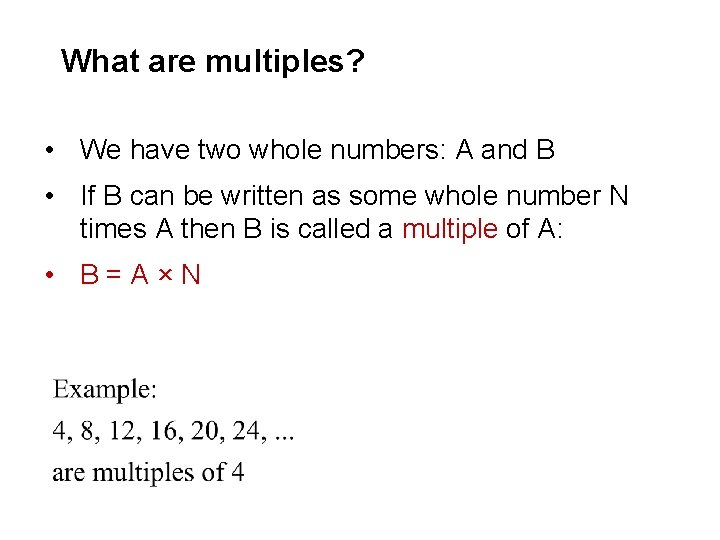
What are multiples? • We have two whole numbers: A and B • If B can be written as some whole number N times A then B is called a multiple of A: • B=A×N
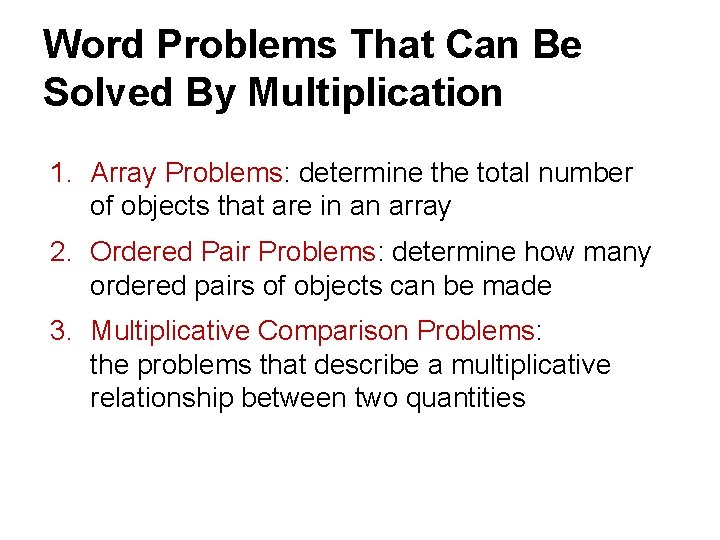
Word Problems That Can Be Solved By Multiplication 1. Array Problems: determine the total number of objects that are in an array 2. Ordered Pair Problems: determine how many ordered pairs of objects can be made 3. Multiplicative Comparison Problems: the problems that describe a multiplicative relationship between two quantities
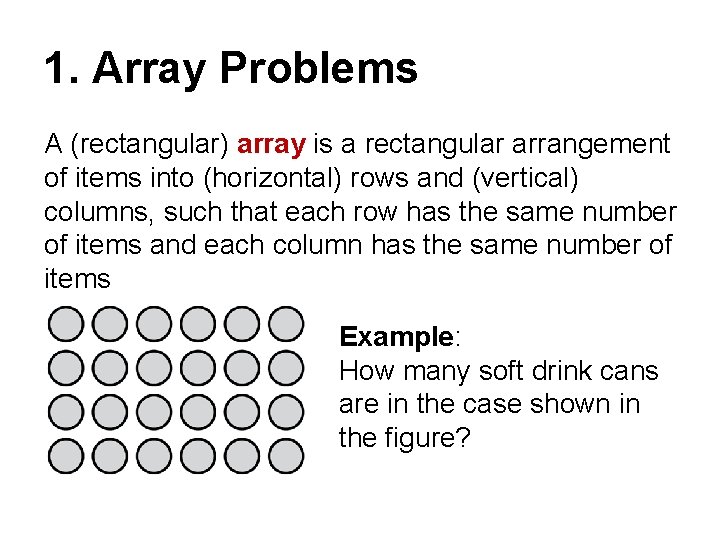
1. Array Problems A (rectangular) array is a rectangular arrangement of items into (horizontal) rows and (vertical) columns, such that each row has the same number of items and each column has the same number of items Example: How many soft drink cans are in the case shown in the figure?
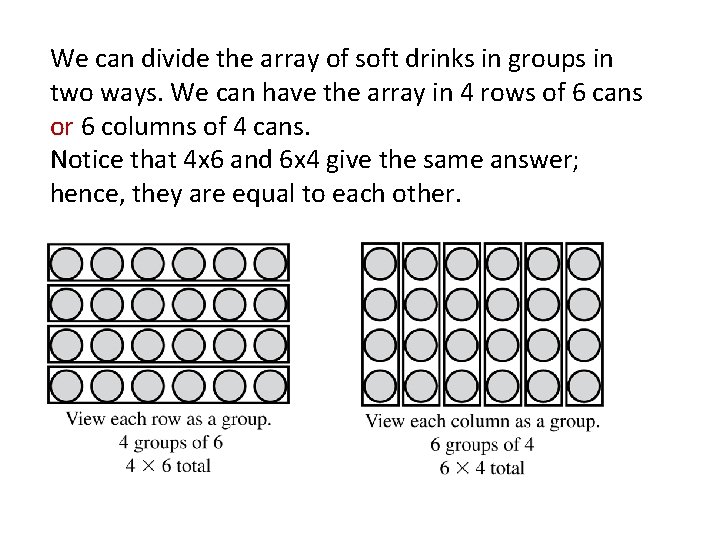
We can divide the array of soft drinks in groups in two ways. We can have the array in 4 rows of 6 cans or 6 columns of 4 cans. Notice that 4 x 6 and 6 x 4 give the same answer; hence, they are equal to each other.
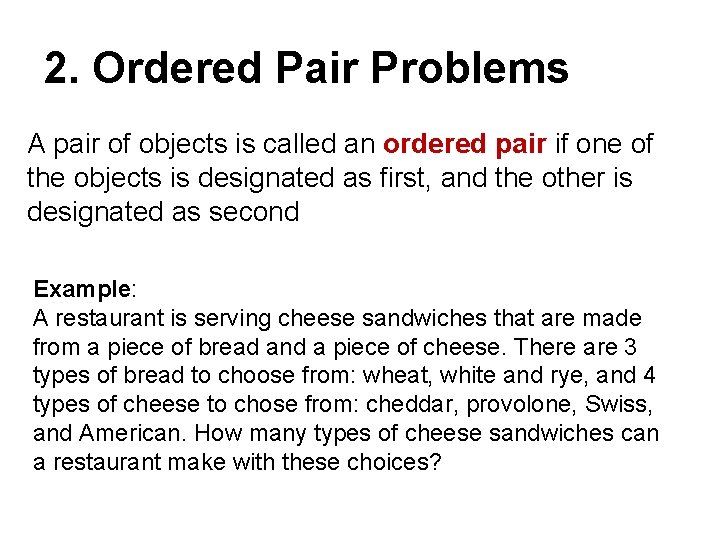
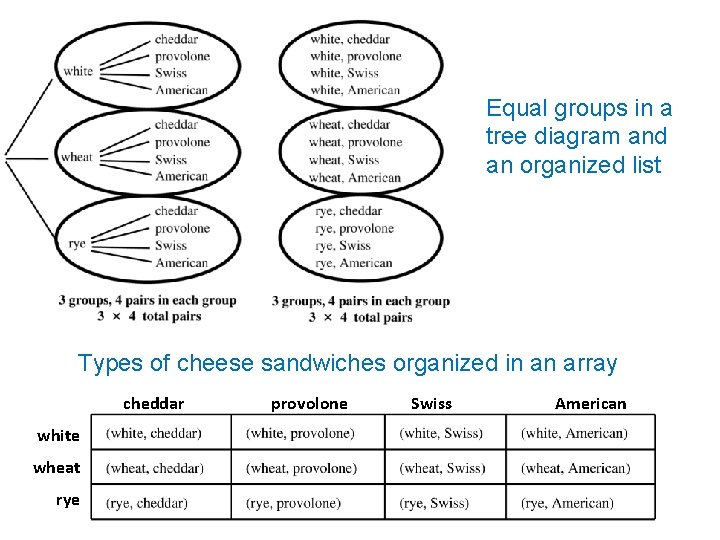
2. Ordered Pair Problems A pair of objects is called an ordered pair if one of the objects is designated as first, and the other is designated as second Example: A restaurant is serving cheese sandwiches that are made from a piece of bread and a piece of cheese. There are 3 types of bread to choose from: wheat, white and rye, and 4 types of cheese to chose from: cheddar, provolone, Swiss, and American. How many types of cheese sandwiches can a restaurant make with these choices?
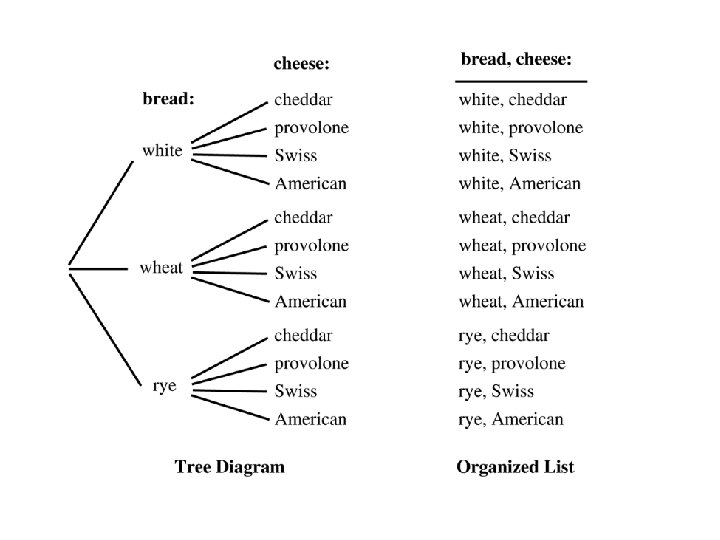
Equal groups in a tree diagram and an organized list Types of cheese sandwiches organized in an array cheddar white wheat rye provolone Swiss American
What about unordered pairs? Example 1. You have bags of apples, oranges, pears, and bananas. You need to choose 2 fruits for your lunch. In how many different ways can you do it? Example 2. You have one apple, one orange, one pear, and one banana. You need to choose 2 fruits for your lunch. In how many different ways can you do it?
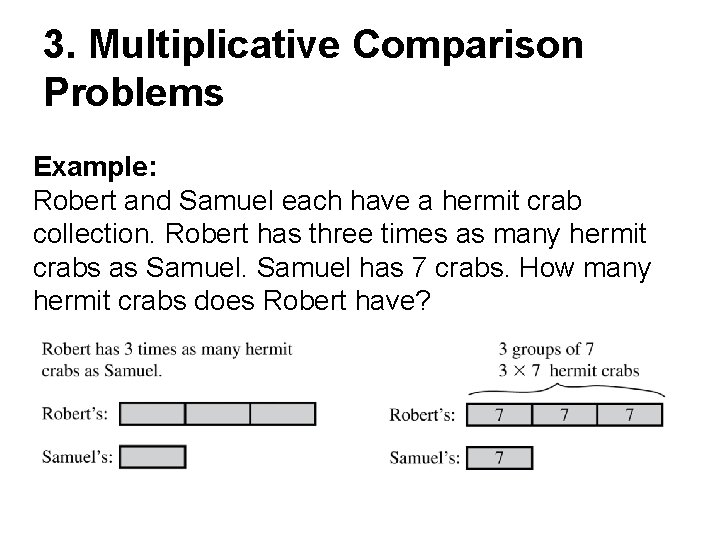
3. Multiplicative Comparison Problems Example: Robert and Samuel each have a hermit crab collection. Robert has three times as many hermit crabs as Samuel has 7 crabs. How many hermit crabs does Robert have?
Problem Solving: Section 4. 1, Problem 1 Use the meaning of multiplication to explain why each of the following problems can be solved by multiplying: a) There are 3 feet in a yard. If a rug is 5 yards long, how long is it in feet? b) There are 5280 feet in a mile. How long in feet is 4 -mile -long stretch of road? c) Will is driving 65 miles per hour. If he continues driving at that speed, how far will he drive in 3 hours?
Problem 8. John, Trey, and Miles want to know how many two-letter secret codes there are that don’t have a repeated letter. For example, they want to count BA and AB, but they don’t want to count doubles such as ZZ, XX, AA, … John says there are 26+25 because you don’t want to use the same letter twice; that’s why the second number is 25. Trey says he thinks it should be times not plus: 26 x 25. Miles says the number is 26 x 26 – 26 because you need to take away the double letters. Discuss the boy’s ideas. Which answers are correct, which are not, and why? Explain your answers clearly and thoroughly, drawing on the meaning of multiplication.
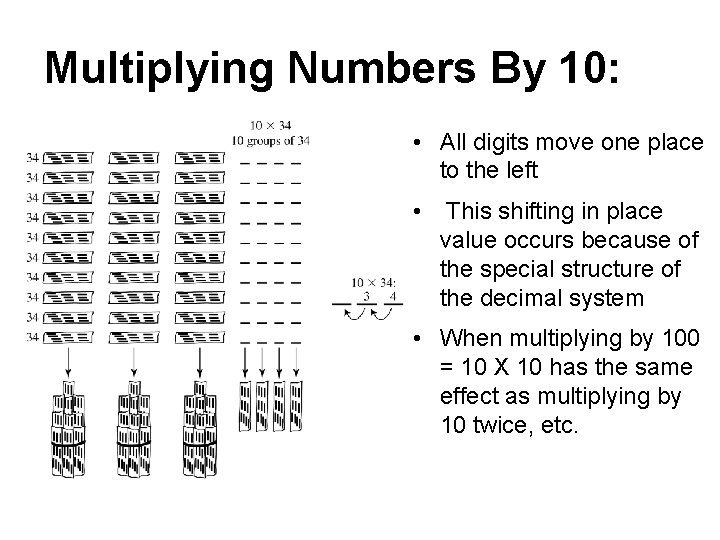
Multiplying Numbers By 10: • All digits move one place to the left • This shifting in place value occurs because of the special structure of the decimal system • When multiplying by 100 = 10 X 10 has the same effect as multiplying by 10 twice, etc.
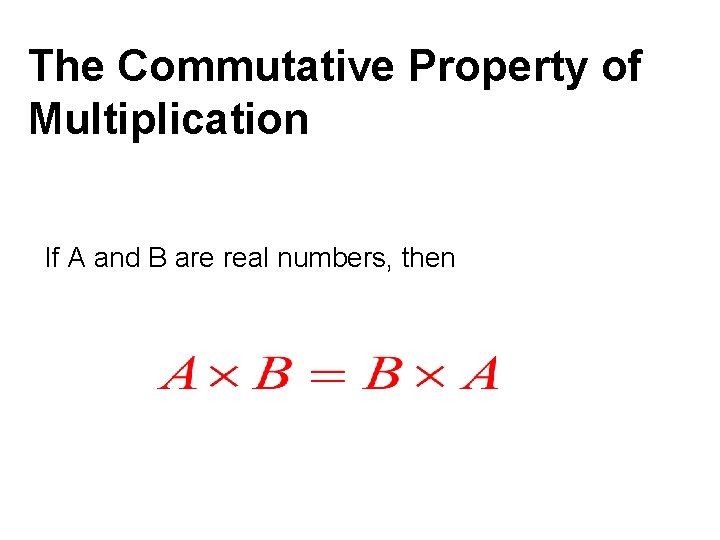
The Commutative Property of Multiplication If A and B are real numbers, then
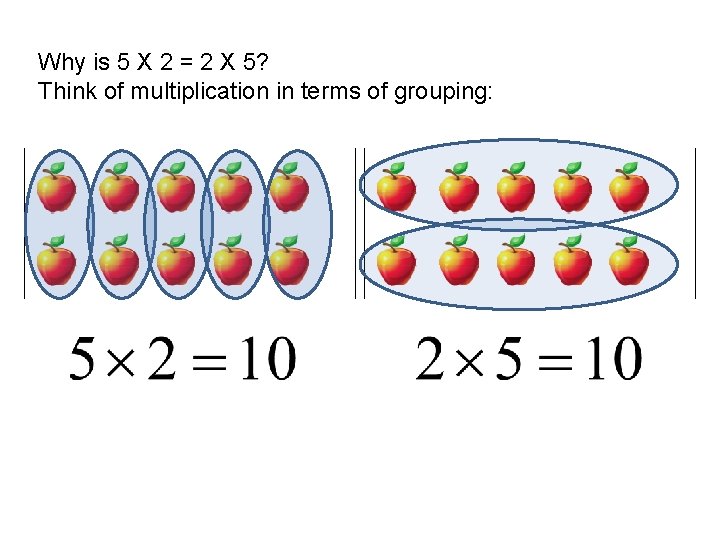
Why is 5 X 2 = 2 X 5? Think of multiplication in terms of grouping:
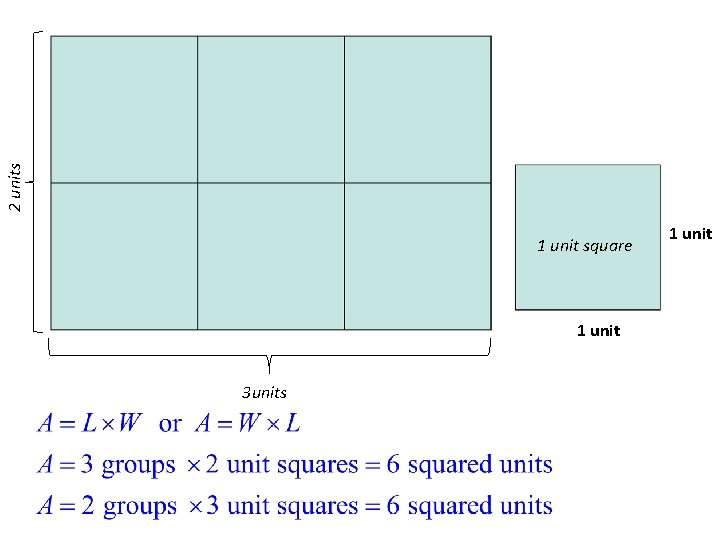
Multiplication, Areas of Rectangles and the Commutative Property • Area is usually measured in square units • We may use squared inches, centimeters, feet etc. • For a particular unit of length, one square unit is the area of a (1 unit) by (1 unit) square • For example, a square inch is the area of a square 1 inch long by 1 inch wide • The area of a region in square units is the number of unit-by-unit squares it takes to cover the entire region, without gaps or overlaps
2 units 1 unit square 1 unit 3 units 1 unit
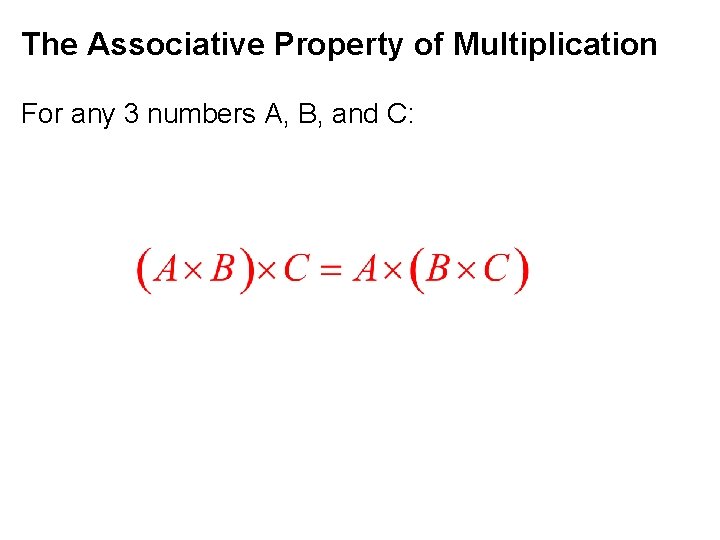
The Associative Property of Multiplication For any 3 numbers A, B, and C:
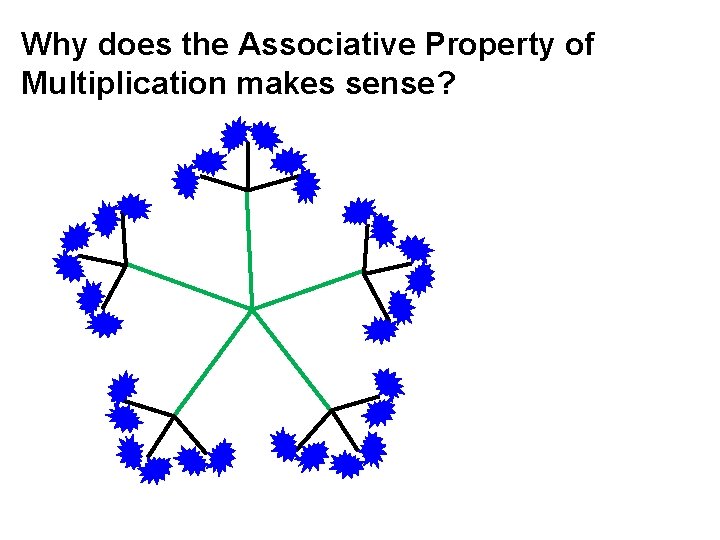
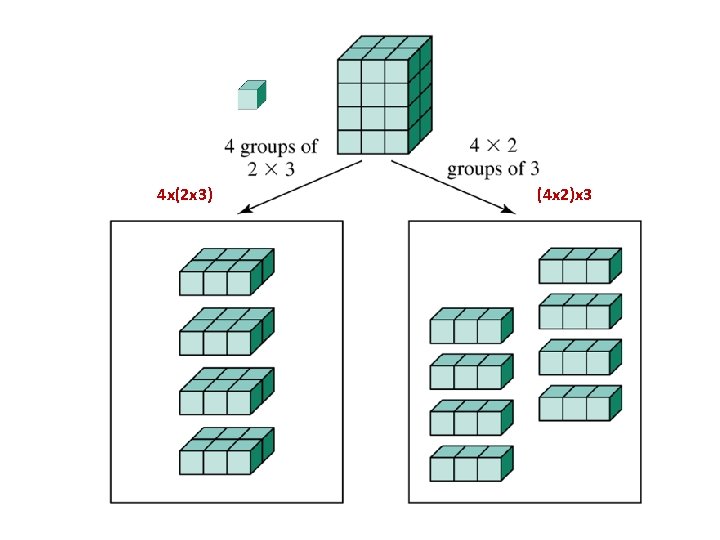
Why does the Associative Property of Multiplication makes sense?
Multiplication, Volume of Boxes and The Associative Property • One cubic centimeter, written as 1 cm 3 , is the volume of a cube that is 1 cm long, 1 cm wide and 1 cm high • In general, one cubic unit is the volume of a cube with dimensions of 1 unit length, 1 unit width, and 1 unit height. • The volume of a box in cubic units, is just the number of (1 unit)-by-(1 unit) cubes that will fit in that box shape without gaps and overlaps
4 x(2 x 3) (4 x 2)x 3
Using the Associative and Commutative Properties of Multiplication Mental math:
Example. Use the associative property of multiplication to make the problem 32 x 0. 25 easy to solve mentally.
Problem Solving Section 4. 3 Problem 10 Explain how you use the associative property of multiplication to make 16 x 25 easy to calculate mentally. Write the equations that show why your method is valid, and show specifically where you have used the associative property of multiplication.
Problem 14 Carmen says it’s easy to multiply even numbers by 5 because you just take half the number and add zero at the end. Write equations that incorporate Carmen’s method to demonstrate that her method is valid. Use the case 5 x 224.
Multiplication – Part 1 • The Distributive Property • Mental Math, and Single Digit Multiplication Facts • Why The Algorithm for Multiplying Whole Numbers Works
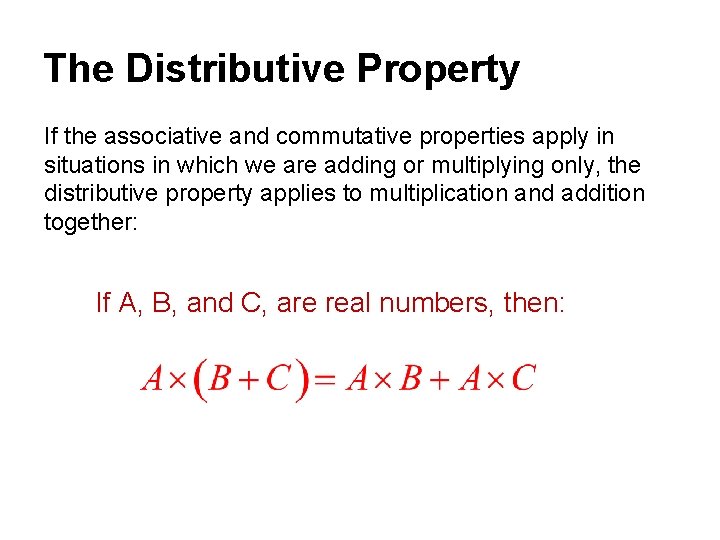
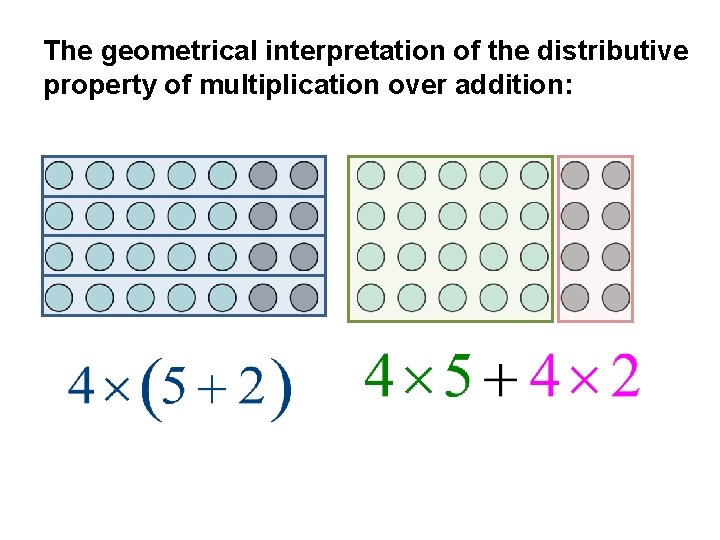
The Distributive Property If the associative and commutative properties apply in situations in which we are adding or multiplying only, the distributive property applies to multiplication and addition together: If A, B, and C, are real numbers, then:
The geometrical interpretation of the distributive property of multiplication over addition:
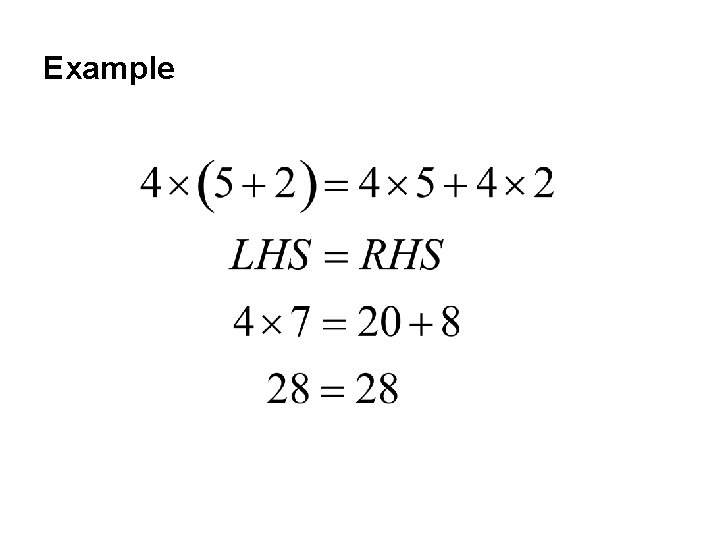
Example
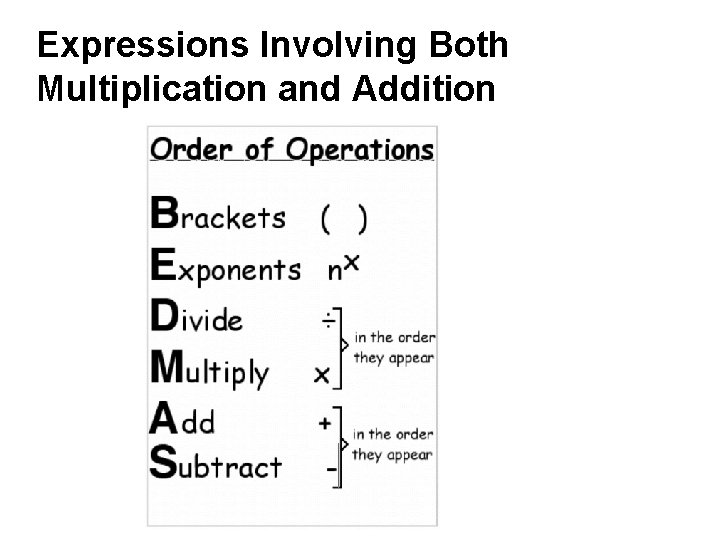
Expressions Involving Both Multiplication and Addition
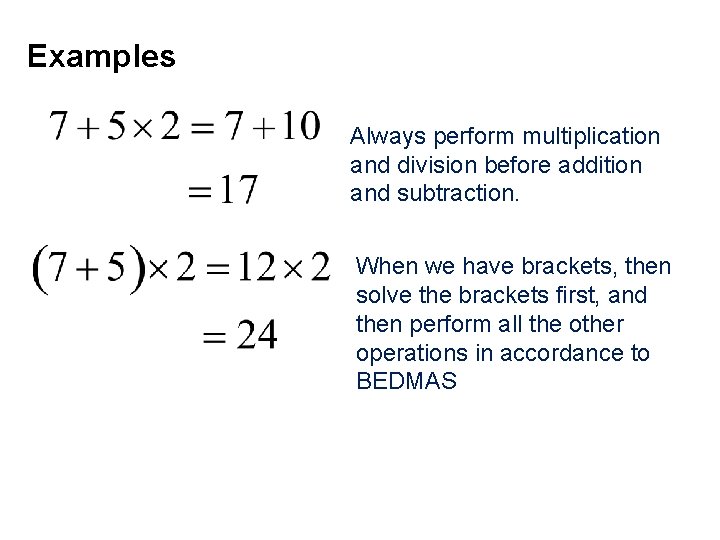
Examples Always perform multiplication and division before addition and subtraction. When we have brackets, then solve the brackets first, and then perform all the other operations in accordance to BEDMAS
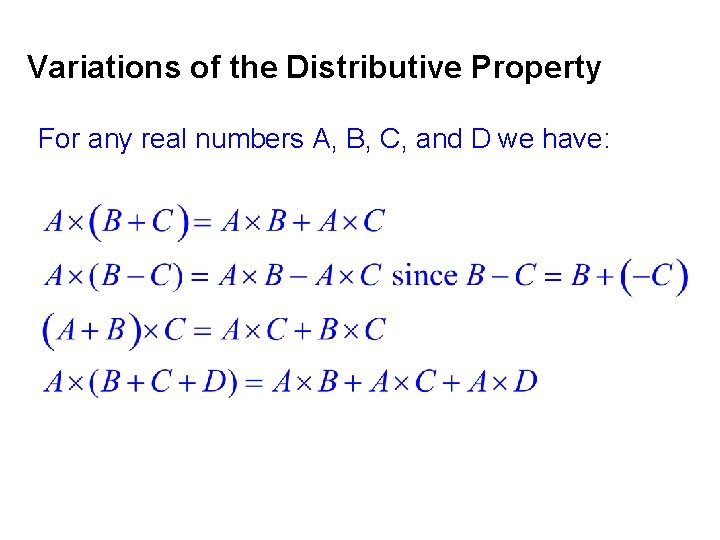
Variations of the Distributive Property For any real numbers A, B, C, and D we have:
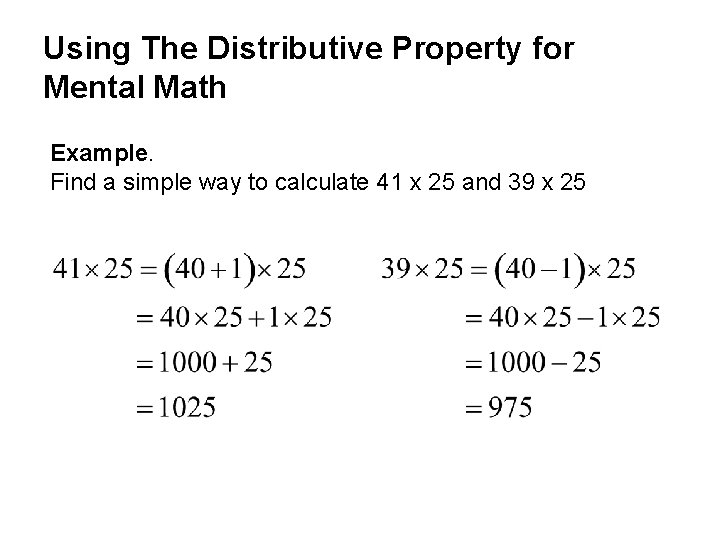
Using The Distributive Property for Mental Math Example. Find a simple way to calculate 41 x 25 and 39 x 25
FOIL and the Extended Distributive Property
Proof:
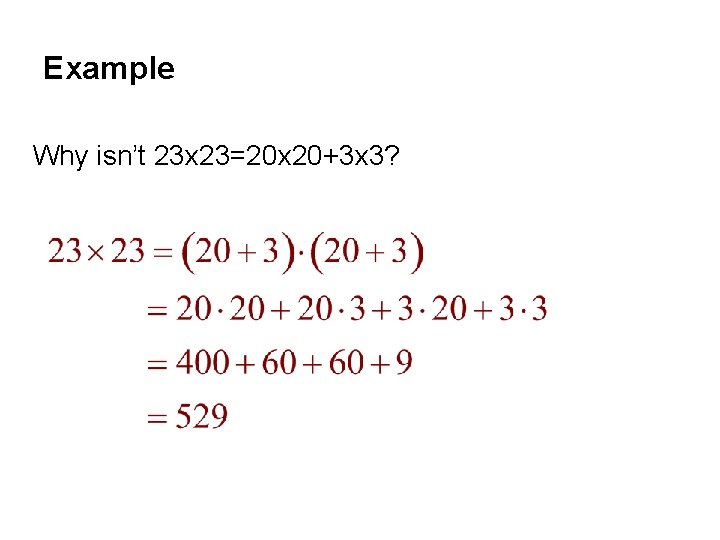
Example Why isn’t 23 x 23=20 x 20+3 x 3?
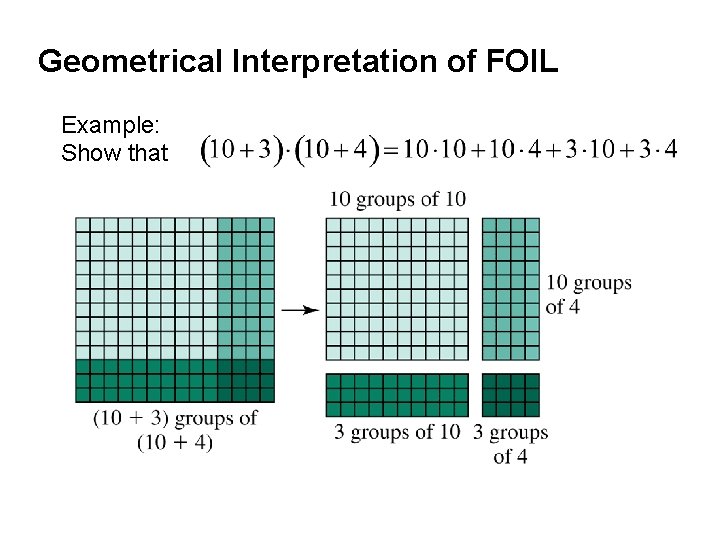
Geometrical Interpretation of FOIL Example: Show that
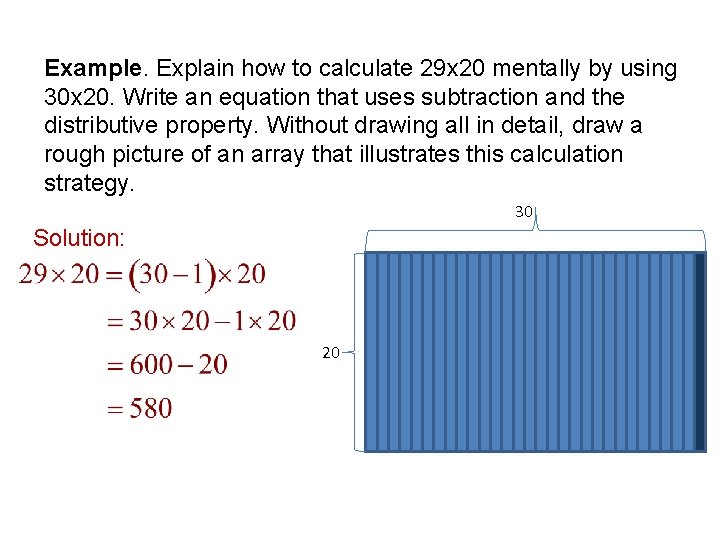
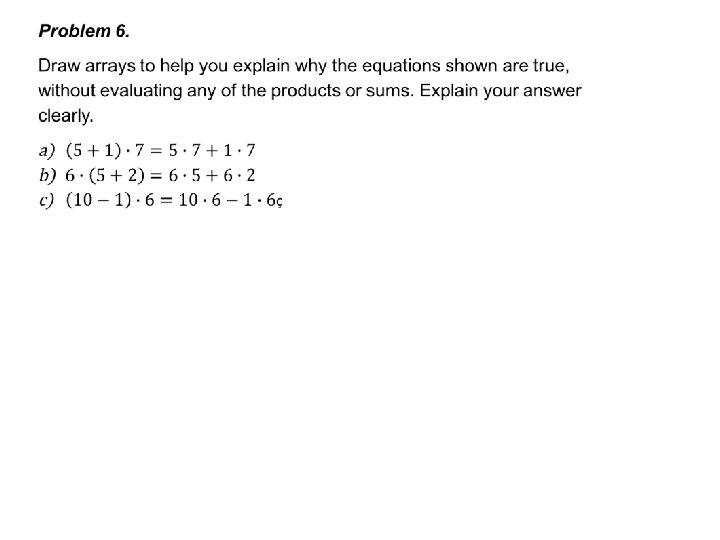
Example. Explain how to calculate 29 x 20 mentally by using 30 x 20. Write an equation that uses subtraction and the distributive property. Without drawing all in detail, draw a rough picture of an array that illustrates this calculation strategy. 30 Solution: 20
Properties of Arithmetic, Mental Math, and Single-Digit Multiplication Facts When children begin first to multiply, they multiply by skip counting. For example to multiply 5 by 7, a child will count by 5 s seven times: 5, 10, 15, 20, 25, 30, 35 If a child knows that 7 x 5=35 then she/he can figure out how much is 7 x 6 by simply doing 7 x 5+7=7 x(5+1)=35+7=42 Unknowingly, the child used the distributive property of multiplication.
Problem Solving Section 4. 4 Problem 5. There are 6 cars travelling together. Each car has 2 people in front and 3 people in the back. Explain how you use this situation to illustrate the distributive property.
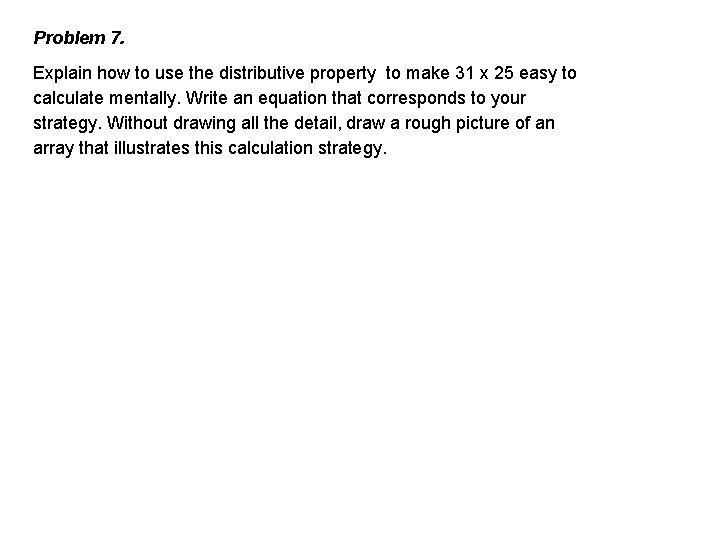
Problem 7. Explain how to use the distributive property to make 31 x 25 easy to calculate mentally. Write an equation that corresponds to your strategy. Without drawing all the detail, draw a rough picture of an array that illustrates this calculation strategy.
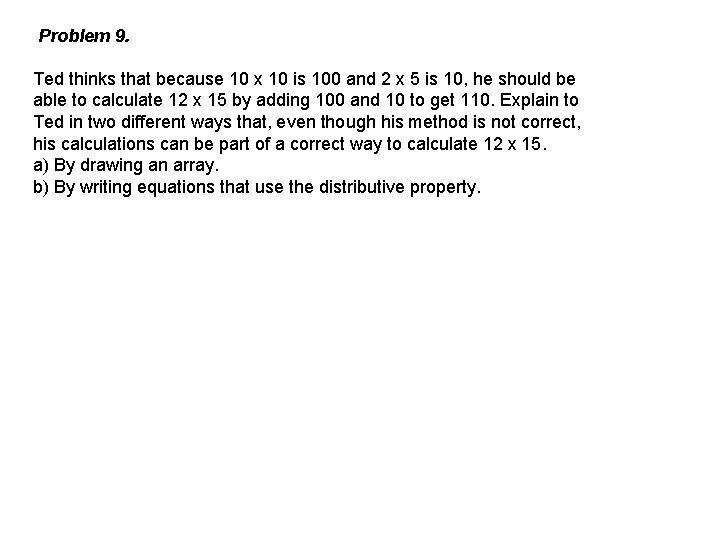
Problem 9. Ted thinks that because 10 x 10 is 100 and 2 x 5 is 10, he should be able to calculate 12 x 15 by adding 100 and 10 to get 110. Explain to Ted in two different ways that, even though his method is not correct, his calculations can be part of a correct way to calculate 12 x 15. a) By drawing an array. b) By writing equations that use the distributive property.
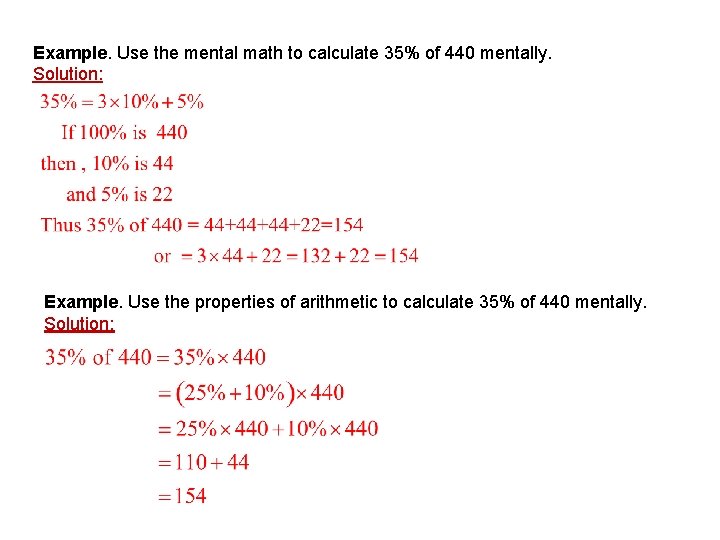
Example. Use the mental math to calculate 35% of 440 mentally. Solution: Example. Use the properties of arithmetic to calculate 35% of 440 mentally. Solution:
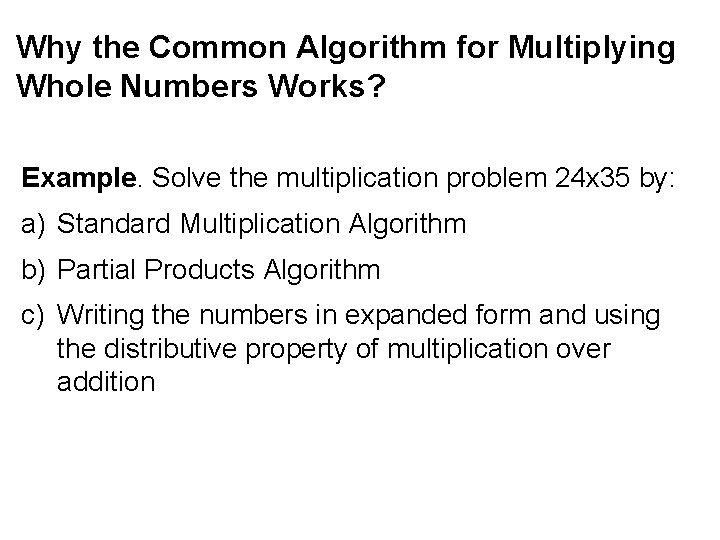
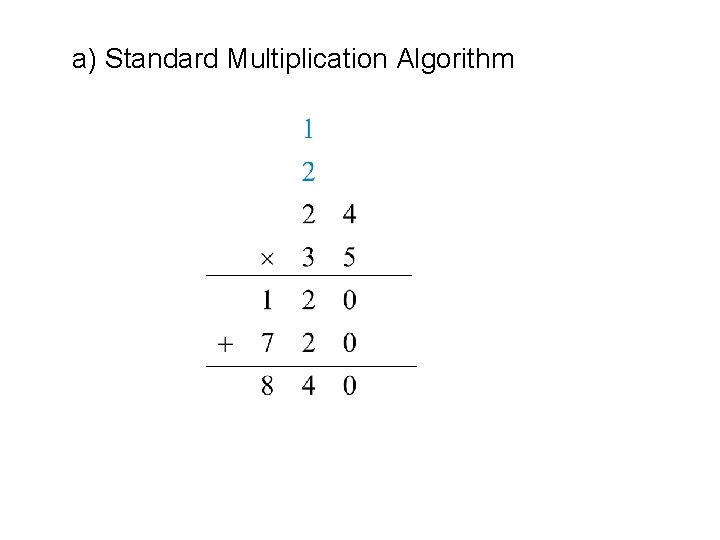
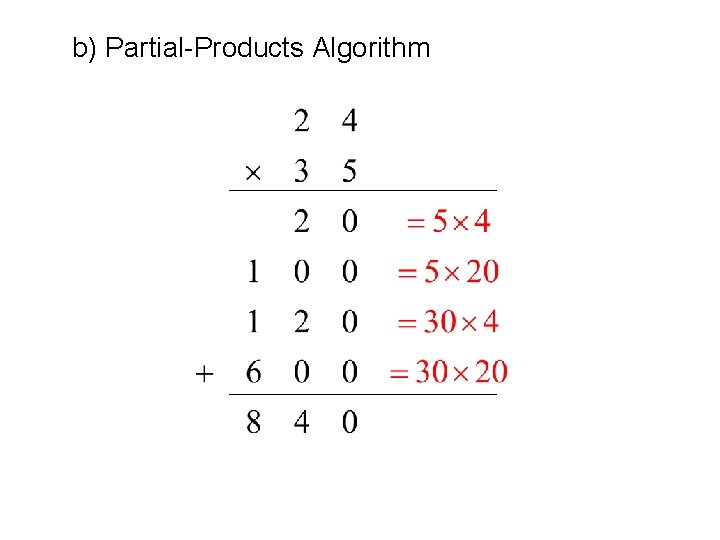
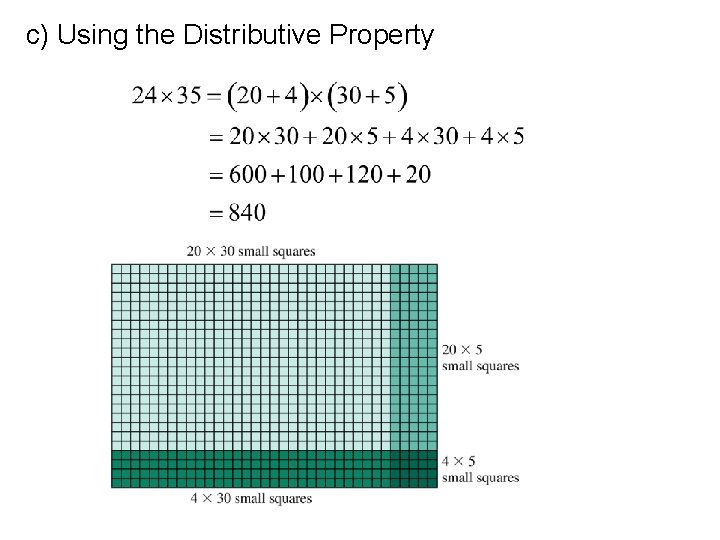
Why the Common Algorithm for Multiplying Whole Numbers Works? Example. Solve the multiplication problem 24 x 35 by: a) Standard Multiplication Algorithm b) Partial Products Algorithm c) Writing the numbers in expanded form and using the distributive property of multiplication over addition
a) Standard Multiplication Algorithm
b) Partial-Products Algorithm
с) Using the Distributive Property
Problem Solving Section 4. 6 Problem 7. Use the partial-products and standard algorithms to calculate 27 x 28.
Multiplication and distance • Suppose a car (or any other object) travel with a constant speed S unit per hour (e. g. km/h) • If it travels for T hours, the total distance covered is S x T • Example. Alex walks up the hill at 3 km/h for 3 hours and down the hill at 6 km/h for 2 hours. Find the total distance that Alex walked.