Chapter 2 Culture and Multinational Management Copyright 2007

- Slides: 57
Chapter 2 Culture and Multinational Management Copyright© 2007 Thomson Learning All rights
Learning Objectives • Define culture and understand the basic components of culture • Identify instances of cultural stereotyping and ethnocentrism • Understand how various levels of culture influence multinational operations Copyright© 2007 South-Western/Thomson Learning All rights
Learning Objectives • Understand the Hofstede and 7 d models • Appreciate the complex differences among cultures and use these differences for building better organizations • Recognize the complexity of understanding new cultures and the dangers of stereotyping and cultural paradoxes Copyright© 2007 South-Western/Thomson Learning All rights
What is Culture? • Pervasive and shared beliefs, norms, values, and symbols that guide everyday life. • Cultural norms: both prescribe and proscribe behaviors • What we should do and what we cannot do. • Cultural values: what is good/beautiful/holy beautiful, and what are legitimate goals for life. Copyright© 2007 South-Western/Thomson Learning All rights
What is Culture? (cont. ) • Cultural beliefs: represent our understandings about what is true. • Cultural symbols, stories, and rituals: communicate the norms, values, and beliefs of a society or a group to its members. • Culture is pervasive in society • Affects all aspects of life • Not all aspects are observable Copyright© 2007 South-Western/Thomson Learning All rights
Culture: Front Stage & Back Stage • Front stage of culture: easily observable aspect of culture • E. g. , Japanese executive bows or North American robust handshake. • Back stage of culture: only insiders or members of the culture understand other aspects of culture • E. g. , Japanese saying “it’s difficult” and twisting head to one side really means it’s Copyright© 2007 South-Western/Thomson Learning All rights
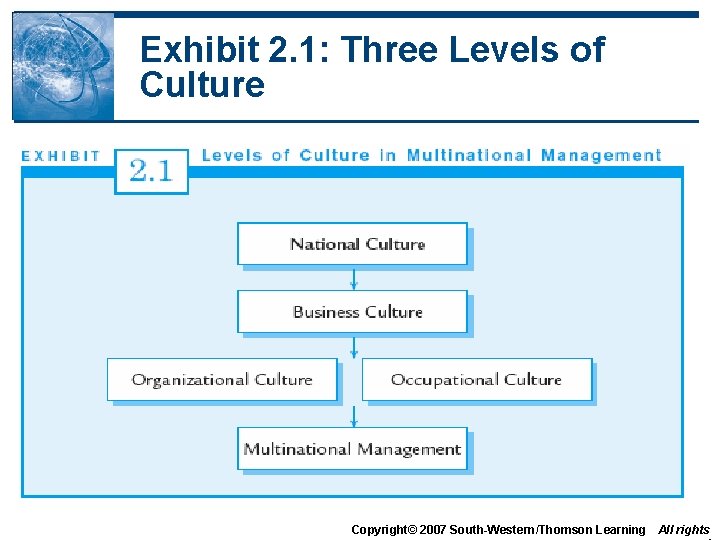
Three Levels of Culture 1. National culture: the dominant culture within the political boundaries of the nation-state. 2. Business culture: norms, values, and beliefs that pertain to business in a culture. – Tells people the correct, acceptable ways to conduct business in a society. Copyright© 2007 South-Western/Thomson Learning All rights
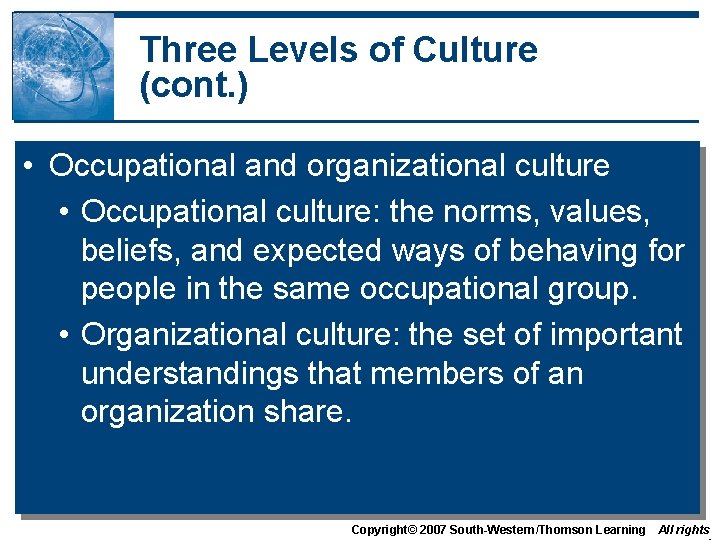
Three Levels of Culture (cont. ) • Occupational and organizational culture • Occupational culture: the norms, values, beliefs, and expected ways of behaving for people in the same occupational group. • Organizational culture: the set of important understandings that members of an organization share. Copyright© 2007 South-Western/Thomson Learning All rights
Exhibit 2. 1: Three Levels of Culture Copyright© 2007 South-Western/Thomson Learning All rights
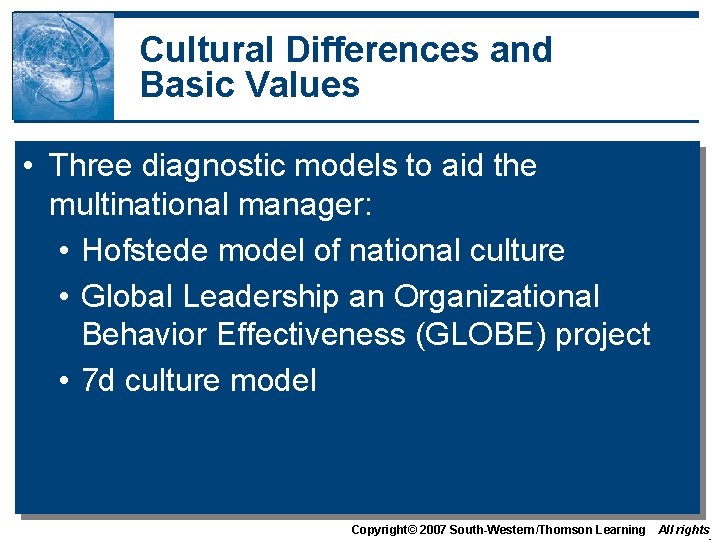
Cultural Differences and Basic Values • Three diagnostic models to aid the multinational manager: • Hofstede model of national culture • Global Leadership an Organizational Behavior Effectiveness (GLOBE) project • 7 d culture model Copyright© 2007 South-Western/Thomson Learning All rights
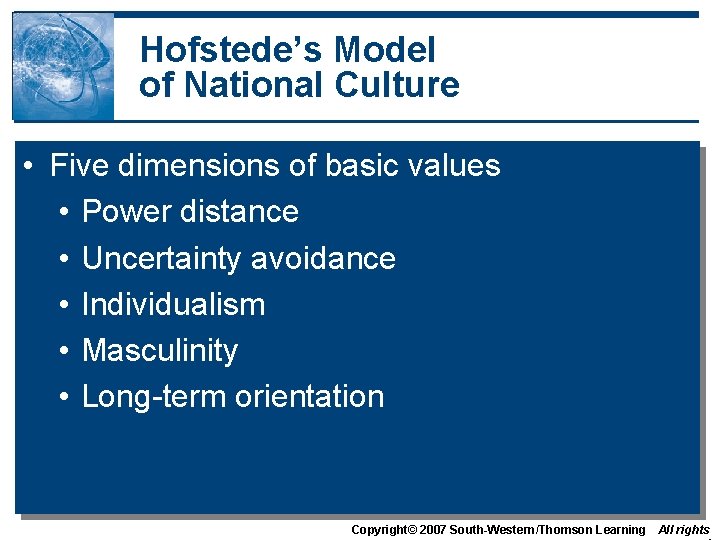
Hofstede’s Model of National Culture • Five dimensions of basic values • Power distance • Uncertainty avoidance • Individualism • Masculinity • Long-term orientation Copyright© 2007 South-Western/Thomson Learning All rights
Hofstede’s Model Applied to Organizations and Management • Management practices considered in the discussion of Hofstede’s model include: • 1. Human resources management • Management selection • Training • Evaluation and promotion • Remuneration Copyright© 2007 South-Western/Thomson Learning All rights
Hofstede’s Model Applied to Organizations • • Leadership styles Motivational assumptions Decision making and organizational design Strategy Copyright© 2007 South-Western/Thomson Learning All rights
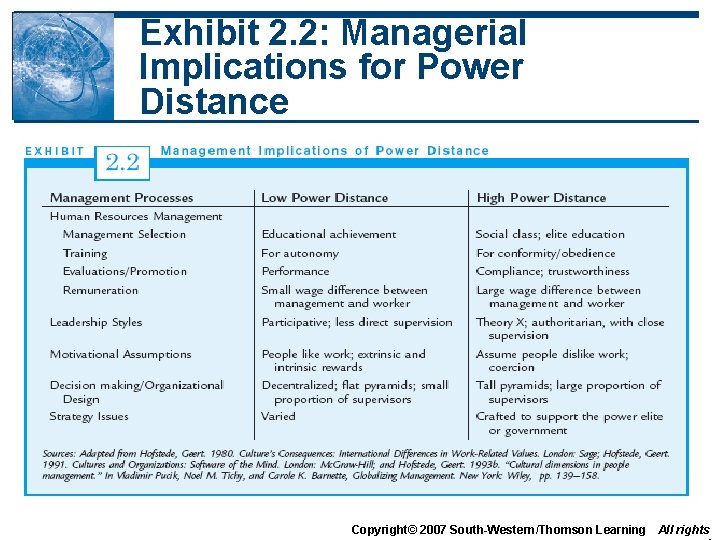
Power Distance • Power distance concerns how cultures deal with inequality and focuses on • Norms that tell superiors (e. g. , bosses) how much they can determine the behavior of their subordinates • Values and beliefs that superiors and subordinates are different kinds of people Copyright© 2007 South-Western/Thomson Learning All rights
Power Distance (cont. ) • High power distance countries have norms, values, and beliefs such as • Inequality is fundamentally good • Everyone has a place: some are high, some are low • Most people should be dependent on a leader • The powerful are entitled to privileges • The powerful should not hide their power Copyright© 2007 South-Western/Thomson Learning All rights
Exhibit 2. 2: Managerial Implications for Power Distance Copyright© 2007 South-Western/Thomson Learning All rights
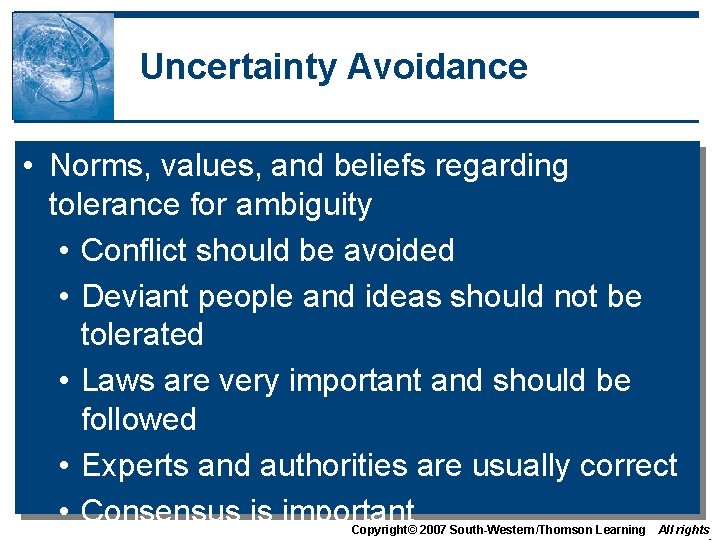
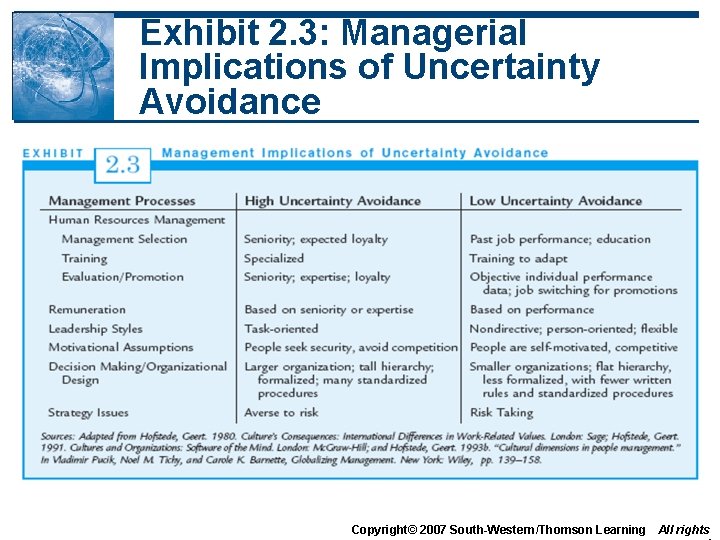
Uncertainty Avoidance • Norms, values, and beliefs regarding tolerance for ambiguity • Conflict should be avoided • Deviant people and ideas should not be tolerated • Laws are very important and should be followed • Experts and authorities are usually correct • Consensus is important Copyright© 2007 South-Western/Thomson Learning All rights
Exhibit 2. 3: Managerial Implications of Uncertainty Avoidance Copyright© 2007 South-Western/Thomson Learning All rights
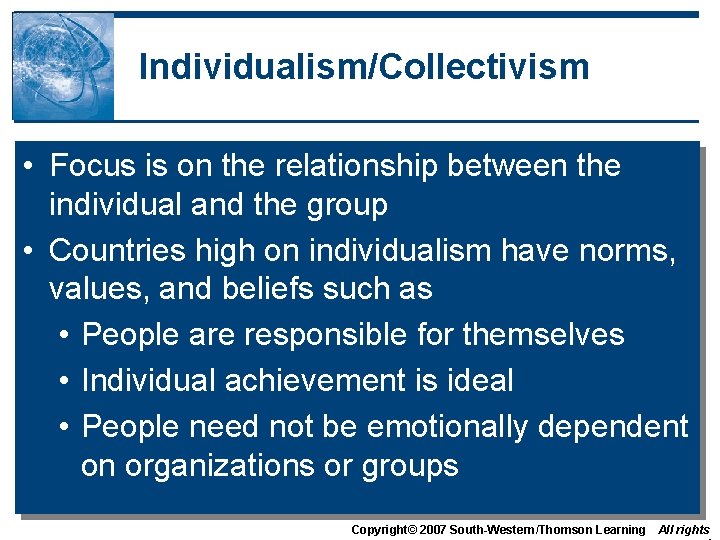
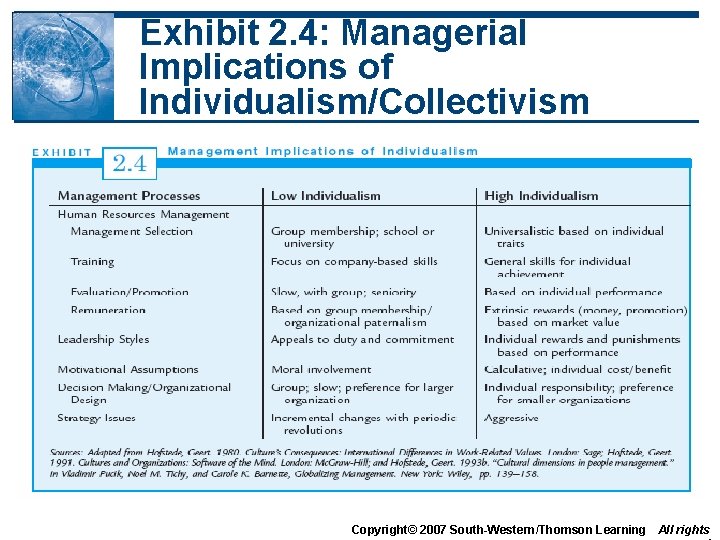
Individualism/Collectivism • Focus is on the relationship between the individual and the group • Countries high on individualism have norms, values, and beliefs such as • People are responsible for themselves • Individual achievement is ideal • People need not be emotionally dependent on organizations or groups Copyright© 2007 South-Western/Thomson Learning All rights
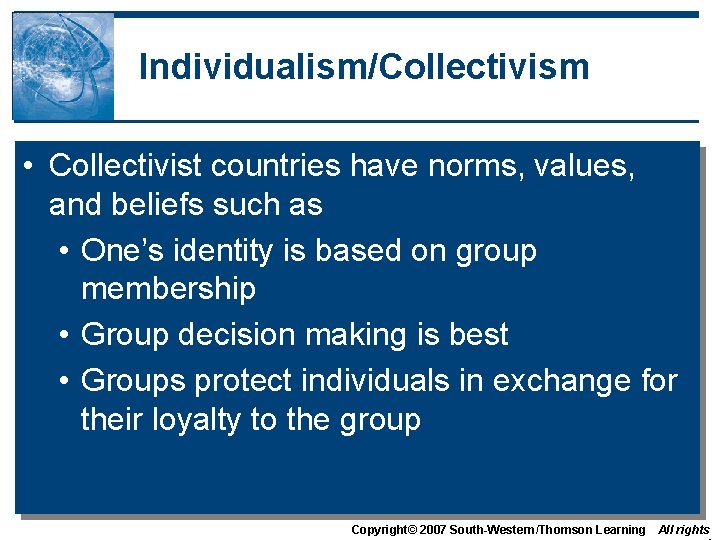
Individualism/Collectivism • Collectivist countries have norms, values, and beliefs such as • One’s identity is based on group membership • Group decision making is best • Groups protect individuals in exchange for their loyalty to the group Copyright© 2007 South-Western/Thomson Learning All rights
Exhibit 2. 4: Managerial Implications of Individualism/Collectivism Copyright© 2007 South-Western/Thomson Learning All rights
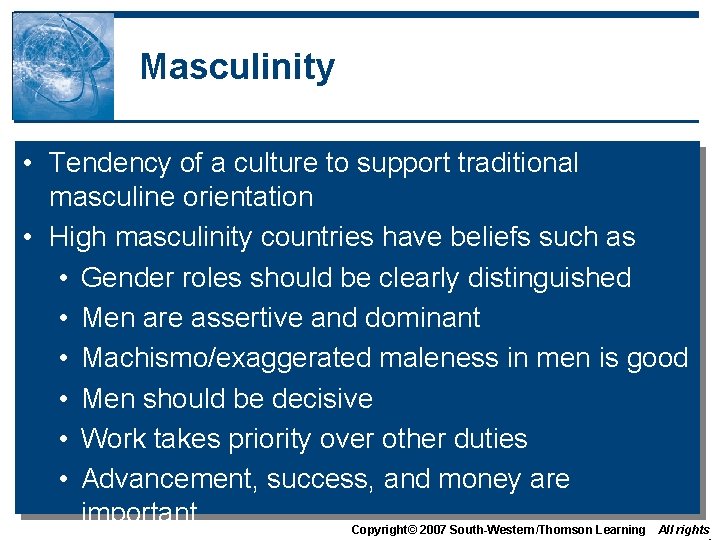
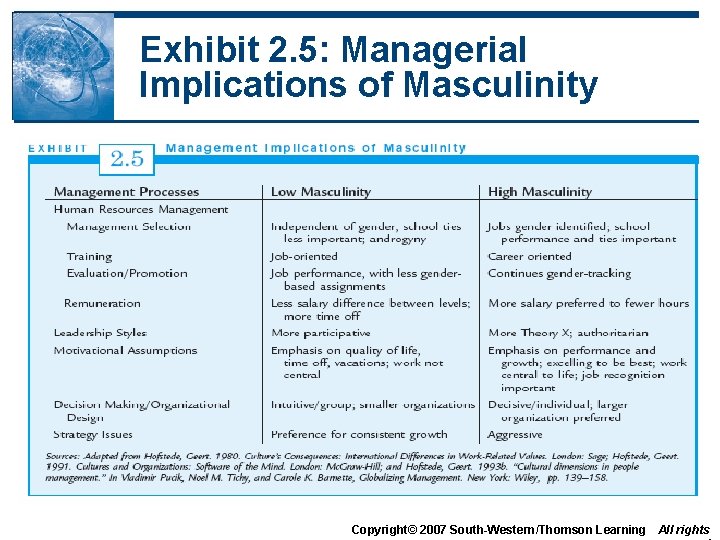
Masculinity • Tendency of a culture to support traditional masculine orientation • High masculinity countries have beliefs such as • Gender roles should be clearly distinguished • Men are assertive and dominant • Machismo/exaggerated maleness in men is good • Men should be decisive • Work takes priority over other duties • Advancement, success, and money are important Copyright© 2007 South-Western/Thomson Learning All rights
Exhibit 2. 5: Managerial Implications of Masculinity Copyright© 2007 South-Western/Thomson Learning All rights
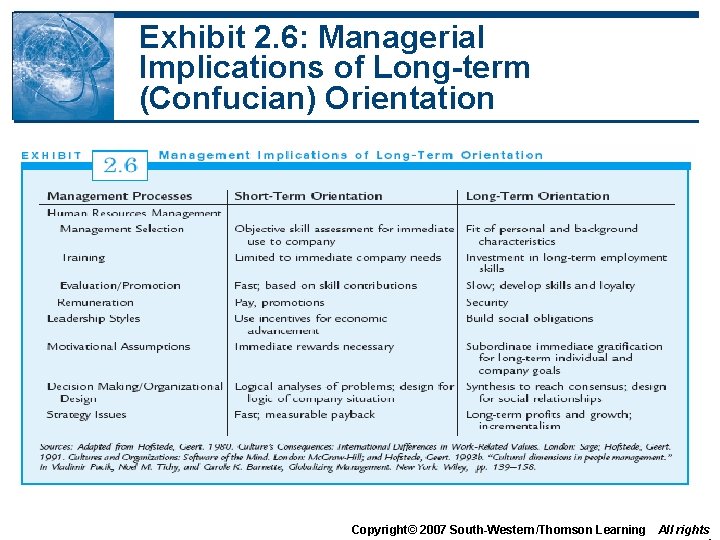
Long-Term (Confucian) Orientation • Managers are selected based on the fit of their personal and educational characteristics • A prospective employee’s particular skills have less importance in the hiring decision • Training and socialization for a long-term commitment to the organization compensate for any initial weaknesses in work-related skills Copyright© 2007 South-Western/Thomson Learning All rights
Long-Term (Confucian) Orientation • Eastern cultures rank highest on long-term orientation • Value synthesis in organizational decisions • Belief in substantial savings • Willingness to invest • Acceptance of slow results • Persistence to achieve goals • Sensitivity to social relationships • Pragmatic adaptation Copyright© 2007 South-Western/Thomson Learning All rights
Short-Term Orientation • Must focus immediately on usable skills • Results high employee turnover rates • Can’t assured of a return on any investment in employee training and socialization • Leaders use short-term rewards that focus on pay and rapid promotion Copyright© 2007 South-Western/Thomson Learning All rights
Short-term Orientation • Western cultures, which tend to have shortterm orientations, value logical analysis in their approach to organizational decisions • Designed and managed purposefully to respond to immediate pressures from the environment • Often use quick layoffs of “excess” employees to adjust to shrinking demand for products Copyright© 2007 South-Western/Thomson Learning All rights
Long-Term Orientation vs. Short-Term Orientation • The difference between long- and short-term cultures is apparent in the goals companies set in strategic decision making • Managers in countries (short-term) such as the U. S. want immediate financial returns and want fast, measurable success Copyright© 2007 South-Western/Thomson Learning All rights
Long-Term Orientation vs. Short-Term Orientation • Countries with long-term orientations prioritize growth and long-term paybacks • The long time horizons allow managers to experiment and seek success by developing their “game plans” as they go along Copyright© 2007 South-Western/Thomson Learning All rights
Exhibit 2. 6: Managerial Implications of Long-term (Confucian) Orientation Copyright© 2007 South-Western/Thomson Learning All rights
GLOBE National Culture Framework • GLOBE (Global Leadership and Organizational Behavior Studies) involves 170 researchers who collected data from 17, 000 managers in 62 countries • Seven dimensions of GLOBE are similar to Hofstede • Unique dimensions • Performance orientation • Humane orientation Copyright© 2007 South-Western/Thomson Learning All rights
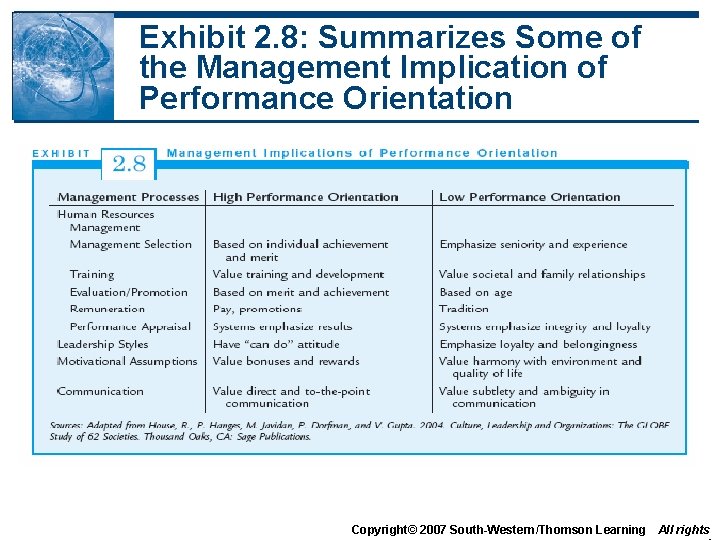
Performance Orientation • Performance Orientation – refers to the degree to which the society encourages societal members to innovate, to improve their performance, and to strive for excellence • E. g. , the United States and Singapore have high scores while Russia and Greece have low scores on the dimension Copyright© 2007 South-Western/Thomson Learning All rights
Exhibit 2. 8: Summarizes Some of the Management Implication of Performance Orientation Copyright© 2007 South-Western/Thomson Learning All rights
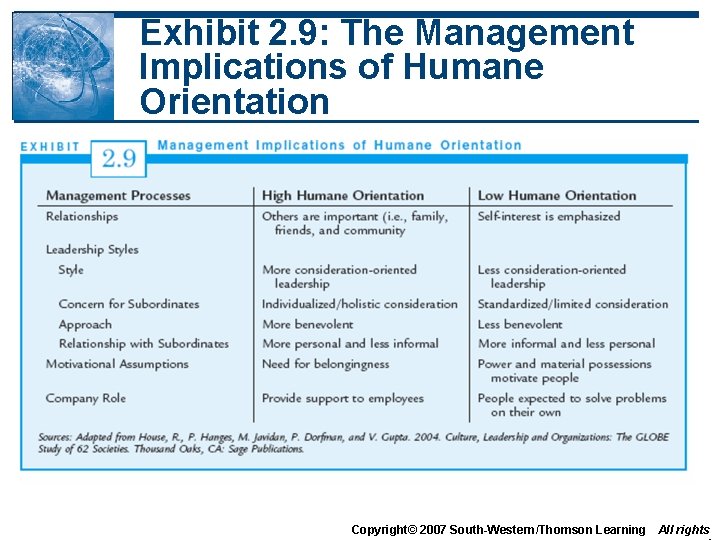
Humane Orientation • Humane Orientation – an indication of the extent to which individuals are expected to be fair, altruistic, caring, and generous • Need for belongingness and affiliation is emphasized more than material possessions, self -fulfillment, and pleasure • Less humane oriented societies are more likely to value self-interest and self-gratification • E. g. , Malaysia and Egypt score highly while France and Germany have low scores Copyright© 2007 South-Western/Thomson Learning All rights
Exhibit 2. 9: The Management Implications of Humane Orientation Copyright© 2007 South-Western/Thomson Learning All rights
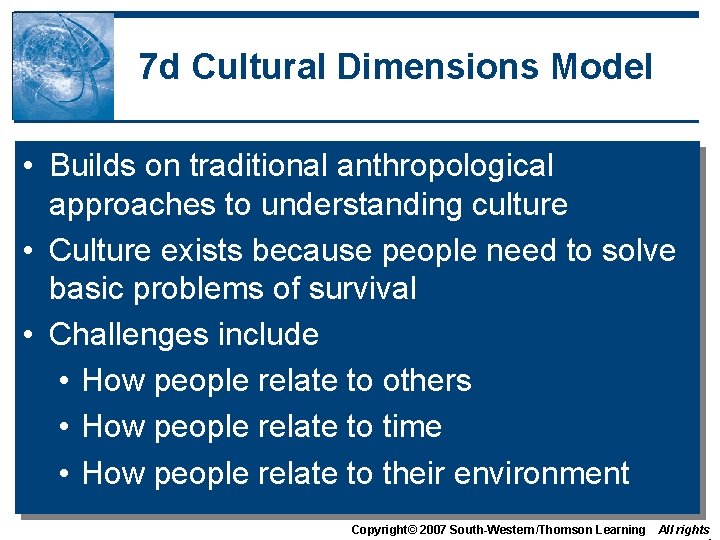
7 d Cultural Dimensions Model • Builds on traditional anthropological approaches to understanding culture • Culture exists because people need to solve basic problems of survival • Challenges include • How people relate to others • How people relate to time • How people relate to their environment Copyright© 2007 South-Western/Thomson Learning All rights
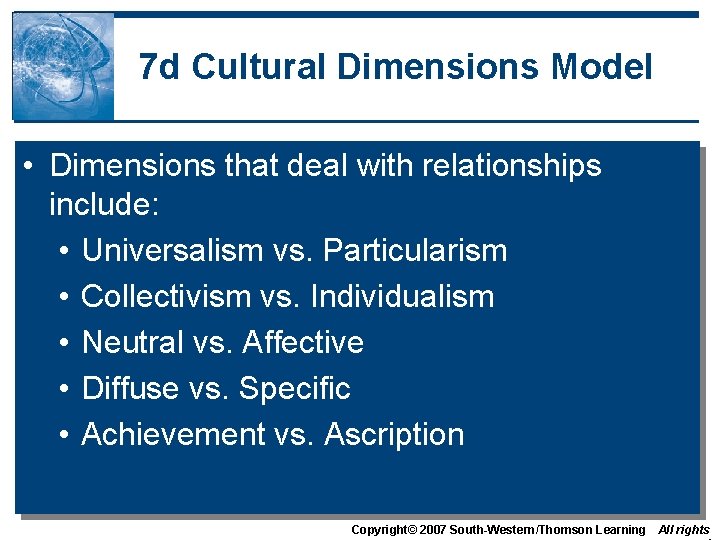
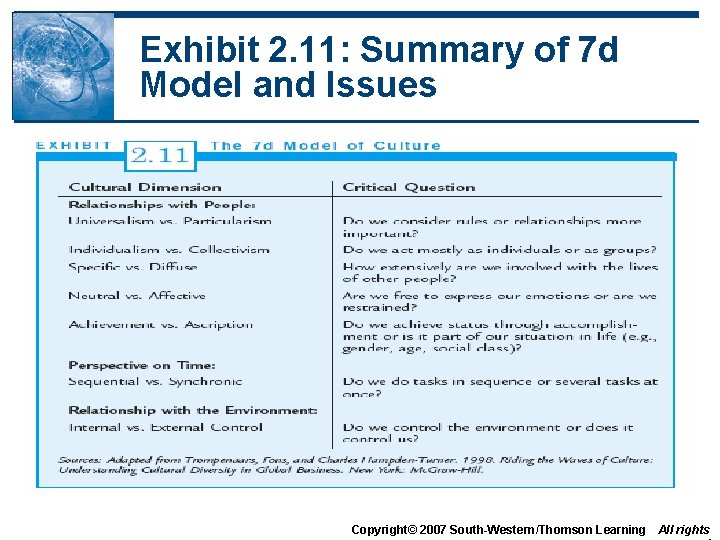
7 d Cultural Dimensions Model • Dimensions that deal with relationships include: • Universalism vs. Particularism • Collectivism vs. Individualism • Neutral vs. Affective • Diffuse vs. Specific • Achievement vs. Ascription Copyright© 2007 South-Western/Thomson Learning All rights
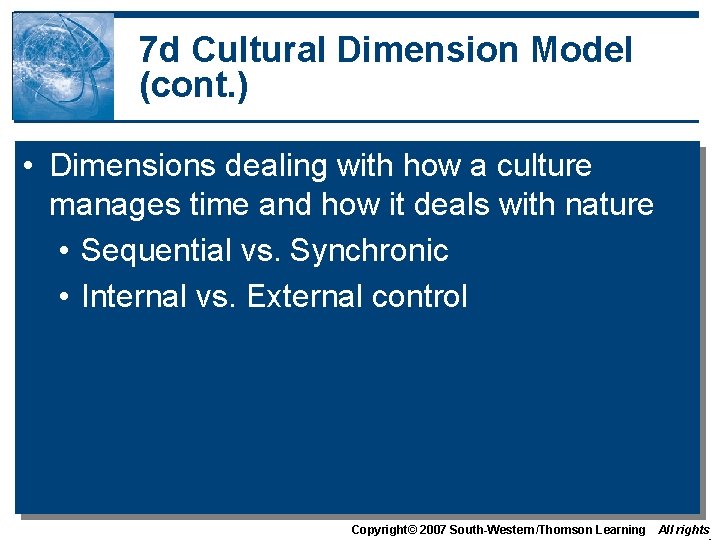
7 d Cultural Dimension Model (cont. ) • Dimensions dealing with how a culture manages time and how it deals with nature • Sequential vs. Synchronic • Internal vs. External control Copyright© 2007 South-Western/Thomson Learning All rights
Exhibit 2. 11: Summary of 7 d Model and Issues Copyright© 2007 South-Western/Thomson Learning All rights
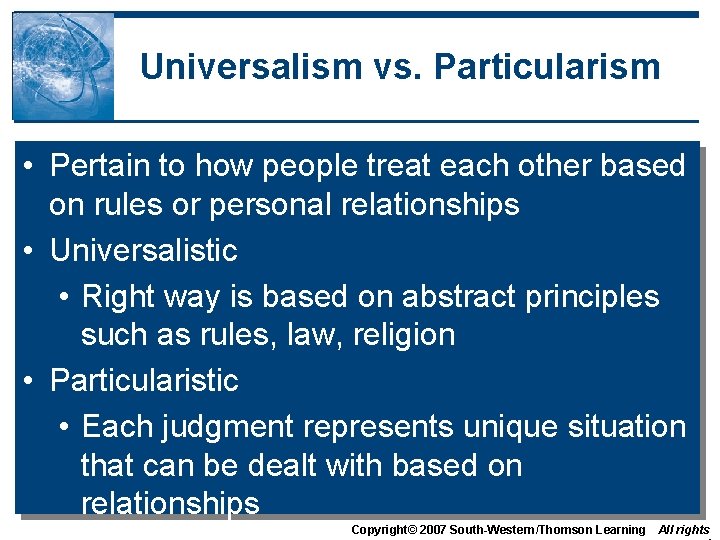
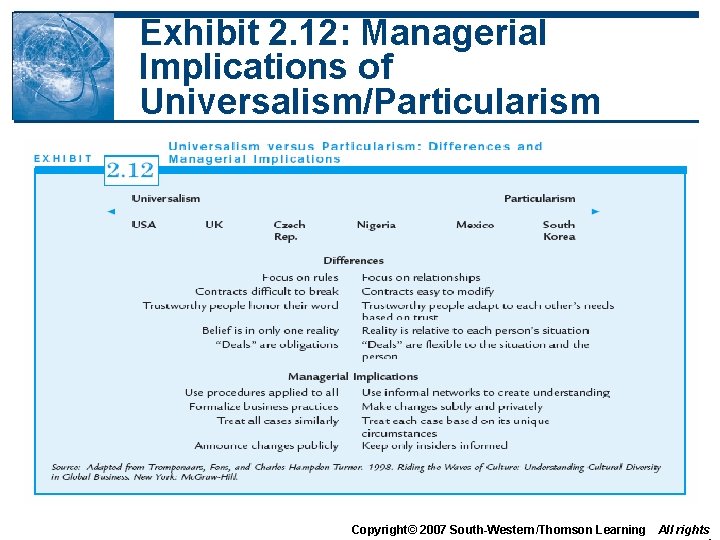
Universalism vs. Particularism • Pertain to how people treat each other based on rules or personal relationships • Universalistic • Right way is based on abstract principles such as rules, law, religion • Particularistic • Each judgment represents unique situation that can be dealt with based on relationships Copyright© 2007 South-Western/Thomson Learning All rights
Exhibit 2. 12: Managerial Implications of Universalism/Particularism Copyright© 2007 South-Western/Thomson Learning All rights
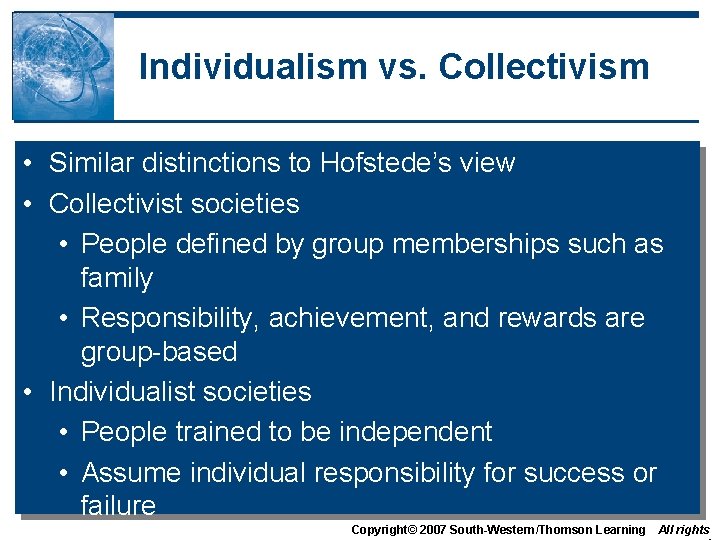
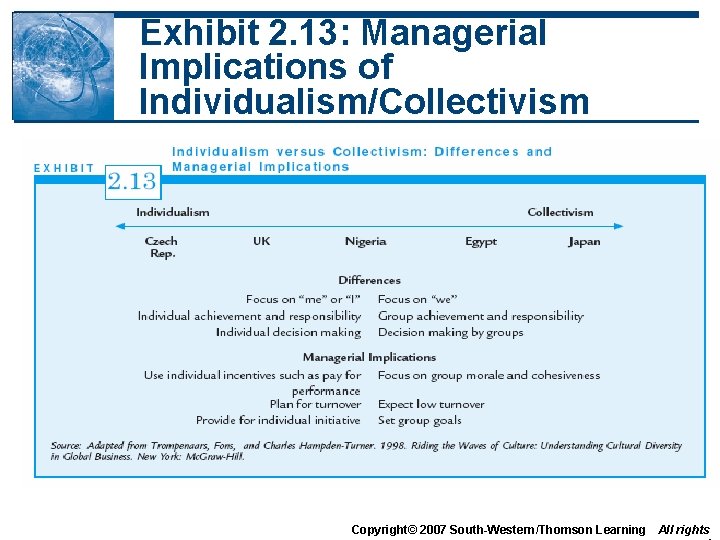
Individualism vs. Collectivism • Similar distinctions to Hofstede’s view • Collectivist societies • People defined by group memberships such as family • Responsibility, achievement, and rewards are group-based • Individualist societies • People trained to be independent • Assume individual responsibility for success or failure Copyright© 2007 South-Western/Thomson Learning All rights
Exhibit 2. 13: Managerial Implications of Individualism/Collectivism Copyright© 2007 South-Western/Thomson Learning All rights
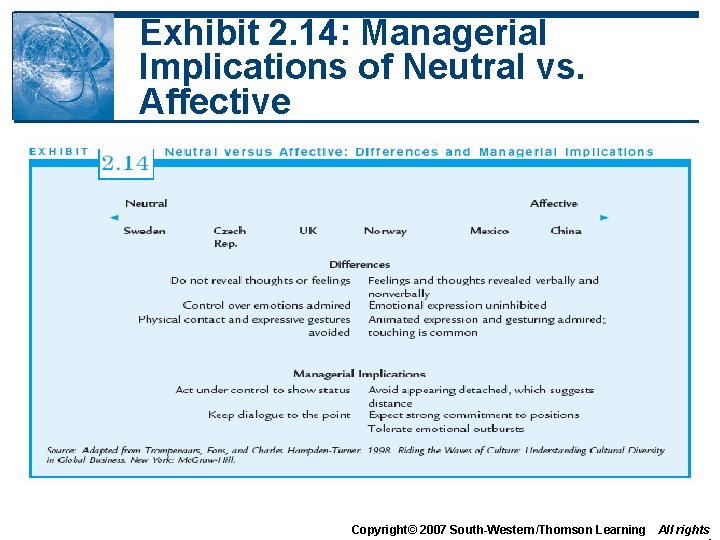
Neutral vs. Affective • Concerns acceptability of expressing emotions • Neutral • Interactions are objective and detached • Focus is on tasks rather than relationships • Affective • Emotions are appropriate in all situations Copyright© 2007 South-Western/Thomson Learning All rights
Exhibit 2. 14: Managerial Implications of Neutral vs. Affective Copyright© 2007 South-Western/Thomson Learning All rights
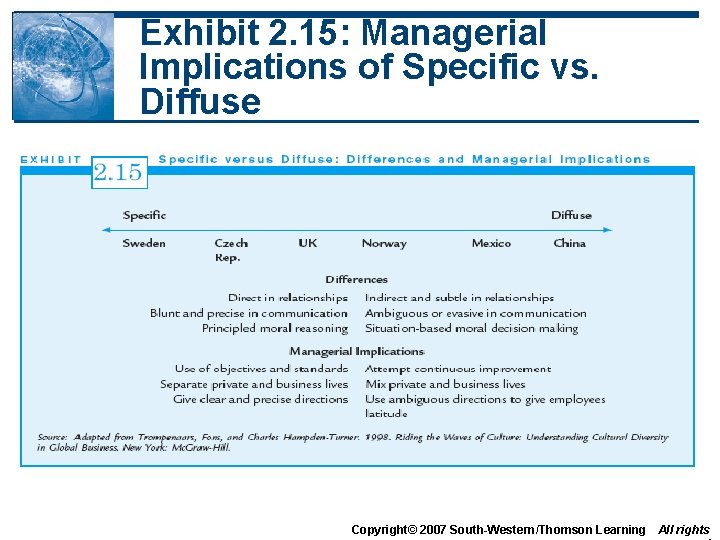
Specific vs. Diffuse • Extent to which an individual’s life is involved in work • Specific • Business segregated from other parts of life • Contracts often delineate relationships • Diffuse • Business relationships encompassing/involving Copyright© 2007 South-Western/Thomson Learning All rights
Exhibit 2. 15: Managerial Implications of Specific vs. Diffuse Copyright© 2007 South-Western/Thomson Learning All rights
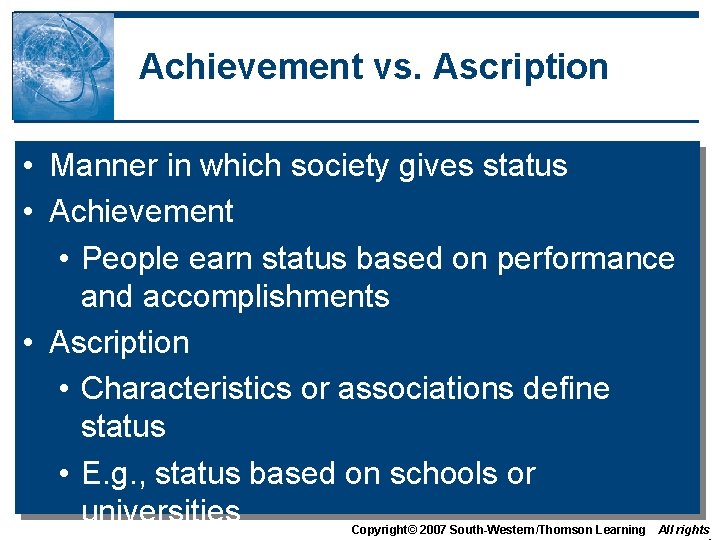
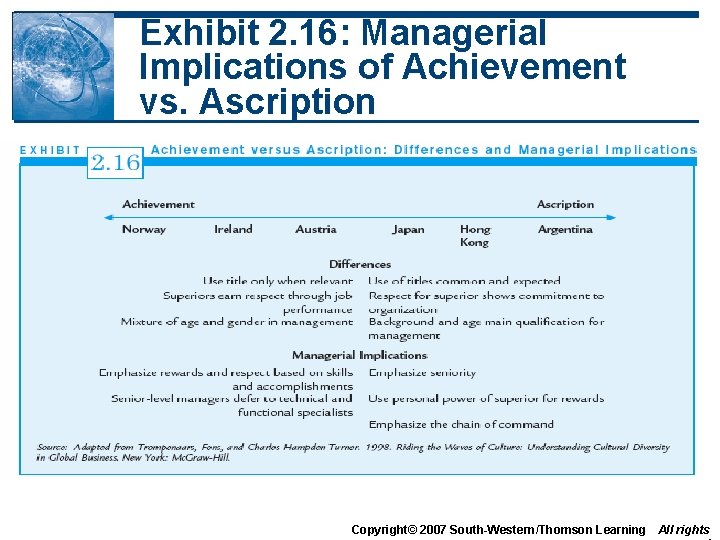
Achievement vs. Ascription • Manner in which society gives status • Achievement • People earn status based on performance and accomplishments • Ascription • Characteristics or associations define status • E. g. , status based on schools or universities Copyright© 2007 South-Western/Thomson Learning All rights
Exhibit 2. 16: Managerial Implications of Achievement vs. Ascription Copyright© 2007 South-Western/Thomson Learning All rights
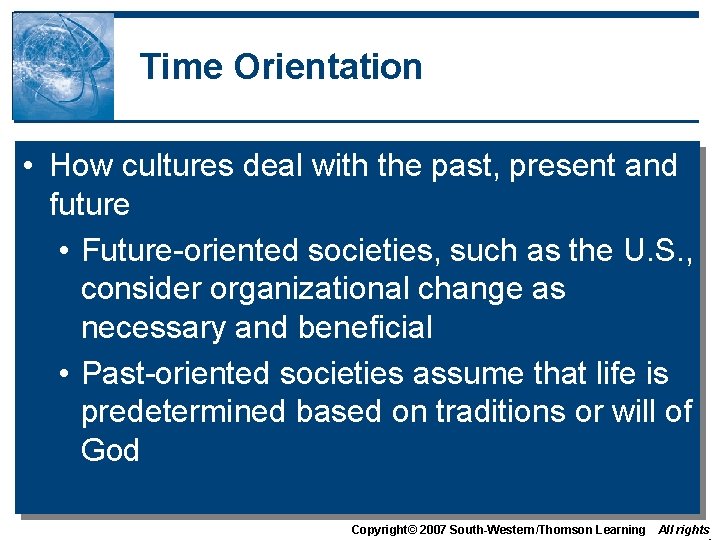
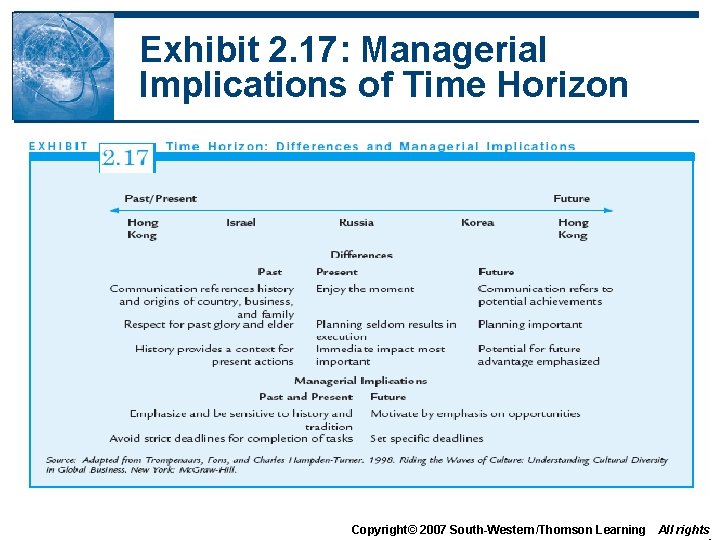
Time Orientation • How cultures deal with the past, present and future • Future-oriented societies, such as the U. S. , consider organizational change as necessary and beneficial • Past-oriented societies assume that life is predetermined based on traditions or will of God Copyright© 2007 South-Western/Thomson Learning All rights
Exhibit 2. 17: Managerial Implications of Time Horizon Copyright© 2007 South-Western/Thomson Learning All rights
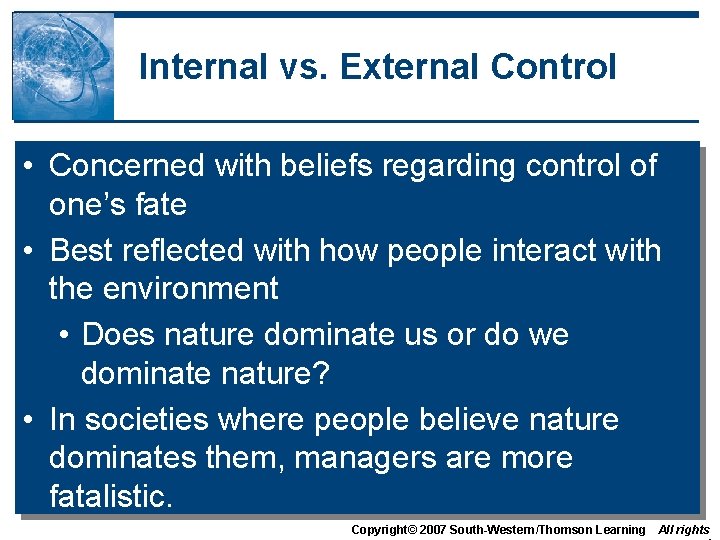
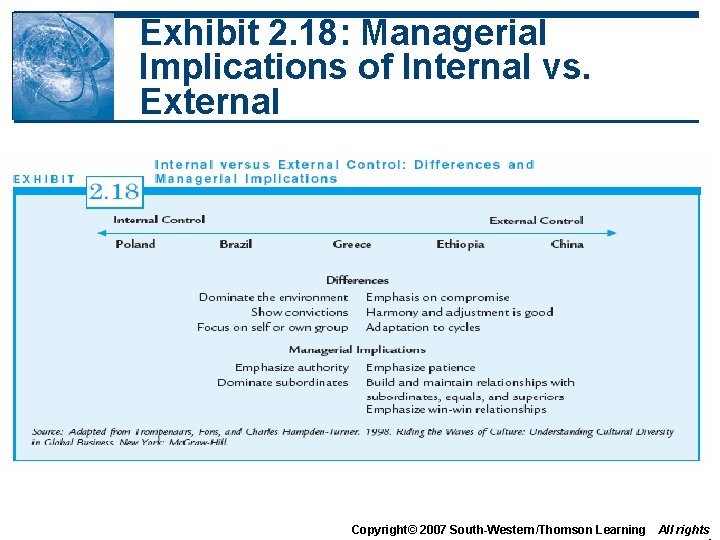
Internal vs. External Control • Concerned with beliefs regarding control of one’s fate • Best reflected with how people interact with the environment • Does nature dominate us or do we dominate nature? • In societies where people believe nature dominates them, managers are more fatalistic. Copyright© 2007 South-Western/Thomson Learning All rights
Exhibit 2. 18: Managerial Implications of Internal vs. External Copyright© 2007 South-Western/Thomson Learning All rights
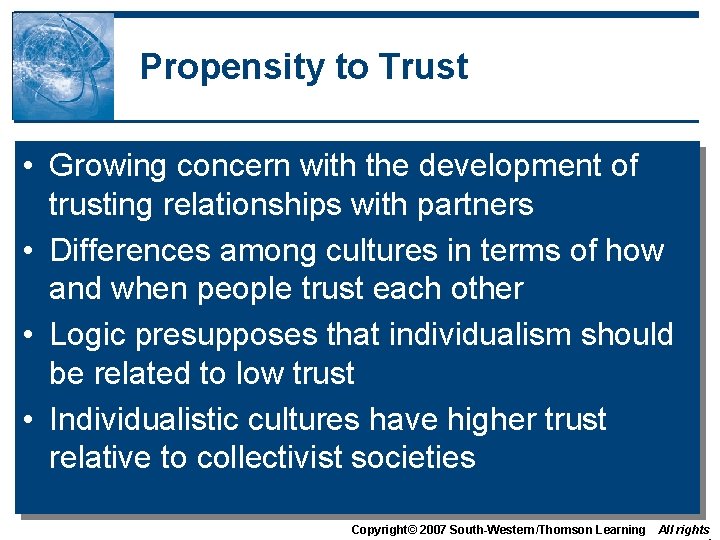
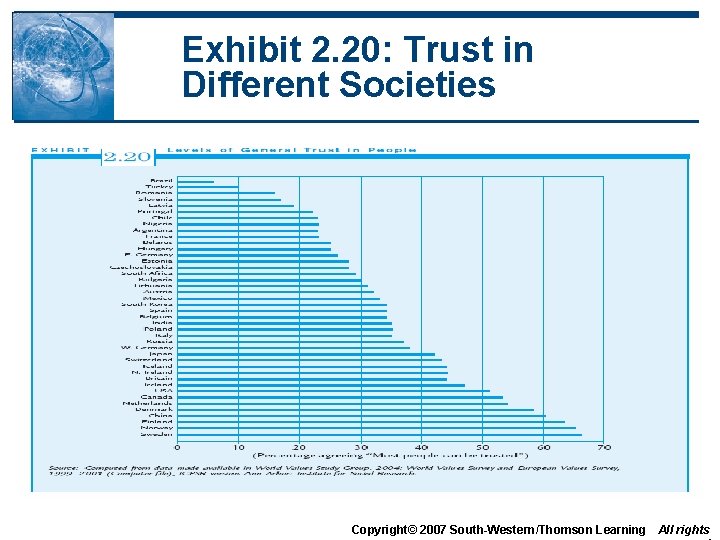
Propensity to Trust • Growing concern with the development of trusting relationships with partners • Differences among cultures in terms of how and when people trust each other • Logic presupposes that individualism should be related to low trust • Individualistic cultures have higher trust relative to collectivist societies Copyright© 2007 South-Western/Thomson Learning All rights
Exhibit 2. 20: Trust in Different Societies Copyright© 2007 South-Western/Thomson Learning All rights
Caveats and Cautions • Stereotyping: assumes that all people within one culture behave, believe, feel, and act the same. • Ethnocentrism: occurs when people from one culture believe that theirs are the only correct norms, values, and beliefs. • Cultural relativism: all cultures, no matter how different, are correct and moral for the people of those cultures. Copyright© 2007 South-Western/Thomson Learning All rights
Conclusion • Chapter provides understanding of various ways to understand national cultures • Cultures also exist at different levels • Astute managers can comprehend cultures at the various levels Copyright© 2007 South-Western/Thomson Learning All rights