International Finance Chapter 18 Multinational Cash Management Cash













- Slides: 45
International Finance Chapter 18: Multinational Cash Management
Cash Management for a Global Firm • A global firm’s cash management is actually part of the larger issue of working capital management. – Working capital = current assets – current liabilities. – Current assets: • Cash, accounts receivable, inventories, short term investments. – Current liabilities: • Accounts payable, bank loans and notes payable, current taxes payable.
Working Capital Management • Broader issue than cash. • Global firm needs to manage the: – Individual components in its working capital structure. – Ensure that funds are available when needed to meet current liabilities as they come due. • If internal funds are not available, need to enter short term money markets to cover.
Focus on Cash Management • Issues for Global Firms: – Size of cash balances – Currency denominations of cash balances – Where cash balances are located among the global firm’s foreign affiliates. • Goal of Global Firms: – Minimize the size of cash balances. • Non-interest earning assets! – Reduce foreign exchange transaction expenses and exposure.
Additional Objectives of Cash Management • When sourcing short term funds to cover cash flow needs: – Do so at the lowest possible borrowing cost. • When investing short term (“excess” cash) funds: – Do so where the greatest returns can be earned. • Both objectives need to consider: – Risk – Foreign exchange expsoure
Operational Consideration • Global firm must decide whether its cash management shall be done: • Centrally (e. g. , at headquarters), or – Centralized organizational structure. • Locally (e. g. , at the affiliate level). – Decentralized organizational structure.
Cash Management Techniques • The following are the two major techniques which are used by global firms in managing their cash positions: – Netting Systems • Bilateral and Multilateral – Netting the cash positions of the various affiliates. Transferring the net amounts (not the gross amounts). – Transfer Pricing • Establishing prices among affiliates for the intra-global firm selling of produces and services. • Means of moving (repositioning) cash within the global firm.
Netting Systems • Begins with an analysis of the global firm’s internal cash flows (i. e. , among affiliates and the parent). – What are the amount of the payments that each entity expects to pay and expects to receive. • Netting the above amounts is a way of reducing the amount of cash flow (and its associated cost) within the organization. – Netting is an efficient and cost-effective mechanism for settling interaffiliate foreign exchange transactions. • However, not all countries allow MNCs to net payments – If this is the case, larger foreign exchange transactions flow through the local (host country) banking system.
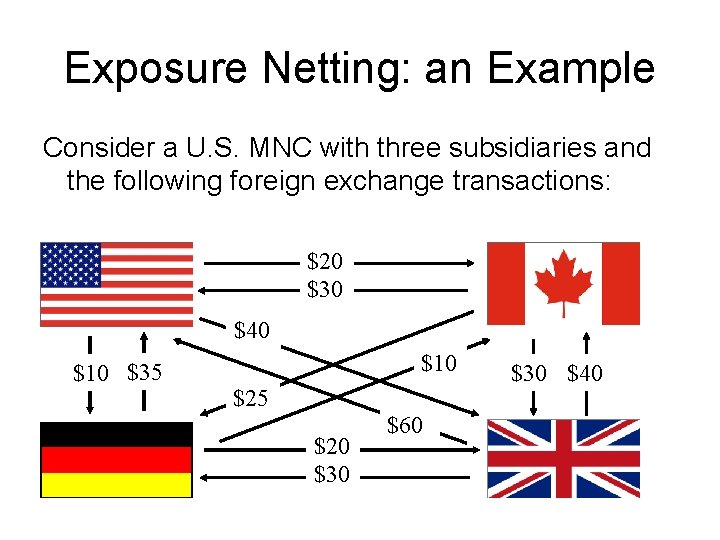
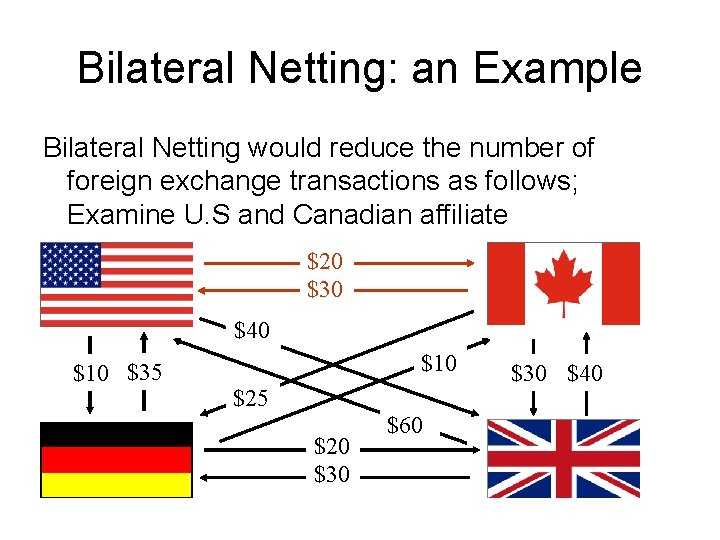
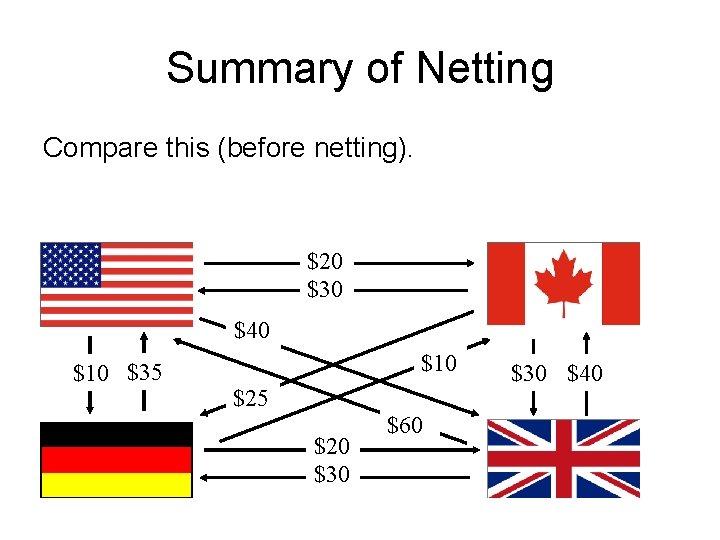
Exposure Netting: an Example Consider a U. S. MNC with three subsidiaries and the following foreign exchange transactions: $20 $30 $40 $10 $35 $10 $25 $20 $30 $60 $30 $40
Bilateral Netting: an Example Bilateral Netting would reduce the number of foreign exchange transactions as follows; Examine U. S and Canadian affiliate $20 $30 $40 $10 $35 $10 $25 $20 $30 $60 $30 $40
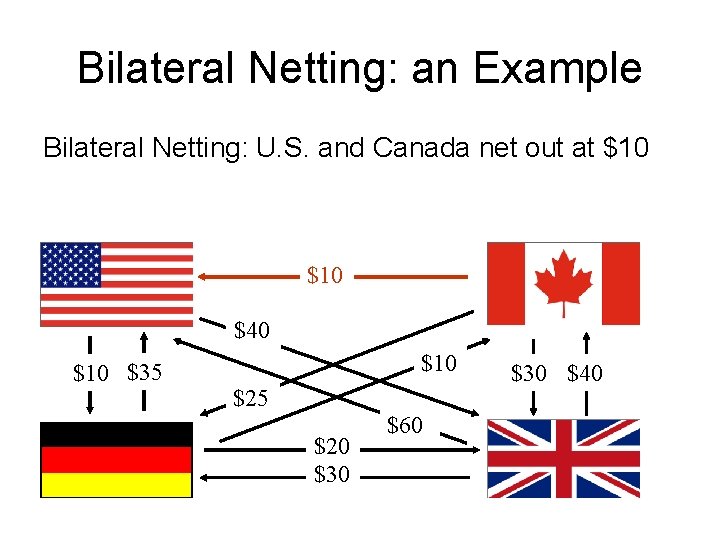
Bilateral Netting: an Example Bilateral Netting: U. S. and Canada net out at $10 $40 $10 $35 $10 $25 $20 $30 $60 $30 $40
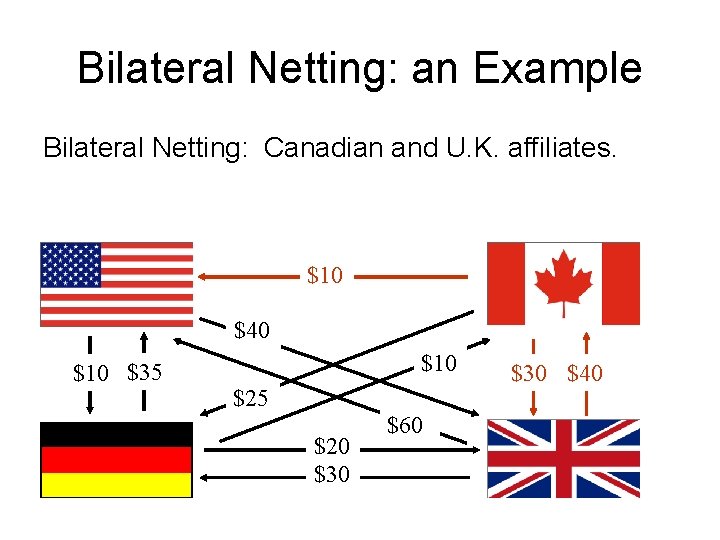
Bilateral Netting: an Example Bilateral Netting: Canadian and U. K. affiliates. $10 $40 $10 $35 $10 $25 $20 $30 $60 $30 $40
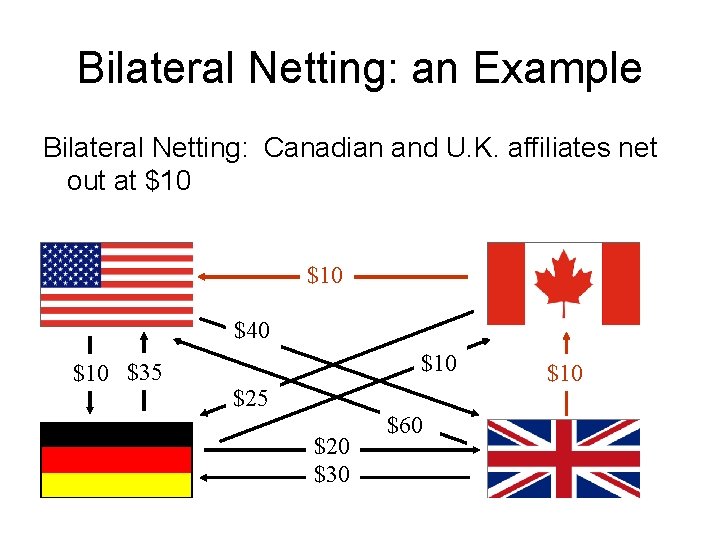
Bilateral Netting: an Example Bilateral Netting: Canadian and U. K. affiliates net out at $10 $40 $10 $35 $10 $25 $20 $30 $60 $10
Bilateral Netting: an Example Bilateral Netting: U. K. and German affiliates. $10 $40 $10 $35 $10 $25 $20 $30 $60 $10
Bilateral Netting: an Example Bilateral Netting: U. K. and German affiliates net out at $10 $40 $10 $35 $10 $25 $60 $10
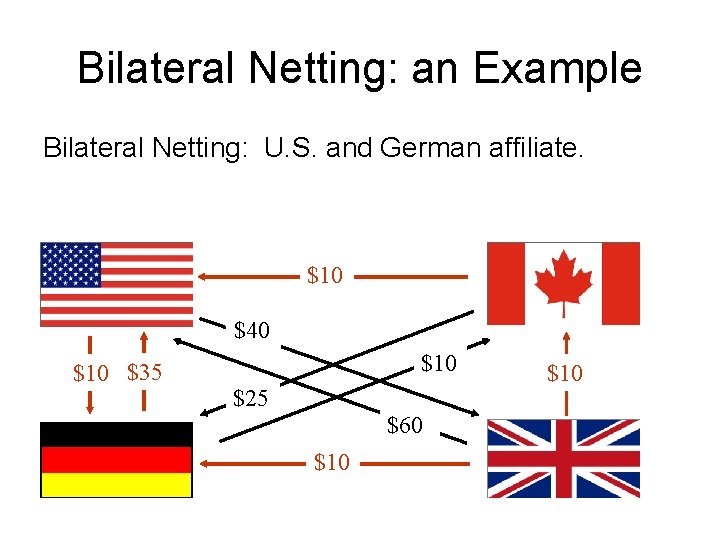
Bilateral Netting: an Example Bilateral Netting: U. S. and German affiliate. $10 $40 $10 $35 $10 $25 $60 $10
Bilateral Netting: an Example Bilateral Netting: U. S. and German affiliate net out at $25. $10 $40 $25 $10 $25 $60 $10
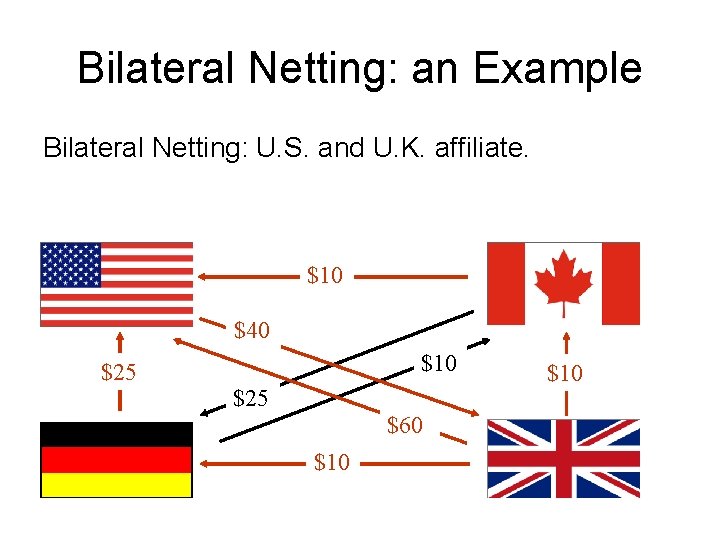
Bilateral Netting: an Example Bilateral Netting: U. S. and U. K. affiliate. $10 $40 $25 $10 $25 $60 $10
Bilateral Netting: an Example Bilateral Netting: U. S. and U. K. affiliate net out at $20. $10 $25 $20 $10 $25 $10
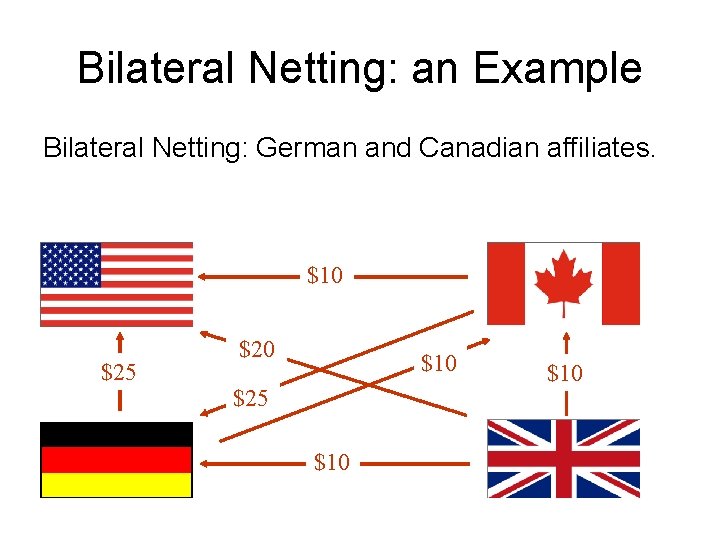
Bilateral Netting: an Example Bilateral Netting: German and Canadian affiliates. $10 $25 $20 $10 $25 $10
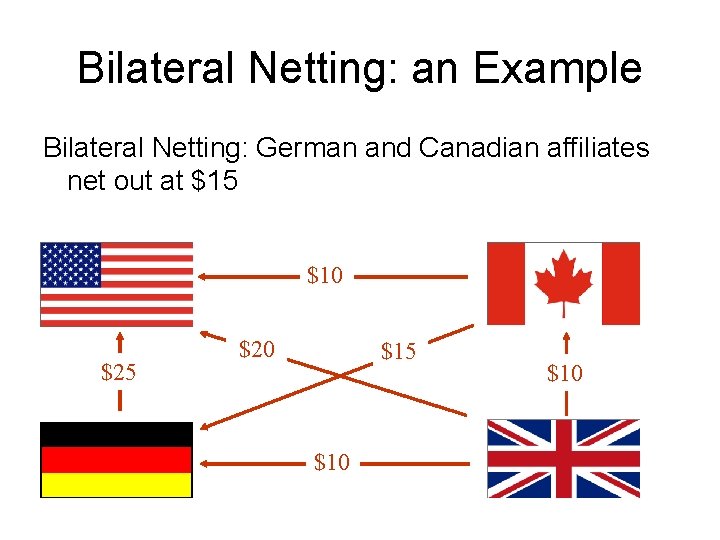
Bilateral Netting: an Example Bilateral Netting: German and Canadian affiliates net out at $15 $10 $25 $20 $15 $10
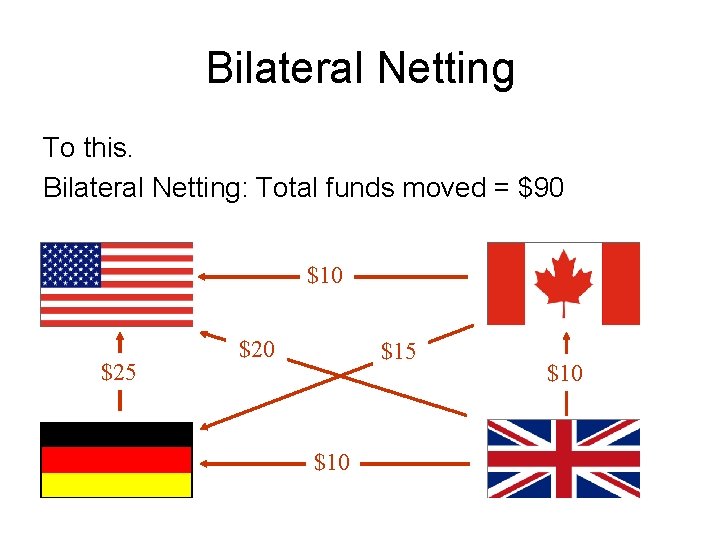
Bilateral Netting • Before bilateral netting: – Total funds (gross) to be moved: $350 • With bilateral netting: – Total funds (net( to be moved: $90 • This is a reduction of $260 in foreign exchange transactions.
Multilateral Netting: an Example Consider simplifying the bilateral netting with multilateral netting: Start with the bilateral amounts. $10 $25 $20 $15 $10
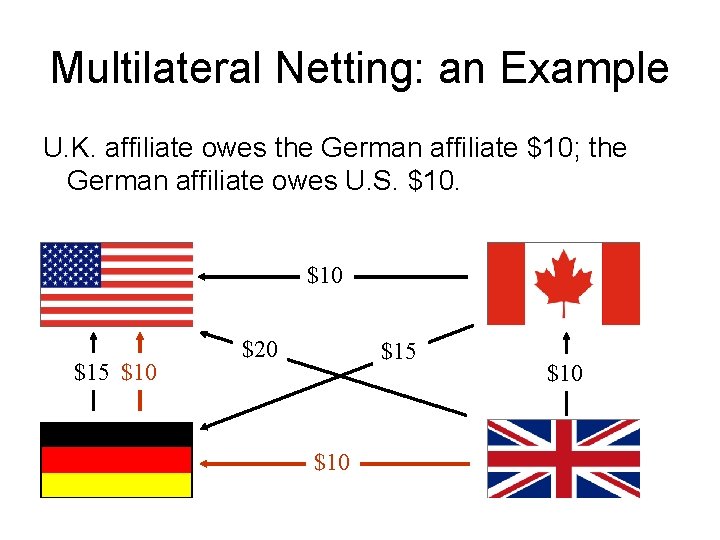
Multilateral Netting: an Example U. K. affiliate owes the German affiliate $10; the German affiliate owes U. S. $10 $15 $10 $20 $15 $10
Multilateral Netting: an Example Thus, the U. K. affiliate nets its payment to the U. S. of $10 $15 $20 $15 $10
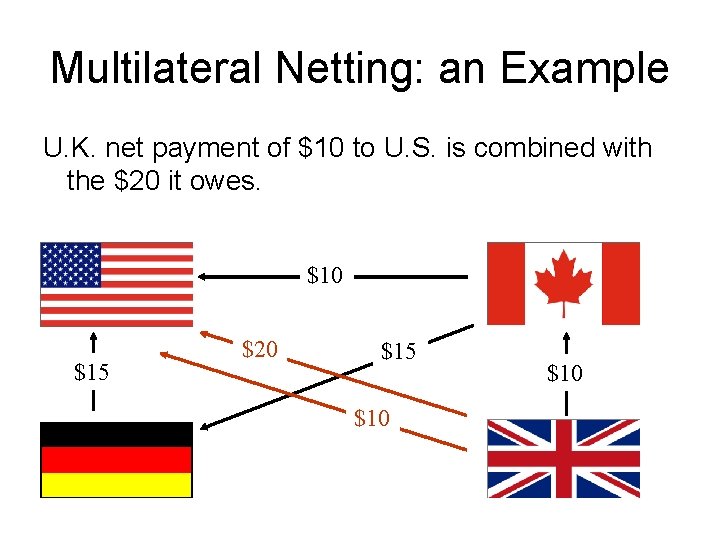
Multilateral Netting: an Example U. K. net payment of $10 to U. S. is combined with the $20 it owes. $10 $15 $20 $15 $10
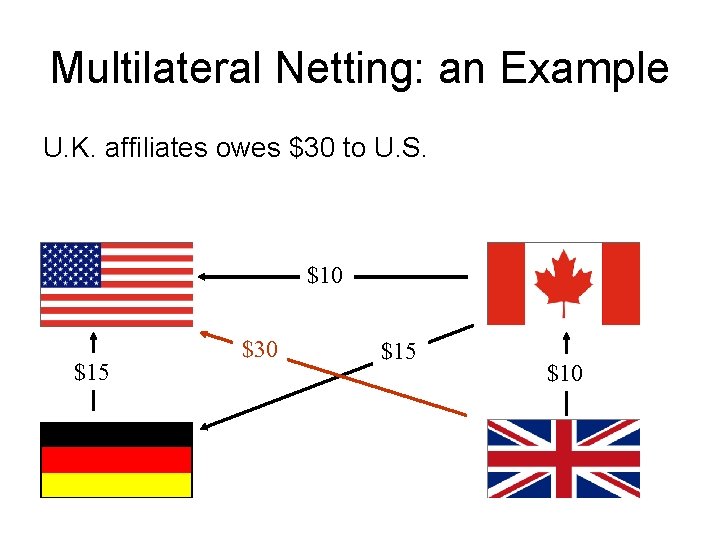
Multilateral Netting: an Example U. K. affiliates owes $30 to U. S. $10 $15 $30 $15 $10
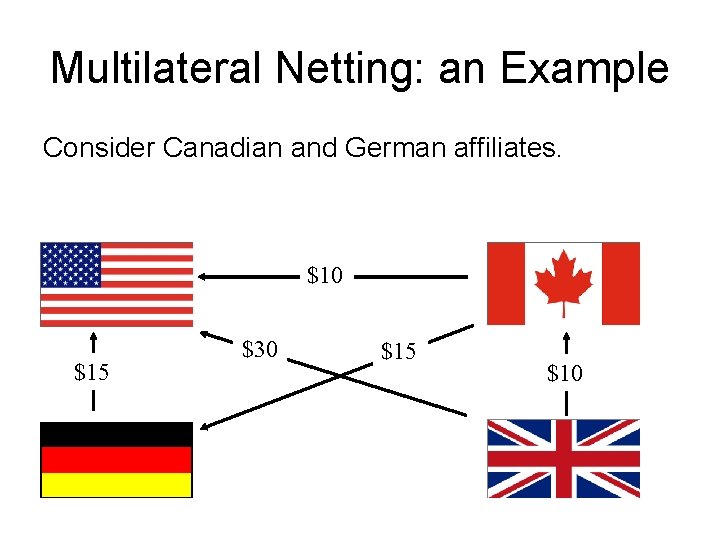
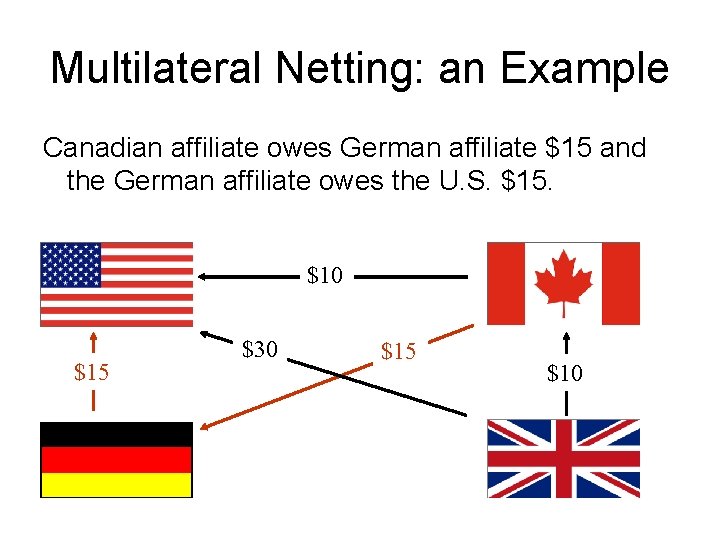
Multilateral Netting: an Example Consider Canadian and German affiliates. $10 $15 $30 $15 $10
Multilateral Netting: an Example Canadian affiliate owes German affiliate $15 and the German affiliate owes the U. S. $15. $10 $15 $30 $15 $10
Multilateral Netting: an Example Canadian affiliate nets its payment to the U. S. of $15; total Canadian affiliate payment to U. S. $25. $10 $15 $30 $10
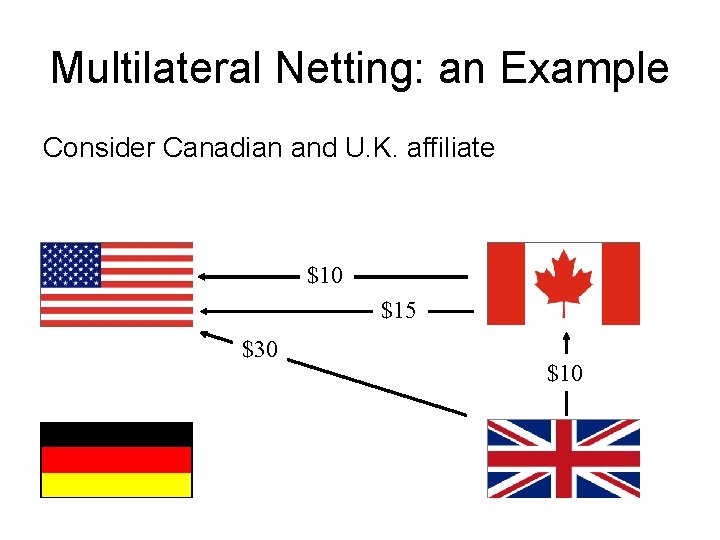
Multilateral Netting: an Example Consider Canadian and U. K. affiliate $10 $15 $30 $10
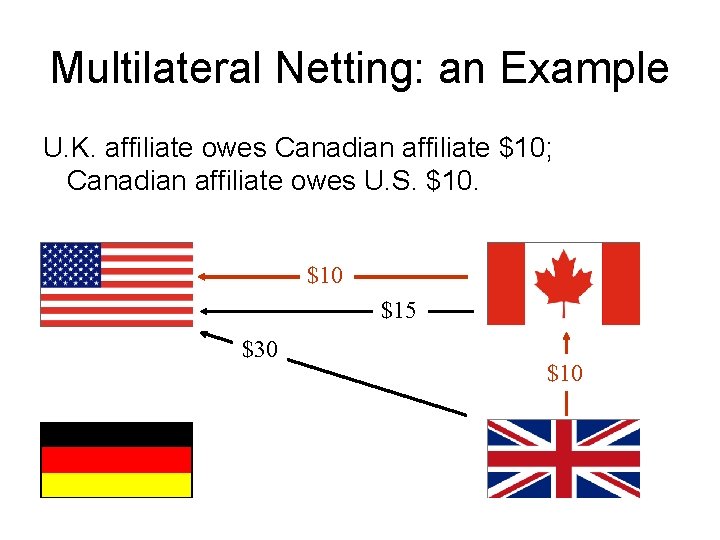
Multilateral Netting: an Example U. K. affiliate owes Canadian affiliate $10; Canadian affiliate owes U. S. $10 $15 $30 $10
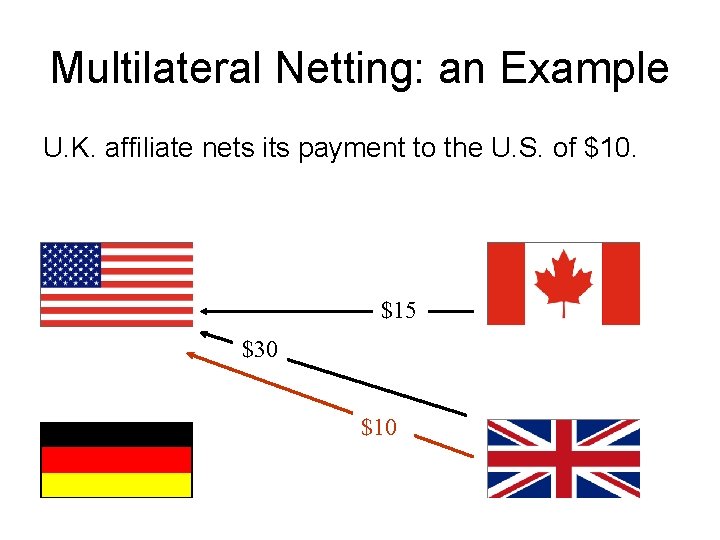
Multilateral Netting: an Example U. K. affiliate nets its payment to the U. S. of $10. $15 $30 $10
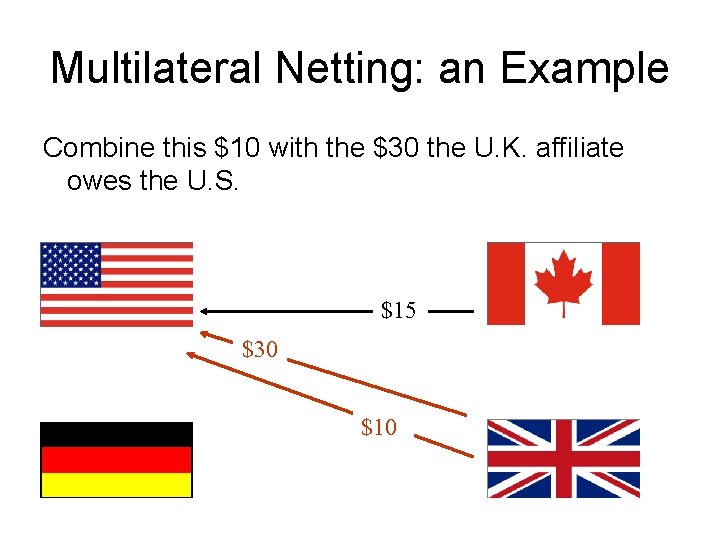
Multilateral Netting: an Example Combine this $10 with the $30 the U. K. affiliate owes the U. S. $15 $30 $10
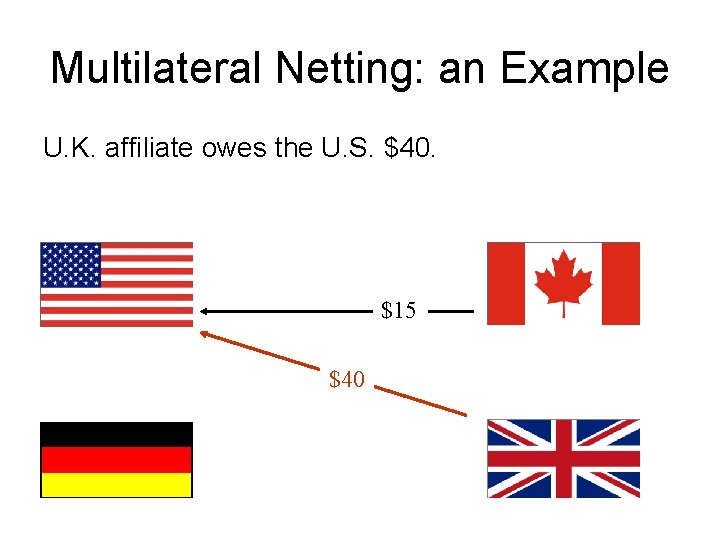
Multilateral Netting: an Example U. K. affiliate owes the U. S. $40. $15 $40
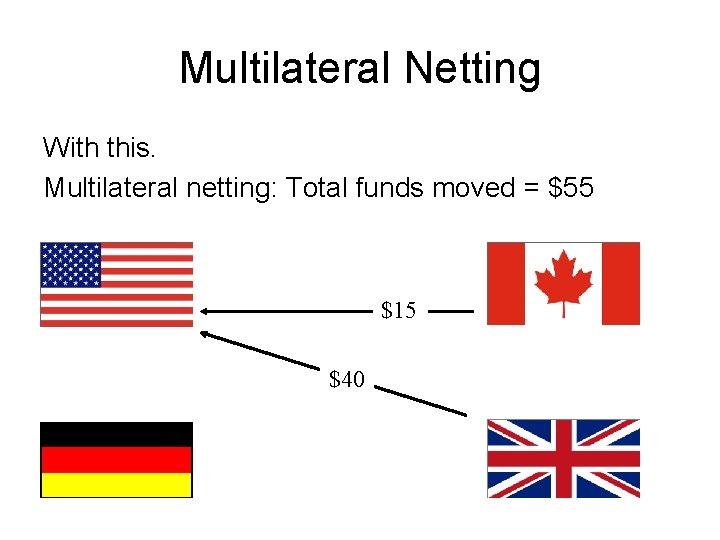
Multilateral Netting: an Example Total funds to be moved under multilateral netting is $55. $15 $40
Summary of Netting Compare this (before netting). $20 $30 $40 $10 $35 $10 $25 $20 $30 $60 $30 $40
Bilateral Netting To this. Bilateral Netting: Total funds moved = $90 $10 $25 $20 $15 $10
Multilateral Netting With this. Multilateral netting: Total funds moved = $55 $15 $40
Government Policies and Netting • As noted, not all governments permit global firms to net their account: – Who does without request: • United States, U. K. , Canada, Germany, Switzerland, Hong Kong. – Who does upon request and approval: • Italy, the Netherlands, Belgium. – Who doesn’t: • Spain. Austria, the Philippines. • Why: Want transactions to flow through local banking system (generate fees for local banks).
Benefits of Netting • Studies have shown the following: – Decrease in the expenses associated with moving funds internationally. – Decrease in the number of foreign exchange transactions (also reduces costs). – Reduction in intra-company float (wire transfers can take up to 5 days). – Savings in administrative time.
Transfer Pricing • Refers to the prices being assigned to goods and/or services transferred among the affiliates (including the parent) within a global organization. – The transfer price will reposition funds (cash) within the organization. • High transfer price transfers to selling entity!
Reasons for Transfer Pricing • Reposition funds. – Out of high risk areas • Concerns about exchange rate changes, host government policy changes affecting funds transfers, political risk… – Move funds (profits) into low tax rate countries. • Minimize the consolidated tax liability of the global firm.
Government Involvement in Transfer Pricing • Most governments monitor the use of transfer pricing by firms within their political boundaries. – Concerned with companies attempting to escape their “appropriate” tax liabilities. • Most governments insist that the transfer price be: – An “arm’s-length” price, or what the selling affiliate would charge an unrelated customer.
Calculating the “Arm’s-Length” Price • United States (IRS) government uses the following procedures for calculating an “arm’s-length” price: – Comparable uncontrolled price. • Between affiliate and unrelated parties – Third party price • Similar goods/services sold in the market place. – Cost-plus price • Appropriate profit added to the cost of production