Chapter 18 Stacks and Queues Starting Out with
- Slides: 42
Chapter 18: Stacks and Queues Starting Out with C++ Early Objects Seventh Edition by Tony Gaddis, Judy Walters, and Godfrey Muganda
Topics � 18. 1 � 18. 2 � 18. 3 � 18. 4 � 18. 5 � 18. 6 � 18. 7 Introduction to the Stack ADT Dynamic Stacks The STL stack Container Introduction to the Queue ADT Dynamic Queues The STL deque and queue Containers Eliminating Recursion 18 -2
18. 1 Introduction to the Stack ADT � Stack: a LIFO (last in, first out) data structure � Examples: ◦ plates in a cafeteria serving area ◦ return addresses for function calls 18 -3
Stack Basics �Stack is implemented as a list, with additions & removals taking place at one end of the list �The active end of the list implementing the stack is the top of the stack �Stack types: ◦ Static – fixed size, often implemented using an array ◦ Dynamic – size varies as needed, often implemented using a linked list 18 -4
Stack Operations and Functions Operations: ◦ push: add a value at the top of the stack ◦ pop: remove a value from the top of the stack Functions: ◦ is. Empty: true if the stack currently contains no elements ◦ is. Full: true if the stack is full; only useful for static stacks 18 -5
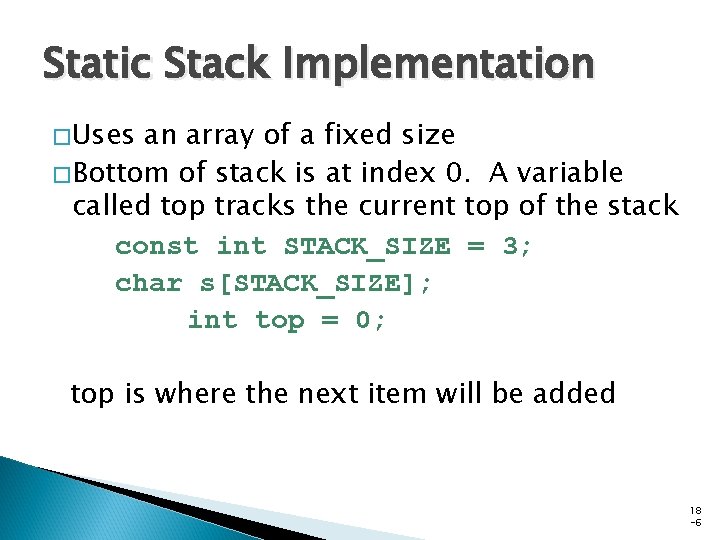
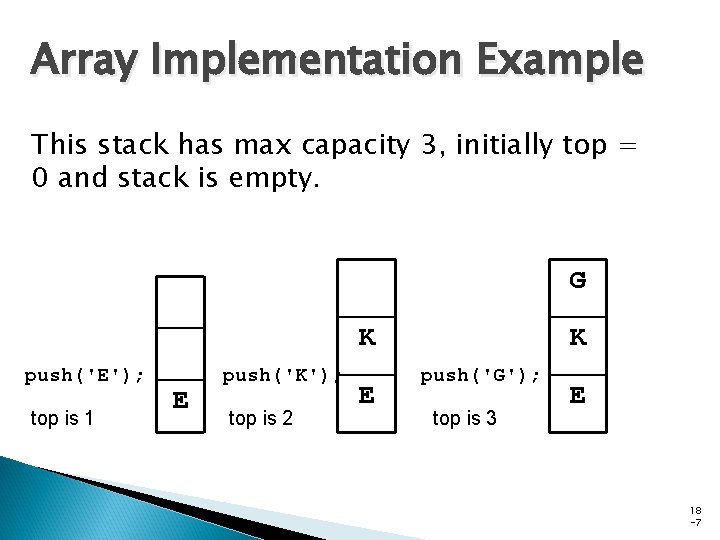
Static Stack Implementation �Uses an array of a fixed size �Bottom of stack is at index 0. A variable called top tracks the current top of the stack const int STACK_SIZE = 3; char s[STACK_SIZE]; int top = 0; top is where the next item will be added 18 -6
Array Implementation Example This stack has max capacity 3, initially top = 0 and stack is empty. G K push('E'); top is 1 E push('K'); top is 2 E K push('G'); top is 3 E 18 -7
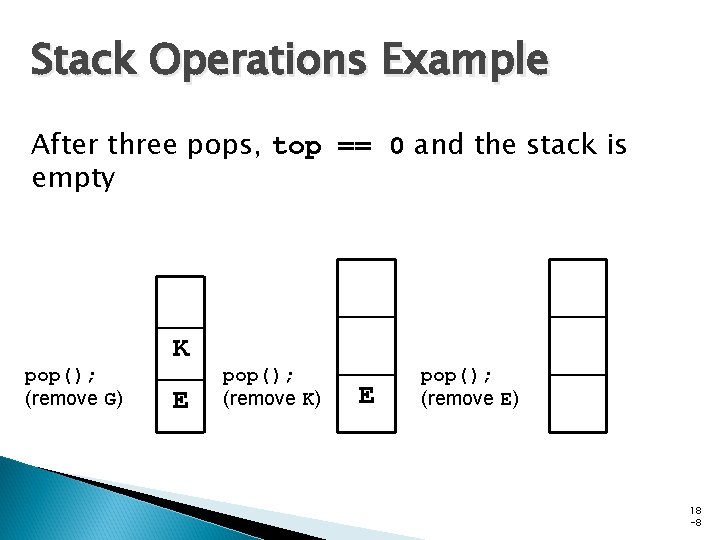
Stack Operations Example After three pops, top == 0 and the stack is empty pop(); (remove G) K E pop(); (remove K) E pop(); (remove E) 18 -8
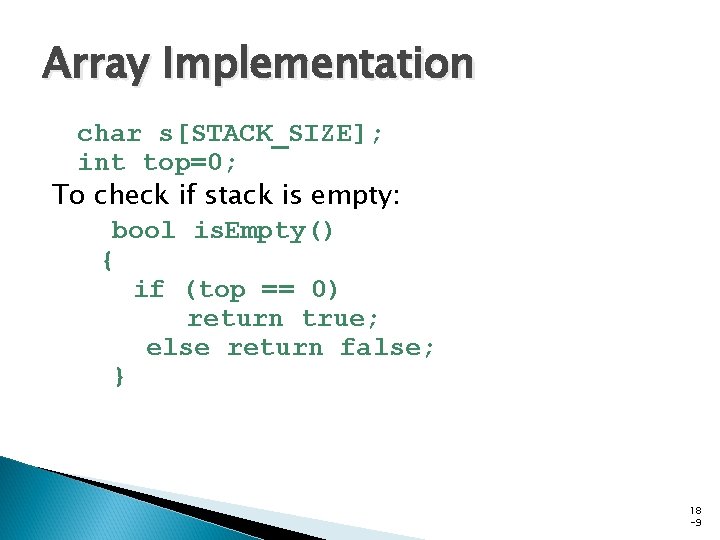
Array Implementation char s[STACK_SIZE]; int top=0; To check if stack is empty: bool is. Empty() { if (top == 0) return true; else return false; } 18 -9
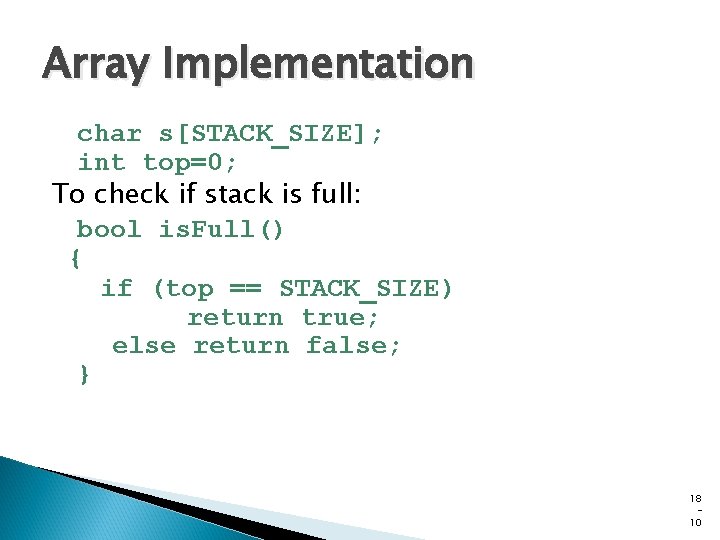
Array Implementation char s[STACK_SIZE]; int top=0; To check if stack is full: bool is. Full() { if (top == STACK_SIZE) return true; else return false; } 18 10
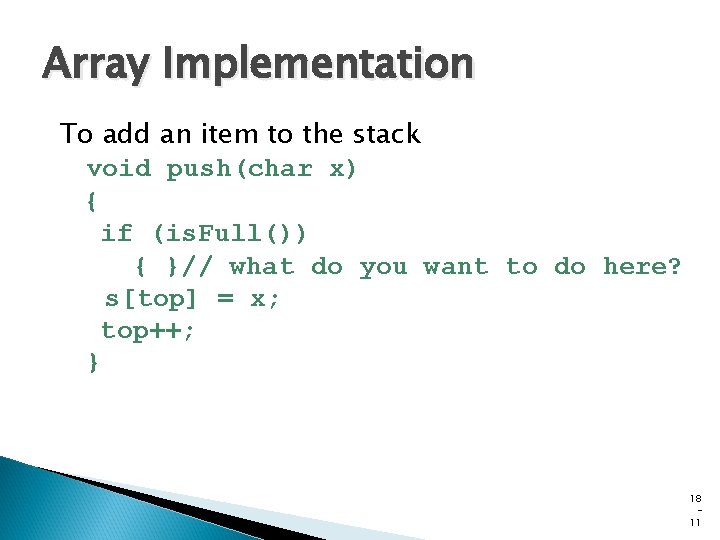
Array Implementation To add an item to the stack void push(char x) { if (is. Full()) { }// what do you want to do here? s[top] = x; top++; } 18 11
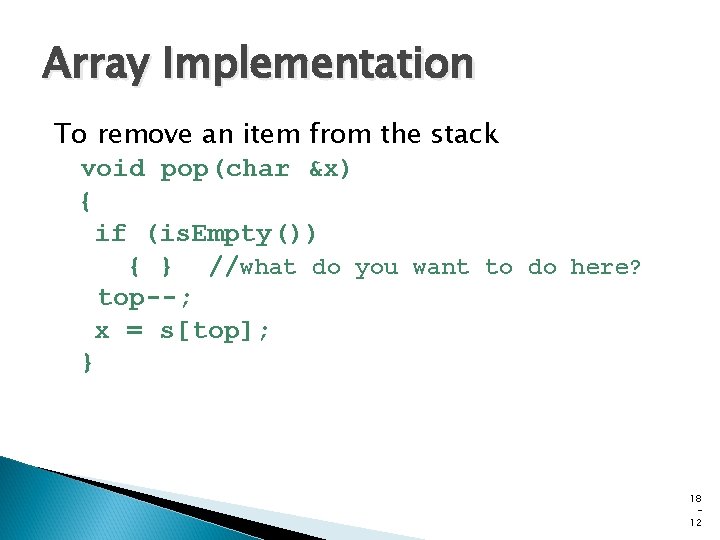
Array Implementation To remove an item from the stack void pop(char &x) { if (is. Empty()) { } //what do you want to do here? top--; x = s[top]; } 18 12
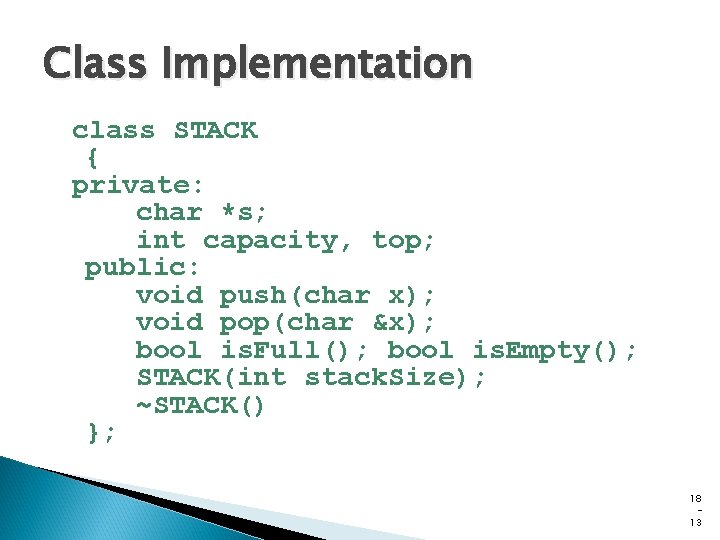
Class Implementation class STACK { private: char *s; int capacity, top; public: void push(char x); void pop(char &x); bool is. Full(); bool is. Empty(); STACK(int stack. Size); ~STACK() }; 18 13
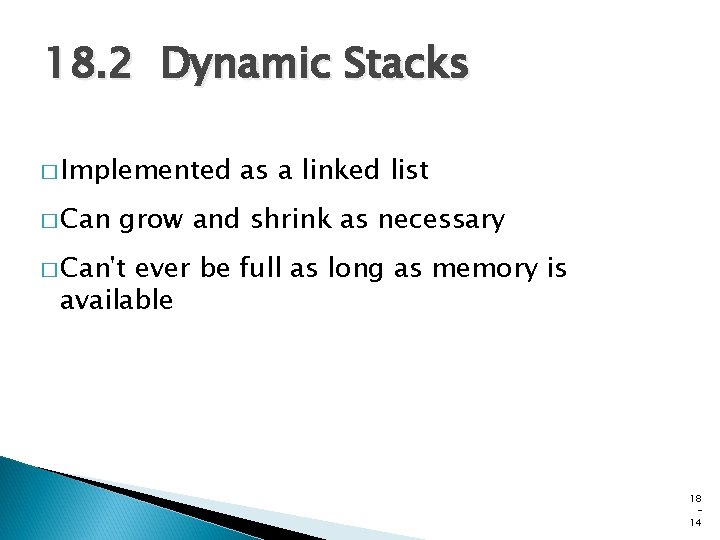
18. 2 Dynamic Stacks � Implemented � Can as a linked list grow and shrink as necessary � Can't ever be full as long as memory is available 18 14
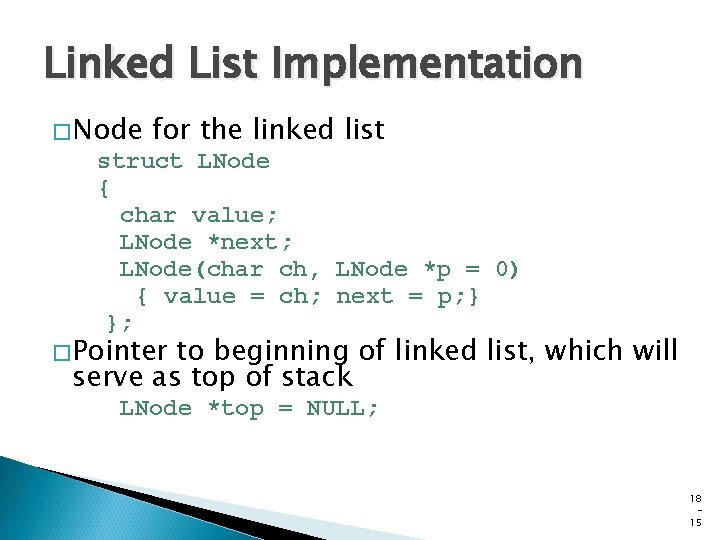
Linked List Implementation �Node for the linked list struct LNode { char value; LNode *next; LNode(char ch, LNode *p = 0) { value = ch; next = p; } }; �Pointer to beginning of linked list, which will serve as top of stack LNode *top = NULL; 18 15
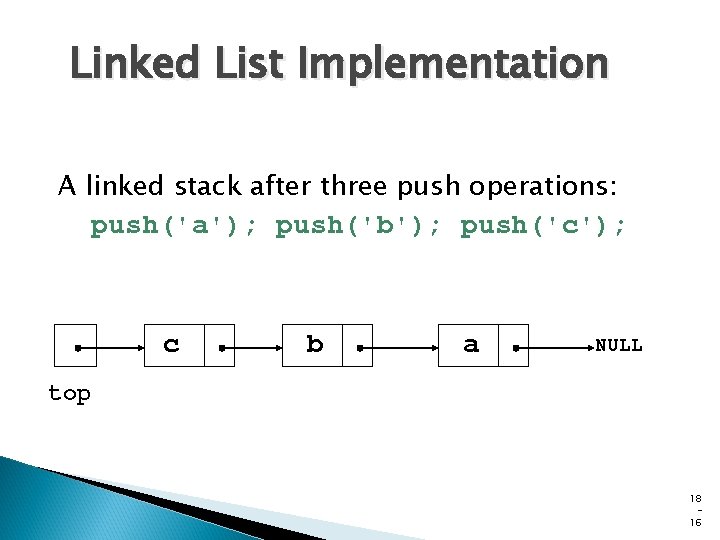
Linked List Implementation A linked stack after three push operations: push('a'); push('b'); push('c'); c b a NULL top 18 16
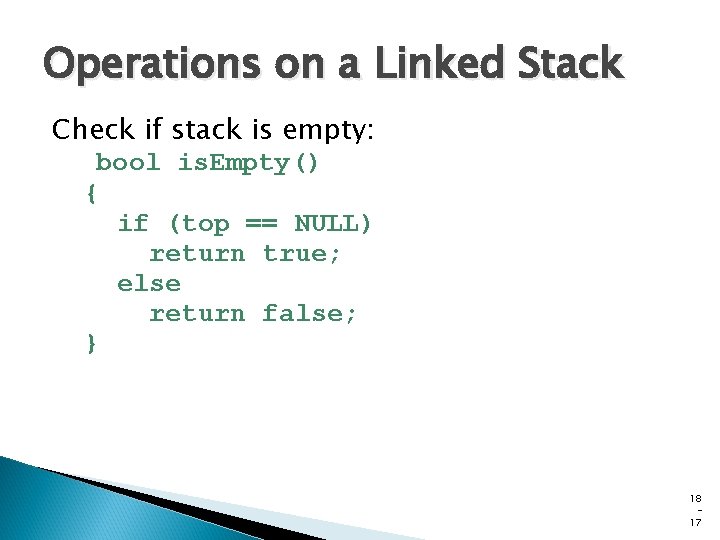
Operations on a Linked Stack Check if stack is empty: bool is. Empty() { if (top == NULL) return true; else return false; } 18 17
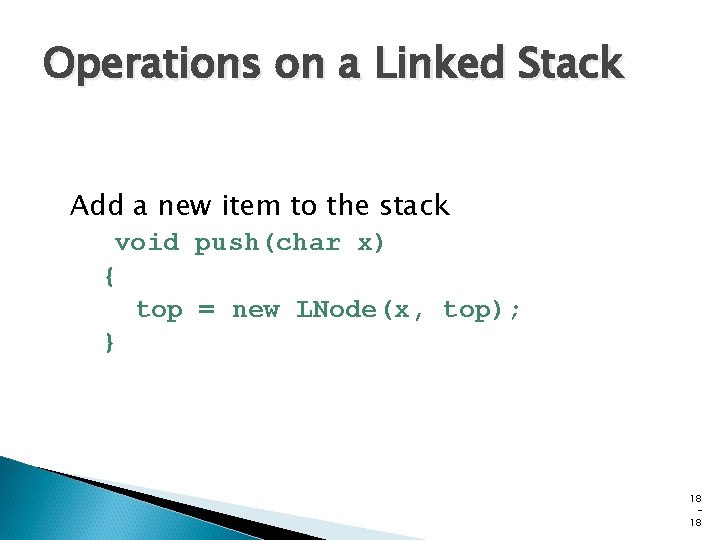
Operations on a Linked Stack Add a new item to the stack void push(char x) { top = new LNode(x, top); } 18 18
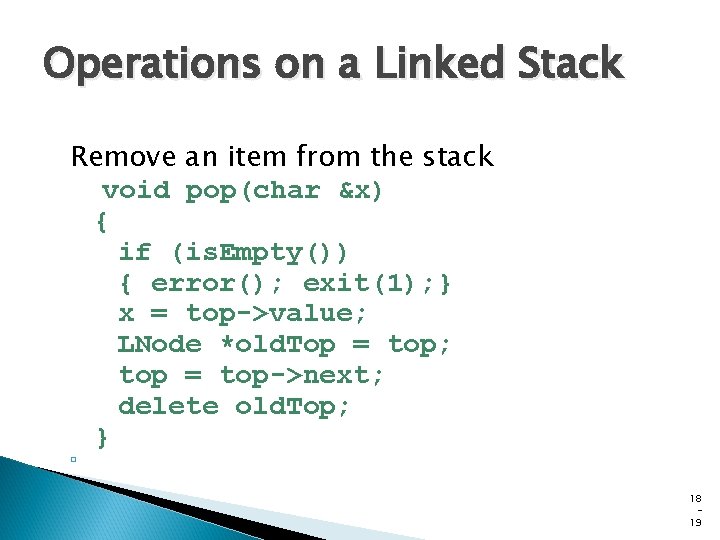
Operations on a Linked Stack Remove an item from the stack void pop(char &x) { if (is. Empty()) { error(); exit(1); } x = top->value; LNode *old. Top = top; top = top->next; delete old. Top; } � 18 19
18. 3 The STL stack Container � Stack template can be implemented as a vector, list, or a deque � Implements push, pop, and empty member functions � Implements other member functions: ◦ size: number of elements on the stack ◦ top: reference to element on top of the stack (must be used with pop to remove and retrieve top element) 18 20
Defining an STL-based Stack �Defining a stack of char, named cstack, implemented using a vector: stack< char, vector<char> > cstack; �Implemented using a list: �Implemented using a deque (default): stack< char, list<char> > cstack; stack< char > cstack; �Spaces are required between consecutive > > symbols to distinguish from stream extraction 18 21
18. 4 Introduction to the Queue ADT � Queue: a FIFO (first in, first out) data structure. � Examples: ◦ people in line at theatre box office ◦ print jobs sent to a printer � Implementation: ◦ static: fixed size, implemented as array ◦ dynamic: variable size, implemented as linked list 18 22
Queue Locations and Operations � rear: position where elements are added � front: position from which elements are removed � enqueue: add an element to the rear of the queue � dequeue: remove an element from the front of a queue 18 23
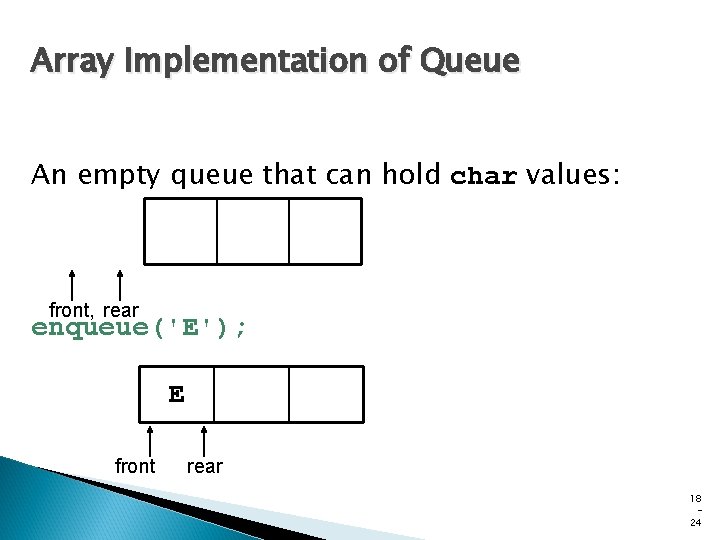
Array Implementation of Queue An empty queue that can hold char values: front, rear enqueue('E'); E front rear 18 24
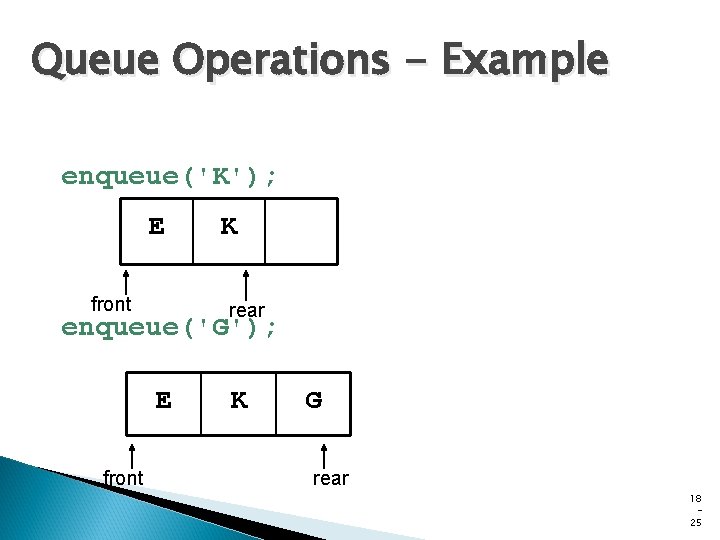
Queue Operations - Example enqueue('K'); E front K rear enqueue('G'); E front K G rear 18 25
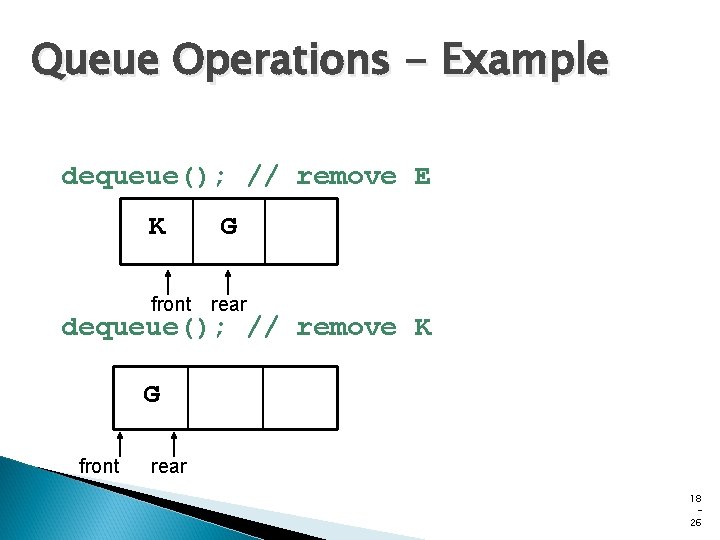
Queue Operations - Example dequeue(); // remove E K front G rear dequeue(); // remove K G front rear 18 26
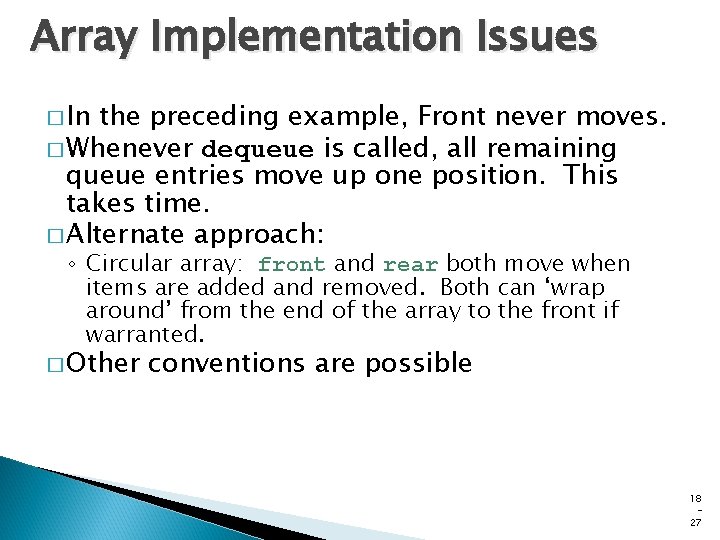
Array Implementation Issues � In the preceding example, Front never moves. � Whenever dequeue is called, all remaining queue entries move up one position. This takes time. � Alternate approach: ◦ Circular array: front and rear both move when items are added and removed. Both can ‘wrap around’ from the end of the array to the front if warranted. � Other conventions are possible 18 27
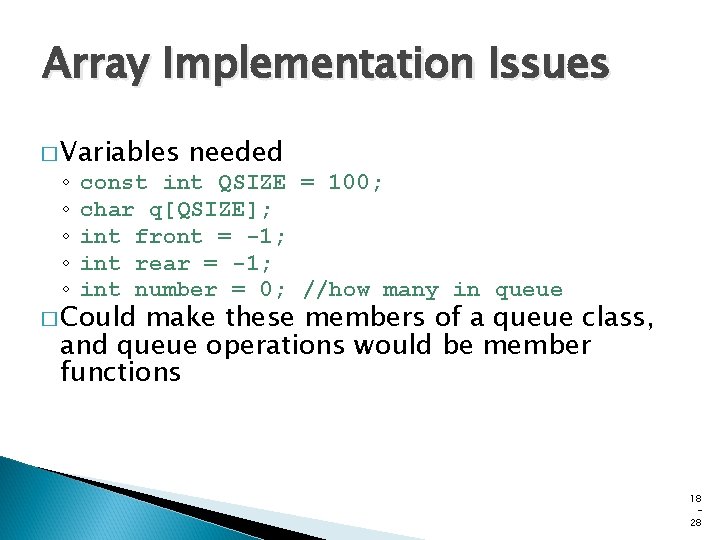
Array Implementation Issues � Variables ◦ ◦ ◦ needed const int QSIZE = 100; char q[QSIZE]; int front = -1; int rear = -1; int number = 0; //how many in queue � Could make these members of a queue class, and queue operations would be member functions 18 28
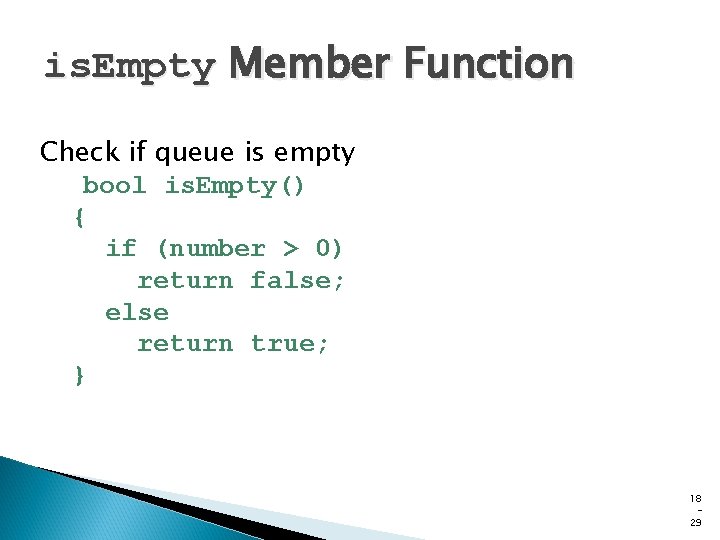
is. Empty Member Function Check if queue is empty bool is. Empty() { if (number > 0) return false; else return true; } 18 29
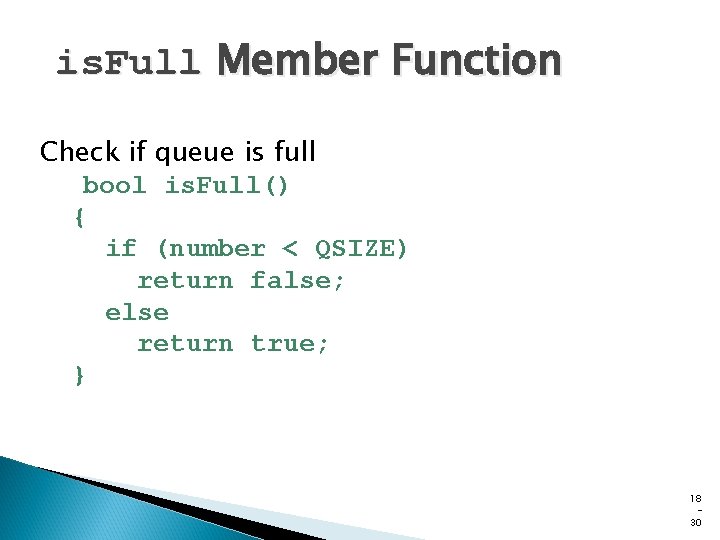
is. Full Member Function Check if queue is full bool is. Full() { if (number < QSIZE) return false; else return true; } 18 30
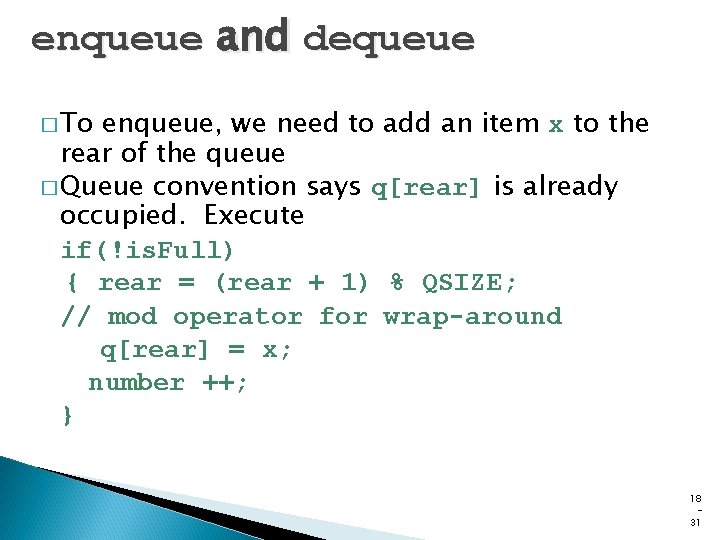
enqueue and dequeue � To enqueue, we need to add an item x to the rear of the queue � Queue convention says q[rear] is already occupied. Execute if(!is. Full) { rear = (rear + 1) % QSIZE; // mod operator for wrap-around q[rear] = x; number ++; } 18 31
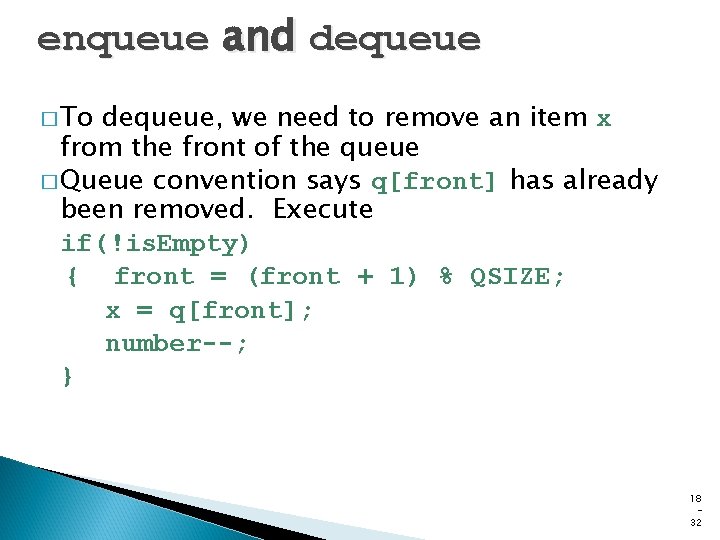
enqueue and dequeue � To dequeue, we need to remove an item x from the front of the queue � Queue convention says q[front] has already been removed. Execute if(!is. Empty) { front = (front + 1) % QSIZE; x = q[front]; number--; } 18 32
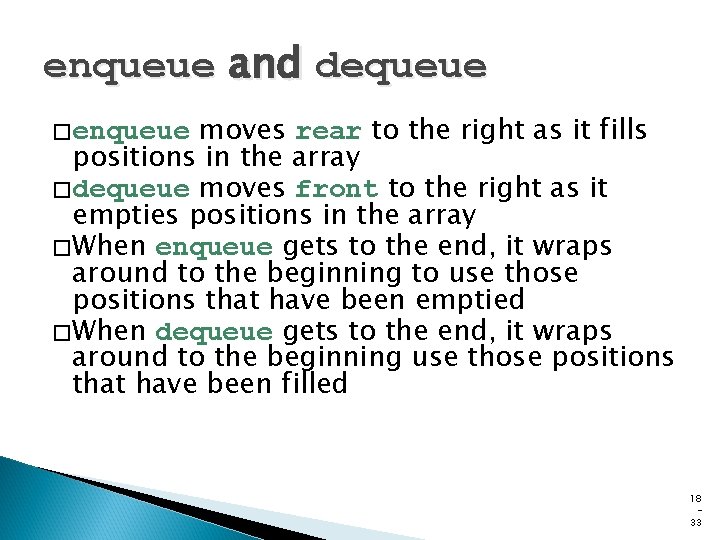
enqueue and dequeue moves rear to the right as it fills positions in the array �dequeue moves front to the right as it empties positions in the array �When enqueue gets to the end, it wraps around to the beginning to use those positions that have been emptied �When dequeue gets to the end, it wraps around to the beginning use those positions that have been filled �enqueue 18 33
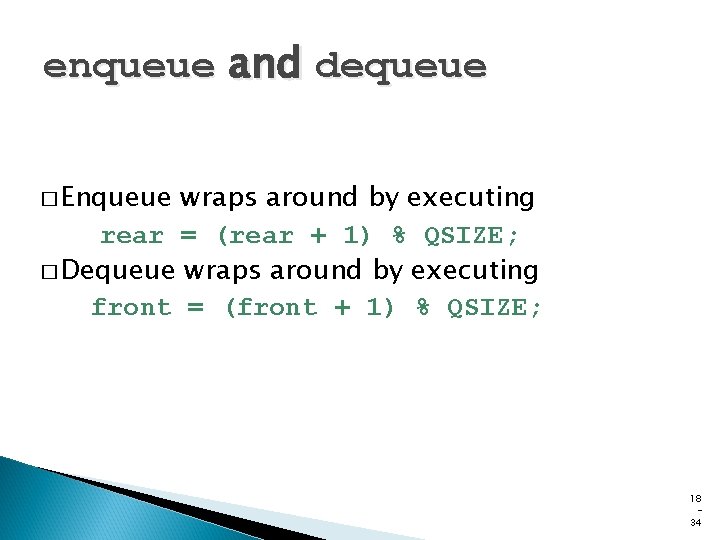
enqueue and dequeue � Enqueue wraps around by executing rear = (rear + 1) % QSIZE; � Dequeue wraps around by executing front = (front + 1) % QSIZE; 18 34
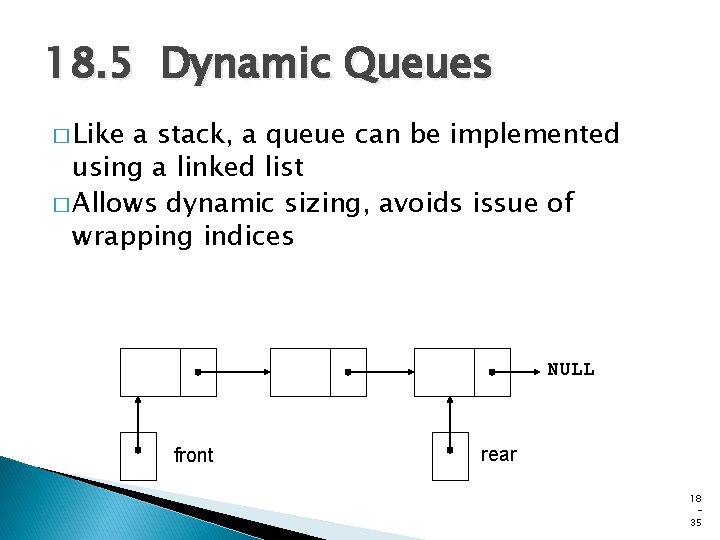
18. 5 Dynamic Queues � Like a stack, a queue can be implemented using a linked list � Allows dynamic sizing, avoids issue of wrapping indices NULL front rear 18 35
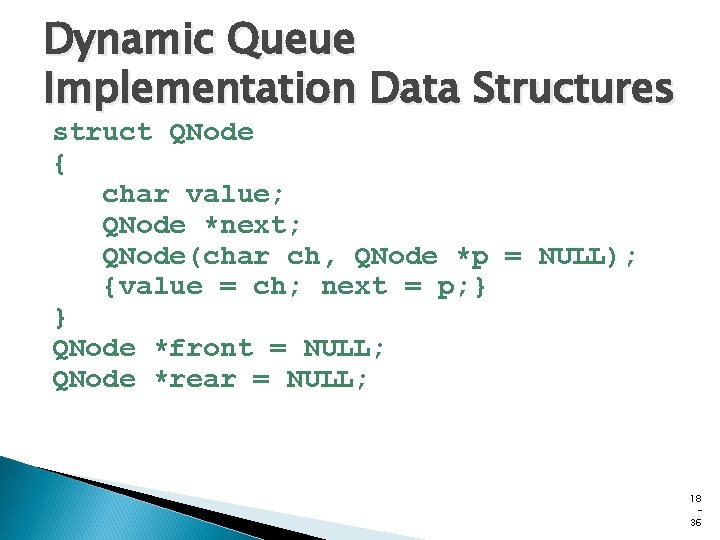
Dynamic Queue Implementation Data Structures struct QNode { char value; QNode *next; QNode(char ch, QNode *p = NULL); {value = ch; next = p; } } QNode *front = NULL; QNode *rear = NULL; 18 36
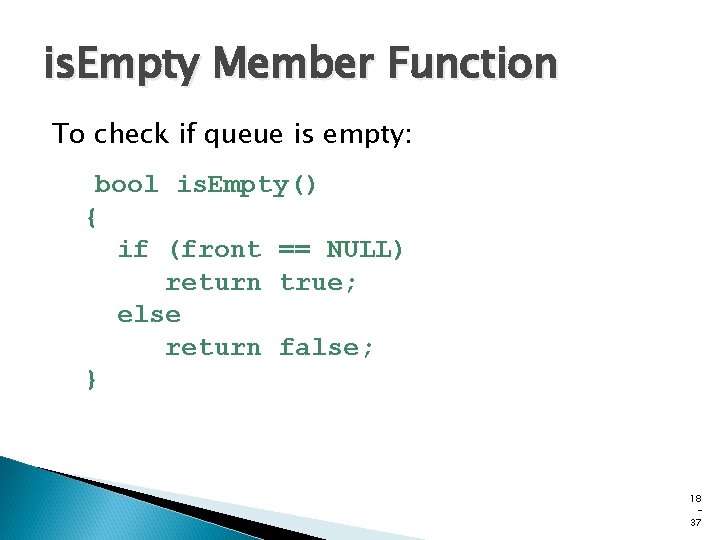
is. Empty Member Function To check if queue is empty: bool is. Empty() { if (front == NULL) return true; else return false; } 18 37
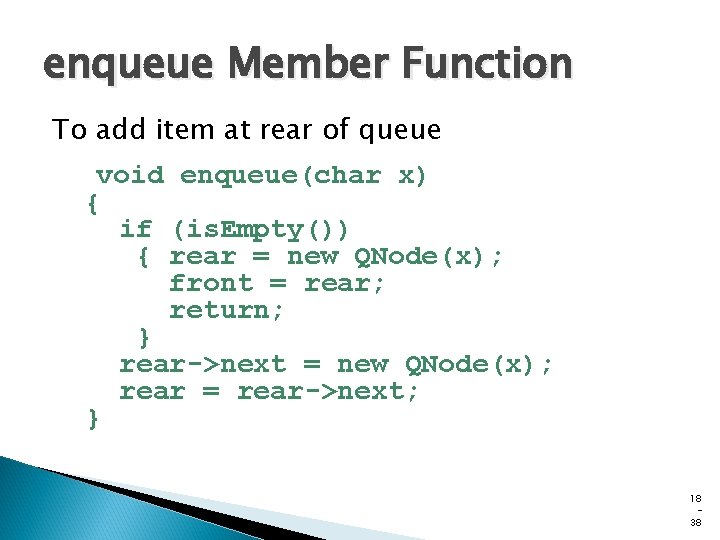
enqueue Member Function To add item at rear of queue void enqueue(char x) { if (is. Empty()) { rear = new QNode(x); front = rear; return; } rear->next = new QNode(x); rear = rear->next; } 18 38
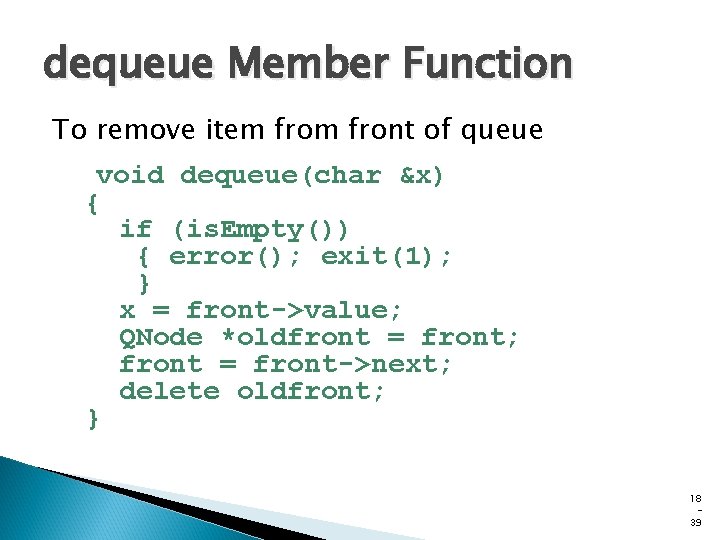
dequeue Member Function To remove item front of queue void dequeue(char &x) { if (is. Empty()) { error(); exit(1); } x = front->value; QNode *oldfront = front; front = front->next; delete oldfront; } 18 39
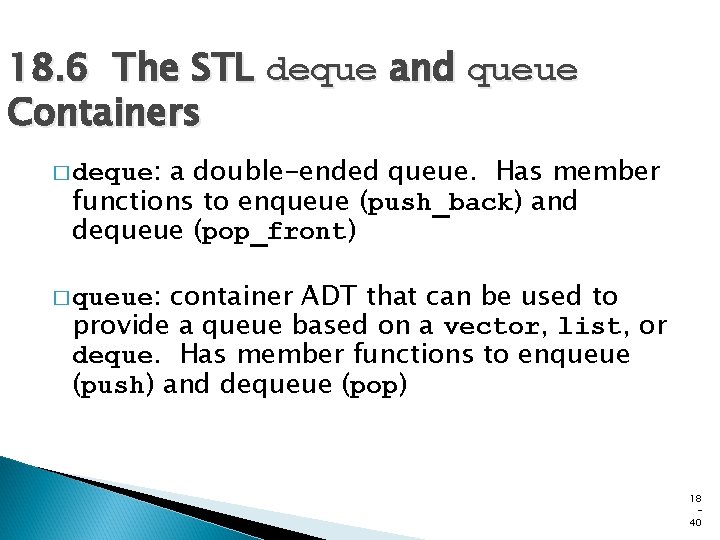
18. 6 The STL deque and queue Containers a double-ended queue. Has member functions to enqueue (push_back) and dequeue (pop_front) � deque: container ADT that can be used to provide a queue based on a vector, list, or deque. Has member functions to enqueue (push) and dequeue (pop) � queue: 18 40
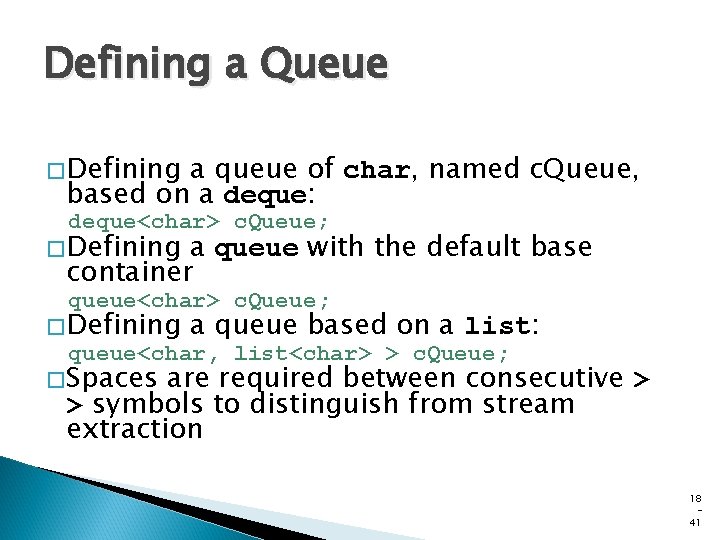
Defining a Queue � Defining a queue of char, named c. Queue, based on a deque: deque<char> c. Queue; � Defining a queue with the default base container queue<char> c. Queue; � Defining a queue based on a list: queue<char, list<char> > c. Queue; � Spaces are required between consecutive > > symbols to distinguish from stream extraction 18 41
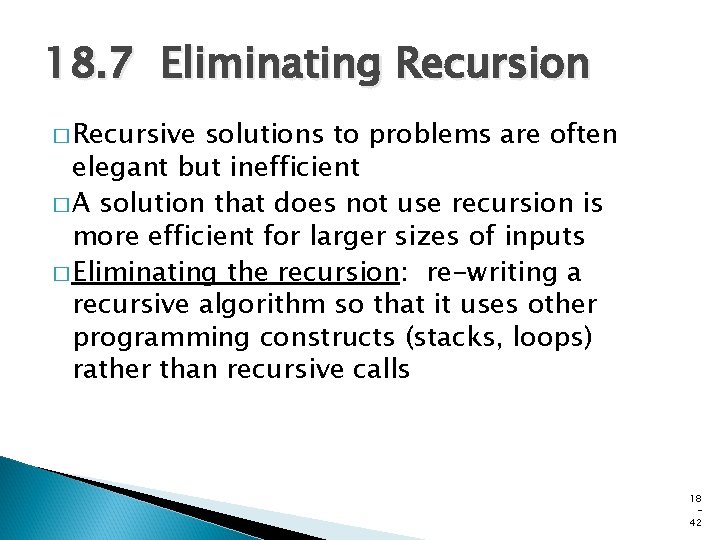
18. 7 Eliminating Recursion � Recursive solutions to problems are often elegant but inefficient � A solution that does not use recursion is more efficient for larger sizes of inputs � Eliminating the recursion: re-writing a recursive algorithm so that it uses other programming constructs (stacks, loops) rather than recursive calls 18 42