
CHAPTER 14 COMPENSATING SALESPEOPLE THE SALES FORCE REWARD


- Slides: 32
CHAPTER 14 COMPENSATING SALESPEOPLE
THE SALES FORCE REWARD SYSTEM F Financial compensation F Non-financial compensation
IMPORTANCE OF SALES FORCE REWARDS F Sales force F Company F Customer relations and goodwill F Strategic planning
DESIGN CONSIDERATIONS F Inherent conflicts F No plan fits all situations F Internal equity F External equity
COMPENSATION PLAN OBJECTIVES F Correlate efforts, results, and rewards F Control activities F Ensure proper treatment of customers F Attract and keep good salespeople
BASIC REQUIREMENTS F Provision for two types of income F Flexibility and stability F Simplicity F Economy and competitiveness F Fairness
STEPS IN DESIGNING A PLAN 1. 2. 3. 4. 5. 6. Review job analysis/description Determine objectives Determine job elements Establish level of compensation Pretest Administer/Evaluate
REVIEW JOB DESCRIPTION F Review of job nature, scope, and difficulty
SET OBJECTIVES F Increase volume F Obtain new accounts F Minimize expenses
ESTABLISH JOB ELEMENTS F Controllable F Measurable
LEVEL OF COMPENSATION F Type of plan F Size of company F Age of salespeople F Industry
COMPENSATION ISSUE F Should sales managers always be paid more than the people they manage?
PRETEST F Start with one or two sales divisions
ADMINISTER/EVALUATE F Implement F Review and modify where necessary
METHODS OF COMPENSATION F Straight salary F Straight commission F Combination F Team Selling F Optimum Pay Plans
STRAIGHT SALARY PLANS F Salary is a fixed element F Degree of security F Lower turnover F “Full” approach to selling F No direct incentive
WHEN TO USE F While in a training mode F Entering a new territory/new product market F Tremendous time to sell to one account F Missionary sales positions F Joint selling
STRAIGHT COMMISSION PLANS F Based on a unit of accomplishment F Base, rate and starting point F Advances (drawing account) F Provides incentive F Weeds out poor performers F Supervision problems F Split commissions
WHEN TO USE F Company is weak financially F Great incentive required F Little non-selling work required F Supervision not possible F Long term relationships not important F Part-time sales people/manufacturer’s agents
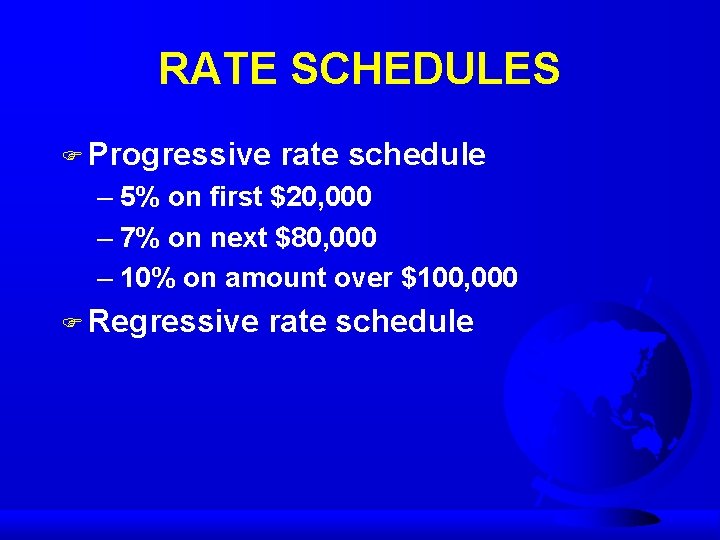
RATE SCHEDULES F Progressive rate schedule – 5% on first $20, 000 – 7% on next $80, 000 – 10% on amount over $100, 000 F Regressive rate schedule
COMBINATION PLAN F Most popular plan F Overcomes some of the weaknesses of straight salary and straight commission plans
TEAM SELLING F More common today F Difficult to provide rewards F Shared commissions/group bonuses
OPTIMUM PAY PLANS F Commission based on gross margin F Forces individuals to focus on items which maximize profits for the company
OTHER COMPENSATION ISSUES F Bonuses F Drawing Accounts F Expense Accounts
BONUSES F Payment for above normal performance F No obligation to provide regularly
DRAWING ACCOUNT F Cash advance called a “draw”
DRAWING ACCOUNT
EXPENSE ACCOUNTS F Reimbursement for travel and other sales related costs F A troublesome task for the sales manager!
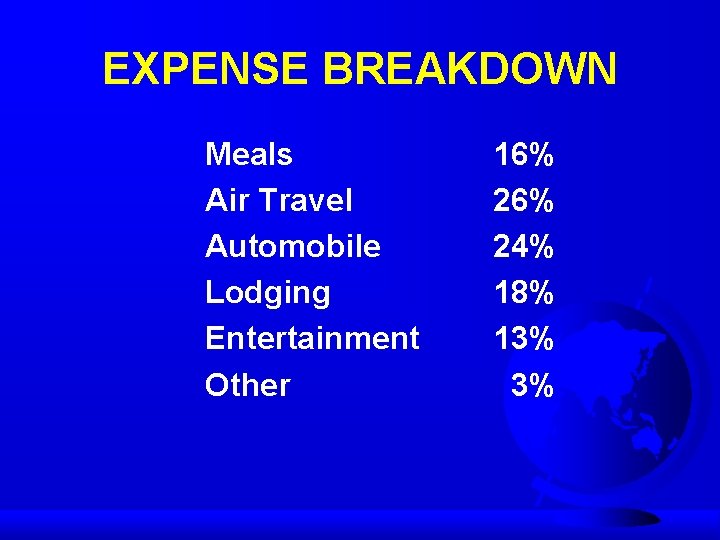
EXPENSE BREAKDOWN Meals Air Travel Automobile Lodging Entertainment Other 16% 24% 18% 13% 3%
CHARACTERISTICS OF A GOOD EXPENSE PLAN F No net gain/loss F Equitable treatment F No curtailment of beneficial activities F Simple and economical F Avoidance of disputes F Company control/elimination of padding
CONTROLLING EXPENSES F Type of plan – salary versus commission – unlimited versus per diem F Automobiles F Training F Travel planning
FROM THE TEXT F Read everything in Chapter 14!!