Chapter 17 Personal Selling and Sales Promotion 2019
- Slides: 47
Chapter 17 Personal Selling and Sales Promotion © 2019 Cengage. All rights reserved.
Learning Objectives 17– 1 Describe the major purposes of personal selling. 17– 2 Summarize the seven basic steps in the personalselling process. 17– 3 Identify the types of sales-force personnel. 17– 4 Define team selling and relationship selling. 17– 5 Discuss eight major decisions in sales management. 17– 6 Describe sales-promotion activities and their use. 17– 7 Review specific consumer-sales-promotion methods. 17– 8 Investigate trade-sales-promotion methods. © 2019 Cengage. All rights reserved.
The Nature of Personal Selling (1 of 4) Personal selling – paid personal communication that attempts to inform customers and persuade them to buy products in an exchange situation Gives marketers freedom to adjust a message to satisfy customers’ information needs Enables marketers to focus on the most promising sales prospects Most effective way to form relationships with customers Most critical with business-to-business transactions involving purchase of expensive products Most expensive element in the promotion mix © 2019 Cengage. All rights reserved.
The Nature of Personal Selling (2 of 4) A sales career offers: Requirements for sales personnel: © 2019 Cengage. All rights reserved.
The Nature of Personal Selling (3 of 4) Customer information is shared through: Creates transparency and communication between salesperson and customers Social CRM provides opportunities to manage data in discovering and engaging customers. © 2019 Cengage. All rights reserved.
The Nature of Personal Selling (4 of 4) Sales function is a part of a cross-functional strategic solution to customer management. Customer satisfaction is key for repeat sales. The burden of customer satisfaction falls on salespeople. Collaboration between sales and other marketing areas is related to market orientation that puts the customer first. Salespersons need both managerial and strategic skills. © 2019 Cengage. All rights reserved.
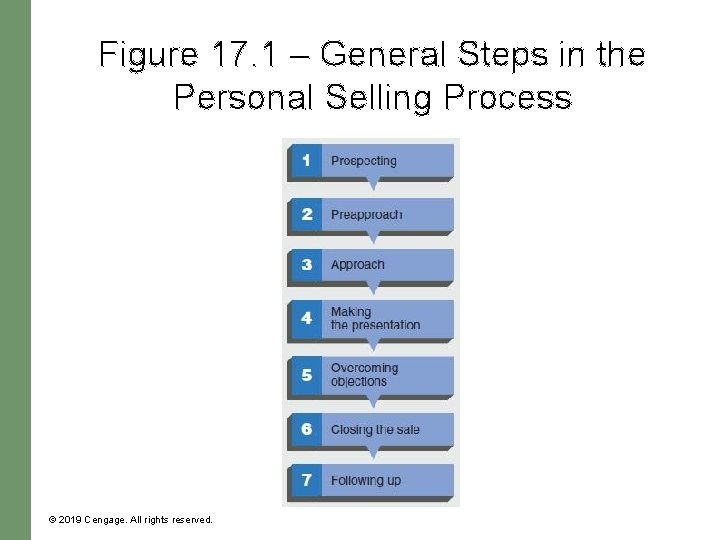
Figure 17. 1 – General Steps in the Personal Selling Process © 2019 Cengage. All rights reserved.
Prospecting – developing a database of potential customers Sources for the names of the potential customers: © 2019 Cengage. All rights reserved.
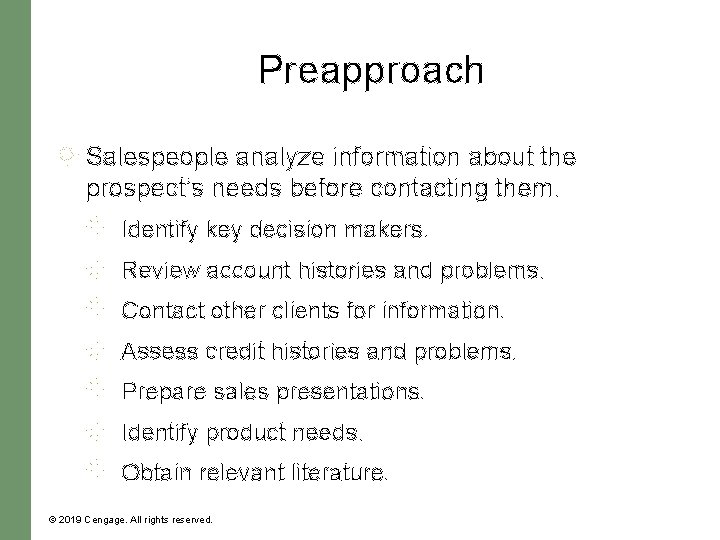
Preapproach Salespeople analyze information about the prospect’s needs before contacting them. Identify key decision makers. Review account histories and problems. Contact other clients for information. Assess credit histories and problems. Prepare sales presentations. Identify product needs. Obtain relevant literature. © 2019 Cengage. All rights reserved.
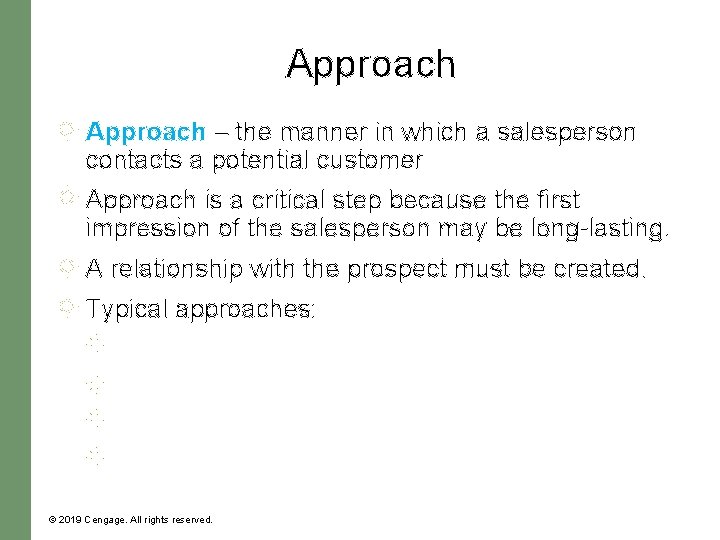
Approach – the manner in which a salesperson contacts a potential customer Approach is a critical step because the first impression of the salesperson may be long-lasting. A relationship with the prospect must be created. Typical approaches: © 2019 Cengage. All rights reserved.
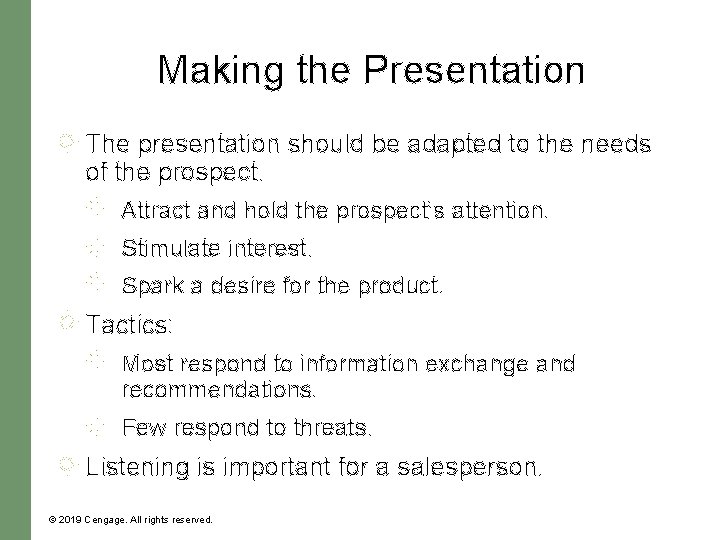
Making the Presentation The presentation should be adapted to the needs of the prospect. Attract and hold the prospect’s attention. Stimulate interest. Spark a desire for the product. Tactics: Most respond to information exchange and recommendations. Few respond to threats. Listening is important for a salesperson. © 2019 Cengage. All rights reserved.
Overcoming Objections Effective salespeople anticipate and counter objections before the prospect raises them. The safest approach is to be prepared and handle objections as they arise. © 2019 Cengage. All rights reserved.
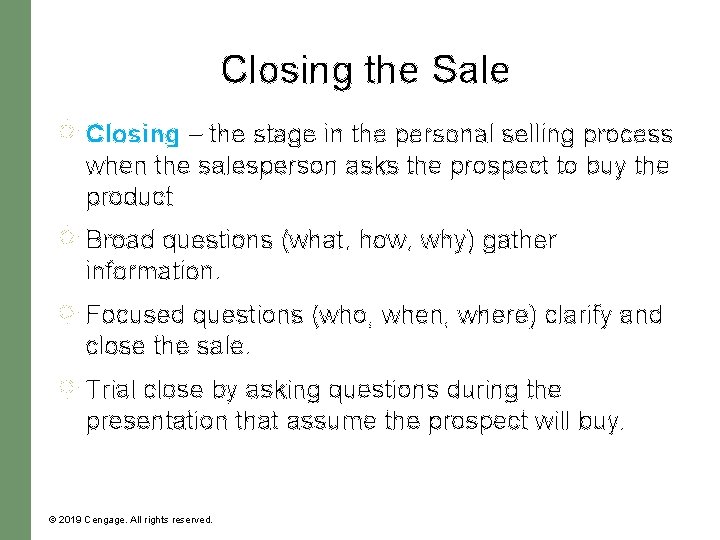
Closing the Sale Closing – the stage in the personal selling process when the salesperson asks the prospect to buy the product Broad questions (what, how, why) gather information. Focused questions (who, when, where) clarify and close the sale. Trial close by asking questions during the presentation that assume the prospect will buy. © 2019 Cengage. All rights reserved.
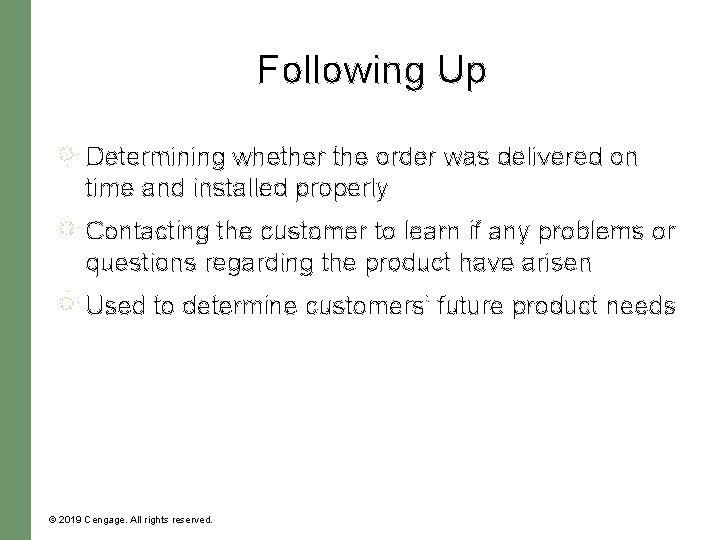
Following Up Determining whether the order was delivered on time and installed properly Contacting the customer to learn if any problems or questions regarding the product have arisen Used to determine customers’ future product needs © 2019 Cengage. All rights reserved.
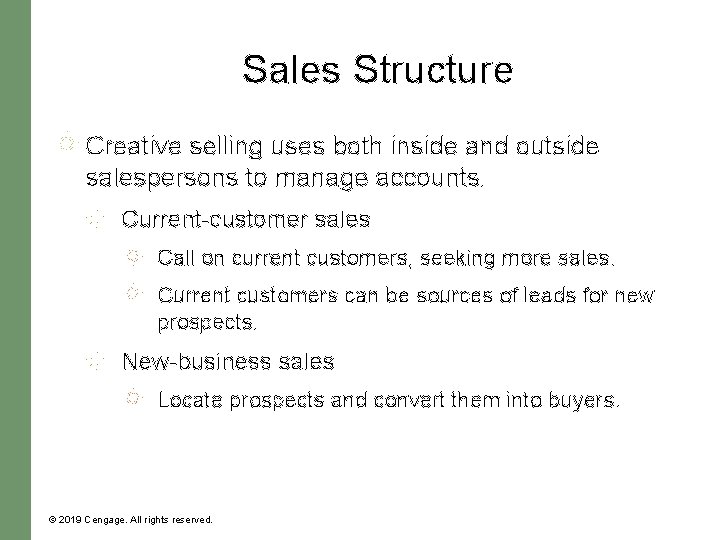
Sales Structure Creative selling uses both inside and outside salespersons to manage accounts. Current-customer sales Call on current customers, seeking more sales. Current customers can be sources of leads for new prospects. New-business sales Locate prospects and convert them into buyers. © 2019 Cengage. All rights reserved.
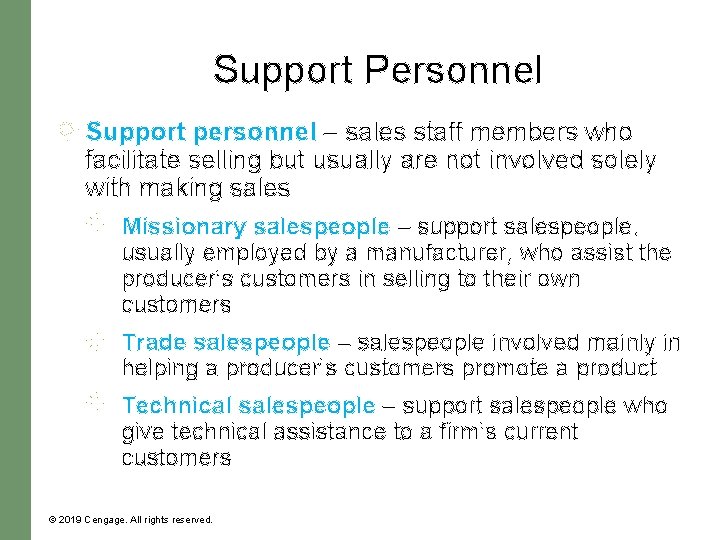
Support Personnel Support personnel – sales staff members who facilitate selling but usually are not involved solely with making sales Missionary salespeople – support salespeople, usually employed by a manufacturer, who assist the producer’s customers in selling to their own customers Trade salespeople – salespeople involved mainly in helping a producer’s customers promote a product Technical salespeople – support salespeople who give technical assistance to a firm’s current customers © 2019 Cengage. All rights reserved.
Team and Relationship Selling Team selling – the use of a team of experts from all functional areas of a firm, led by a salesperson, to conduct the personal selling process Relationship selling – the building of mutually beneficial long-term associations with a customer through regular communications over prolonged periods of time © 2019 Cengage. All rights reserved.
Managing the Sales Force The sales force is directly responsible for generating sales revenue. Morale and success of a firm’s sales force depend on: © 2019 Cengage. All rights reserved.
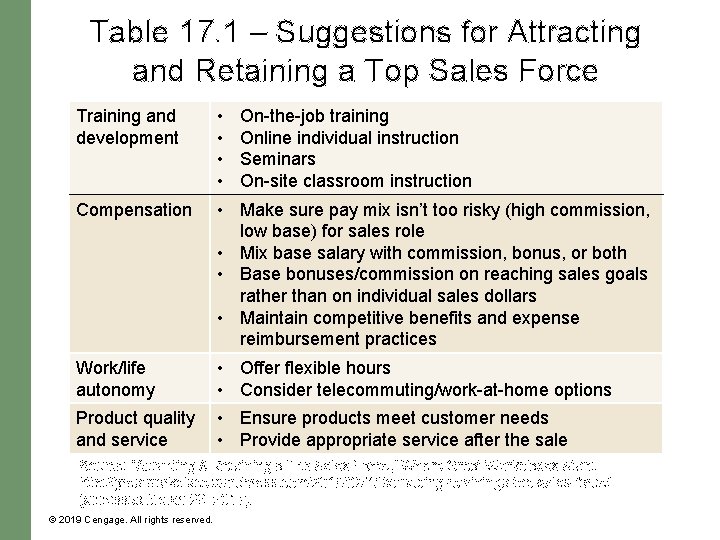
Table 17. 1 – Suggestions for Attracting and Retaining a Top Sales Force Training and development • • Compensation • Make sure pay mix isn’t too risky (high commission, low base) for sales role • Mix base salary with commission, bonus, or both • Base bonuses/commission on reaching sales goals rather than on individual sales dollars • Maintain competitive benefits and expense reimbursement practices Work/life autonomy • Offer flexible hours • Consider telecommuting/work-at-home options Product quality and service • Ensure products meet customer needs • Provide appropriate service after the sale On-the-job training Online individual instruction Seminars On-site classroom instruction Source: “Attracting & Retaining a Top Sales Force, ” Where Great Workplaces Start, http: //greatworkplace. wordpress. com/2010/02/10/attracting-retaininga-top-sales-force/ (accessed March 29, 2017). © 2019 Cengage. All rights reserved.
Establishing Sales Force Objectives Sales objectives give a sales force direction and purpose. Objectives should be: Objectives are established for: Entire sales force as sales volume, market share, or profit Individuals as quotas—dollars or unit sales volume © 2019 Cengage. All rights reserved.
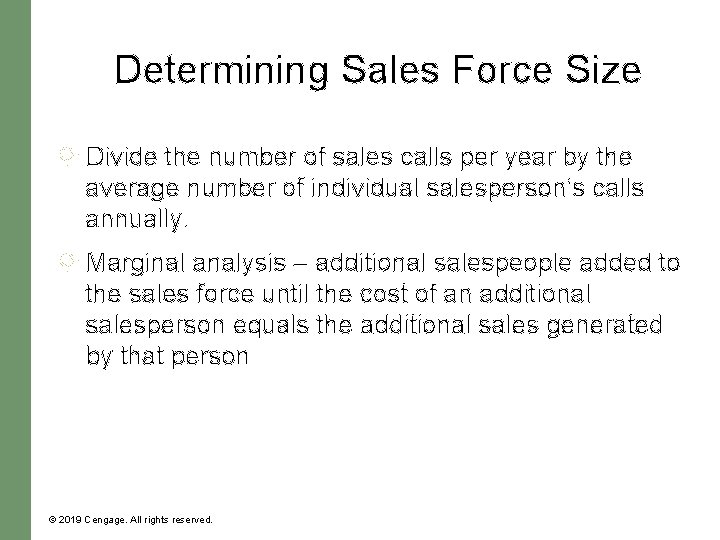
Determining Sales Force Size Divide the number of sales calls per year by the average number of individual salesperson’s calls annually. Marginal analysis – additional salespeople added to the sales force until the cost of an additional salesperson equals the additional sales generated by that person © 2019 Cengage. All rights reserved.
Recruiting and Selecting Salespeople Recruiting – developing a list of qualified applicants for sales positions Establish needed qualifications before recruiting. Sources of recruitment: Recruitment should be continuous and systematic. © 2019 Cengage. All rights reserved.
Training Sales Personnel (1 of 2) Training can be formal or informal and on-the-job. Training can be aimed at salespeople at all seniority and experience levels. Sales training can concentrate on: Sales training may be done: © 2019 Cengage. All rights reserved.
Training Sales Personnel (2 of 2) Ethics training: Institutionalizes an ethical climate Improves employee satisfaction Helps prevent misconduct Choice of methods and materials depends on: © 2019 Cengage. All rights reserved.
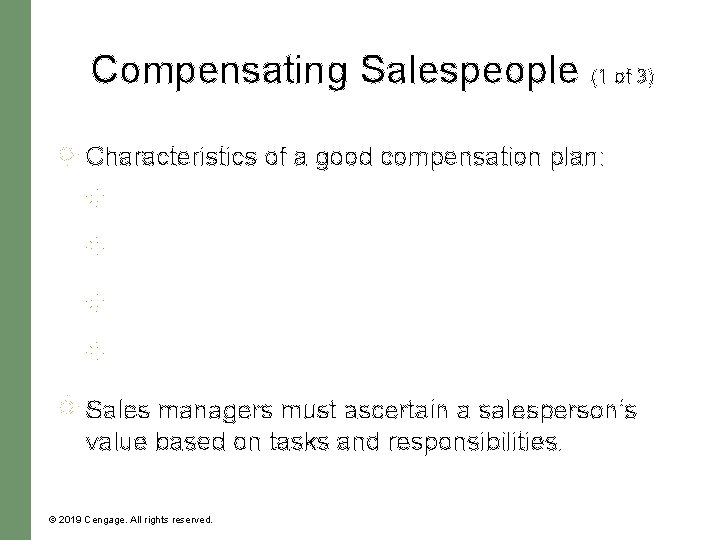
Compensating Salespeople (1 of 3) Characteristics of a good compensation plan: Sales managers must ascertain a salesperson’s value based on tasks and responsibilities. © 2019 Cengage. All rights reserved.
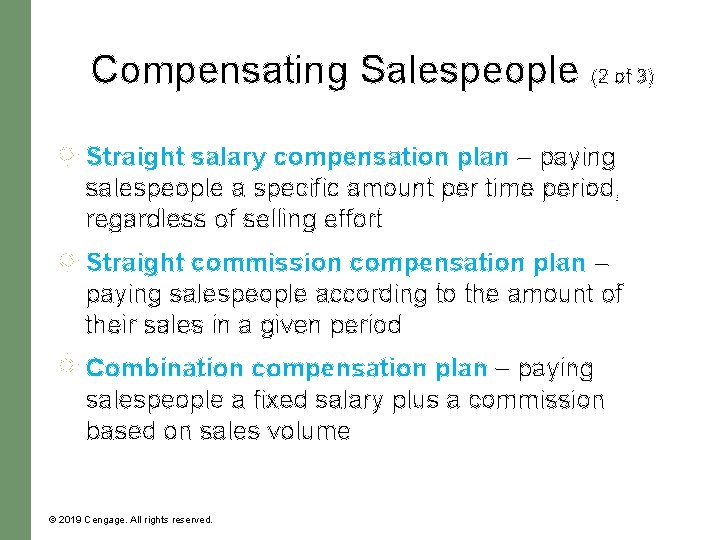
Compensating Salespeople (2 of 3) Straight salary compensation plan – paying salespeople a specific amount per time period, regardless of selling effort Straight commission compensation plan – paying salespeople according to the amount of their sales in a given period Combination compensation plan – paying salespeople a fixed salary plus a commission based on sales volume © 2019 Cengage. All rights reserved.
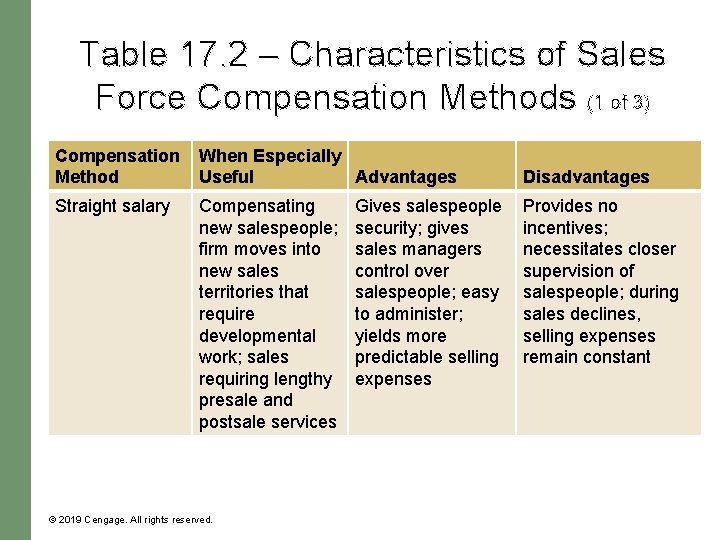
Table 17. 2 – Characteristics of Sales Force Compensation Methods (1 of 3) Compensation Method When Especially Useful Advantages Straight salary Compensating new salespeople; firm moves into new sales territories that require developmental work; sales requiring lengthy presale and postsale services © 2019 Cengage. All rights reserved. Gives salespeople security; gives sales managers control over salespeople; easy to administer; yields more predictable selling expenses Disadvantages Provides no incentives; necessitates closer supervision of salespeople; during sales declines, selling expenses remain constant
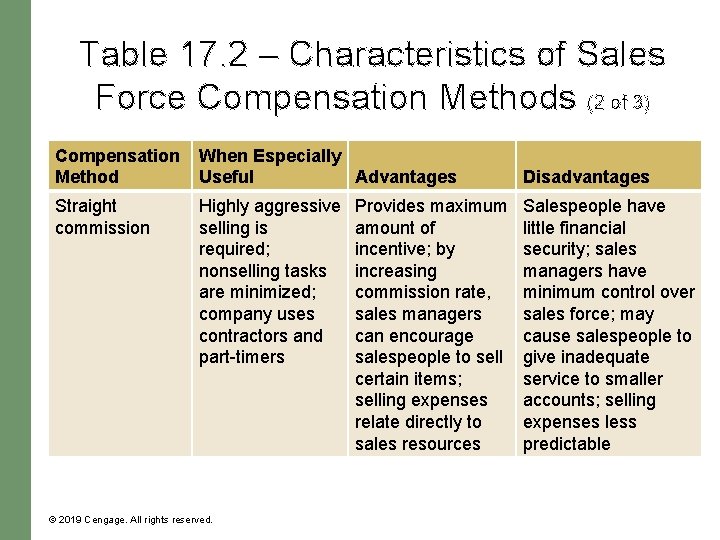
Table 17. 2 – Characteristics of Sales Force Compensation Methods (2 of 3) Compensation Method When Especially Useful Advantages Straight commission Highly aggressive selling is required; nonselling tasks are minimized; company uses contractors and part-timers © 2019 Cengage. All rights reserved. Provides maximum amount of incentive; by increasing commission rate, sales managers can encourage salespeople to sell certain items; selling expenses relate directly to sales resources Disadvantages Salespeople have little financial security; sales managers have minimum control over sales force; may cause salespeople to give inadequate service to smaller accounts; selling expenses less predictable
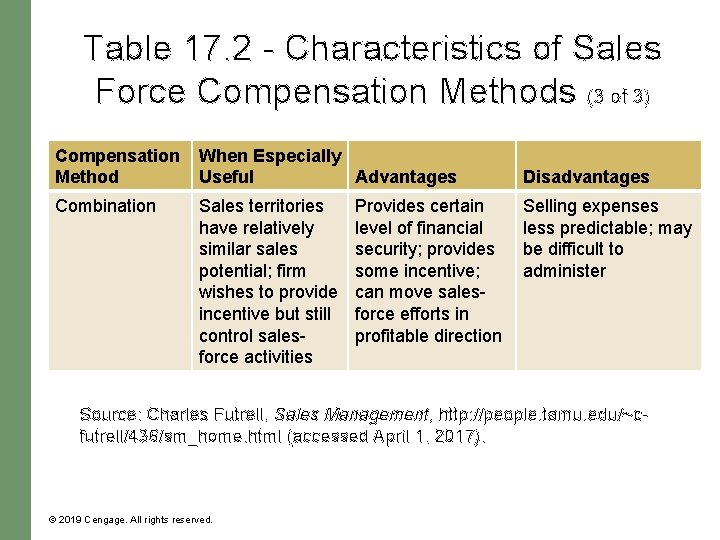
Table 17. 2 - Characteristics of Sales Force Compensation Methods (3 of 3) Compensation Method When Especially Useful Advantages Combination Sales territories have relatively similar sales potential; firm wishes to provide incentive but still control salesforce activities Provides certain level of financial security; provides some incentive; can move salesforce efforts in profitable direction Disadvantages Selling expenses less predictable; may be difficult to administer Source: Charles Futrell, Sales Management, http: //people. tamu. edu/~cfutrell/436/sm_home. html (accessed April 1, 2017). © 2019 Cengage. All rights reserved.
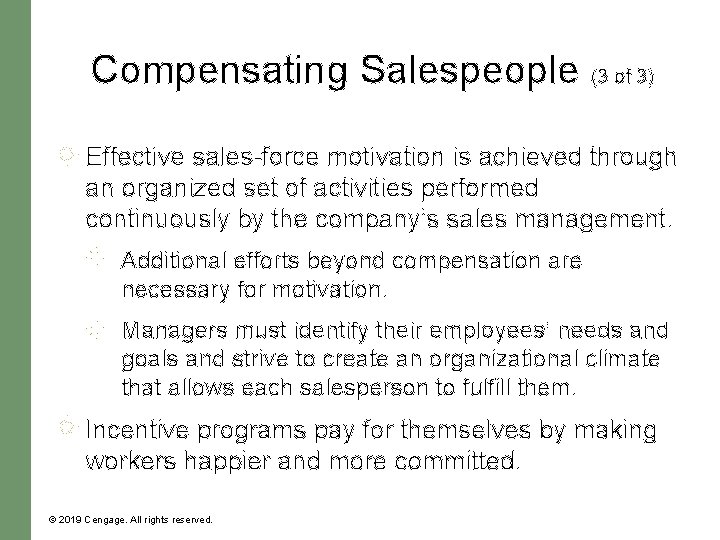
Compensating Salespeople (3 of 3) Effective sales-force motivation is achieved through an organized set of activities performed continuously by the company’s sales management. Additional efforts beyond compensation are necessary for motivation. Managers must identify their employees’ needs and goals and strive to create an organizational climate that allows each salesperson to fulfill them. Incentive programs pay for themselves by making workers happier and more committed. © 2019 Cengage. All rights reserved.
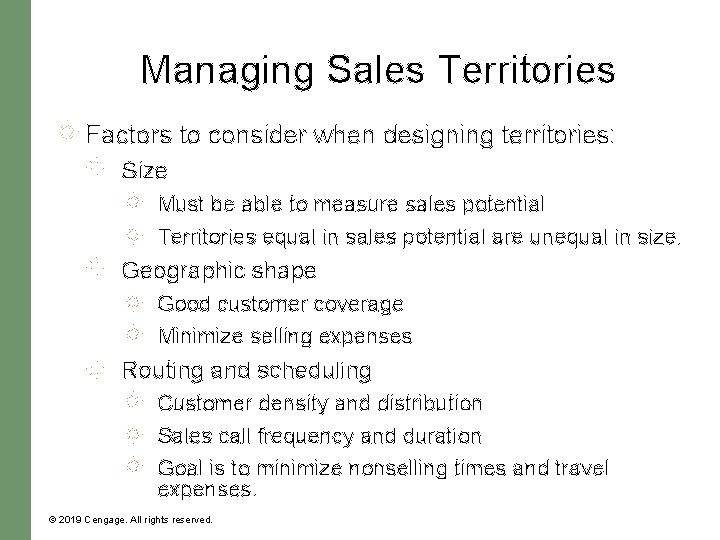
Managing Sales Territories Factors to consider when designing territories: Size Must be able to measure sales potential Territories equal in sales potential are unequal in size. Geographic shape Good customer coverage Minimize selling expenses Routing and scheduling Customer density and distribution Sales call frequency and duration Goal is to minimize nonselling times and travel expenses. © 2019 Cengage. All rights reserved.
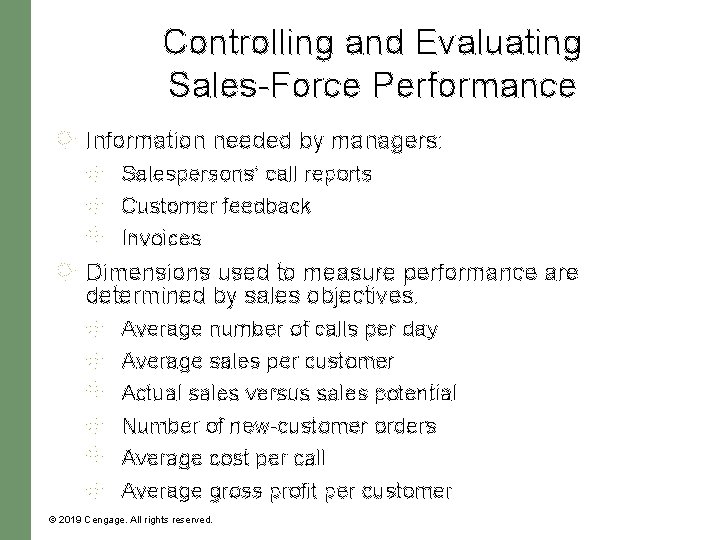
Controlling and Evaluating Sales-Force Performance Information needed by managers: Salespersons’ call reports Customer feedback Invoices Dimensions used to measure performance are determined by sales objectives. Average number of calls per day Average sales per customer Actual sales versus sales potential Number of new-customer orders Average cost per call Average gross profit per customer © 2019 Cengage. All rights reserved.
The Nature of Sales Promotion Sales promotion – an activity and/or material intended to induce resellers or salespeople to sell a product or consumers to buy it Factors to determine the best consumer salespromotion methods: The use of sales promotion has increased dramatically at the expense of advertising. © 2019 Cengage. All rights reserved.
Consumer Sales Promotion Methods Consumer sales promotion methods – salespromotion techniques that encourage consumers to patronize specific stores or try particular products Initiated by retailers – aim to attract customer to specific locations Initiated by manufacturers – introduce new products or promote established brands Online sales promotion creates a higher level of product and brand recall. © 2019 Cengage. All rights reserved.
Coupons and Cents-Off Offers (1 of 2) Coupons – written price reductions used to encourage consumers to buy a specific product Most widely used consumer sales-promotion method Advantages: © 2019 Cengage. All rights reserved.
Coupons and Cents-Off Offers (2 of 2) Coupons (cont. ) Disadvantages: Cents-off offers – promotions that allow buyers to pay less than the regular price to encourage purchase © 2019 Cengage. All rights reserved.
Money Refunds and Rebates Money refunds – sales-promotion techniques that offer consumers a specified amount of money when they mail in a proof of purchase, usually for multiple product purchases Rebates – sales-promotion techniques in which a consumer receives a specified amount of money for making a single product purchase © 2019 Cengage. All rights reserved.
Shopper Loyalty and Frequent-User Incentives Many firms give frequent-user incentives, rewarding customers who engage in repeat or frequent purchases. Loyalty or shopper cards Impact on brand loyalty purchases for secondary brands No impact on brands with strong performance Rewards for repeat purchases Frequent-flyer programs © 2019 Cengage. All rights reserved.
Point-of-Purchase Materials and Demonstrations Point-of-purchase (POP) materials – signs, window displays, display racks, and similar devices used to attract customers Retailers use if they are: Demonstrations – sales-promotion methods a manufacturer uses temporarily to encourage trial use and purchase of a product or to show a product works © 2019 Cengage. All rights reserved.
Free Samples and Premiums Free samples – samples of a product given out to encourage trial and purchase Most expensive sales-promotion method Can be one of the most effective methods Use of sampling is increasing. Premiums – items offered free or at a minimal cost as a bonus for purchasing a product Used to: © 2019 Cengage. All rights reserved.
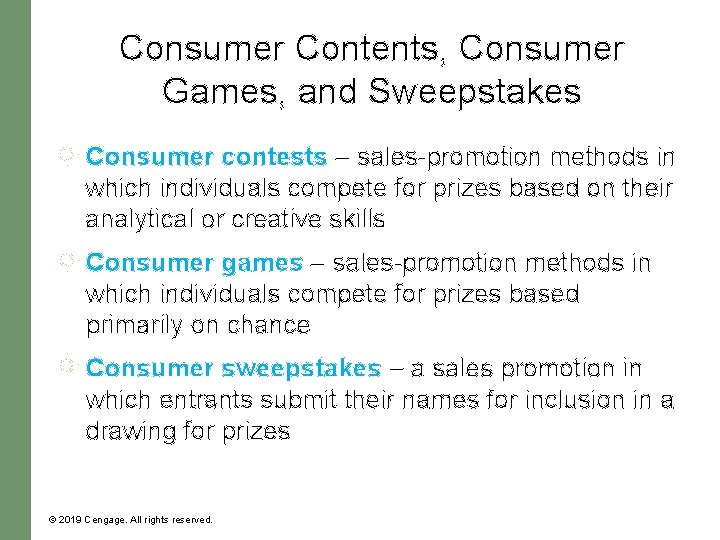
Consumer Contents, Consumer Games, and Sweepstakes Consumer contests – sales-promotion methods in which individuals compete for prizes based on their analytical or creative skills Consumer games – sales-promotion methods in which individuals compete for prizes based primarily on chance Consumer sweepstakes – a sales promotion in which entrants submit their names for inclusion in a drawing for prizes © 2019 Cengage. All rights reserved.
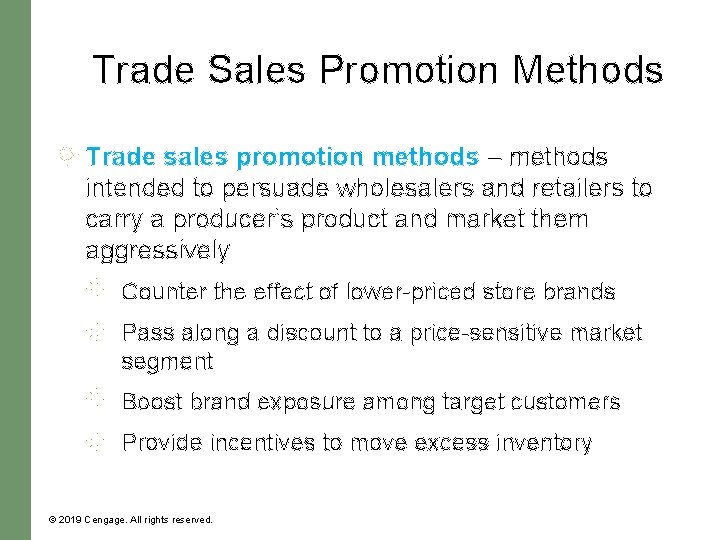
Trade Sales Promotion Methods Trade sales promotion methods – methods intended to persuade wholesalers and retailers to carry a producer’s product and market them aggressively Counter the effect of lower-priced store brands Pass along a discount to a price-sensitive market segment Boost brand exposure among target customers Provide incentives to move excess inventory © 2019 Cengage. All rights reserved.
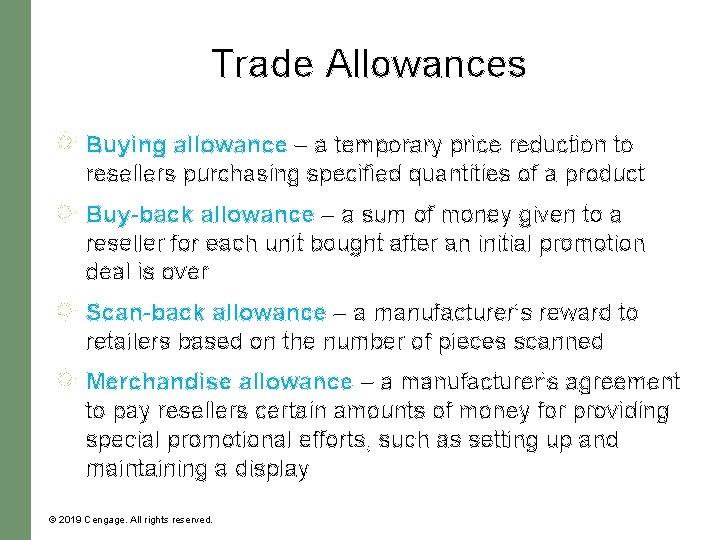
Trade Allowances Buying allowance – a temporary price reduction to resellers purchasing specified quantities of a product Buy-back allowance – a sum of money given to a reseller for each unit bought after an initial promotion deal is over Scan-back allowance – a manufacturer’s reward to retailers based on the number of pieces scanned Merchandise allowance – a manufacturer’s agreement to pay resellers certain amounts of money for providing special promotional efforts, such as setting up and maintaining a display © 2019 Cengage. All rights reserved.
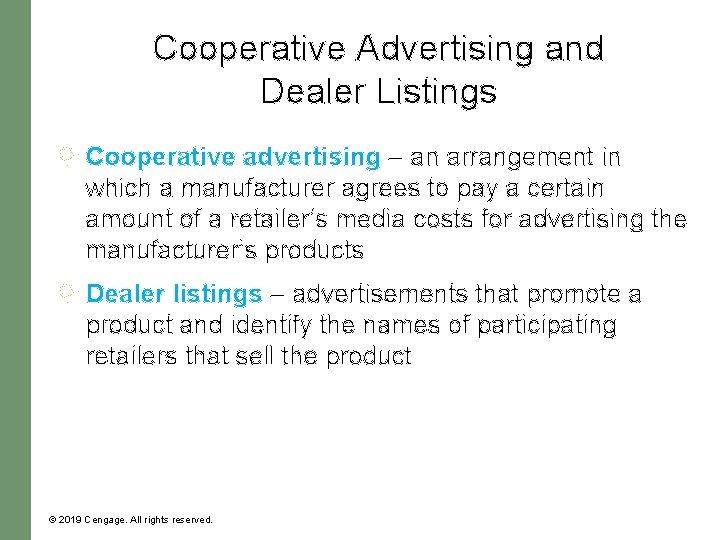
Cooperative Advertising and Dealer Listings Cooperative advertising – an arrangement in which a manufacturer agrees to pay a certain amount of a retailer’s media costs for advertising the manufacturer’s products Dealer listings – advertisements that promote a product and identify the names of participating retailers that sell the product © 2019 Cengage. All rights reserved.
Free Merchandise and Gifts Free merchandise – a manufacturer’s reward given to resellers that purchase a stated quantity of products Dealer loader – a gift, often part of a display, given to a retailer that purchases a specified quantity of merchandise © 2019 Cengage. All rights reserved.
Premium Money Premium money (push money) – extra compensation to salespeople for pushing a line of goods Appropriate when personal selling is important to the marketing effort Not effective for promoting products sold through self -service Helps manufacturer obtain commitment from sales force Can be very expensive © 2019 Cengage. All rights reserved.
Sales Contest Sales contest – a sales-promotion method used to motivate distributors, retailers, and sales personnel through recognition of outstanding achievements Must be equitable for all individuals involved Can achieve participation at all distribution levels Positive effects may be temporary. Prizes are usually expensive. © 2019 Cengage. All rights reserved.