
Chapter 15 Integrated Marketing Communications wecandGetty Imag es
- Slides: 26
Chapter 15 Integrated Marketing Communications ©wecand/Getty. Imag es © 2015 Cengage Learning. All Rights Reserved. May not be scanned, copied or duplicated, or posted to a publicly accessible website, in whole or in part.
©wecand/Getty. Images Integrated Marketing Communications Refer to coordination promotion and other marketing efforts for maximum informational and persuasive impact Goal - To send a consistent message to customers Allow an organization to coordinate and manage its promotional efforts Enable synchronization of promotion elements Improve the efficiency and effectiveness of promotion budgets Foster long-term customer relationships © 2015 Cengage Learning. All Rights Reserved. May not be scanned, copied or duplicated, or posted to a publicly accessible website, in whole or in part.
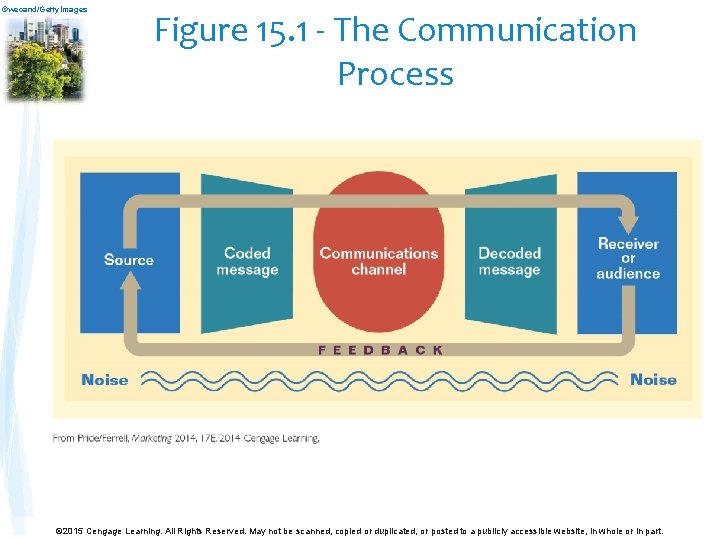
©wecand/Getty. Images Communication Process Communication: Sharing of meaning through the transmission of information Source: Person, group, or organization with a meaning it tries to share with a receiver or an audience Receiver: Individual, group, or organization that decodes a coded message Coding process: Converting meaning into a series of signs or symbols Communications channel: Medium of transmission that carries the coded message from the source to the receiver © 2015 Cengage Learning. All Rights Reserved. May not be scanned, copied or duplicated, or posted to a publicly accessible website, in whole or in part.
©wecand/Getty. Images Figure 15. 1 - The Communication Process © 2015 Cengage Learning. All Rights Reserved. May not be scanned, copied or duplicated, or posted to a publicly accessible website, in whole or in part.
©wecand/Getty. Images Decoding Process Converting signs or symbols into concepts and ideas Noise: Anything that reduces a communication’s clarity and accuracy Has many sources and may affect any or all parts of the communication process Occurs when a source uses signs or symbols that are unfamiliar to the receiver Can originate in the receiver © 2015 Cengage Learning. All Rights Reserved. May not be scanned, copied or duplicated, or posted to a publicly accessible website, in whole or in part.
©wecand/Getty. Images Decoding Process Feedback: Receiver’s response to a decoded message Coded and sent through a communications channel Decoded by the receiver Immediate during face-to-face communication Slow when mass communication is used Channel capacity: Limit on the volume of information a communication channel can handle effectively © 2015 Cengage Learning. All Rights Reserved. May not be scanned, copied or duplicated, or posted to a publicly accessible website, in whole or in part.
©wecand/Getty. Images Promotion Communication to build and maintain favorable relationships by informing and persuading one or more audiences To view an organization positively and accept its products For maximum benefit, marketers strive for proper: Planning Implementation Coordination Control of communications © 2015 Cengage Learning. All Rights Reserved. May not be scanned, copied or duplicated, or posted to a publicly accessible website, in whole or in part.
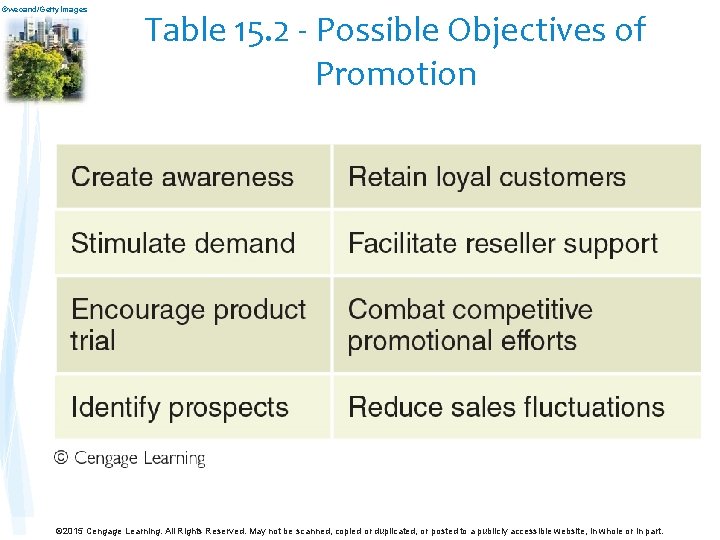
©wecand/Getty. Images Table 15. 2 - Possible Objectives of Promotion © 2015 Cengage Learning. All Rights Reserved. May not be scanned, copied or duplicated, or posted to a publicly accessible website, in whole or in part.
©wecand/Getty. Images Promotion Mix Combination of specific methods used to manage the integrated marketing communications for a particular product © 2015 Cengage Learning. All Rights Reserved. May not be scanned, copied or duplicated, or posted to a publicly accessible website, in whole or in part.
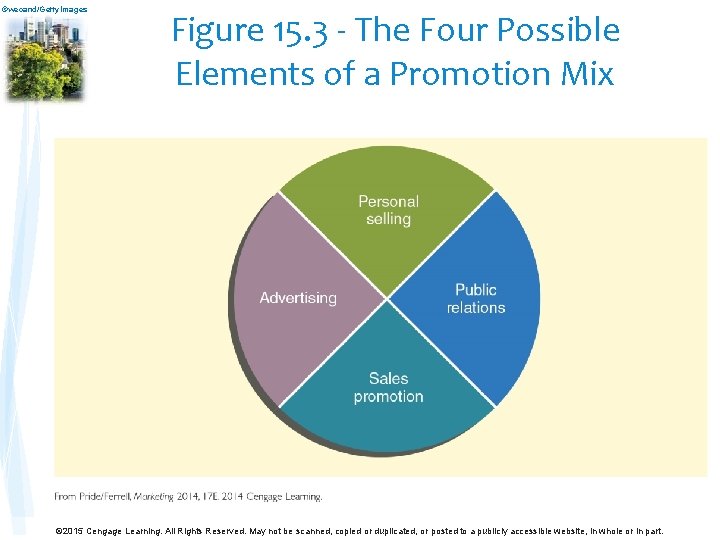
©wecand/Getty. Images Figure 15. 3 - The Four Possible Elements of a Promotion Mix © 2015 Cengage Learning. All Rights Reserved. May not be scanned, copied or duplicated, or posted to a publicly accessible website, in whole or in part.
©wecand/Getty. Images Advantages of Advertising Cost-efficient when it reaches a vast number of people at a low cost person Lets the source repeat the message several times Adds to a product’s value Provides visibility that enhances an organization's image Including celebrity endorsers can enhance a firm’s and product's image © 2015 Cengage Learning. All Rights Reserved. May not be scanned, copied or duplicated, or posted to a publicly accessible website, in whole or in part.
©wecand/Getty. Images Disadvantages of Advertising Absolute dollar outlay is high during popular television shows Rarely provides rapid feedback Difficult to measure its effect on sales Less persuasive than personal selling Limited time available to communicate a message to customers https: //www. youtube. com/watch? v=b 8 Jkz. YFFYPs © 2015 Cengage Learning. All Rights Reserved. May not be scanned, copied or duplicated, or posted to a publicly accessible website, in whole or in part.
©wecand/Getty. Images Advantages and Disadvantages of Personal Selling Advantages Is a more specific form of advertising Has greater impact on consumers Provides immediate feedback Disadvantages Is expensive Is directed to a small number of individuals © 2015 Cengage Learning. All Rights Reserved. May not be scanned, copied or duplicated, or posted to a publicly accessible website, in whole or in part.
©wecand/Getty. Images Types of Interpersonal Communication Kinesic communication: Communicating through the movement of head, eyes, arms, hands, legs, or torso Proxemic communication: Communicating by varying the physical distance in face-to-face interactions Tactile communication: Communication through touching like handshaking © 2015 Cengage Learning. All Rights Reserved. May not be scanned, copied or duplicated, or posted to a publicly accessible website, in whole or in part.
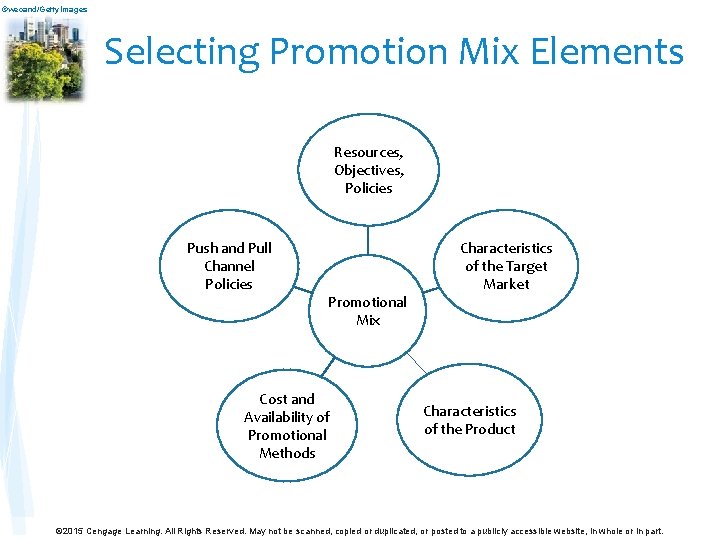
©wecand/Getty. Images Selecting Promotion Mix Elements Resources, Objectives, Policies Push and Pull Channel Policies Promotional Mix Cost and Availability of Promotional Methods Characteristics of the Target Market Characteristics of the Product © 2015 Cengage Learning. All Rights Reserved. May not be scanned, copied or duplicated, or posted to a publicly accessible website, in whole or in part.
©wecand/Getty. Images Characteristics of the Target Market Size When limited - Promotion mix may emphasize personal selling When large - Promotion mix may be advertising and sales promotion When the population density is uneven - Marketers may utilize regional advertising and target larger markets © 2015 Cengage Learning. All Rights Reserved. May not be scanned, copied or duplicated, or posted to a publicly accessible website, in whole or in part.
©wecand/Getty. Images Characteristics of the Target Market Geographic distribution Personal selling is used when the customers are concentrated in a small area Regional or national advertising is used when the customers are numerous and dispersed Demographic characteristics affect: Types of promotional techniques selected Messages and images employed © 2015 Cengage Learning. All Rights Reserved. May not be scanned, copied or duplicated, or posted to a publicly accessible website, in whole or in part.
©wecand/Getty. Images Characteristics of the Product Business products Concentrate on personal selling Use some advertising and sales promotion Consumer products Advertising and sales promotion for convenience goods Personal selling for consumer durables Public relations for both convenience goods and consumer durables © 2015 Cengage Learning. All Rights Reserved. May not be scanned, copied or duplicated, or posted to a publicly accessible website, in whole or in part.
©wecand/Getty. Images Characteristics of the Product Price influences the promotion mix High-priced products - Personal selling Low-priced products - Advertising Distribution intensity affects the promotion mix Intensive distribution - Advertising and sales promotion Selective distribution - Promotion mixes vary Exclusive distribution - Personal selling © 2015 Cengage Learning. All Rights Reserved. May not be scanned, copied or duplicated, or posted to a publicly accessible website, in whole or in part.
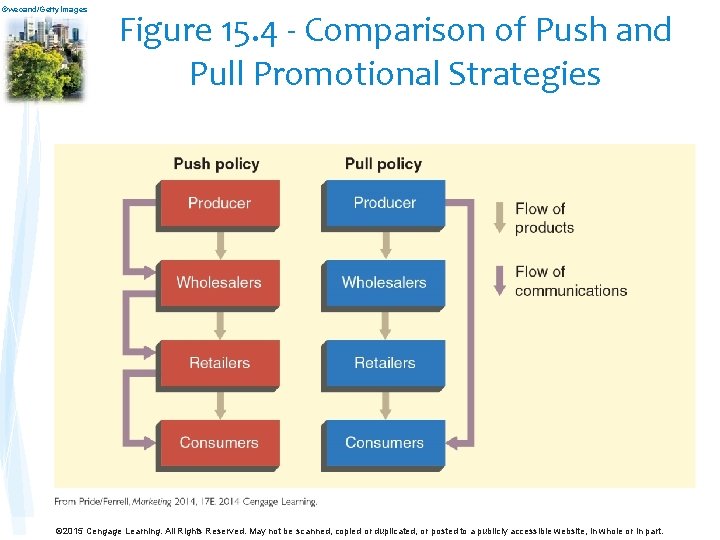
©wecand/Getty. Images Push and Pull Channel Policies Push policy: Promoting a product only to the next institution down the marketing channel Pull policy: Promoting a product directly to consumers Develops strong consumer demand that pulls products through a marketing channel Not mutually exclusive and can be used simultaneously © 2015 Cengage Learning. All Rights Reserved. May not be scanned, copied or duplicated, or posted to a publicly accessible website, in whole or in part.
©wecand/Getty. Images Figure 15. 4 - Comparison of Push and Pull Promotional Strategies © 2015 Cengage Learning. All Rights Reserved. May not be scanned, copied or duplicated, or posted to a publicly accessible website, in whole or in part.
©wecand/Getty. Images Word-of-Mouth Communications Personal informal exchanges of communication shared by customers about products, brands, and companies Crucial for customers in selecting services Leads to new-customer acquisition Effective for new-to-market and more expensive products Electronic word of mouth Communicating about products through websites, blogs, e-mail, social networks, or online forums © 2015 Cengage Learning. All Rights Reserved. May not be scanned, copied or duplicated, or posted to a publicly accessible website, in whole or in part.
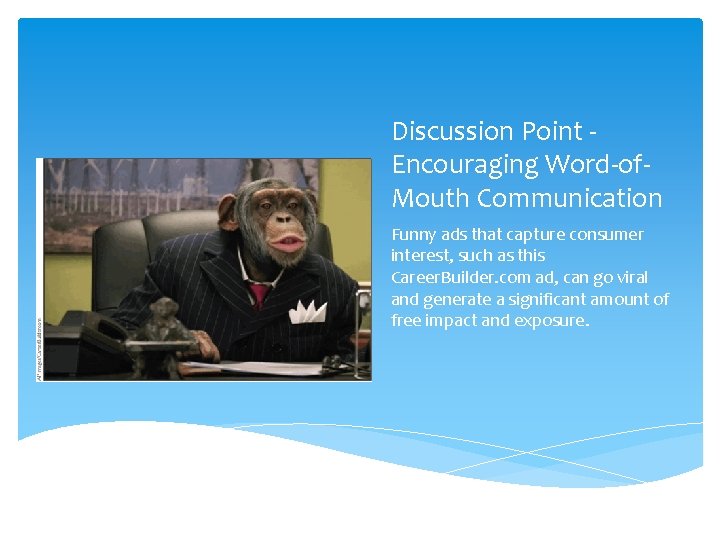
Discussion Point Encouraging Word-of. Mouth Communication Funny ads that capture consumer interest, such as this Career. Builder. com ad, can go viral and generate a significant amount of free impact and exposure.
©wecand/Getty. Images Growing Importance of Word-of. Mouth Communications Buzz marketing: Attempt to incite publicity and public excitement surrounding a product through a creative event Should not violate any laws or have the potential to be misconstrued and cause undue alarm Viral marketing: Strategy to get consumers to share a marketer’s message Done through e-mail or online video Done in a way that spreads dramatically and quickly © 2015 Cengage Learning. All Rights Reserved. May not be scanned, copied or duplicated, or posted to a publicly accessible website, in whole or in part.
©wecand/Getty. Images Product Placement Strategically locates products or product promotions within entertainment media content to reach the product’s target market Important due to increasing fragmentation of television viewers In-program product placements Successful in reaching consumers as they are being entertained Reality programming - Close interchange between the participants and the product exists © 2015 Cengage Learning. All Rights Reserved. May not be scanned, copied or duplicated, or posted to a publicly accessible website, in whole or in part.
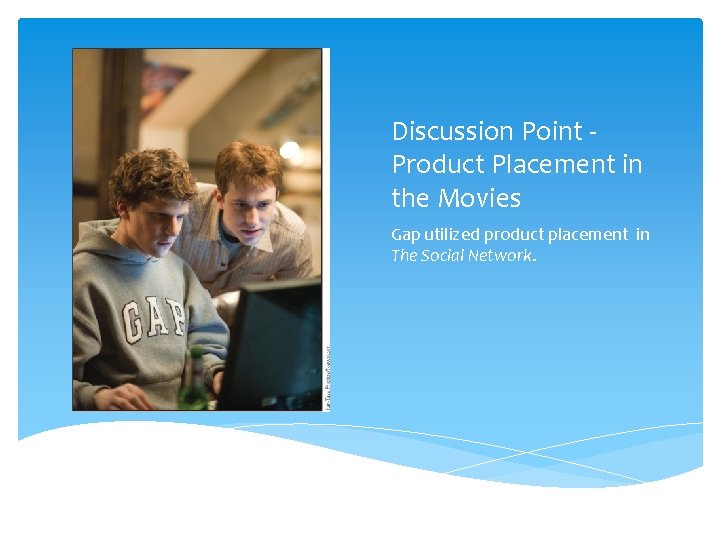
Discussion Point Product Placement in the Movies Gap utilized product placement in The Social Network.