Chapter 11 Forces Inside the Earth A When


- Slides: 28
Chapter 11
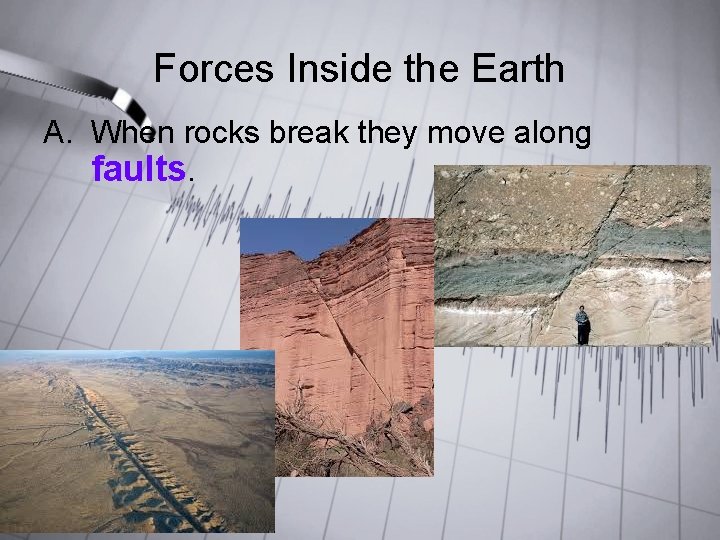
Forces Inside the Earth A. When rocks break they move along faults.
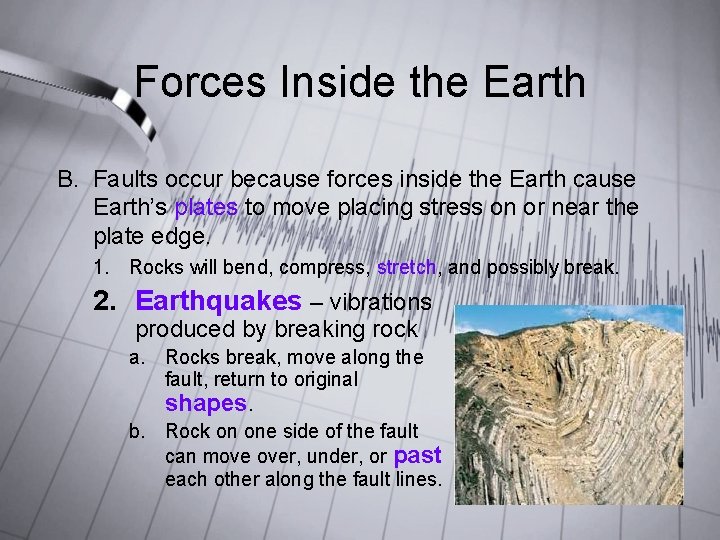
Forces Inside the Earth B. Faults occur because forces inside the Earth cause Earth’s plates to move placing stress on or near the plate edge. 1. Rocks will bend, compress, stretch, and possibly break. 2. Earthquakes – vibrations produced by breaking rock a. Rocks break, move along the fault, return to original shapes. b. Rock on one side of the fault can move over, under, or past each other along the fault lines.
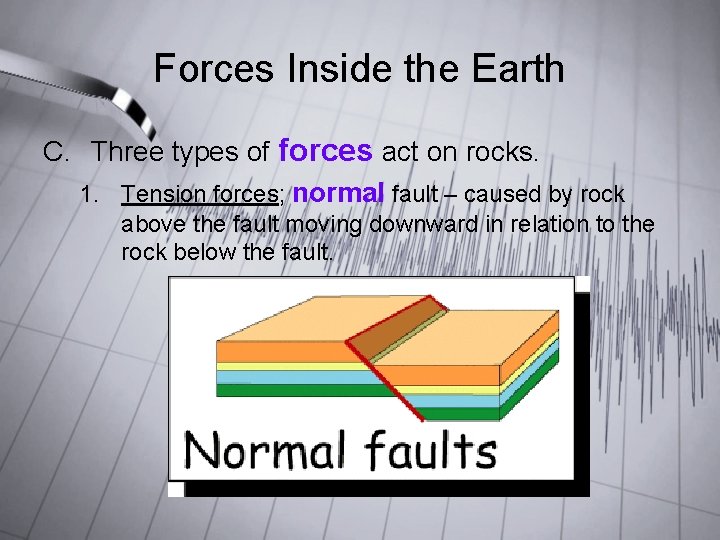
Forces Inside the Earth C. Three types of forces act on rocks. 1. Tension forces; normal fault – caused by rock above the fault moving downward in relation to the rock below the fault.
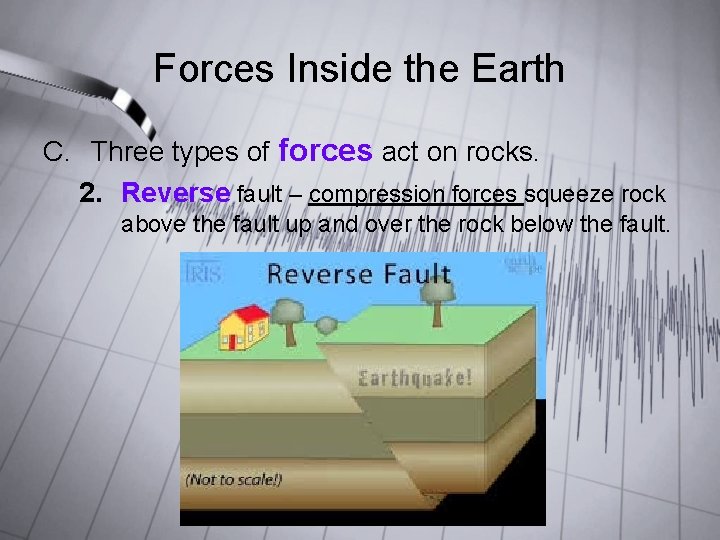
Forces Inside the Earth C. Three types of forces act on rocks. 2. Reverse fault – compression forces squeeze rock above the fault up and over the rock below the fault.
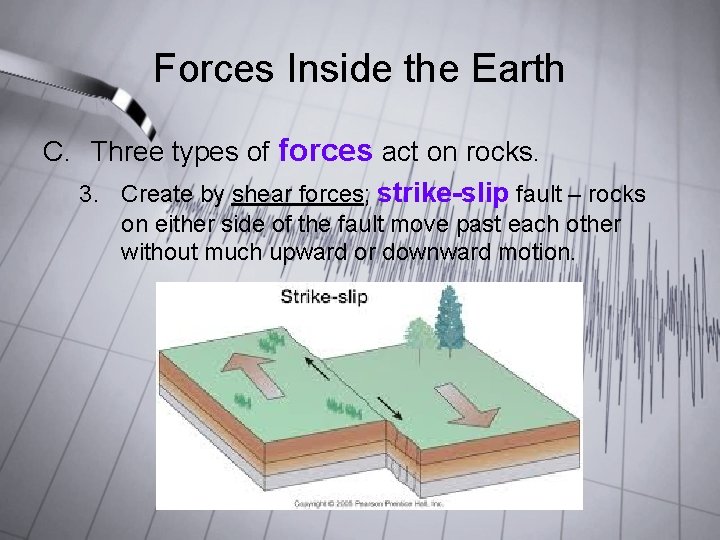
Forces Inside the Earth C. Three types of forces act on rocks. 3. Create by shear forces; strike-slip fault – rocks on either side of the fault move past each other without much upward or downward motion.
Forces Inside the Earth 1. An earthquake is a vibration in the Earth’s crust produced by the breaking or shifting of rocks at a fault line. 2. Reverse faults force rocks upward and are producing the Himalaya Mountain range. It is the compression of the two plates pushing the rocks upward. 3. For a normal fault the rocks move in a downward direction.
Forces Inside the Earth 4. The San Andreas Fault in California is a strike-slip fault because the two plates are sliding past each other. 5. Predicting where an earthquake will occur is easy: they occur at fault lines. Predicting when they will occur is impossible: scientists can not calculate when the elastic limit will be exceeded. 6. What three types of forces act on rocks to create faults? The three types of forces that act on rocks are tension, compression, and shear.
Features of Earthquakes A. Seismic Waves – waves generated by an earthquake, can move the ground forward and backward, up and down, and side to side. 1. Focus – an earthquake’s point of energy release 2. Primary waves ( P-waves) – cause particles in rocks to move back and forth in the same direction that the wave is traveling. 3. Secondary waves (S-waves) – cause particles in rock to move at right angles to the direction of the wave travel. 4. Surface waves – move rock particles in a backward, rolling 5. motion and sideways swaying motion. The point on the earth’s surface directly above the earthquake focus is called the epicenter.
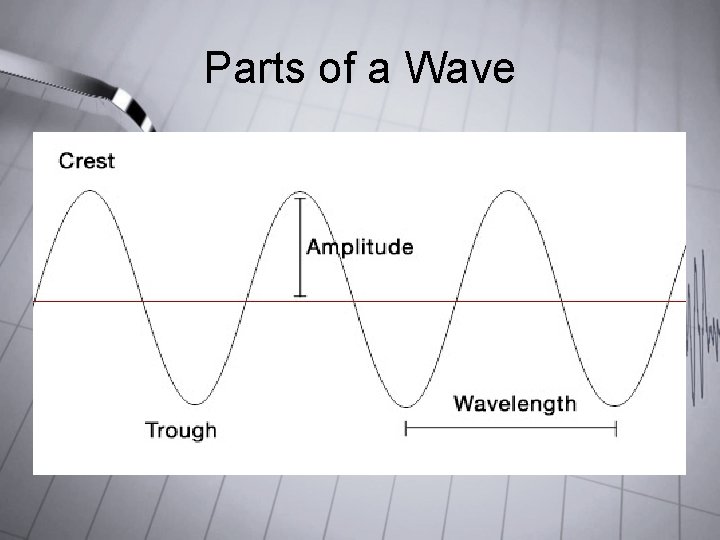
Parts of a Wave
Primary (P-Waves) https: //www. youtube. com/watch? v=6 y. Xgf. YHAS 7 c
Secondary (S-Waves) https: //www. youtube. com/watch? v=en 4 Hpt. C 0 m. Q 4
Features of Earthquakes B. The different speeds of seismic waves allow scientists to determine the epicenter. 1. Primary waves move fastest. 2. Secondary waves follow. 3. Surface waves move slowest and arrive at the seismograph station last. http: //study. com/academy/lesson/what-aresurface-waves-definition-typesexamples. html
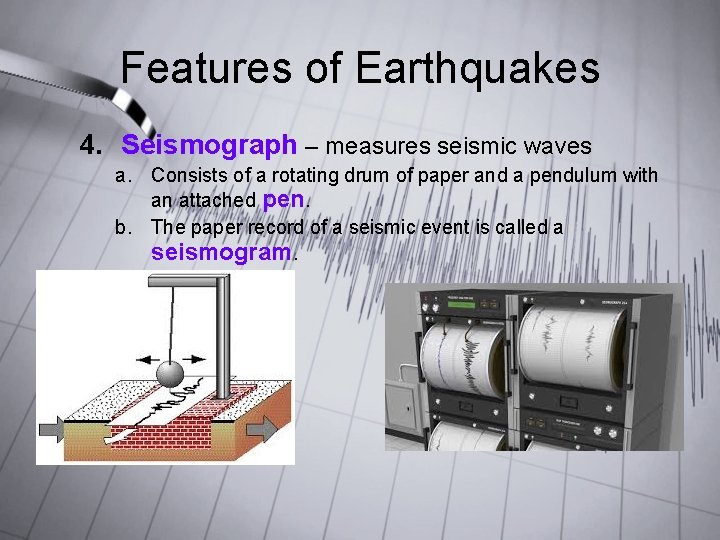
Features of Earthquakes 4. Seismograph – measures seismic waves a. Consists of a rotating drum of paper and a pendulum with an attached pen. b. The paper record of a seismic event is called a seismogram.
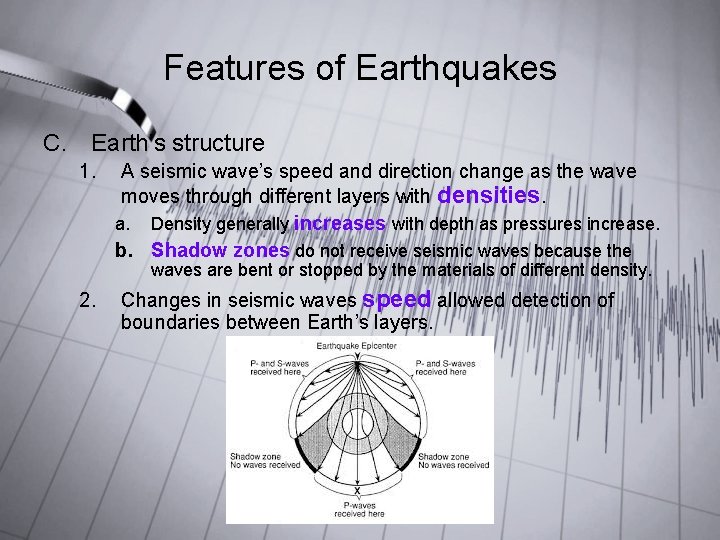
Features of Earthquakes C. Earth’s structure 1. A seismic wave’s speed and direction change as the wave moves through different layers with densities. a. Density generally increases with depth as pressures increase. b. Shadow zones do not receive seismic waves because the waves are bent or stopped by the materials of different density. 2. Changes in seismic waves speed allowed detection of boundaries between Earth’s layers.
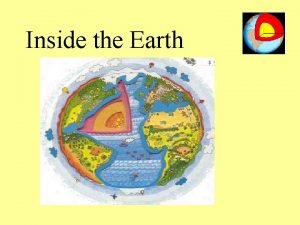
Features of Earthquakes 1. 2. 3. 4. The process of triangulation takes three seismographic stations and can pinpoint the earthquakes epicenter. The Earth’s layers in order from inside to outside are: inner core, outer core, mantle, and crust. The inner core of the Earth is thought to be made of iron. The three types of waves produced by an earthquake are: Primary, Secondary, and Surface. The most damage is caused by the Surface waves.
Features of Earthquakes 5. 6. Shadow zones areas that do not record seismic activity and are produced by the internal structure of the Earth. Name three seismic wave types in order of fastest to slowest. The fastest seismic waves are the primary waves with the slowest waves being the surface waves. The secondary waves are faster than surface waves but slower than primary waves.
People and Earthquakes A. Although earthquakes are natural geologic events, they kill many people and cause a lot of damage. 1. Seismologists – scientists who study earthquakes
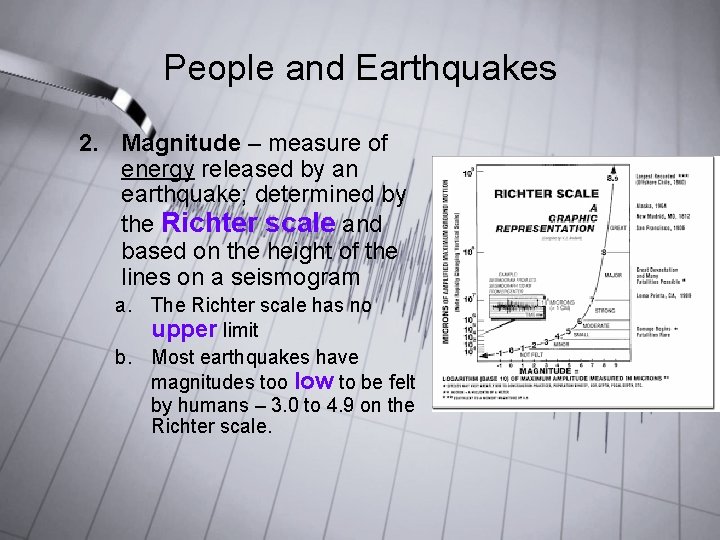
People and Earthquakes 2. Magnitude – measure of energy released by an earthquake; determined by the Richter scale and based on the height of the lines on a seismogram a. The Richter scale has no upper limit b. Most earthquakes have magnitudes too low to be felt by humans – 3. 0 to 4. 9 on the Richter scale.
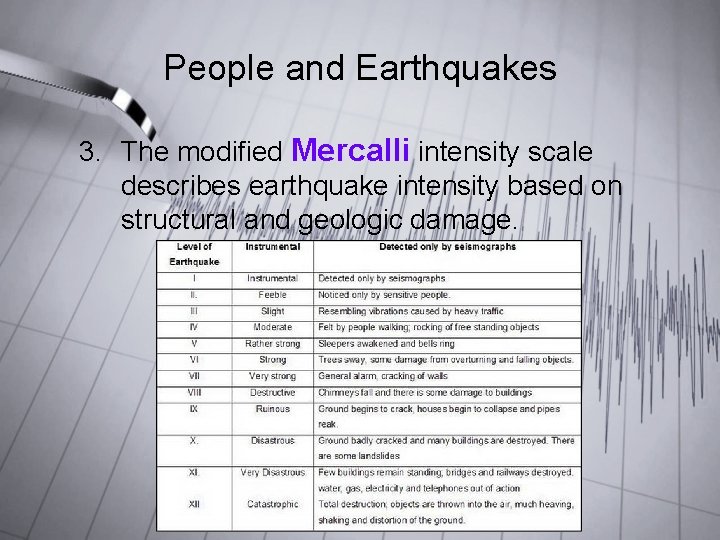
People and Earthquakes 3. The modified Mercalli intensity scale describes earthquake intensity based on structural and geologic damage.
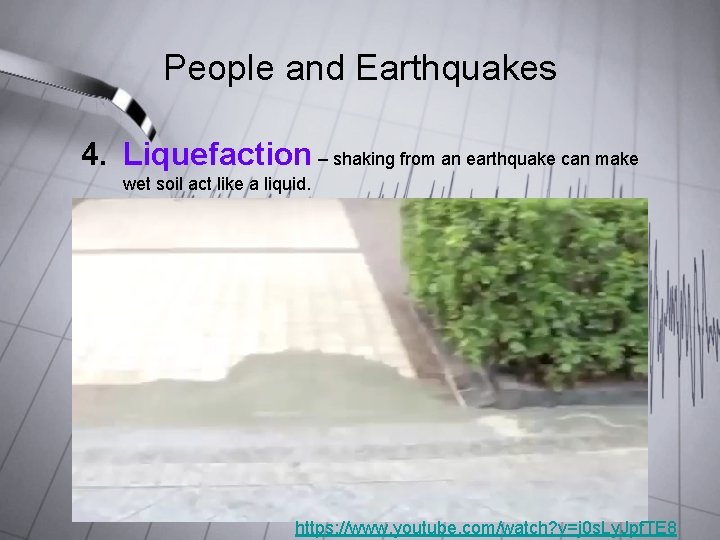
People and Earthquakes 4. Liquefaction – shaking from an earthquake can make wet soil act like a liquid. https: //www. youtube. com/watch? v=j 0 s. Ly. Jpf. TE 8
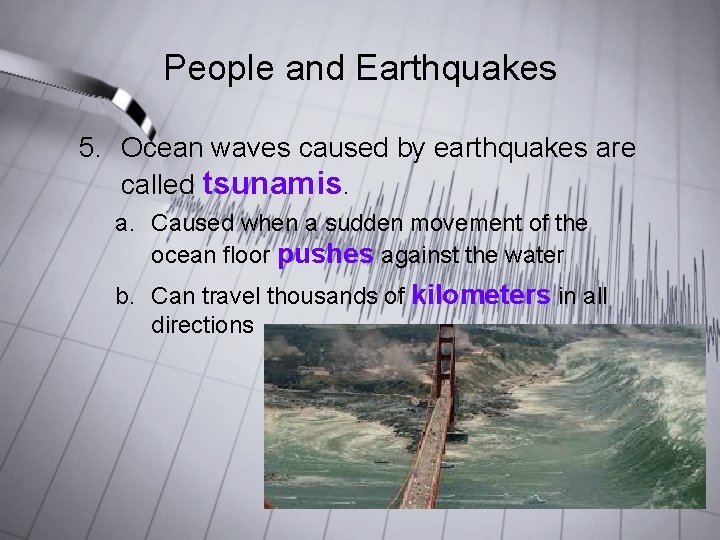
People and Earthquakes 5. Ocean waves caused by earthquakes are called tsunamis. a. Caused when a sudden movement of the ocean floor pushes against the water b. Can travel thousands of kilometers in all directions
People and Earthquakes B. Earthquakes cannot be reliably predicted. 1. Knowing how and where to plan for earthquakes can help prevent death and damage. 2. Buildings can be constructed to withstand seismic vibrations a. Flexible, circular moorings are placed under buildings; made of alternating layers of rubber and steel. b. The rubber acts like a cushion to absorb earthquake waves 3. Homes can be protected by careful placement of heavy objects and securing gas appliances.
People and Earthquakes 4. During an earthquake, crawl under a sturdy table or desk; outdoors; stay away from buildings and power lines. 5. After an earthquake, check for water or gas line damage; leave immediately if a gas smell is present. http: //earthquake. usgs. gov/earthquakes/map/
People and Earthquakes 1. If you live near a fault line, you are likely to experience an earthquake. 2. To make your house safer in case of an earthquake, you can move heavier objects to lower shelves or place a sensor on your gas line to detect a leak.
People and Earthquakes 3. The magnitude of an earthquake is measured by the size of the line drawn on the drum of a seismogram. 4. Damages from an earthquake can come in several forms: the shaking of the buildings, fires, liquefaction, or tsunamis
People and Earthquakes 5. By building a mooring of alternating rubber and concrete, a shock absorber effect occurs for the building and the building will shake/move less 6. What two scales measure earthquakes magnitude and intensity? The Richter scale measures magnitude; modified Mercalli intensity scale measures intensity.
Chapter 11 Using Vocabulary 1. _______ - n/Surface Waves 2. _______ - m/Strike-slip Fault 3. _______ - b/Epicenter 4. _______ - f/Magnitude 5. _______ - o/Tsunami