Chapter 10 Early Adulthood Ages 20 through 39




- Slides: 51
Chapter 10 Early Adulthood: Ages 20 through 39
Objectives • Describe events that commonly occur during the transitional stage of young adulthood. • Analyze the physical development of young adults ages 20 through 39. • Analyze the cognitive development of young adults ages 20 through 39. continued © Goodheart-Willcox Co. , Inc. Permission granted to reproduce for educational use only.
Objectives • Analyze the socio-emotional development of young adults ages 20 through 39. • Summarize how young adults form attachments and establish committed relationships. • Identify special needs that people may develop or acquire during early adulthood. © Goodheart-Willcox Co. , Inc. Permission granted to reproduce for educational use only.
Becoming an Adult • In the U. S. , the law often treats teens as adults when they become 18 years of age • The transition from teen to independent adult varies for everyone • Social expectations of adulthood vary by culture and are often tied to social clock expectations continued © Goodheart-Willcox Co. , Inc. Permission granted to reproduce for educational use only.
Becoming an Adult • There comes a time when young adults must claim responsibility for their own well-being • As people transition out of high school, they often become more responsible for making decisions that can affect their lifestyle for years to come continued © Goodheart-Willcox Co. , Inc. Permission granted to reproduce for educational use only.
Becoming an Adult • Early adulthood is often a time of experimentation and new emotions • In many cultures, leaving the family home is a mark of independence and adulthood • As young adults establish their selfdependence, living situations often change © Goodheart-Willcox Co. , Inc. Permission granted to reproduce for educational use only.
Checkpoint 1. In the United States, at what age does the law often treat teens as adults? ü 18 years of age 2. What does the term social clock mean? List two common social clock expectations. ü cultural expectations of when major life milestones should occur (Examples will vary, but may include: ) completing an education, living on their own, establishing a career, marrying, having children continued © Goodheart-Willcox Co. , Inc. Permission granted to reproduce for educational use only.
Checkpoint 3. List three postsecondary options often available after the completion of high school. ü (Answers will vary, but may include: ) attending a college or university, pursuing a career option, joining the military, traveling abroad 4. Give an example of how young adults may test living situations. ü (Examples will vary, but may include: ) staying in college dorms, renting an apartment, having a roommate, buying a house © Goodheart-Willcox Co. , Inc. Permission granted to reproduce for educational use only.
Physical Qualities and Changes • During young adulthood, adults no longer grow physically • Young adults are in better physical condition than middle age or older adults • By the age of 30, physical abilities often start to decline and weight gain is common continued © Goodheart-Willcox Co. , Inc. Permission granted to reproduce for educational use only.
Physical Qualities and Changes • Young adulthood is the time for strong physical performance • Part of the peak performance of this stage relates to skeletal maturity • After the age of 30, physical performance and athletic ability begin to decline continued © Goodheart-Willcox Co. , Inc. Permission granted to reproduce for educational use only.
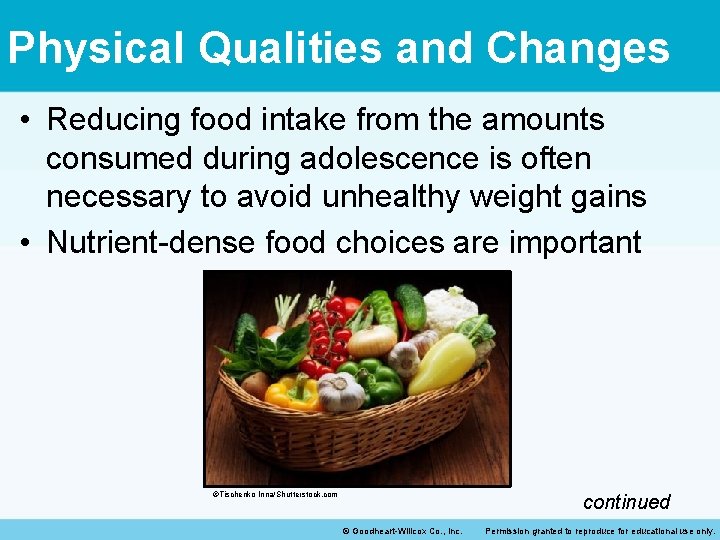
Physical Qualities and Changes • Reducing food intake from the amounts consumed during adolescence is often necessary to avoid unhealthy weight gains • Nutrient-dense food choices are important ©Tischenko Inna/Shutterstock. com continued © Goodheart-Willcox Co. , Inc. Permission granted to reproduce for educational use only.
Physical Qualities and Changes • The Physical Activity Guidelines for Americans recommend adults participate in 150 minutes of moderate or 75 minutes of vigorous physical activity per week • Aerobic and muscle-strengthening activities are important for maintaining physical health continued © Goodheart-Willcox Co. , Inc. Permission granted to reproduce for educational use only.
Physical Qualities and Changes • On average, adults need 7 to 9 hours of sleep per night • The body needs sleep to relax and revitalize • During early adulthood, people may experience insomnia • Getting the necessary hours of sleep each night is important to maintaining health continued © Goodheart-Willcox Co. , Inc. Permission granted to reproduce for educational use only.
Physical Qualities and Changes • Medical and dental exams continue to be important during early adulthood • Family medical history is important to review with the doctor • Healthful lifestyle choices during early adulthood can act as preventive health measures for the future continued © Goodheart-Willcox Co. , Inc. Permission granted to reproduce for educational use only.
Physical Qualities and Changes • Experimentation with alcohol is often more prevalent for young adults • Binge drinking is especially common during the transitional years and can lead to alcoholism • Alcohol is a toxin and impairs the body’s ability to physically and mentally function continued © Goodheart-Willcox Co. , Inc. Permission granted to reproduce for educational use only.
Physical Qualities and Changes • Alcoholism affects physical health, personal relationships, and work performance • Support groups, hotlines, and therapy sessions can help a person struggling with an addiction • For others, programs such as rehabilitation may be a necessary intervention © Goodheart-Willcox Co. , Inc. Permission granted to reproduce for educational use only.
Checkpoint 1. Describe common physical qualities and capabilities that can be expected in young adulthood. ü (Answers will vary, but should reflect an understanding of text pages 242– 243. ) 2. Which nutrient needs increase during young adulthood? ü calcium, iron, potassium, zinc, vitamin D, and the B vitamins continued © Goodheart-Willcox Co. , Inc. Permission granted to reproduce for educational use only.
Checkpoint 3. List four factors that can contribute to insomnia. ü (Answers will vary, but may include the following: ) stress; anxiety; depression; caffeine, nicotine, and alcohol; medications; medical conditions; change in work schedule; irregular sleep schedules or uncomfortable sleep environment continued © Goodheart-Willcox Co. , Inc. Permission granted to reproduce for educational use only.
Checkpoint 4. How can young adults make healthful lifestyle choices to act as preventive health measures for the future? ü by maintaining regular sleep, eating, and physical activity habits; by maintaining oral care and hygiene; and by monitoring lifestyle choices, such as avoiding high-risk behaviors continued © Goodheart-Willcox Co. , Inc. Permission granted to reproduce for educational use only.
Checkpoint 5. Define the terms binge drinking and alcoholism. ü Binge drinking is the heavy consumption of alcohol over a short period of time. Alcoholism is the addiction to alcohol. 6. What types of resources are available to help alcoholics? ü support groups, such as Alcoholics Anonymous; hotlines, pamphlets, and therapy sessions; intervention programs such as rehabilitation © Goodheart-Willcox Co. , Inc. Permission granted to reproduce for educational use only.
Signs of Cognitive Change • Fluid intelligence, the ability to reason abstractly, is at a peak in young adulthood • Crystallized intelligence is the focus of much of this stage • Many inventions, social movements, and new ways of approaching life have come from young adults continued © Goodheart-Willcox Co. , Inc. Permission granted to reproduce for educational use only.
Signs of Cognitive Change • Piaget’s final stage of cognitive development, or formal operations, emerges in adolescence and continues throughout adulthood • Some researchers have proposed that much cognitive development happens after adolescence, which they have termed the postformal stage continued © Goodheart-Willcox Co. , Inc. Permission granted to reproduce for educational use only.
Signs of Cognitive Change • The prefrontal cortex of the brain, which regulates emotions and impulse control, is not fully developed until about age 26 • After this age, young adults rely less on emotions in their cognitive reasoning • They are able to think deeply and more realistically about many issues continued © Goodheart-Willcox Co. , Inc. Permission granted to reproduce for educational use only.
Signs of Cognitive Change • A transition occurs in communication style from adolescence to early adulthood • In adulthood, the expectations for professional conversation and written skills can be a very big change • In addition to written language, verbal and nonverbal skills are important continued © Goodheart-Willcox Co. , Inc. Permission granted to reproduce for educational use only.
Signs of Cognitive Change • Kohlberg’s final stage of moral development is postconventional morality • During this stage, adults begin to care about the community, environment, and society • Values and ethics become factors in making decisions • This moral stage is less egocentric and, therefore, differs from earlier stages © Goodheart-Willcox Co. , Inc. Permission granted to reproduce for educational use only.
Checkpoint 1. What is the difference between fluid and crystallized intelligence? ü Fluid intelligence contains abstract reasoning, while crystallized intelligence includes the judgment, knowledge, and skills needed in life and work. continued © Goodheart-Willcox Co. , Inc. Permission granted to reproduce for educational use only.
Checkpoint 2. How do young adult cognitive skills differ from adolescent cognitive skills? ü Adults are better at dealing with complex questions; more readily accept the reality of seemingly “fuzzy” problems; understand that a solution may be appropriate in one context, but inappropriate in another; and tend to be less concerned with finding the one right answer and more concerned with practical results. continued © Goodheart-Willcox Co. , Inc. Permission granted to reproduce for educational use only.
Checkpoint 3. Define postformal stage. ü stage of development occurring after adolescence in which adults are better able to deal with complex questions they may never fully answer 4. What are the two types of communication? ü verbal and nonverbal continued © Goodheart-Willcox Co. , Inc. Permission granted to reproduce for educational use only.
Checkpoint 5. What is Kohlberg’s final stage of moral development? How does this moral stage differ from earlier stages? ü postconventional morality, it is less egocentric than the earlier stages © Goodheart-Willcox Co. , Inc. Permission granted to reproduce for educational use only.
Signs of Socio-emotional Change • Young adults are establishing their identity, making decisions, and taking responsibility for themselves and others • Erikson captured early adulthood as the stage when faced with making social decisions • He referred to this as the intimacy versus isolation phase continued © Goodheart-Willcox Co. , Inc. Permission granted to reproduce for educational use only.
Signs of Socio-emotional Change • Intimacy refers to the self-disclosure and sharing of private thoughts and emotions • During the transition to adulthood, young adults alter their relationships with family members • Sibling relationships also change as people enter adulthood continued © Goodheart-Willcox Co. , Inc. Permission granted to reproduce for educational use only.
Signs of Socio-emotional Change • Friendships are an important aspect of young adulthood • Friendships in early adulthood differ from earlier stages in life • In addition to changing relationships, entirely new friendships form from new environments continued © Goodheart-Willcox Co. , Inc. Permission granted to reproduce for educational use only.
Signs of Socio-emotional Change • Intimacy can occur in friendships, family relationships, and romantic relationships • When forming new relationships, intimacy gradually develops as trust is established • Developing trusting and intimate relationships is a key task during early adulthood continued © Goodheart-Willcox Co. , Inc. Permission granted to reproduce for educational use only.
Signs of Socio-emotional Change • Young adults who show a secure attachment style perceive relationships positively • Some young adults exhibit an avoidant attachment style • Others show an anxious attachment style continued © Goodheart-Willcox Co. , Inc. Permission granted to reproduce for educational use only.
Signs of Socio-emotional Change • There are many different types of love people experience in relationships • Friendly love is care and consideration for another • Affectionate love involves romantic ways of expressing love for each other, which are not necessarily sexual continued © Goodheart-Willcox Co. , Inc. Permission granted to reproduce for educational use only.
Signs of Socio-emotional Change • Romantic love creates feelings of security and care and appreciation for each other • Consummate love is the combination of affectionate love and a desire to commit to the relationship • Love differs from infatuation continued © Goodheart-Willcox Co. , Inc. Permission granted to reproduce for educational use only.
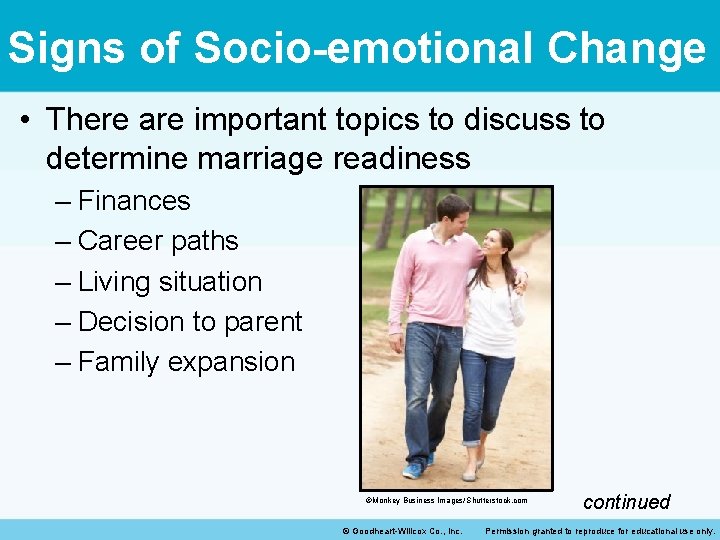
Signs of Socio-emotional Change • There are important topics to discuss to determine marriage readiness – Finances – Career paths – Living situation – Decision to parent – Family expansion ©Monkey Business Images/Shutterstock. com © Goodheart-Willcox Co. , Inc. continued Permission granted to reproduce for educational use only.
Signs of Socio-emotional Change • Early in marriage, partners often have to adjust to new lifestyle changes • All relationships experience conflict, which is a healthy, normal part of relationships • When making decisions or arguing, spouses need to learn to compromise continued © Goodheart-Willcox Co. , Inc. Permission granted to reproduce for educational use only.
Signs of Socio-emotional Change • Choosing to become a parent is a permanent decision that requires careful consideration • Parenting carries with it certain roles and responsibilities • Parents often have unconditional love for their children continued © Goodheart-Willcox Co. , Inc. Permission granted to reproduce for educational use only.
Signs of Socio-emotional Change • The ability to meet some of a child’s needs is related to the family’s financial ability • To meet the physical, cognitive, and socioemotional needs of children, parents make personal sacrifices and adjustments • Children can offer tremendous, unique rewards continued © Goodheart-Willcox Co. , Inc. Permission granted to reproduce for educational use only.
Signs of Socio-emotional Change • When conflicts arise, open communication can help resolve an issue and relieve tension and stress • Sometimes, even with counseling and effort from both partners, the relationship is still dysfunctional continued © Goodheart-Willcox Co. , Inc. Permission granted to reproduce for educational use only.
Signs of Socio-emotional Change • Breakups, separation, and divorce can feel tragic to those involved • Children especially feel the impact of divorce • About half of divorced adults remarry • Stepfamilies present their own challenges in family relationships continued © Goodheart-Willcox Co. , Inc. Permission granted to reproduce for educational use only.
Signs of Socio-emotional Change • Individuals in early adulthood face many cultural influences and expectations • Family members and culture may influence young adults’ postsecondary decisions • Individuals may deviate from expected timelines or choose not to follow expectations • One rising trend in U. S. culture is singlehood © Goodheart-Willcox Co. , Inc. Permission granted to reproduce for educational use only.
Checkpoint 1. Define social clock. ü cultural expectations of when major life milestones should occur 2. What is the primary socio-emotional task of early adulthood? ü intimacy versus isolation continued © Goodheart-Willcox Co. , Inc. Permission granted to reproduce for educational use only.
Checkpoint 3. How do relationships with parents change in early adulthood? ü Young adults tend to get along better with their parents than they did as adolescents. Parents are a source of emotional and often financial support as young adults begin to establish financial independence. 4. Name the different kinds of love. ü friendly, affectionate, romantic, and consummate continued © Goodheart-Willcox Co. , Inc. Permission granted to reproduce for educational use only.
Checkpoint 5. List five important topics couples discuss to help determine marriage readiness. ü finances, career paths, living situation, the decision to parent, and family expansion 6. What is the most important function of parenting? ü meeting the children’s needs continued © Goodheart-Willcox Co. , Inc. Permission granted to reproduce for educational use only.
Checkpoint 7. What are some of the pressures young adults feel from cultural influences? ü which postsecondary option to choose, how to manage personal relationships, and when to have children © Goodheart-Willcox Co. , Inc. Permission granted to reproduce for educational use only.
Special Needs • For some people, special needs are acquired or discovered in early adulthood • One disorder detected in the latter teen years or early adulthood is bipolar disorder • One disorder that can be acquired in early adulthood is post traumatic stress disorder • Adults with severe cognitive disorders may need frequent help from caregivers © Goodheart-Willcox Co. , Inc. Permission granted to reproduce for educational use only.
Checkpoint 1. Describe characteristics of bipolar disorder. ü manic phases including high energy, irritability, and impulsive behavior; also depressive phases including fatigue, loss of interest in favored activities, and changes in eating or sleeping continued © Goodheart-Willcox Co. , Inc. Permission granted to reproduce for educational use only.
Checkpoint 2. What is PTSD? What are some of the effects of PTSD? ü Post traumatic stress disorder (PTSD) is a condition that results when an individual experiences a dangerous, horrific situation. Feelings of anxiety, anger, and fear, as well as difficulty sleeping, nightmares, tenseness, or feeling a loss of emotions are common effects. 3. What are mental health adult living facilities? ü facilities that offer a transition from home and assistance and supervision with daily living © Goodheart-Willcox Co. , Inc. Permission granted to reproduce for educational use only.