Ch 5 Gdels Theorem Limits on Logic Jason
- Slides: 27
Ch 5 - Gödel's Theorem Limits on Logic Jason Hand. Uber
n “…there have been within the experience of people now living at least three serious crises…There have been two such crises in physics…The third crisis was in mathematics. It was a very serious conceptual crisis, dealing with rigor and the proper way to carry out a correct mathematical proof. In view of the earlier notions of the absolute rigor of mathematics, it is surprising that such a thing could have happened, and even more surprising that it could have happened in these latter days when miracles are not supposed to take place. Yet it did happen. ”
Overview Who is Gödel? n History and such n Necessary Definitions n Gödel Numbering n Gödel’s Theorem n Effects & Abuses of Gödel’s Theorem n References, Discussion, Questions… n
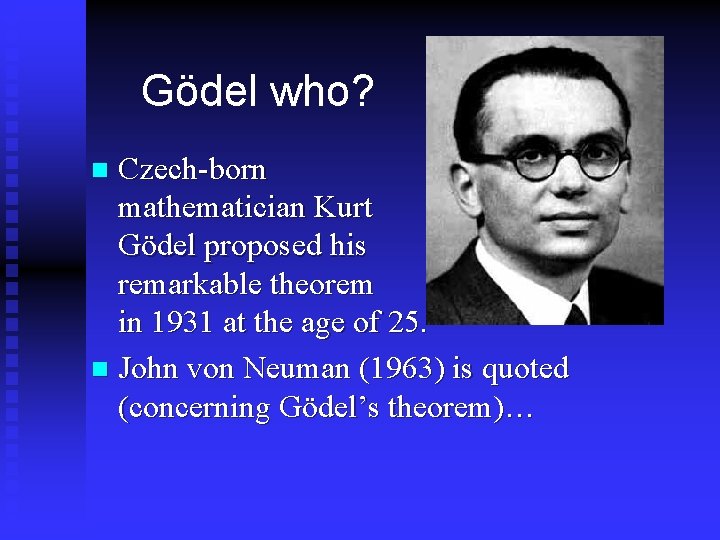
Gödel who? Czech-born mathematician Kurt Gödel proposed his remarkable theorem in 1931 at the age of 25. n John von Neuman (1963) is quoted (concerning Gödel’s theorem)… n
Before 1931 n n In the early 1900’s there was a quest within the mathematical community to reduce all of number theory to a formal axiomatic system. Such a system would start off with a few simple axioms and some mechanical way of deriving theorems from such axioms. Such a proof would yield a system that would represent every statement one could possibly make concerning natural numbers (i. e. a “Universal Truth Machine”).
Before (part deux) Gödel attempted his proof in the early 1930’s, attempting to show that “Principia Mathematica and related systems” were “complete”. n He proved that Principia Mathematica was either incomplete or inconsistent. Since it had been proven consistent, Gödel had shown it to be incomplete. Such “failure” led to Gödel’s theorem. n
1931 Gödel’s Theorem states (simplified): All axiomatic systems, including the whole of number theory, are incomplete. n In other words, for any formal (valid) axiomatic system, Gödel proved that their exists a statement which is true but cannot be proven using the conventions of the given system. n
After 1931 n Hermann Weyl (1946): “We are less certain than ever about the ultimate foundation of (logic and) mathematics… Outwardly it does not seem to hamper our daily work, and yet I for one confess that it has had a considerable practical influence on my mathematical life: it directed my interests to fields I considered relatively “safe, ” and has been a constant drain on the enthusiasm and determination with which I pursued my research and work. This experience is probably shared by other mathematicians who are not indifferent to what their scientific endeavors mean in the context of man’s who caring and knowing, suffering and creative existence in the world.
Definitions Axiom – 1) A self-evident or universally recognized truth; a maxim: “It is an economic axiom as old as the hills that goods and services can only be paid for only with goods and services” (Albert Jay Nock). 2) An established rule, principle, or law. A selfevident principle or one that is accepted as true without proof as the basis for argument; a postulate.
Definitions n Axiomatic System - A logical system which possesses an explicitly stated set of axioms from which theorems can be derived.
Definitions n Completeness - Can a system solve all problems that can be posed of it, or, in particular, can it be used to reason about all properties of its own members? q For example, can a Turing machine be built that can decide which Turing machines halt on all input?
Definitions n Gödel Numbering – An elaborately clever system devised by Gödel that enables one to uniquely identify all possible statements created from Gödel’s building blocks. n. For instance…
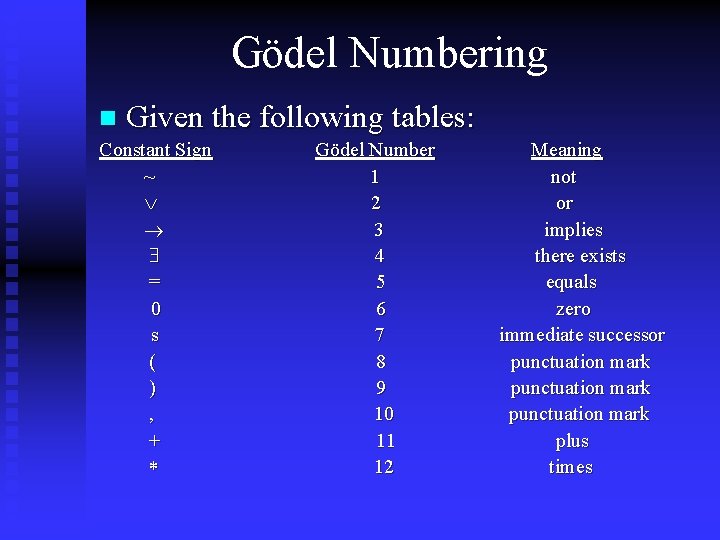
Gödel Numbering n Given the following tables: Constant Sign ~ = 0 s ( ) , + Gödel Number 1 2 3 4 5 6 7 8 9 10 11 12 Meaning not or implies there exists equals zero immediate successor punctuation mark plus times
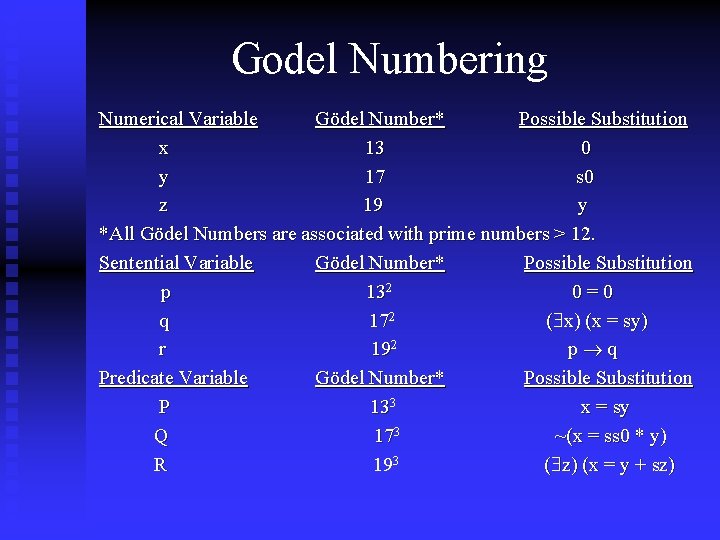
Godel Numbering Numerical Variable Gödel Number* Possible Substitution x 13 0 y 17 s 0 z 19 y *All Gödel Numbers are associated with prime numbers > 12. Sentential Variable Gödel Number* Possible Substitution p 132 0=0 q 172 ( x) (x = sy) r 192 p q Predicate Variable Gödel Number* Possible Substitution P 133 x = sy Q 173 ~(x = ss 0 * y) R 193 ( z) (x = y + sz)
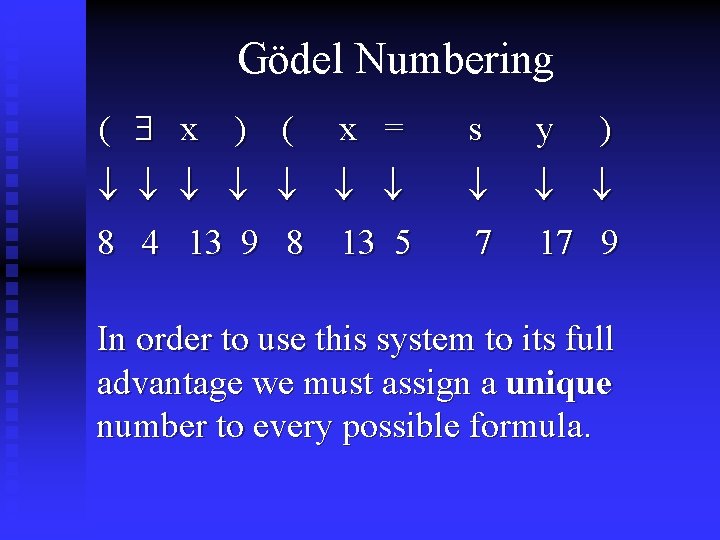
Gödel Numbering ( x ) ( x = 8 4 13 9 8 13 5 s y ) 7 17 9 In order to use this system to its full advantage we must assign a unique number to every possible formula.
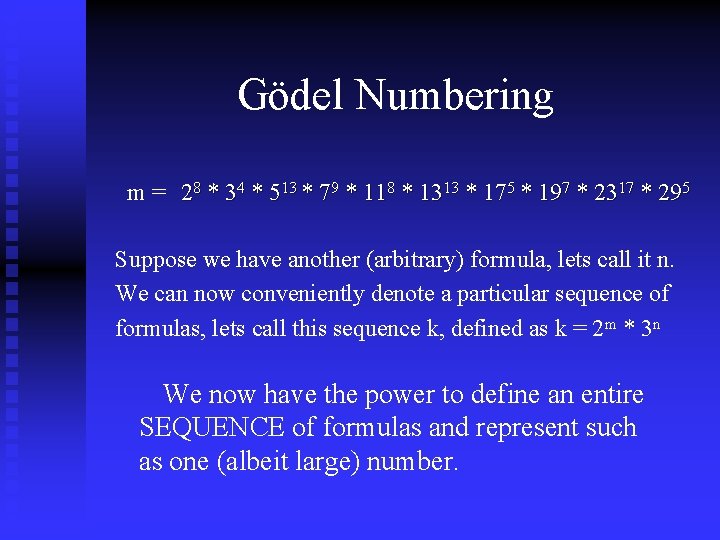
Gödel Numbering m = 28 * 34 * 513 * 79 * 118 * 1313 * 175 * 197 * 2317 * 295 Suppose we have another (arbitrary) formula, lets call it n. We can now conveniently denote a particular sequence of formulas, lets call this sequence k, defined as k = 2 m * 3 n We now have the power to define an entire SEQUENCE of formulas and represent such as one (albeit large) number.
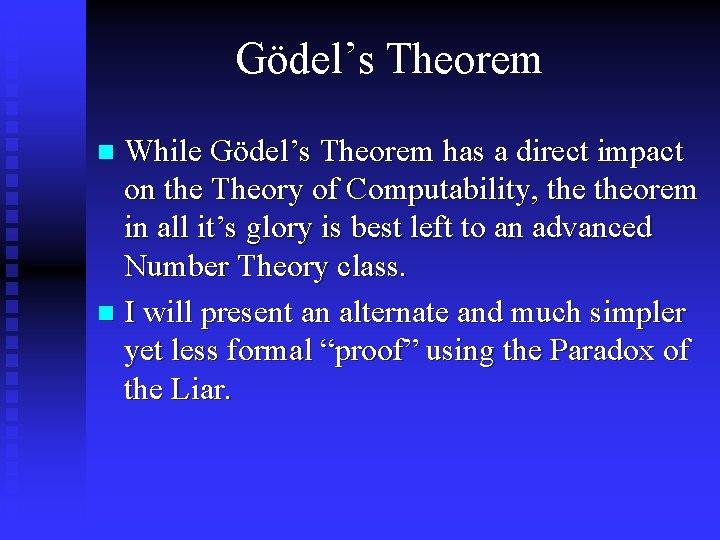
Gödel’s Theorem While Gödel’s Theorem has a direct impact on the Theory of Computability, theorem in all it’s glory is best left to an advanced Number Theory class. n I will present an alternate and much simpler yet less formal “proof” using the Paradox of the Liar. n
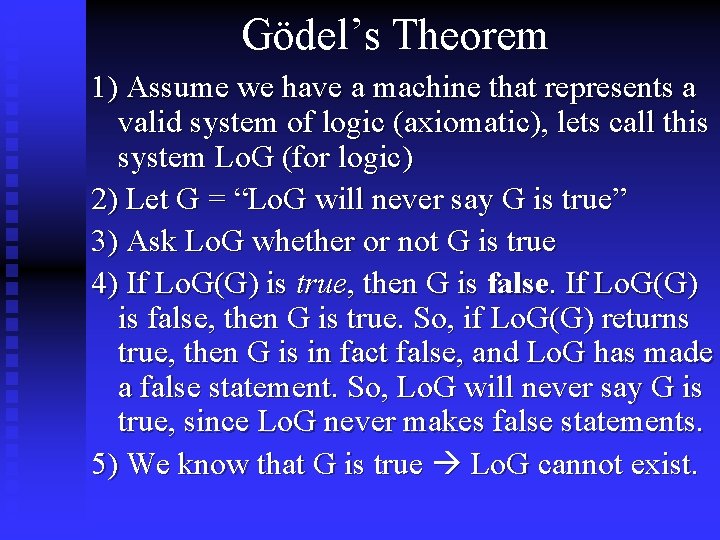
Gödel’s Theorem 1) Assume we have a machine that represents a valid system of logic (axiomatic), lets call this system Lo. G (for logic) 2) Let G = “Lo. G will never say G is true” 3) Ask Lo. G whether or not G is true 4) If Lo. G(G) is true, then G is false. If Lo. G(G) is false, then G is true. So, if Lo. G(G) returns true, then G is in fact false, and Lo. G has made a false statement. So, Lo. G will never say G is true, since Lo. G never makes false statements. 5) We know that G is true Lo. G cannot exist.
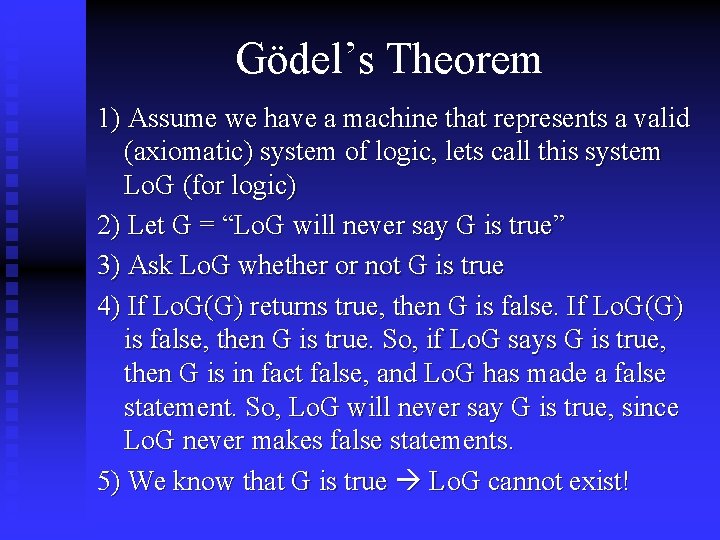
Gödel’s Theorem 1) Assume we have a machine that represents a valid (axiomatic) system of logic, lets call this system Lo. G (for logic) 2) Let G = “Lo. G will never say G is true” 3) Ask Lo. G whether or not G is true 4) If Lo. G(G) returns true, then G is false. If Lo. G(G) is false, then G is true. So, if Lo. G says G is true, then G is in fact false, and Lo. G has made a false statement. So, Lo. G will never say G is true, since Lo. G never makes false statements. 5) We know that G is true Lo. G cannot exist!
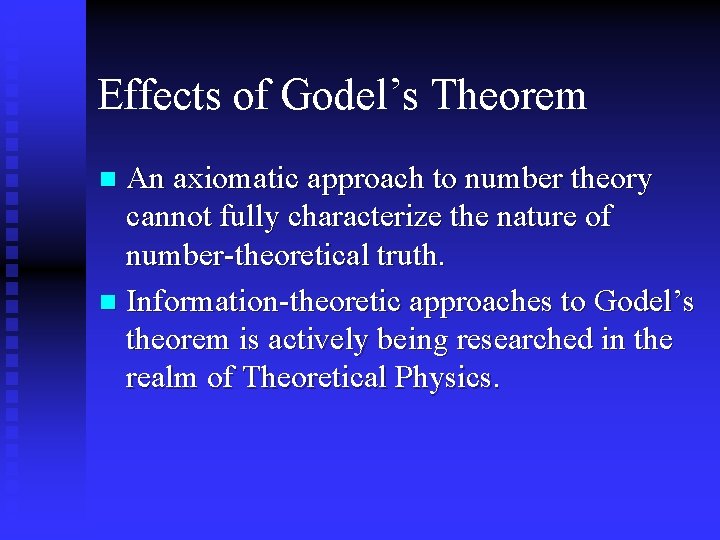
Effects of Godel’s Theorem An axiomatic approach to number theory cannot fully characterize the nature of number-theoretical truth. n Information-theoretic approaches to Godel’s theorem is actively being researched in the realm of Theoretical Physics. n
Information-theoretic approaches Suggests that the incompleteness phenomenon discovered by Godel is more natural and widespread rather than pathological and unusual. n Basic Conclusion: if a theorem contains more information than a given set of axioms, then it is impossible for theorem to be derived from the axioms. n
Gödel’s effects on C. S. Significant effects on Artificial Intelligence. n Dismisses the possibility of creating a “Universal Truth Machine” (based on an axiomatic scheme) or similar machines that could, given all axioms and valid rules (within some universe), deduce all truths (in such universe). n
Gödel and Artificial Intelligence n n n Gödel’s conclusions bear on the question whether a calculating machine can be constructed that would match the human brain in mathematical intelligence. Any machine which reasons solely on a fixed axiomatic method is incapable of answering innumerable problems in elementary number theory, no matter how complex or fast the machine may be. Consequently, there is no immediate prospect of replacing the human mind by robots.
Common Abuses of Gödel’s Theorem This theorem has been applied everywhere from philosophy to biology. n We must remember that the domain of Gödel’s theorem is axiomatic systems and axiomatic systems alone. n
References n n n n Nagel, Ernest. Newman, James. Gödel's Proof. New York University Press. 2001. - UCF Call # QA 9. 65. N 34 2001 Gödel’s Incompleteness Theorem http: //www. miskatonic. org/godel. html Gödel’s Theorem http: //www. cscs. umich. edu/~crshalizi/notebooks/godelstheorem. html Gödel’s Theorem and Information. http: //www. auckland. ac. nz/CDMTCS/chaitin/georgia. html Kenny’s Overview of Hofstadter’s Explanation of Gödel’s Theorem http: //www 2. ncsu. edu/unity/lockers/users/f/felder/public/kenny/pa pers/godel. html Mathematical Limitations to Software Estimation http: //www. idiom. com/~zilla/Work/Softestim/softestim. html Special thanks to Dr. Hughes
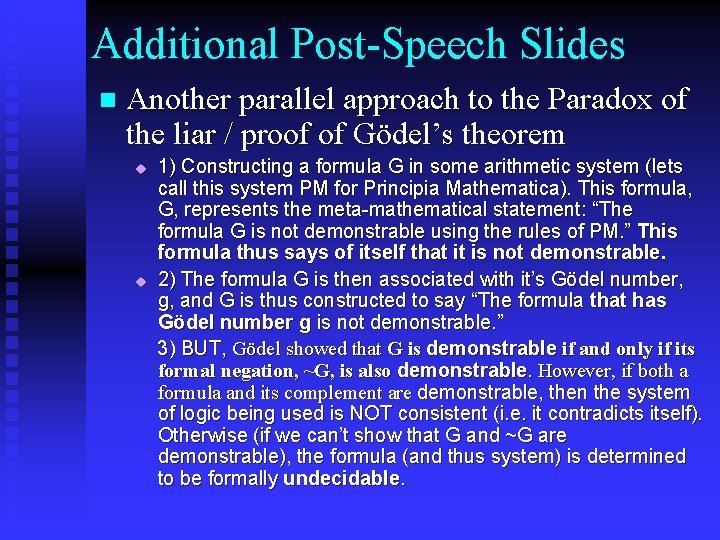
Additional Post-Speech Slides n Another parallel approach to the Paradox of the liar / proof of Gödel’s theorem u u 1) Constructing a formula G in some arithmetic system (lets call this system PM for Principia Mathematica). This formula, G, represents the meta-mathematical statement: “The formula G is not demonstrable using the rules of PM. ” This formula thus says of itself that it is not demonstrable. 2) The formula G is then associated with it’s Gödel number, g, and G is thus constructed to say “The formula that has Gödel number g is not demonstrable. ” 3) BUT, Gödel showed that G is demonstrable if and only if its formal negation, ~G, is also demonstrable. However, if both a formula and its complement are demonstrable, then the system of logic being used is NOT consistent (i. e. it contradicts itself). Otherwise (if we can’t show that G and ~G are demonstrable), the formula (and thus system) is determined to be formally undecidable.
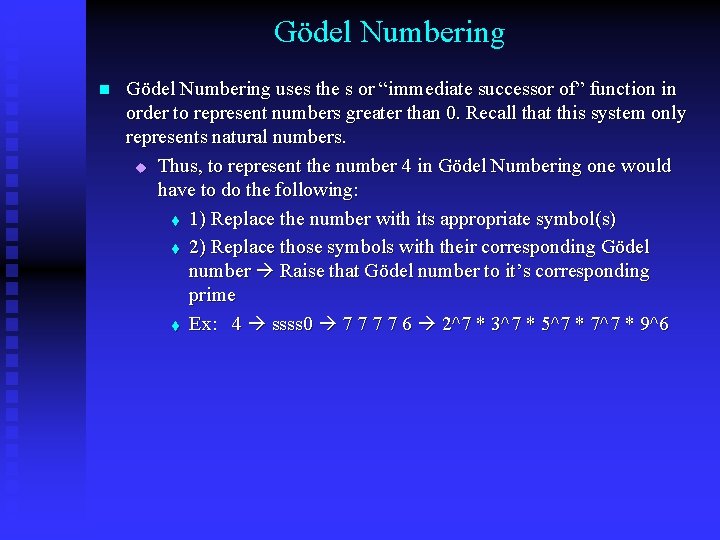
Gödel Numbering n Gödel Numbering uses the s or “immediate successor of” function in order to represent numbers greater than 0. Recall that this system only represents natural numbers. u Thus, to represent the number 4 in Gödel Numbering one would have to do the following: t 1) Replace the number with its appropriate symbol(s) t 2) Replace those symbols with their corresponding Gödel number Raise that Gödel number to it’s corresponding prime t Ex: 4 ssss 0 7 7 6 2^7 * 3^7 * 5^7 * 7^7 * 9^6