Ch 20 Magnetic Fields Forces Copyright 2009 Pearson

- Slides: 40
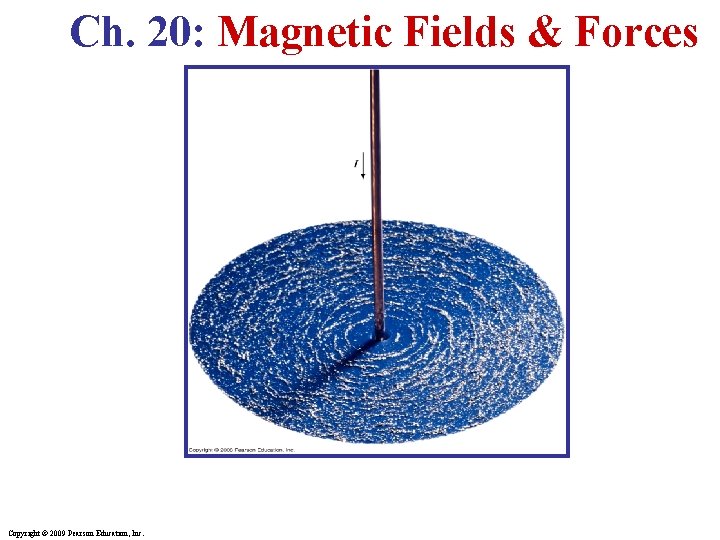
Ch. 20: Magnetic Fields & Forces Copyright © 2009 Pearson Education, Inc.
Magnetism Outline • Magnets & Magnetic Fields B Fields Electric Currents Produce B Fields!! • Force on Electric Current in a B Field; Definition of B • Force on a moving Electric Charge in a B Field • Torque on a Current Loop • Magnetic Dipole Moment μ Copyright © 2009 Pearson Education, Inc.
Outline Applications: • Motors, Loudspeakers, Galvanometers • Discovery & Properties of the Electron • The Hall Effect • Mass Spectrometer Copyright © 2009 Pearson Education, Inc.
Brief History of Magnetism th • 13 Century BC: The Chinese used a compass. –Uses a magnetic needle –Probably an invention of Arabic or Indian origin • 800 BC: The Greeks –Discovered that magnetite (Fe 3 O 4) attracts pieces of iron Copyright © 2009 Pearson Education, Inc.
History • 1269: Pierre de Maricourt –Found that the direction of a needle near a spherical natural magnet formed lines that encircled the sphere. –The lines also passed through 2 points diametrically opposed to each other. He called the points poles Copyright © 2009 Pearson Education, Inc.
• 1600: William Gilbert –Expanded experiments with magnetism to a variety of Materials –Suggested the Earth itself was a large permanent magnet • 1750: Experimenters showed that magnetic poles exert attractive or repulsive forces on each other. • 1819: Found that an electric current deflected a compass needle Copyright © 2009 Pearson Education, Inc.
• 1819: Found that an electric current deflected a compass needle • 1820’s: Faraday and Henry –Found further connections between electricity and magnetism –A changing magnetic field creates an electric field. James Clerk Maxwell: • A changing electric field produces a magnetic field. Copyright © 2009 Pearson Education, Inc.
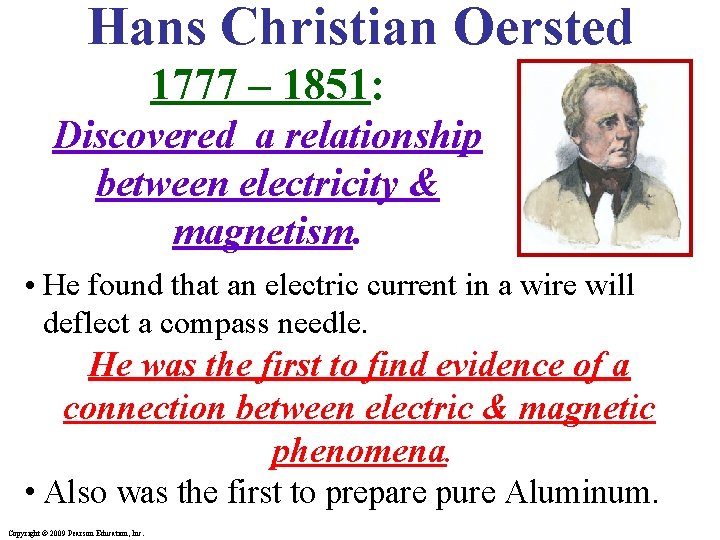
Hans Christian Oersted 1777 – 1851: Discovered a relationship between electricity & magnetism. • He found that an electric current in a wire will deflect a compass needle. He was the first to find evidence of a connection between electric & magnetic phenomena. • Also was the first to prepare pure Aluminum. Copyright © 2009 Pearson Education, Inc.
Magnetism Physics is an Experimental Science! Experiments show that: Magnetic fields are produced by moving electric charges Magnetic fields exert forces on other moving charges Copyright © 2009 Pearson Education, Inc.
Magnetism • The Focus of this chapter: –Understand the sources of magnetic fields & the fields they produce –Calculate the magnetic force on a charged particle • Magnetism & electricity are connected • More connections will be studied in later chapters Copyright © 2009 Pearson Education, Inc.
Magnets • The first observations of magnetic fields involved permanent magnets – Many ancient cultures discovered natural magnetic properties of materials: Magnetite & Others • Permanent magnet applications: – Compass needles – Speakers – Computer hard disks Copyright © 2009 Pearson Education, Inc.
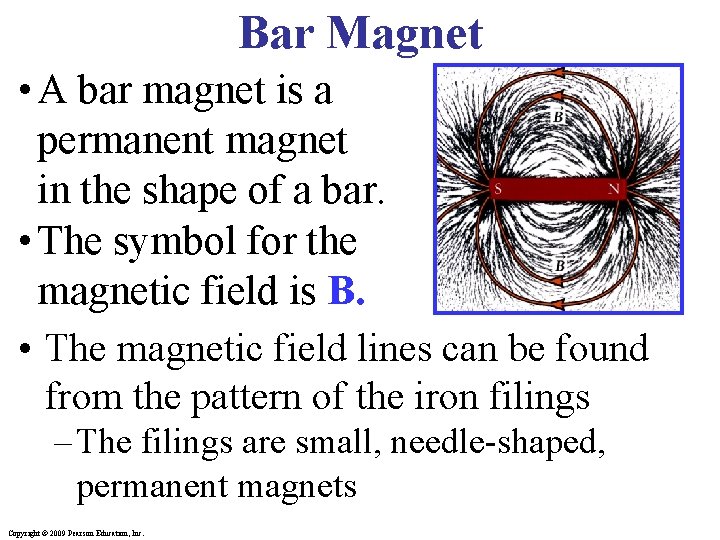
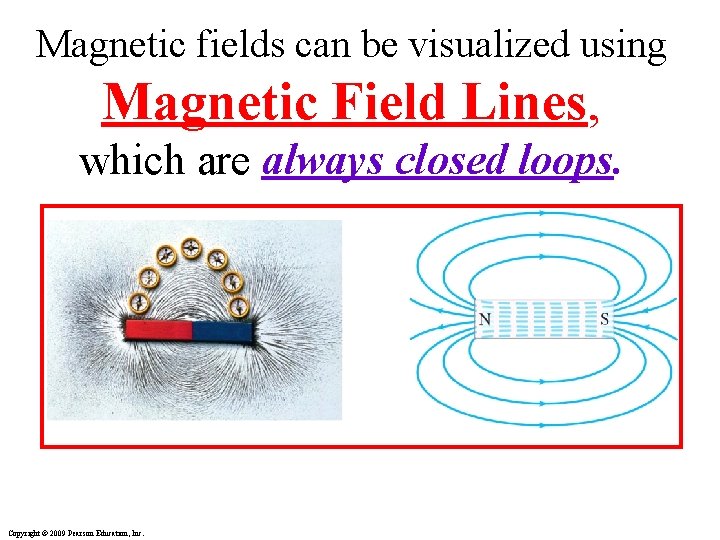
Bar Magnet • A bar magnet is a permanent magnet in the shape of a bar. • The symbol for the magnetic field is B. • The magnetic field lines can be found from the pattern of the iron filings – The filings are small, needle-shaped, permanent magnets Copyright © 2009 Pearson Education, Inc.
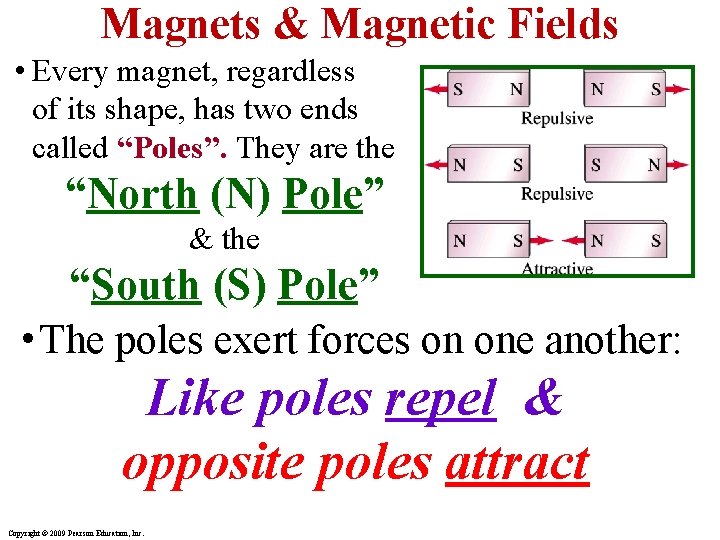
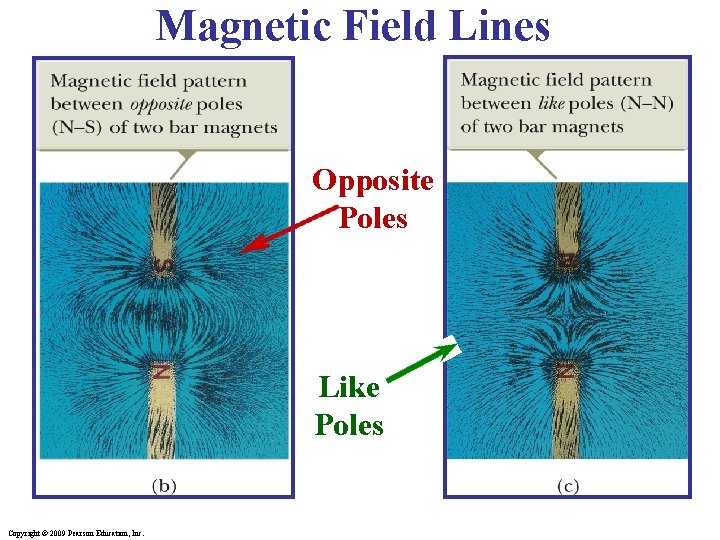
Magnets & Magnetic Fields • Every magnet, regardless of its shape, has two ends called “Poles”. They are the “North (N) Pole” & the “South (S) Pole” • The poles exert forces on one another: Like poles repel & opposite poles attract Copyright © 2009 Pearson Education, Inc.
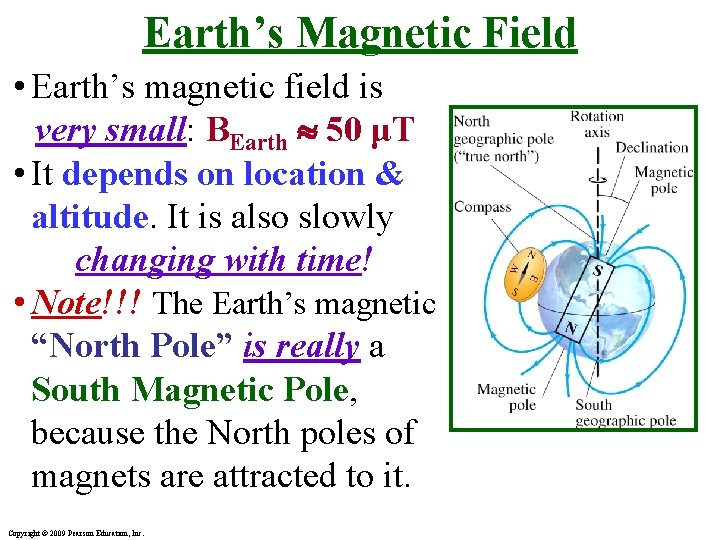
The poles received their names due to the way a magnet behaves in the Earth’s magnetic field: • If a bar magnet is suspended so that it can move freely, it will rotate. The North pole of a magnet points toward the Earth’s North magnetic pole. Copyright © 2009 Pearson Education, Inc.
• This means that Earth’s North magnetic pole is actually a magnetic South pole! • Similarly, the Earth’s South magnetic Pole is actually a magnetic North pole! Copyright © 2009 Pearson Education, Inc.
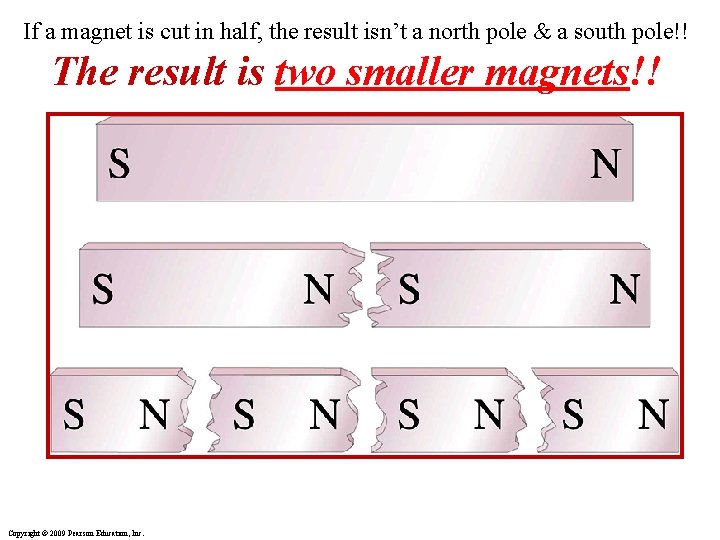
• The force between two poles varies as the inverse square of the distance between them. (Similar to the force between 2 point charges) A single magnetic pole has never been isolated. That is, magnetic poles are always found in pairs. • All attempts so far to detect an isolated magnetic pole (a magnetic monopole) have been unsuccessful. • No matter how many times a permanent magnet is cut in 2, each piece always has north & south poles. Copyright © 2009 Pearson Education, Inc.
If a magnet is cut in half, the result isn’t a north pole & a south pole!! The result is two smaller magnets!! Copyright © 2009 Pearson Education, Inc.
Magnetic Fields: Observations • Reminder: An electric field surrounds any electric charge. • Similarly, The region of space surrounding any MOVING electric charge also contains a magnetic field. Copyright © 2009 Pearson Education, Inc.
Magnetic Fields: Observations • A magnetic field also surrounds a magnetic substance making up a permanent magnet. • A magnetic field is a vector quantity. It is symbolized by B. • The direction of field B is given by the direction the North pole of a compass needle points in that location. • Iron filings can be used to show the field lines, as traced out by a compass, would look. Copyright © 2009 Pearson Education, Inc.
Magnetic fields can be visualized using Magnetic Field Lines, which are always closed loops. Copyright © 2009 Pearson Education, Inc.
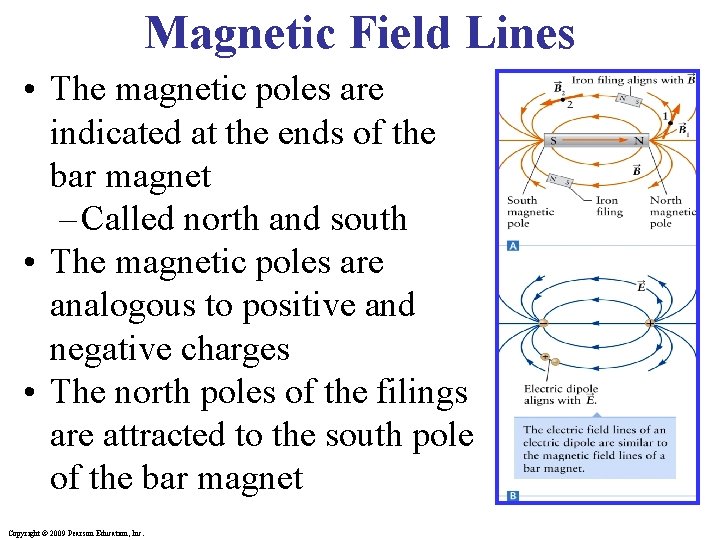
Magnetic Field Lines, Bar Magnet • A compass can be used to trace the field lines. • The lines outside the magnet point from the North pole to the South pole. • Iron filings can also be used to show the pattern of the magnetic field lines. • The direction of the magnetic field is the direction a north pole would point. Copyright © 2009 Pearson Education, Inc.
Magnetic Field Lines Opposite Poles Like Poles Copyright © 2009 Pearson Education, Inc.
Magnetic Field Lines • The magnetic poles are indicated at the ends of the bar magnet – Called north and south • The magnetic poles are analogous to positive and negative charges • The north poles of the filings are attracted to the south pole of the bar magnet Copyright © 2009 Pearson Education, Inc.
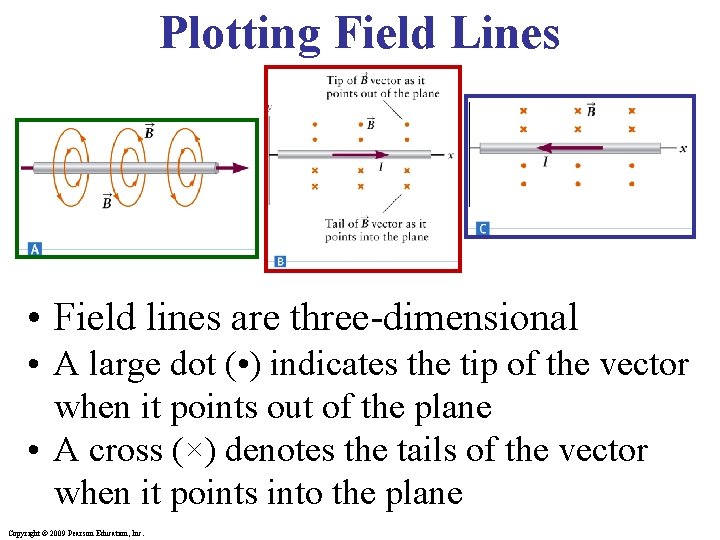
Plotting Field Lines • Field lines are three-dimensional • A large dot ( • ) indicates the tip of the vector when it points out of the plane • A cross (×) denotes the tails of the vector when it points into the plane Copyright © 2009 Pearson Education, Inc.
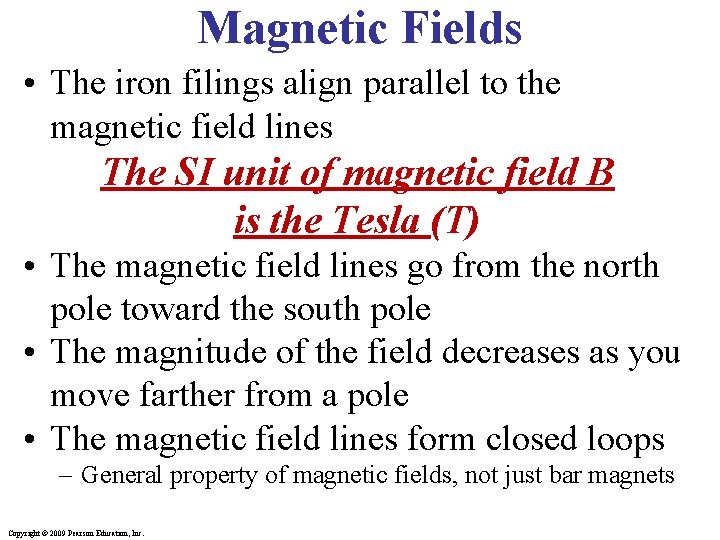
Magnetic Fields • The iron filings align parallel to the magnetic field lines The SI unit of magnetic field B is the Tesla (T) • The magnetic field lines go from the north pole toward the south pole • The magnitude of the field decreases as you move farther from a pole • The magnetic field lines form closed loops – General property of magnetic fields, not just bar magnets Copyright © 2009 Pearson Education, Inc.
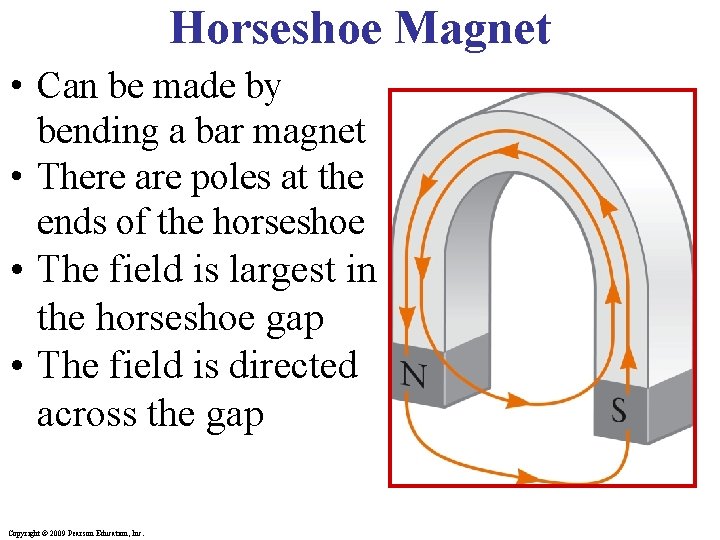
Horseshoe Magnet • Can be made by bending a bar magnet • There are poles at the ends of the horseshoe • The field is largest in the horseshoe gap • The field is directed across the gap Copyright © 2009 Pearson Education, Inc.
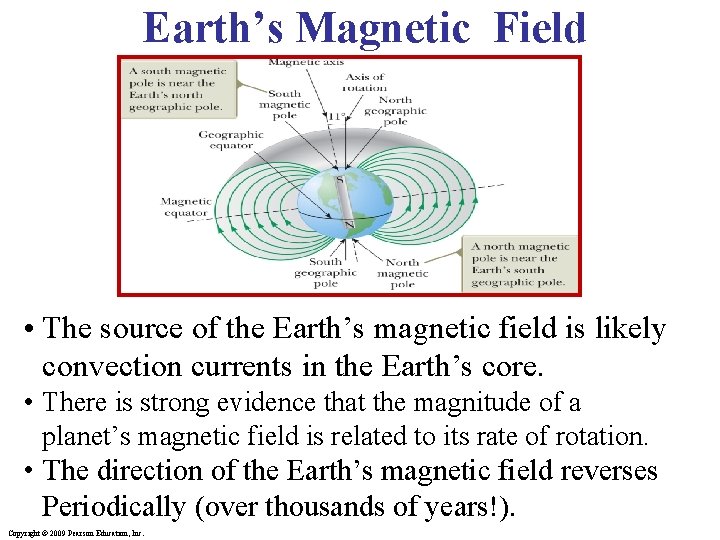
Earth’s Magnetic Field • Earth’s magnetic field is very small: BEarth 50 μT • It depends on location & altitude. It is also slowly changing with time! • Note!!! The Earth’s magnetic “North Pole” is really a South Magnetic Pole, because the North poles of magnets are attracted to it. Copyright © 2009 Pearson Education, Inc.
Earth’s Magnetic Field • The source of the Earth’s magnetic field is likely convection currents in the Earth’s core. • There is strong evidence that the magnitude of a planet’s magnetic field is related to its rate of rotation. • The direction of the Earth’s magnetic field reverses Periodically (over thousands of years!). Copyright © 2009 Pearson Education, Inc.
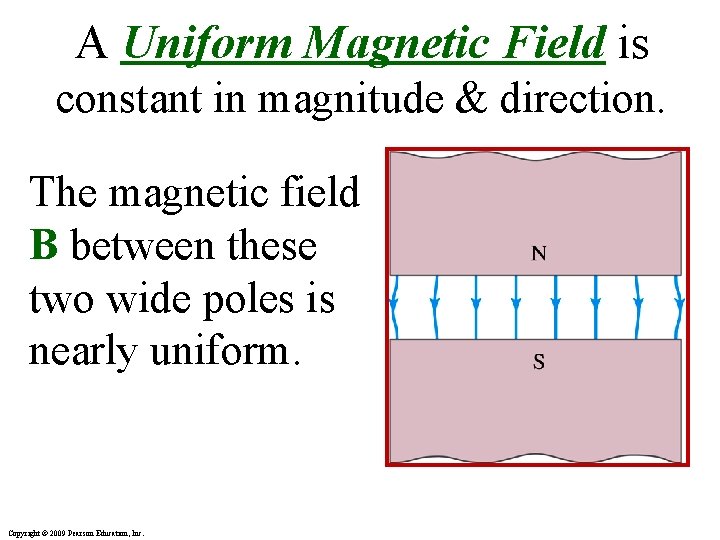
A Uniform Magnetic Field is constant in magnitude & direction. The magnetic field B between these two wide poles is nearly uniform. Copyright © 2009 Pearson Education, Inc.
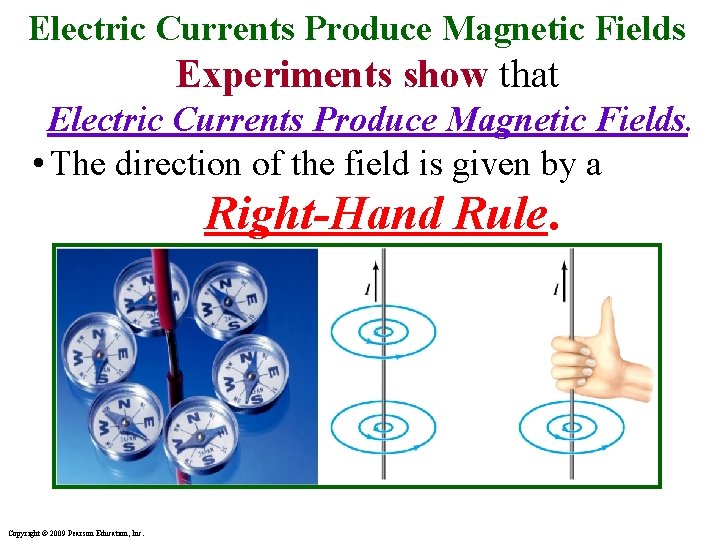
Electric Currents Produce Magnetic Fields Experiments show that Electric Currents Produce Magnetic Fields. • The direction of the field is given by a Right-Hand Rule. Copyright © 2009 Pearson Education, Inc.
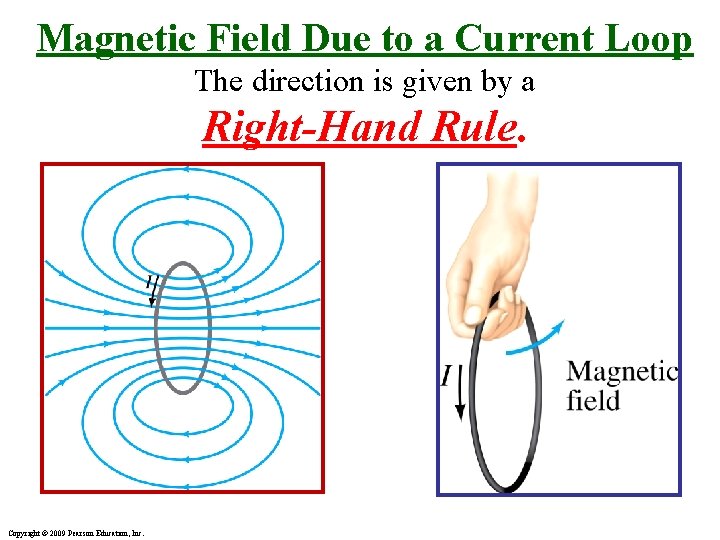
Magnetic Field Due to a Current Loop The direction is given by a Right-Hand Rule. Copyright © 2009 Pearson Education, Inc.
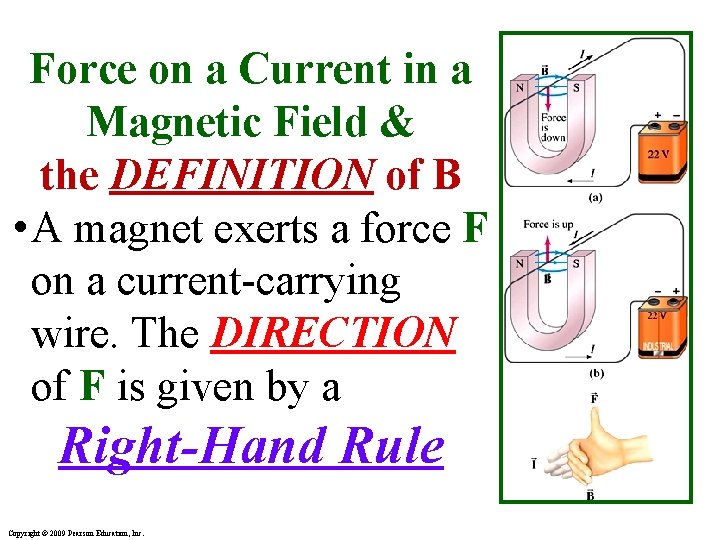
Force on a Current in a Magnetic Field & the DEFINITION of B • A magnet exerts a force F on a current-carrying wire. The DIRECTION of F is given by a Right-Hand Rule Copyright © 2009 Pearson Education, Inc.
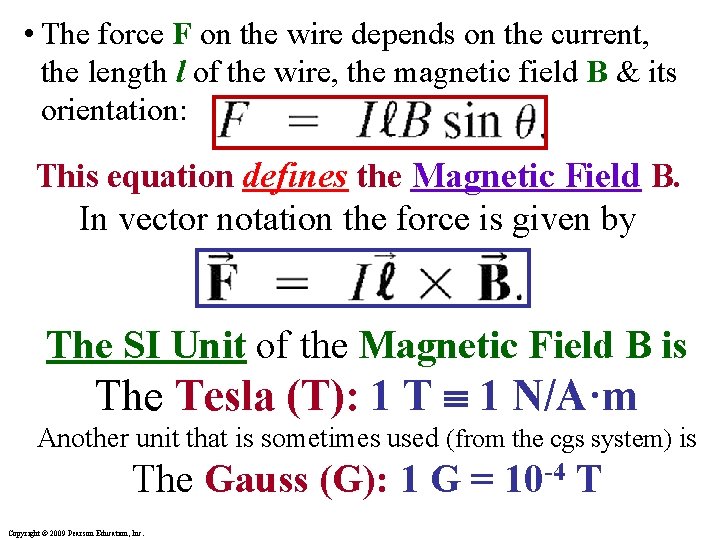
• The force F on the wire depends on the current, the length l of the wire, the magnetic field B & its orientation: This equation defines the Magnetic Field B. In vector notation the force is given by The SI Unit of the Magnetic Field B is The Tesla (T): 1 T 1 N/A·m Another unit that is sometimes used (from the cgs system) is The Gauss (G): 1 G = 10 -4 T Copyright © 2009 Pearson Education, Inc.
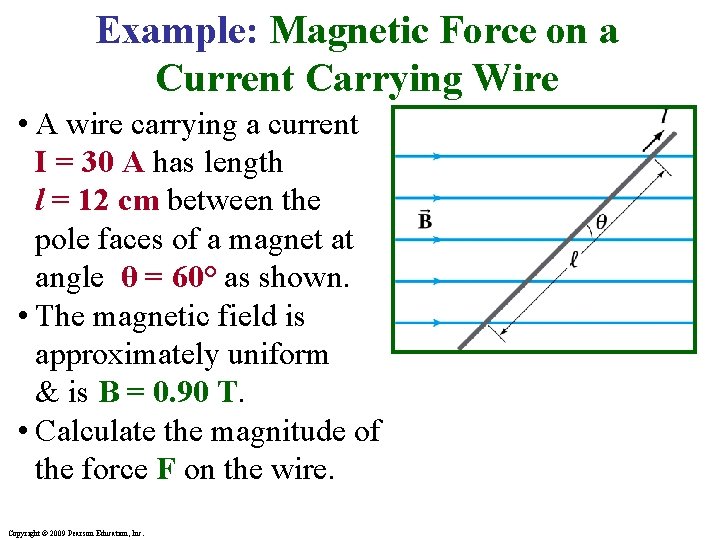
Example: Magnetic Force on a Current Carrying Wire • A wire carrying a current I = 30 A has length l = 12 cm between the pole faces of a magnet at angle θ = 60° as shown. • The magnetic field is approximately uniform & is B = 0. 90 T. • Calculate the magnitude of the force F on the wire. Copyright © 2009 Pearson Education, Inc.
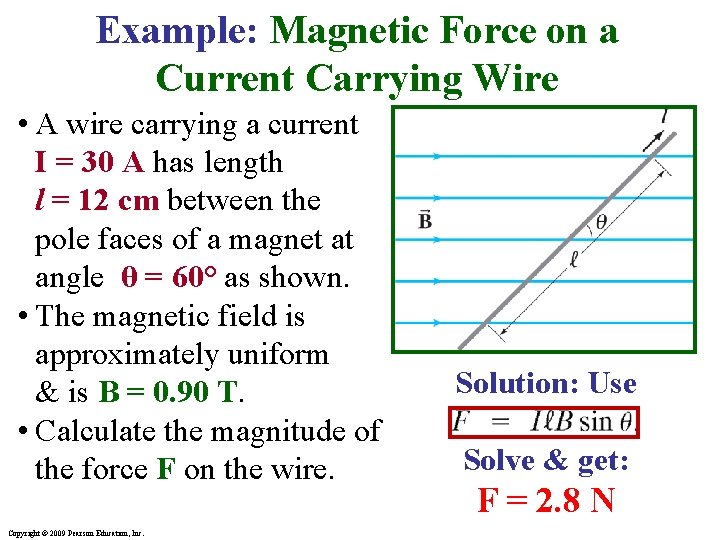
Example: Magnetic Force on a Current Carrying Wire • A wire carrying a current I = 30 A has length l = 12 cm between the pole faces of a magnet at angle θ = 60° as shown. • The magnetic field is approximately uniform & is B = 0. 90 T. • Calculate the magnitude of the force F on the wire. Copyright © 2009 Pearson Education, Inc. Solution: Use Solve & get: F = 2. 8 N
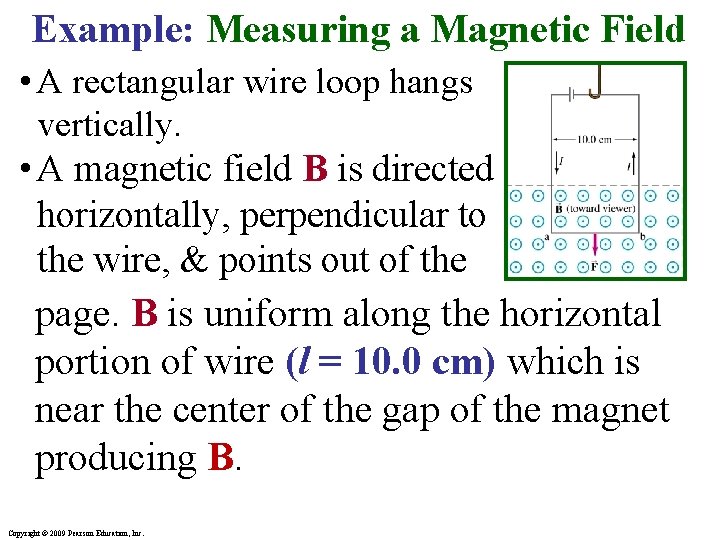
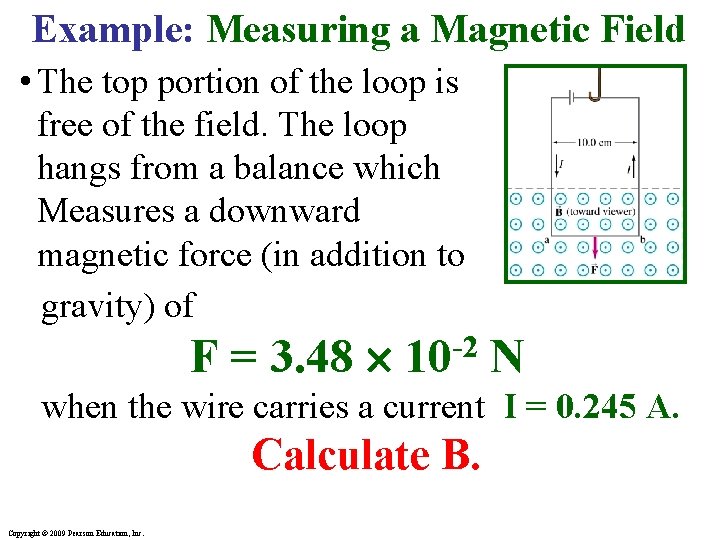
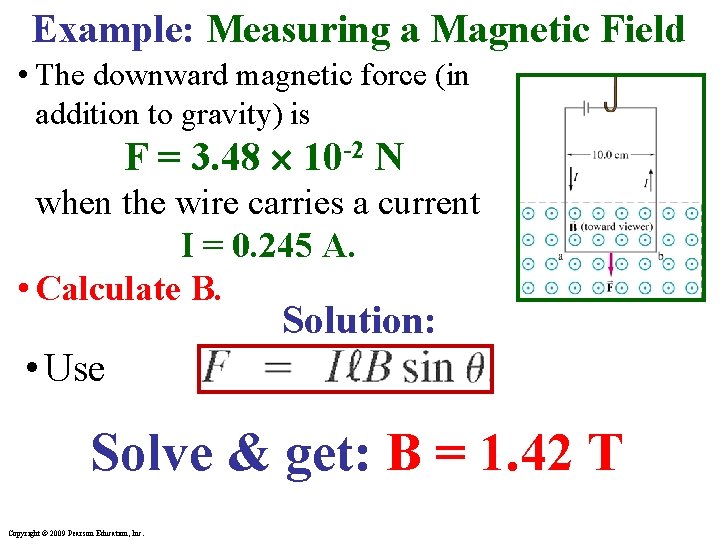
Example: Measuring a Magnetic Field • A rectangular wire loop hangs vertically. • A magnetic field B is directed horizontally, perpendicular to the wire, & points out of the page. B is uniform along the horizontal portion of wire (l = 10. 0 cm) which is near the center of the gap of the magnet producing B. Copyright © 2009 Pearson Education, Inc.
Example: Measuring a Magnetic Field • The top portion of the loop is free of the field. The loop hangs from a balance which Measures a downward magnetic force (in addition to gravity) of F = 3. 48 10 -2 N when the wire carries a current I = 0. 245 A. Calculate B. Copyright © 2009 Pearson Education, Inc.
Example: Measuring a Magnetic Field • The downward magnetic force (in addition to gravity) is F = 3. 48 10 -2 N when the wire carries a current I = 0. 245 A. • Calculate B. Solution: • Use Solve & get: B = 1. 42 T Copyright © 2009 Pearson Education, Inc.
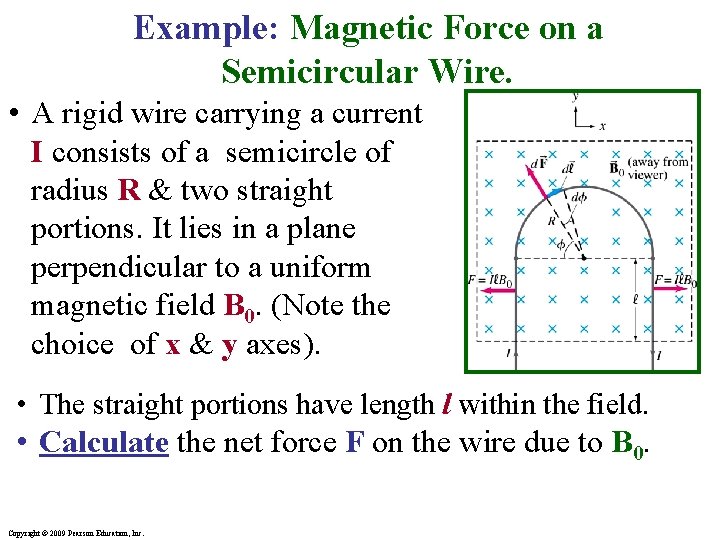
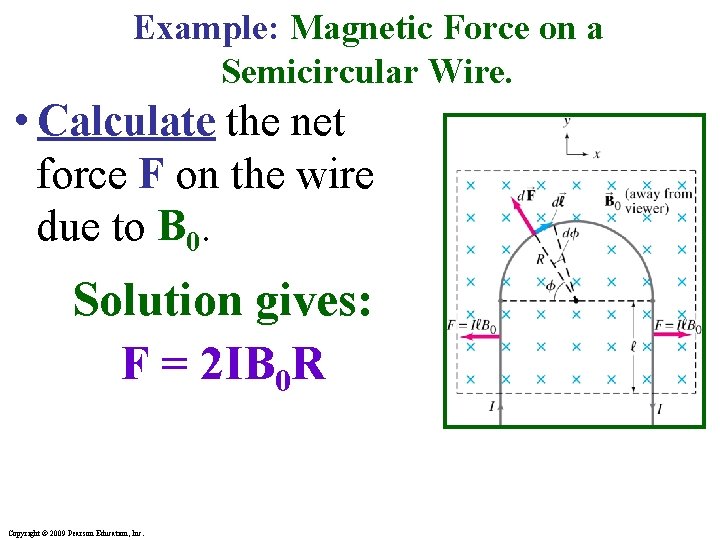
Example: Magnetic Force on a Semicircular Wire. • A rigid wire carrying a current I consists of a semicircle of radius R & two straight portions. It lies in a plane perpendicular to a uniform magnetic field B 0. (Note the choice of x & y axes). • The straight portions have length l within the field. • Calculate the net force F on the wire due to B 0. Copyright © 2009 Pearson Education, Inc.
Example: Magnetic Force on a Semicircular Wire. • Calculate the net force F on the wire due to B 0. Solution gives: F = 2 IB 0 R Copyright © 2009 Pearson Education, Inc.