Case Study Chemist Certification Program of Alcohol and
- Slides: 25
Case Study: Chemist Certification Program of Alcohol and Tobacco Tax and Trade Bureau (TTB) November 5, 2013 1
TTB Chemist Certification Overview of Certificates of Analysis How TTB Chemist Certification program works Results from the Certification program What about ISO 17025? What are the alternatives to ISO 17025 Certification? Summary 2
Certificates of Analysis Needed Certificates of Analysis (COAs) are currently required as a condition of entry in many markets. COAs need to be valid COAs need to be generated: ◦ Efficiently ◦ Economically 3
Requirements for Certificates of Analysis Validity ◦ Generating Laboratory/Chemist should be qualified/certified/accredited. ◦ Options 3 rd party accredited Government accredited ◦ Analysis Methods Data is compared to TTB’s values (which are generated by validated methods) 4
Requirements for Certificates of Analysis Efficient/Economical ◦ Number of samples received by the laboratory generating COAs must be within the capacity of the lab. ◦ The sample transportation and analysis costs must be reasonable, including for small or mixed lot shipments. ◦ The turnaround time for the COAs must be quick enough to not slow down trade. 5
Solution— TTB Chemist Certification Program Allows qualified and certified chemists in winery laboratories to generate Certificates of Analysis (COAs) under TTB supervision. 6
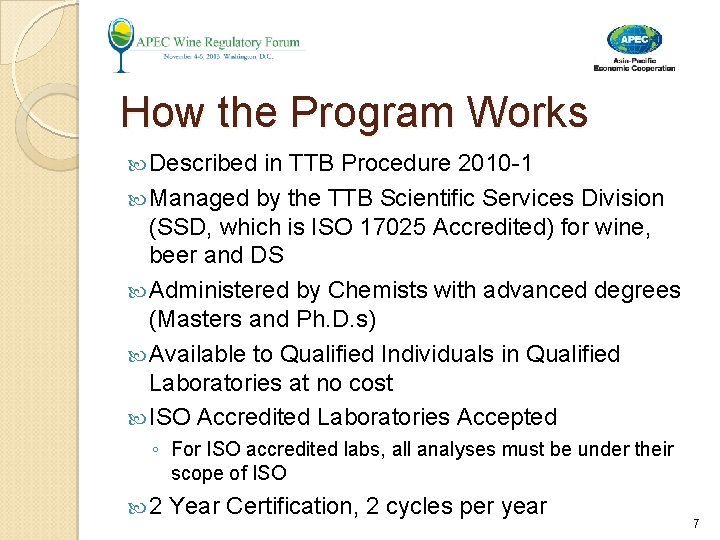
How the Program Works Described in TTB Procedure 2010 -1 Managed by the TTB Scientific Services Division (SSD, which is ISO 17025 Accredited) for wine, beer and DS Administered by Chemists with advanced degrees (Masters and Ph. D. s) Available to Qualified Individuals in Qualified Laboratories at no cost ISO Accredited Laboratories Accepted ◦ For ISO accredited labs, all analyses must be under their scope of ISO 2 Year Certification, 2 cycles per year 7
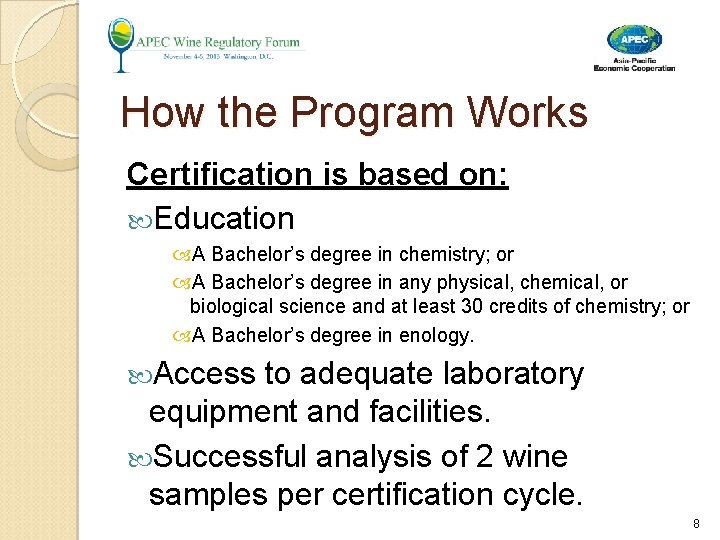
How the Program Works Certification is based on: Education A Bachelor’s degree in chemistry; or A Bachelor’s degree in any physical, chemical, or biological science and at least 30 credits of chemistry; or A Bachelor’s degree in enology. Access to adequate laboratory equipment and facilities. Successful analysis of 2 wine samples per certification cycle. 8
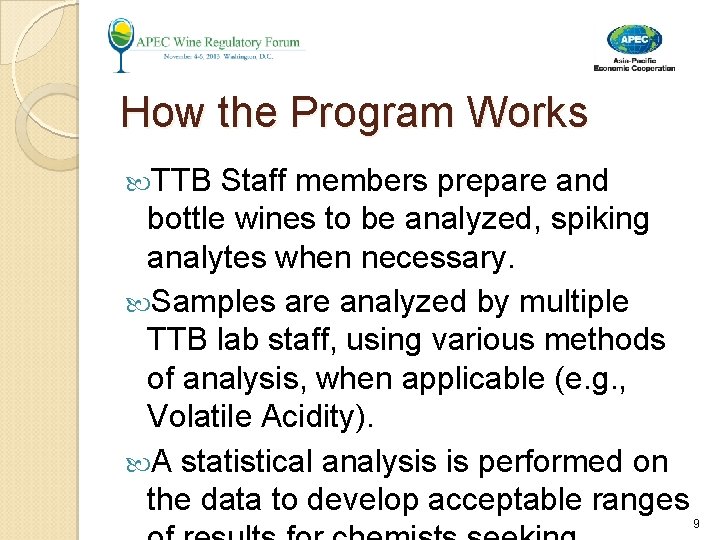
How the Program Works TTB Staff members prepare and bottle wines to be analyzed, spiking analytes when necessary. Samples are analyzed by multiple TTB lab staff, using various methods of analysis, when applicable (e. g. , Volatile Acidity). A statistical analysis is performed on the data to develop acceptable ranges 9
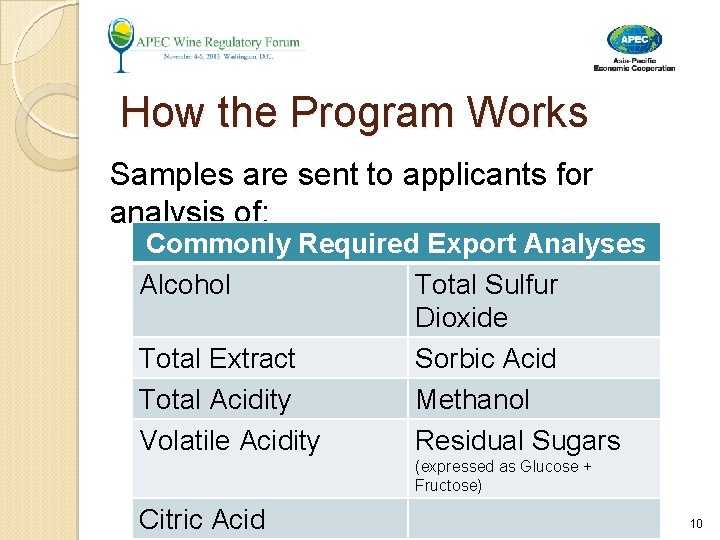
How the Program Works Samples are sent to applicants for analysis of: Commonly Required Export Analyses Alcohol Total Sulfur Dioxide Total Extract Sorbic Acid Total Acidity Methanol Volatile Acidity Residual Sugars (expressed as Glucose + Fructose) Citric Acid 10
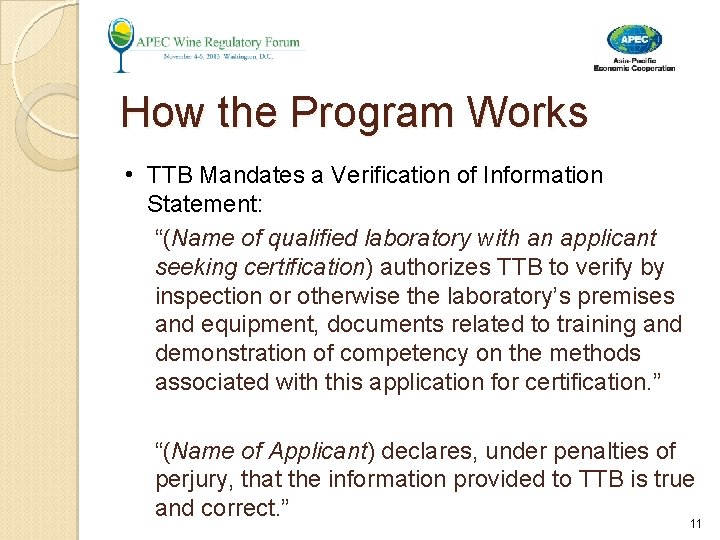
How the Program Works • TTB Mandates a Verification of Information Statement: “(Name of qualified laboratory with an applicant seeking certification) authorizes TTB to verify by inspection or otherwise the laboratory’s premises and equipment, documents related to training and demonstration of competency on the methods associated with this application for certification. ” “(Name of Applicant) declares, under penalties of perjury, that the information provided to TTB is true and correct. ” 11
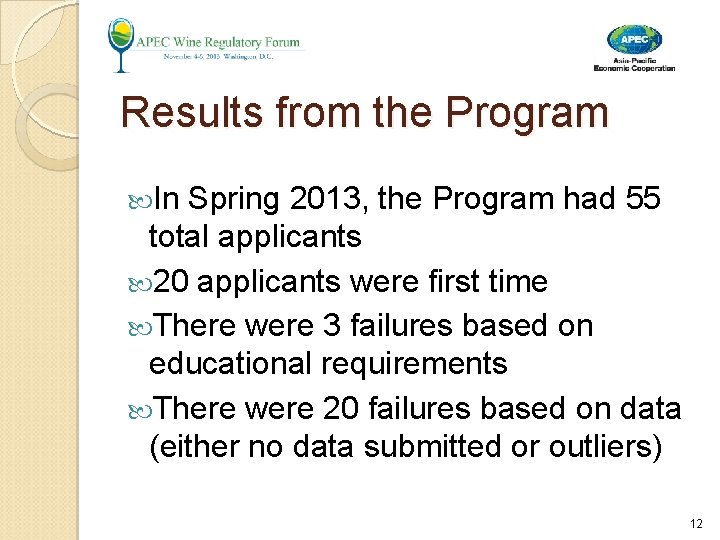
Results from the Program In Spring 2013, the Program had 55 total applicants 20 applicants were first time There were 3 failures based on educational requirements There were 20 failures based on data (either no data submitted or outliers) 12
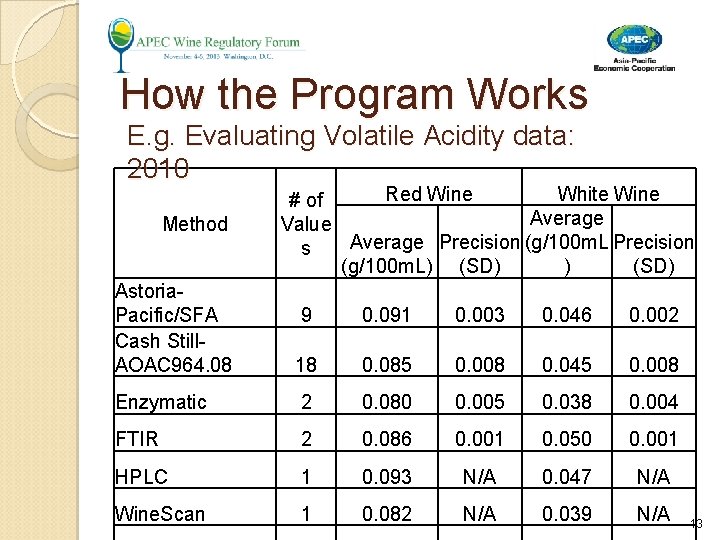
How the Program Works E. g. Evaluating Volatile Acidity data: 2010 Method Red Wine White Wine # of Average Value Average Precision (g/100 m. L Precision s (g/100 m. L) (SD) Astoria. Pacific/SFA Cash Still. AOAC 964. 08 9 0. 091 0. 003 0. 046 0. 002 18 0. 085 0. 008 0. 045 0. 008 Enzymatic 2 0. 080 0. 005 0. 038 0. 004 FTIR 2 0. 086 0. 001 0. 050 0. 001 HPLC 1 0. 093 N/A 0. 047 N/A Wine. Scan 1 0. 082 N/A 0. 039 N/A 13
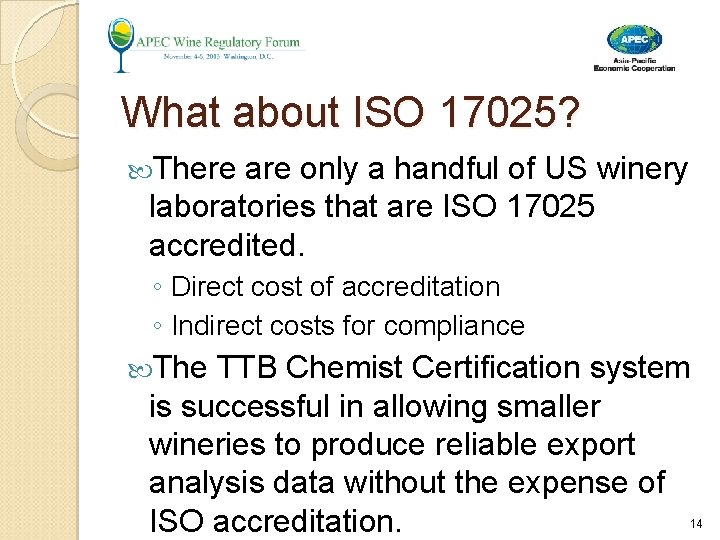
What about ISO 17025? There are only a handful of US winery laboratories that are ISO 17025 accredited. ◦ Direct cost of accreditation ◦ Indirect costs for compliance The TTB Chemist Certification system is successful in allowing smaller wineries to produce reliable export analysis data without the expense of ISO accreditation. 14
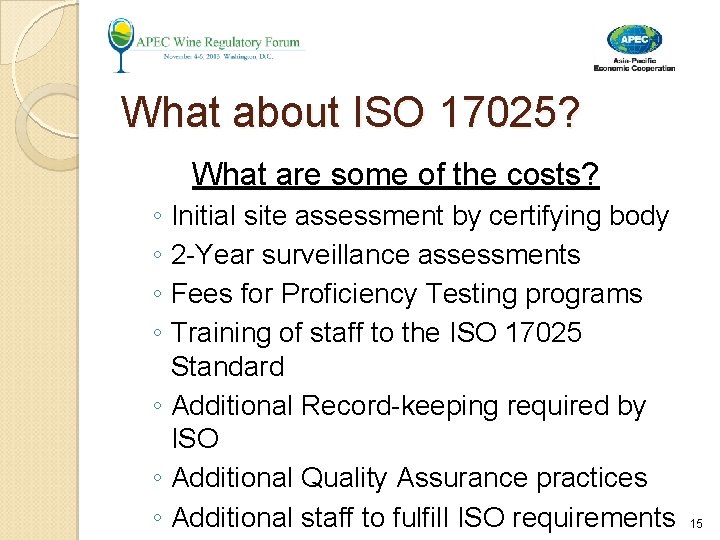
What about ISO 17025? What are some of the costs? ◦ Initial site assessment by certifying body ◦ 2 -Year surveillance assessments ◦ Fees for Proficiency Testing programs ◦ Training of staff to the ISO 17025 Standard ◦ Additional Record-keeping required by ISO ◦ Additional Quality Assurance practices ◦ Additional staff to fulfill ISO requirements 15
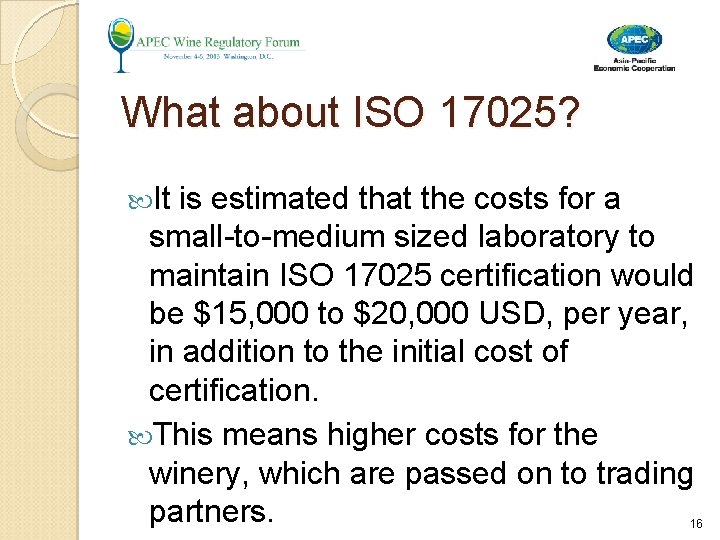
What about ISO 17025? It is estimated that the costs for a small-to-medium sized laboratory to maintain ISO 17025 certification would be $15, 000 to $20, 000 USD, per year, in addition to the initial cost of certification. This means higher costs for the winery, which are passed on to trading partners. 16
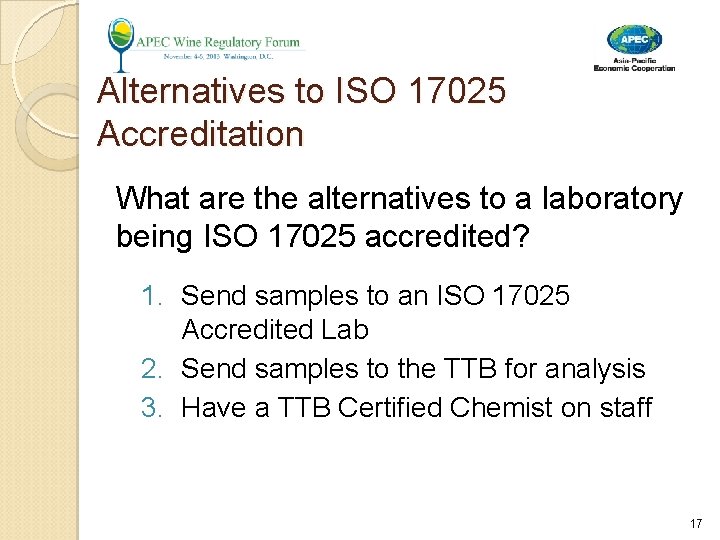
Alternatives to ISO 17025 Accreditation What are the alternatives to a laboratory being ISO 17025 accredited? 1. Send samples to an ISO 17025 Accredited Lab 2. Send samples to the TTB for analysis 3. Have a TTB Certified Chemist on staff 17
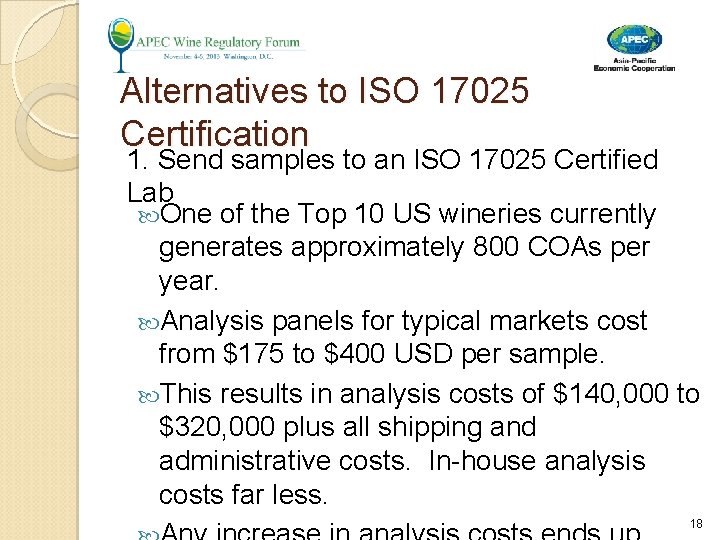
Alternatives to ISO 17025 Certification 1. Send samples to an ISO 17025 Certified Lab One of the Top 10 US wineries currently generates approximately 800 COAs per year. Analysis panels for typical markets cost from $175 to $400 USD per sample. This results in analysis costs of $140, 000 to $320, 000 plus all shipping and administrative costs. In-house analysis costs far less. 18
Alternatives to ISO 17025 Certification 2. Send samples to the TTB for analysis According to data collected by the California Wine Institute, over 47 million cases of wine were exported in 2012. Approximately 2/3 of these wines were sent to countries requiring COAs. The average shipment was 1000 cases. This would result in nearly 32, 000 COAs (all data from www. wineinstitute. org) 19
Alternatives to ISO 17025 Certification 2. Send samples to the TTB for analysis (cont’d) TTB does not have the resources The costs for shipping these 32, 000 samples would be roughly $320, 000 (plus admin. costs) These 32, 000 additional samples submitted to the TTB would increase their workload by a factor of more than 20. (Source: TTB presentation, 2011) This will increase costs at a time when government spending is being scrutinized. Sending samples out for analysis will slow down the process of trade, resulting in delays. 20
Alternatives to ISO 17025 Certification 3. Have a TTB-Certified Chemist on staff Chemists can analyze samples prior to offering for sale to ensure that the wines meet all legal requirements of the importing country. No need for shipping of samples (or the associated administrative costs). Many analyses have already been run as quality control measures for the wine, so there is no need to incur the expense of re 21 analyzing it.
Alternatives to ISO 17025 Certification 3. Have a TTB-Certified Chemist on staff (cont’d) COAs can be prepared at little or no cost for wines offered for sale. If a sale does not occur, the winery has not incurred the additional expenses. Laboratories can prepare certificates for export customers in a few hours, rather than a minimum of 3 days when sending samples out for analysis. 22
Summary TTB operates a very robust and selective Chemist Certification program. TTB-Certified Chemists work under the authority of the Scientific Services Division. Certified Chemists are required to demonstrate the quality of their data. 23
Summary The TTB-Certified Chemist Program results in: ◦ Confidence in the quality of chemists and laboratories generating the COA ◦ Decreased costs for Industry ◦ Increased speed for document preparation ◦ Fewer interruptions to trade This program facilitates trade by enabling efficient and economical COA generation. The program is successful and growing 24
Summary The TTB Certified Chemist Program aligns with the “Twelve Principles for Regulatory Coherence” ◦ “Analyses of wine for compliance purposes should be undertaken by suitably accredited laboratories (or overseen by certified analysts) that perform acceptably for the specific test methods used. ” 25