C 2 Foundation Smart teach sessions 1 and


- Slides: 52
C 2 Foundation Smart teach sessions 1 and 2
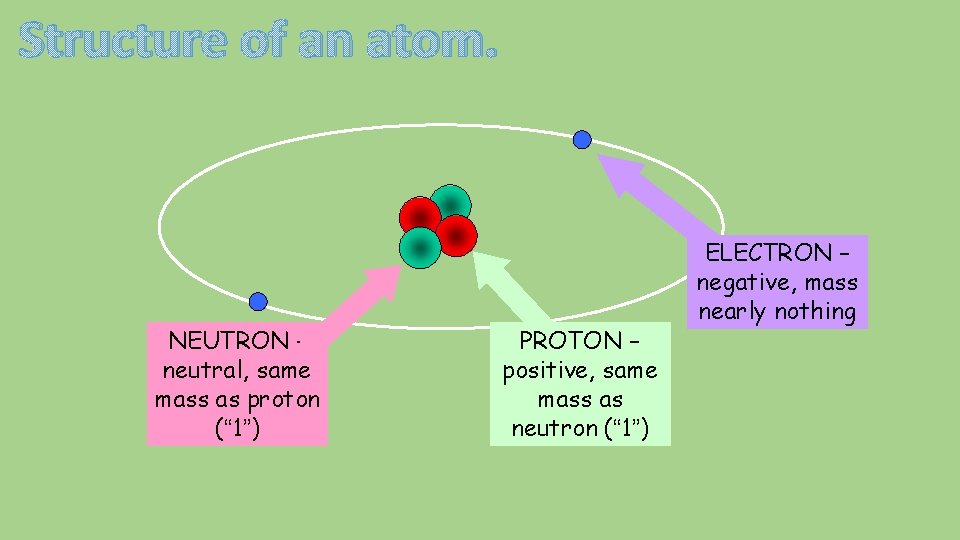
Structure of an atom. NEUTRON – neutral, same mass as proton (“ 1”) PROTON – positive, same mass as neutron (“ 1”) ELECTRON – negative, mass nearly nothing
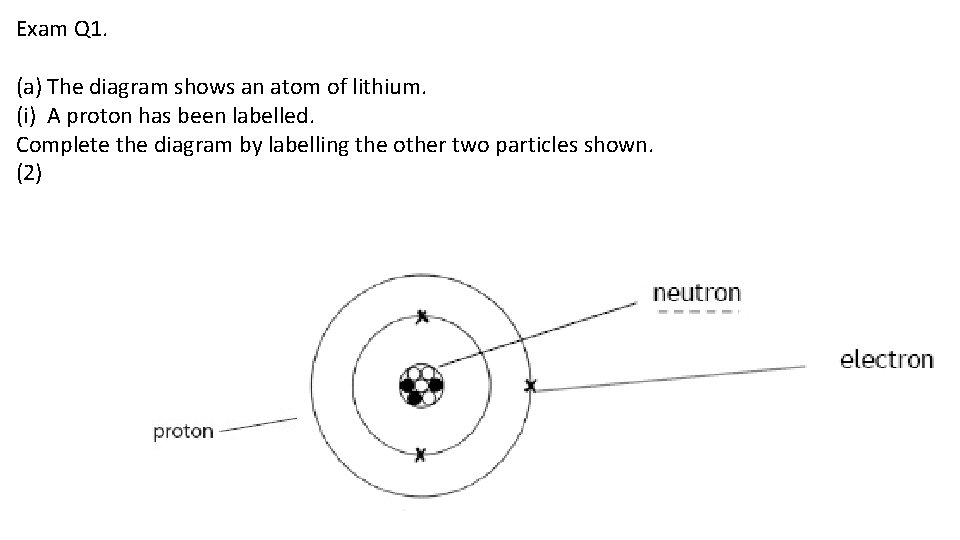
Exam Q 1. (a) The diagram shows an atom of lithium. (i) A proton has been labelled. Complete the diagram by labelling the other two particles shown. (2)
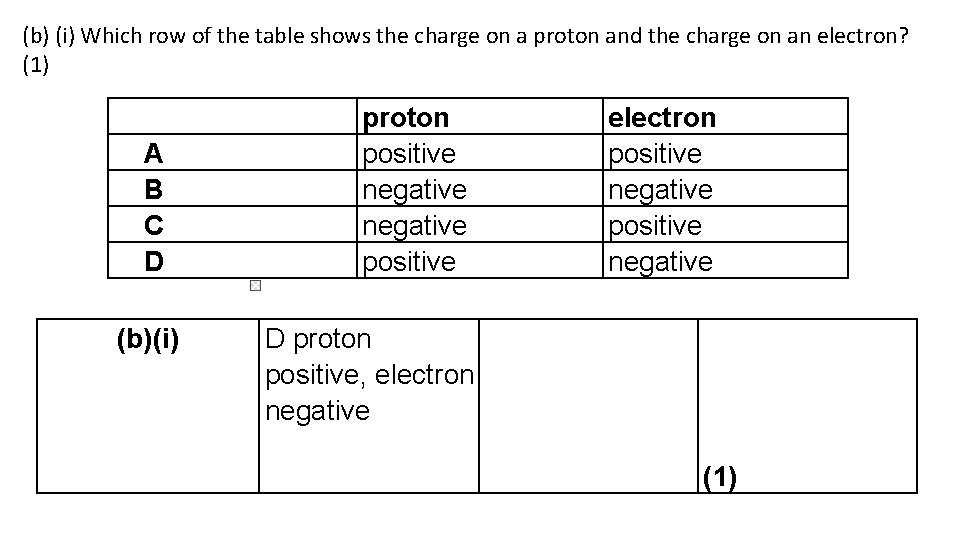
(b) (i) Which row of the table shows the charge on a proton and the charge on an electron? (1) A B C D (b)(i) proton positive negative positive electron positive negative D proton positive, electron negative (1)
Electron structure 25/09/2020 Consider an atom of Potassium: Potassium has 19 electrons. These electrons occupy specific energy levels “shells”… Nucleus The inner shell has __ electrons The next shell has the remaining __ electron Electron structure = 2, 8, 8, 1
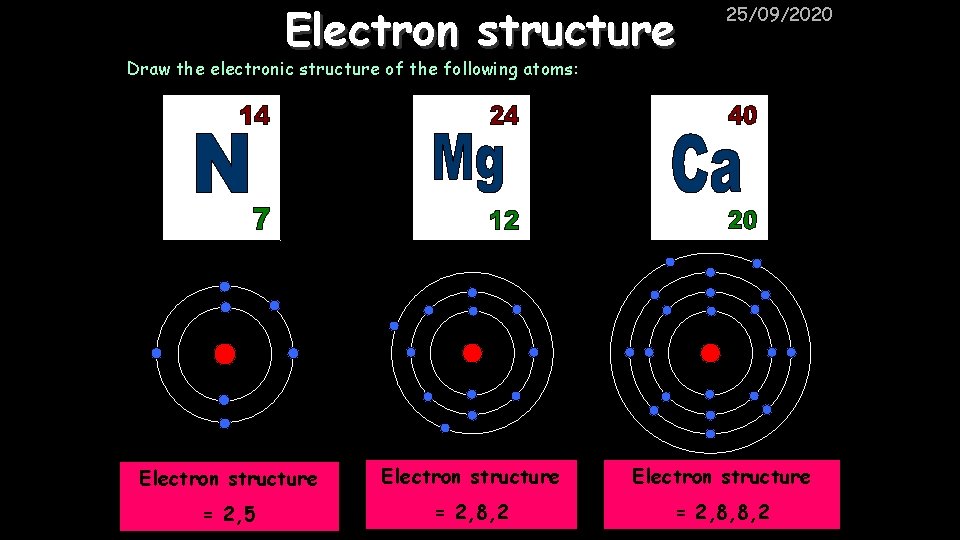
Electron structure 25/09/2020 Draw the electronic structure of the following atoms: Nucleus Electron structure = 2, 5 = 2, 8, 2 = 2, 8, 8, 2
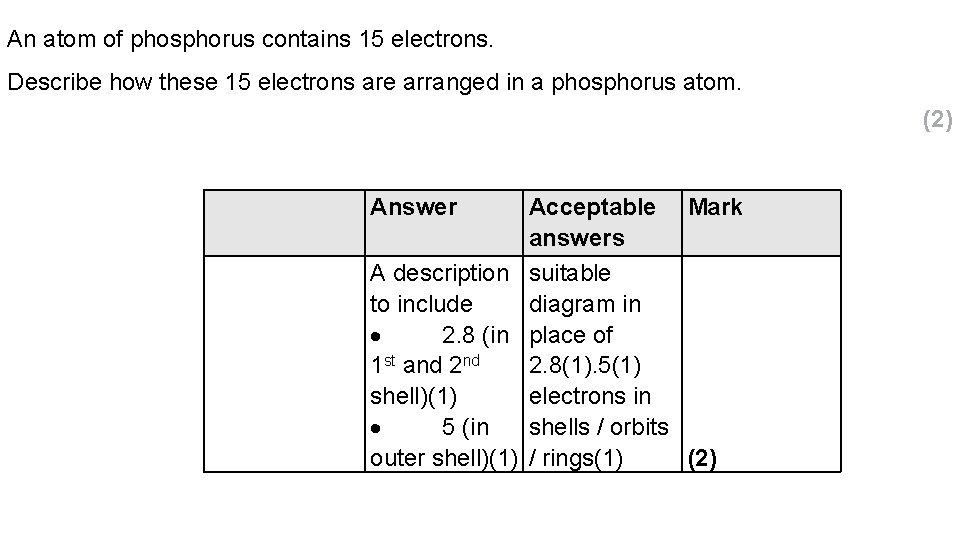
An atom of phosphorus contains 15 electrons. Describe how these 15 electrons are arranged in a phosphorus atom. (2) Answer Acceptable Mark answers A description suitable to include diagram in · 2. 8 (in place of 1 st and 2. 8(1). 5(1) shell)(1) electrons in · 5 (in shells / orbits outer shell)(1) / rings(1) (2)
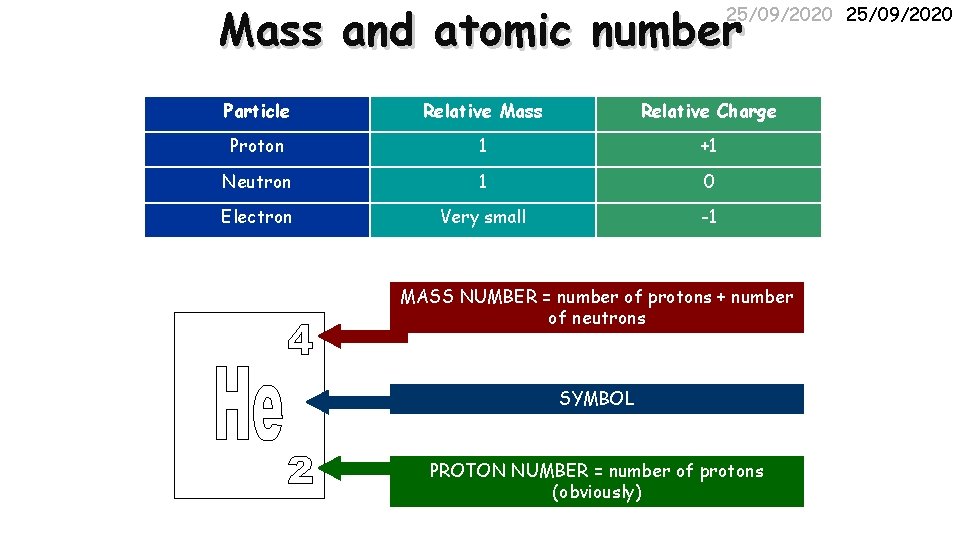
Mass and atomic number 25/09/2020 Particle Relative Mass Relative Charge Proton 1 +1 Neutron 1 0 Electron Very small -1 MASS NUMBER = number of protons + number of neutrons SYMBOL PROTON NUMBER = number of protons (obviously)
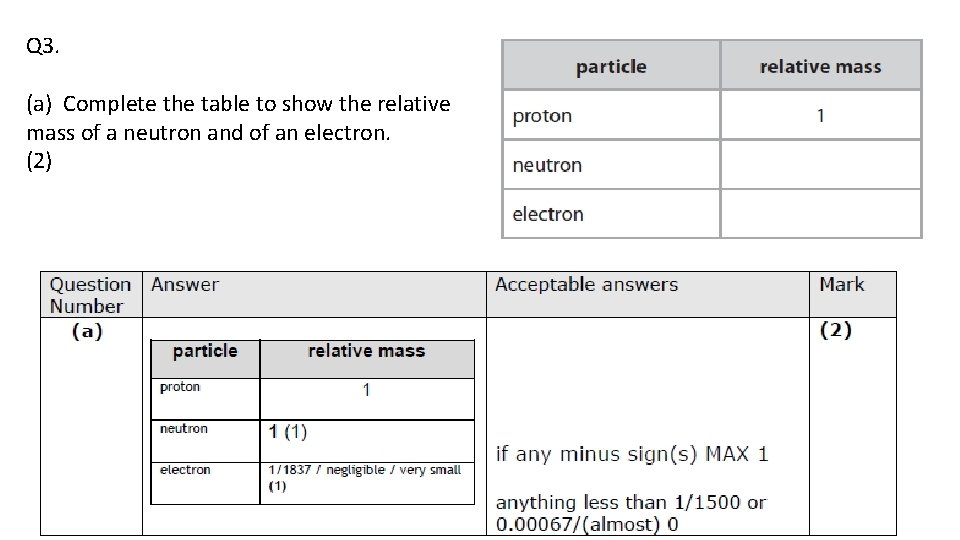
Q 3. (a) Complete the table to show the relative mass of a neutron and of an electron. (2)
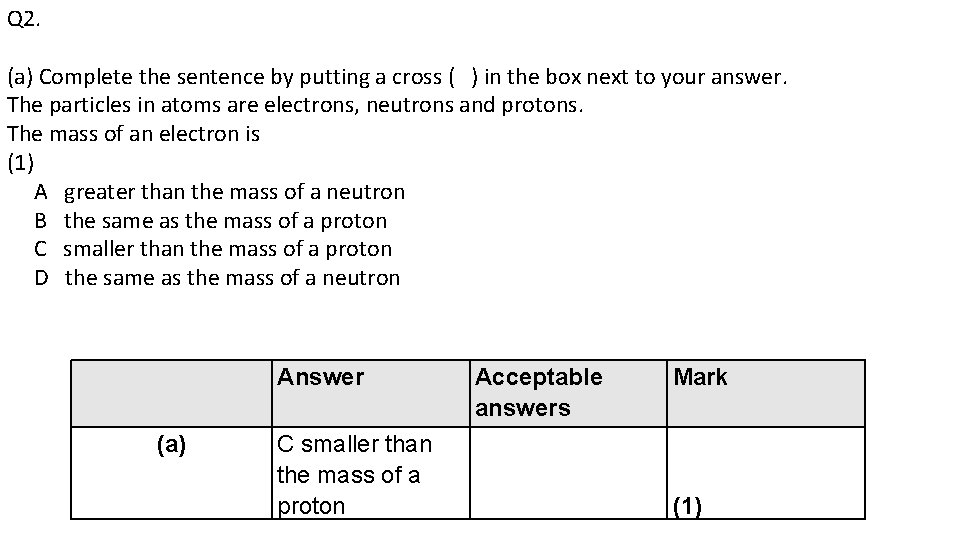
Q 2. (a) Complete the sentence by putting a cross ( ) in the box next to your answer. The particles in atoms are electrons, neutrons and protons. The mass of an electron is (1) A greater than the mass of a neutron B the same as the mass of a proton C smaller than the mass of a proton D the same as the mass of a neutron (a) Answer Acceptable answers C smaller than the mass of a proton Mark (1)
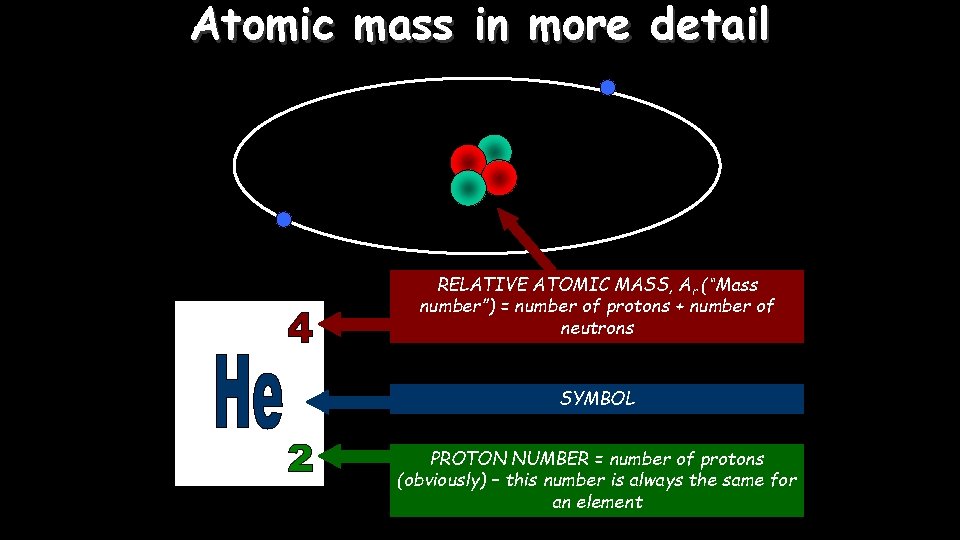
Atomic mass in more detail RELATIVE ATOMIC MASS, Ar (“Mass number”) = number of protons + number of neutrons SYMBOL PROTON NUMBER = number of protons (obviously) – this number is always the same for an element 25/09/2020
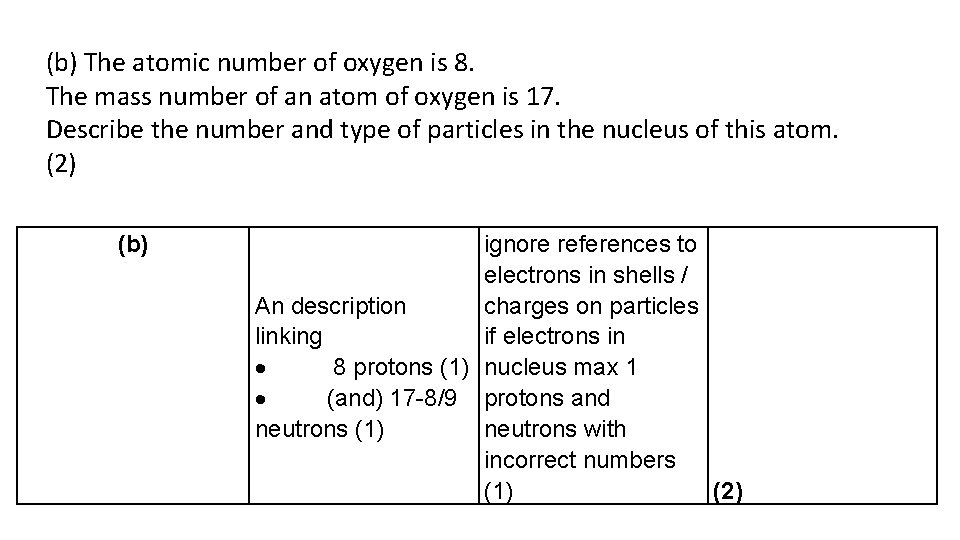
(b) The atomic number of oxygen is 8. The mass number of an atom of oxygen is 17. Describe the number and type of particles in the nucleus of this atom. (2) (b) ignore references to electrons in shells / An description charges on particles linking if electrons in · 8 protons (1) nucleus max 1 · (and) 17 -8/9 protons and neutrons with neutrons (1) incorrect numbers (1) (2)
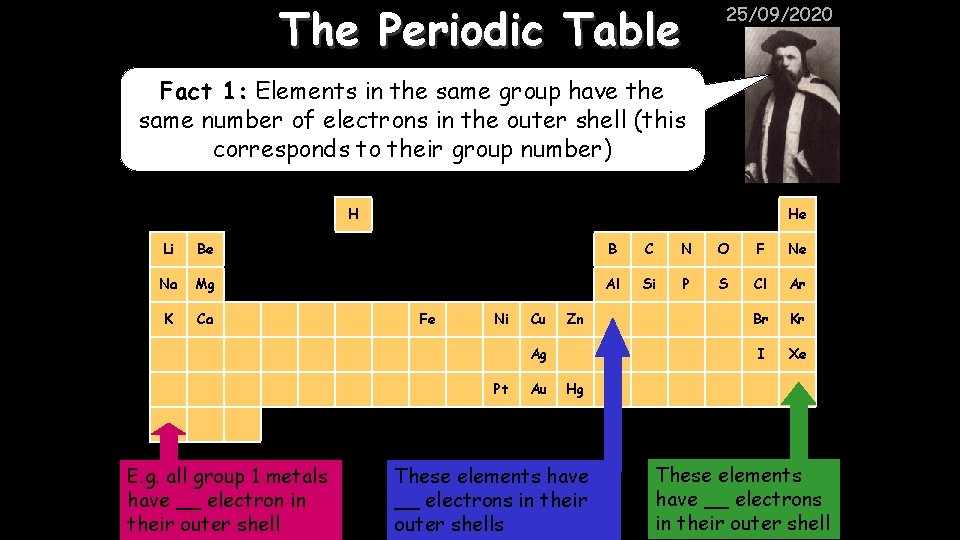
The Periodic Table 25/09/2020 Fact 1: Elements in the same group have the same number of electrons in the outer shell (this corresponds to their group number) H He Li Be B C N O F Ne Na Mg Al Si P S Cl Ar K Ca Br Kr I Xe Fe Ni Cu Zn Ag Pt E. g. all group 1 metals have __ electron in their outer shell Au Hg These elements have __ electrons in their outer shells These elements have __ electrons in their outer shell
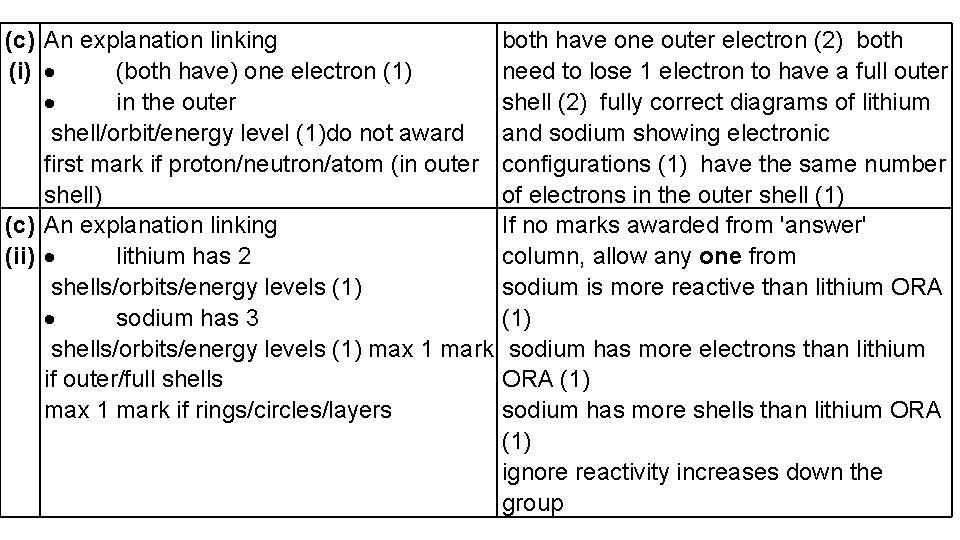
The electronic configuration of lithium is 2. 1. The electronic configuration of sodium is 2. 8. 1. (i) Explain, in terms of their electronic configurations, why lithium and sodium are both in group 1 of the periodic table. (2) (ii) Explain, in terms of their electronic configurations, why lithium is placed in period 2 and sodium is placed in period 3 of the periodic table. (2)
(c) An explanation linking both have one outer electron (2) both (i) · (both have) one electron (1) need to lose 1 electron to have a full outer · in the outer shell (2) fully correct diagrams of lithium shell/orbit/energy level (1)do not award and sodium showing electronic first mark if proton/neutron/atom (in outer configurations (1) have the same number shell) of electrons in the outer shell (1) (c) An explanation linking If no marks awarded from 'answer' (ii) · lithium has 2 column, allow any one from shells/orbits/energy levels (1) sodium is more reactive than lithium ORA · sodium has 3 (1) shells/orbits/energy levels (1) max 1 mark sodium has more electrons than lithium if outer/full shells ORA (1) max 1 mark if rings/circles/layers sodium has more shells than lithium ORA (1) ignore reactivity increases down the group
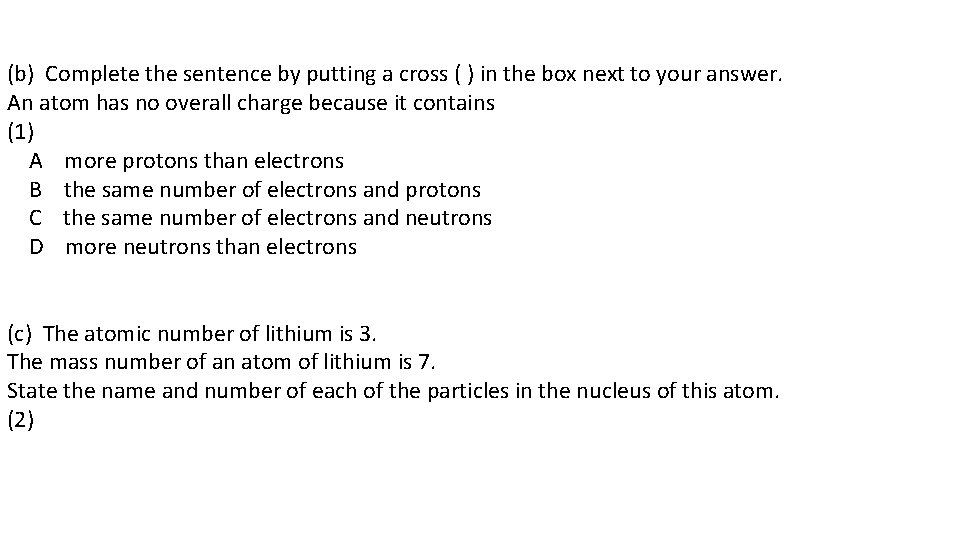
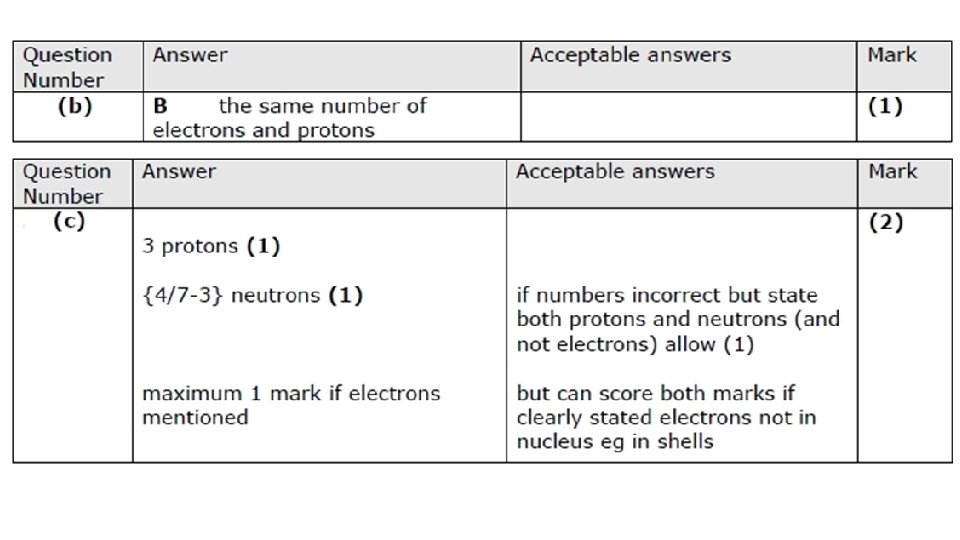
(b) Complete the sentence by putting a cross ( ) in the box next to your answer. An atom has no overall charge because it contains (1) A more protons than electrons B the same number of electrons and protons C the same number of electrons and neutrons D more neutrons than electrons (c) The atomic number of lithium is 3. The mass number of an atom of lithium is 7. State the name and number of each of the particles in the nucleus of this atom. (2)
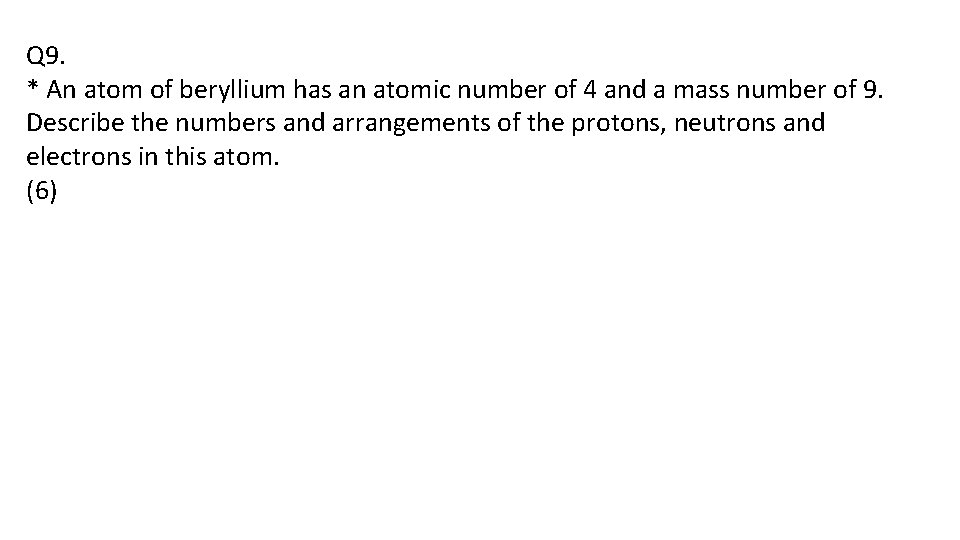
Q 9. * An atom of beryllium has an atomic number of 4 and a mass number of 9. Describe the numbers and arrangements of the protons, neutrons and electrons in this atom. (6)
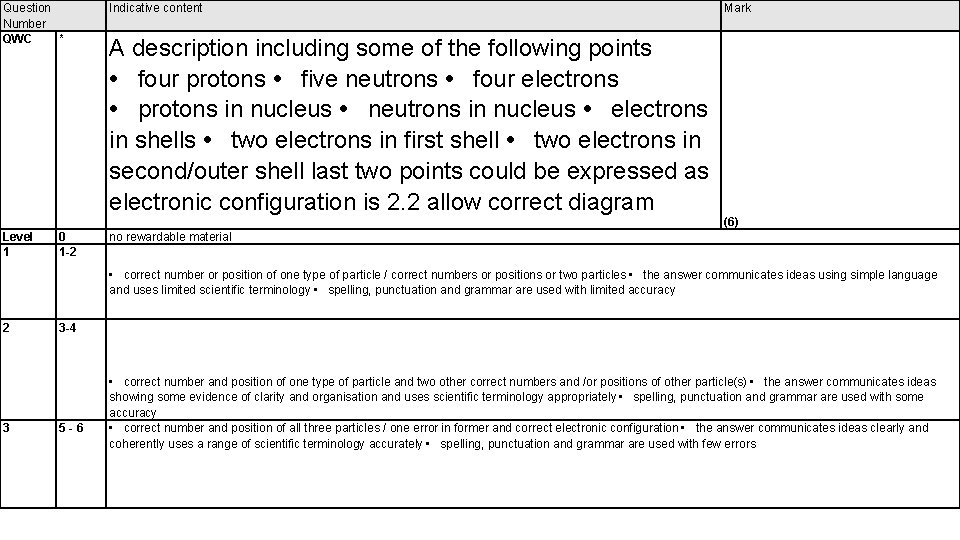
Question Number QWC * Level 1 0 1 -2 Indicative content A description including some of the following points • four protons • five neutrons • four electrons • protons in nucleus • neutrons in nucleus • electrons in shells • two electrons in first shell • two electrons in second/outer shell last two points could be expressed as electronic configuration is 2. 2 allow correct diagram Mark (6) no rewardable material • correct number or position of one type of particle / correct numbers or positions or two particles • the answer communicates ideas using simple language and uses limited scientific terminology • spelling, punctuation and grammar are used with limited accuracy 2 3 3 -4 5 -6 • correct number and position of one type of particle and two other correct numbers and /or positions of other particle(s) • the answer communicates ideas showing some evidence of clarity and organisation and uses scientific terminology appropriately • spelling, punctuation and grammar are used with some accuracy • correct number and position of all three particles / one error in former and correct electronic configuration • the answer communicates ideas clearly and coherently uses a range of scientific terminology accurately • spelling, punctuation and grammar are used with few errors
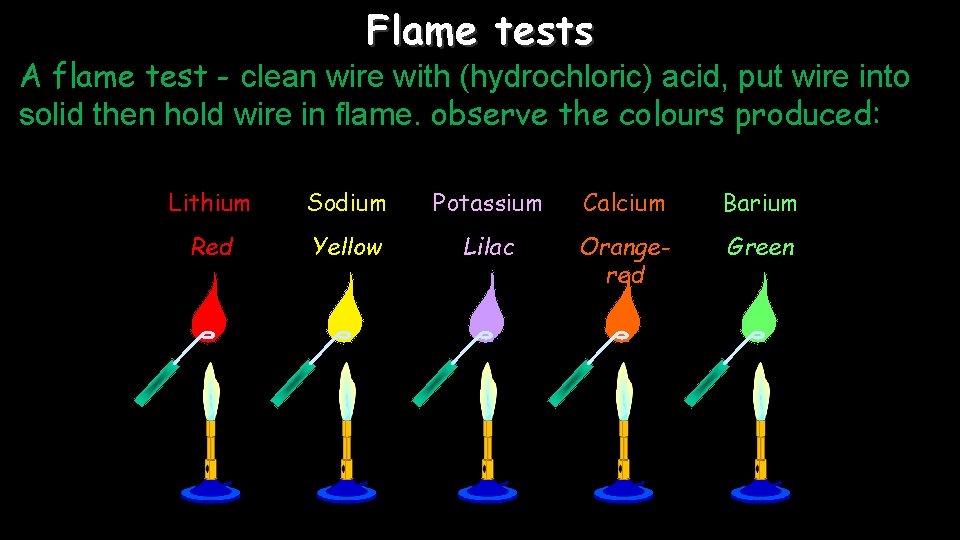
Flame tests 25/09/2020 A flame test - clean wire with (hydrochloric) acid, put wire into solid then hold wire in flame. observe the colours produced: Lithium Sodium Potassium Calcium Barium Red Yellow Lilac Orangered Green
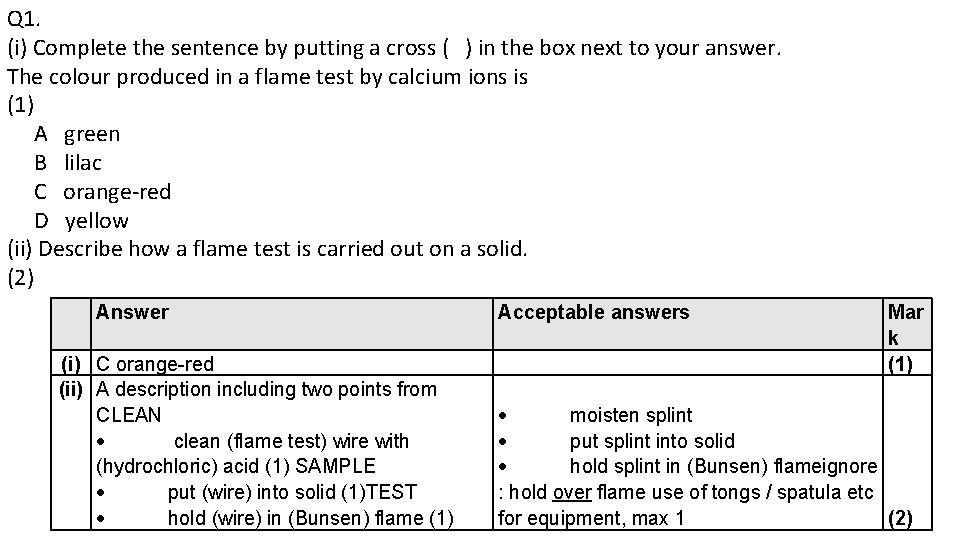
Q 1. (i) Complete the sentence by putting a cross ( ) in the box next to your answer. The colour produced in a flame test by calcium ions is (1) A green B lilac C orange-red D yellow (ii) Describe how a flame test is carried out on a solid. (2) Answer (i) C orange-red (ii) A description including two points from CLEAN · clean (flame test) wire with (hydrochloric) acid (1) SAMPLE · put (wire) into solid (1)TEST · hold (wire) in (Bunsen) flame (1) Acceptable answers Mar k (1) · moisten splint · put splint into solid · hold splint in (Bunsen) flameignore : hold over flame use of tongs / spatula etc for equipment, max 1 (2)
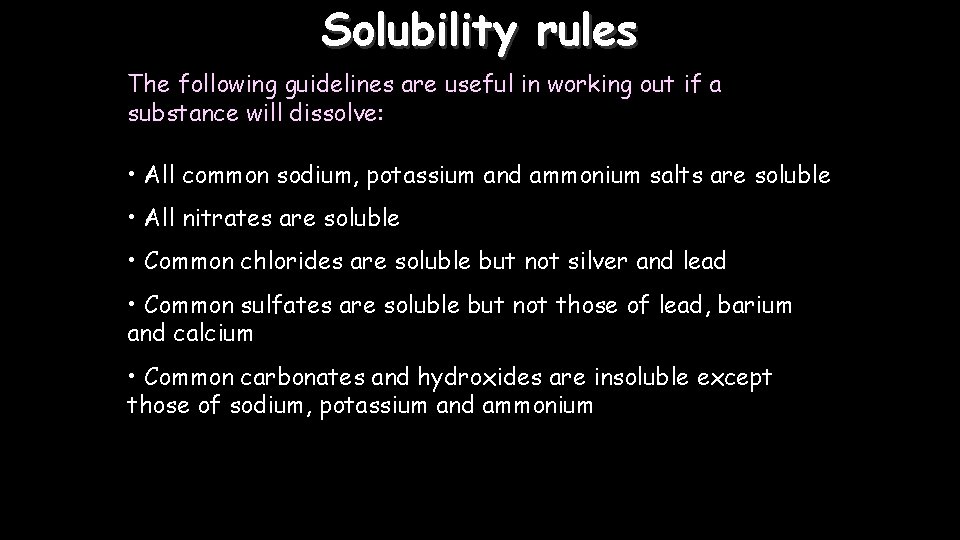
Solubility rules The following guidelines are useful in working out if a substance will dissolve: • All common sodium, potassium and ammonium salts are soluble • All nitrates are soluble • Common chlorides are soluble but not silver and lead • Common sulfates are soluble but not those of lead, barium and calcium • Common carbonates and hydroxides are insoluble except those of sodium, potassium and ammonium 25/09/2020
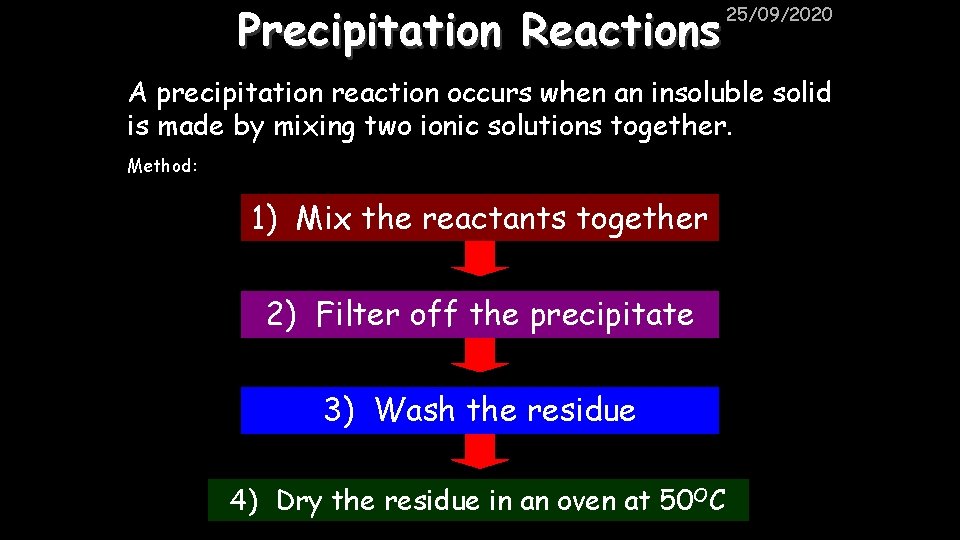
Precipitation Reactions 25/09/2020 A precipitation reaction occurs when an insoluble solid is made by mixing two ionic solutions together. Method: 1) Mix the reactants together 2) Filter off the precipitate 3) Wash the residue 4) Dry the residue in an oven at 50 OC
Q 2. * Barium sulfate is prepared by reacting barium chloride with sodium sulfate. The barium sulfate is formed as a precipitate. Describe an experiment to prepare a pure, dry sample of barium sulfate, starting with barium chloride crystals and sodium sulfate crystals. (6)
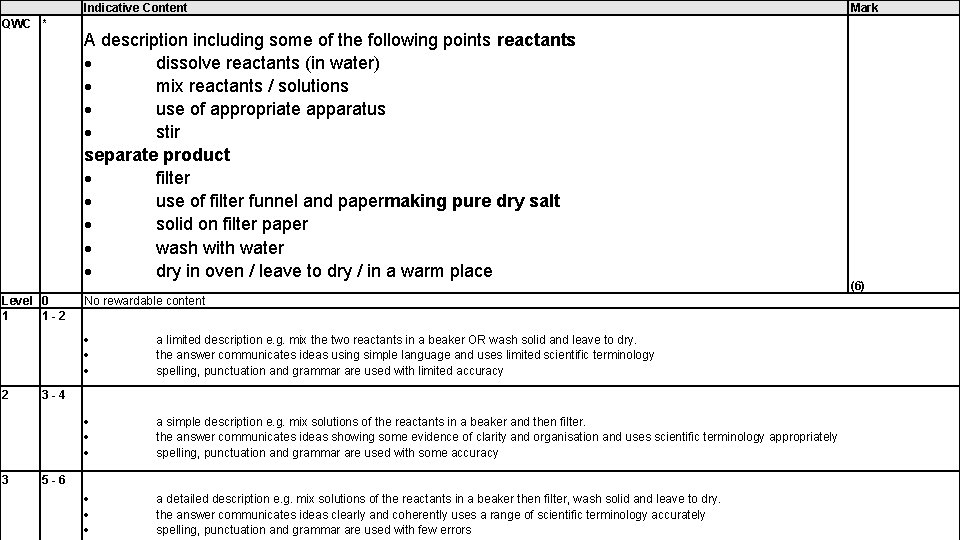
QWC * Level 0 1 1 -2 2 3 Indicative Content A description including some of the following points reactants · dissolve reactants (in water) · mix reactants / solutions · use of appropriate apparatus · stir separate product · filter · use of filter funnel and papermaking pure dry salt · solid on filter paper · wash with water · dry in oven / leave to dry / in a warm place No rewardable content · · · a limited description e. g. mix the two reactants in a beaker OR wash solid and leave to dry. the answer communicates ideas using simple language and uses limited scientific terminology spelling, punctuation and grammar are used with limited accuracy · · · a simple description e. g. mix solutions of the reactants in a beaker and then filter. the answer communicates ideas showing some evidence of clarity and organisation and uses scientific terminology appropriately spelling, punctuation and grammar are used with some accuracy · · · a detailed description e. g. mix solutions of the reactants in a beaker then filter, wash solid and leave to dry. the answer communicates ideas clearly and coherently uses a range of scientific terminology accurately spelling, punctuation and grammar are used with few errors 3 -4 5 -6 Mark (6)
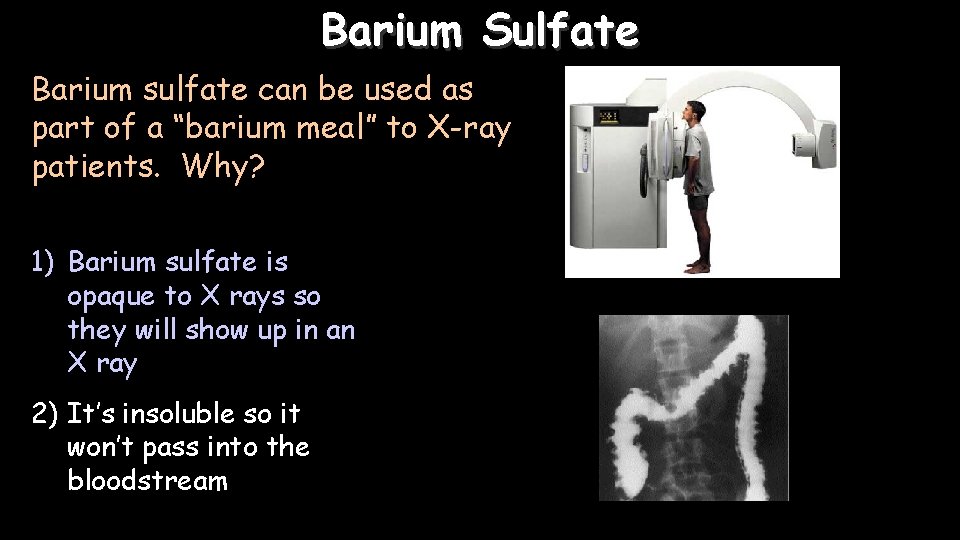
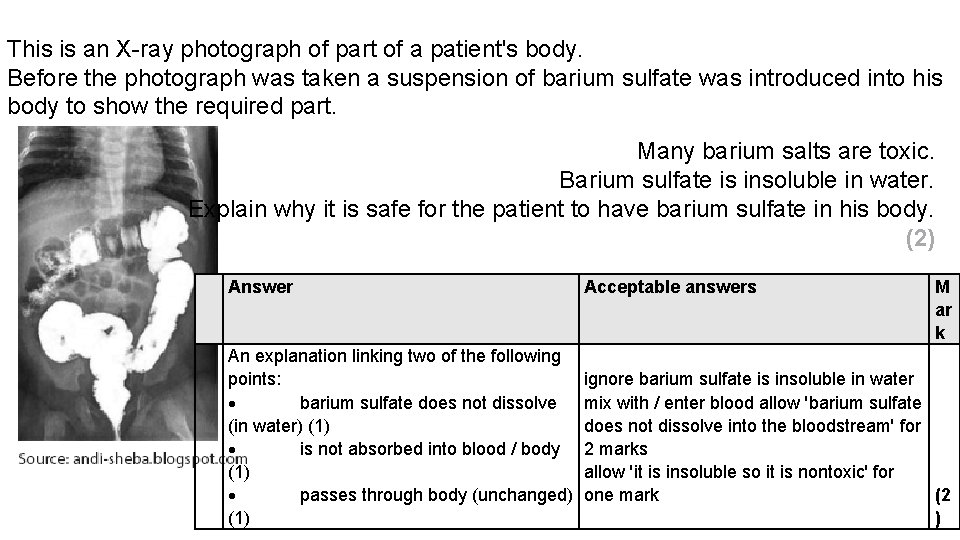
Barium Sulfate Barium sulfate can be used as part of a “barium meal” to X-ray patients. Why? 1) Barium sulfate is opaque to X rays so they will show up in an X ray 2) It’s insoluble so it won’t pass into the bloodstream 25/09/2020
This is an X-ray photograph of part of a patient's body. Before the photograph was taken a suspension of barium sulfate was introduced into his body to show the required part. Many barium salts are toxic. Barium sulfate is insoluble in water. Explain why it is safe for the patient to have barium sulfate in his body. (2) Answer An explanation linking two of the following points: · barium sulfate does not dissolve (in water) (1) · is not absorbed into blood / body (1) · passes through body (unchanged) (1) Acceptable answers M ar k ignore barium sulfate is insoluble in water mix with / enter blood allow 'barium sulfate does not dissolve into the bloodstream' for 2 marks allow 'it is insoluble so it is nontoxic' for one mark (2 )
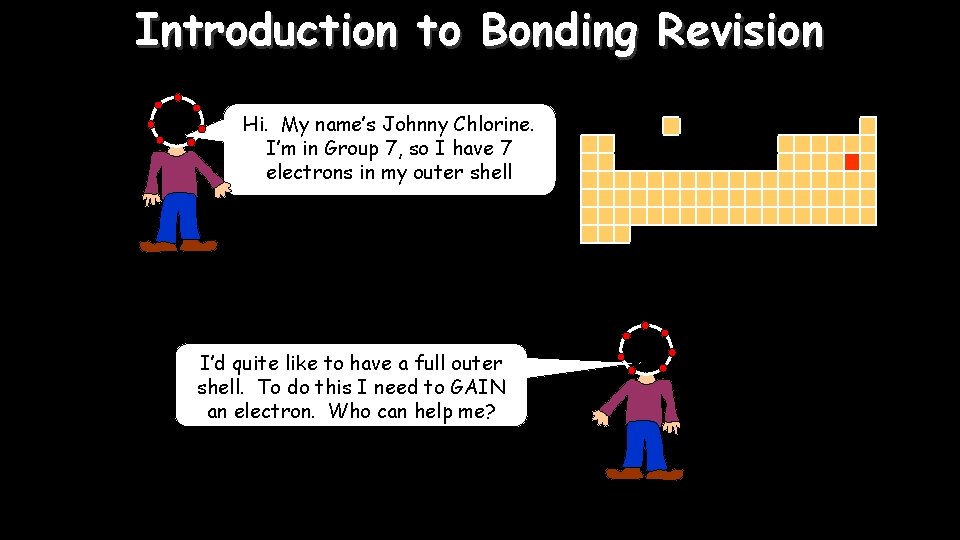
Introduction to Bonding Revision Cl Hi. My name’s Johnny Chlorine. I’m in Group 7, so I have 7 electrons in my outer shell I’d quite like to have a full outer shell. To do this I need to GAIN an electron. Who can help me? Cl 25/09/2020
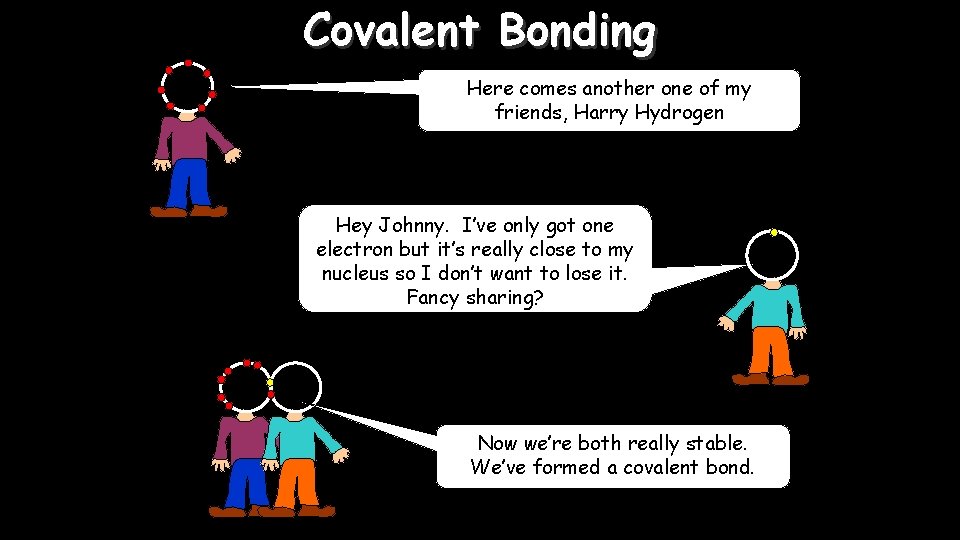
Covalent Bonding Cl 25/09/2020 Here comes another one of my friends, Harry Hydrogen Hey Johnny. I’ve only got one electron but it’s really close to my nucleus so I don’t want to lose it. Fancy sharing? Cl H Now we’re both really stable. We’ve formed a covalent bond. H
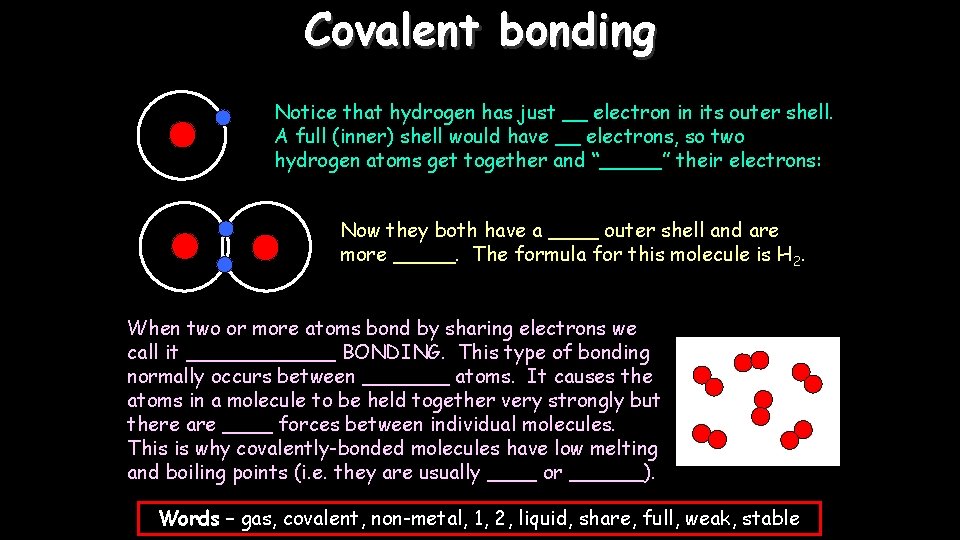
Covalent bonding Consider an atom of hydrogen: Notice that hydrogen has just __ electron in its outer shell. A full (inner) shell would have __ electrons, so two hydrogen atoms get together and “_____” their electrons: Now they both have a ____ outer shell and are more _____. The formula for this molecule is H 2. When two or more atoms bond by sharing electrons we call it ______ BONDING. This type of bonding normally occurs between _______ atoms. It causes the atoms in a molecule to be held together very strongly but there are ____ forces between individual molecules. This is why covalently-bonded molecules have low melting and boiling points (i. e. they are usually ____ or ______). Words – gas, covalent, non-metal, 1, 2, liquid, share, full, weak, stable 25/09/2020
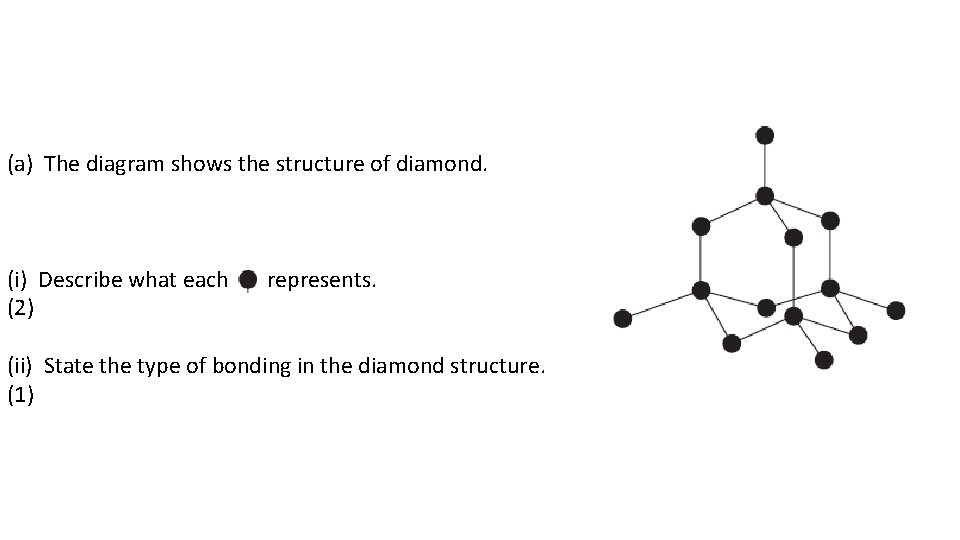
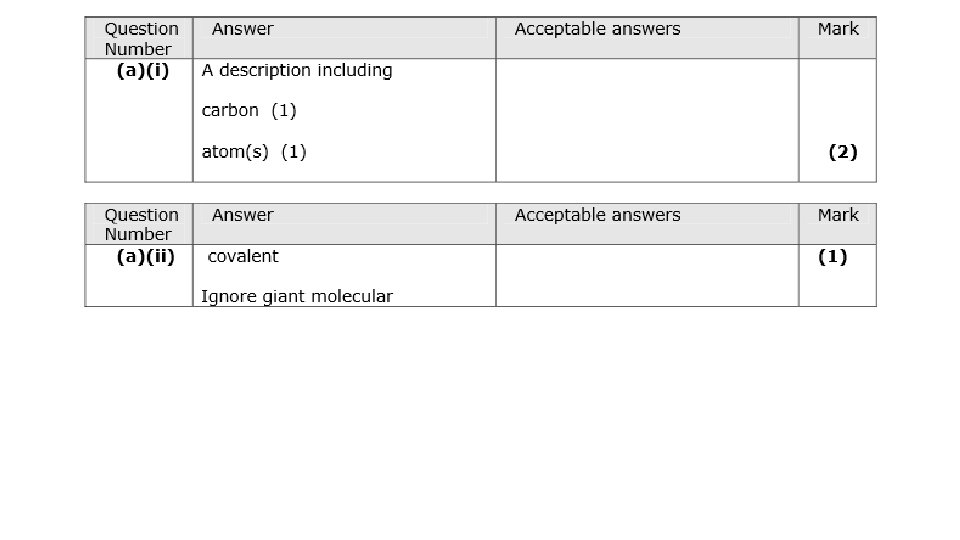
(a) The diagram shows the structure of diamond. (i) Describe what each represents. (2) (ii) State the type of bonding in the diamond structure. (1)
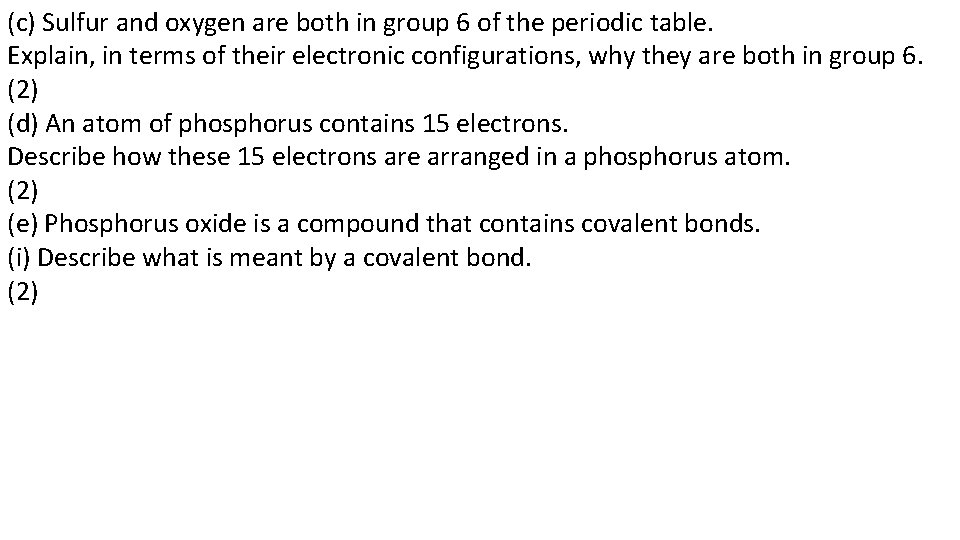
(c) Sulfur and oxygen are both in group 6 of the periodic table. Explain, in terms of their electronic configurations, why they are both in group 6. (2) (d) An atom of phosphorus contains 15 electrons. Describe how these 15 electrons are arranged in a phosphorus atom. (2) (e) Phosphorus oxide is a compound that contains covalent bonds. (i) Describe what is meant by a covalent bond. (2)
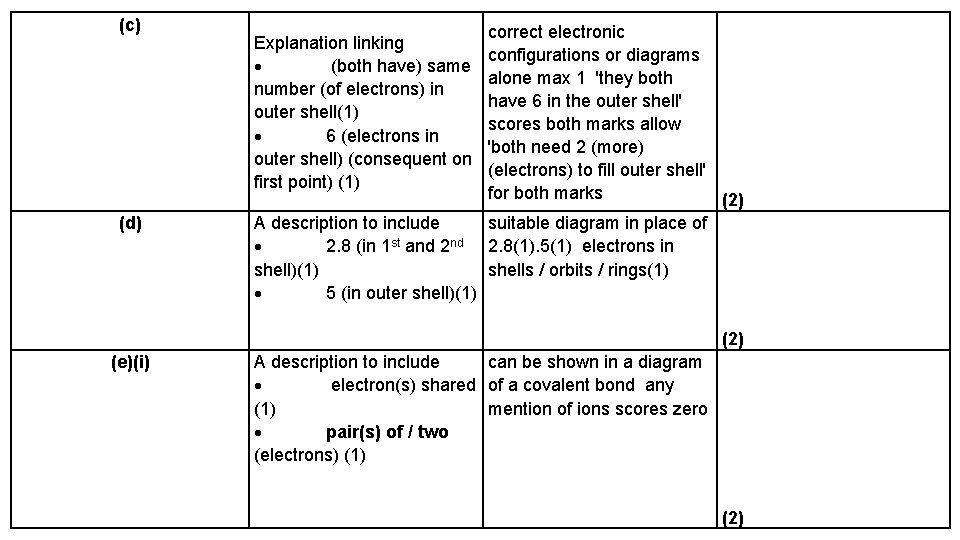
(c) (d) Explanation linking · (both have) same number (of electrons) in outer shell(1) · 6 (electrons in outer shell) (consequent on first point) (1) A description to include · 2. 8 (in 1 st and 2 nd shell)(1) · 5 (in outer shell)(1) correct electronic configurations or diagrams alone max 1 'they both have 6 in the outer shell' scores both marks allow 'both need 2 (more) (electrons) to fill outer shell' for both marks (2) suitable diagram in place of 2. 8(1). 5(1) electrons in shells / orbits / rings(1) (2) (e)(i) A description to include can be shown in a diagram · electron(s) shared of a covalent bond any (1) mention of ions scores zero · pair(s) of / two (electrons) (1) (2)
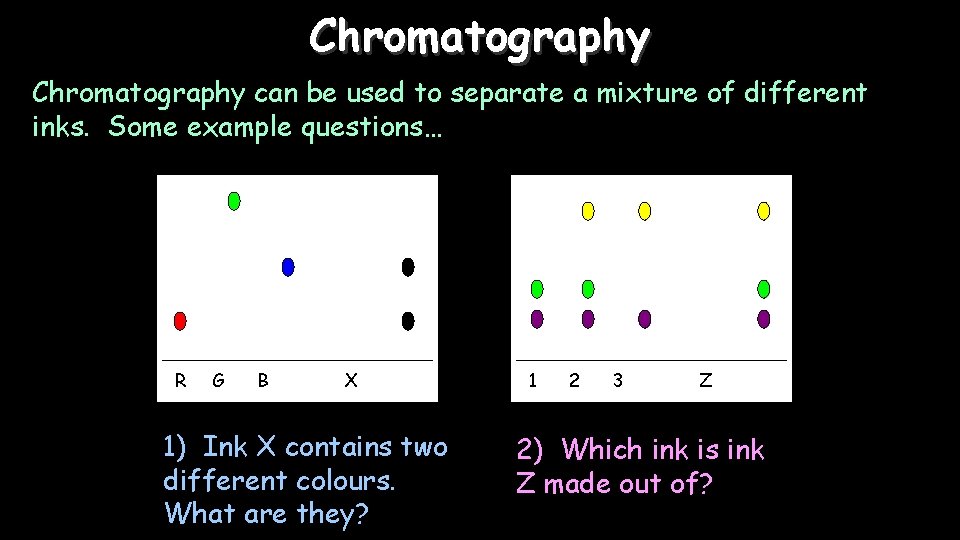
25/09/2020 Chromatography can be used to separate a mixture of different inks. Some example questions… R G B X 1) Ink X contains two different colours. What are they? 1 2 3 Z 2) Which ink is ink Z made out of?
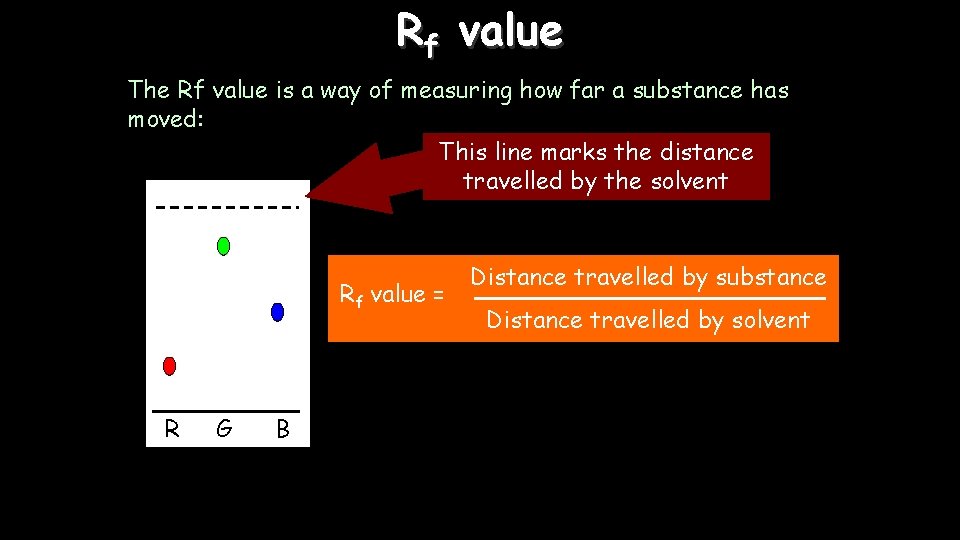
Rf value The Rf value is a way of measuring how far a substance has moved: This line marks the distance travelled by the solvent Rf value = R G B Distance travelled by substance Distance travelled by solvent 25/09/2020
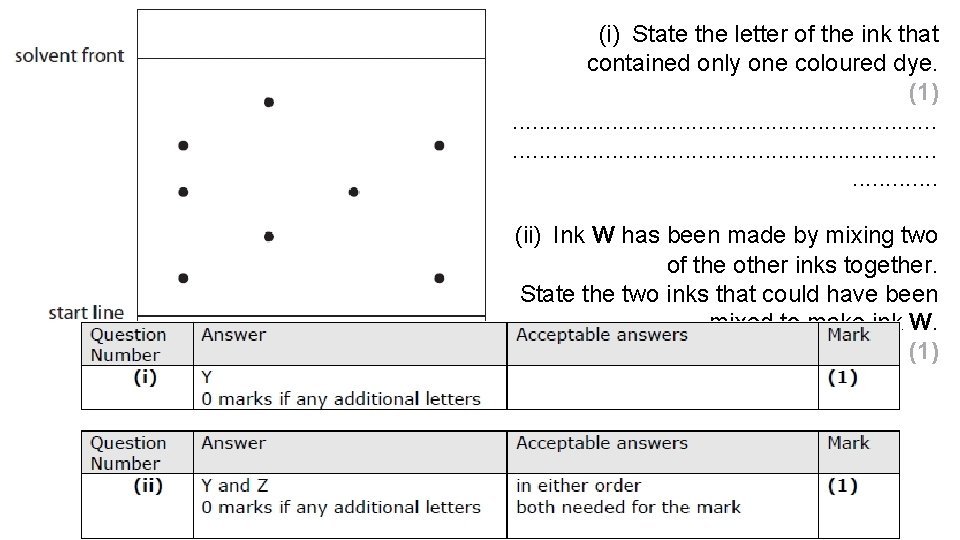
(i) State the letter of the ink that contained only one coloured dye. (1). . . . . . . . . (ii) Ink W has been made by mixing two of the other inks together. State the two inks that could have been mixed to make ink W. (1)
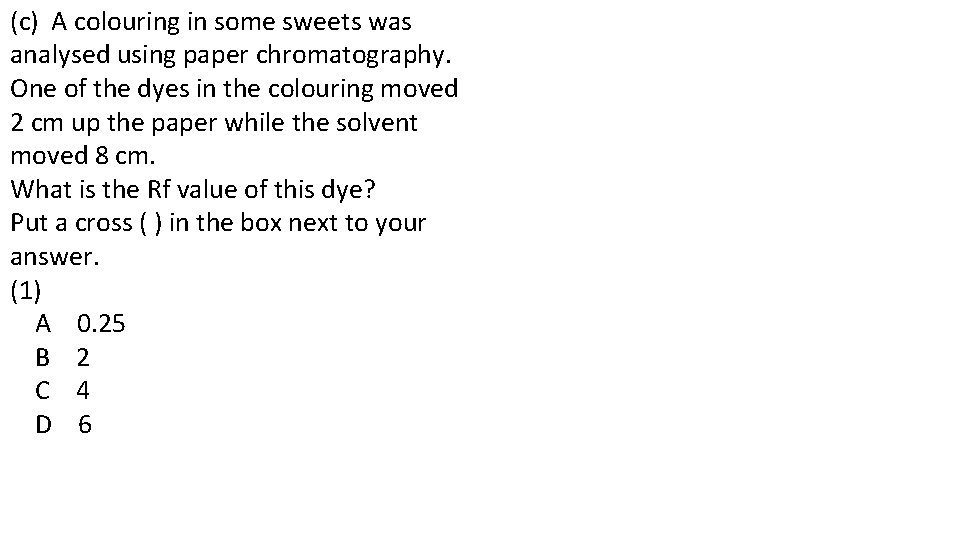
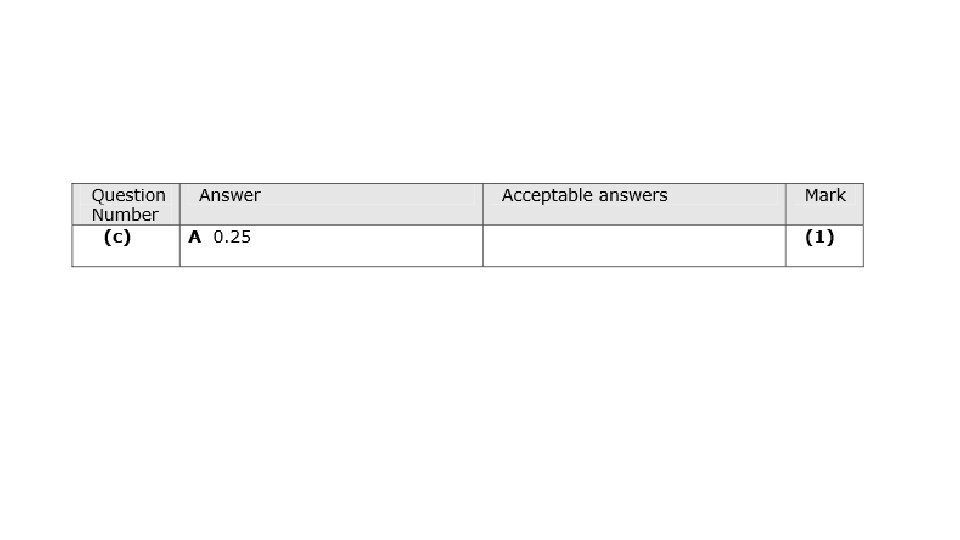
(c) A colouring in some sweets was analysed using paper chromatography. One of the dyes in the colouring moved 2 cm up the paper while the solvent moved 8 cm. What is the Rf value of this dye? Put a cross ( ) in the box next to your answer. (1) A 0. 25 B 2 C 4 D 6
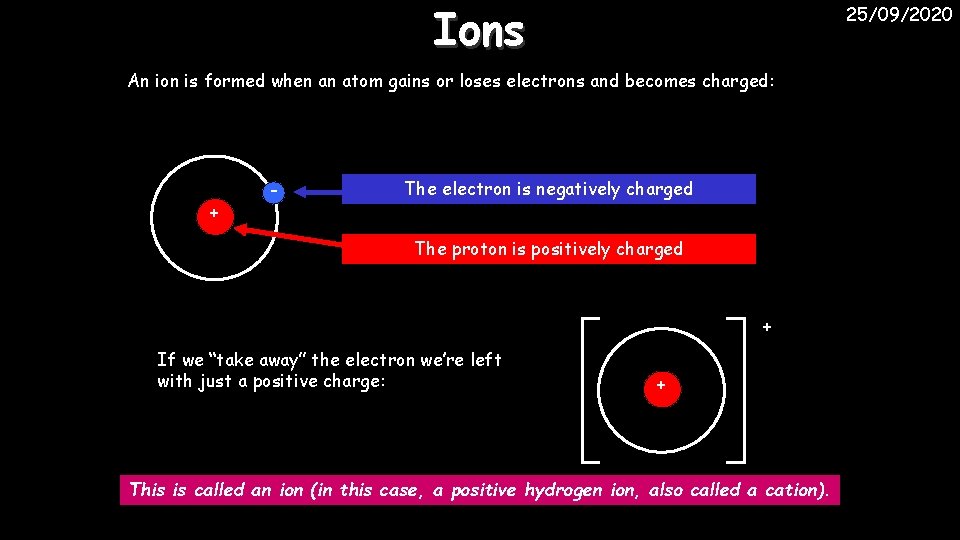
Ions 25/09/2020 An ion is formed when an atom gains or loses electrons and becomes charged: + - The electron is negatively charged The proton is positively charged + If we “take away” the electron we’re left with just a positive charge: + This is called an ion (in this case, a positive hydrogen ion, also called a cation).
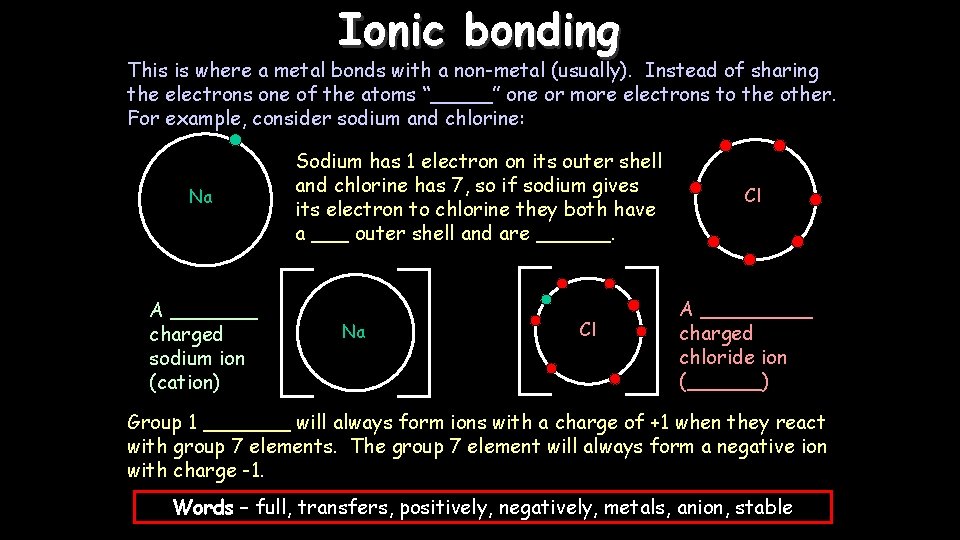
Ionic bonding 25/09/2020 This is where a metal bonds with a non-metal (usually). Instead of sharing the electrons one of the atoms “_____” one or more electrons to the other. For example, consider sodium and chlorine: Na Sodium has 1 electron on its outer shell and chlorine has 7, so if sodium gives its electron to chlorine they both have a ___ outer shell and are ______. - + A _______ charged sodium ion (cation) Na Cl Cl A _____ charged chloride ion (______) Group 1 _______ will always form ions with a charge of +1 when they react with group 7 elements. The group 7 element will always form a negative ion with charge -1. Words – full, transfers, positively, negatively, metals, anion, stable
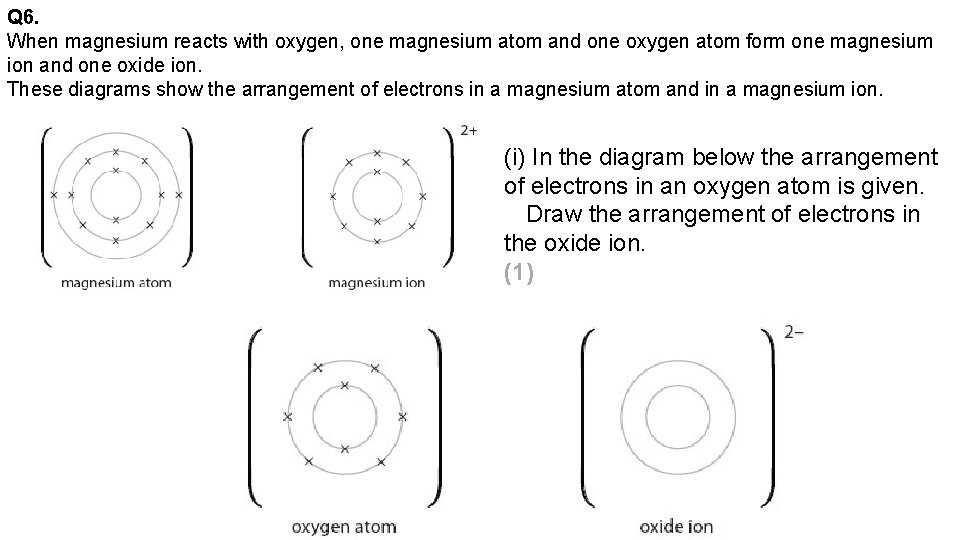
Q 6. When magnesium reacts with oxygen, one magnesium atom and one oxygen atom form one magnesium ion and one oxide ion. These diagrams show the arrangement of electrons in a magnesium atom and in a magnesium ion. (i) In the diagram below the arrangement of electrons in an oxygen atom is given. Draw the arrangement of electrons in the oxide ion. (1)
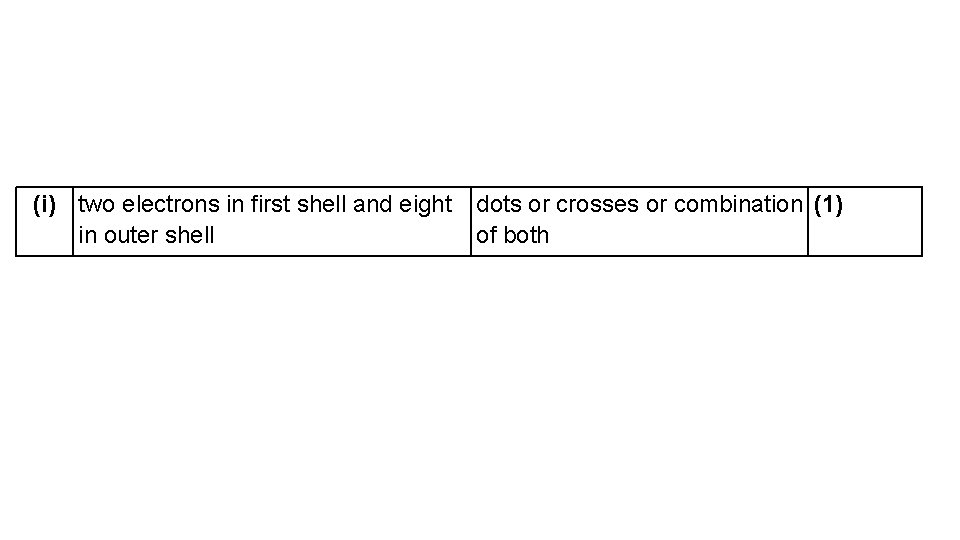
(i) two electrons in first shell and eight dots or crosses or combination (1) in outer shell of both
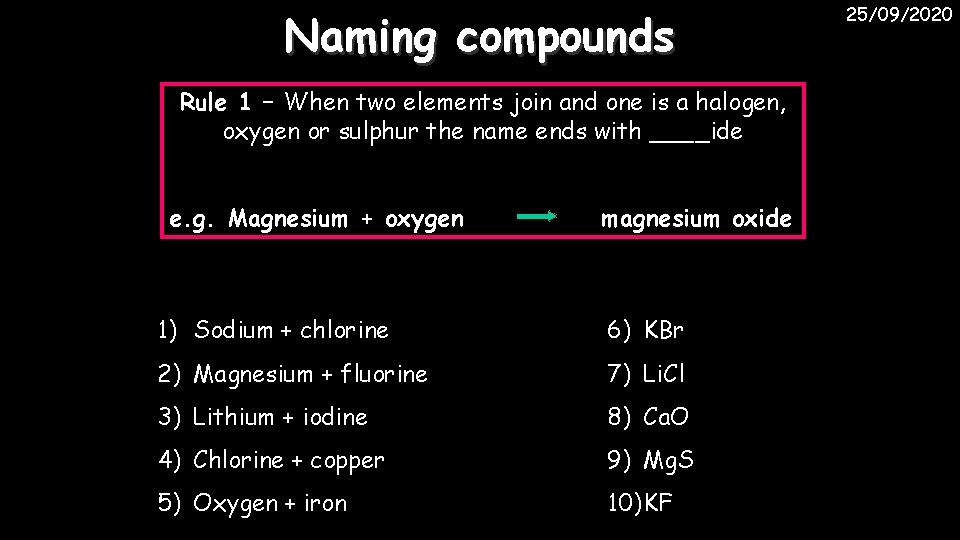
Naming compounds Rule 1 – When two elements join and one is a halogen, oxygen or sulphur the name ends with ____ide e. g. Magnesium + oxygen magnesium oxide 1) Sodium + chlorine 6) KBr 2) Magnesium + fluorine 7) Li. Cl 3) Lithium + iodine 8) Ca. O 4) Chlorine + copper 9) Mg. S 5) Oxygen + iron 10) KF 25/09/2020
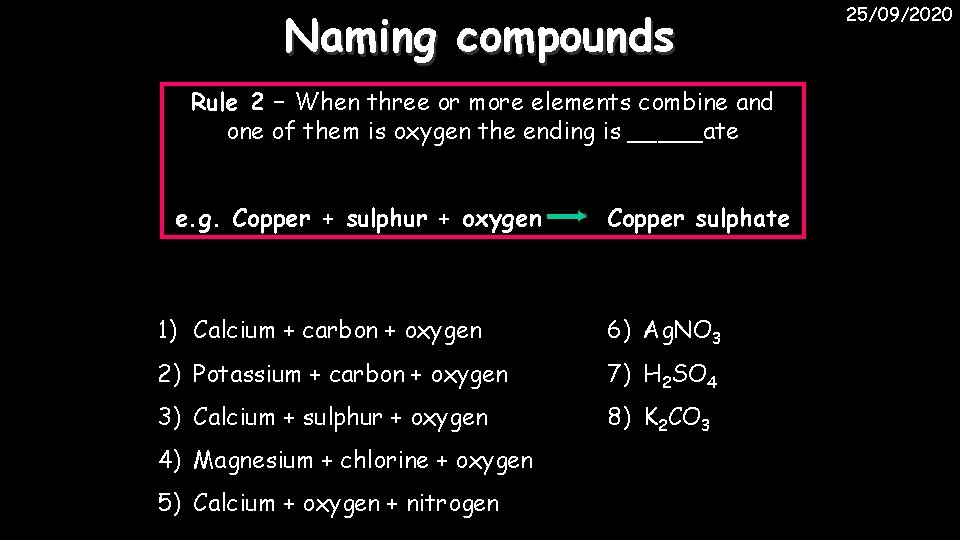
Naming compounds Rule 2 – When three or more elements combine and one of them is oxygen the ending is _____ate e. g. Copper + sulphur + oxygen Copper sulphate 1) Calcium + carbon + oxygen 6) Ag. NO 3 2) Potassium + carbon + oxygen 7) H 2 SO 4 3) Calcium + sulphur + oxygen 8) K 2 CO 3 4) Magnesium + chlorine + oxygen 5) Calcium + oxygen + nitrogen 25/09/2020
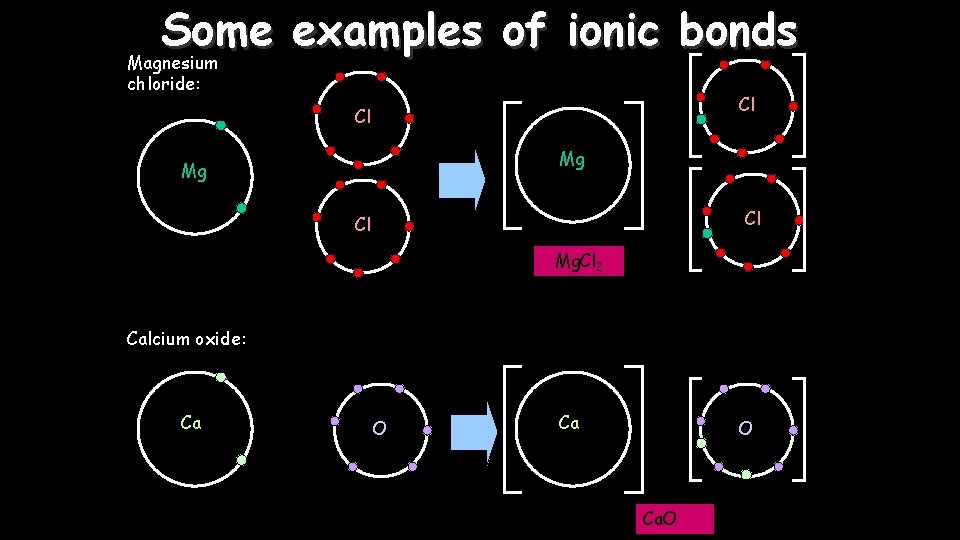
Some examples of ionic bonds Magnesium chloride: 2+ Cl Mg + Cl Cl Mg. Cl 2 Calcium oxide: 2+ Ca + O Ca 2 O Ca. O 25/09/2020
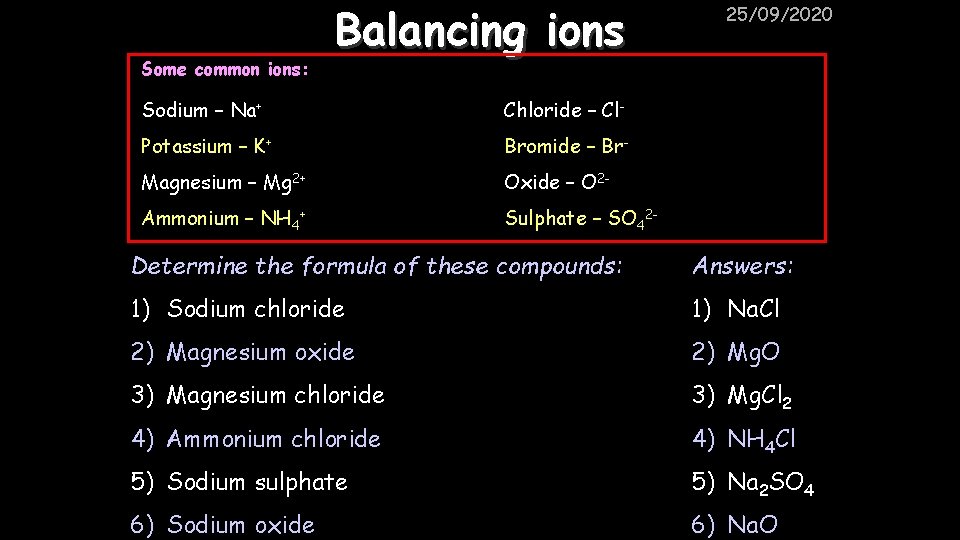
Some common ions: Balancing ions Sodium – Na+ Chloride – Cl- Potassium – K+ Bromide – Br- Magnesium – Mg 2+ Oxide – O 2 - Ammonium – NH 4+ Sulphate – SO 42 - 25/09/2020 Determine the formula of these compounds: Answers: 1) Sodium chloride 1) Na. Cl 2) Magnesium oxide 2) Mg. O 3) Magnesium chloride 3) Mg. Cl 2 4) Ammonium chloride 4) NH 4 Cl 5) Sodium sulphate 5) Na 2 SO 4 6) Sodium oxide 6) Na. O
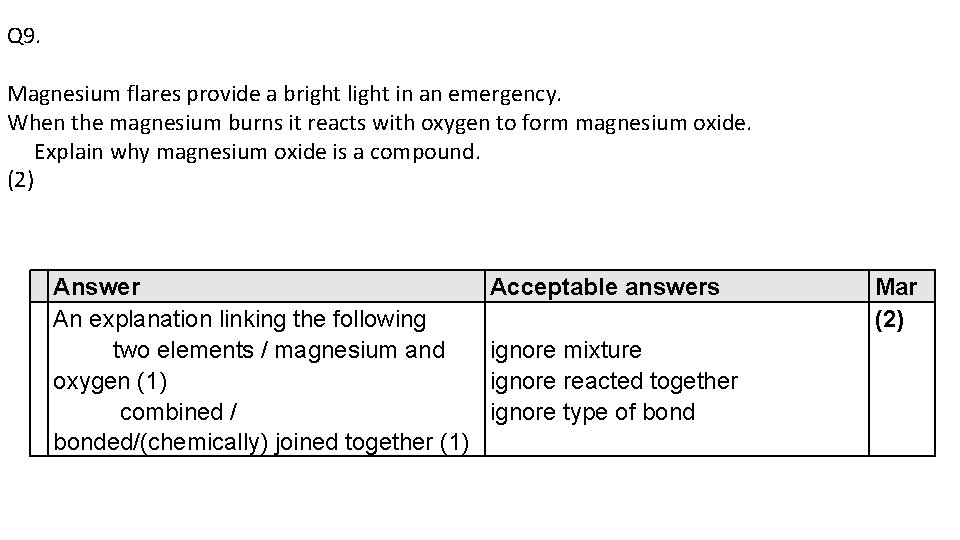
Q 9. Magnesium flares provide a bright light in an emergency. When the magnesium burns it reacts with oxygen to form magnesium oxide. Explain why magnesium oxide is a compound. (2) Answer An explanation linking the following two elements / magnesium and oxygen (1) combined / bonded/(chemically) joined together (1) Acceptable answers ignore mixture ignore reacted together ignore type of bond Mar (2)
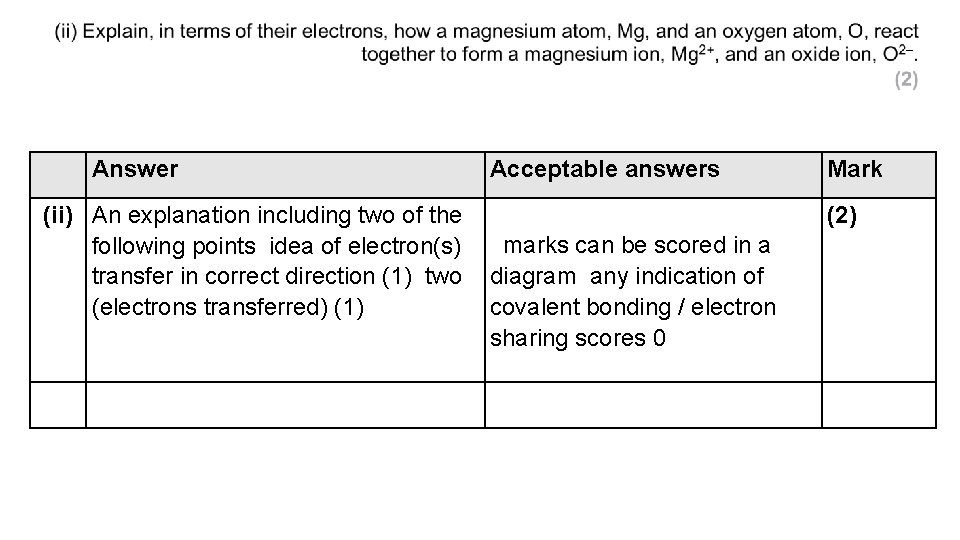
Answer Acceptable answers (ii) An explanation including two of the following points idea of electron(s) marks can be scored in a transfer in correct direction (1) two diagram any indication of covalent bonding / electron (electrons transferred) (1) sharing scores 0 Mark (2)
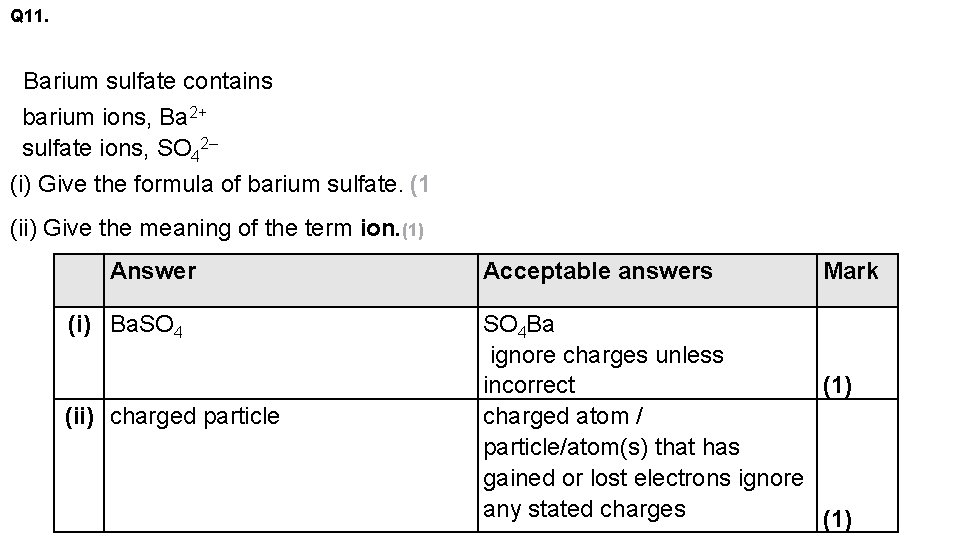
Q 11. Barium sulfate contains barium ions, Ba 2+ sulfate ions, SO 42– (i) Give the formula of barium sulfate. (1 (ii) Give the meaning of the term ion. (1) Answer (i) Ba. SO 4 (ii) charged particle Acceptable answers Mark SO 4 Ba ignore charges unless incorrect (1) charged atom / particle/atom(s) that has gained or lost electrons ignore any stated charges (1)
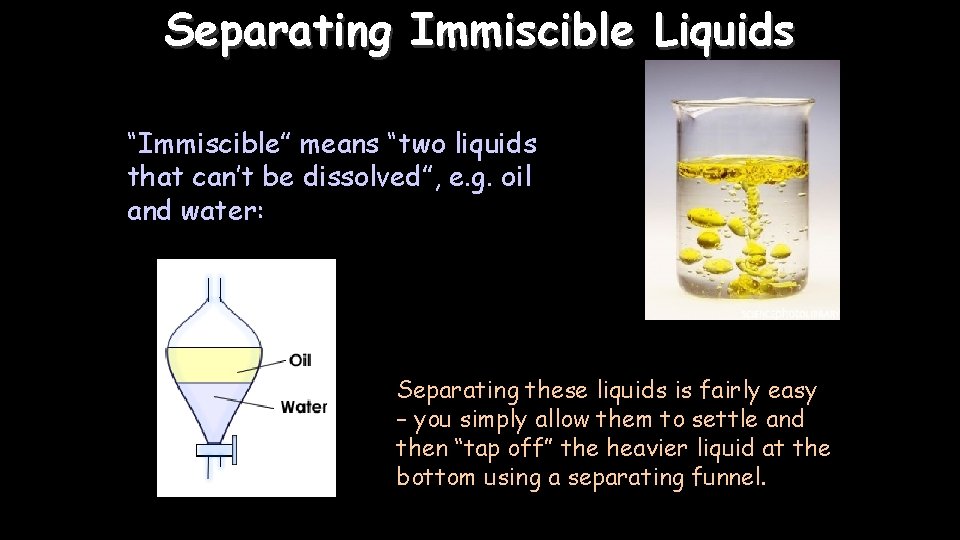
Separating Immiscible Liquids “Immiscible” means “two liquids that can’t be dissolved”, e. g. oil and water: Separating these liquids is fairly easy – you simply allow them to settle and then “tap off” the heavier liquid at the bottom using a separating funnel. 25/09/2020
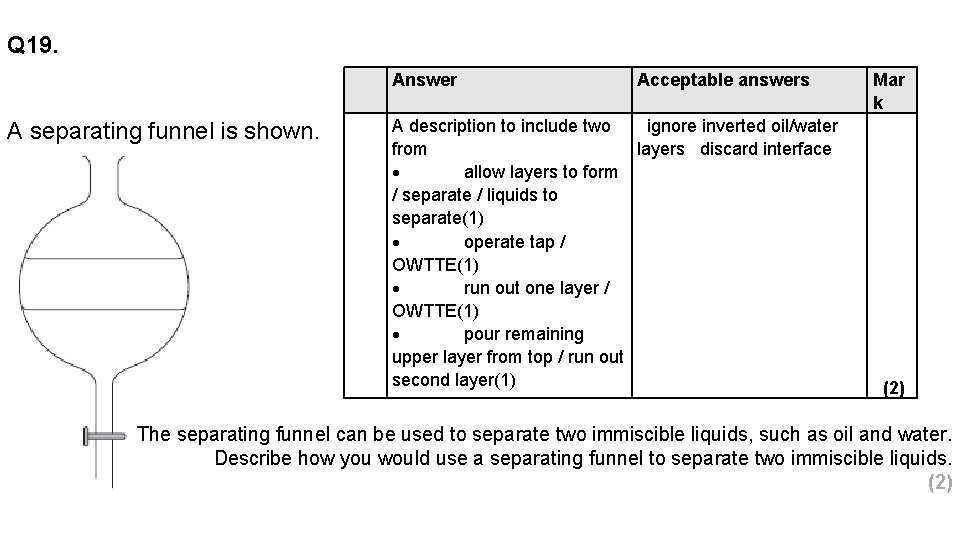
Q 19. Answer A separating funnel is shown. Acceptable answers A description to include two ignore inverted oil/water from layers discard interface · allow layers to form / separate / liquids to separate(1) · operate tap / OWTTE(1) · run out one layer / OWTTE(1) · pour remaining upper layer from top / run out second layer(1) Mar k (2) The separating funnel can be used to separate two immiscible liquids, such as oil and water. Describe how you would use a separating funnel to separate two immiscible liquids. (2)