Assigning CVE IDs CVE Team CVE is sponsored
- Slides: 65
Assigning CVE IDs CVE Team CVE is sponsored by U. S. Department of Homeland Security (DHS) Cybersecurity and Infrastructure Security Agency (CISA). Copyright © 1999– 2020, The MITRE Corporation. CVE and the CVE logo are registered trademarks of The MITRE Corporation.
|2| 7. 1 – What is a Vulnerability? CVE is sponsored by U. S. Department of Homeland Security (DHS) Cybersecurity and Infrastructure Security Agency (CISA). Copyright © 1999– 2020, The MITRE Corporation. CVE and the CVE logo are registered trademarks of The MITRE Corporation.
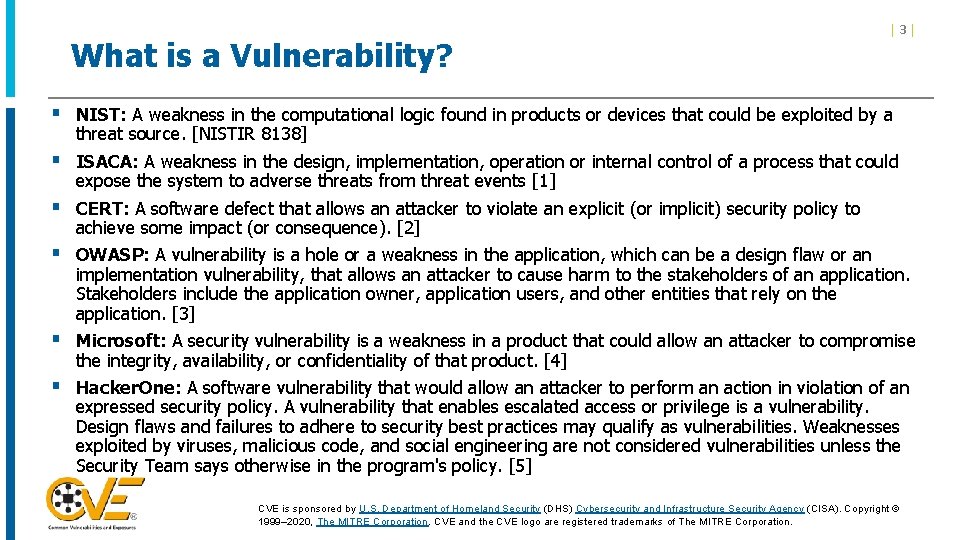
What is a Vulnerability? |3| § NIST: A weakness in the computational logic found in products or devices that could be exploited by a threat source. [NISTIR 8138] § ISACA: A weakness in the design, implementation, operation or internal control of a process that could expose the system to adverse threats from threat events [1] § CERT: A software defect that allows an attacker to violate an explicit (or implicit) security policy to achieve some impact (or consequence). [2] § OWASP: A vulnerability is a hole or a weakness in the application, which can be a design flaw or an implementation vulnerability, that allows an attacker to cause harm to the stakeholders of an application. Stakeholders include the application owner, application users, and other entities that rely on the application. [3] § Microsoft: A security vulnerability is a weakness in a product that could allow an attacker to compromise the integrity, availability, or confidentiality of that product. [4] § Hacker. One: A software vulnerability that would allow an attacker to perform an action in violation of an expressed security policy. A vulnerability that enables escalated access or privilege is a vulnerability. Design flaws and failures to adhere to security best practices may qualify as vulnerabilities. Weaknesses exploited by viruses, malicious code, and social engineering are not considered vulnerabilities unless the Security Team says otherwise in the program's policy. [5] CVE is sponsored by U. S. Department of Homeland Security (DHS) Cybersecurity and Infrastructure Security Agency (CISA). Copyright © 1999– 2020, The MITRE Corporation. CVE and the CVE logo are registered trademarks of The MITRE Corporation.
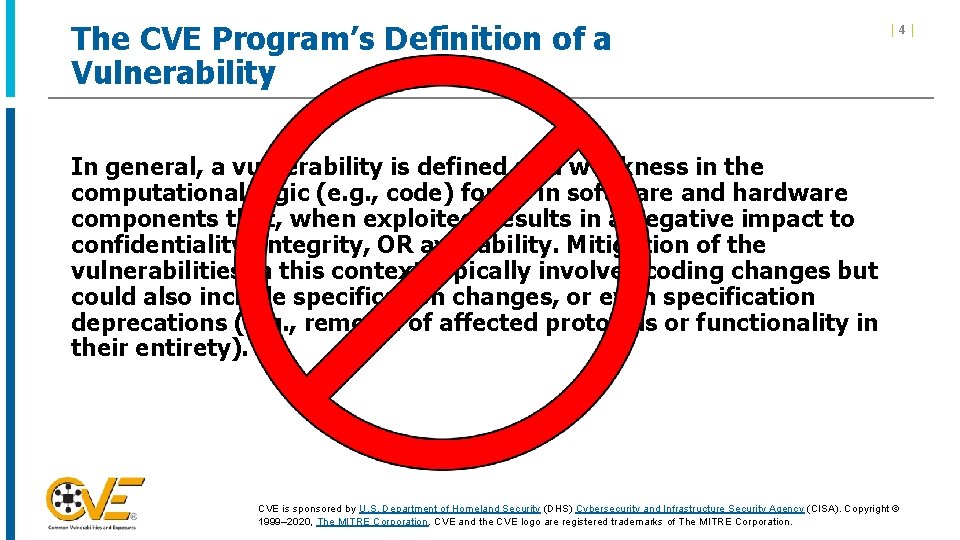
The CVE Program’s Definition of a Vulnerability |4| In general, a vulnerability is defined as a weakness in the computational logic (e. g. , code) found in software and hardware components that, when exploited, results in a negative impact to confidentiality, integrity, OR availability. Mitigation of the vulnerabilities in this context typically involves coding changes but could also include specification changes, or even specification deprecations (e. g. , removal of affected protocols or functionality in their entirety). CVE is sponsored by U. S. Department of Homeland Security (DHS) Cybersecurity and Infrastructure Security Agency (CISA). Copyright © 1999– 2020, The MITRE Corporation. CVE and the CVE logo are registered trademarks of The MITRE Corporation.
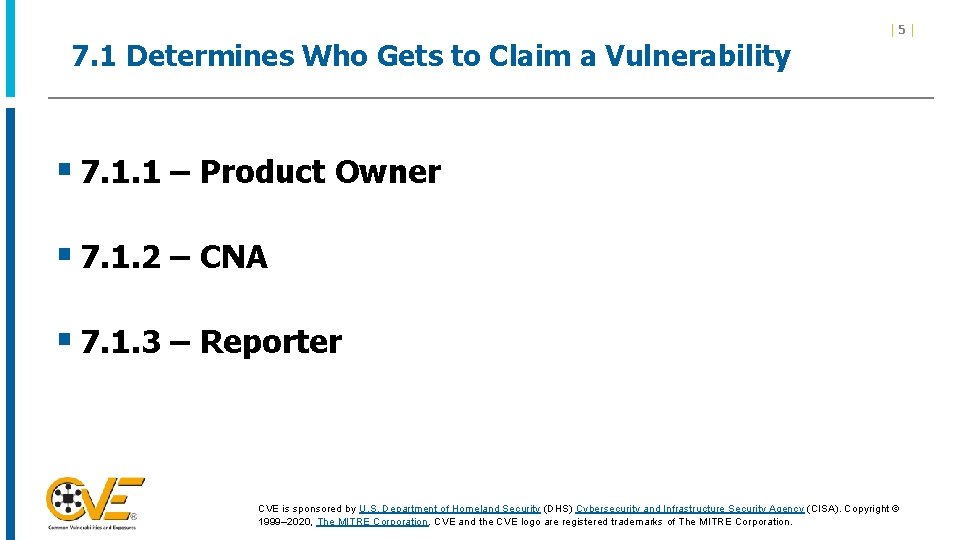
7. 1 Determines Who Gets to Claim a Vulnerability |5| § 7. 1. 1 – Product Owner § 7. 1. 2 – CNA § 7. 1. 3 – Reporter CVE is sponsored by U. S. Department of Homeland Security (DHS) Cybersecurity and Infrastructure Security Agency (CISA). Copyright © 1999– 2020, The MITRE Corporation. CVE and the CVE logo are registered trademarks of The MITRE Corporation.
|6| 7. 1. 1 Product Owner Acknowledgement CVE is sponsored by U. S. Department of Homeland Security (DHS) Cybersecurity and Infrastructure Security Agency (CISA). Copyright © 1999– 2020, The MITRE Corporation. CVE and the CVE logo are registered trademarks of The MITRE Corporation.
7. 1. 1 Who is the Product Owner? |7| § Product owners can be: – Anyone who develops, own, or uses software in their products § Software vendors § Hardware vendors § Open source projects § Service providers CVE is sponsored by U. S. Department of Homeland Security (DHS) Cybersecurity and Infrastructure Security Agency (CISA). Copyright © 1999– 2020, The MITRE Corporation. CVE and the CVE logo are registered trademarks of The MITRE Corporation.
|8| Upstream vendors cannot override downstream vendor claims CVE is sponsored by U. S. Department of Homeland Security (DHS) Cybersecurity and Infrastructure Security Agency (CISA). Copyright © 1999– 2020, The MITRE Corporation. CVE and the CVE logo are registered trademarks of The MITRE Corporation.
7. 1. 1 What is an Acknowledgement? |9| § Vendor needs to clearly state – There is a vulnerability – Provide enough information to ensure it is acknowledging the same vulnerability CVE is sponsored by U. S. Department of Homeland Security (DHS) Cybersecurity and Infrastructure Security Agency (CISA). Copyright © 1999– 2020, The MITRE Corporation. CVE and the CVE logo are registered trademarks of The MITRE Corporation.
What do you do if… § § | 10 | The software owner does not acknowledge the vulnerability The software owner denies the vulnerability You cannot contact the software owner You are not sure who owns the software § Use 7. 1. 2 or 7. 1. 3 CVE is sponsored by U. S. Department of Homeland Security (DHS) Cybersecurity and Infrastructure Security Agency (CISA). Copyright © 1999– 2020, The MITRE Corporation. CVE and the CVE logo are registered trademarks of The MITRE Corporation.
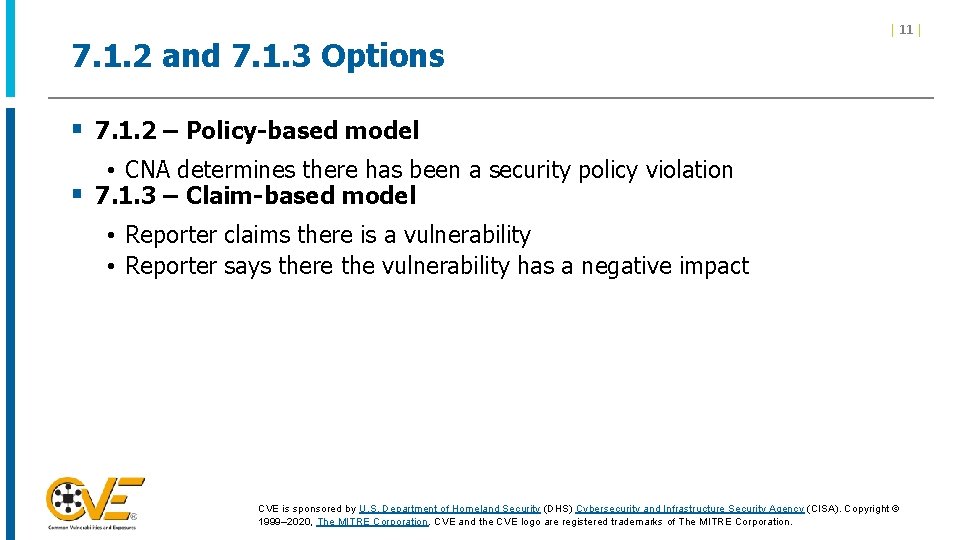
7. 1. 2 and 7. 1. 3 Options | 11 | § 7. 1. 2 – Policy-based model • CNA determines there has been a security policy violation § 7. 1. 3 – Claim-based model • Reporter claims there is a vulnerability • Reporter says there the vulnerability has a negative impact CVE is sponsored by U. S. Department of Homeland Security (DHS) Cybersecurity and Infrastructure Security Agency (CISA). Copyright © 1999– 2020, The MITRE Corporation. CVE and the CVE logo are registered trademarks of The MITRE Corporation.
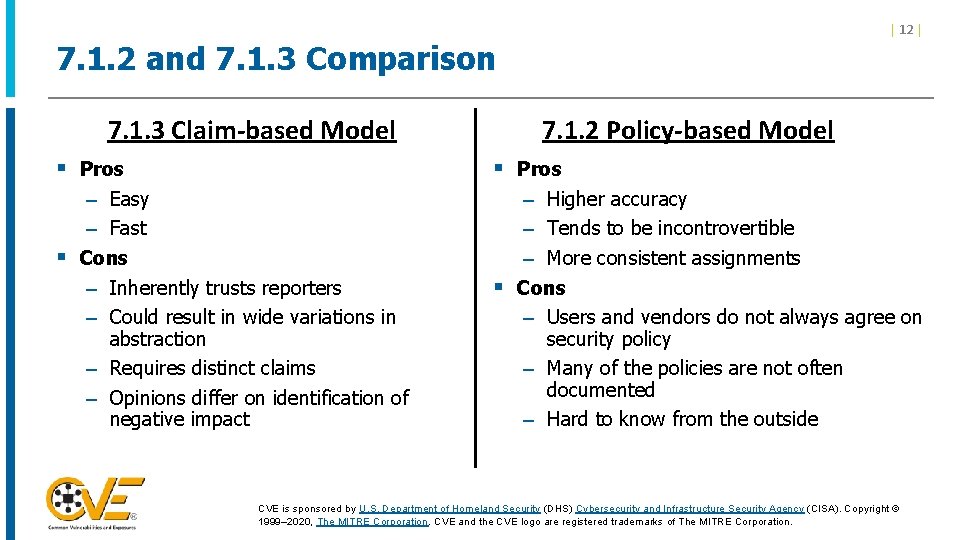
| 12 | 7. 1. 2 and 7. 1. 3 Comparison 7. 1. 3 Claim-based Model 7. 1. 2 Policy-based Model § Pros – Easy – Fast § Cons – Inherently trusts reporters – Could result in wide variations in abstraction – Requires distinct claims – Opinions differ on identification of negative impact – Higher accuracy – Tends to be incontrovertible – More consistent assignments § Cons – Users and vendors do not always agree on security policy – Many of the policies are not often documented – Hard to know from the outside CVE is sponsored by U. S. Department of Homeland Security (DHS) Cybersecurity and Infrastructure Security Agency (CISA). Copyright © 1999– 2020, The MITRE Corporation. CVE and the CVE logo are registered trademarks of The MITRE Corporation.
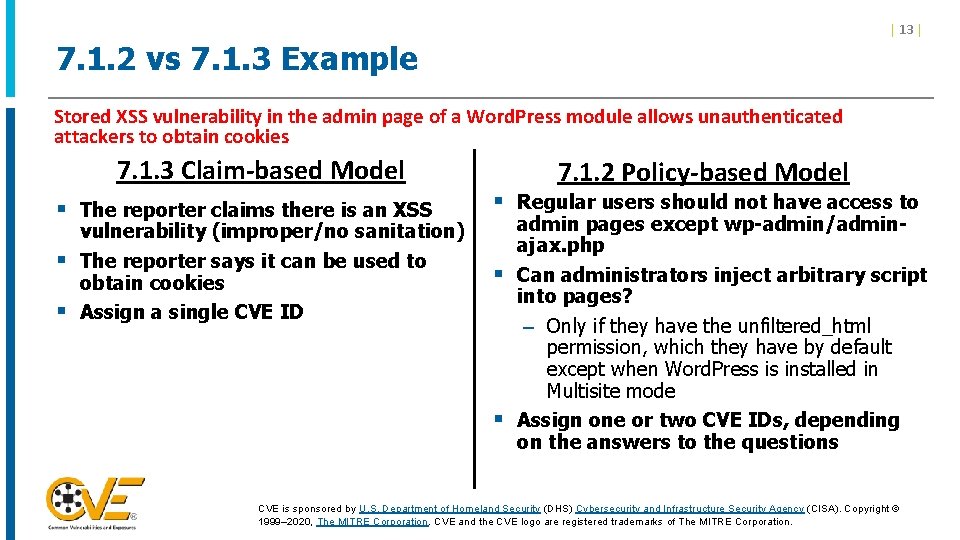
| 13 | 7. 1. 2 vs 7. 1. 3 Example Stored XSS vulnerability in the admin page of a Word. Press module allows unauthenticated attackers to obtain cookies 7. 1. 3 Claim-based Model § The reporter claims there is an XSS § § vulnerability (improper/no sanitation) The reporter says it can be used to obtain cookies Assign a single CVE ID 7. 1. 2 Policy-based Model § Regular users should not have access to § § admin pages except wp-admin/adminajax. php Can administrators inject arbitrary script into pages? – Only if they have the unfiltered_html permission, which they have by default except when Word. Press is installed in Multisite mode Assign one or two CVE IDs, depending on the answers to the questions CVE is sponsored by U. S. Department of Homeland Security (DHS) Cybersecurity and Infrastructure Security Agency (CISA). Copyright © 1999– 2020, The MITRE Corporation. CVE and the CVE logo are registered trademarks of The MITRE Corporation.
| 14 | 7. 2 – How Many Vulnerabilities CVE is sponsored by U. S. Department of Homeland Security (DHS) Cybersecurity and Infrastructure Security Agency (CISA). Copyright © 1999– 2020, The MITRE Corporation. CVE and the CVE logo are registered trademarks of The MITRE Corporation.
| 15 | 7. 2. 1 – Independently Fixable Vulnerabilities CVE is sponsored by U. S. Department of Homeland Security (DHS) Cybersecurity and Infrastructure Security Agency (CISA). Copyright © 1999– 2020, The MITRE Corporation. CVE and the CVE logo are registered trademarks of The MITRE Corporation.
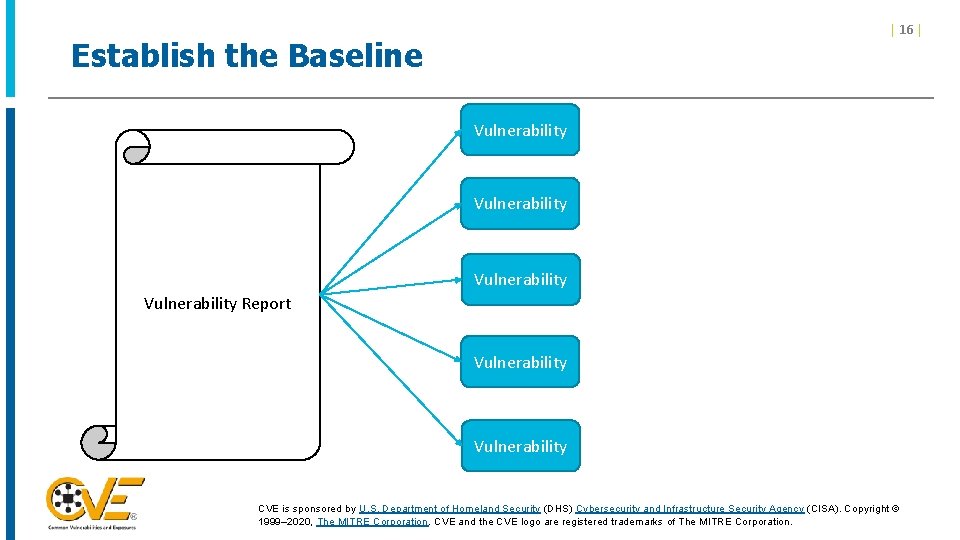
| 16 | Establish the Baseline Vulnerability Report Vulnerability CVE is sponsored by U. S. Department of Homeland Security (DHS) Cybersecurity and Infrastructure Security Agency (CISA). Copyright © 1999– 2020, The MITRE Corporation. CVE and the CVE logo are registered trademarks of The MITRE Corporation.
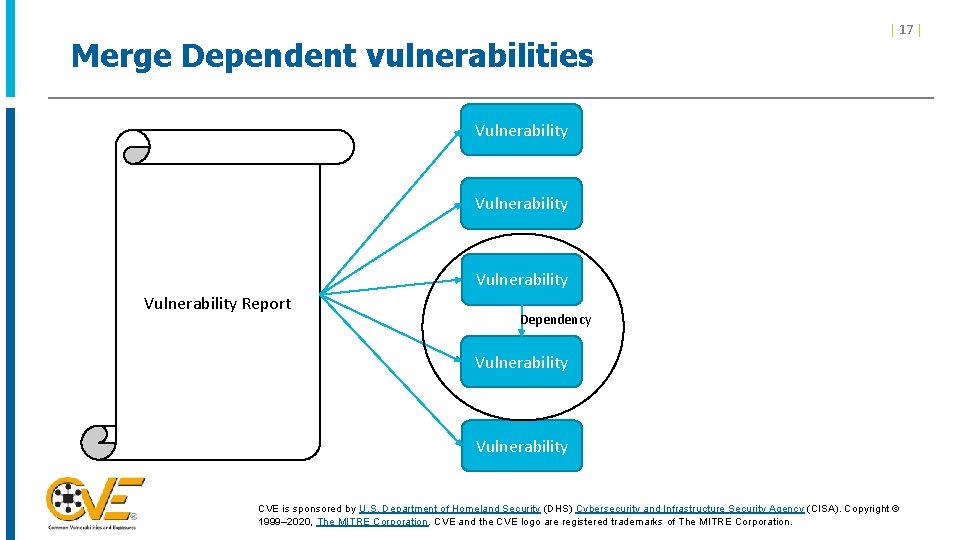
Merge Dependent vulnerabilities | 17 | Vulnerability Report Dependency Vulnerability CVE is sponsored by U. S. Department of Homeland Security (DHS) Cybersecurity and Infrastructure Security Agency (CISA). Copyright © 1999– 2020, The MITRE Corporation. CVE and the CVE logo are registered trademarks of The MITRE Corporation.
| 18 | Difficulties in Identifying Independent vulnerabilities CVE is sponsored by U. S. Department of Homeland Security (DHS) Cybersecurity and Infrastructure Security Agency (CISA). Copyright © 1999– 2020, The MITRE Corporation. CVE and the CVE logo are registered trademarks of The MITRE Corporation.
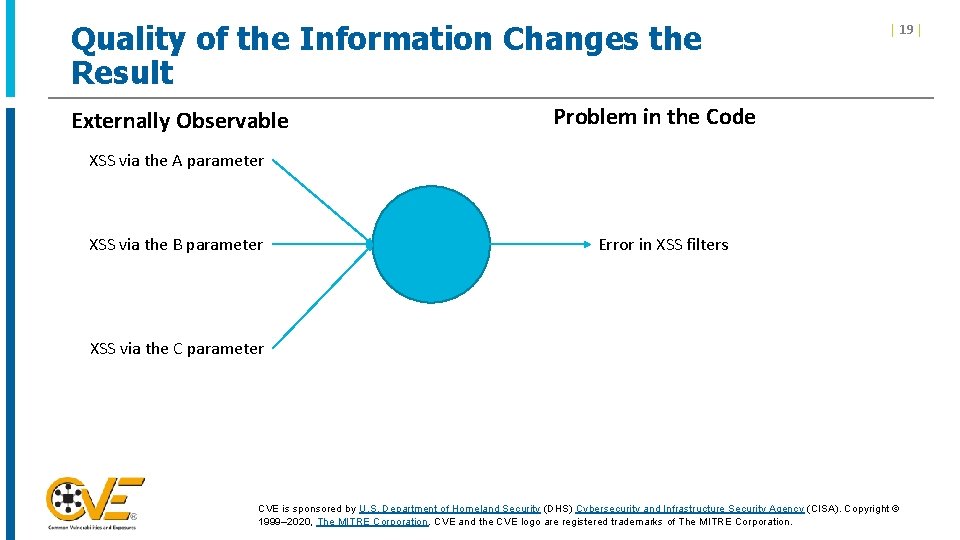
Quality of the Information Changes the Result Externally Observable | 19 | Problem in the Code XSS via the A parameter XSS via the B parameter Error in XSS filters XSS via the C parameter CVE is sponsored by U. S. Department of Homeland Security (DHS) Cybersecurity and Infrastructure Security Agency (CISA). Copyright © 1999– 2020, The MITRE Corporation. CVE and the CVE logo are registered trademarks of The MITRE Corporation.
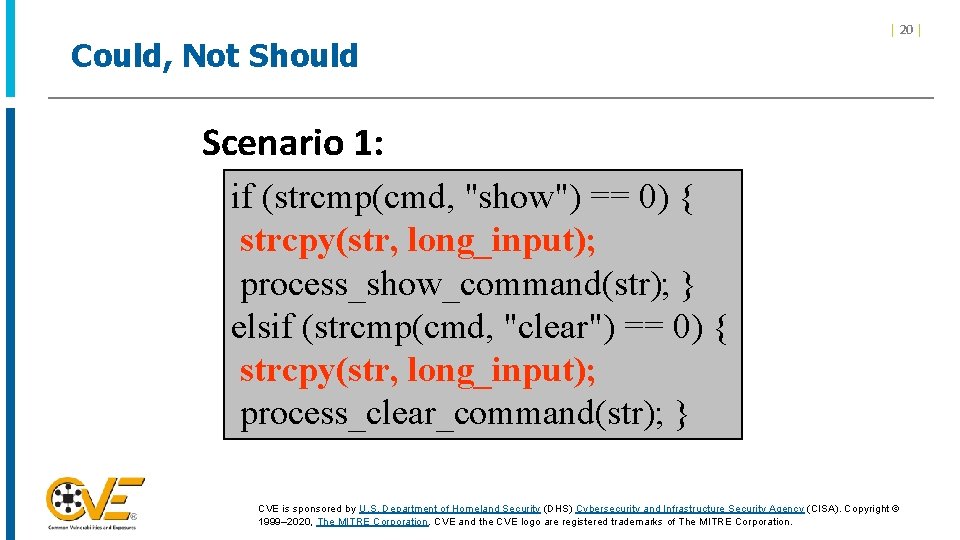
Could, Not Should | 20 | Scenario 1: if (strcmp(cmd, "show") == 0) { strcpy(str, long_input); process_show_command(str); } elsif (strcmp(cmd, "clear") == 0) { strcpy(str, long_input); process_clear_command(str); } CVE is sponsored by U. S. Department of Homeland Security (DHS) Cybersecurity and Infrastructure Security Agency (CISA). Copyright © 1999– 2020, The MITRE Corporation. CVE and the CVE logo are registered trademarks of The MITRE Corporation.
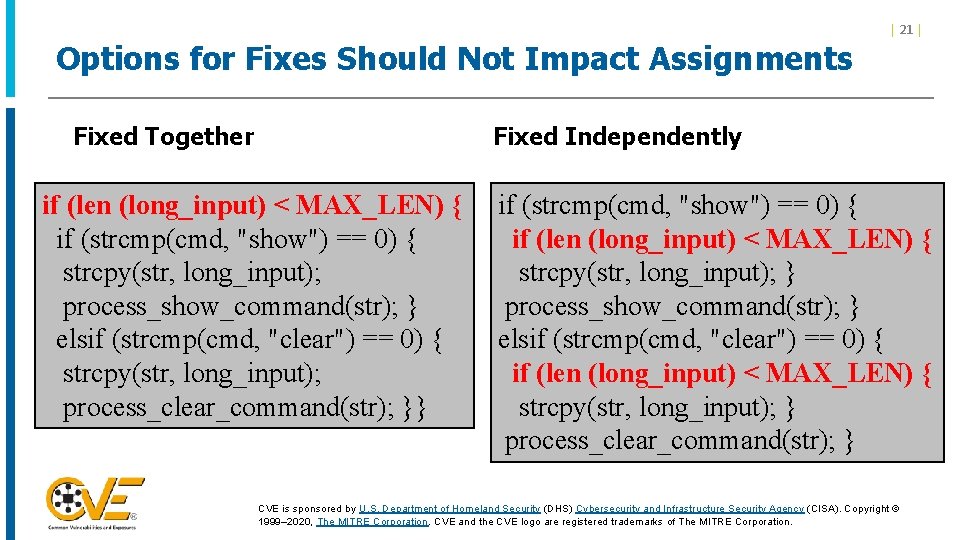
Options for Fixes Should Not Impact Assignments Fixed Together | 21 | Fixed Independently if (len (long_input) < MAX_LEN) { if (strcmp(cmd, "show") == 0) { strcpy(str, long_input); process_show_command(str); } elsif (strcmp(cmd, "clear") == 0) { strcpy(str, long_input); process_clear_command(str); }} if (strcmp(cmd, "show") == 0) { if (len (long_input) < MAX_LEN) { strcpy(str, long_input); } process_show_command(str); } elsif (strcmp(cmd, "clear") == 0) { if (len (long_input) < MAX_LEN) { strcpy(str, long_input); } process_clear_command(str); } CVE is sponsored by U. S. Department of Homeland Security (DHS) Cybersecurity and Infrastructure Security Agency (CISA). Copyright © 1999– 2020, The MITRE Corporation. CVE and the CVE logo are registered trademarks of The MITRE Corporation.
| 22 | 7. 2. 2 - Dependent vulnerabilities CVE is sponsored by U. S. Department of Homeland Security (DHS) Cybersecurity and Infrastructure Security Agency (CISA). Copyright © 1999– 2020, The MITRE Corporation. CVE and the CVE logo are registered trademarks of The MITRE Corporation.
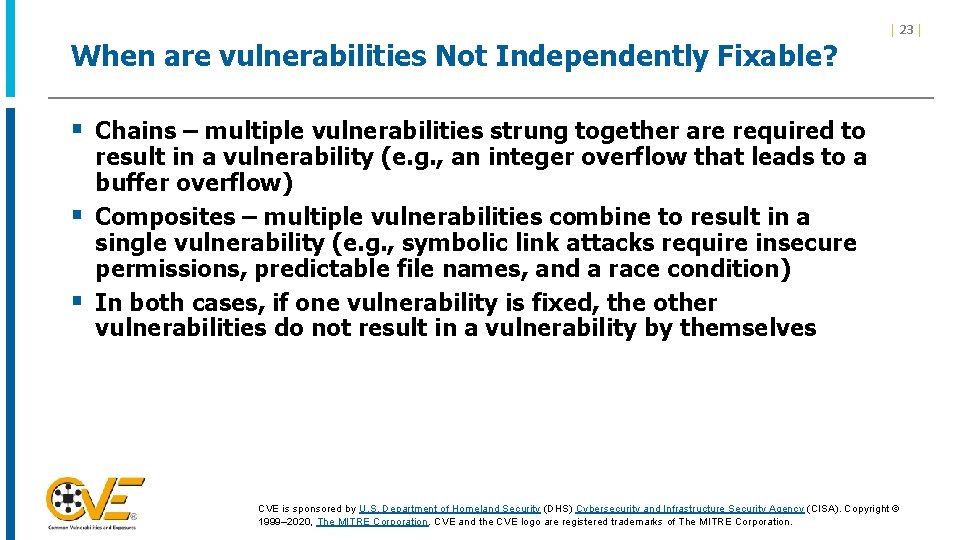
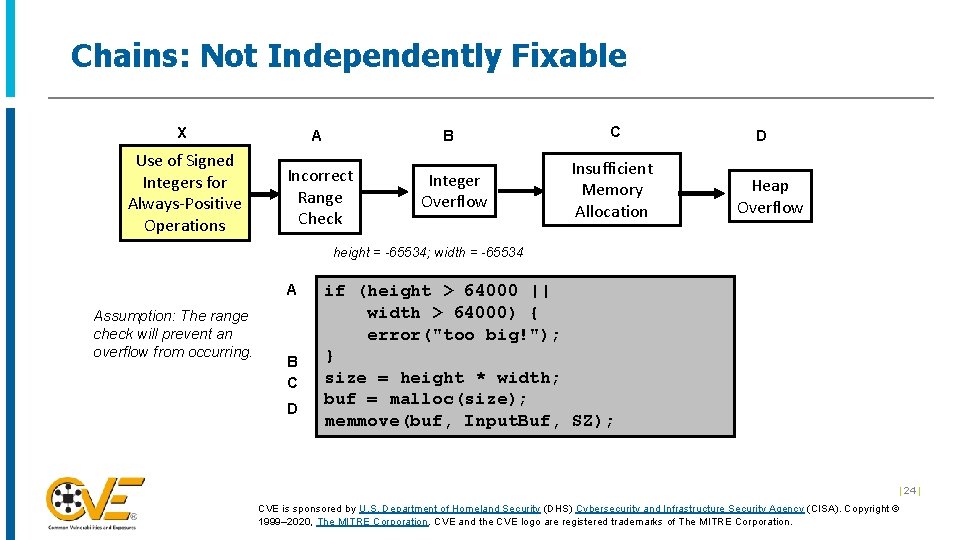
When are vulnerabilities Not Independently Fixable? | 23 | § Chains – multiple vulnerabilities strung together are required to § § result in a vulnerability (e. g. , an integer overflow that leads to a buffer overflow) Composites – multiple vulnerabilities combine to result in a single vulnerability (e. g. , symbolic link attacks require insecure permissions, predictable file names, and a race condition) In both cases, if one vulnerability is fixed, the other vulnerabilities do not result in a vulnerability by themselves CVE is sponsored by U. S. Department of Homeland Security (DHS) Cybersecurity and Infrastructure Security Agency (CISA). Copyright © 1999– 2020, The MITRE Corporation. CVE and the CVE logo are registered trademarks of The MITRE Corporation.
Chains: Not Independently Fixable X A Use of Signed Integers for Always-Positive Operations Incorrect Range Check B Integer Overflow C Insufficient Memory Allocation D Heap Overflow height = -65534; width = -65534 A Assumption: The range check will prevent an overflow from occurring. B C D if (height > 64000 || width > 64000) { error("too big!"); } size = height * width; buf = malloc(size); memmove(buf, Input. Buf, SZ); | 24 | CVE is sponsored by U. S. Department of Homeland Security (DHS) Cybersecurity and Infrastructure Security Agency (CISA). Copyright © 1999– 2020, The MITRE Corporation. CVE and the CVE logo are registered trademarks of The MITRE Corporation.
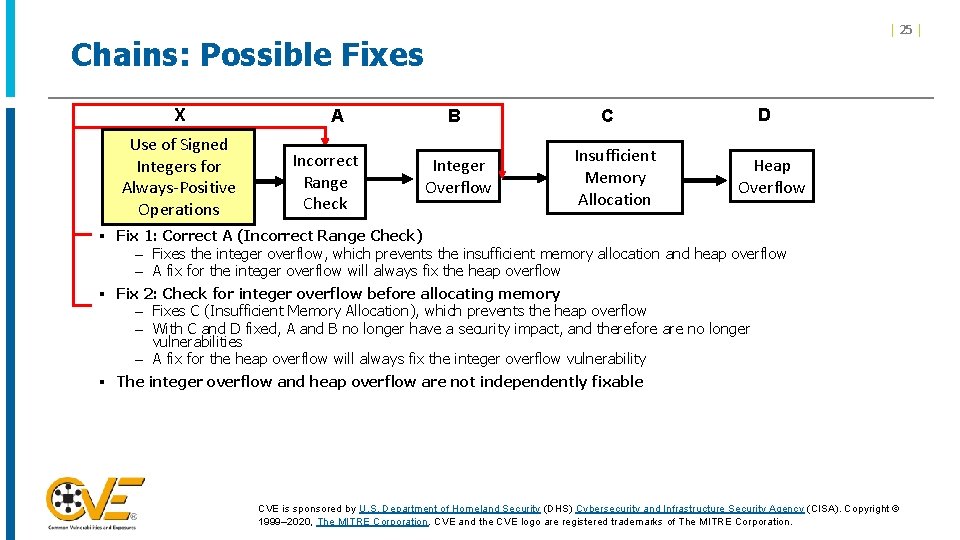
| 25 | Chains: Possible Fixes X Use of Signed Integers for Always-Positive Operations A Incorrect Range Check B Integer Overflow C Insufficient Memory Allocation D Heap Overflow § Fix 1: Correct A (Incorrect Range Check) – Fixes the integer overflow, which prevents the insufficient memory allocation and heap overflow – A fix for the integer overflow will always fix the heap overflow § Fix 2: Check for integer overflow before allocating memory – Fixes C (Insufficient Memory Allocation), which prevents the heap overflow – With C and D fixed, A and B no longer have a security impact, and therefore are no longer vulnerabilities – A fix for the heap overflow will always fix the integer overflow vulnerability § The integer overflow and heap overflow are not independently fixable CVE is sponsored by U. S. Department of Homeland Security (DHS) Cybersecurity and Infrastructure Security Agency (CISA). Copyright © 1999– 2020, The MITRE Corporation. CVE and the CVE logo are registered trademarks of The MITRE Corporation.
| 26 | Affected Product Groupings CVE is sponsored by U. S. Department of Homeland Security (DHS) Cybersecurity and Infrastructure Security Agency (CISA). Copyright © 1999– 2020, The MITRE Corporation. CVE and the CVE logo are registered trademarks of The MITRE Corporation.
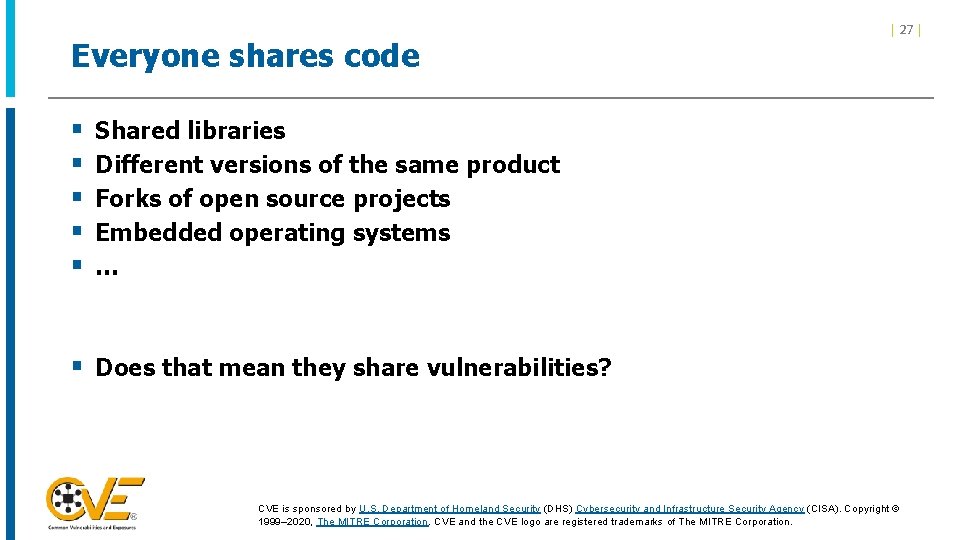
Everyone shares code § § § | 27 | Shared libraries Different versions of the same product Forks of open source projects Embedded operating systems … § Does that mean they share vulnerabilities? CVE is sponsored by U. S. Department of Homeland Security (DHS) Cybersecurity and Infrastructure Security Agency (CISA). Copyright © 1999– 2020, The MITRE Corporation. CVE and the CVE logo are registered trademarks of The MITRE Corporation.
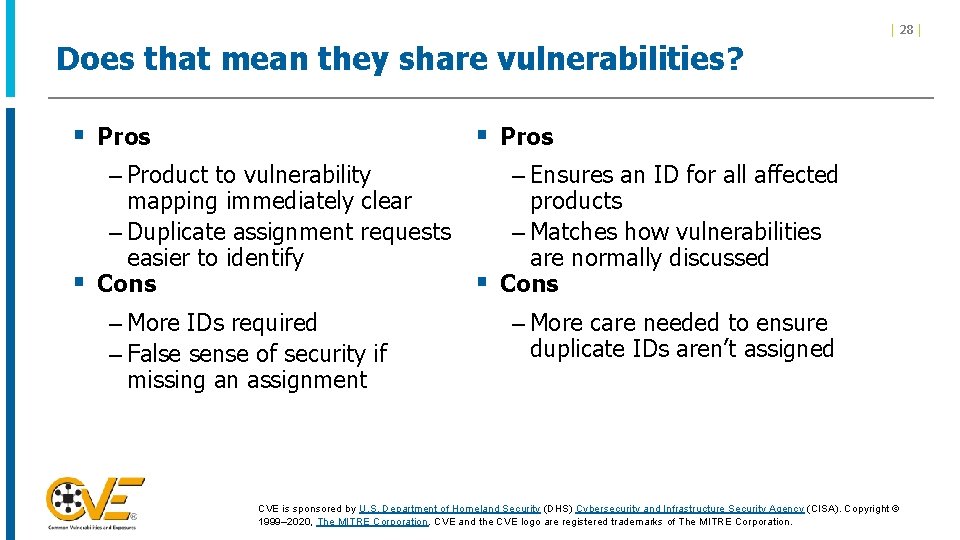
Does that mean they share vulnerabilities? § Pros – Product to vulnerability mapping immediately clear – Duplicate assignment requests easier to identify § Cons – Ensures an ID for all affected products – Matches how vulnerabilities are normally discussed § Cons – More IDs required – False sense of security if missing an assignment | 28 | – More care needed to ensure duplicate IDs aren’t assigned CVE is sponsored by U. S. Department of Homeland Security (DHS) Cybersecurity and Infrastructure Security Agency (CISA). Copyright © 1999– 2020, The MITRE Corporation. CVE and the CVE logo are registered trademarks of The MITRE Corporation.
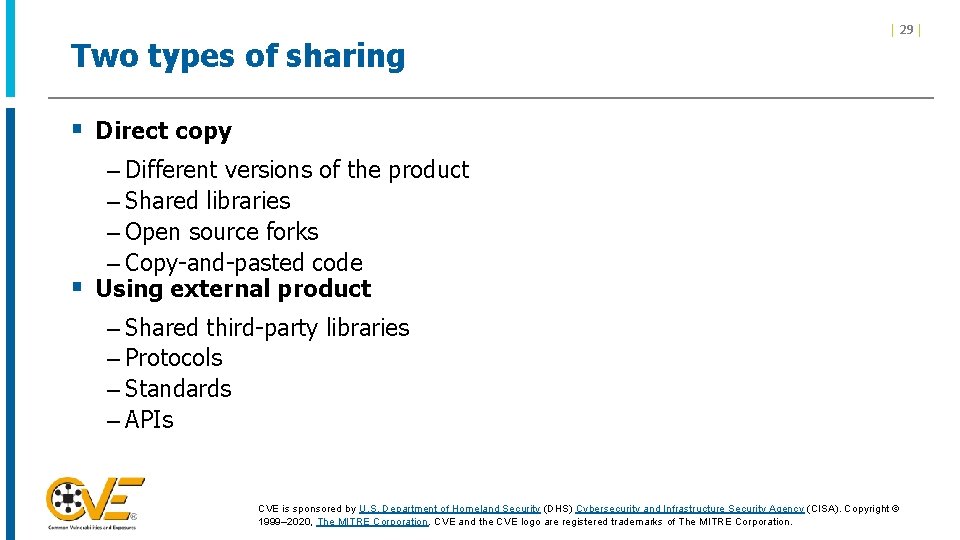
Two types of sharing | 29 | § Direct copy – Different versions of the product – Shared libraries – Open source forks – Copy-and-pasted code § Using external product – Shared third-party libraries – Protocols – Standards – APIs CVE is sponsored by U. S. Department of Homeland Security (DHS) Cybersecurity and Infrastructure Security Agency (CISA). Copyright © 1999– 2020, The MITRE Corporation. CVE and the CVE logo are registered trademarks of The MITRE Corporation.
| 30 | 7. 2. 4 – Sharing Code CVE is sponsored by U. S. Department of Homeland Security (DHS) Cybersecurity and Infrastructure Security Agency (CISA). Copyright © 1999– 2020, The MITRE Corporation. CVE and the CVE logo are registered trademarks of The MITRE Corporation.
| 31 | One Product Affected, One Vulnerability CVE is sponsored by U. S. Department of Homeland Security (DHS) Cybersecurity and Infrastructure Security Agency (CISA). Copyright © 1999– 2020, The MITRE Corporation. CVE and the CVE logo are registered trademarks of The MITRE Corporation.
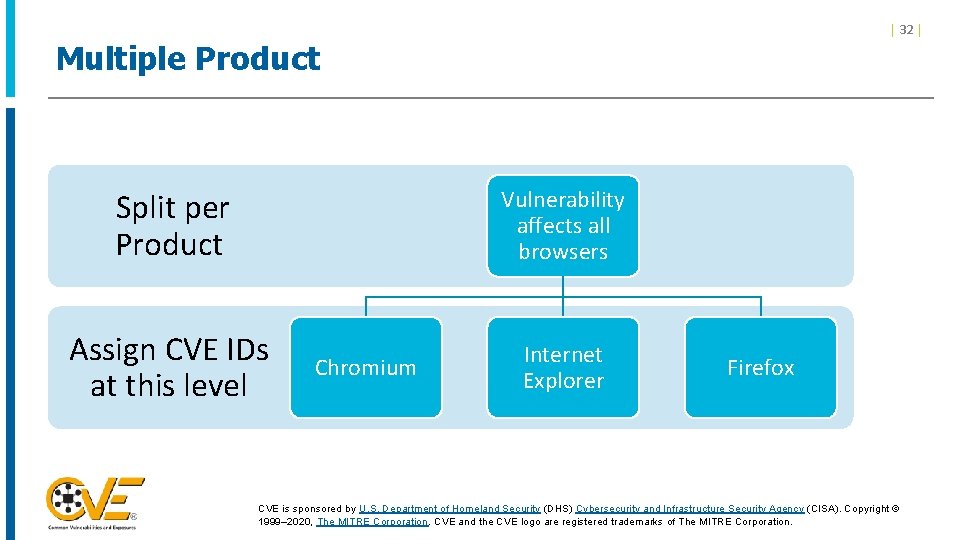
| 32 | Multiple Product Vulnerability affects all browsers Split per Product Assign CVE IDs at this level Chromium Internet Explorer Firefox CVE is sponsored by U. S. Department of Homeland Security (DHS) Cybersecurity and Infrastructure Security Agency (CISA). Copyright © 1999– 2020, The MITRE Corporation. CVE and the CVE logo are registered trademarks of The MITRE Corporation.
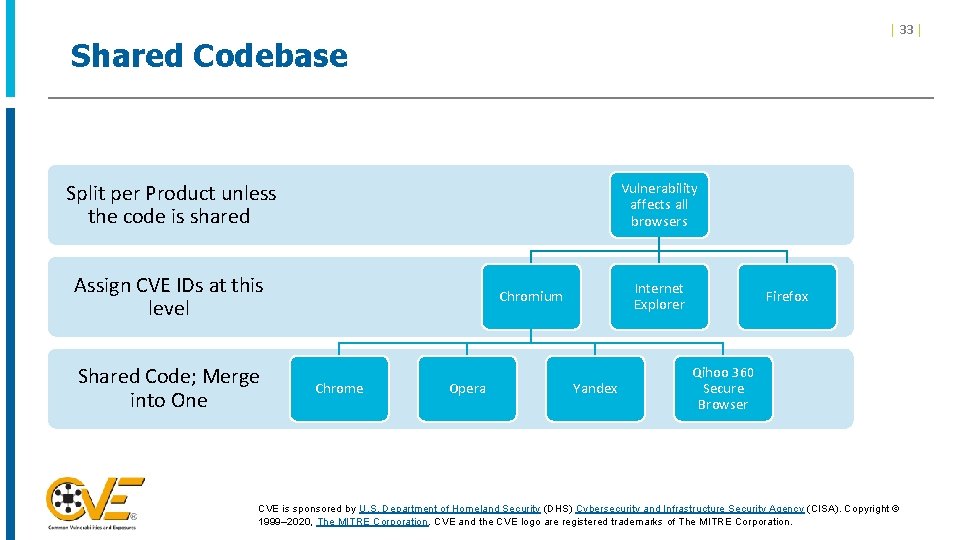
| 33 | Shared Codebase Split per Product unless the code is shared Vulnerability affects all browsers Assign CVE IDs at this level Shared Code; Merge into One Internet Explorer Chromium Chrome Opera Yandex Firefox Qihoo 360 Secure Browser CVE is sponsored by U. S. Department of Homeland Security (DHS) Cybersecurity and Infrastructure Security Agency (CISA). Copyright © 1999– 2020, The MITRE Corporation. CVE and the CVE logo are registered trademarks of The MITRE Corporation.
| 34 | If unsure, split one vulnerability per product CVE is sponsored by U. S. Department of Homeland Security (DHS) Cybersecurity and Infrastructure Security Agency (CISA). Copyright © 1999– 2020, The MITRE Corporation. CVE and the CVE logo are registered trademarks of The MITRE Corporation.
| 35 | 7. 2. 5 – Products using other functionality or specifications CVE is sponsored by U. S. Department of Homeland Security (DHS) Cybersecurity and Infrastructure Security Agency (CISA). Copyright © 1999– 2020, The MITRE Corporation. CVE and the CVE logo are registered trademarks of The MITRE Corporation.
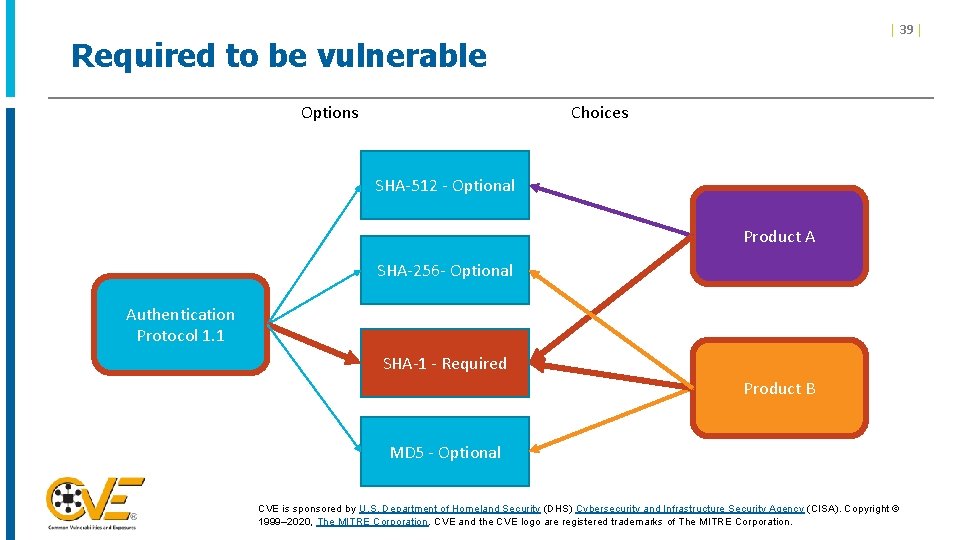
Using External Products | 36 | § If the implementer choose to use an insecure option over a § § secure one; assign a CVE ID to each affected codebase/product If the implementer was not given a secure option; assign a CVE ID to the external product Not sure; assign a CVE ID to each affected codebase/product CVE is sponsored by U. S. Department of Homeland Security (DHS) Cybersecurity and Infrastructure Security Agency (CISA). Copyright © 1999– 2020, The MITRE Corporation. CVE and the CVE logo are registered trademarks of The MITRE Corporation.
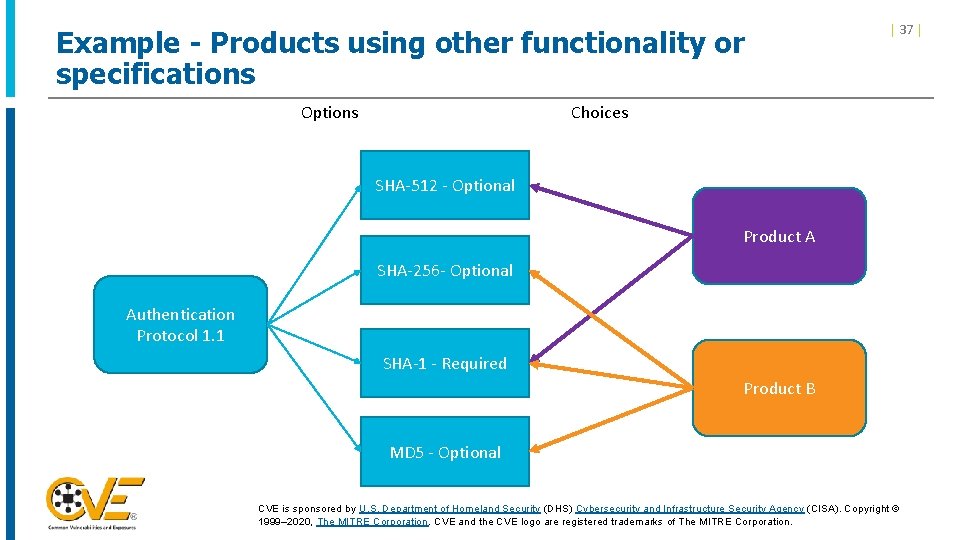
Example - Products using other functionality or specifications Options | 37 | Choices SHA-512 - Optional Product A SHA-256 - Optional Authentication Protocol 1. 1 SHA-1 - Required Product B MD 5 - Optional CVE is sponsored by U. S. Department of Homeland Security (DHS) Cybersecurity and Infrastructure Security Agency (CISA). Copyright © 1999– 2020, The MITRE Corporation. CVE and the CVE logo are registered trademarks of The MITRE Corporation.
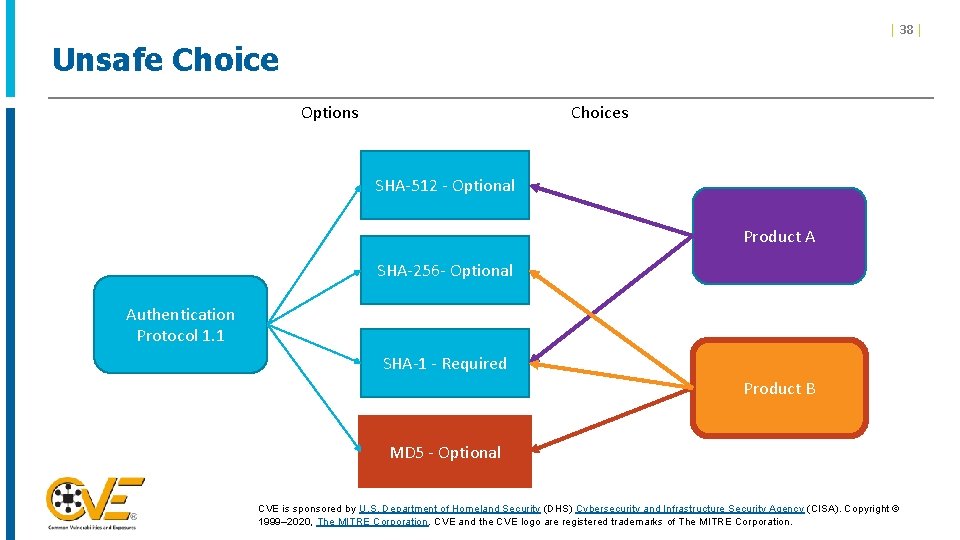
| 38 | Unsafe Choice Options Choices SHA-512 - Optional Product A SHA-256 - Optional Authentication Protocol 1. 1 SHA-1 - Required Product B MD 5 - Optional CVE is sponsored by U. S. Department of Homeland Security (DHS) Cybersecurity and Infrastructure Security Agency (CISA). Copyright © 1999– 2020, The MITRE Corporation. CVE and the CVE logo are registered trademarks of The MITRE Corporation.
| 39 | Required to be vulnerable Options Choices SHA-512 - Optional Product A SHA-256 - Optional Authentication Protocol 1. 1 SHA-1 - Required Product B MD 5 - Optional CVE is sponsored by U. S. Department of Homeland Security (DHS) Cybersecurity and Infrastructure Security Agency (CISA). Copyright © 1999– 2020, The MITRE Corporation. CVE and the CVE logo are registered trademarks of The MITRE Corporation.
| 40 | 7. 3 In Scope of Authority CVE is sponsored by U. S. Department of Homeland Security (DHS) Cybersecurity and Infrastructure Security Agency (CISA). Copyright © 1999– 2020, The MITRE Corporation. CVE and the CVE logo are registered trademarks of The MITRE Corporation.
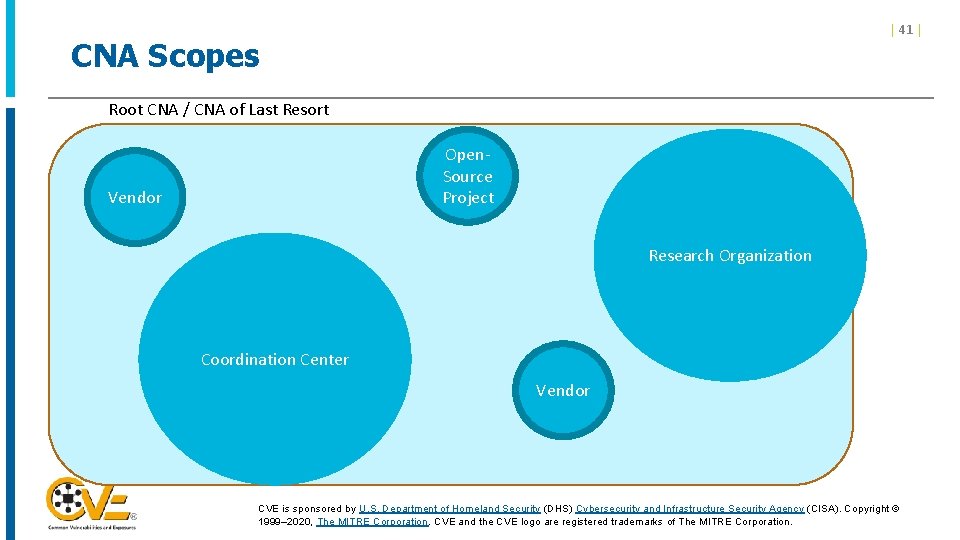
| 41 | CNA Scopes Root CNA / CNA of Last Resort Open. Source Project Vendor Research Organization Coordination Center Vendor CVE is sponsored by U. S. Department of Homeland Security (DHS) Cybersecurity and Infrastructure Security Agency (CISA). Copyright © 1999– 2020, The MITRE Corporation. CVE and the CVE logo are registered trademarks of The MITRE Corporation.
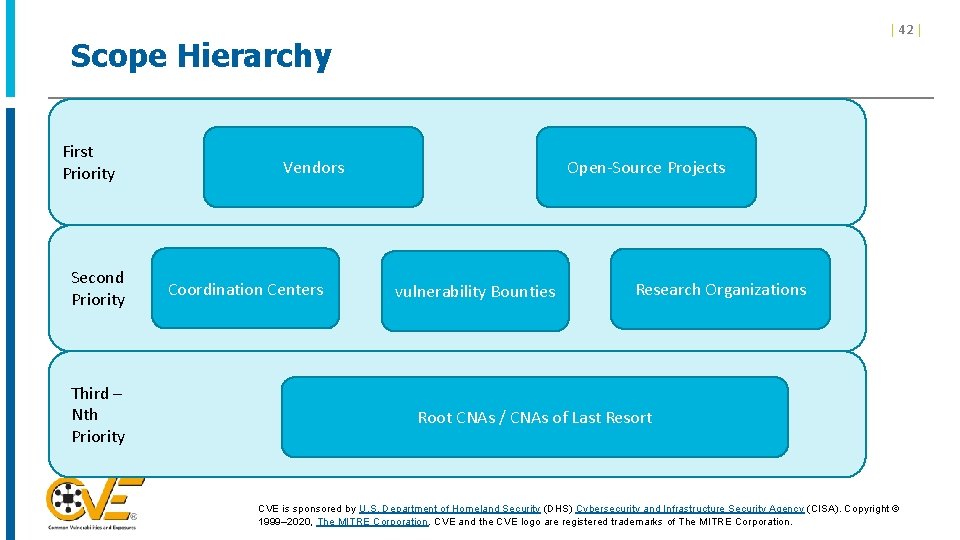
| 42 | Scope Hierarchy First Priority Second Priority Third – Nth Priority Vendors Coordination Centers Open-Source Projects vulnerability Bounties Research Organizations Root CNAs / CNAs of Last Resort CVE is sponsored by U. S. Department of Homeland Security (DHS) Cybersecurity and Infrastructure Security Agency (CISA). Copyright © 1999– 2020, The MITRE Corporation. CVE and the CVE logo are registered trademarks of The MITRE Corporation.
| 43 | Overlapping Scopes: Vendors and Open Source CVE is sponsored by U. S. Department of Homeland Security (DHS) Cybersecurity and Infrastructure Security Agency (CISA). Copyright © 1999– 2020, The MITRE Corporation. CVE and the CVE logo are registered trademarks of The MITRE Corporation.
Software Dependencies | 44 | § Upstream is a CNA – Upstream gets priority – Escalate to Root if upstream disputes § Upstream is not a CNA – Must make good-faith effort to contact upstream – Option 1 § Request CVE ID from CNA of Last Resort – Option 2 § Assign if no other CNAs involved § Negotiate assignment if multiple CNAs are involved § Go to CNA of Last Resort if negotiations fail CVE is sponsored by U. S. Department of Homeland Security (DHS) Cybersecurity and Infrastructure Security Agency (CISA). Copyright © 1999– 2020, The MITRE Corporation. CVE and the CVE logo are registered trademarks of The MITRE Corporation.
Vendor CNAs Collaborate on a Project | 45 | § Option 1 – Negotiate – Escalate to Root if negotiations fail § Option 2 – Create project-focused CNA CVE is sponsored by U. S. Department of Homeland Security (DHS) Cybersecurity and Infrastructure Security Agency (CISA). Copyright © 1999– 2020, The MITRE Corporation. CVE and the CVE logo are registered trademarks of The MITRE Corporation.
| 46 | Forks § Defer to main branch (if one exists) § Negotiate the assignment otherwise § Escalate to Root if negotiations fail CVE is sponsored by U. S. Department of Homeland Security (DHS) Cybersecurity and Infrastructure Security Agency (CISA). Copyright © 1999– 2020, The MITRE Corporation. CVE and the CVE logo are registered trademarks of The MITRE Corporation.
| 47 | Overlapping Scopes: Non-Vendor CNAs CVE is sponsored by U. S. Department of Homeland Security (DHS) Cybersecurity and Infrastructure Security Agency (CISA). Copyright © 1999– 2020, The MITRE Corporation. CVE and the CVE logo are registered trademarks of The MITRE Corporation.
Coordinators, Bounties, and Researchers | 48 | § Difficult to detect duplicate assignments before disclosure § Good-faith effort to contact vendor required – Vendor can detect independent discoveries § First to populate gets priority CVE is sponsored by U. S. Department of Homeland Security (DHS) Cybersecurity and Infrastructure Security Agency (CISA). Copyright © 1999– 2020, The MITRE Corporation. CVE and the CVE logo are registered trademarks of The MITRE Corporation.
| 49 | 7. 4 – Requirements for Assigning a CVE ID CVE is sponsored by U. S. Department of Homeland Security (DHS) Cybersecurity and Infrastructure Security Agency (CISA). Copyright © 1999– 2020, The MITRE Corporation. CVE and the CVE logo are registered trademarks of The MITRE Corporation.
| 50 | 7. 4. 1 - Intended to be Public CVE is sponsored by U. S. Department of Homeland Security (DHS) Cybersecurity and Infrastructure Security Agency (CISA). Copyright © 1999– 2020, The MITRE Corporation. CVE and the CVE logo are registered trademarks of The MITRE Corporation.
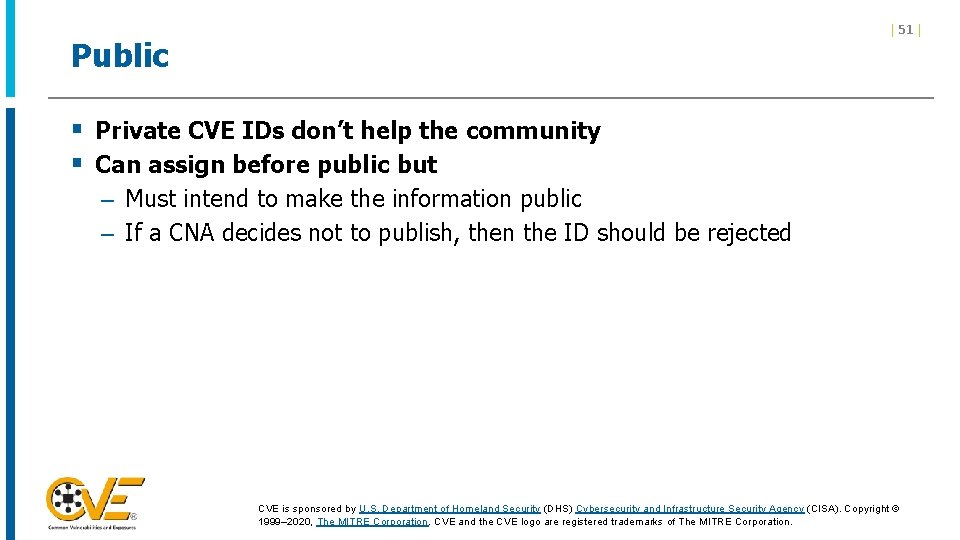
| 51 | Public § Private CVE IDs don’t help the community § Can assign before public but – Must intend to make the information public – If a CNA decides not to publish, then the ID should be rejected CVE is sponsored by U. S. Department of Homeland Security (DHS) Cybersecurity and Infrastructure Security Agency (CISA). Copyright © 1999– 2020, The MITRE Corporation. CVE and the CVE logo are registered trademarks of The MITRE Corporation.
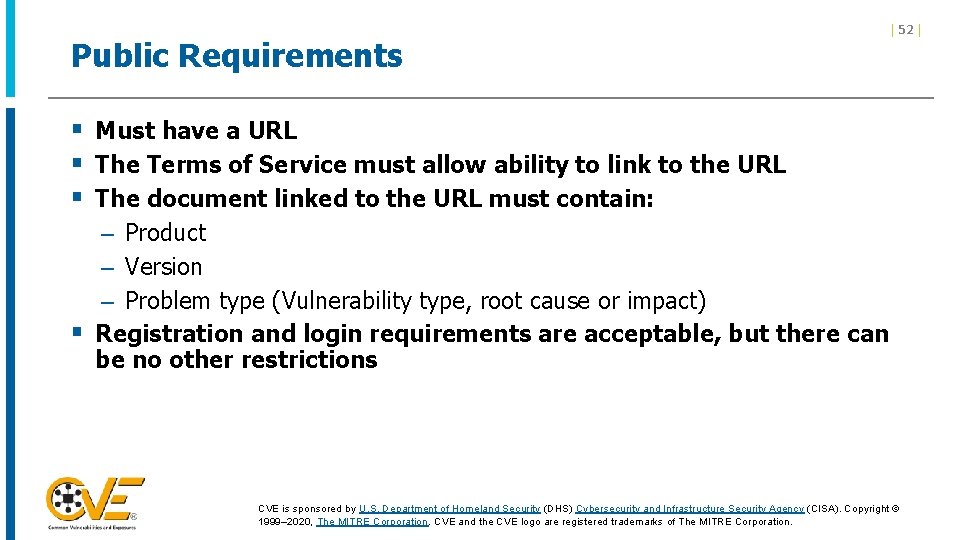
Public Requirements | 52 | § Must have a URL § The Terms of Service must allow ability to link to the URL § The document linked to the URL must contain: – Product – Version – Problem type (Vulnerability type, root cause or impact) § Registration and login requirements are acceptable, but there can be no other restrictions CVE is sponsored by U. S. Department of Homeland Security (DHS) Cybersecurity and Infrastructure Security Agency (CISA). Copyright © 1999– 2020, The MITRE Corporation. CVE and the CVE logo are registered trademarks of The MITRE Corporation.
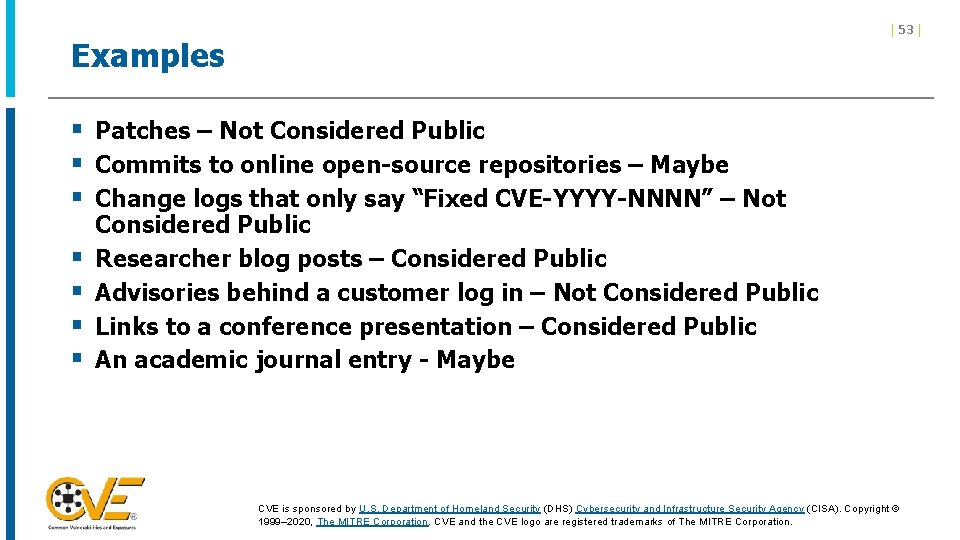
| 53 | Examples § Patches – Not Considered Public § Commits to online open-source repositories – Maybe § Change logs that only say “Fixed CVE-YYYY-NNNN” – Not § § Considered Public Researcher blog posts – Considered Public Advisories behind a customer log in – Not Considered Public Links to a conference presentation – Considered Public An academic journal entry - Maybe CVE is sponsored by U. S. Department of Homeland Security (DHS) Cybersecurity and Infrastructure Security Agency (CISA). Copyright © 1999– 2020, The MITRE Corporation. CVE and the CVE logo are registered trademarks of The MITRE Corporation.
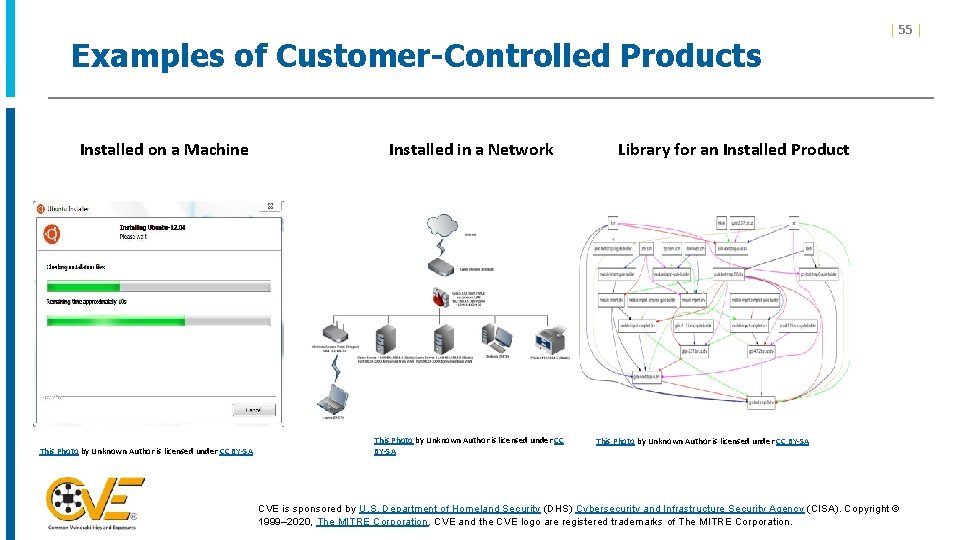
| 54 | 7. 4. 4 – 7. 4. 6 Customer-Controlled Software CVE is sponsored by U. S. Department of Homeland Security (DHS) Cybersecurity and Infrastructure Security Agency (CISA). Copyright © 1999– 2020, The MITRE Corporation. CVE and the CVE logo are registered trademarks of The MITRE Corporation.
Examples of Customer-Controlled Products Installed on a Machine This Photo by Unknown Author is licensed under CC BY-SA Installed in a Network This Photo by Unknown Author is licensed under CC BY-SA | 55 | Library for an Installed Product This Photo by Unknown Author is licensed under CC BY-SA CVE is sponsored by U. S. Department of Homeland Security (DHS) Cybersecurity and Infrastructure Security Agency (CISA). Copyright © 1999– 2020, The MITRE Corporation. CVE and the CVE logo are registered trademarks of The MITRE Corporation.
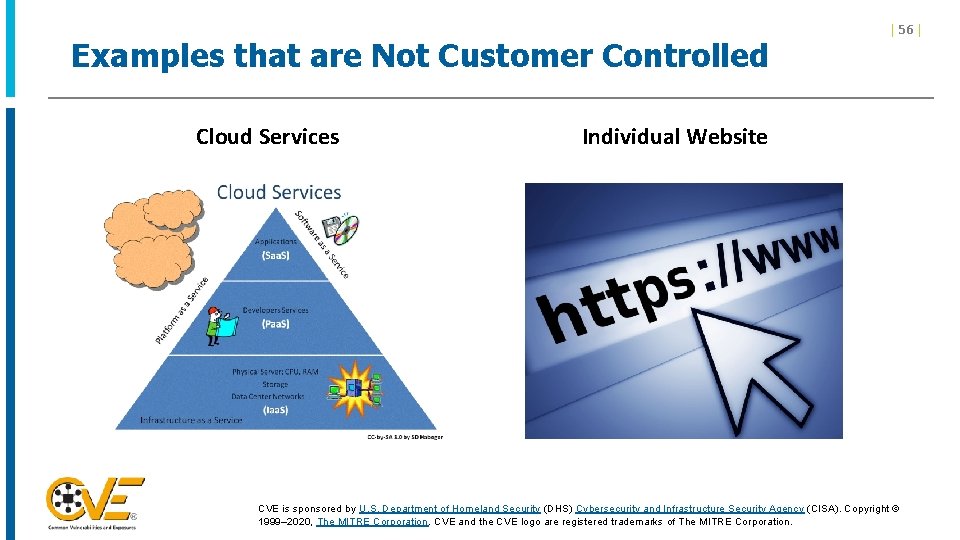
Examples that are Not Customer Controlled Cloud Services | 56 | Individual Website CVE is sponsored by U. S. Department of Homeland Security (DHS) Cybersecurity and Infrastructure Security Agency (CISA). Copyright © 1999– 2020, The MITRE Corporation. CVE and the CVE logo are registered trademarks of The MITRE Corporation.
| 57 | 7. 4. 7 - Publicly Available and Licensable Products CVE is sponsored by U. S. Department of Homeland Security (DHS) Cybersecurity and Infrastructure Security Agency (CISA). Copyright © 1999– 2020, The MITRE Corporation. CVE and the CVE logo are registered trademarks of The MITRE Corporation.
| 58 | Excludes § § § Betas Unofficial open source releases Malware Internal business software Code snippets from Stack Overflow CVE is sponsored by U. S. Department of Homeland Security (DHS) Cybersecurity and Infrastructure Security Agency (CISA). Copyright © 1999– 2020, The MITRE Corporation. CVE and the CVE logo are registered trademarks of The MITRE Corporation.
| 59 | 7. 4. 3 - Check for Duplicates CVE is sponsored by U. S. Department of Homeland Security (DHS) Cybersecurity and Infrastructure Security Agency (CISA). Copyright © 1999– 2020, The MITRE Corporation. CVE and the CVE logo are registered trademarks of The MITRE Corporation.
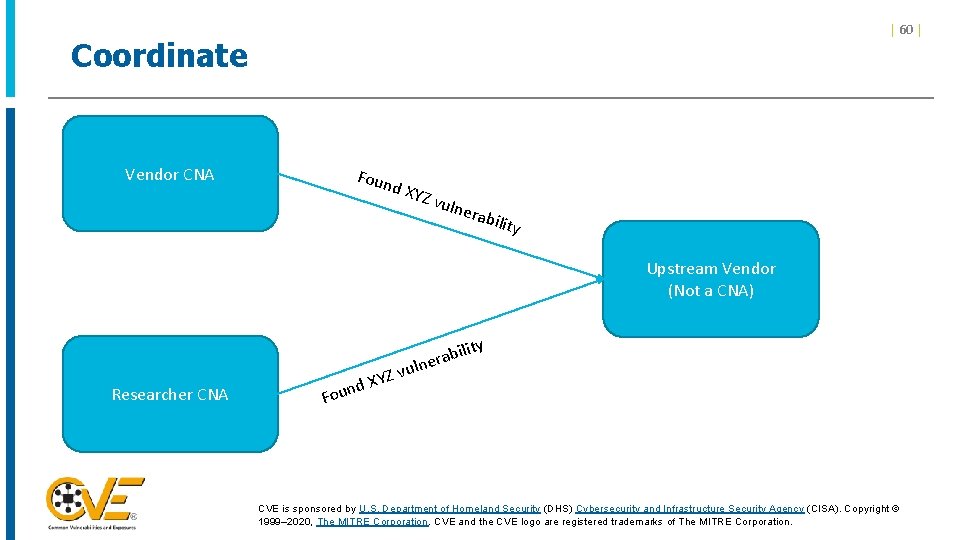
| 60 | Coordinate Vendor CNA Foun d XY Z vu lner abili ty Upstream Vendor (Not a CNA) Researcher CNA Zv Y X nd lity i b a r ulne Fou CVE is sponsored by U. S. Department of Homeland Security (DHS) Cybersecurity and Infrastructure Security Agency (CISA). Copyright © 1999– 2020, The MITRE Corporation. CVE and the CVE logo are registered trademarks of The MITRE Corporation.
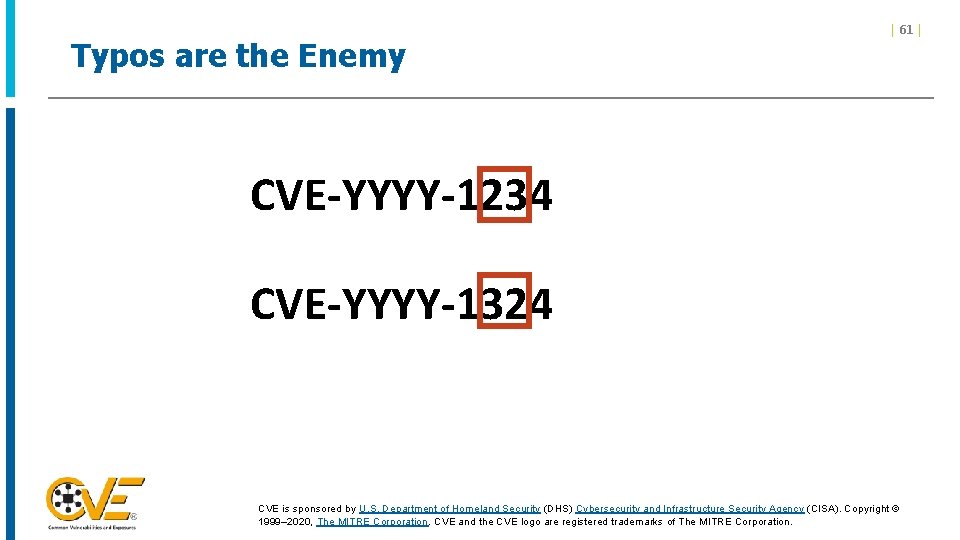
Typos are the Enemy | 61 | CVE-YYYY-1234 CVE-YYYY-1324 CVE is sponsored by U. S. Department of Homeland Security (DHS) Cybersecurity and Infrastructure Security Agency (CISA). Copyright © 1999– 2020, The MITRE Corporation. CVE and the CVE logo are registered trademarks of The MITRE Corporation.
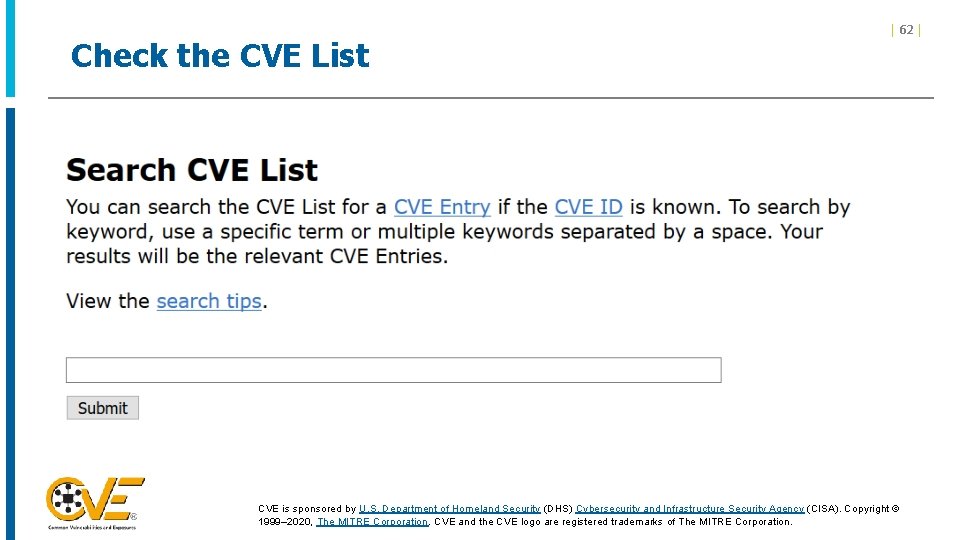
Check the CVE List | 62 | CVE is sponsored by U. S. Department of Homeland Security (DHS) Cybersecurity and Infrastructure Security Agency (CISA). Copyright © 1999– 2020, The MITRE Corporation. CVE and the CVE logo are registered trademarks of The MITRE Corporation.
| 63 | 7. 4. 8 – Do not consider other factors CVE is sponsored by U. S. Department of Homeland Security (DHS) Cybersecurity and Infrastructure Security Agency (CISA). Copyright © 1999– 2020, The MITRE Corporation. CVE and the CVE logo are registered trademarks of The MITRE Corporation.
CNAs Can’t Add Requirements | 64 | § Additional factors should not be considered § If additional factors are considered, then escalating the issue to the § parent CNA is warranted The following factors have been rejected in the past: – Merge by flaw type – CVSS scores below a certain level don’t get an ID – Only affects end-of-life products CVE is sponsored by U. S. Department of Homeland Security (DHS) Cybersecurity and Infrastructure Security Agency (CISA). Copyright © 1999– 2020, The MITRE Corporation. CVE and the CVE logo are registered trademarks of The MITRE Corporation.
| 65 | Conclusion CVE is sponsored by U. S. Department of Homeland Security (DHS) Cybersecurity and Infrastructure Security Agency (CISA). Copyright © 1999– 2020, The MITRE Corporation. CVE and the CVE logo are registered trademarks of The MITRE Corporation.