AP Literature and Composition 5 th Sixweeks Drama


- Slides: 57
AP Literature and Composition 5 th Six-weeks Drama
Block 1: Feb 17/18 Obj: ● Discuss archetypes, motifs/ theme o Get out paper for notes ● Watch Acts 1 -2 ● Work on motif organizer HW: ● Read annotate Act 3 ● Get Glass Menagerie by Tennessee Williams
Archetypes ● Review ● Name some from Lear ● How is meaning added/enriched through the use of an archetype?
Discuss film & begin watching it ● Take notes on the following motifs: o o o eyesight/blindness illness MADNESS wisdom/foolishness nakedness fate/fortune ● Watch Acts 1 -2 o The film is available online at pbs: § http: //video. pbs. org/video/1075274407/
Block 2: Feb 19/20 Obj: ● Get out motif notes ● Watch Act 3 and start of 4 HW: ● Finish reading and annotating King Lear ● Get Glass Menagerie by Tennessee Williams
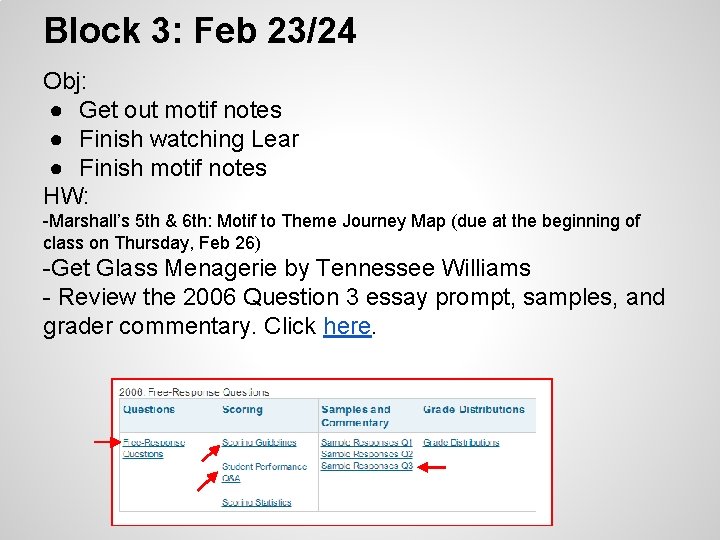
Block 3: Feb 23/24 Obj: ● Get out motif notes ● Finish watching Lear ● Finish motif notes HW: -Marshall’s 5 th & 6 th: Motif to Theme Journey Map (due at the beginning of class on Thursday, Feb 26) -Get Glass Menagerie by Tennessee Williams - Review the 2006 Question 3 essay prompt, samples, and grader commentary. Click here.
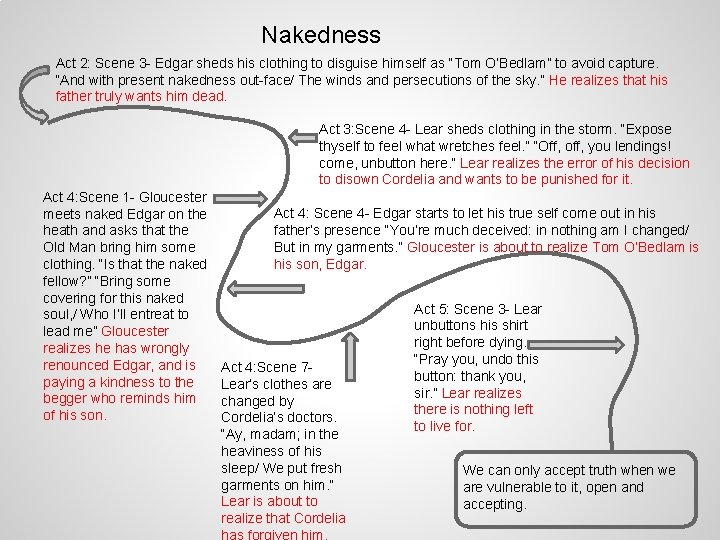
Motif and Theme Example: Nakedness What ideas do we associate with nakedness? Which characters appear naked? When are they naked? What is revealed about their character when they are naked? Theme: We can only accept truth when we are vulnerable.
A Motif’s Journey ● Get in motif groups ● Trace your assigned motif throughout the play Create a map of where the motif occurs and who is involved at each point o Illustrate each point on your “map” with visuals o The endpoint of your journey should be theme that the motif leads to o
Nakedness Act 2: Scene 3 - Edgar sheds his clothing to disguise himself as “Tom O’Bedlam” to avoid capture. “And with present nakedness out-face/ The winds and persecutions of the sky. ” He realizes that his father truly wants him dead. Act 3: Scene 4 - Lear sheds clothing in the storm. “Expose thyself to feel what wretches feel. ” “Off, off, you lendings! come, unbutton here. ” Lear realizes the error of his decision to disown Cordelia and wants to be punished for it. Act 4: Scene 1 - Gloucester meets naked Edgar on the heath and asks that the Old Man bring him some clothing. “Is that the naked fellow? ” “Bring some covering for this naked soul, / Who I’ll entreat to lead me” Gloucester realizes he has wrongly renounced Edgar, and is paying a kindness to the begger who reminds him of his son. Act 4: Scene 4 - Edgar starts to let his true self come out in his father’s presence “You’re much deceived: in nothing am I changed/ But in my garments. ” Gloucester is about to realize Tom O’Bedlam is his son, Edgar. Act 4: Scene 7 Lear’s clothes are changed by Cordelia’s doctors. “Ay, madam; in the heaviness of his sleep/ We put fresh garments on him. ” Lear is about to realize that Cordelia has forgiven him. Act 5: Scene 3 - Lear unbuttons his shirt right before dying. “Pray you, undo this button: thank you, sir. ” Lear realizes there is nothing left to live for. We can only accept truth when we are vulnerable to it, open and accepting.
Block 4: Feb 25/26 Due to SAT administration, Ms. Marshall’s classes will meet in an alternative location on Wed 02/25. ---> 1 st=B 229, 2 nd=B 228 Obj: ● Turn in Motif notes and Journey Maps (Marshall’s classes) ● MC and Timed Writing Practice- Minor grade HW: ● Answer questions over Lear to prepare for Socratic seminar next class ● Get Glass Menagerie by Tennessee Williams (You will need next block!)
Questions over King Lear 1. Discuss the Fool in King Lear and his function in the play. What is his character’s purpose? 2. What is your opinion of the condition of Lear's mind in the opening scene? What effect does his increasing passion seem to have upon his faculties? Discuss the character of the king. 3. What is the view of human society in King Lear? 4. What is your idea of the aim and lesson of the play? 5. Trace the different stages of Lear's insanity. Is it true that King Lear is the tragedy of a "man going sane", as some critics suggest? 6. What is the significance of the Gloucester subplot? 7. Compare Lear's three daughters. By what means does Shakespeare deepen the contrast between Cordelia and her two sinister sisters? 8. Outline the character of Kent. How is he similar to Lear? 9. Discuss the effect of suffering on both Lear and Gloucester. 10. What are the comedic elements of the play and how do they function?
Block 5: Feb 27/ Mar 2 Agenda: ● Poetry Review- “King Lear in Respite Care” ● Socratic Seminar HW: ● Read scenes 1 -3 in Glass Menagerie (make sure to also read any introductory material) ● Get a copy of Great Expectations
King Lear in Respite Care Bridging question: Is the presence of a motif in a work necessary to the creation of a theme? Why or why not? Make sure to include support from either “King Lear” or “King Lear in Respite Care.
Find your name and sit there!
Block 6: Mar 3/4 Obj: ● Practice Exam Review/ Reflection HW: ● Read scenes 4 -5 of Glass Menagerie o Bring The Glass Menagerie by Tennessee Williams to class from now on ● Get a copy of Great Expectations by Charles Dickens ● REGISTER FOR AP EXAMS!!!! LATE FEES START MARCH 5 (THURSDAY)!!!
Group Review ● Read the poem and passage again ● Discuss each question o What is the question testing? o Discuss answers- if they differ, try to figure who is right ● Review the rubric for the essay o Titles of plays are UNDERLINED o Discuss which character(s) would make the strongest argument (it may not be the most obvious) o Some implications to consider: § Is the full work analyzed? or only a small piece? § Does the essay focus on ONE character? ● Take turns reading essays aloud ● Discuss each person’s work using the rubric as a guide: praise strengths, constructively address weaknesses, and come to a score ● The last few minutes of class we will go over the questions together, and you will receive your essay scores
Block 7: Mar 5/6 Obj: ● Discuss character complexities ● Watch Part One ● Take notes over character complexities HW: ● Read scenes 6 -7, keep looking for character complexities ● Get a copy of Great Expectations (we start reading next class!)
Contrasting Traits What makes a character (or person, for that matter) interesting and compelling? Complexity! What makes you complex? What are some of your traits that contradict each other or work against each other?
Complex Characters in GM Describe the various complex sides of each of the characters. Write about at least two contrasting traits of Tom, Laura, and Amanda. 1. 2. 3. 4. Name trait Provide evidence (direct quote with scene #) What literary element helps to emphasize the trait? What insight is gained about the character? (answer this just once- overall for each character)
Block 8: Mar 9/10 Obj: ● Watch Part Two of The Glass Menagerie. ● Finish character complexities notes- if not finished in class, it is homework o Turn in! ● Begin reading Great Expectations, if time permits. HW: ● Finish character complexities notes ● Read Ch 1 -4 in Great Expectations: Write down any questions you have while reading.
Block 9: Mar 11/12 Obj: 1. Turn in Character Complexities, if you didn’t already last class. 2. Glass Menagerie Group Presentations: o Language/ diction of scene settings o POV/ Rhetoric of Tom o Symbols o Thematic language HW: ● Read ch 5 -8 in Great Expectations - write down any questions you have while reading
The Glass Menagerie On Broadway https: //www. youtube. com/watch? v=QD 0 x. S 5 v 4 mf. A Pay attention to characterization and setting! • Costuming • Props • Lighting • Staging
Form Groups ● Each group will be given an area of focus and instructions. ● At the end of class, you will be sharing your findings in a short presentation ● Use any digital presentation method you are comfortable with ● Your presentation must cover all of the instructions for your focus area. ● Assign a group manager who will assign roles and make sure all members of the group have something to contribute. The manager must also make sure that all group members understand the concept for your presentation, and will oversee its construction.
Language/ Diction in Scene Settings Language- overall way of speaking (classified with an adjective or two) Diction- specific words chosen for their associations ● Identify impactful diction and list associations ● Classify the language overall ● What is learned about the characters? ● What is learned about the author’s purpose?
Language/ Diction in Scene Settings Scene II: Diction • Laura = delicate, small, violet, stiffly, nervous • Amanda = grim, hopeless, absurd, dreadful, purses Overall diction- tense Characterization • Laura is worried about pleasing her mother • Amanda is desperately trying (and likely failing) to be classy Author’s purpose?
POV/ Rhetoric of Tom is both a character and the narrator, an important choice by the playwright to analyze. ● Locate Tom’s monologues to the audience ● Identify rhetorical devices used by Tom ● What meaning is added through the use of the device? ● Consider narrator reliability ● Evaluation: Why is the play told from Tom’s POV?
POV/ Rhetoric of Tom Example 1773: “…O Laura, I tried to leave you behind me, but I am more faithful than I intended to be!” • Apostrophe • Adds to overall haunted tone of Tom finally escaping from his old life, only to be reminded of Laura
Symbols Identify the symbols present throughout the play. For each: ● What/who does it represent? o Text evidence o Explanation of symbolic inference ● What layers of meaning are added through its use?
Symbols Example The Glass Menagerie Who/what does it represent? • Laura’s personality • Ordinary vs Extraordinary Evidence: • 1767: “I happened to notice you had this inferiority complex…” • 1769: “You want me to have him? Laura? ”
Thematic language Locate phrases/sentences throughout the entire work that function on both a literal and thematic level. ● Explain the significance of the phrase/ sentence ● What is conveyed about the author’s purpose through thematic language?
Thematic Language Example Page 1744, Scene 5: “You are the only young man that I know of who ignores the fact that the future becomes the present, the present the past, and the past turns into everlasting regret if you don’t plan for it!” Theme: Time continues on whether you’re prepared or not.
Presentation ● Present- each person in the group should have a part in it ● Take needed notes as you view each presentation.
The Author’s Purpose In your opinion, what is the author’s purpose in The Glass Menagerie? Use textual evidence from your or another group’s presentation for support.
Block 10: Mar 13/23 (spring break) Agenda: Poetry Review- connections to The Glass Menagerie HW: ● Read ch 9 -12 in Great Expectations- write down questions while reading ● Prepare for MC and timed writing (open question over Glass Menagerie)
Poem Rotations ● Form groups ● Each group will focus on a specific element ● Visit each poem, annotating each and observing the other annotations ● Make connections to Glass Menagerie in the margins
Mirror by Sylvia Plath I am silver and exact. I have no preconceptions. Whatever I see I swallow immediately Just as it is, unmisted by love or dislike. I am not cruel, only truthful ‚ The eye of a little god, four-cornered. Most of the time I meditate on the opposite wall. It is pink, with speckles. I have looked at it so long I think it is part of my heart. But it flickers. Faces and darkness separate us over and over. Now I am a lake. A woman bends over me, Searching my reaches for what she really is. Then she turns to those liars, the candles or the moon. I see her back, and reflect it faithfully. She rewards me with tears and an agitation of hands. I am important to her. She comes and goes. Each morning it is her face that replaces the darkness. In me she has drowned a young girl, and in me an old woman Rises toward her day after day, like a terrible fish.
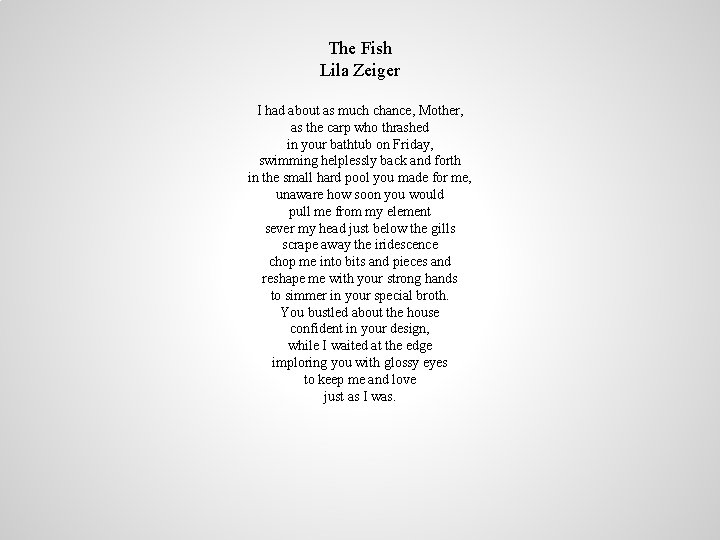
The Fish Lila Zeiger I had about as much chance, Mother, as the carp who thrashed in your bathtub on Friday, swimming helplessly back and forth in the small hard pool you made for me, unaware how soon you would pull me from my element sever my head just below the gills scrape away the iridescence chop me into bits and pieces and reshape me with your strong hands to simmer in your special broth. You bustled about the house confident in your design, while I waited at the edge imploring you with glossy eyes to keep me and love just as I was.
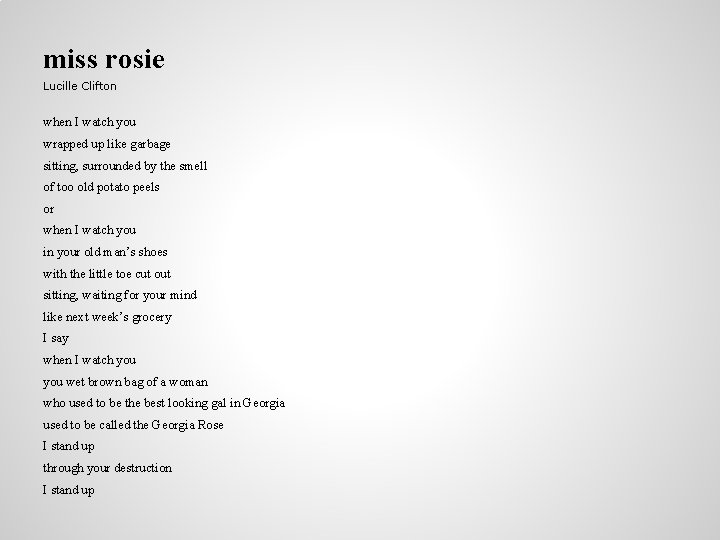
miss rosie Lucille Clifton when I watch you wrapped up like garbage sitting, surrounded by the smell of too old potato peels or when I watch you in your old man’s shoes with the little toe cut out sitting, waiting for your mind like next week’s grocery I say when I watch you wet brown bag of a woman who used to be the best looking gal in Georgia used to be called the Georgia Rose I stand up through your destruction I stand up
Block 11: Mar 24/25 Obj: ● MC and Timed Writing Practice HW: Read ch 13 -16 in Great Expectations- write down questions while reading
Block 12: March 26/27 Obj: ● Context of Great Expectations ● Discuss use of dialect in GE ● Characterization HW: Read ch 17 -20 in Great Expectations- write down questions while reading
Journal/ Discuss ● What "great expectations" exist in your life? Their origins (family, self, friends, etc. )? Their effect on you? Welcome? Unwelcome? How do you plan to handle them once you have graduated? Will they change? How might you evaluate them when you look back on them in a few years?
A little context for you. . . Rude Words/ Slums Seventh Child/ Victorian Maid Pets/ Traffic
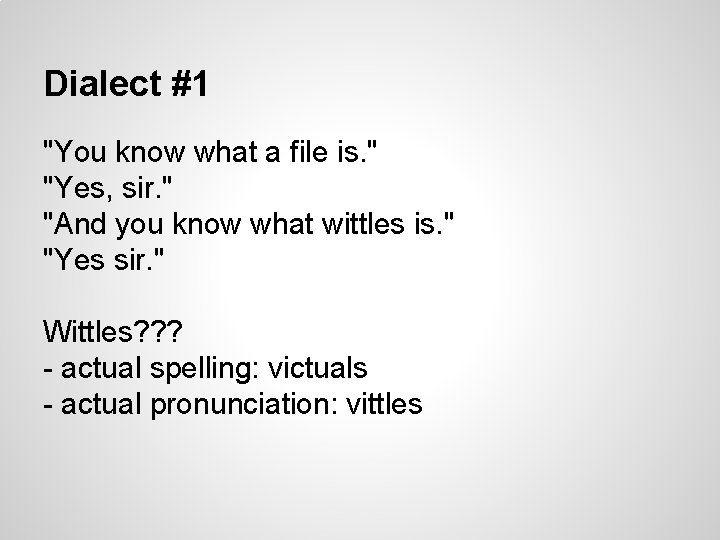
Dialect #1 "You know what a file is. " "Yes, sir. " "And you know what wittles is. " "Yes sir. " Wittles? ? ? - actual spelling: victuals - actual pronunciation: vittles
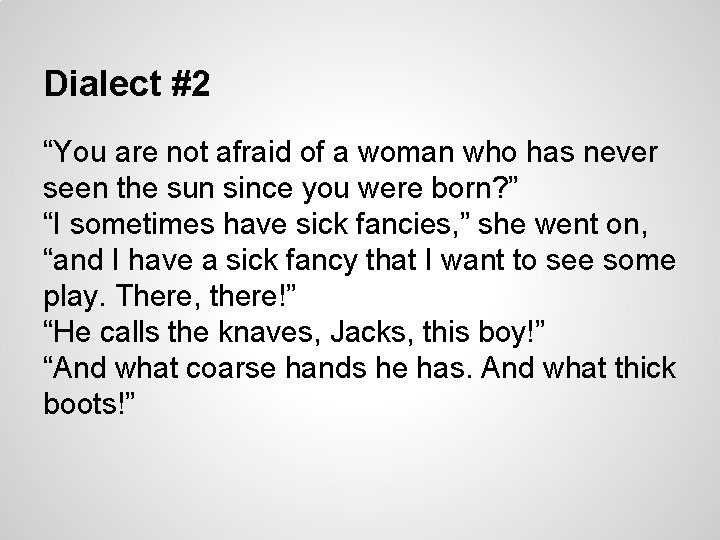
Dialect #2 “You are not afraid of a woman who has never seen the sun since you were born? ” “I sometimes have sick fancies, ” she went on, “and I have a sick fancy that I want to see some play. There, there!” “He calls the knaves, Jacks, this boy!” “And what coarse hands he has. And what thick boots!”
Who speaks what? Name the two dialects and list the characters that speak each. What is Dickens’ purpose in using the two distinct dialects?
Characterization Activities ● Characterize (think archetypes and complexity) Pip, Joe, Mrs. Joe, the convict, Mr. Wopsle, and Mr. Pumblechook o Example: Bill is the “evil figure with an ultimately good heart” archetype due to ____; however, he is also the _______ archetype because of _____. ● Connect each to other movie, book, & tv characters Conversation Activity: ● Pick a character from GE and one from elsewhere (this is from what you have written above) to have a conversation. Write a script or story version of their conversation.
Part 2 ● Trade papers ● Annotate the conversation, looking for how the dialogue illuminates that character’s traits ● Reflect on how accurately the character is portrayed ● Give constructive criticism about how to more accurately capture the character
Block 13: Mar 30/31 Agenda: Prose Prompt Practice Start Personal Reading Inventory HW: Read through ch. 21 -24 - write down questions while reading
Prose Prompt Practice 10 minutes. Read the prompt and excerpt- annotate Create an outline and a thesis
Prose Prompt Practice Share at tables Take notes on insights you gain from classmates - Did they notice something you didn’t? - Did they structure their thesis in an interesting way? Share out to class
Your Personal Reading Inventory (PRI) Follow these instructions.
Block 14: April 1/2 Obj: Poetry prompt practice Finish PRI HW: Read ch. 25 -28 - write down questions while reading Pick your best 2 questions that have potential to spark conversation and bring to Socratic seminar next class
Poetry Prompt Practice 10 minutes. Read the prompt and poem- annotate Create an outline and a thesis
Poetry Prompt Practice Share at tables Take notes on insights you gain from classmates - Did they notice something you didn’t? - Did they structure their thesis in an interesting way? Share out to class
Block 15: 4/6 -7 Obj: Prose Multiple Choice Practice Socratic seminar- part 1 HW: Read ch. 29 -32 - write down questions while reading
Block 16: 4/8 -9 Agenda: ● Poetry Multiple Choice Practice ● Socratic seminar part 2 HW: Read ch. 33 -36