Android GNSS Raw Measurements and Galileo High Accuracy
- Slides: 42
Android GNSS Raw Measurements and Galileo High Accuracy Service Martin Sunkevic, European GNSS Agency 29 November 2018 RNN`s New GNSS Signals seminar – opportunities for new PNT applications and improved robustness
Presentation Outline • GSA and Galileo HAS • Android Raw Measurements • Main benefits/uses of Raw measurements • GSA Raw Measurements Task Force 2
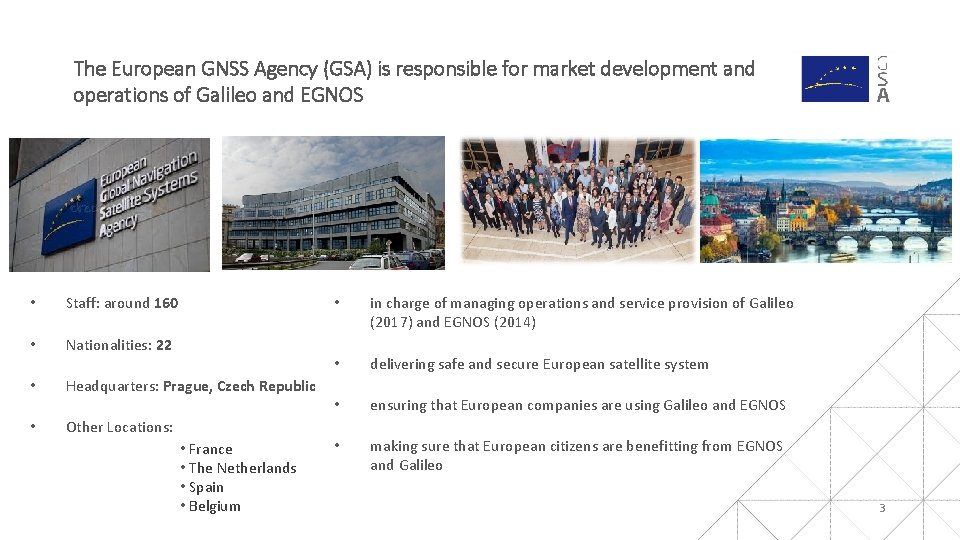
The European GNSS Agency (GSA) is responsible for market development and operations of Galileo and EGNOS • Staff: around 160 • Nationalities: 22 • • Headquarters: Prague, Czech Republic Other Locations: • France • The Netherlands • Spain • Belgium • in charge of managing operations and service provision of Galileo (2017) and EGNOS (2014) • delivering safe and secure European satellite system • ensuring that European companies are using Galileo and EGNOS • making sure that European citizens are benefitting from EGNOS and Galileo 3
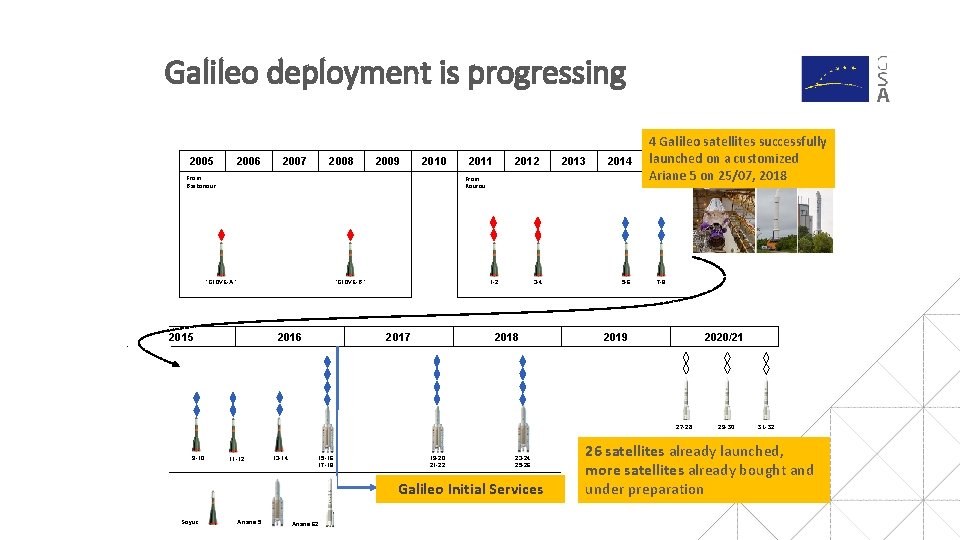
Galileo deployment is progressing 2005 2006 2007 2008 2009 2010 From Baïkonour 2011 2012 2013 2014 From Kourou "GIOVE-B" "GIOVE-A" 2015 2016 1 -2 3 -4 2018 2017 5 -6 4 Galileo satellites successfully launched on a customized 2015 Ariane 5 on 25/07, 2018 7 -8 2019 2020/21 27 -28 9 -10 11 -12 13 -14 15 -16 17 -18 19 -20 21 -22 23 -24 25 -26 Galileo Initial Services Soyuz Ariane 5 Ariane 62 29 -30 31 -32 26 satellites already launched, more satellites already bought and under preparation
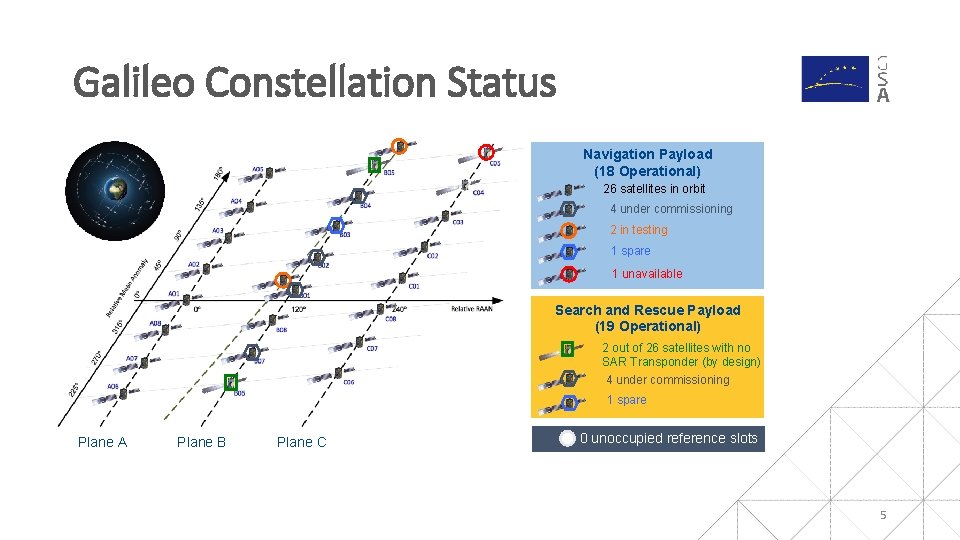
Galileo Constellation Status Navigation Payload (18 Operational) 26 satellites in orbit 4 under commissioning 2 in testing 1 spare 1 unavailable Search and Rescue Payload (19 Operational) 2 out of 26 satellites with no SAR Transponder (by design) 4 under commissioning 1 spare Plane A Plane B Plane C 0 unoccupied reference slots 5
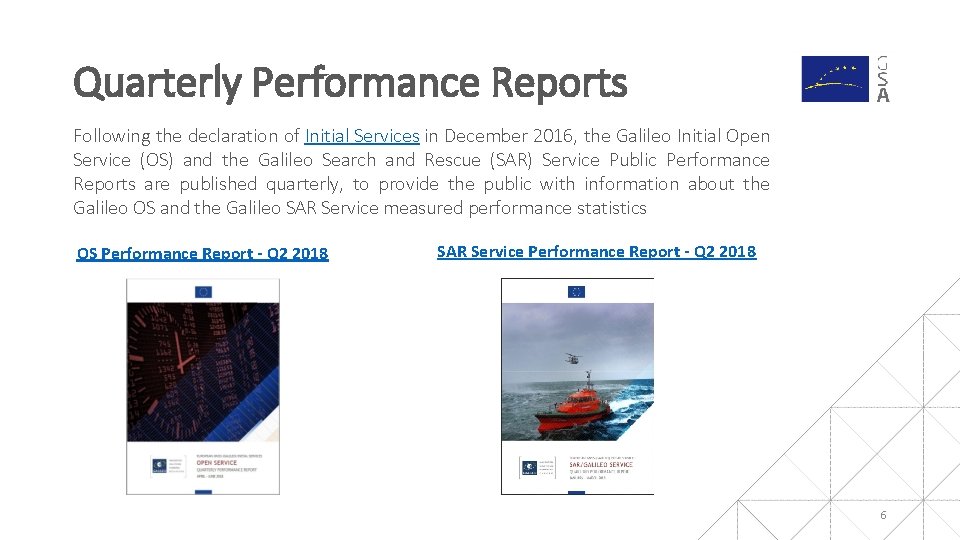
Quarterly Performance Reports Following the declaration of Initial Services in December 2016, the Galileo Initial Open Service (OS) and the Galileo Search and Rescue (SAR) Service Public Performance Reports are published quarterly, to provide the public with information about the Galileo OS and the Galileo SAR Service measured performance statistics OS Performance Report - Q 2 2018 SAR Service Performance Report - Q 2 2018 6
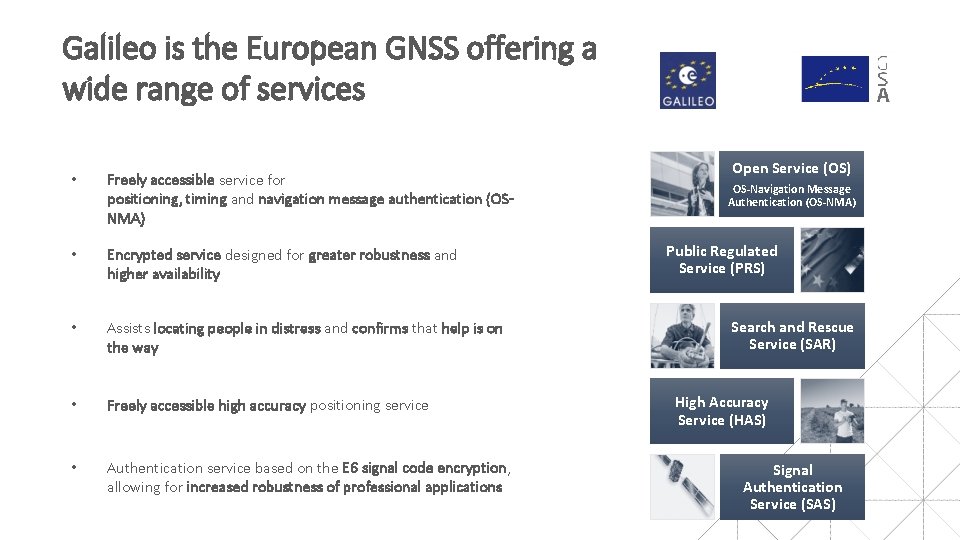
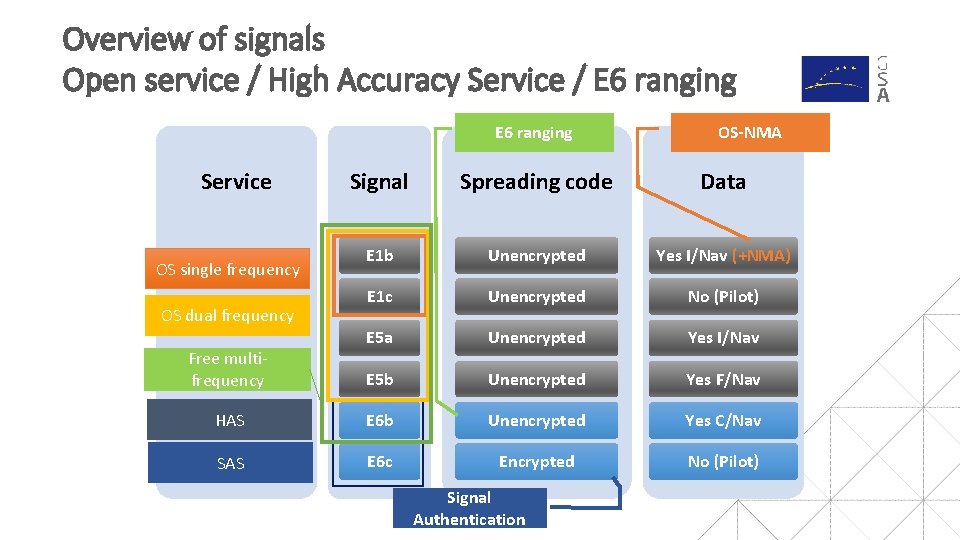
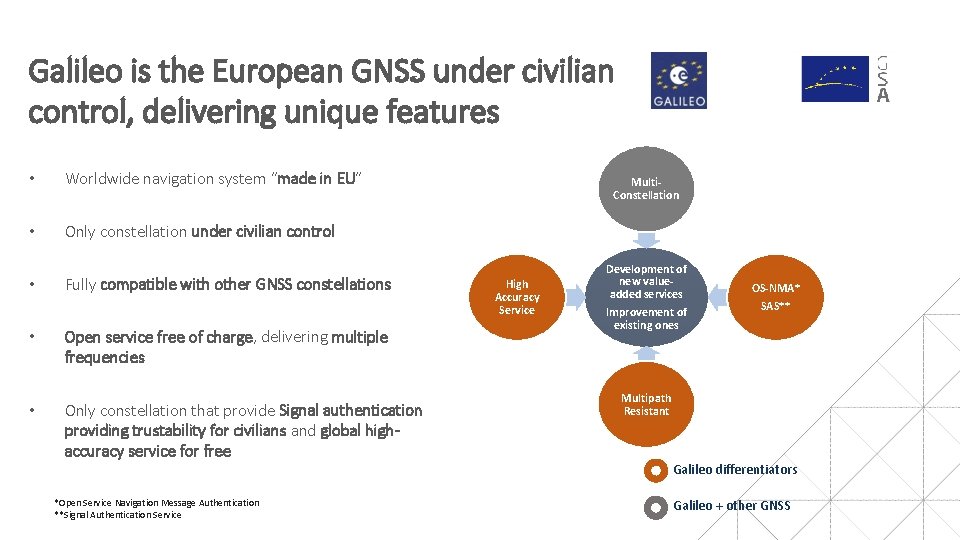
Galileo is the European GNSS offering a wide range of services • Freely accessible service for positioning, timing and navigation message authentication (OSNMA) • Encrypted service designed for greater robustness and higher availability • Assists locating people in distress and confirms that help is on the way • Freely accessible high accuracy positioning service • Authentication service based on the E 6 signal code encryption, allowing for increased robustness of professional applications Open Service (OS) OS-Navigation Message Authentication (OS-NMA) Public Regulated Service (PRS) Search and Rescue Service (SAR) High Accuracy Service (HAS) Signal Authentication Service (SAS)
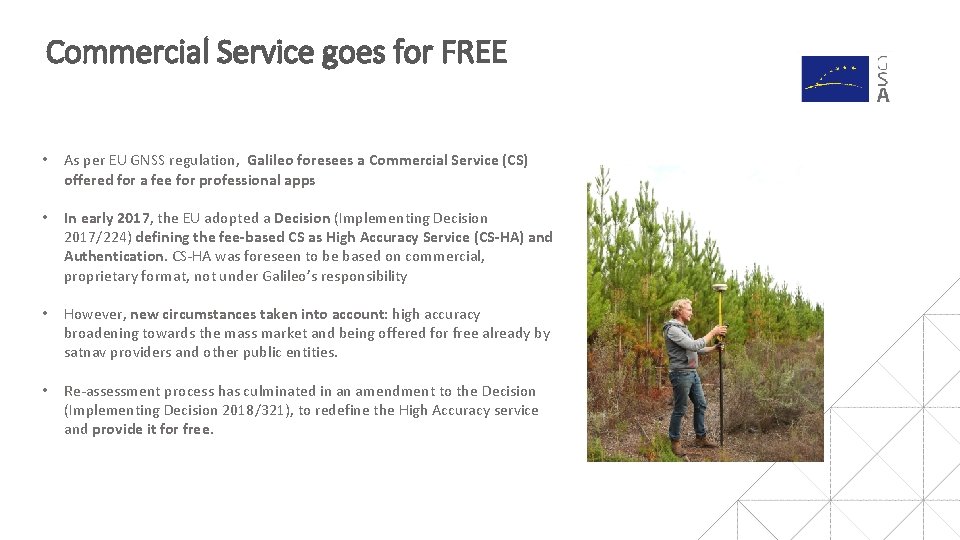
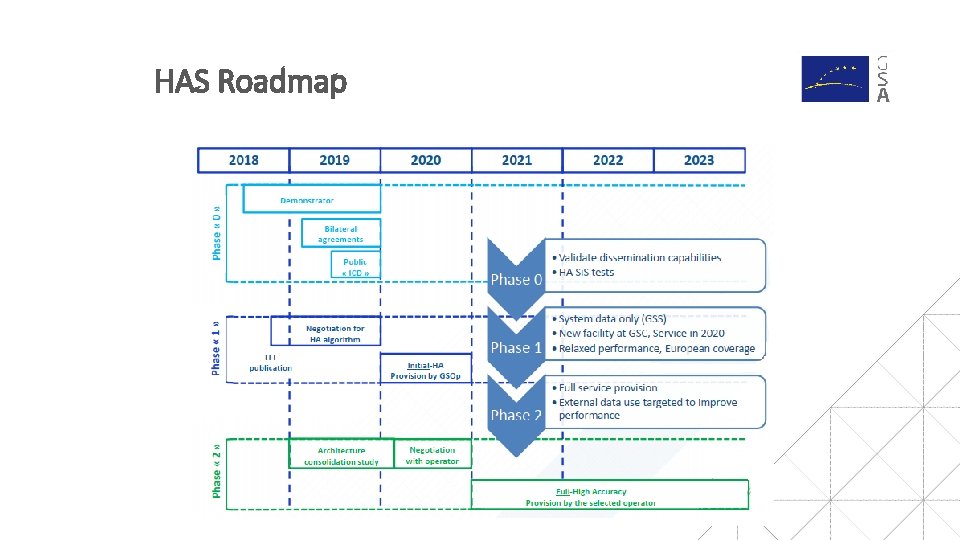
Commercial Service goes for FREE • As per EU GNSS regulation, Galileo foresees a Commercial Service (CS) offered for a fee for professional apps • In early 2017, the EU adopted a Decision (Implementing Decision 2017/224) defining the fee-based CS as High Accuracy Service (CS-HA) and Authentication. CS-HA was foreseen to be based on commercial, proprietary format, not under Galileo’s responsibility • However, new circumstances taken into account: high accuracy broadening towards the mass market and being offered for free already by satnav providers and other public entities. • Re-assessment process has culminated in an amendment to the Decision (Implementing Decision 2018/321), to redefine the High Accuracy service and provide it for free.
Overview of signals Open service / High Accuracy Service / E 6 ranging Service OS-NMA Signal Spreading code Data E 1 b Unencrypted Yes I/Nav (+NMA) E 1 c Unencrypted No (Pilot) Free multifrequency E 5 a Unencrypted Yes I/Nav E 5 b Unencrypted Yes F/Nav HAS E 6 b Unencrypted Yes C/Nav SAS E 6 c Encrypted No (Pilot) OS single frequency OS dual frequency Signal Authentication
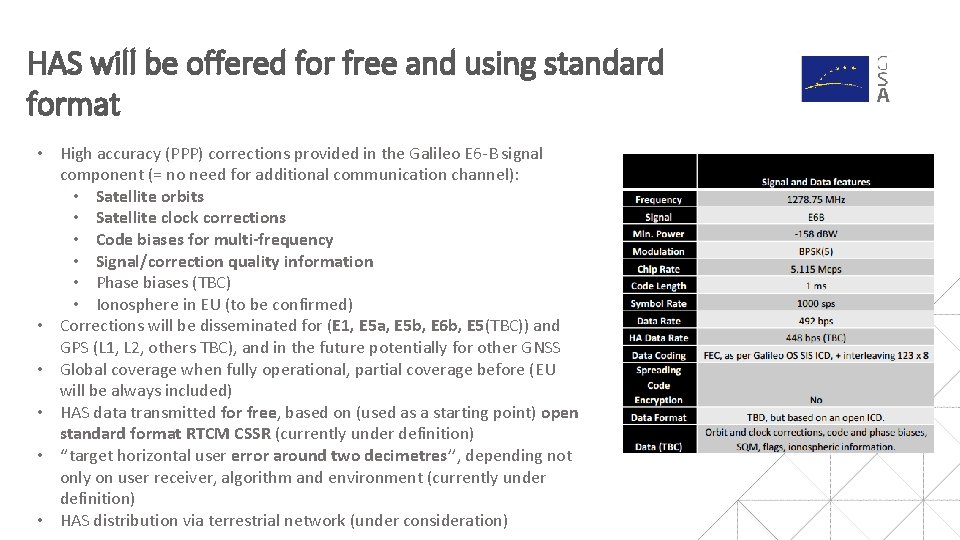
HAS will be offered for free and using standard format • High accuracy (PPP) corrections provided in the Galileo E 6 -B signal component (= no need for additional communication channel): • Satellite orbits • Satellite clock corrections • Code biases for multi-frequency • Signal/correction quality information • Phase biases (TBC) • Ionosphere in EU (to be confirmed) • Corrections will be disseminated for (E 1, E 5 a, E 5 b, E 6 b, E 5(TBC)) and GPS (L 1, L 2, others TBC), and in the future potentially for other GNSS • Global coverage when fully operational, partial coverage before (EU will be always included) • HAS data transmitted for free, based on (used as a starting point) open standard format RTCM CSSR (currently under definition) • ‘’target horizontal user error around two decimetres’’, depending not only on user receiver, algorithm and environment (currently under definition) • HAS distribution via terrestrial network (under consideration)
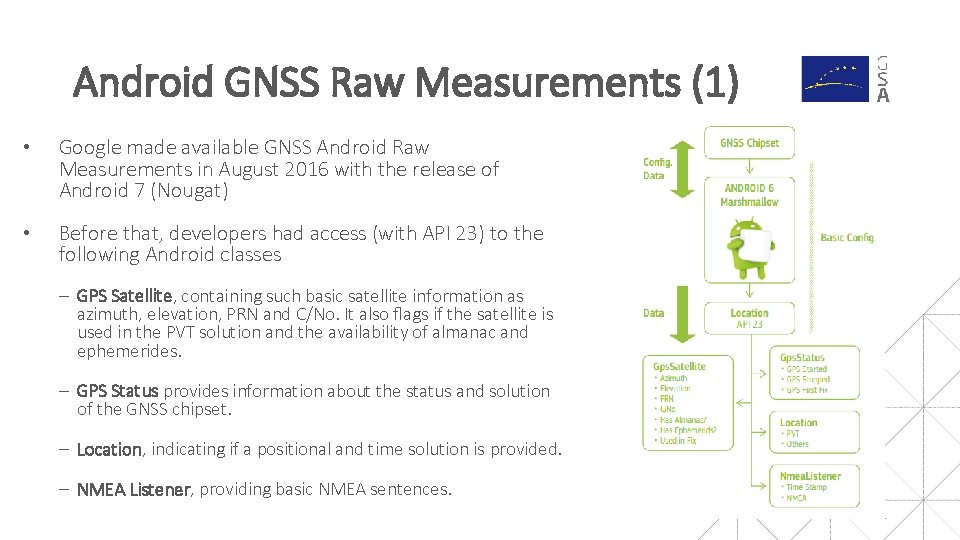
Android GNSS Raw Measurements (1) • Google made available GNSS Android Raw Measurements in August 2016 with the release of Android 7 (Nougat) • Before that, developers had access (with API 23) to the following Android classes ‒ GPS Satellite, containing such basic satellite information as azimuth, elevation, PRN and C/No. It also flags if the satellite is used in the PVT solution and the availability of almanac and ephemerides. ‒ GPS Status provides information about the status and solution of the GNSS chipset. ‒ Location, indicating if a positional and time solution is provided. ‒ NMEA Listener, providing basic NMEA sentences. 11
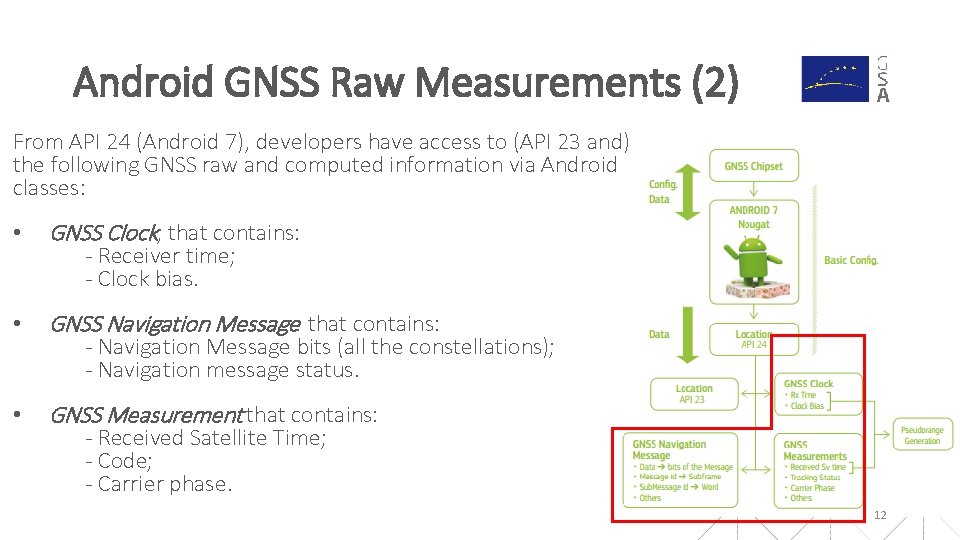
Android GNSS Raw Measurements (2) From API 24 (Android 7), developers have access to (API 23 and) the following GNSS raw and computed information via Android classes: • GNSS Clock, that contains: • GNSS Navigation Message that contains: • GNSS Measurement that contains: - Receiver time; - Clock bias. - Navigation Message bits (all the constellations); - Navigation message status. - Received Satellite Time; - Code; - Carrier phase. 12
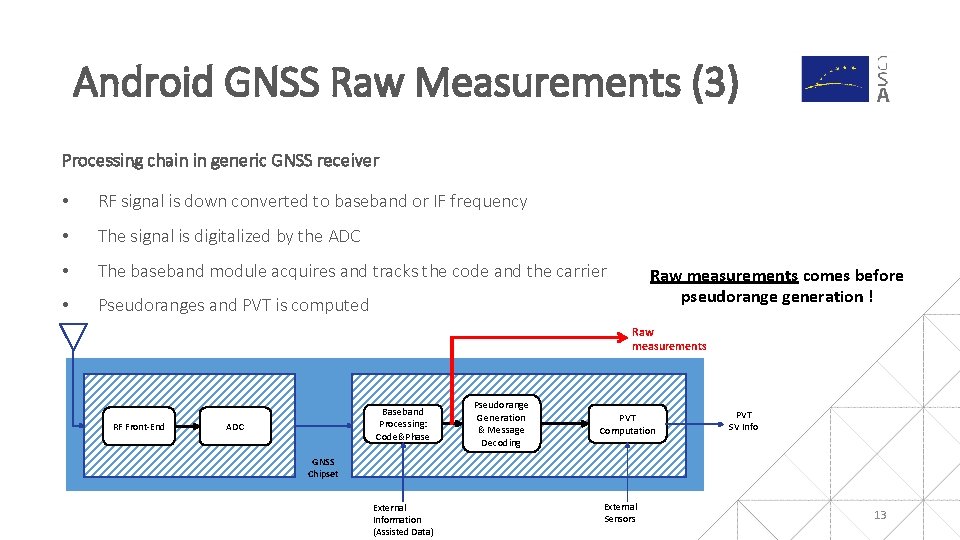
Android GNSS Raw Measurements (3) Processing chain in generic GNSS receiver • RF signal is down converted to baseband or IF frequency • The signal is digitalized by the ADC • The baseband module acquires and tracks the code and the carrier • Pseudoranges and PVT is computed Raw measurements comes before pseudorange generation ! Raw measurements RF Front-End Baseband Processing: Code&Phase ADC Pseudorange Generation & Message Decoding PVT Computation PVT SV Info GNSS Chipset External Information (Assisted Data) External Sensors 13
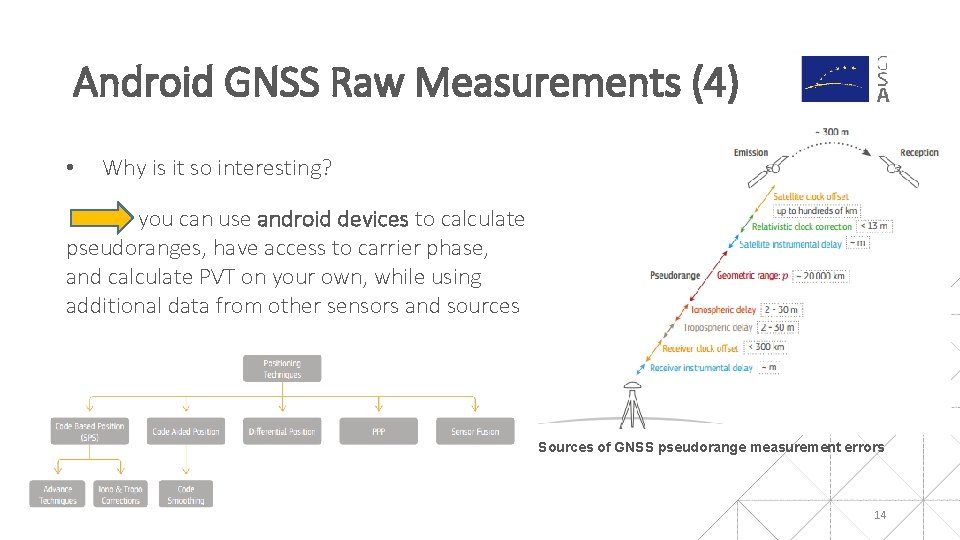
Android GNSS Raw Measurements (4) • Why is it so interesting? you can use android devices to calculate pseudoranges, have access to carrier phase, and calculate PVT on your own, while using additional data from other sensors and sources Sources of GNSS pseudorange measurement errors 14
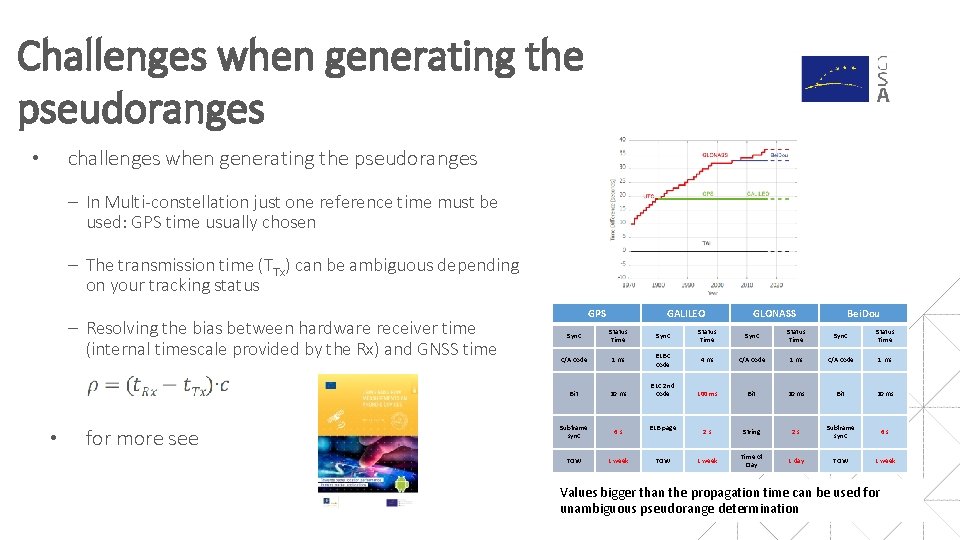
Challenges when generating the pseudoranges challenges when generating the pseudoranges • ‒ In Multi-constellation just one reference time must be used: GPS time usually chosen ‒ The transmission time (TTx) can be ambiguous depending on your tracking status ‒ Resolving the bias between hardware receiver time (internal timescale provided by the Rx) and GNSS time • for more see GPS GALILEO GLONASS Bei. Dou Sync Status Time C/A code 1 ms E 1 BC code 4 ms C/A code 1 ms Bit 20 ms 100 ms Bit 20 ms Subframe sync 6 s 2 s String 2 s Subframe sync 6 s TOW 1 week Time of Day 1 day TOW 1 week E 1 C 2 nd code E 1 B page TOW Values bigger than the propagation time can be used for unambiguous pseudorange determination 15
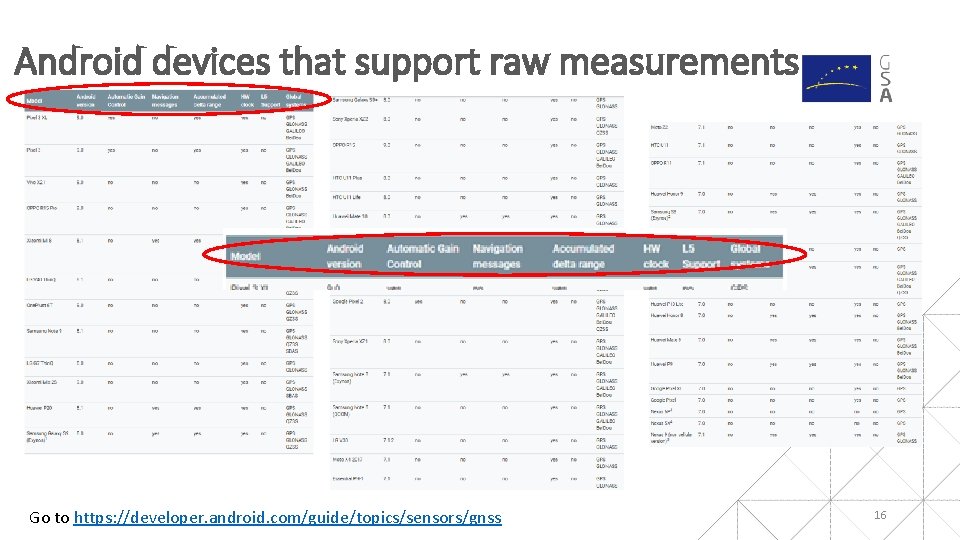
Android devices that support raw measurements Go to https: //developer. android. com/guide/topics/sensors/gnss 16
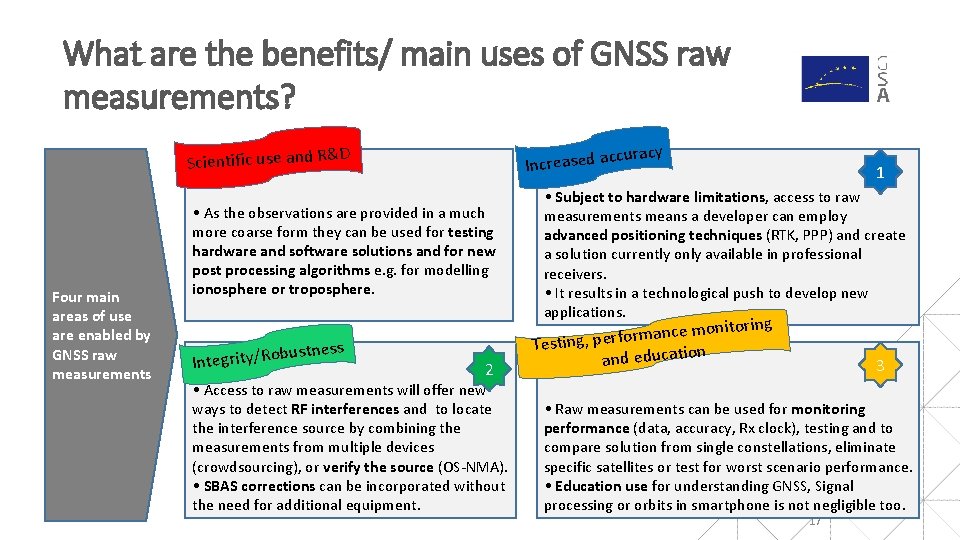
What are the benefits/ main uses of GNSS raw measurements? ccuracy D Scientific use and R& Four main areas of use are enabled by GNSS raw measurements Increased a • As the observations are provided in a much more coarse form they can be used for testing hardware and software solutions and for new post processing algorithms e. g. for modelling ionosphere or troposphere. bustness o R / y it r g e t In 2 • Access to raw measurements will offer new ways to detect RF interferences and to locate the interference source by combining the measurements from multiple devices (crowdsourcing), or verify the source (OS-NMA). • SBAS corrections can be incorporated without the need for additional equipment. 1 • Subject to hardware limitations, access to raw measurements means a developer can employ advanced positioning techniques (RTK, PPP) and create a solution currently only available in professional receivers. • It results in a technological push to develop new applications. ring o it n o m e c n a rm Testing, perfo and education 3 • Raw measurements can be used for monitoring performance (data, accuracy, Rx clock), testing and to compare solution from single constellations, eliminate specific satellites or test for worst scenario performance. • Education use for understanding GNSS, Signal processing or orbits in smartphone is not negligible too. 17
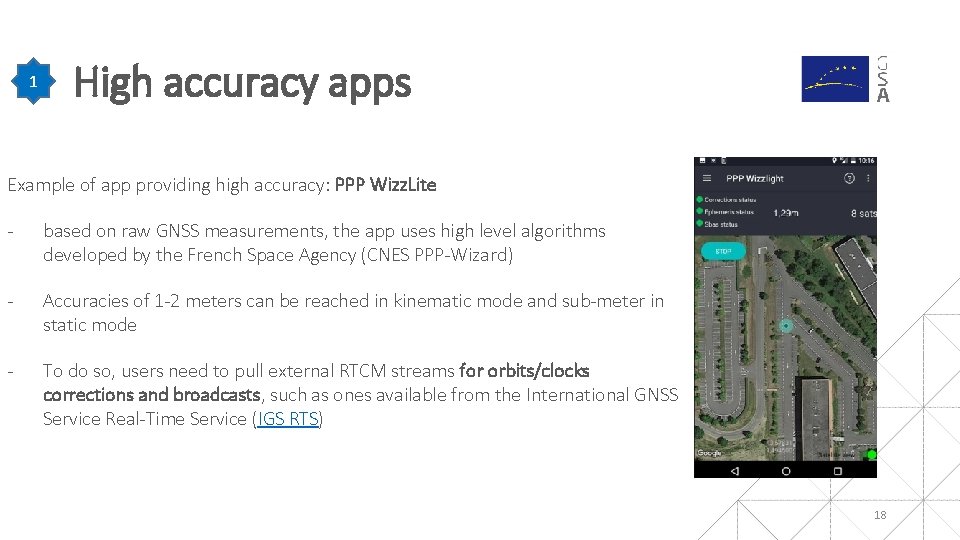
1 High accuracy apps Example of app providing high accuracy: PPP Wizz. Lite - based on raw GNSS measurements, the app uses high level algorithms developed by the French Space Agency (CNES PPP-Wizard) - Accuracies of 1 -2 meters can be reached in kinematic mode and sub-meter in static mode - To do so, users need to pull external RTCM streams for orbits/clocks corrections and broadcasts, such as ones available from the International GNSS Service Real-Time Service (IGS RTS) 18
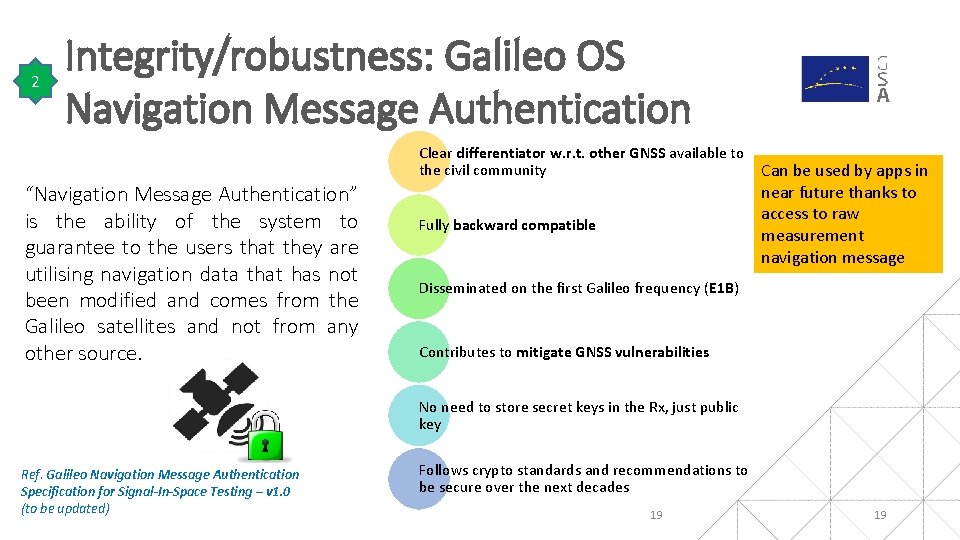
2 Integrity/robustness: Galileo OS Navigation Message Authentication “Navigation Message Authentication” is the ability of the system to guarantee to the users that they are utilising navigation data that has not been modified and comes from the Galileo satellites and not from any other source. Clear differentiator w. r. t. other GNSS available to the civil community Can be used by apps in near future thanks to access to raw measurement navigation message Fully backward compatible Disseminated on the first Galileo frequency (E 1 B) Contributes to mitigate GNSS vulnerabilities No need to store secret keys in the Rx, just public key Ref. Galileo Navigation Message Authentication Specification for Signal-In-Space Testing – v 1. 0 (to be updated) Follows crypto standards and recommendations to be secure over the next decades 19 19
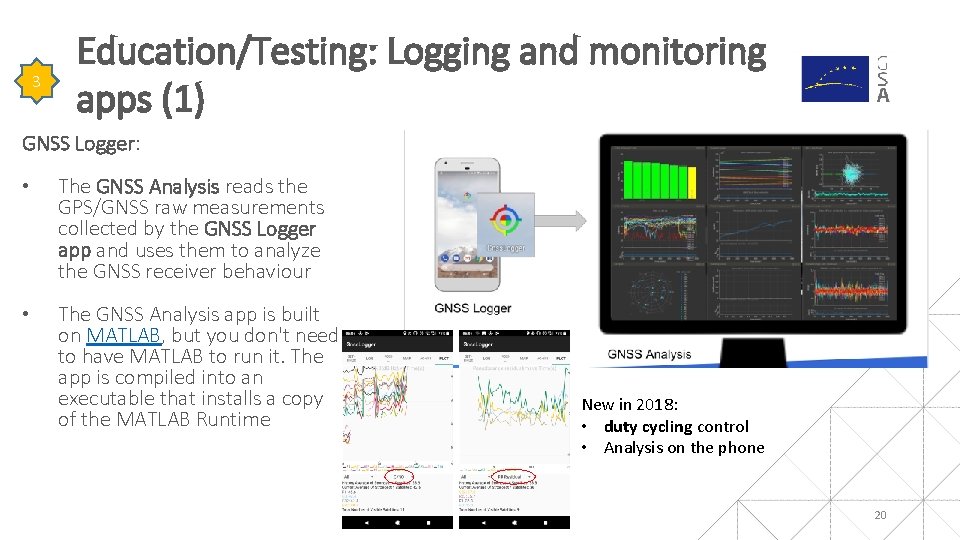
3 Education/Testing: Logging and monitoring apps (1) GNSS Logger: • The GNSS Analysis reads the GPS/GNSS raw measurements collected by the GNSS Logger app and uses them to analyze the GNSS receiver behaviour • The GNSS Analysis app is built on MATLAB, but you don't need to have MATLAB to run it. The app is compiled into an executable that installs a copy of the MATLAB Runtime New in 2018: • duty cycling control • Analysis on the phone 20
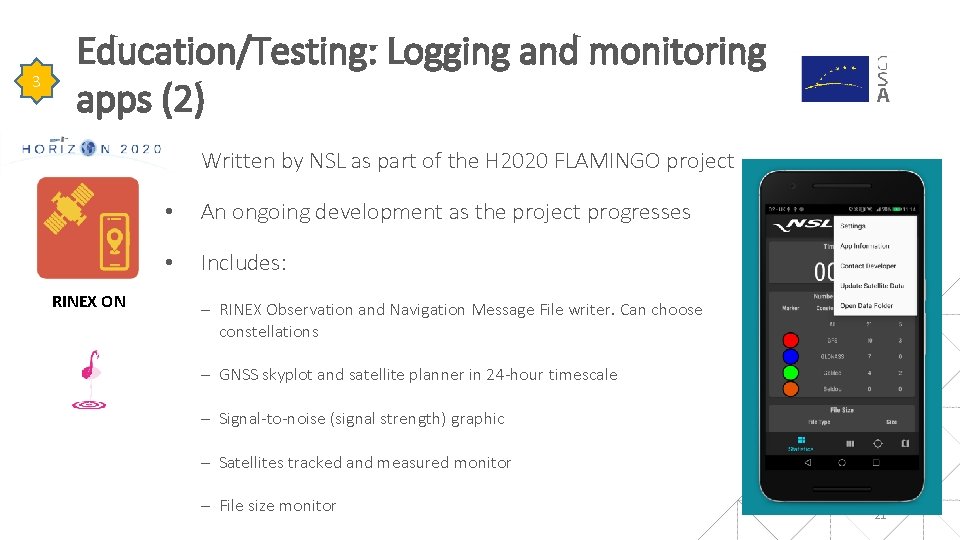
3 Education/Testing: Logging and monitoring apps (2) RINEX ON • Written by NSL as part of the H 2020 FLAMINGO project • An ongoing development as the project progresses • Includes: ‒ RINEX Observation and Navigation Message File writer. Can choose constellations ‒ GNSS skyplot and satellite planner in 24 -hour timescale ‒ Signal-to-noise (signal strength) graphic ‒ Satellites tracked and measured monitor ‒ File size monitor 21
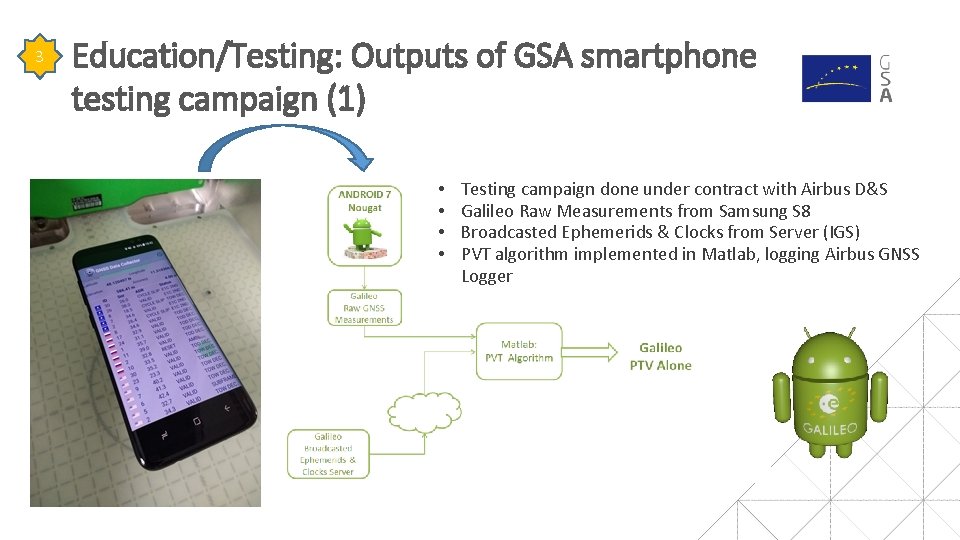
Galileo PVT 3 Education/Testing: Outputs of GSA smartphone testing campaign (1) • • Testing campaign done under contract with Airbus D&S Galileo Raw Measurements from Samsung S 8 Broadcasted Ephemerids & Clocks from Server (IGS) PVT algorithm implemented in Matlab, logging Airbus GNSS Logger
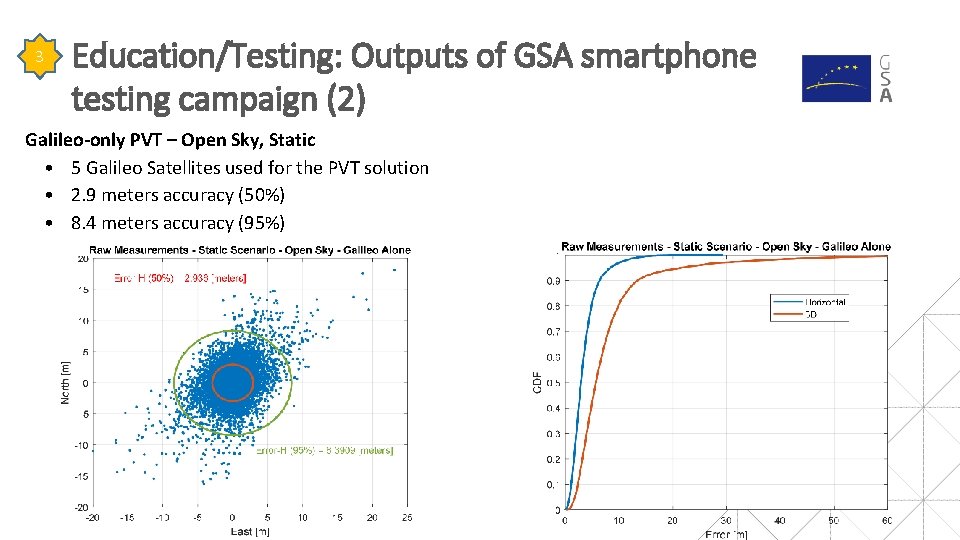
Galileo PVT 3 Education/Testing: Outputs of GSA smartphone testing campaign (2) Galileo-only PVT – Open Sky, Static • 5 Galileo Satellites used for the PVT solution • 2. 9 meters accuracy (50%) • 8. 4 meters accuracy (95%)
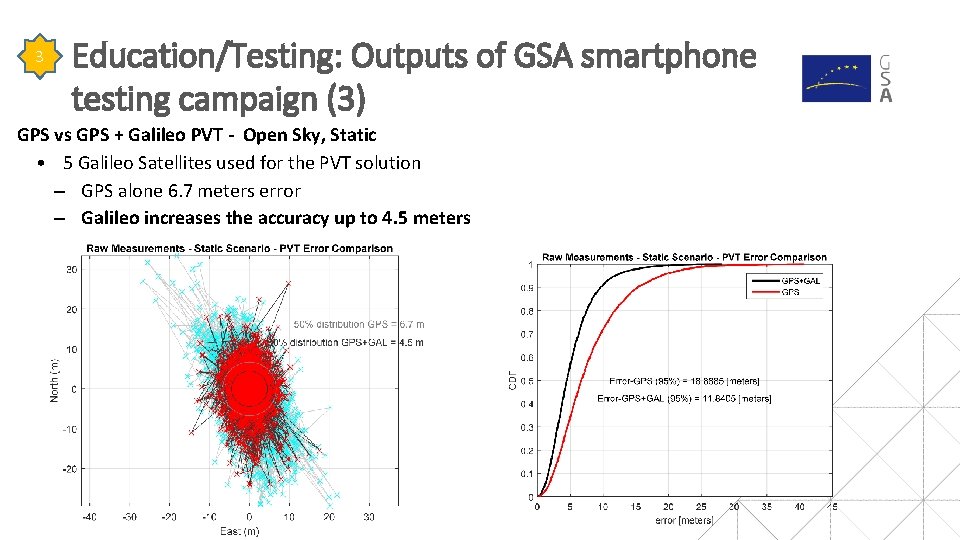
Galileo PVT 3 Education/Testing: Outputs of GSA smartphone testing campaign (3) GPS vs GPS + Galileo PVT - Open Sky, Static • 5 Galileo Satellites used for the PVT solution – GPS alone 6. 7 meters error – Galileo increases the accuracy up to 4. 5 meters
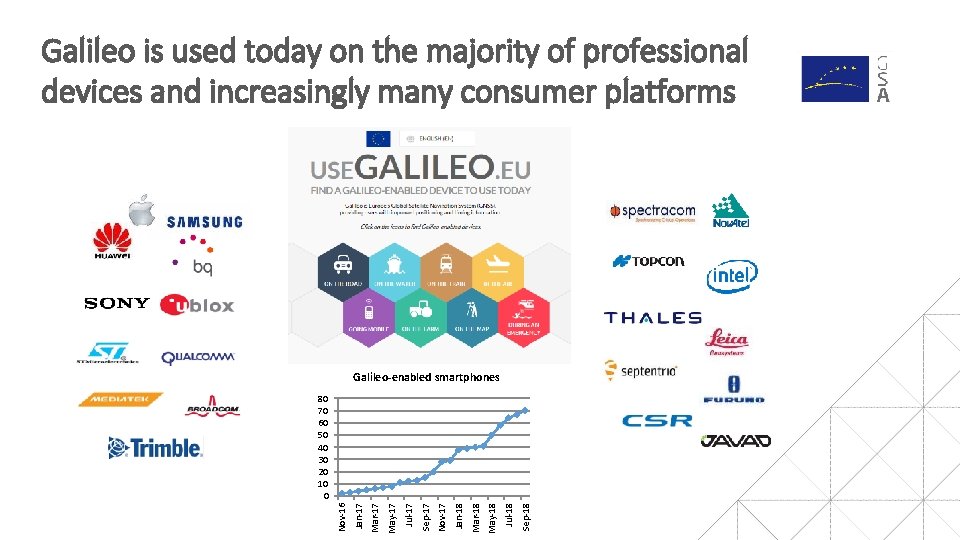
Galileo is used today on the majority of professional devices and increasingly many consumer platforms Galileo-enabled smartphones Sep-18 Jul-18 May-18 Mar-18 Jan-18 Nov-17 Sep-17 Jul-17 May-17 Mar-17 Jan-17 Nov-16 80 70 60 50 40 30 20 10 0
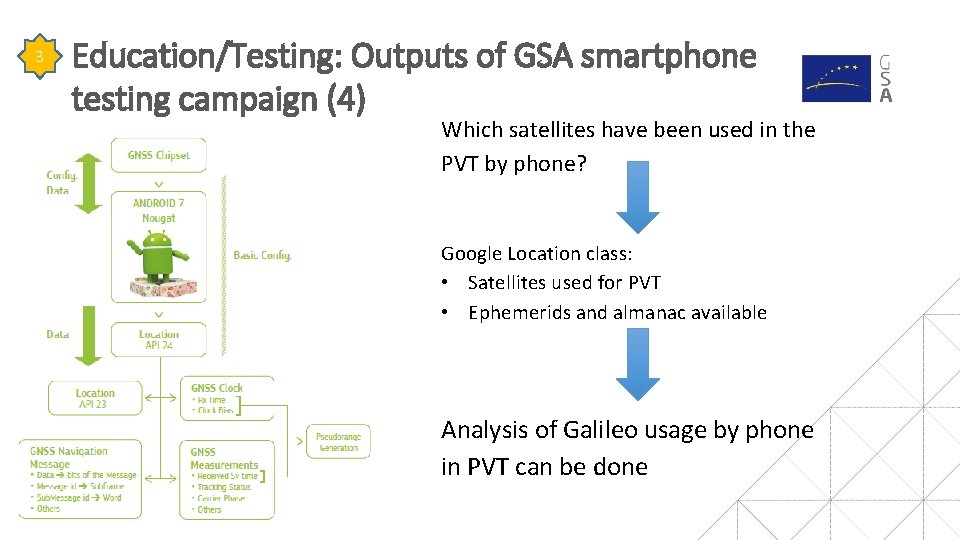
Galileo usage in PVT 3 Education/Testing: Outputs of GSA smartphone testing campaign (4) Which satellites have been used in the PVT by phone? Google Location class: • Satellites used for PVT • Ephemerids and almanac available Analysis of Galileo usage by phone in PVT can be done
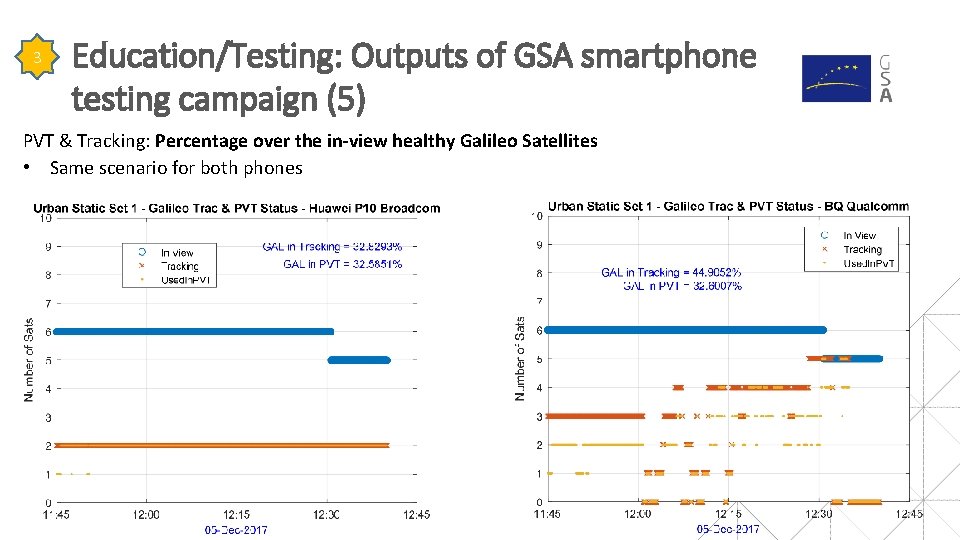
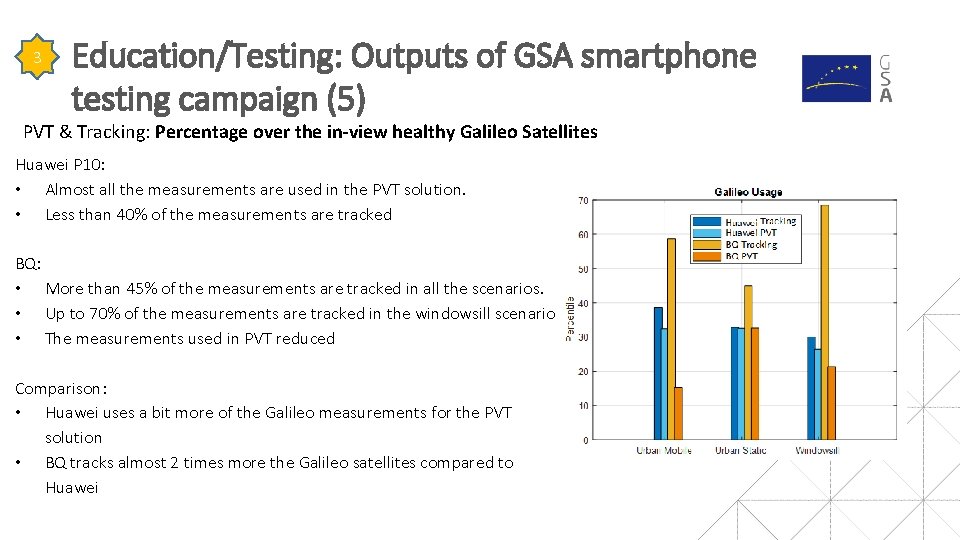
Galileo usage in PVT 3 Education/Testing: Outputs of GSA smartphone testing campaign (5) PVT & Tracking: Percentage over the in-view healthy Galileo Satellites • Same scenario for both phones
Galileo usage in PVT 3 Education/Testing: Outputs of GSA smartphone testing campaign (5) PVT & Tracking: Percentage over the in-view healthy Galileo Satellites Huawei P 10: • Almost all the measurements are used in the PVT solution. • Less than 40% of the measurements are tracked BQ: • More than 45% of the measurements are tracked in all the scenarios. • Up to 70% of the measurements are tracked in the windowsill scenario • The measurements used in PVT reduced Comparison: • Huawei uses a bit more of the Galileo measurements for the PVT solution • BQ tracks almost 2 times more the Galileo satellites compared to Huawei
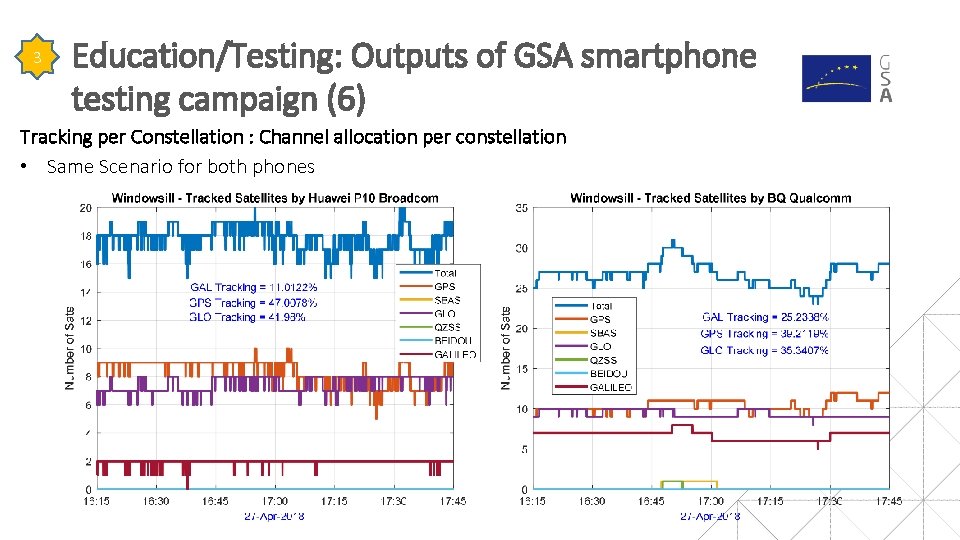
Galileo usage in PVT 3 Education/Testing: Outputs of GSA smartphone testing campaign (6) Tracking per Constellation : Channel allocation per constellation • Same Scenario for both phones
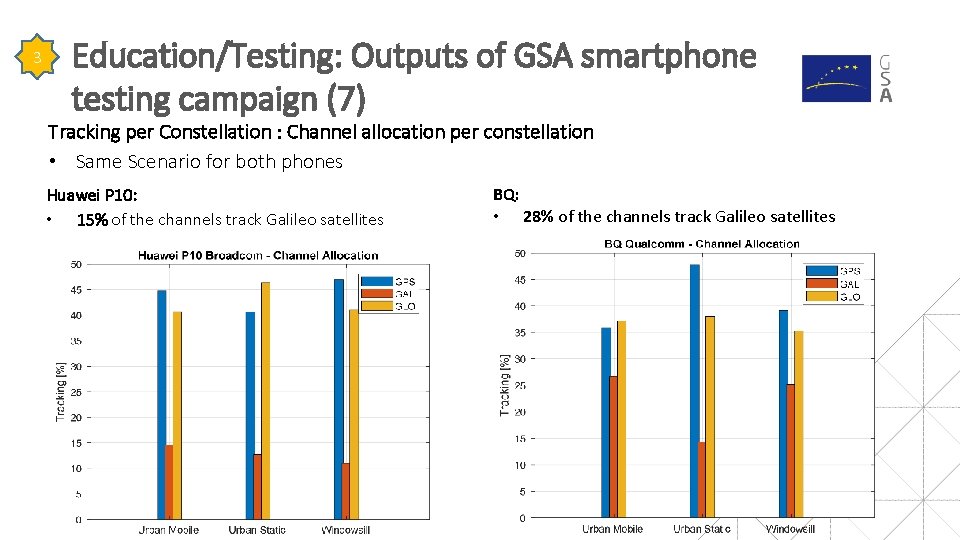
Galileo usage in PVT 3 Education/Testing: Outputs of GSA smartphone testing campaign (7) Tracking per Constellation : Channel allocation per constellation • Same Scenario for both phones Huawei P 10: • 15% of the channels track Galileo satellites BQ: • 28% of the channels track Galileo satellites
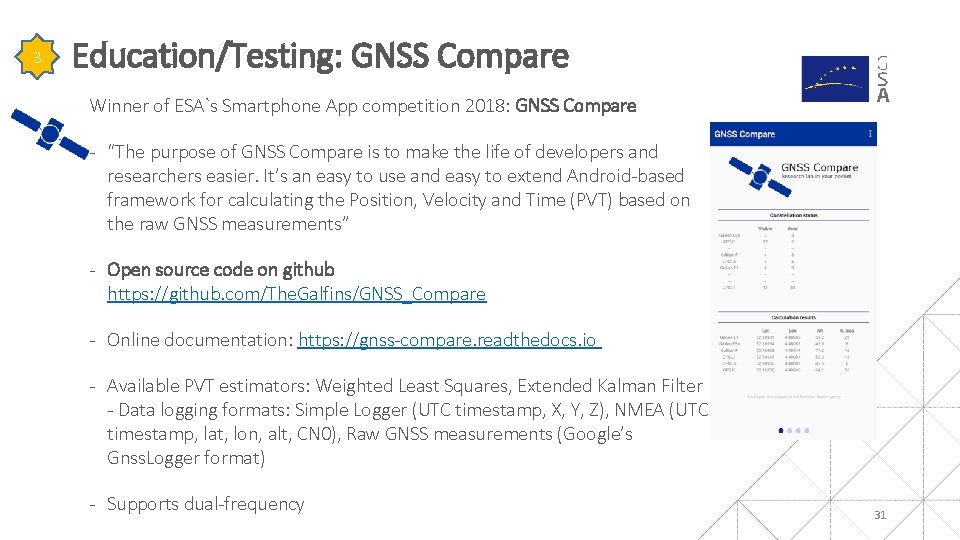
3 Education/Testing: GNSS Compare Winner of ESA`s Smartphone App competition 2018: GNSS Compare - “The purpose of GNSS Compare is to make the life of developers and researchers easier. It’s an easy to use and easy to extend Android-based framework for calculating the Position, Velocity and Time (PVT) based on the raw GNSS measurements” - Open source code on github https: //github. com/The. Galfins/GNSS_Compare - Online documentation: https: //gnss-compare. readthedocs. io - Available PVT estimators: Weighted Least Squares, Extended Kalman Filter - Data logging formats: Simple Logger (UTC timestamp, X, Y, Z), NMEA (UTC timestamp, lat, lon, alt, CN 0), Raw GNSS measurements (Google’s Gnss. Logger format) - Supports dual-frequency 31
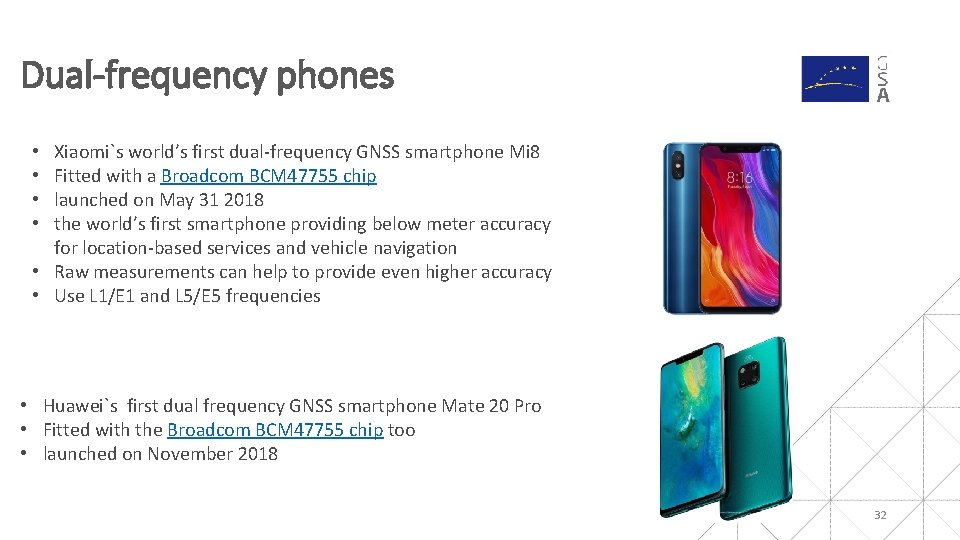
Dual-frequency phones Xiaomi`s world’s first dual-frequency GNSS smartphone Mi 8 Fitted with a Broadcom BCM 47755 chip launched on May 31 2018 the world’s first smartphone providing below meter accuracy for location-based services and vehicle navigation • Raw measurements can help to provide even higher accuracy • Use L 1/E 1 and L 5/E 5 frequencies • • • Huawei`s first dual frequency GNSS smartphone Mate 20 Pro • Fitted with the Broadcom BCM 47755 chip too • launched on November 2018 32
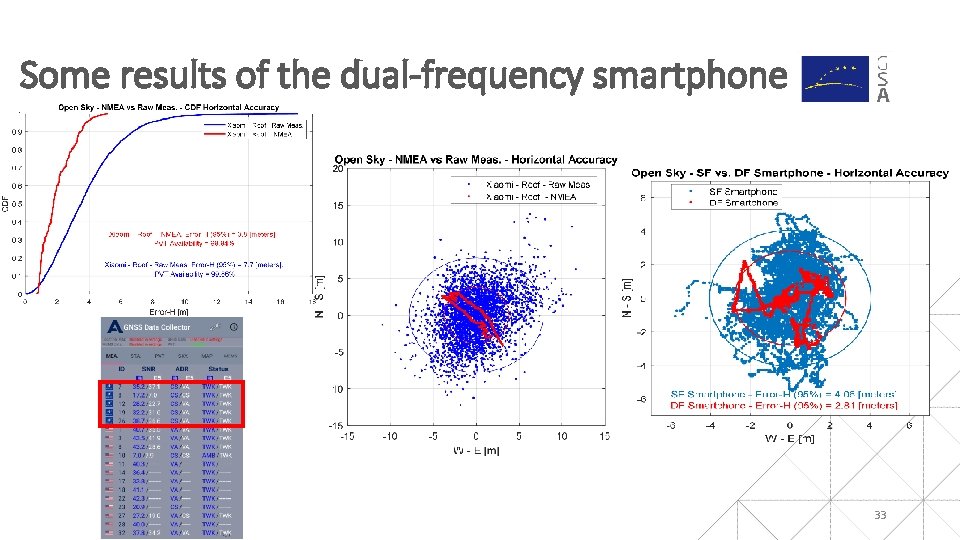
Some results of the dual-frequency smartphone 33
GSA Task Force: created shortly after Google`s announcement • The GSA GNSS Raw Measurements Task Force was established following the announcement of Google in 2016 to make the Android Raw Measurements available from Android 7. 0 • Continuously open call for participation (write to market@gsa. europa. eu ) • No fee for membership • Objective(s): -“to share knowledge and expertise on Android raw measurements and its wider use, including its potential for high accuracy positioning techniques” - “valorise the Galileo differentiators” 34
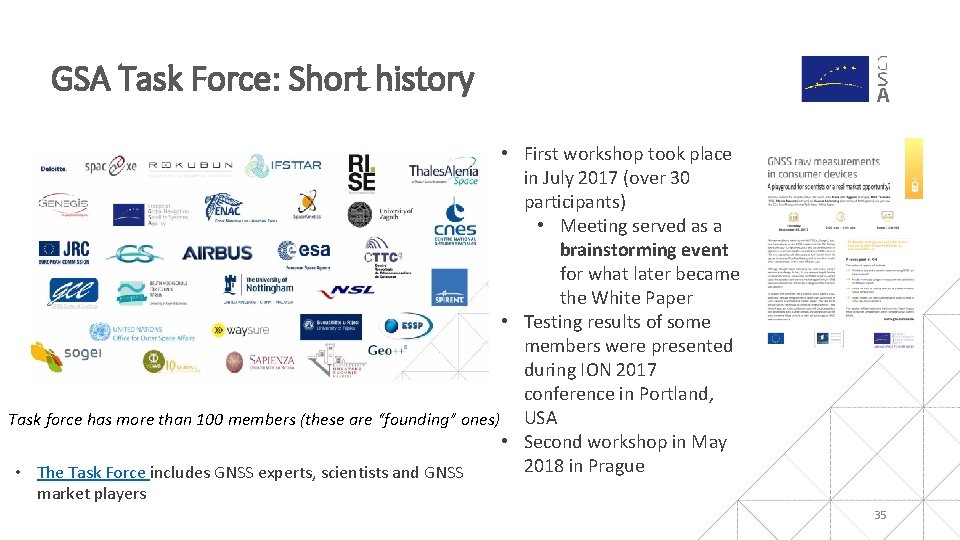
GSA Task Force: Short history • First workshop took place in July 2017 (over 30 participants) • Meeting served as a brainstorming event for what later became the White Paper • Testing results of some members were presented during ION 2017 conference in Portland, Task force has more than 100 members (these are “founding” ones) USA • Second workshop in May 2018 in Prague • The Task Force includes GNSS experts, scientists and GNSS market players 35
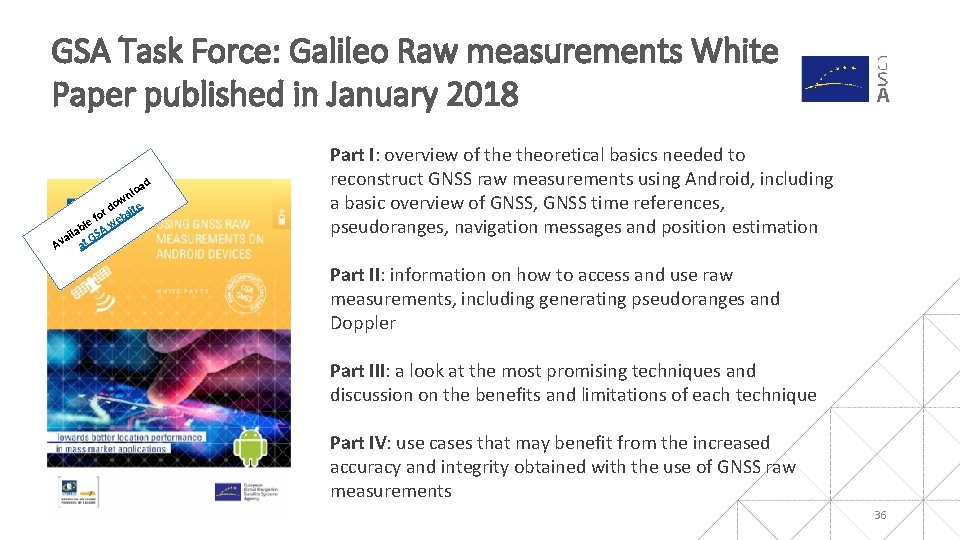
GSA Task Force: Galileo Raw measurements White Paper published in January 2018 d loa n w do site r o b f le we b A a ail GS Av at Part I: overview of theoretical basics needed to reconstruct GNSS raw measurements using Android, including a basic overview of GNSS, GNSS time references, pseudoranges, navigation messages and position estimation Part II: information on how to access and use raw measurements, including generating pseudoranges and Doppler Part III: a look at the most promising techniques and discussion on the benefits and limitations of each technique Part IV: use cases that may benefit from the increased accuracy and integrity obtained with the use of GNSS raw measurements 36
GSA Task Force: Discussion Forum and Measurements Database • Discussion Forum set up for the TF members ‒ http: //rawmeasurementstaskforce. forums-free. com • Database of measurements at Google Docs ‒ https: //docs. google. com/spreadsheets/d/1 Li 4 a. Kf 43 e. Jip. ZGwe. Wp. EIRHa. Rgj 4 t. Sac. Z 9 W Nu. PHObt 88/copy 37
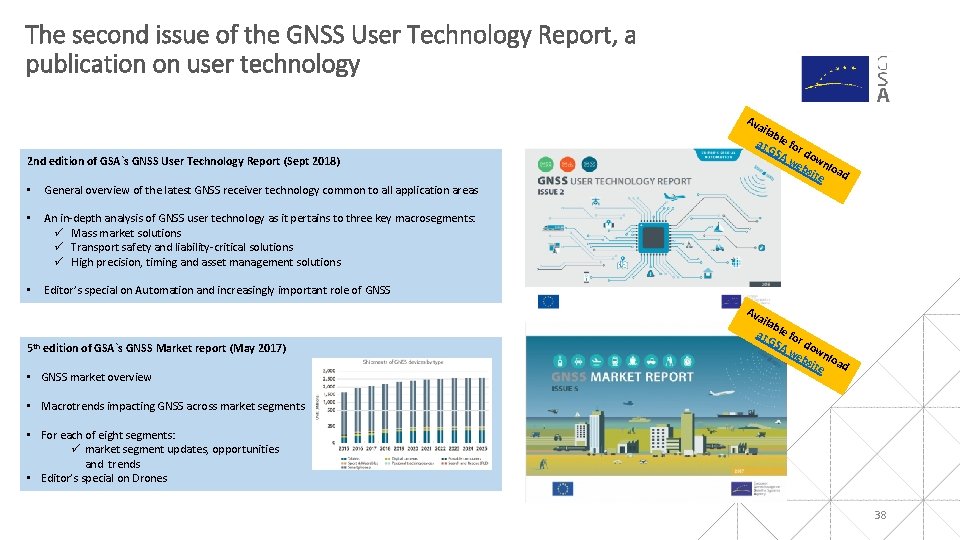
The second issue of the GNSS User Technology Report, a publication on user technology Av 2 nd edition of GSA`s GNSS User Technology Report (Sept 2018) • General overview of the latest GNSS receiver technology common to all application areas • An in-depth analysis of GNSS user technology as it pertains to three key macrosegments: ü Mass market solutions ü Transport safety and liability-critical solutions ü High precision, timing and asset management solutions • Editor’s special on Automation and increasingly important role of GNSS aila b at le fo GS r d A w ow eb nlo site ad Av 5 th edition of GSA`s GNSS Market report (May 2017) • GNSS market overview aila b at le fo GS r d A w ow eb nlo site ad • Macrotrends impacting GNSS across market segments • For each of eight segments: ü market segment updates, opportunities and trends • Editor’s special on Drones 38
Linking space to user needs How to get in touch: EGNOS-portal. eu www. GSA. europa. eu GSC-europa. eu G Use. Galileo. eu 39
HAS Roadmap
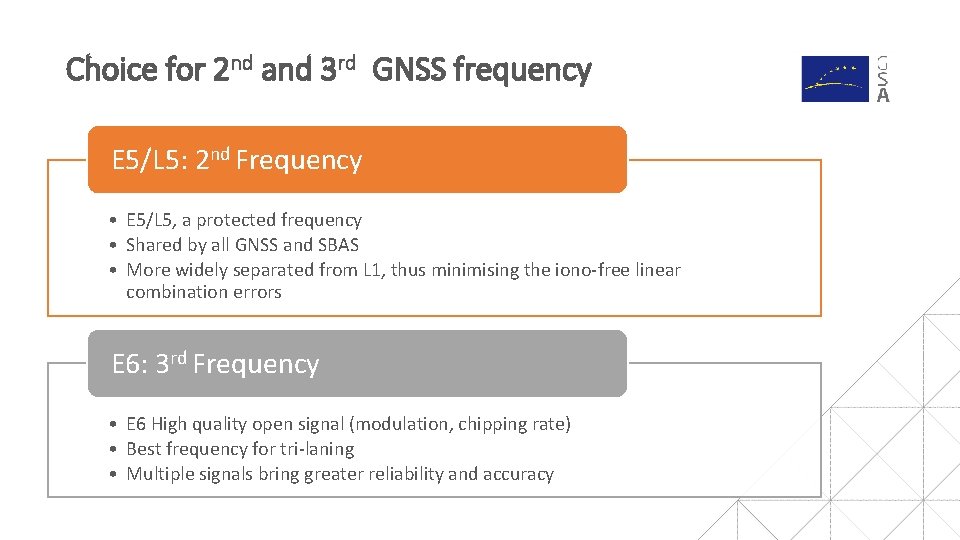
Choice for 2 nd and 3 rd GNSS frequency E 5/L 5: 2 nd Frequency • E 5/L 5, a protected frequency • Shared by all GNSS and SBAS • More widely separated from L 1, thus minimising the iono-free linear combination errors E 6: 3 rd Frequency • E 6 High quality open signal (modulation, chipping rate) • Best frequency for tri-laning • Multiple signals bring greater reliability and accuracy
Galileo is the European GNSS under civilian control, delivering unique features • Worldwide navigation system “made in EU” • Only constellation under civilian control • Fully compatible with other GNSS constellations • Open service free of charge, delivering multiple frequencies • Only constellation that provide Signal authentication providing trustability for civilians and global highaccuracy service for free *Open Service Navigation Message Authentication **Signal Authentication Service Multi. Constellation High Accuracy Service Development of new valueadded services Improvement of existing ones OS-NMA* SAS** Multipath Resistant Galileo differentiators Galileo + other GNSS