
Positioning in a multiGlobal Navigation Satellite Systems GNSS

Positioning in a multi-Global Navigation Satellite Systems (GNSS) World Jacob Heck December 14, 2017 NGS Webinar Series 14 December 2017 Positioning in a multi-GNSS World 1
About me • Geodesist at NOAA’s National Geodetic Survey since 2016. • Previously a graduate research associate at The Ohio State University as well as a surveyor in private industry and for county and state governments. • Ph. D. Candidate in Geodetic Science at Ohio State. • M. S. in Geodetic Science from Ohio State. • B. S. in Surveying Engineering from Michigan Technological University in Houghton, Michigan. 14 December 2017 Positioning in a multi-GNSS World 2

Outline • Overview of the history of GNSS • Describe the different constellations • Advantages/challenges of a multiconstellation solution • Show some examples of improvements when using extra satellites 14 December 2017 Positioning in a multi-GNSS World 3
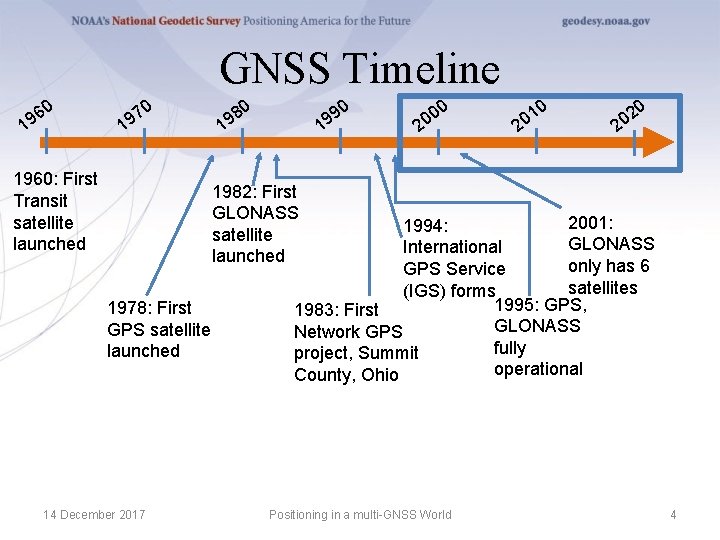
GNSS Timeline 60 9 1 0 1960: First Transit satellite launched 90 9 1 0 7 19 8 19 00 0 2 0 1 20 0 2 20 1982: First GLONASS satellite launched 1978: First GPS satellite launched 14 December 2017 2001: 1994: GLONASS International only has 6 GPS Service satellites (IGS) forms 1995: GPS, 1983: First GLONASS Network GPS fully project, Summit operational County, Ohio Positioning in a multi-GNSS World 4
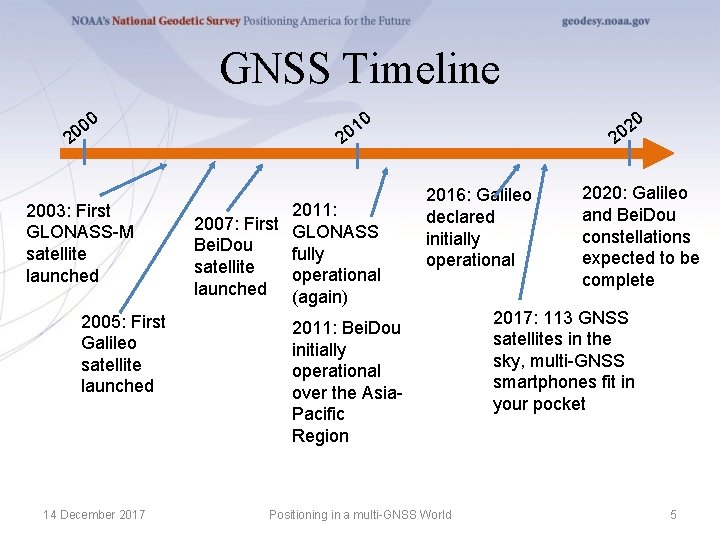
GNSS Timeline 10 0 20 2003: First GLONASS-M satellite launched 2005: First Galileo satellite launched 14 December 2017 2007: First Bei. Dou satellite launched 2011: GLONASS fully operational (again) 0 2 20 2016: Galileo declared initially operational 2011: Bei. Dou initially operational over the Asia. Pacific Region Positioning in a multi-GNSS World 2020: Galileo and Bei. Dou constellations expected to be complete 2017: 113 GNSS satellites in the sky, multi-GNSS smartphones fit in your pocket 5
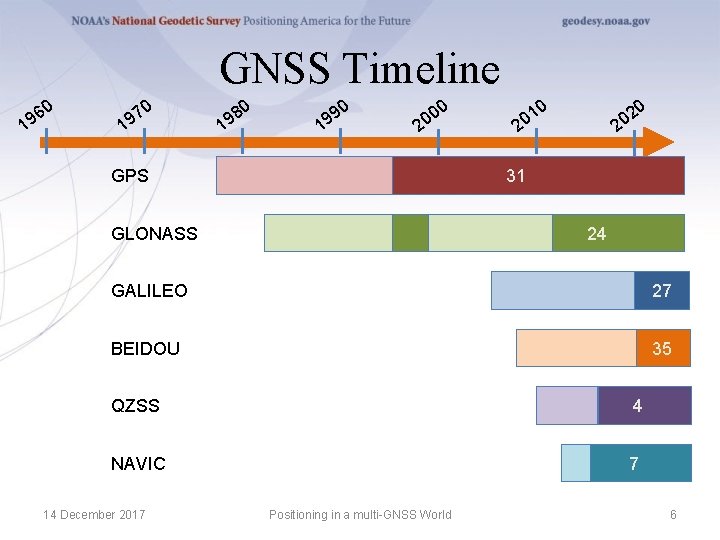
GNSS Timeline 60 9 1 0 7 19 0 8 19 90 9 1 00 0 2 GPS 0 0 1 20 2 20 31 GLONASS 24 GALILEO 27 BEIDOU 35 QZSS 4 NAVIC 7 14 December 2017 Positioning in a multi-GNSS World 6
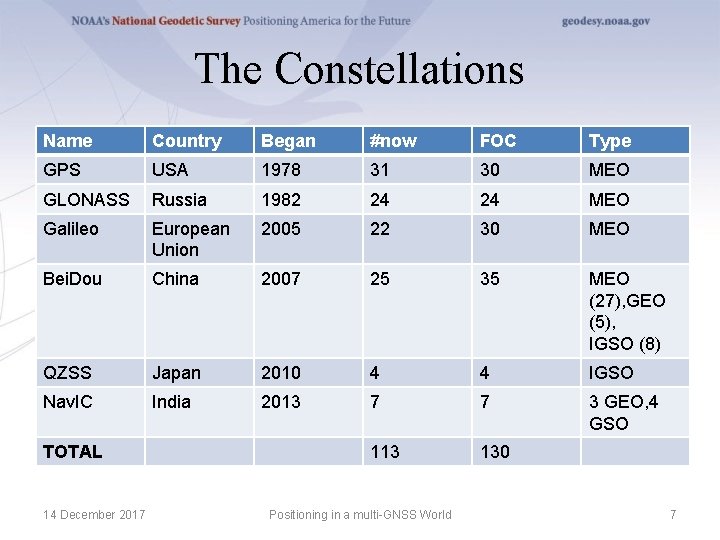
The Constellations Name Country Began #now FOC Type GPS USA 1978 31 30 MEO GLONASS Russia 1982 24 24 MEO Galileo European Union 2005 22 30 MEO Bei. Dou China 2007 25 35 MEO (27), GEO (5), IGSO (8) QZSS Japan 2010 4 4 IGSO Nav. IC India 2013 7 7 3 GEO, 4 GSO 113 130 TOTAL 14 December 2017 Positioning in a multi-GNSS World 7
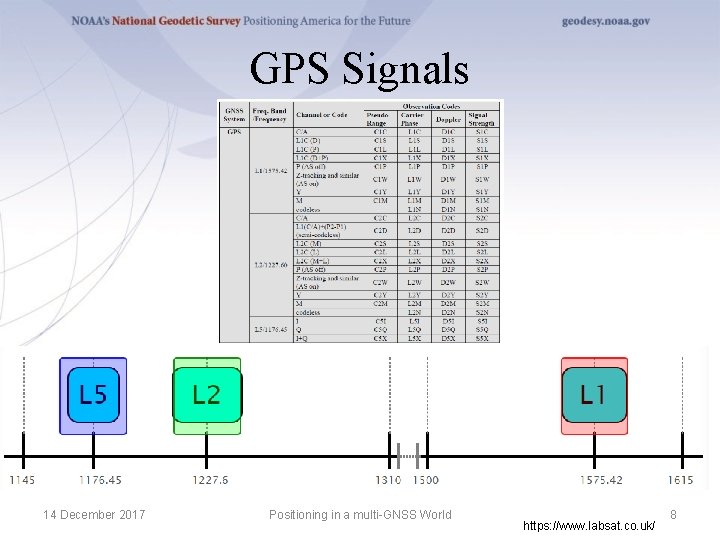
GPS Signals 14 December 2017 Positioning in a multi-GNSS World https: //www. labsat. co. uk/ 8
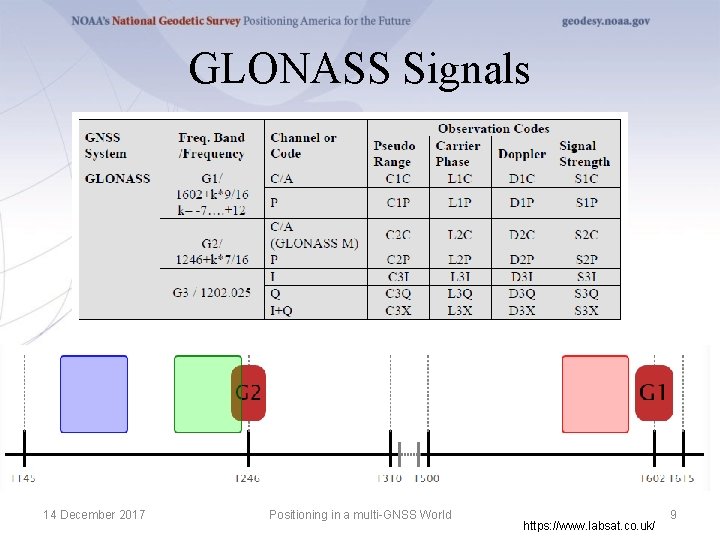
GLONASS Signals 14 December 2017 Positioning in a multi-GNSS World https: //www. labsat. co. uk/ 9
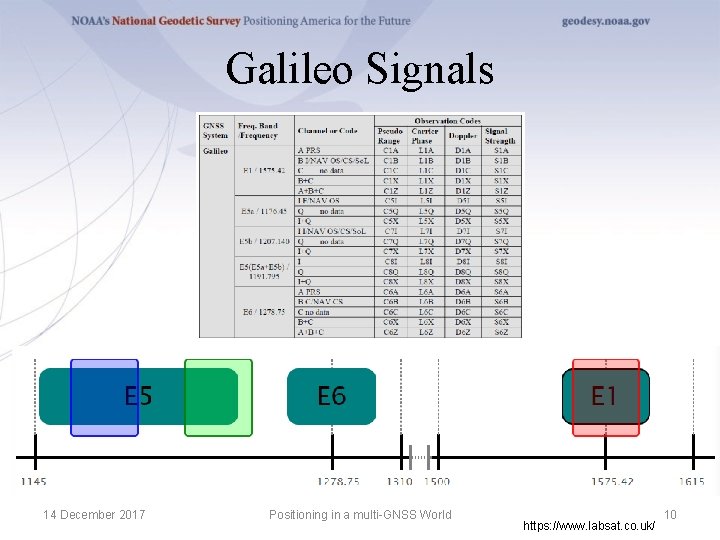
Galileo Signals 14 December 2017 Positioning in a multi-GNSS World https: //www. labsat. co. uk/ 10
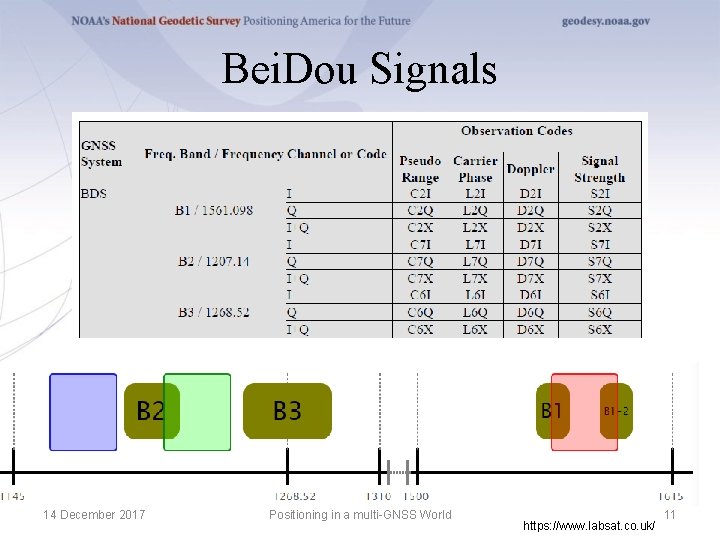
Bei. Dou Signals 14 December 2017 Positioning in a multi-GNSS World https: //www. labsat. co. uk/ 11

QZSS Signals 14 December 2017 Positioning in a multi-GNSS World https: //www. labsat. co. uk/ 12
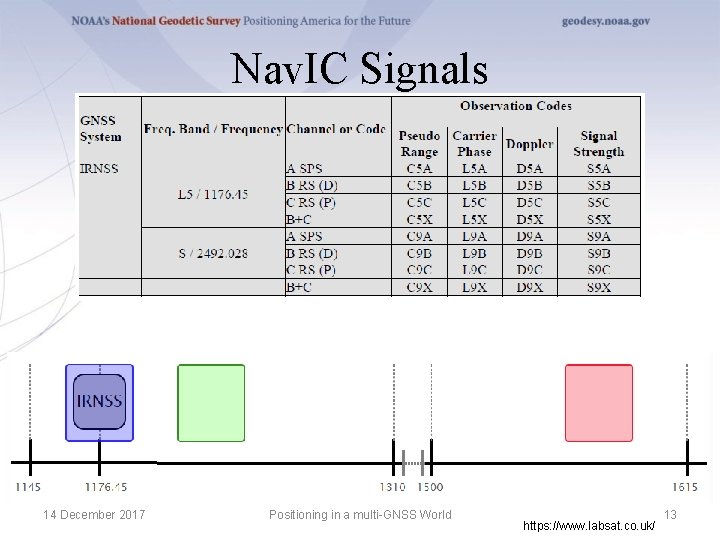
Nav. IC Signals 14 December 2017 Positioning in a multi-GNSS World https: //www. labsat. co. uk/ 13

GNSS Signals 14 December 2017 Positioning in a multi-GNSS World https: //www. labsat. co. uk/ 14
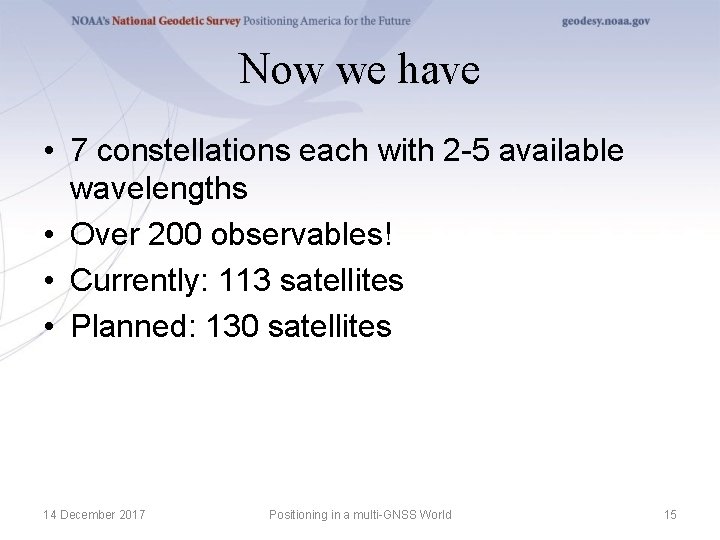
Now we have • 7 constellations each with 2 -5 available wavelengths • Over 200 observables! • Currently: 113 satellites • Planned: 130 satellites 14 December 2017 Positioning in a multi-GNSS World 15

How GNSS works in 5 slides. (1/5) A GNSS satellite passes overhead broadcasting a signal: I’m SV 1 at XYZ 1 (1) at Time 1(1). I’m SV 1 at XYZ 1 (2) at Time 1(2). I’m SV 1 at XYZ 1 (3) at Time 1(3). • • • 14 December 2017 Positioning in a multi-GNSS World 16
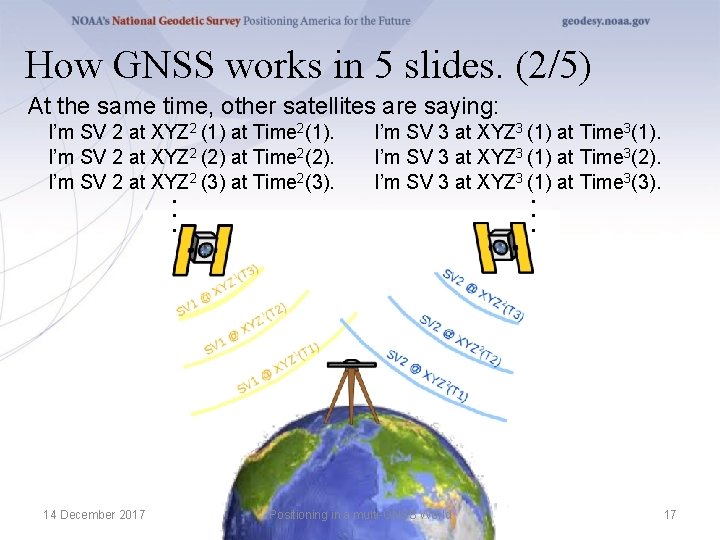
How GNSS works in 5 slides. (2/5) At the same time, other satellites are saying: I’m SV 2 at XYZ 2 (1) at Time 2(1). I’m SV 2 at XYZ 2 (2) at Time 2(2). I’m SV 2 at XYZ 2 (3) at Time 2(3). I’m SV 3 at XYZ 3 (1) at Time 3(1). I’m SV 3 at XYZ 3 (1) at Time 3(2). I’m SV 3 at XYZ 3 (1) at Time 3(3). • • • 14 December 2017 • • • Positioning in a multi-GNSS World 17
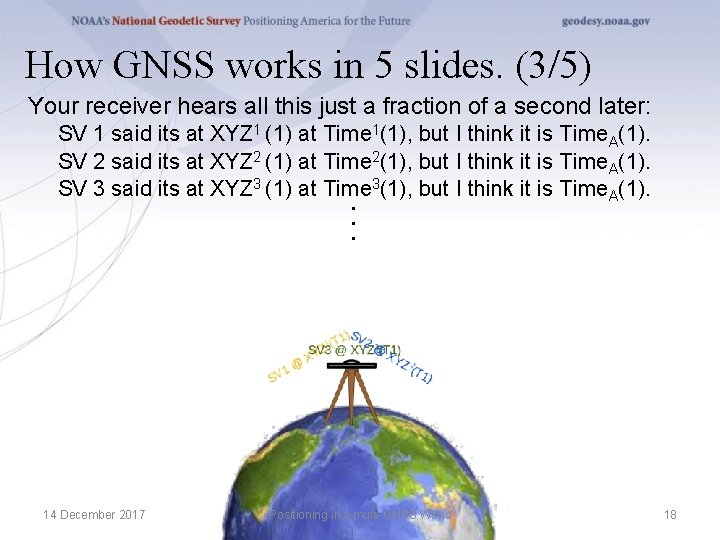
How GNSS works in 5 slides. (3/5) Your receiver hears all this just a fraction of a second later: SV 1 said its at XYZ 1 (1) at Time 1(1), but I think it is Time. A(1). SV 2 said its at XYZ 2 (1) at Time 2(1), but I think it is Time. A(1). SV 3 said its at XYZ 3 (1) at Time 3(1), but I think it is Time. A(1). • • • 14 December 2017 Positioning in a multi-GNSS World 18

How GNSS works in 5 slides. (4/5) Your receiver knows that these signals are travelling at the speed of light, c, so it starts doing a some math: c × (Time. A(1) – Time 1(1)) means I’m Range. A 1(1) from XYZ 1(1). c × (Time. A (1) – Time 2(1)) means I’m Range. A 2(1) from XYZ 2(1). c × (Time. A (1) – Time 3(1)) means I’m Range. A 3(1) from XYZ 3(1). • • • 14 December 2017 Positioning in a multi-GNSS World 19
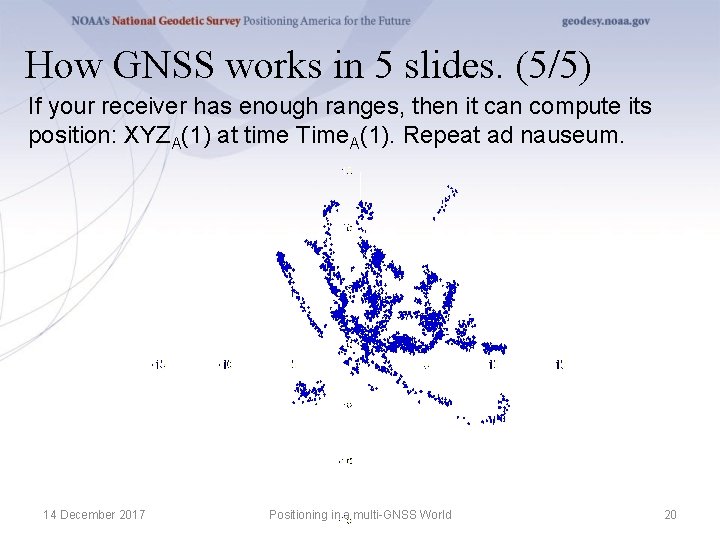
How GNSS works in 5 slides. (5/5) If your receiver has enough ranges, then it can compute its position: XYZA(1) at time Time. A(1). Repeat ad nauseum. 14 December 2017 Positioning in a multi-GNSS World 20
HOW IS THIS GOING TO IMPROVE MY POSITIONING? 14 December 2017 Positioning in a multi-GNSS World 21
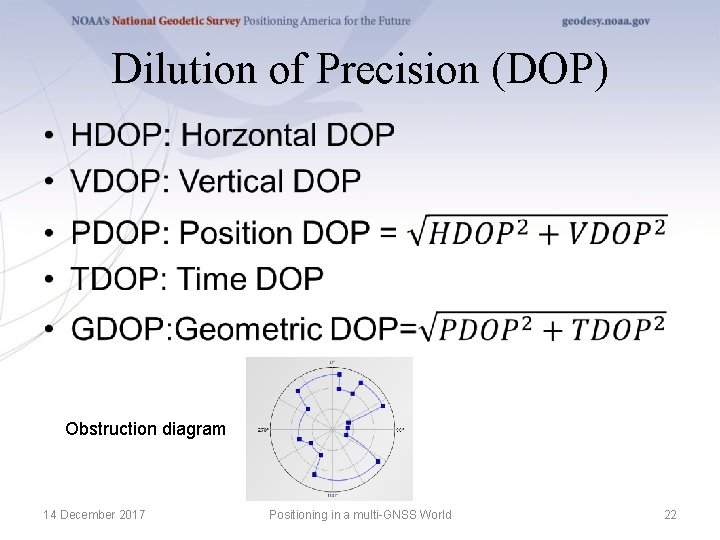
Dilution of Precision (DOP) • Obstruction diagram 14 December 2017 Positioning in a multi-GNSS World 22
14 December 2017 Positioning in a multi-GNSS World 23
MID-LATITUDE, NO OBSTRUCTIONS 10 DEGREE MASK 14 December 2017 Positioning in a multi-GNSS World 24
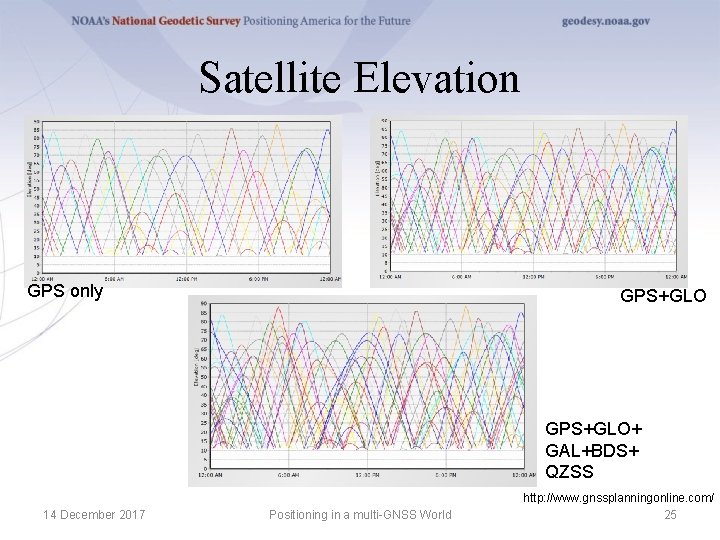
Satellite Elevation GPS only GPS+GLO+ GAL+BDS+ QZSS 14 December 2017 Positioning in a multi-GNSS World http: //www. gnssplanningonline. com/ 25

Satellite Visibility GPS only GPS+GLO 14 December 2017 Positioning in a multi-GNSS World GPS+GLO+ GAL+BDS+ QZSS http: //www. gnssplanningonline. com/ 26

DOP GPS only GPS+GLO+ GAL+BDS+ QZSS 14 December 2017 Positioning in a multi-GNSS World 27 http: //www. gnssplanningonline. com/
HIGH-LATITUDE, NO OBSTRUCTIONS 10 DEGREE MASK 14 December 2017 Positioning in a multi-GNSS World 28
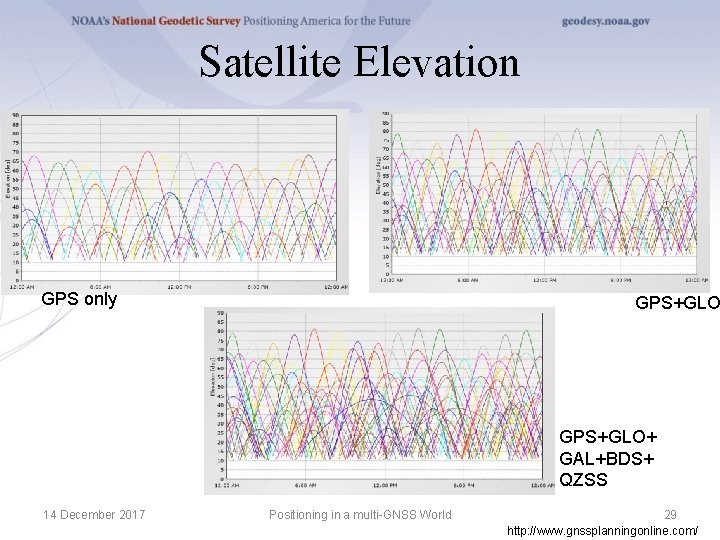
Satellite Elevation GPS only GPS+GLO+ GAL+BDS+ QZSS 14 December 2017 Positioning in a multi-GNSS World 29 http: //www. gnssplanningonline. com/
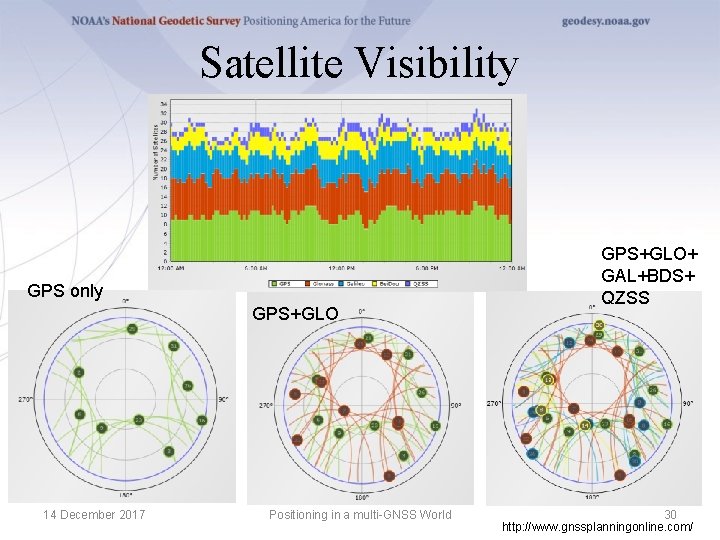
Satellite Visibility GPS only GPS+GLO 14 December 2017 Positioning in a multi-GNSS World GPS+GLO+ GAL+BDS+ QZSS 30 http: //www. gnssplanningonline. com/

DOP GPS only GPS+GLO+ GAL+BDS+ QZSS 14 December 2017 Positioning in a multi-GNSS World 31 http: //www. gnssplanningonline. com/
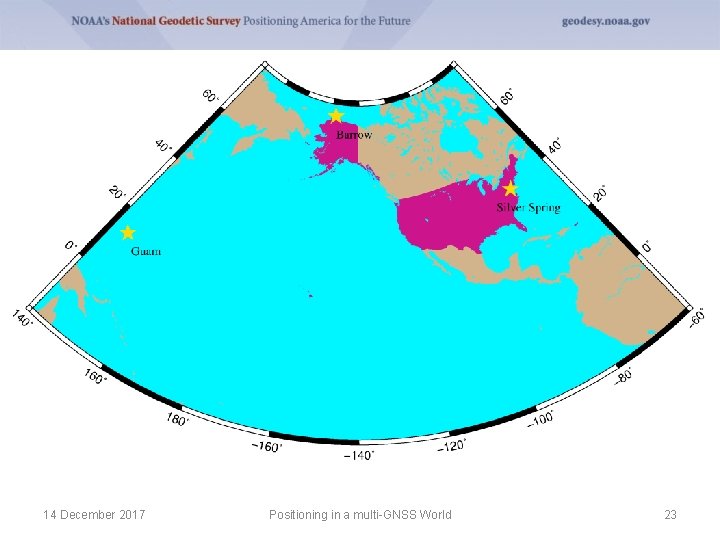
LOW-LATITUDE, NO OBSTRUCTIONS 10 DEGREE MASK 14 December 2017 Positioning in a multi-GNSS World 32
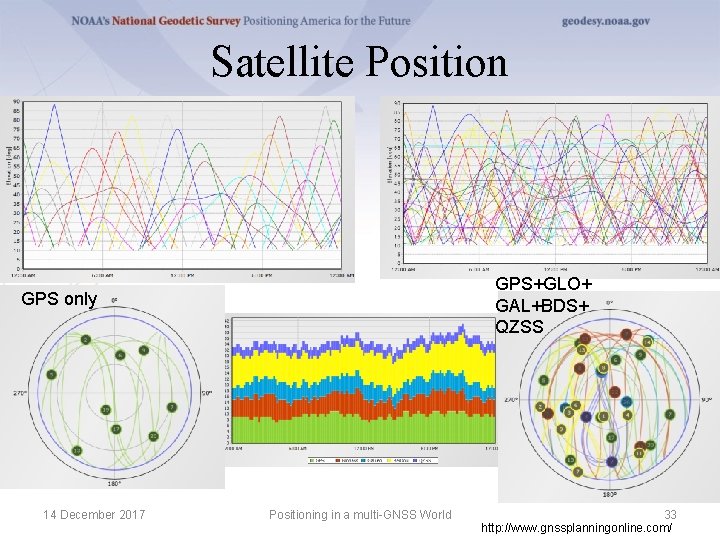
Satellite Position GPS+GLO+ GAL+BDS+ QZSS GPS only 14 December 2017 Positioning in a multi-GNSS World 33 http: //www. gnssplanningonline. com/
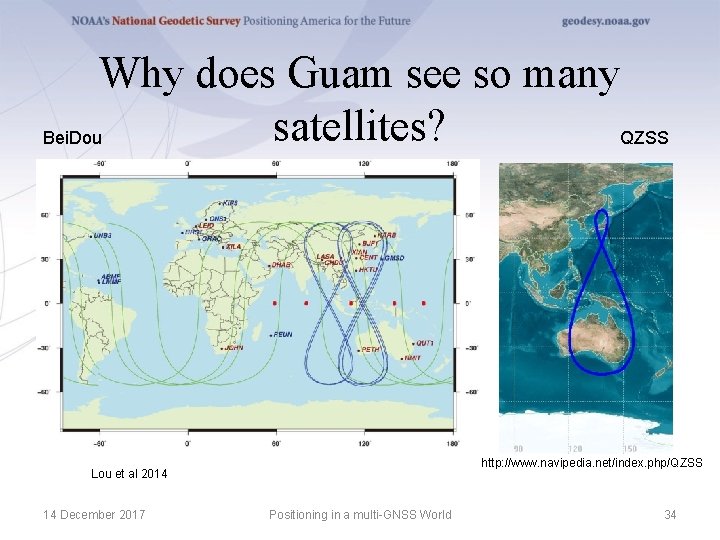
Why does Guam see so many satellites? Bei. Dou QZSS http: //www. navipedia. net/index. php/QZSS Lou et al 2014 14 December 2017 Positioning in a multi-GNSS World 34
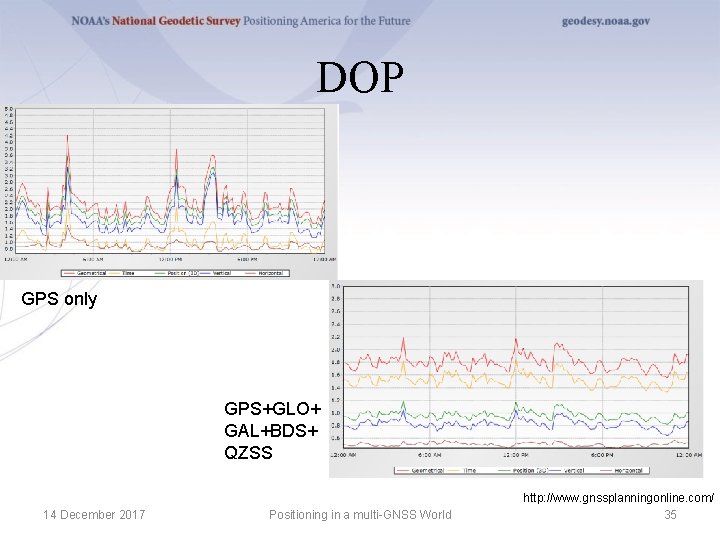
DOP GPS only GPS+GLO+ GAL+BDS+ QZSS 14 December 2017 Positioning in a multi-GNSS World http: //www. gnssplanningonline. com/ 35
LOW-LATITUDE, WITH OBSTRUCTIONS 14 December 2017 Positioning in a multi-GNSS World 36
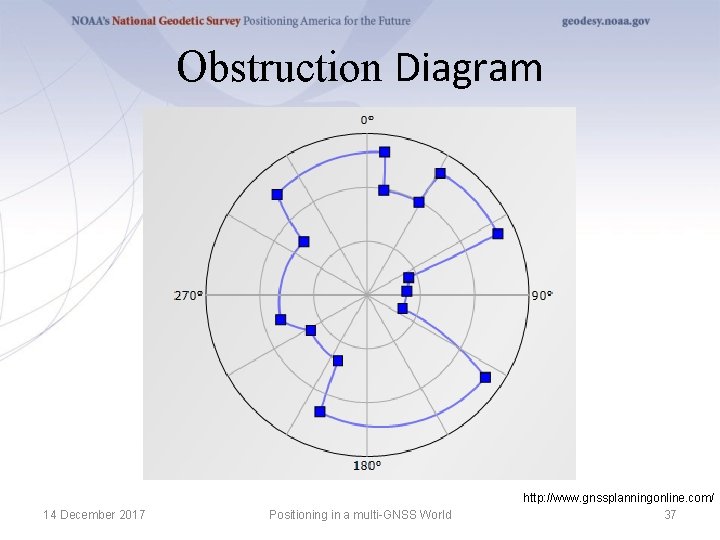
Obstruction Diagram 14 December 2017 Positioning in a multi-GNSS World http: //www. gnssplanningonline. com/ 37
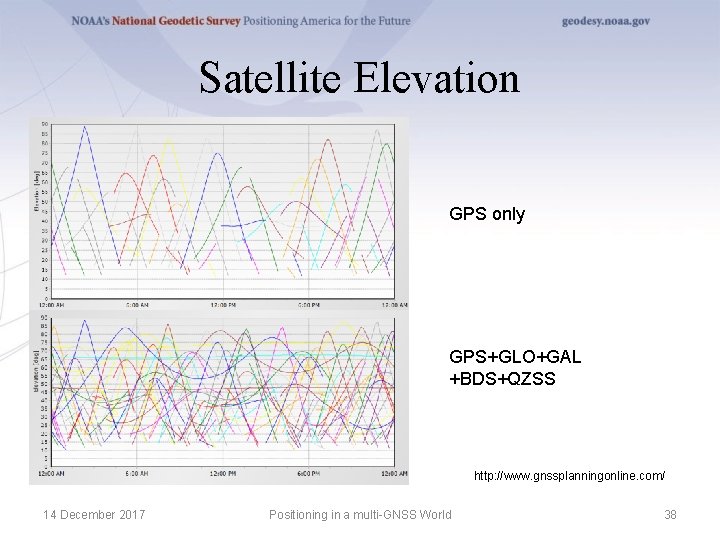
Satellite Elevation GPS only GPS+GLO+GAL +BDS+QZSS http: //www. gnssplanningonline. com/ 14 December 2017 Positioning in a multi-GNSS World 38
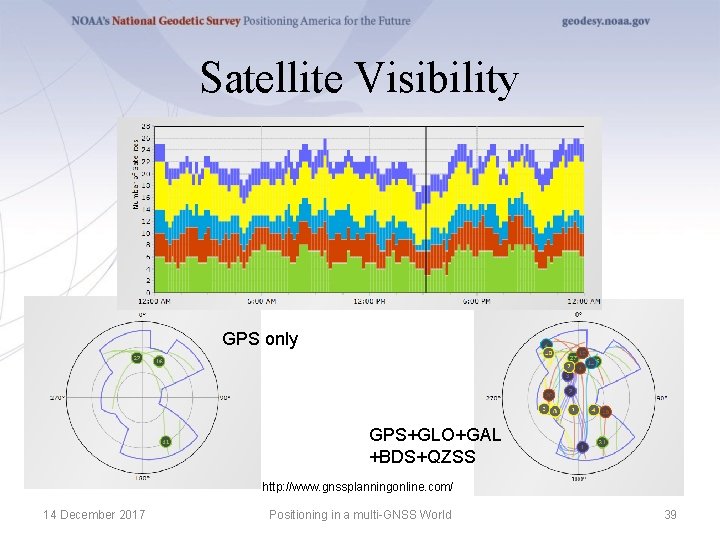
Satellite Visibility GPS only GPS+GLO+GAL +BDS+QZSS http: //www. gnssplanningonline. com/ 14 December 2017 Positioning in a multi-GNSS World 39
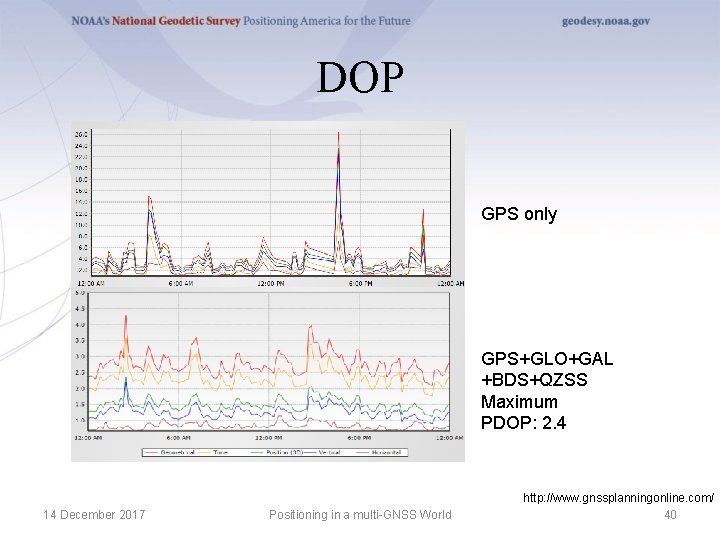
DOP GPS only GPS+GLO+GAL +BDS+QZSS Maximum PDOP: 2. 4 14 December 2017 Positioning in a multi-GNSS World http: //www. gnssplanningonline. com/ 40
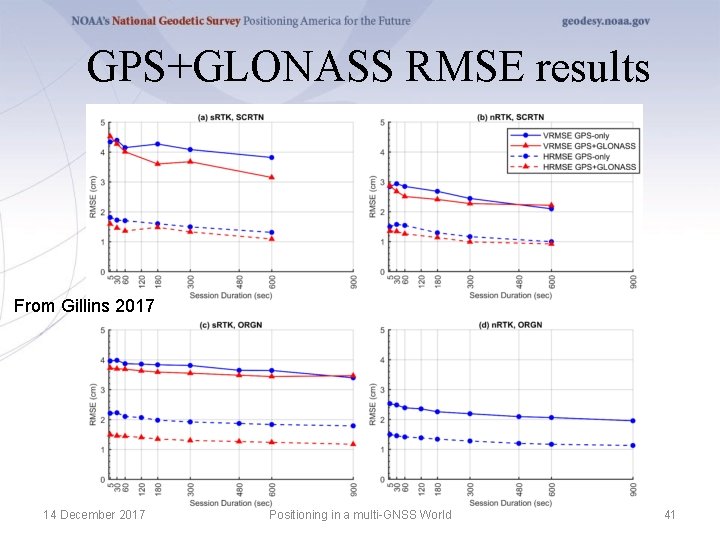
GPS+GLONASS RMSE results From Gillins 2017 14 December 2017 Positioning in a multi-GNSS World 41
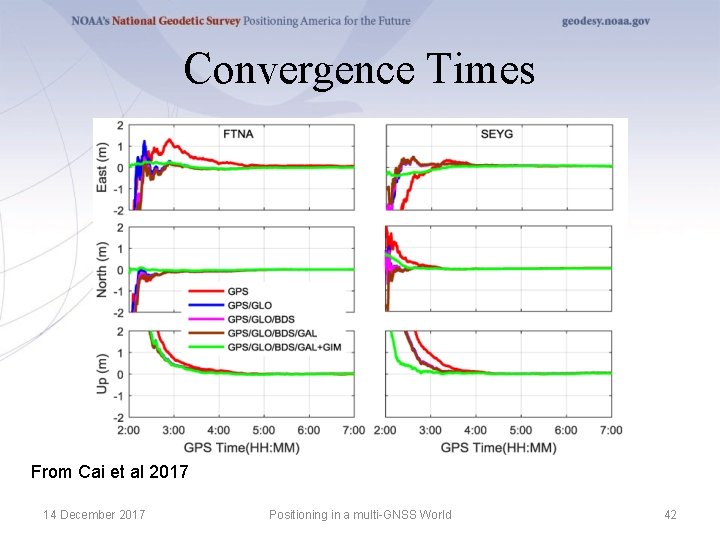
Convergence Times From Cai et al 2017 14 December 2017 Positioning in a multi-GNSS World 42
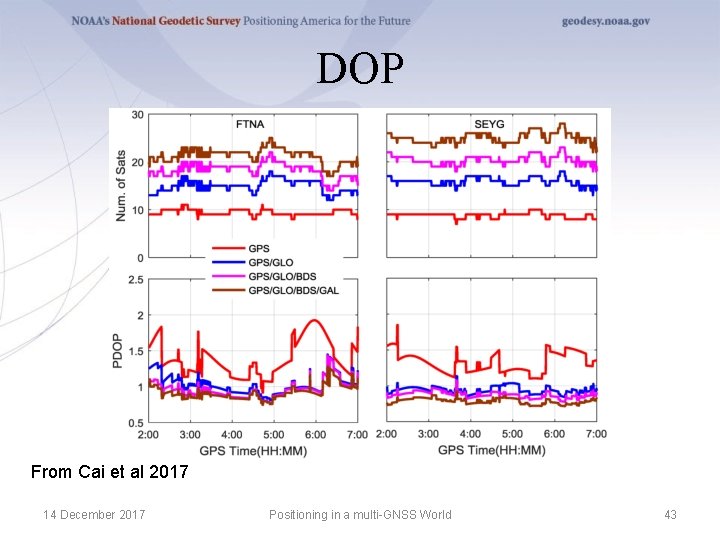
DOP From Cai et al 2017 14 December 2017 Positioning in a multi-GNSS World 43
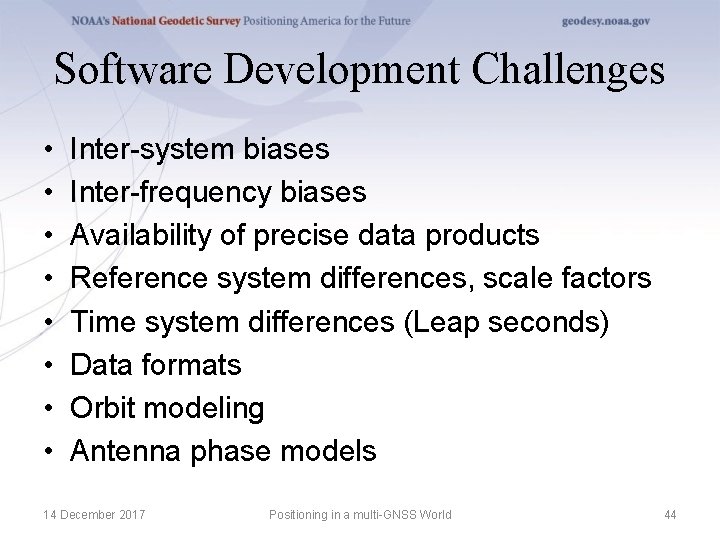
Software Development Challenges • • Inter-system biases Inter-frequency biases Availability of precise data products Reference system differences, scale factors Time system differences (Leap seconds) Data formats Orbit modeling Antenna phase models 14 December 2017 Positioning in a multi-GNSS World 44
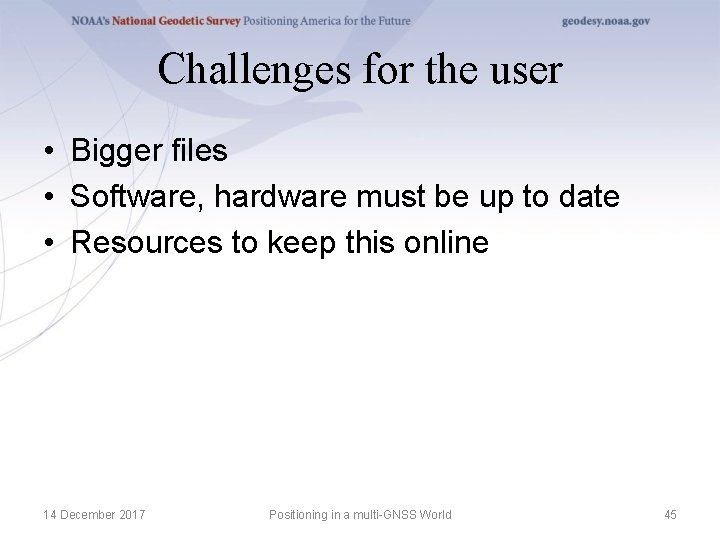
Challenges for the user • Bigger files • Software, hardware must be up to date • Resources to keep this online 14 December 2017 Positioning in a multi-GNSS World 45
Summary • By 2020, the sky will be very full • NGS currently only has GPS capability • Using more satellites, convergence times, sky coverage, and DOP will improve 14 December 2017 Positioning in a multi-GNSS World 46
Acknowledgements Thanks to Andria Bilich, Steve Hilla, Mark Schenewerk, Xiaopeng Li for your help with this presentation 14 December 2017 Positioning in a multi-GNSS World 47
References • http: //www. gnssplanningonline. com • https: //www. labsat. co. uk/index. php/en/applications/labsat -frequency-guide • Cai, C. ; Gong, Y. ; Gao, Y. ; Kuang, C. An Approach to Speed up Single-Frequency PPP Convergence with Quad-Constellation GNSS and GIM. Sensors 2017, 1302. • Gillins, D (2017) Deriving High-accuracy Ellipsoid Heights Using OPUS-Projects. NGS Webinar Series • Lou YD, Liu Y, Shi C, Yao XG, Zheng F (2014) Precise orbit determination of Bei. Dou constellation based on BETS and MGEX network. Sci Rep 4: 4692. 14 December 2017 Positioning in a multi-GNSS World 48
QUESTIONS 14 December 2017 Positioning in a multi-GNSS World 49
- Slides: 49