Although the superpowers attention was initially focused on
- Slides: 53
Although the superpowers’ attention was initially focused on Europe, World War II had been a watershed for the rest of the world as well. The colonial empires that had seemed destined to last for decades had been weakened dramatically by the conflict, while independence movements had been strengthened. The wave of decolonisation that ensued offered the United States and the Soviet Union the possibility to extend their influence and gain allies all over the world. However, the expansion of the battleground to newly independent states posed distinctive ideological and political challenges for each bloc. Asia, in particular, became a key battlefield with the conclusion of the Chinese civil war and the outbreak of the Korean War. American theories of containment were now applied to the perceived expansion of communist influence in the area, with long-lasting consequences. The global competition took different forms rather than just open military conflicts like Korea. The Eisenhower administration, in fact, relied significantly on covert operations carried out by the CIA to undermine or overthrow regimes considered sympathetic to communism, such as Iran and Guatemala. The situation changed again after Stalin’s death in 1953, as the Soviet Union adopted a new policy toward developing countries and renewed ideological competition for the Third World. At the same time, a decade after the end of World War II, a movement emerged that questioned fundamentally the premise of the Cold War, and suggested an alternative model for the rest of the world.
The first wave of decolonisation The European powers that emerged from the political and economic ruins of World War II hoped that their colonial possessions would provide them with the resources necessary for reconstruction. The conflict, however, had marked a turning point in the relationship between imperial powers and the rest of the world. The consequences were most immediately visible in Asia, where Japanese occupation had disrupted decades-long regimes and, in some cases, actively encouraged independence movements. In the decade after the end of World War II, southeast Asia was at the forefront of the first wave of a momentous process of decolonisation. The United States and the Soviet Union, as the emerging superpowers, had to adapt their policies to this new phenomenon. The USSR, which had little history of imperial occupation outside Europe, could more easily present itself as a supporter of independence movements. Until the death of Stalin, however, the security concerns of the Soviet Union were given priority over the attempts by local communists to spark revolutions. The United States was in a more ambiguous position: as a former colony without a formal imperial record, independence movements and newly established countries looked at it favourably. On the other hand, its alliance with European colonial powers, and the increasing importance of anti-communism over any other consideration, contributed to a growing hostility toward American foreign policy.
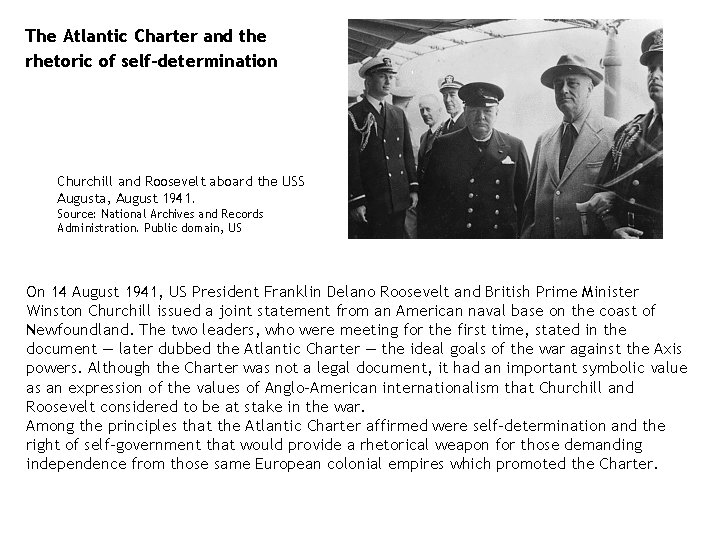
The Atlantic Charter and the rhetoric of self-determination Churchill and Roosevelt aboard the USS Augusta, August 1941. Source: National Archives and Records Administration. Public domain, US On 14 August 1941, US President Franklin Delano Roosevelt and British Prime Minister Winston Churchill issued a joint statement from an American naval base on the coast of Newfoundland. The two leaders, who were meeting for the first time, stated in the document — later dubbed the Atlantic Charter — the ideal goals of the war against the Axis powers. Although the Charter was not a legal document, it had an important symbolic value as an expression of the values of Anglo-American internationalism that Churchill and Roosevelt considered to be at stake in the war. Among the principles that the Atlantic Charter affirmed were self-determination and the right of self-government that would provide a rhetorical weapon for those demanding independence from those same European colonial empires which promoted the Charter.
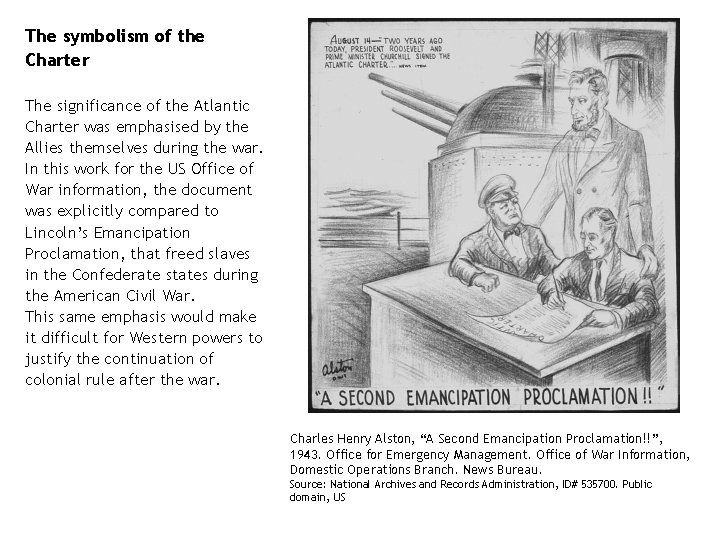
The symbolism of the Charter The significance of the Atlantic Charter was emphasised by the Allies themselves during the war. In this work for the US Office of War information, the document was explicitly compared to Lincoln’s Emancipation Proclamation, that freed slaves in the Confederate states during the American Civil War. This same emphasis would make it difficult for Western powers to justify the continuation of colonial rule after the war. Charles Henry Alston, “A Second Emancipation Proclamation!!”, 1943. Office for Emergency Management. Office of War Information, Domestic Operations Branch. News Bureau. Source: National Archives and Records Administration, ID# 535700. Public domain, US
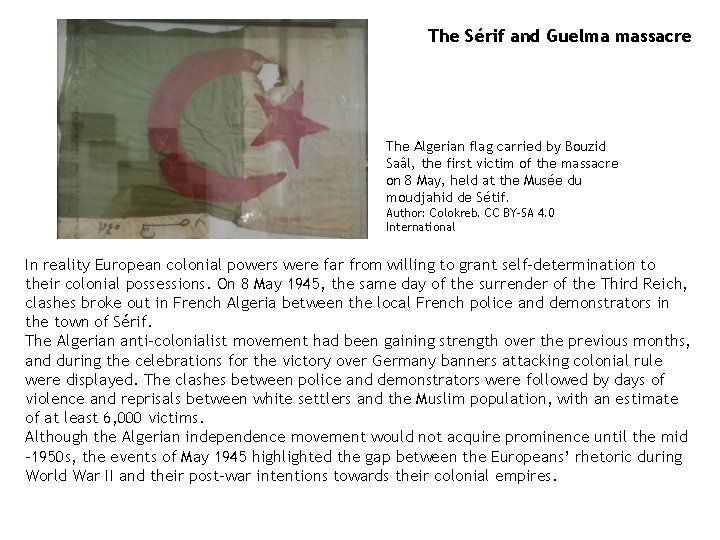
The Sérif and Guelma massacre The Algerian flag carried by Bouzid Saâl, the first victim of the massacre on 8 May, held at the Musée du moudjahid de Sétif. Author: Colokreb. CC BY-SA 4. 0 International In reality European colonial powers were far from willing to grant self-determination to their colonial possessions. On 8 May 1945, the same day of the surrender of the Third Reich, clashes broke out in French Algeria between the local French police and demonstrators in the town of Sérif. The Algerian anti-colonialist movement had been gaining strength over the previous months, and during the celebrations for the victory over Germany banners attacking colonial rule were displayed. The clashes between police and demonstrators were followed by days of violence and reprisals between white settlers and the Muslim population, with an estimate of at least 6, 000 victims. Although the Algerian independence movement would not acquire prominence until the mid -1950 s, the events of May 1945 highlighted the gap between the Europeans’ rhetoric during World War II and their post-war intentions towards their colonial empires.
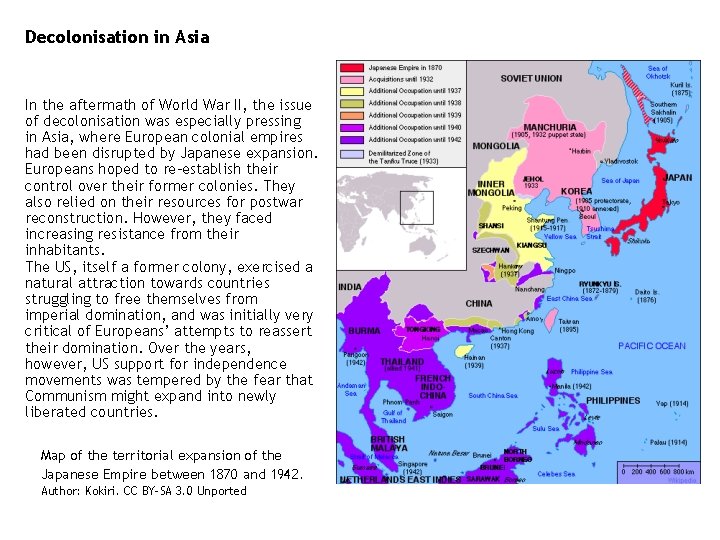
Decolonisation in Asia In the aftermath of World War II, the issue of decolonisation was especially pressing in Asia, where European colonial empires had been disrupted by Japanese expansion. Europeans hoped to re-establish their control over their former colonies. They also relied on their resources for postwar reconstruction. However, they faced increasing resistance from their inhabitants. The US, itself a former colony, exercised a natural attraction towards countries struggling to free themselves from imperial domination, and was initially very critical of Europeans’ attempts to reassert their domination. Over the years, however, US support for independence movements was tempered by the fear that Communism might expand into newly liberated countries. Map of the territorial expansion of the Japanese Empire between 1870 and 1942. Author: Kokiri. CC BY-SA 3. 0 Unported
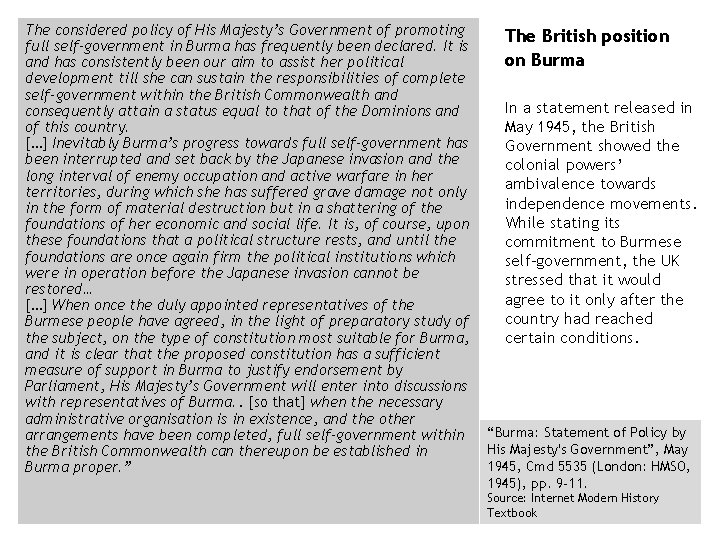
The considered policy of His Majesty’s Government of promoting full self-government in Burma has frequently been declared. It is and has consistently been our aim to assist her political development till she can sustain the responsibilities of complete self-government within the British Commonwealth and consequently attain a status equal to that of the Dominions and of this country. […] Inevitably Burma’s progress towards full self-government has been interrupted and set back by the Japanese invasion and the long interval of enemy occupation and active warfare in her territories, during which she has suffered grave damage not only in the form of material destruction but in a shattering of the foundations of her economic and social life. It is, of course, upon these foundations that a political structure rests, and until the foundations are once again firm the political institutions which were in operation before the Japanese invasion cannot be restored… […] When once the duly appointed representatives of the Burmese people have agreed, in the light of preparatory study of the subject, on the type of constitution most suitable for Burma, and it is clear that the proposed constitution has a sufficient measure of support in Burma to justify endorsement by Parliament, His Majesty’s Government will enter into discussions with representatives of Burma. . [so that] when the necessary administrative organisation is in existence, and the other arrangements have been completed, full self-government within the British Commonwealth can thereupon be established in Burma proper. ” The British position on Burma In a statement released in May 1945, the British Government showed the colonial powers’ ambivalence towards independence movements. While stating its commitment to Burmese self-government, the UK stressed that it would agree to it only after the country had reached certain conditions. “Burma: Statement of Policy by His Majesty's Government”, May 1945, Cmd 5535 (London: HMSO, 1945), pp. 9 -11. Source: Internet Modern History Textbook
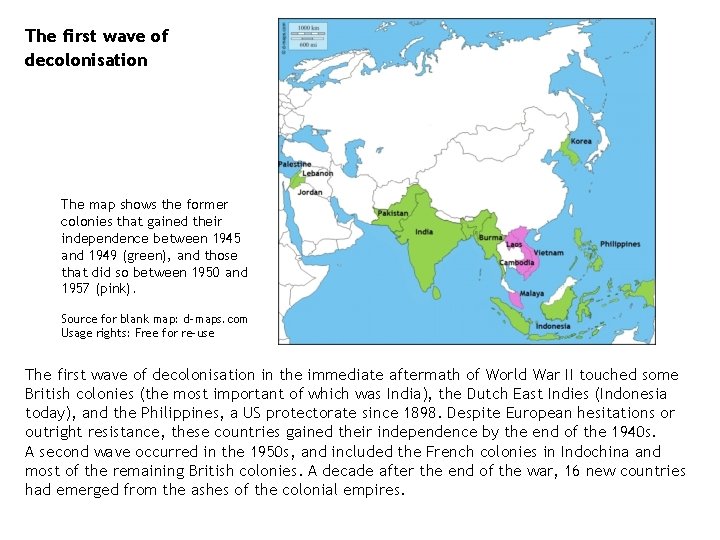
The first wave of decolonisation The map shows the former colonies that gained their independence between 1945 and 1949 (green), and those that did so between 1950 and 1957 (pink). Source for blank map: d-maps. com Usage rights: Free for re-use The first wave of decolonisation in the immediate aftermath of World War II touched some British colonies (the most important of which was India), the Dutch East Indies (Indonesia today), and the Philippines, a US protectorate since 1898. Despite European hesitations or outright resistance, these countries gained their independence by the end of the 1940 s. A second wave occurred in the 1950 s, and included the French colonies in Indochina and most of the remaining British colonies. A decade after the end of the war, 16 new countries had emerged from the ashes of the colonial empires.
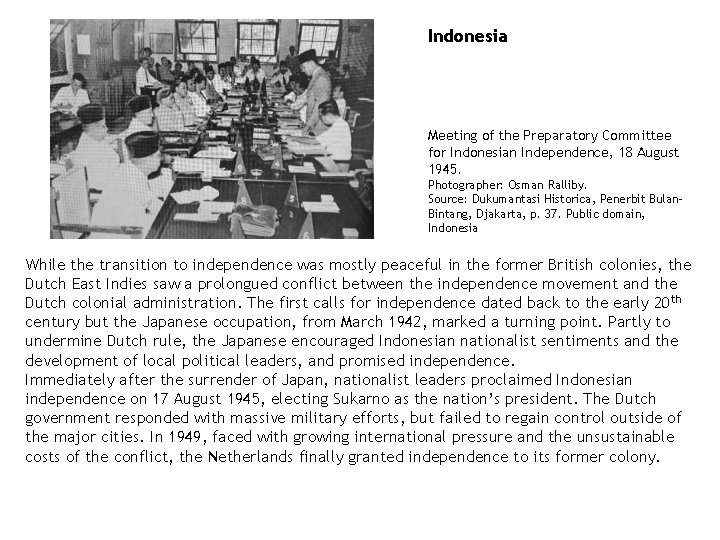
Indonesia Meeting of the Preparatory Committee for Indonesian Independence, 18 August 1945. Photographer: Osman Ralliby. Source: Dukumantasi Historica, Penerbit Bulan. Bintang, Djakarta, p. 37. Public domain, Indonesia While the transition to independence was mostly peaceful in the former British colonies, the Dutch East Indies saw a prolongued conflict between the independence movement and the Dutch colonial administration. The first calls for independence dated back to the early 20 th century but the Japanese occupation, from March 1942, marked a turning point. Partly to undermine Dutch rule, the Japanese encouraged Indonesian nationalist sentiments and the development of local political leaders, and promised independence. Immediately after the surrender of Japan, nationalist leaders proclaimed Indonesian independence on 17 August 1945, electing Sukarno as the nation’s president. The Dutch government responded with massive military efforts, but failed to regain control outside of the major cities. In 1949, faced with growing international pressure and the unsustainable costs of the conflict, the Netherlands finally granted independence to its former colony.
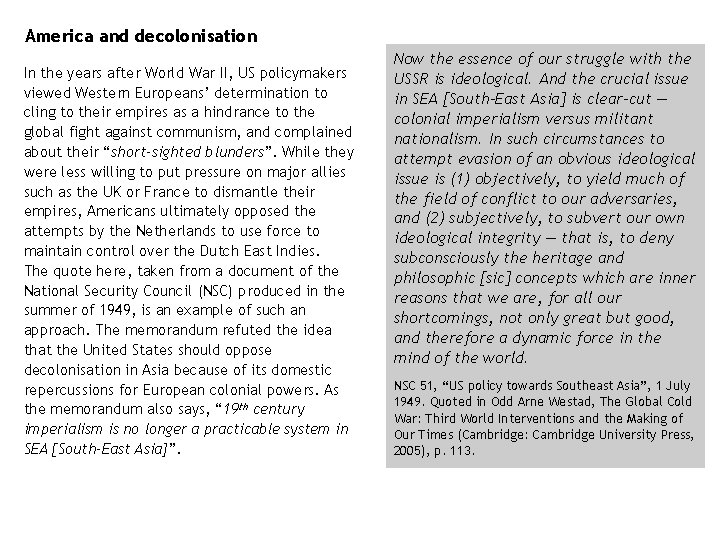
America and decolonisation In the years after World War II, US policymakers viewed Western Europeans’ determination to cling to their empires as a hindrance to the global fight against communism, and complained about their “short-sighted blunders”. While they were less willing to put pressure on major allies such as the UK or France to dismantle their empires, Americans ultimately opposed the attempts by the Netherlands to use force to maintain control over the Dutch East Indies. The quote here, taken from a document of the National Security Council (NSC) produced in the summer of 1949, is an example of such an approach. The memorandum refuted the idea that the United States should oppose decolonisation in Asia because of its domestic repercussions for European colonial powers. As the memorandum also says, “ 19 th century imperialism is no longer a practicable system in SEA [South-East Asia]”. Now the essence of our struggle with the USSR is ideological. And the crucial issue in SEA [South-East Asia] is clear-cut ― colonial imperialism versus militant nationalism. In such circumstances to attempt evasion of an obvious ideological issue is (1) objectively, to yield much of the field of conflict to our adversaries, and (2) subjectively, to subvert our own ideological integrity ― that is, to deny subconsciously the heritage and philosophic [sic] concepts which are inner reasons that we are, for all our shortcomings, not only great but good, and therefore a dynamic force in the mind of the world. NSC 51, “US policy towards Southeast Asia”, 1 July 1949. Quoted in Odd Arne Westad, The Global Cold War: Third World Interventions and the Making of Our Times (Cambridge: Cambridge University Press, 2005), p. 113.
The shift in US policy “The great and ominous crime sought to be committed here is the selling of the African people into further exploitation and slavery for the preservation of an American-European union apparently not strong enough to maintain itself without the blood and liberty of Africans. America, which preaches so much about democracy and about self-determination, [has coldly made] a deal to sell the African colonies back to Italy in order to strengthen a treaty designed to restore Western Europe and keep ‘peace’ with the Soviet Union. Roy Wilkins, assistant secretary of the National Association for the Advancement of Colored People (NAACP) in 1949 on the debates about former Italian colonies. Quoted in Carol Anderson, “Rethinking Radicalism: African Americans and the Liberation Struggles in Somalia, Libya, and Eritrea, 1945– 1949”, The Journal of the Historical Society XI n. 4 (2011), pp. 412 -13. This attitude by US officials, however, changed with the emergence of the Cold War and the perceived threat of global communism. The outcome of the Chinese civil war, in particular, raised the spectre that it could rapidly expand. The world was increasingly seen as rigidly divided into two camps, and the stress placed on ideological commitment and military solutions. Concerned with preserving the economy and national prestige of their allies, Americans softened their criticism of colonialism and even considered, in the case of Italy, allowing for the return of former colonialists under the form of a United Nations trusteeship (e. g. in Somaliland, Libya and Eritrea). African American leaders ― both leftists and moderates ― maintained a critical stance that called for the right of former colonial peoples to self-determination.
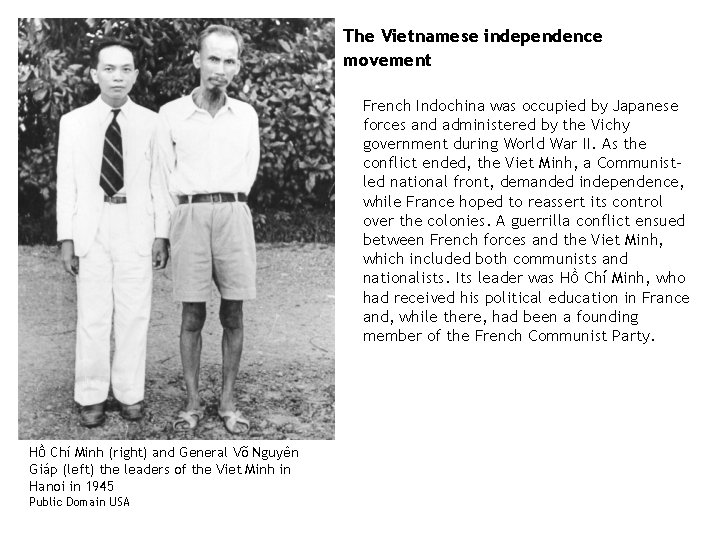
The Vietnamese independence movement French Indochina was occupied by Japanese forces and administered by the Vichy government during World War II. As the conflict ended, the Viet Minh, a Communistled national front, demanded independence, while France hoped to reassert its control over the colonies. A guerrilla conflict ensued between French forces and the Viet Minh, which included both communists and nationalists. Its leader was Hồ Chí Minh, who had received his political education in France and, while there, had been a founding member of the French Communist Party. Hồ Chí Minh (right) and General Võ Nguyên Giáp (left) the leaders of the Viet Minh in Hanoi in 1945 Public Domain USA
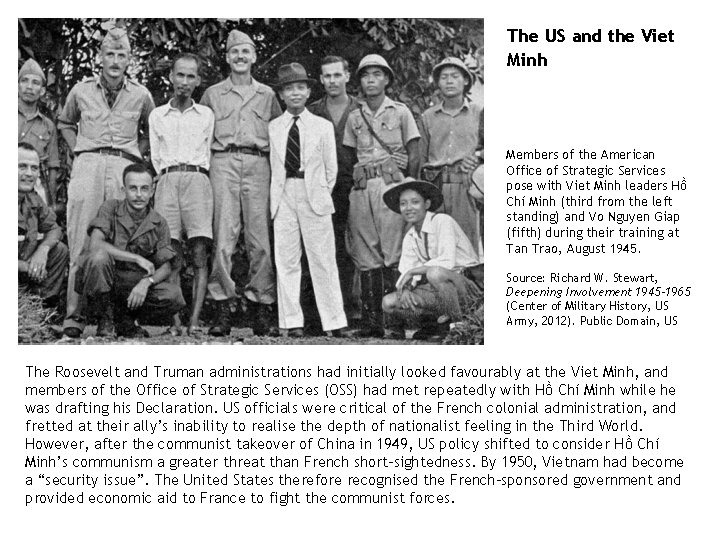
The US and the Viet Minh Members of the American Office of Strategic Services pose with Viet Minh leaders Hồ Chí Minh (third from the left standing) and Vo Nguyen Giap (fifth) during their training at Tan Trao, August 1945. Source: Richard W. Stewart, Deepening Involvement 1945 -1965 (Center of Military History, US Army, 2012). Public Domain, US The Roosevelt and Truman administrations had initially looked favourably at the Viet Minh, and members of the Office of Strategic Services (OSS) had met repeatedly with Hồ Chí Minh while he was drafting his Declaration. US officials were critical of the French colonial administration, and fretted at their ally’s inability to realise the depth of nationalist feeling in the Third World. However, after the communist takeover of China in 1949, US policy shifted to consider Hồ Chí Minh’s communism a greater threat than French short-sightedness. By 1950, Vietnam had become a “security issue”. The United States therefore recognised the French-sponsored government and provided economic aid to France to fight the communist forces.
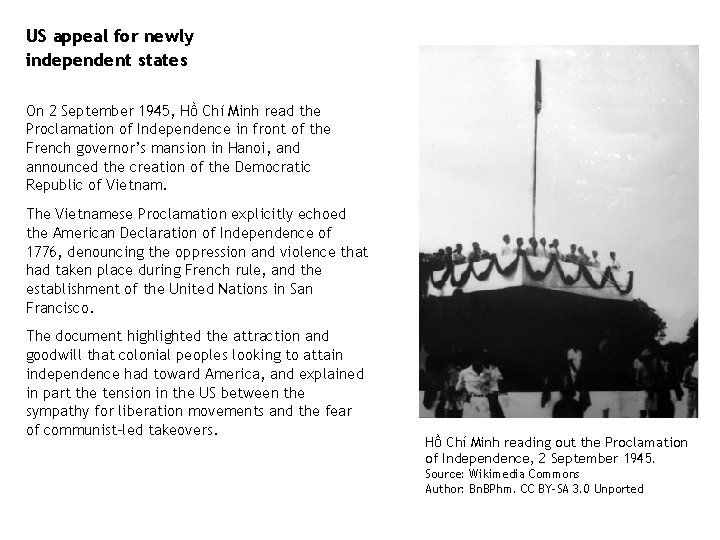
US appeal for newly independent states On 2 September 1945, Hồ Chí Minh read the Proclamation of Independence in front of the French governor’s mansion in Hanoi, and announced the creation of the Democratic Republic of Vietnam. The Vietnamese Proclamation explicitly echoed the American Declaration of Independence of 1776, denouncing the oppression and violence that had taken place during French rule, and the establishment of the United Nations in San Francisco. The document highlighted the attraction and goodwill that colonial peoples looking to attain independence had toward America, and explained in part the tension in the US between the sympathy for liberation movements and the fear of communist-led takeovers. Hồ Chí Minh reading out the Proclamation of Independence, 2 September 1945. Source: Wikimedia Commons Author: Bn. BPhm. CC BY-SA 3. 0 Unported
Proclamation of Independence of the Democratic Republic of Vietnam, 2 September 1945. “‘All men are created equal. They are endowed by their Creator with certain inalienable rights, among these are Life, Liberty, and the pursuit of Happiness’. This immortal statement was made in the Declaration of Independence of the United States of America in 1776. In a broader sense, this means: All the peoples on the earth are equal from birth, all the peoples have a right to live, to be happy and free. The Declaration of the French Revolution made in 1791 on the Rights of Man and the Citizen also states: ‘All men are born free and with equal rights, and must always remain free and have equal rights’. Those are undeniable truths. Nevertheless, for more than eighty years, the French imperialists, abusing the standard of Liberty, Equality, and Fraternity, have violated our Fatherland oppressed our fellowcitizens. They have acted contrary to the ideals of humanity and justice. […] For these reasons, we, the members of the Provisional Government, representing the whole Vietnamese people, declare from now on that we break off all relations of a colonial character with France; we repeal all the international obligations that France has so far subscribed on behalf of Vietnam and we abolish all the special rights the French have unlawfully acquired in our Fatherland. The whole Vietnamese people, animated by a common purpose, are determined to fight to the bitter end against any attempt by the French colonialists to reconquer their country. ” Hồ Chí Minh, Proclamation of Independence of the Democratic Republic of Vietnam, 2 September 1945. Source: Jussi M. Hanhimäki and Odd Arne Westad (eds. ), The Cold War: A History in Documents and Eyewitness Accounts (Oxford: Oxford University Press, 2003), pp. 210 -13.
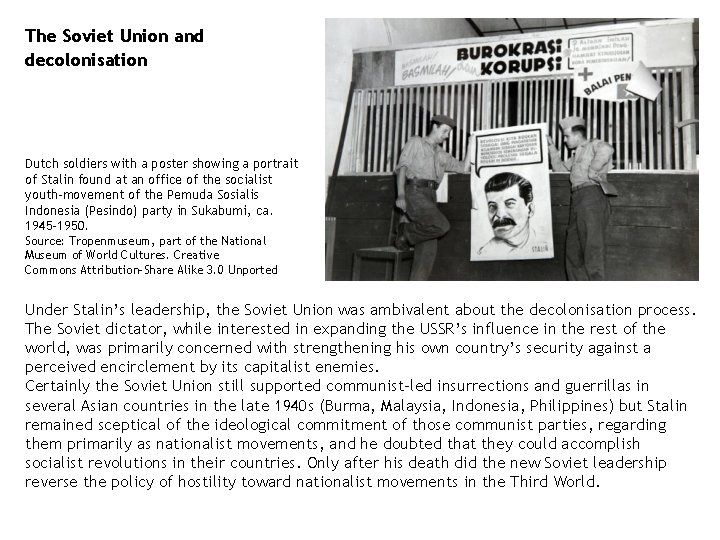
The Soviet Union and decolonisation Dutch soldiers with a poster showing a portrait of Stalin found at an office of the socialist youth-movement of the Pemuda Sosialis Indonesia (Pesindo) party in Sukabumi, ca. 1945 -1950. Source: Tropenmuseum, part of the National Museum of World Cultures. Creative Commons Attribution-Share Alike 3. 0 Unported Under Stalin’s leadership, the Soviet Union was ambivalent about the decolonisation process. The Soviet dictator, while interested in expanding the USSR’s influence in the rest of the world, was primarily concerned with strengthening his own country’s security against a perceived encirclement by its capitalist enemies. Certainly the Soviet Union still supported communist-led insurrections and guerrillas in several Asian countries in the late 1940 s (Burma, Malaysia, Indonesia, Philippines) but Stalin remained sceptical of the ideological commitment of those communist parties, regarding them primarily as nationalist movements, and he doubted that they could accomplish socialist revolutions in their countries. Only after his death did the new Soviet leadership reverse the policy of hostility toward nationalist movements in the Third World.
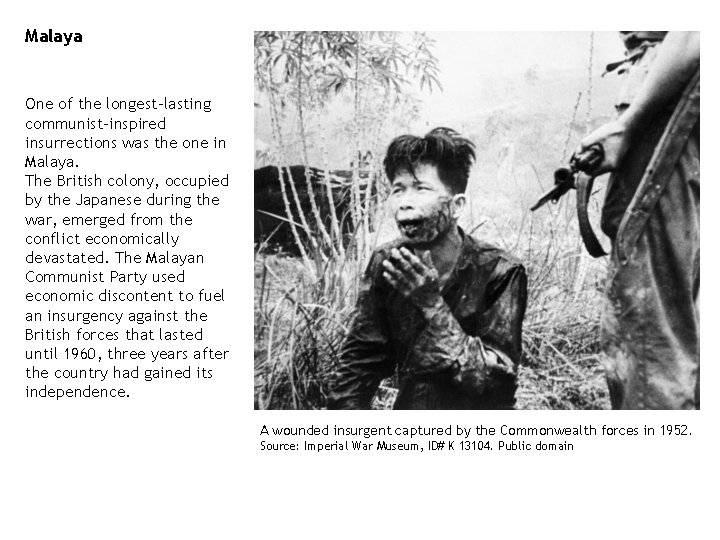
Malaya One of the longest-lasting communist-inspired insurrections was the one in Malaya. The British colony, occupied by the Japanese during the war, emerged from the conflict economically devastated. The Malayan Communist Party used economic discontent to fuel an insurgency against the British forces that lasted until 1960, three years after the country had gained its independence. A wounded insurgent captured by the Commonwealth forces in 1952. Source: Imperial War Museum, ID# K 13104. Public domain
Decolonisation and the Cold War The process of decolonisation, which had its roots in the decades before World War II, nonetheless took place in the context of the Cold War, which influenced its development. As this quote from Westad suggests, the bipolar division of the world between West and East, while limiting their choices, provided independence movements and newly established countries with an immediate access to aid and support. In fact, the allies’ ability to use the Cold War logic for their own interests, remained a constant throughout the conflict. “For the Vietnamese, the Algerians, and all others who attacked the colonial system after 1945, the existence of two superpowers, who both were eager to disassociate themselves from European colonialism, opened up new possibilities for aid and support. Very different from the nineteenth-century system of states and from the process of colonial expansion, the Cold War was bipolar to the point of exclusivity, meaning that if one’s enemies were supported by one superpower, there was always the chance of getting aid from the other. […] in those relatively few cases where the road to independence was a long and open war, military aid – most often from the Soviet Union and its allies – became vital during the 1950 s and 1960 s. ” Westad, The Global Cold War, 89.
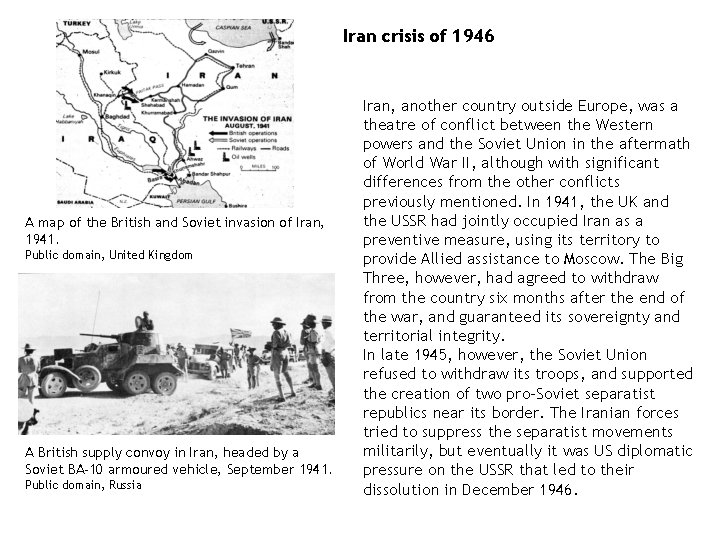
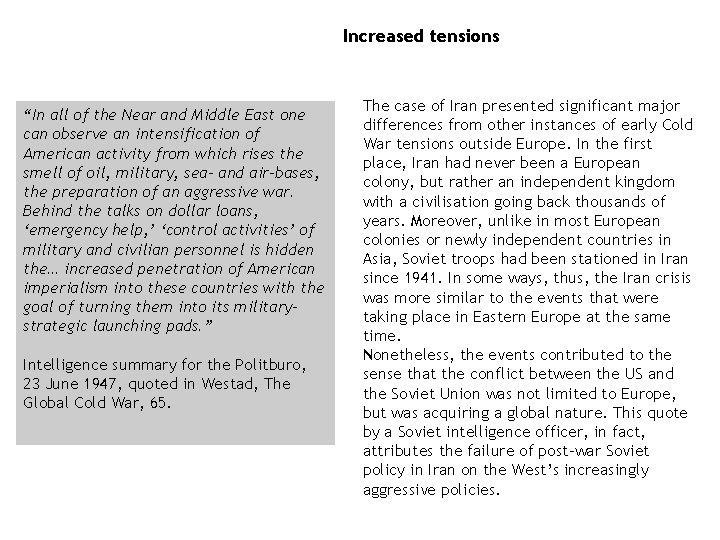
Iran crisis of 1946 A map of the British and Soviet invasion of Iran, 1941. Public domain, United Kingdom A British supply convoy in Iran, headed by a Soviet BA-10 armoured vehicle, September 1941. Public domain, Russia Iran, another country outside Europe, was a theatre of conflict between the Western powers and the Soviet Union in the aftermath of World War II, although with significant differences from the other conflicts previously mentioned. In 1941, the UK and the USSR had jointly occupied Iran as a preventive measure, using its territory to provide Allied assistance to Moscow. The Big Three, however, had agreed to withdraw from the country six months after the end of the war, and guaranteed its sovereignty and territorial integrity. In late 1945, however, the Soviet Union refused to withdraw its troops, and supported the creation of two pro-Soviet separatist republics near its border. The Iranian forces tried to suppress the separatist movements militarily, but eventually it was US diplomatic pressure on the USSR that led to their dissolution in December 1946.
Increased tensions “In all of the Near and Middle East one can observe an intensification of American activity from which rises the smell of oil, military, sea- and air-bases, the preparation of an aggressive war. Behind the talks on dollar loans, ‘emergency help, ’ ‘control activities’ of military and civilian personnel is hidden the… increased penetration of American imperialism into these countries with the goal of turning them into its militarystrategic launching pads. ” Intelligence summary for the Politburo, 23 June 1947, quoted in Westad, The Global Cold War, 65. The case of Iran presented significant major differences from other instances of early Cold War tensions outside Europe. In the first place, Iran had never been a European colony, but rather an independent kingdom with a civilisation going back thousands of years. Moreover, unlike in most European colonies or newly independent countries in Asia, Soviet troops had been stationed in Iran since 1941. In some ways, thus, the Iran crisis was more similar to the events that were taking place in Eastern Europe at the same time. Nonetheless, the events contributed to the sense that the conflict between the US and the Soviet Union was not limited to Europe, but was acquiring a global nature. This quote by a Soviet intelligence officer, in fact, attributes the failure of post-war Soviet policy in Iran on the West’s increasingly aggressive policies.
China and Korea In the late 1940 s, the centre of the geopolitical confrontation between the United States and the Soviet Union moved from Europe to Asia. In the Chinese civil war, the communist forces led by Mao Zedong finally prevailed after years of fighting, forcing the nationalists to retreat to the island of Taiwan and proclaiming the People’s Republic of China. The outcome of the Chinese civil war also had significant repercussions on the global scene: communism was now the dominant ideology of one sixth of the world’s population, and especially powerful in Asia. The events also reinforced the perception in the US and in the Western bloc that communist insurgencies had to be resisted early and forcefully, lest they undermine allied regimes. An immediate repercussion of the changing power balance in Asia was visible in Korea. The former Japanese colony became the stage for a proxy war between the superpowers, which took opposite sides in the conflict between communist and nationalist forces. When the North launched an invasion against its southern neighbour, in June 1950, the Western bloc considered it an attempt by the Soviet Union to expand its influence militarily in thr Pacific. The Korean War symbolised the blurred lines between local conflict and geopolitical rivalry typical of the Cold War, as the involvement of the US and the USSR in a civil war encouraged a permanent division of the country.
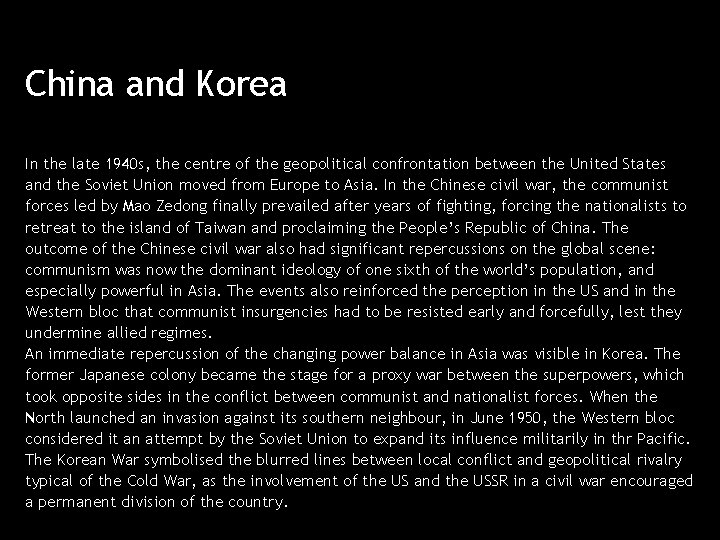
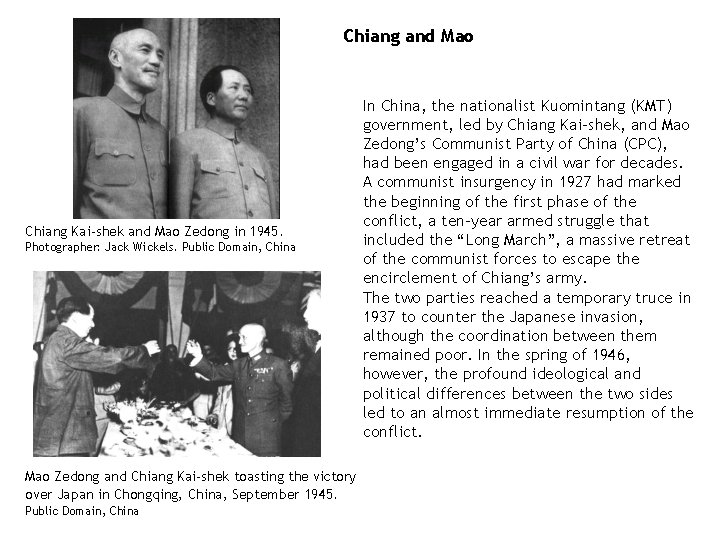
Chiang and Mao Chiang Kai-shek and Mao Zedong in 1945. Photographer: Jack Wickels. Public Domain, China Mao Zedong and Chiang Kai-shek toasting the victory over Japan in Chongqing, China, September 1945. Public Domain, China In China, the nationalist Kuomintang (KMT) government, led by Chiang Kai-shek, and Mao Zedong’s Communist Party of China (CPC), had been engaged in a civil war for decades. A communist insurgency in 1927 had marked the beginning of the first phase of the conflict, a ten-year armed struggle that included the “Long March”, a massive retreat of the communist forces to escape the encirclement of Chiang’s army. The two parties reached a temporary truce in 1937 to counter the Japanese invasion, although the coordination between them remained poor. In the spring of 1946, however, the profound ideological and political differences between the two sides led to an almost immediate resumption of the conflict.
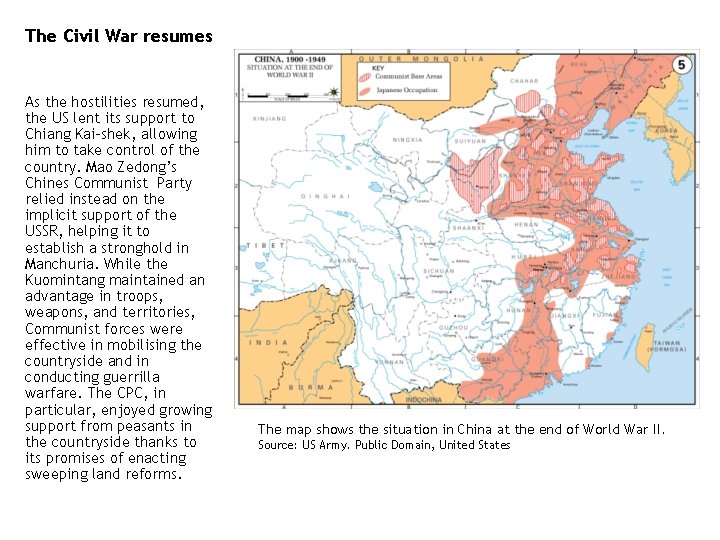
The Civil War resumes As the hostilities resumed, the US lent its support to Chiang Kai-shek, allowing him to take control of the country. Mao Zedong’s Chines Communist Party relied instead on the implicit support of the USSR, helping it to establish a stronghold in Manchuria. While the Kuomintang maintained an advantage in troops, weapons, and territories, Communist forces were effective in mobilising the countryside and in conducting guerrilla warfare. The CPC, in particular, enjoyed growing support from peasants in the countryside thanks to its promises of enacting sweeping land reforms. The map shows the situation in China at the end of World War II. Source: US Army. Public Domain, United States
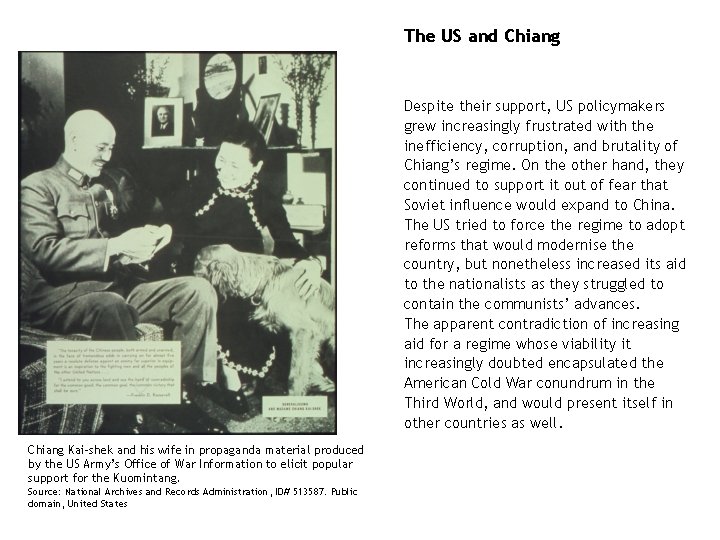
The US and Chiang Despite their support, US policymakers grew increasingly frustrated with the inefficiency, corruption, and brutality of Chiang’s regime. On the other hand, they continued to support it out of fear that Soviet influence would expand to China. The US tried to force the regime to adopt reforms that would modernise the country, but nonetheless increased its aid to the nationalists as they struggled to contain the communists’ advances. The apparent contradiction of increasing aid for a regime whose viability it increasingly doubted encapsulated the American Cold War conundrum in the Third World, and would present itself in other countries as well. Chiang Kai-shek and his wife in propaganda material produced by the US Army’s Office of War Information to elicit popular support for the Kuomintang. Source: National Archives and Records Administration, ID# 513587. Public domain, United States
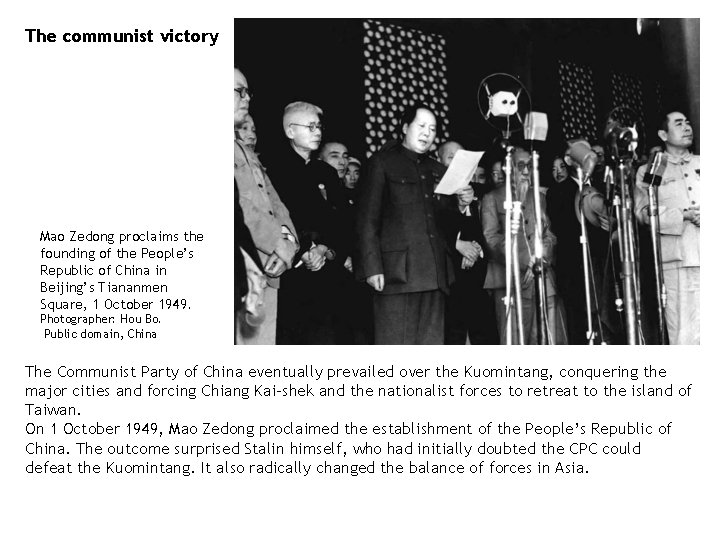
The communist victory Mao Zedong proclaims the founding of the People’s Republic of China in Beijing’s Tiananmen Square, 1 October 1949. Photographer: Hou Bo. Public domain, China The Communist Party of China eventually prevailed over the Kuomintang, conquering the major cities and forcing Chiang Kai-shek and the nationalist forces to retreat to the island of Taiwan. On 1 October 1949, Mao Zedong proclaimed the establishment of the People’s Republic of China. The outcome surprised Stalin himself, who had initially doubted the CPC could defeat the Kuomintang. It also radically changed the balance of forces in Asia.
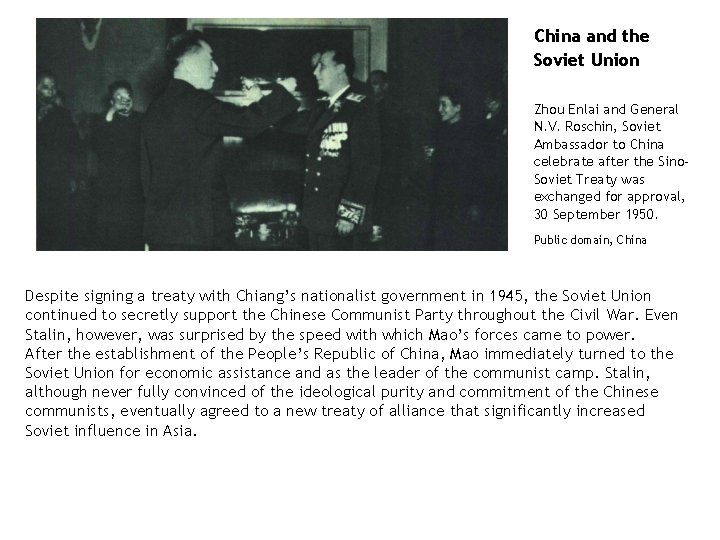
China and the Soviet Union Zhou Enlai and General N. V. Roschin, Soviet Ambassador to China celebrate after the Sino. Soviet Treaty was exchanged for approval, 30 September 1950. Public domain, China Despite signing a treaty with Chiang’s nationalist government in 1945, the Soviet Union continued to secretly support the Chinese Communist Party throughout the Civil War. Even Stalin, however, was surprised by the speed with which Mao’s forces came to power. After the establishment of the People’s Republic of China, Mao immediately turned to the Soviet Union for economic assistance and as the leader of the communist camp. Stalin, although never fully convinced of the ideological purity and commitment of the Chinese communists, eventually agreed to a new treaty of alliance that significantly increased Soviet influence in Asia.
“Up to now the principal and fundamental experience the Chinese people have gained is twofold: […] Externally, unite in a common struggle with those nations of the world which treat us as equals and unite with the peoples of all countries. That is, ally ourselves with the Soviet Union, with the People's Democracies and with the proletariat and the broad masses of the people in all other countries, and form an international united front. […] The forty years' experience of Sun Yat-sen and the twenty -eight years' experience of the Communist Party have taught us to lean to one side, and we are firmly convinced that in order to win victory and consolidate it we must lean to one side… Sitting on the fence will not do, nor is there a third road. We oppose the Chiang Kai-shek reactionaries who lean to the side of imperialism, and we also oppose the illusions about a third road. […] "Victory is possible even without international help. " This is a mistaken idea. In the epoch in which imperialism exists, it is impossible for a genuine people's revolution to win victory in any country without various forms of help from the international revolutionary forces, and even if victory were won, it could not be consolidated…” China and the Soviet Union During the final months of the Civil War, Western observers had hoped that a communist China would not align itself closely with the USSR, but would pursue a more autonomous path like Yugoslavia in Europe. However, in a speech on 30 June 1949, Mao announced that the policy of the new Chinese republic would be to “lean to one side”, i. e. to establish closer ties with the Soviet Union. Mao presented a world divided between the camps of “socialism” and “imperialism”, and claimed that little compromise was possible between the two. Mao Zedong, ‘On the people’s democratic dictatorship’, 30 June 1949. Source: Cold War International History Project (CWIHP), Wilson Center.
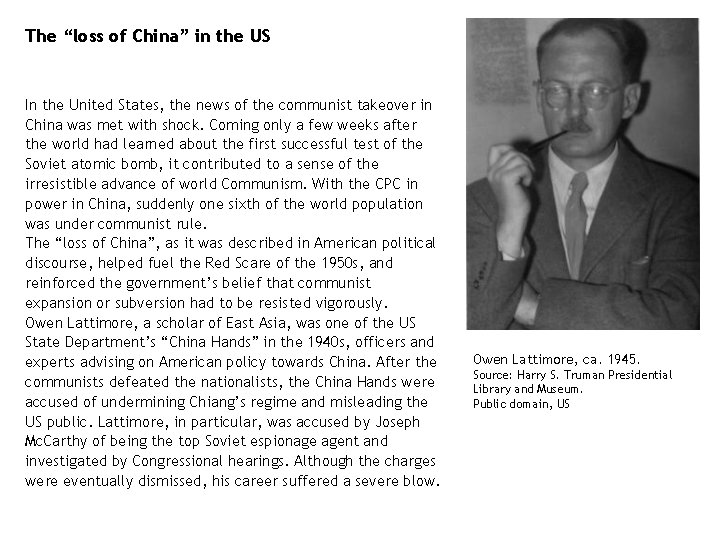
The “loss of China” in the US In the United States, the news of the communist takeover in China was met with shock. Coming only a few weeks after the world had learned about the first successful test of the Soviet atomic bomb, it contributed to a sense of the irresistible advance of world Communism. With the CPC in power in China, suddenly one sixth of the world population was under communist rule. The “loss of China”, as it was described in American political discourse, helped fuel the Red Scare of the 1950 s, and reinforced the government’s belief that communist expansion or subversion had to be resisted vigorously. Owen Lattimore, a scholar of East Asia, was one of the US State Department’s “China Hands” in the 1940 s, officers and experts advising on American policy towards China. After the communists defeated the nationalists, the China Hands were accused of undermining Chiang’s regime and misleading the US public. Lattimore, in particular, was accused by Joseph Mc. Carthy of being the top Soviet espionage agent and investigated by Congressional hearings. Although the charges were eventually dismissed, his career suffered a severe blow. Owen Lattimore, ca. 1945. Source: Harry S. Truman Presidential Library and Museum. Public domain, US
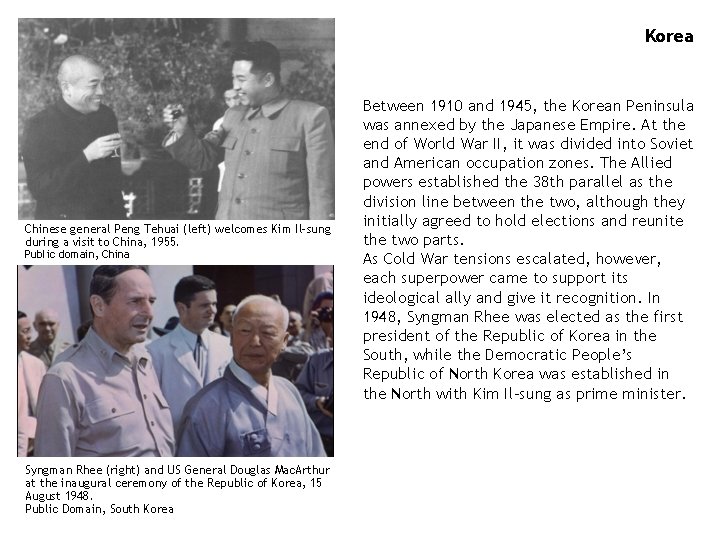
Korea Chinese general Peng Tehuai (left) welcomes Kim Il-sung during a visit to China, 1955. Public domain, China Syngman Rhee (right) and US General Douglas Mac. Arthur at the inaugural ceremony of the Republic of Korea, 15 August 1948. Public Domain, South Korea Between 1910 and 1945, the Korean Peninsula was annexed by the Japanese Empire. At the end of World War II, it was divided into Soviet and American occupation zones. The Allied powers established the 38 th parallel as the division line between the two, although they initially agreed to hold elections and reunite the two parts. As Cold War tensions escalated, however, each superpower came to support its ideological ally and give it recognition. In 1948, Syngman Rhee was elected as the first president of the Republic of Korea in the South, while the Democratic People’s Republic of North Korea was established in the North with Kim Il-sung as prime minister.
Stalin on the Korean situation “In conversations in the Kremlin with Kim Il. Sung in April 1950, Stalin gave four reasons to support his conclusion that the international environment had ‘changed sufficiently to permit a more active stance on the unification of Korea. ’ The first reason was ‘the significant strengthening of the socialist camp in the East: the victory of the Chinese revolution, the signing of an alliance between the USSR and the PRC [People’s Republic of China], and the USSR’s acquisition of an atomic bomb. ’ The second reason concerned ‘the obvious weakness of the reactionary camp [as seen in]: the shameful defeat of America’s intervention into Chinese affairs, Western troubles in Southeast Asia, and the inability of the South Korean regime and its American masters to improve the social, economic, and political situation in South Korea. ’” The DPRK Report (Moscow), no. 23 (Mar. -Apr. 2000). Quoted in Hanhimäki and Westad, The Cold War, pp. 185 -86. Until 1950, both Stalin and Truman had been more reluctant than their allies to engage in an all-out conflict to overthrow the opponent’s regime in Korea. In early 1950, however, Stalin changed his mind and gave the go-ahead to the North Koreans to attack the South. It is likely that the Soviet leader believed that the Communist takeover in China had significantly shifted the balance in Asia, and was not sure that the US would intervene to protect South Korea. The source on the left provides a summary of Stalin’s conversation with Kim given by a Russian journal with access to the archives.
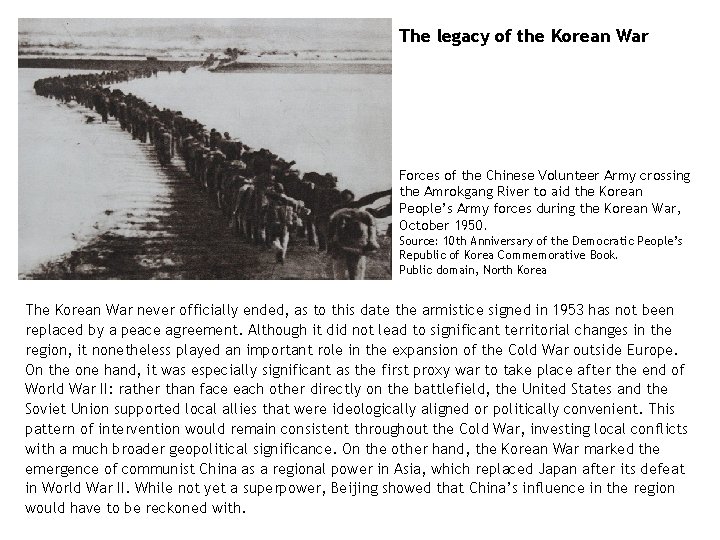
The legacy of the Korean War Forces of the Chinese Volunteer Army crossing the Amrokgang River to aid the Korean People’s Army forces during the Korean War, October 1950. Source: 10 th Anniversary of the Democratic People’s Republic of Korea Commemorative Book. Public domain, North Korea The Korean War never officially ended, as to this date the armistice signed in 1953 has not been replaced by a peace agreement. Although it did not lead to significant territorial changes in the region, it nonetheless played an important role in the expansion of the Cold War outside Europe. On the one hand, it was especially significant as the first proxy war to take place after the end of World War II: rather than face each other directly on the battlefield, the United States and the Soviet Union supported local allies that were ideologically aligned or politically convenient. This pattern of intervention would remain consistent throughout the Cold War, investing local conflicts with a much broader geopolitical significance. On the other hand, the Korean War marked the emergence of communist China as a regional power in Asia, which replaced Japan after its defeat in World War II. While not yet a superpower, Beijing showed that China’s influence in the region would have to be reckoned with.
US policy of covert actions In 1953, Dwight D. Eisenhower replaced Harry Truman as US President after a campaign in which he had criticised the Democrats’ foreign policy as ineffective and weak on communism. An important element of his new administration was thus a fundamental change in American foreign policy, which included among other things the use of nuclear weapons as a deterrent. In addition, Eisenhower and his Secretary of State, John Foster Dulles, relied increasingly on covert actions carried out by the Central Intelligence Agency (CIA) abroad. Such a policy allowed the US government to counter alleged communist expansion through a wider range of methods ― including illegal ones ― without having to take responsibility for them publicly. Two early instances of US covert actions were in Iran and Guatemala, in both cases to carry out coups to replace heads of government that were perceived to be dangerously sympathetic to communism. While the coups were successful, their long-term consequences were to damage significantly the reputation of the United States, not only in Asia and Latin America but generally throughout the developing countries and among left-leaning political and social movements.
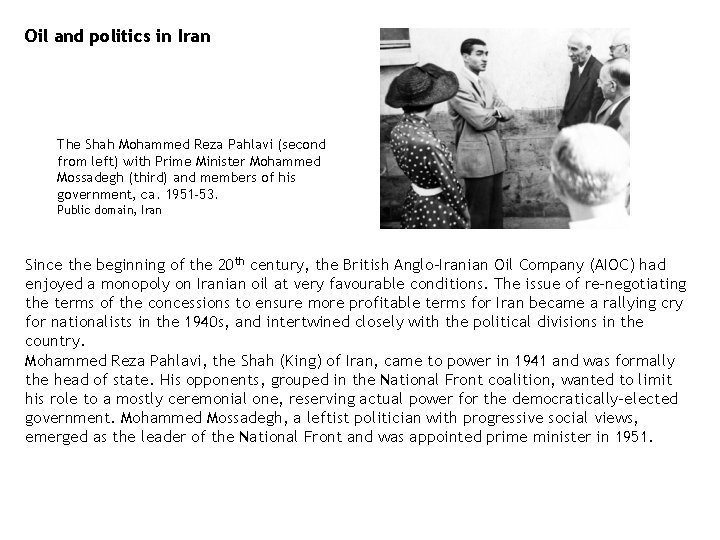
Oil and politics in Iran The Shah Mohammed Reza Pahlavi (second from left) with Prime Minister Mohammed Mossadegh (third) and members of his government, ca. 1951 -53. Public domain, Iran Since the beginning of the 20 th century, the British Anglo-Iranian Oil Company (AIOC) had enjoyed a monopoly on Iranian oil at very favourable conditions. The issue of re-negotiating the terms of the concessions to ensure more profitable terms for Iran became a rallying cry for nationalists in the 1940 s, and intertwined closely with the political divisions in the country. Mohammed Reza Pahlavi, the Shah (King) of Iran, came to power in 1941 and was formally the head of state. His opponents, grouped in the National Front coalition, wanted to limit his role to a mostly ceremonial one, reserving actual power for the democratically-elected government. Mohammed Mossadegh, a leftist politician with progressive social views, emerged as the leader of the National Front and was appointed prime minister in 1951.
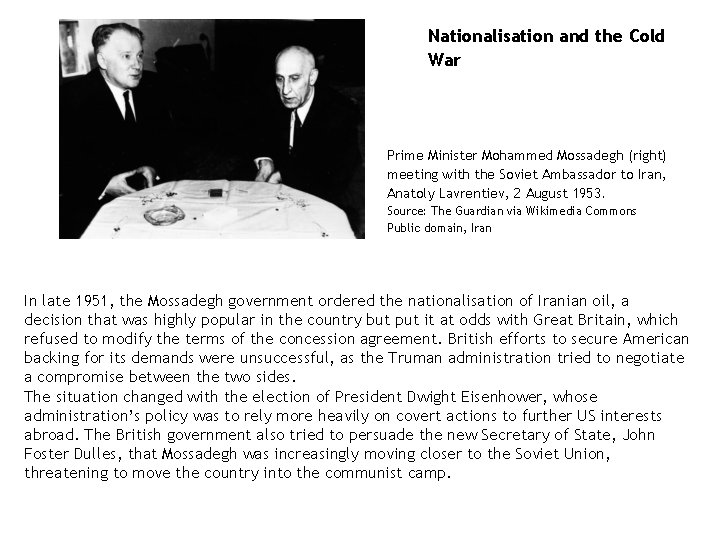
Nationalisation and the Cold War Prime Minister Mohammed Mossadegh (right) meeting with the Soviet Ambassador to Iran, Anatoly Lavrentiev, 2 August 1953. Source: The Guardian via Wikimedia Commons Public domain, Iran In late 1951, the Mossadegh government ordered the nationalisation of Iranian oil, a decision that was highly popular in the country but put it at odds with Great Britain, which refused to modify the terms of the concession agreement. British efforts to secure American backing for its demands were unsuccessful, as the Truman administration tried to negotiate a compromise between the two sides. The situation changed with the election of President Dwight Eisenhower, whose administration’s policy was to rely more heavily on covert actions to further US interests abroad. The British government also tried to persuade the new Secretary of State, John Foster Dulles, that Mossadegh was increasingly moving closer to the Soviet Union, threatening to move the country into the communist camp.
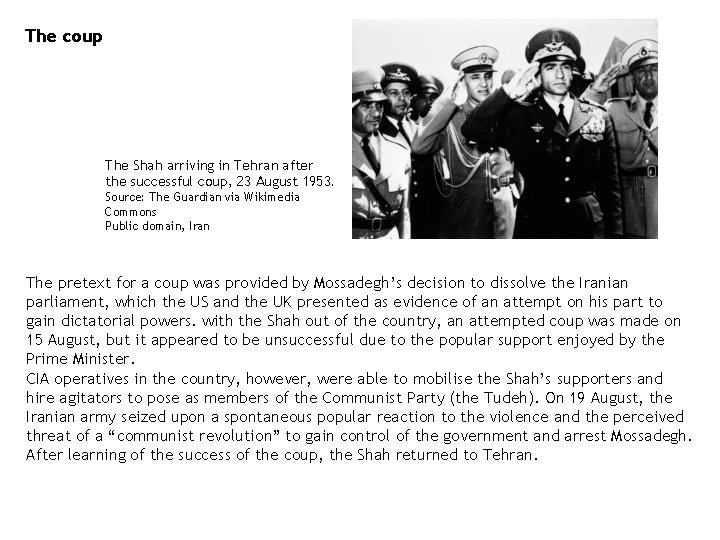
The coup The Shah arriving in Tehran after the successful coup, 23 August 1953. Source: The Guardian via Wikimedia Commons Public domain, Iran The pretext for a coup was provided by Mossadegh’s decision to dissolve the Iranian parliament, which the US and the UK presented as evidence of an attempt on his part to gain dictatorial powers. with the Shah out of the country, an attempted coup was made on 15 August, but it appeared to be unsuccessful due to the popular support enjoyed by the Prime Minister. CIA operatives in the country, however, were able to mobilise the Shah’s supporters and hire agitators to pose as members of the Communist Party (the Tudeh). On 19 August, the Iranian army seized upon a spontaneous popular reaction to the violence and the perceived threat of a “communist revolution” to gain control of the government and arrest Mossadegh. After learning of the success of the coup, the Shah returned to Tehran.
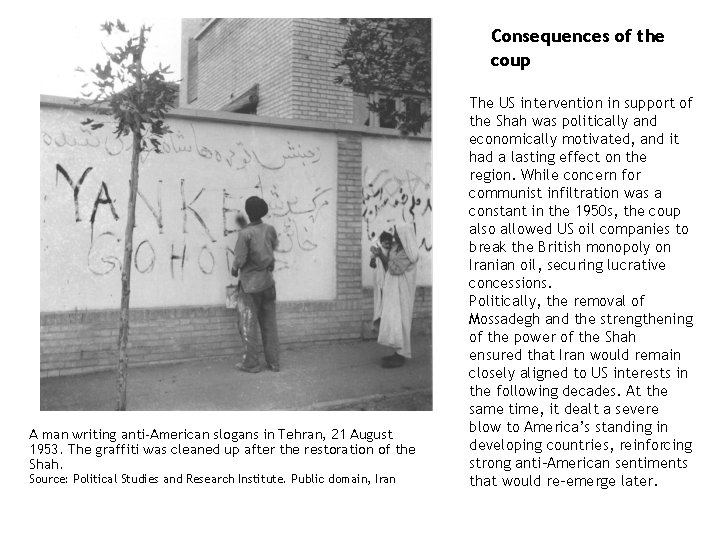
Consequences of the coup A man writing anti-American slogans in Tehran, 21 August 1953. The graffiti was cleaned up after the restoration of the Shah. Source: Political Studies and Research Institute. Public domain, Iran The US intervention in support of the Shah was politically and economically motivated, and it had a lasting effect on the region. While concern for communist infiltration was a constant in the 1950 s, the coup also allowed US oil companies to break the British monopoly on Iranian oil, securing lucrative concessions. Politically, the removal of Mossadegh and the strengthening of the power of the Shah ensured that Iran would remain closely aligned to US interests in the following decades. At the same time, it dealt a severe blow to America’s standing in developing countries, reinforcing strong anti-American sentiments that would re-emerge later.
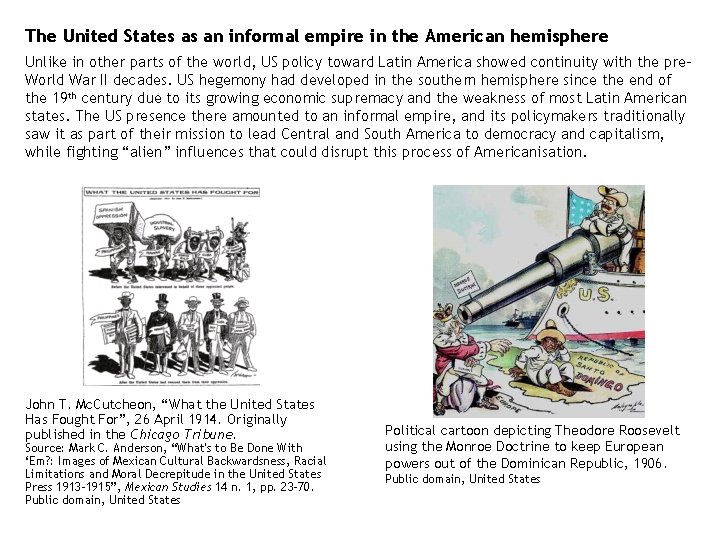
The United States as an informal empire in the American hemisphere Unlike in other parts of the world, US policy toward Latin America showed continuity with the pre. World War II decades. US hegemony had developed in the southern hemisphere since the end of the 19 th century due to its growing economic supremacy and the weakness of most Latin American states. The US presence there amounted to an informal empire, and its policymakers traditionally saw it as part of their mission to lead Central and South America to democracy and capitalism, while fighting “alien” influences that could disrupt this process of Americanisation. John T. Mc. Cutcheon, “What the United States Has Fought For”, 26 April 1914. Originally published in the Chicago Tribune. Source: Mark C. Anderson, “What's to Be Done With ‘Em? : Images of Mexican Cultural Backwardsness, Racial Limitations and Moral Decrepitude in the United States Press 1913 -1915”, Mexican Studies 14 n. 1, pp. 23 -70. Public domain, United States Political cartoon depicting Theodore Roosevelt using the Monroe Doctrine to keep European powers out of the Dominican Republic, 1906. Public domain, United States
“Nevertheless, as things stand today, the activities of the Communists represent our most serious problem in the area. They have progressed to a point where they must be regarded as an urgent, major problem; and a correct understanding of their significance is basic to an understanding of the other phases of our policy problems. […] Here, as elsewhere, the inner core of the Communist leadership is fanatical, disciplined, industrious, and armed with a series of organizational techniques which are absolutely first rate. […] Their present aim, after all, is the destruction of American influence in this part of the world, and the conversion of the Latin American peoples into a hotbed of hostility and trouble for the United States. […] We cannot be too dogmatic about the methods by which local Communists can be dealt with (…) where the concepts and traditions of popular government are too weak to absorb successfully the intensity of the Communist attack, then we must concede that harsh governmental measures of repression may be the only answer; that these measures may have to proceed from regimes whose origins and methods would not stand the test of American concepts of democratic procedure; and that such regimes and such methods may be preferable alternatives, and indeed the only alternatives, to further Communist successes. ” Memorandum by the Counselor of the Department (Kennan) to the Secretary of State, 29 March 1950. Foreign Relations of the United States, 1950. Vol. II, pp. 598 -624. Kennan on US policies in Latin America In a memorandum written after touring the continent, George Kennan laid out his views on the challenges facing US policy in Latin America. While acknowledging that local communists had looser ties to Moscow than European ones, Kennan viewed their influence as potentially disastrous, and offered a rationale for supporting less than democratic operations and regimes.
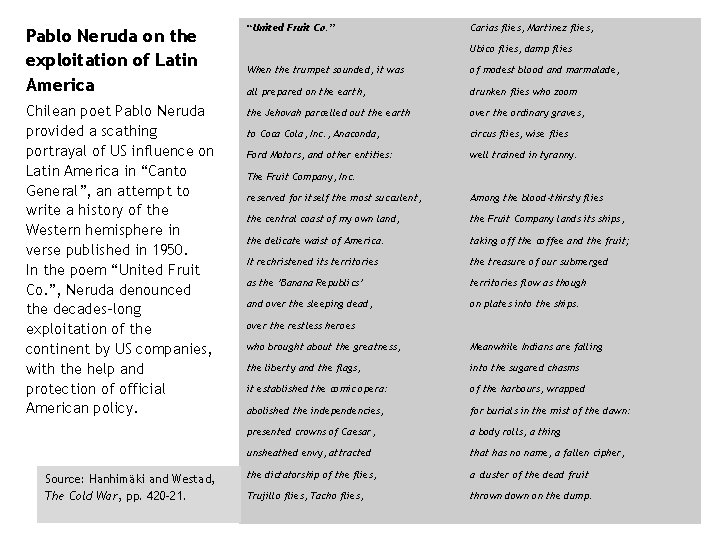
Pablo Neruda on the exploitation of Latin America “United Fruit Co. ” Chilean poet Pablo Neruda provided a scathing portrayal of US influence on Latin America in “Canto General”, an attempt to write a history of the Western hemisphere in verse published in 1950. In the poem “United Fruit Co. ”, Neruda denounced the decades-long exploitation of the continent by US companies, with the help and protection of official American policy. Source: Hanhimäki and Westad, The Cold War, pp. 420 -21. Carias flies, Martinez flies, Ubico flies, damp flies When the trumpet sounded, it was of modest blood and marmalade, all prepared on the earth, drunken flies who zoom the Jehovah parcelled out the earth over the ordinary graves, to Coca Cola, Inc. , Anaconda, circus flies, wise flies Ford Motors, and other entities: well trained in tyranny. The Fruit Company, Inc. reserved for itself the most succulent, Among the blood-thirsty flies the central coast of my own land, the Fruit Company lands its ships, the delicate waist of America. taking off the coffee and the fruit; It rechristened its territories the treasure of our submerged as the ’Banana Republics’ territories flow as though and over the sleeping dead, on plates into the ships. over the restless heroes who brought about the greatness, Meanwhile Indians are falling the liberty and the flags, into the sugared chasms it established the comic opera: of the harbours, wrapped abolished the independencies, for burials in the mist of the dawn: presented crowns of Caesar, a body rolls, a thing unsheathed envy, attracted that has no name, a fallen cipher, the dictatorship of the flies, a cluster of the dead fruit Trujillo flies, Tacho flies, thrown down on the dump.
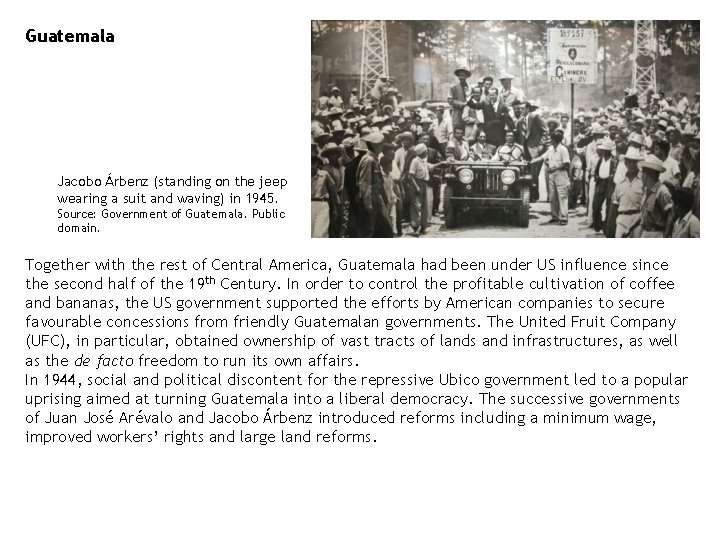
Guatemala Jacobo Árbenz (standing on the jeep wearing a suit and waving) in 1945. Source: Government of Guatemala. Public domain. Together with the rest of Central America, Guatemala had been under US influence since the second half of the 19 th Century. In order to control the profitable cultivation of coffee and bananas, the US government supported the efforts by American companies to secure favourable concessions from friendly Guatemalan governments. The United Fruit Company (UFC), in particular, obtained ownership of vast tracts of lands and infrastructures, as well as the de facto freedom to run its own affairs. In 1944, social and political discontent for the repressive Ubico government led to a popular uprising aimed at turning Guatemala into a liberal democracy. The successive governments of Juan José Arévalo and Jacobo Árbenz introduced reforms including a minimum wage, improved workers’ rights and large land reforms.
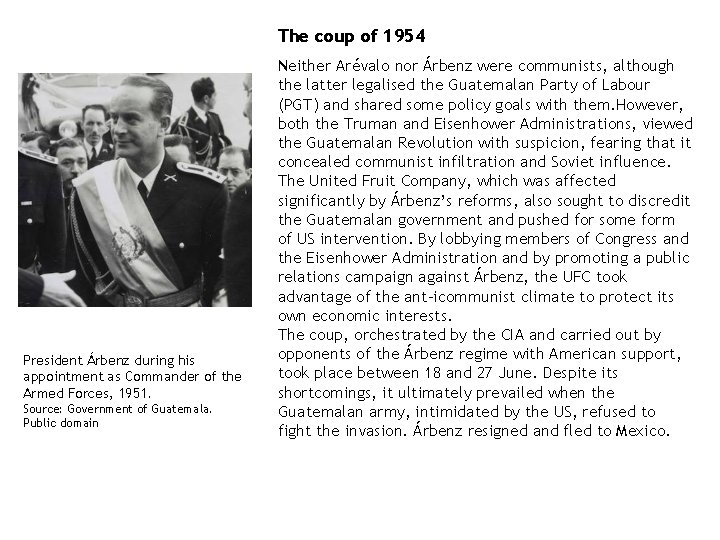
The coup of 1954 President Árbenz during his appointment as Commander of the Armed Forces, 1951. Source: Government of Guatemala. Public domain Neither Arévalo nor Árbenz were communists, although the latter legalised the Guatemalan Party of Labour (PGT) and shared some policy goals with them. However, both the Truman and Eisenhower Administrations, viewed the Guatemalan Revolution with suspicion, fearing that it concealed communist infiltration and Soviet influence. The United Fruit Company, which was affected significantly by Árbenz’s reforms, also sought to discredit the Guatemalan government and pushed for some form of US intervention. By lobbying members of Congress and the Eisenhower Administration and by promoting a public relations campaign against Árbenz, the UFC took advantage of the ant-icommunist climate to protect its own economic interests. The coup, orchestrated by the CIA and carried out by opponents of the Árbenz regime with American support, took place between 18 and 27 June. Despite its shortcomings, it ultimately prevailed when the Guatemalan army, intimidated by the US, refused to fight the invasion. Árbenz resigned and fled to Mexico.
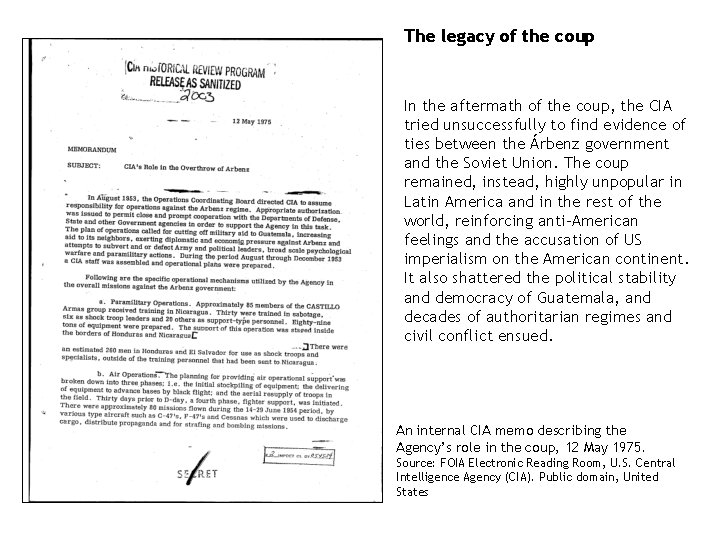
The legacy of the coup In the aftermath of the coup, the CIA tried unsuccessfully to find evidence of ties between the Árbenz government and the Soviet Union. The coup remained, instead, highly unpopular in Latin America and in the rest of the world, reinforcing anti-American feelings and the accusation of US imperialism on the American continent. It also shattered the political stability and democracy of Guatemala, and decades of authoritarian regimes and civil conflict ensued. An internal CIA memo describing the Agency’s role in the coup, 12 May 1975. Source: FOIA Electronic Reading Room, U. S. Central Intelligence Agency (CIA). Public domain, United States
Arevalo on American imperialism In the aftermath of the coup, Juan José Arévalo, Árbenz’s predecessor, expressed his frustration with and criticism of US policy in Latin America. Pointing to the violations of sovereignty to preserve US economic and political interests, he wrote that “international treaties are a farce when they are pacted between a shark and a Sardine”. Juan Jose Arevalo, The Shark and the Sardines, trans. June Cobb and Raul Osegueda (New York: L. Stuart, 1961 [1956]), pp. 9 -13. “The government descended to become a simple entrepreneur for business and protector of illicit commercial profits (…) The new instrument of persuasion was the cannon. Now the United States (…) was neither a religious state nor a juridic state but, rather, a mercantile state―a gigantic mercantile society with all the apparatus of a great world power (…) The immediate victim was Latin America. To the North American millionaires converted into government, Latin America appeared as easy prey, a ‘big business’. The inhabitants of this part of the world came to be looked upon as international braceros [farm workers]. The multiple-faceted exploitation was carried out with intelligence, with shrewdness, with the precision of clockwork, with ‘scientific’ coldness, with harshness and with great arrogance. From the South the river of millions began to flow Northward and every year it increased. The United States became great while progress in Latin America was brought to a halt. And when anything or anyone tried to interfere with the bankers of the companies, use was made of the Marines. […] The North American example has been disastrous to us and has horrified us. We know that a government intimately linked to business and receiving favour from business loses its capacity to strive for the greatest possible happiness for the greatest number of its people. When businessmen are converted into governors, it is no longer possible to speak of social justice; and even the minimum and superficial ‘justice’ of the common courts is corrupted. ”
The mid-1950 s On 5 March 1953, Joseph Stalin died after almost thirty years of near absolute power over the Soviet Union. In the power struggle among Soviet leaders that ensued, Nikita Khrushchev emerged as the eventual primus inter pares in Moscow. The years after Stalin’s death are sometimes referred to as the “Khrushchev thaw”, due to the fact that the two blocs eased the tensions that had characterised the early years of the Cold War. Outside Europe, however, the competition between the United States and the Soviet Union for geopolitical supremacy continued unabated. Soviet policy after Stalin saw a significant shift, as the new leaders in the Kremlin now looked more favourably on those newly independent states that pursued nationalist ― even though not strictly socialist ― policies. The United States under Eisenhower and Dulles promoted instead the creation of multilateral regional alliances, modelled on NATO and largely based on a shared anticommunism. Despite the continuing strength of the Cold War bipolar logic, the mid-1950 s also witnessed the birth of a movement that challenged the assumed need for post-colonial countries to adhere to a rigid division of the world in to two, and tried to offer another alternative to developing countries.
Soviet policy toward the Third World Until his death, Stalin remained sceptical about the possibility of local Communist Parties successfully carrying out a revolution. But, his approach was not shared by the Soviet leaders that succeeded him after 1953. Nikita Khrushchev, who emerged in the mid 1950 s as the undisputed winner of the power struggles in the Kremlin, pushed forward a new strategy to increase Soviet influence in the Third World. Unlike Stalin, Khrushchev stressed the USSR’s willingness to establish friendly relations not only with self-declared socialist regimes, but also with radical bourgeois ones like Indonesia, Egypt and India. The Soviet Union now declared itself willing to contribute in economic and military terms to their “national development” against the common enemies of colonialism and imperialism. “As he solidified his grip on power within the Soviet state, Khrushchev attacked Stalin’s policies toward Asia, Africa, and Latin America in two different directions. On the one hand, [Stalin] had neglected the Third World, by focusing too narrowly on those national-bourgeois movements that by themselves had sought friendship and cooperation with the Soviet Union, and by not attempting “actively” to forge links with others. On the other hand, Stalin had failed to see that transitions to socialism could take many different forms, and that more assistance to Third World workers’ parties was needed, even if some of these parties had no chance of gaining power on their own in the short run. Odd Arne Westad, The Global Cold War, pp. 6768.
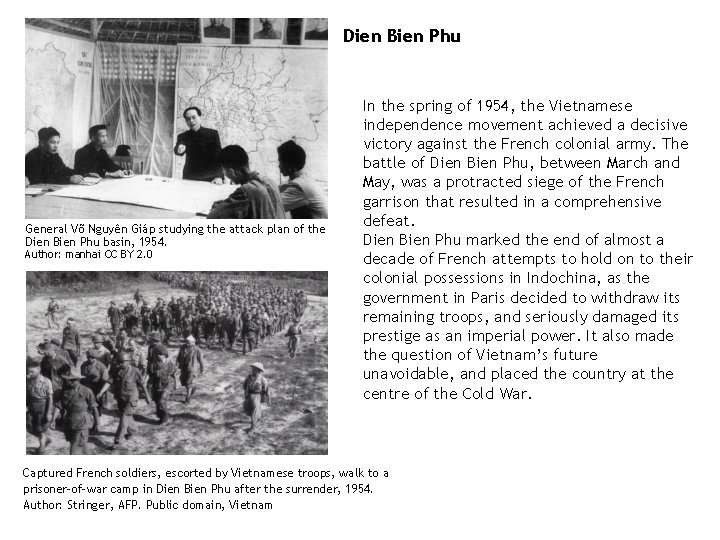
Dien Bien Phu General Võ Nguyên Giáp studying the attack plan of the Dien Bien Phu basin, 1954. Author: manhai CC BY 2. 0 In the spring of 1954, the Vietnamese independence movement achieved a decisive victory against the French colonial army. The battle of Dien Bien Phu, between March and May, was a protracted siege of the French garrison that resulted in a comprehensive defeat. Dien Bien Phu marked the end of almost a decade of French attempts to hold on to their colonial possessions in Indochina, as the government in Paris decided to withdraw its remaining troops, and seriously damaged its prestige as an imperial power. It also made the question of Vietnam’s future unavoidable, and placed the country at the centre of the Cold War. Captured French soldiers, escorted by Vietnamese troops, walk to a prisoner-of-war camp in Dien Bien Phu after the surrender, 1954. Author: Stringer, AFP. Public domain, Vietnam
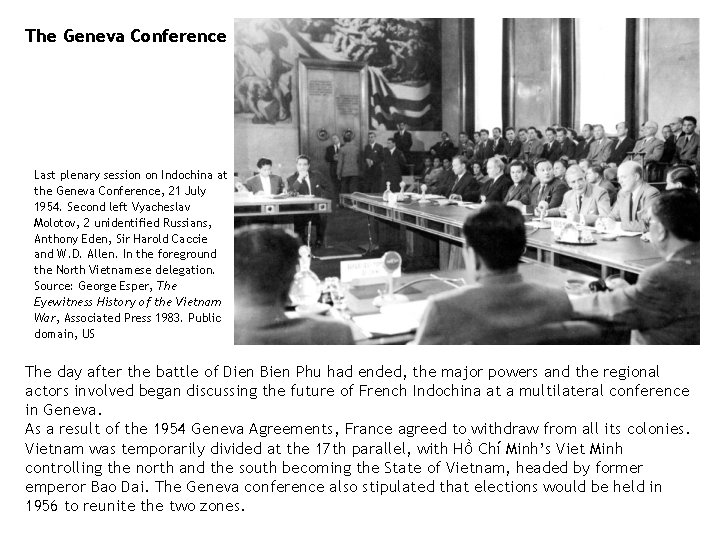
The Geneva Conference Last plenary session on Indochina at the Geneva Conference, 21 July 1954. Second left Vyacheslav Molotov, 2 unidentified Russians, Anthony Eden, Sir Harold Caccie and W. D. Allen. In the foreground the North Vietnamese delegation. Source: George Esper, The Eyewitness History of the Vietnam War, Associated Press 1983. Public domain, US The day after the battle of Dien Bien Phu had ended, the major powers and the regional actors involved began discussing the future of French Indochina at a multilateral conference in Geneva. As a result of the 1954 Geneva Agreements, France agreed to withdraw from all its colonies. Vietnam was temporarily divided at the 17 th parallel, with Hồ Chí Minh’s Viet Minh controlling the north and the south becoming the State of Vietnam, headed by former emperor Bao Dai. The Geneva conference also stipulated that elections would be held in 1956 to reunite the two zones.
“If Indochina falls, Thailand is put in an almost impossible situation. The same is true of Malaya with its rubber and tin. The same is true of Indonesia. If Indochina goes under Communist domination the whole of Southeast Asia will be threatened and that means that the economic and military security of Japan will be inevitably endangered also. ” Vice President Richard M. Nixon, Date: December 1953 Source: Robert D. Schulzinger, A Time for War: The United States and Vietnam, 1941 -1975 (Oxford: Oxford University Press, 1997), p. 58 “Finally, you have broader considerations that might follow what you would call the "falling domino" principle. You have a row of dominoes set up, you knock over the first one, and what will happen to the last one is the certainty that it will go over very quickly. So you could have a beginning of a disintegration that would have the most profound influences. ” Dwight D. Eisenhower, Press Conference, 7 April 1954. Source: The American Presidency Project, University of California, Santa Barbara. American involvement and the “domino theory” The United States, which had provided military assistance to France, had also intentionally refrained from direct intervention. The disappearance of French influence from Indochina, however, generated concerns in Washington about further communist expansion in the region. American policymakers had subscribed to the “domino theory”, which stated that failing to stop the spread of Communism in one country would inevitably endanger its neighbours. The US thus responded to the French withdrawal by gradually increasing its support for the regime in South Vietnam, sending both economic aid and military advisers. It thus laid the premises of further involvement, which would escalate in the following decades and culminate with the Vietnam War.
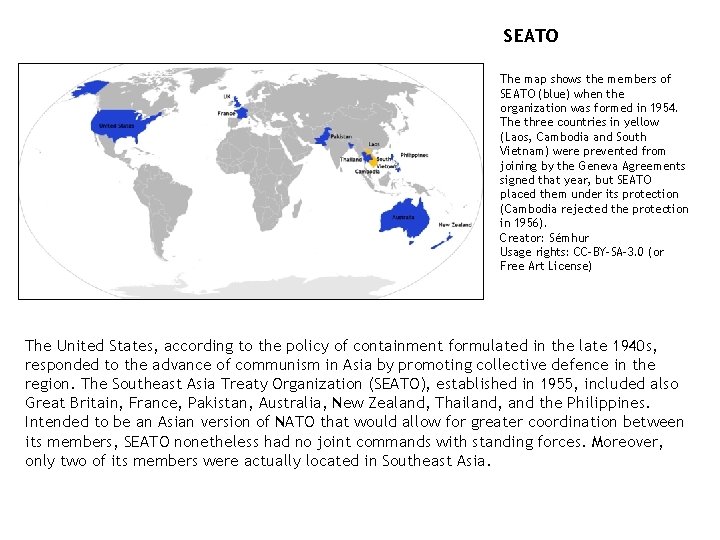
SEATO The map shows the members of SEATO (blue) when the organization was formed in 1954. The three countries in yellow (Laos, Cambodia and South Vietnam) were prevented from joining by the Geneva Agreements signed that year, but SEATO placed them under its protection (Cambodia rejected the protection in 1956). Creator: Sémhur Usage rights: CC-BY-SA-3. 0 (or Free Art License) The United States, according to the policy of containment formulated in the late 1940 s, responded to the advance of communism in Asia by promoting collective defence in the region. The Southeast Asia Treaty Organization (SEATO), established in 1955, included also Great Britain, France, Pakistan, Australia, New Zealand, Thailand, and the Philippines. Intended to be an Asian version of NATO that would allow for greater coordination between its members, SEATO nonetheless had no joint commands with standing forces. Moreover, only two of its members were actually located in Southeast Asia.
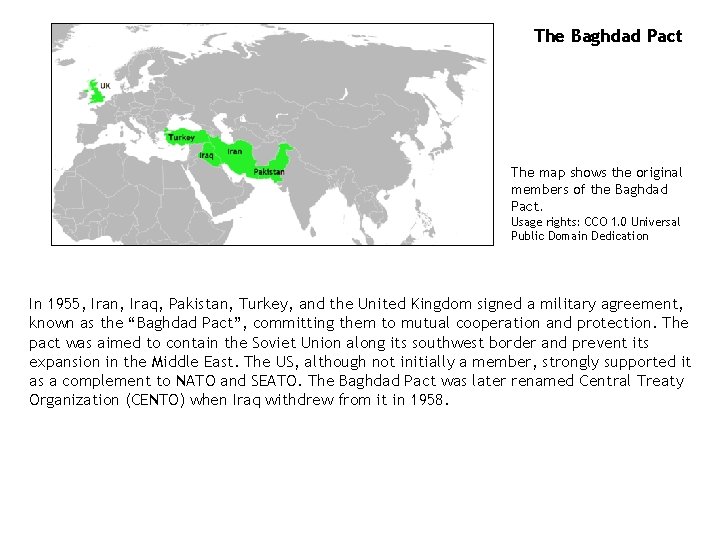
The Baghdad Pact The map shows the original members of the Baghdad Pact. Usage rights: CCO 1. 0 Universal Public Domain Dedication In 1955, Iran, Iraq, Pakistan, Turkey, and the United Kingdom signed a military agreement, known as the “Baghdad Pact”, committing them to mutual cooperation and protection. The pact was aimed to contain the Soviet Union along its southwest border and prevent its expansion in the Middle East. The US, although not initially a member, strongly supported it as a complement to NATO and SEATO. The Baghdad Pact was later renamed Central Treaty Organization (CENTO) when Iraq withdrew from it in 1958.
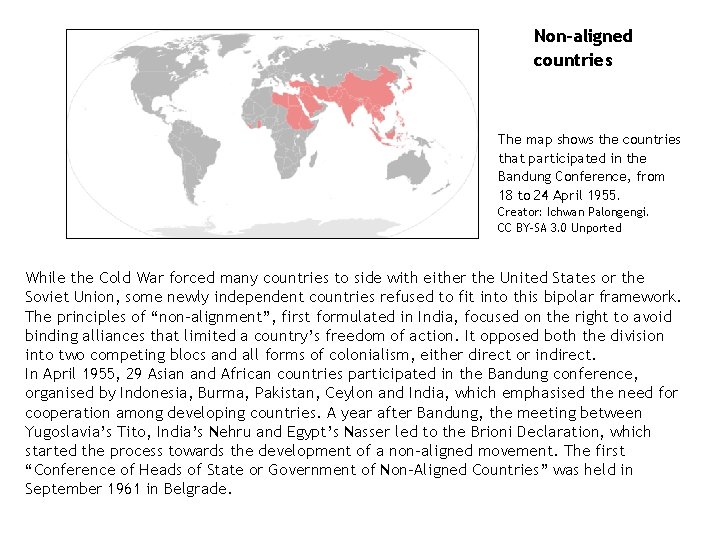
Non-aligned countries The map shows the countries that participated in the Bandung Conference, from 18 to 24 April 1955. Creator: Ichwan Palongengi. CC BY-SA 3. 0 Unported While the Cold War forced many countries to side with either the United States or the Soviet Union, some newly independent countries refused to fit into this bipolar framework. The principles of “non-alignment”, first formulated in India, focused on the right to avoid binding alliances that limited a country’s freedom of action. It opposed both the division into two competing blocs and all forms of colonialism, either direct or indirect. In April 1955, 29 Asian and African countries participated in the Bandung conference, organised by Indonesia, Burma, Pakistan, Ceylon and India, which emphasised the need for cooperation among developing countries. A year after Bandung, the meeting between Yugoslavia’s Tito, India’s Nehru and Egypt’s Nasser led to the Brioni Declaration, which started the process towards the development of a non-aligned movement. The first “Conference of Heads of State or Government of Non-Aligned Countries” was held in September 1961 in Belgrade.
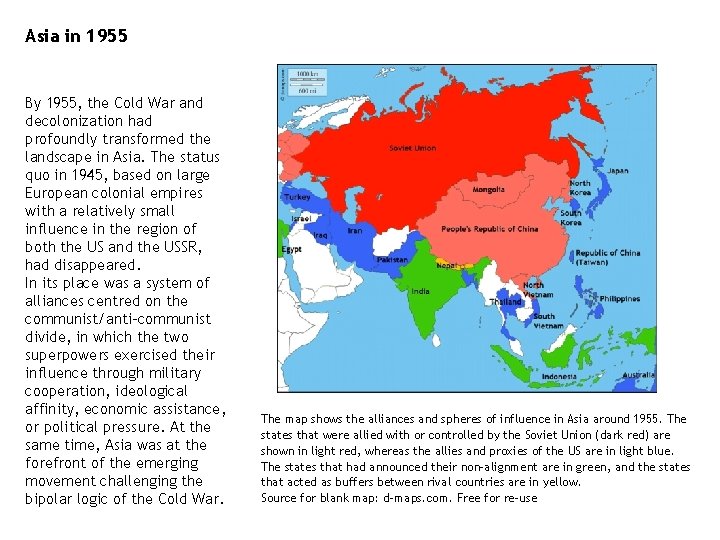
Asia in 1955 By 1955, the Cold War and decolonization had profoundly transformed the landscape in Asia. The status quo in 1945, based on large European colonial empires with a relatively small influence in the region of both the US and the USSR, had disappeared. In its place was a system of alliances centred on the communist/anti-communist divide, in which the two superpowers exercised their influence through military cooperation, ideological affinity, economic assistance, or political pressure. At the same time, Asia was at the forefront of the emerging movement challenging the bipolar logic of the Cold War. The map shows the alliances and spheres of influence in Asia around 1955. The states that were allied with or controlled by the Soviet Union (dark red) are shown in light red, whereas the allies and proxies of the US are in light blue. The states that had announced their non-alignment are in green, and the states that acted as buffers between rival countries are in yellow. Source for blank map: d-maps. com. Free for re-use
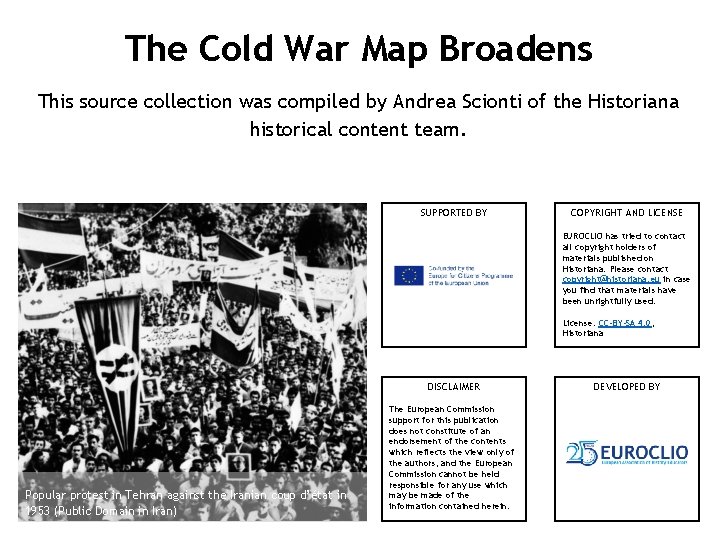
The Cold War Map Broadens This source collection was compiled by Andrea Scionti of the Historiana historical content team. SUPPORTED BY COPYRIGHT AND LICENSE EUROCLIO has tried to contact all copyright holders of materials published on Historiana. Please contact copyright@historiana. eu in case you find that materials have been unrightfully used. License: CC-BY-SA 4. 0, Historiana DISCLAIMER Popular protest in Tehran against the Iranian coup d’état in 1953 (Public Domain in Iran) The European Commission support for this publication does not constitute of an endorsement of the contents which reflects the view only of the authors, and the European Commission cannot be held responsible for any use which may be made of the information contained herein. DEVELOPED BY