Adaptive Pest Management Forecasting Insect Populations January 27
- Slides: 38
Adaptive Pest Management -Forecasting Insect Populations January 27, 2020 Russell L. Groves WI Fresh Fruit and Vegetable Conference Department of Entomology University of Wisconsin http: //labs. russell. wisc. edu/vegento/
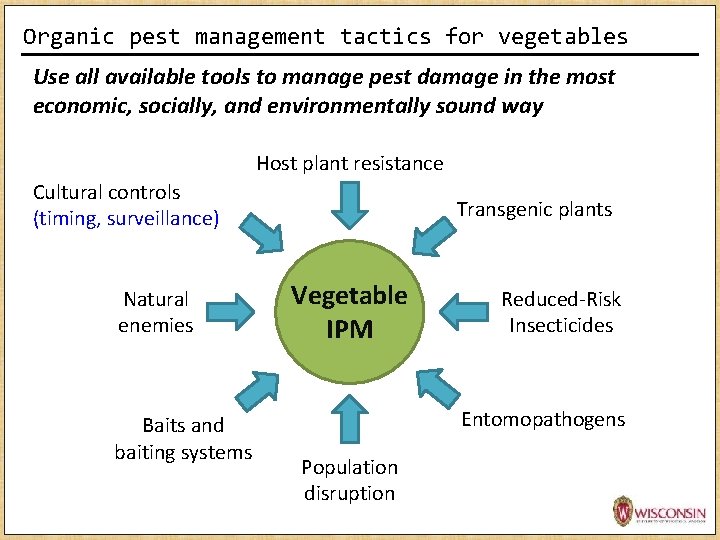
Organic pest management tactics for vegetables Use all available tools to manage pest damage in the most economic, socially, and environmentally sound way Host plant resistance Cultural controls (timing, surveillance) Natural enemies Baits and baiting systems Transgenic plants Vegetable IPM Reduced-Risk Insecticides Entomopathogens Population disruption
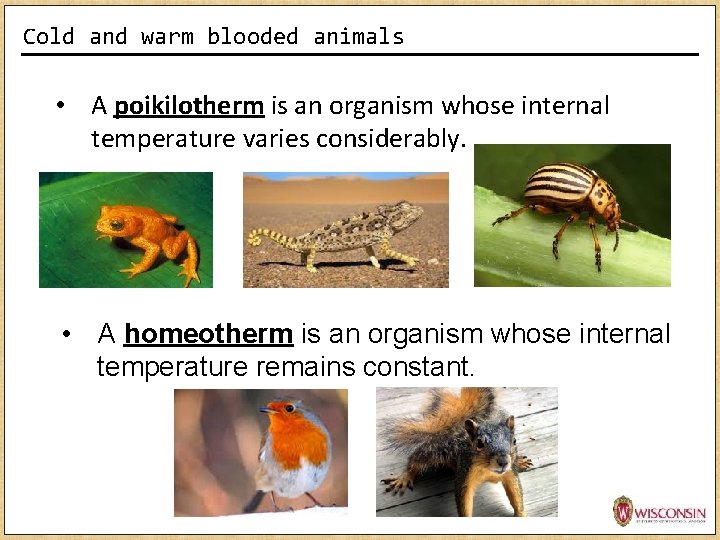
Cold and warm blooded animals • A poikilotherm is an organism whose internal temperature varies considerably. • A homeotherm is an organism whose internal temperature remains constant.
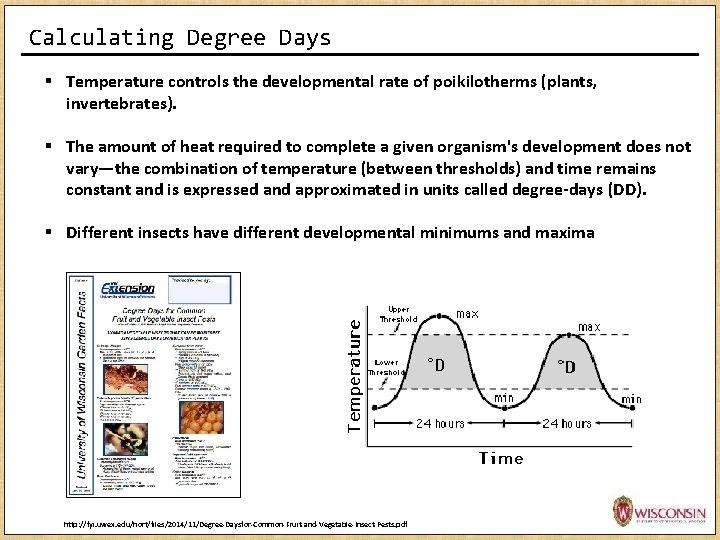
Calculating Degree Days § Temperature controls the developmental rate of poikilotherms (plants, invertebrates). § The amount of heat required to complete a given organism's development does not vary—the combination of temperature (between thresholds) and time remains constant and is expressed and approximated in units called degree-days (DD). § Different insects have different developmental minimums and maxima http: //fyi. uwex. edu/hort/files/2014/11/Degree-Daysfor-Common-Fruit-and-Vegetable-Insect-Pests. pdf
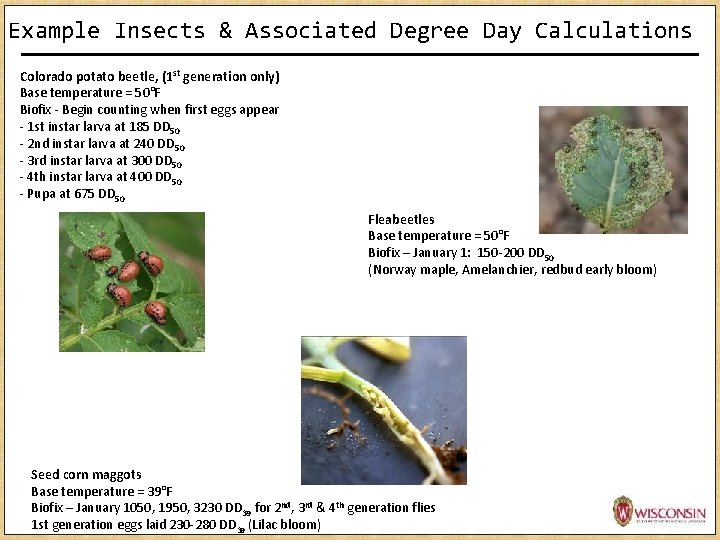
Example Insects & Associated Degree Day Calculations Colorado potato beetle, (1 st generation only) Base temperature = 50°F Biofix - Begin counting when first eggs appear - 1 st instar larva at 185 DD 50 - 2 nd instar larva at 240 DD 50 - 3 rd instar larva at 300 DD 50 - 4 th instar larva at 400 DD 50 - Pupa at 675 DD 50 Fleabeetles Base temperature = 50°F Biofix – January 1: 150 -200 DD 50 (Norway maple, Amelanchier, redbud early bloom) Seed corn maggots Base temperature = 39°F Biofix – January 1050, 1950, 3230 DD 39 for 2 nd, 3 rd & 4 th generation flies 1 st generation eggs laid 230 -280 DD 39 (Lilac bloom)
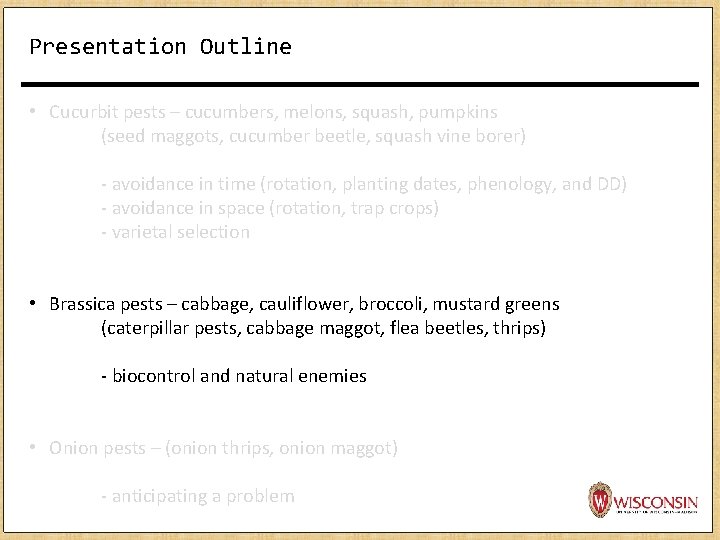
Presentation Outline • Cucurbit pests – cucumbers, melons, squash, pumpkins (seed maggots & squash vine borer) - avoidance in time (rotation, planting dates, phenology and DD) - avoidance in space (rotation, trap crops) - varietal selection • Brassica pests – cabbage, cauliflower, broccoli, mustard greens (caterpillar pests & cabbage maggot) - biocontrol and natural enemies - avoidance in time (rotation, planting dates, phenology and DD)
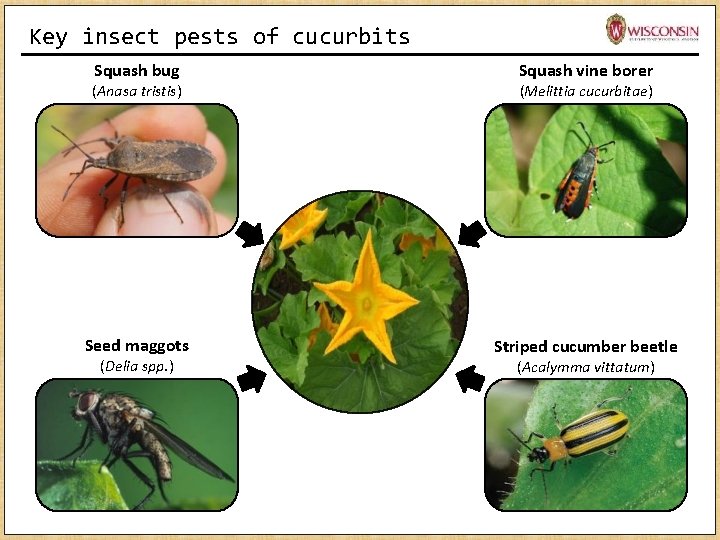
Key insect pests of cucurbits Squash bug Squash vine borer Seed maggots Striped cucumber beetle (Anasa tristis) (Delia spp. ) (Melittia cucurbitae) (Acalymma vittatum)
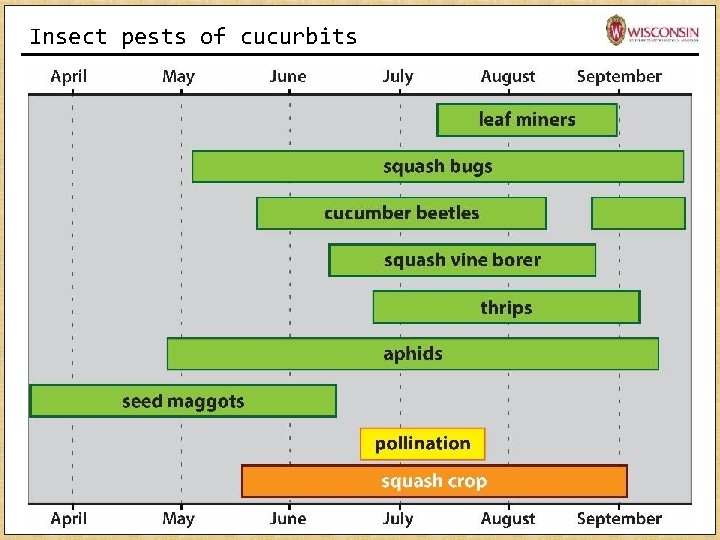
Insect pests of cucurbits
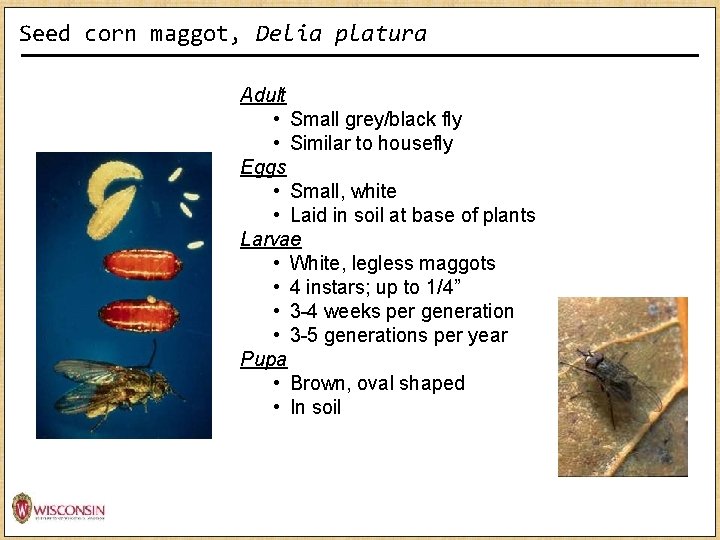
Seed corn maggot, Delia platura Adult • Small grey/black fly • Similar to housefly Eggs • Small, white • Laid in soil at base of plants Larvae • White, legless maggots • 4 instars; up to 1/4” • 3 -4 weeks per generation • 3 -5 generations per year Pupa • Brown, oval shaped • In soil
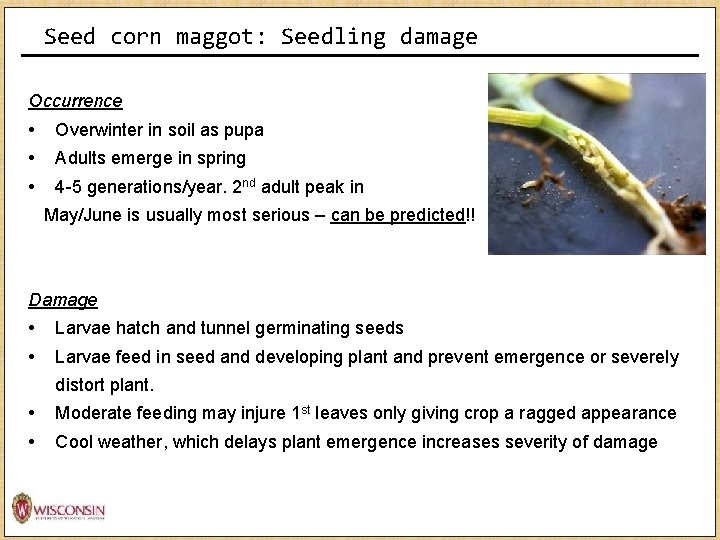
Seed corn maggot: Seedling damage Occurrence • Overwinter in soil as pupa • Adults emerge in spring • 4 -5 generations/year. 2 nd adult peak in May/June is usually most serious – can be predicted!! Damage • Larvae hatch and tunnel germinating seeds • Larvae feed in seed and developing plant and prevent emergence or severely distort plant. • Moderate feeding may injure 1 st leaves only giving crop a ragged appearance • Cool weather, which delays plant emergence increases severity of damage
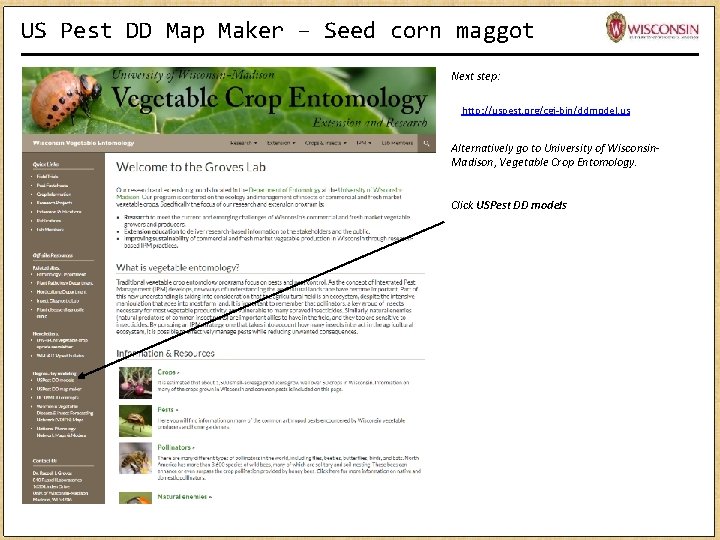
US Pest DD Map Maker – Seed corn maggot Next step: http: //uspest. org/cgi-bin/ddmodel. us Alternatively go to University of Wisconsin. Madison, Vegetable Crop Entomology. Click USPest DD models
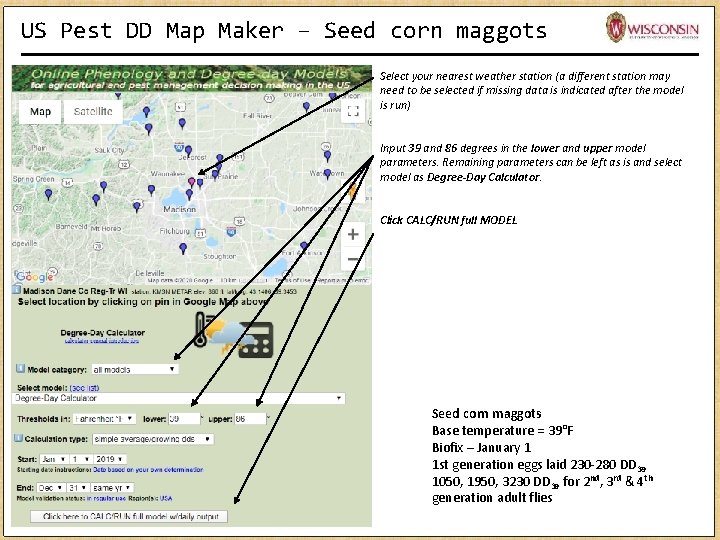
US Pest DD Map Maker – Seed corn maggots Select your nearest weather station (a different station may need to be selected if missing data is indicated after the model is run) Input 39 and 86 degrees in the lower and upper model parameters. Remaining parameters can be left as is and select model as Degree-Day Calculator. Click CALC/RUN full MODEL Seed corn maggots Base temperature = 39°F Biofix – January 1 1 st generation eggs laid 230 -280 DD 39 1050, 1950, 3230 DD 39 for 2 nd, 3 rd & 4 th generation adult flies
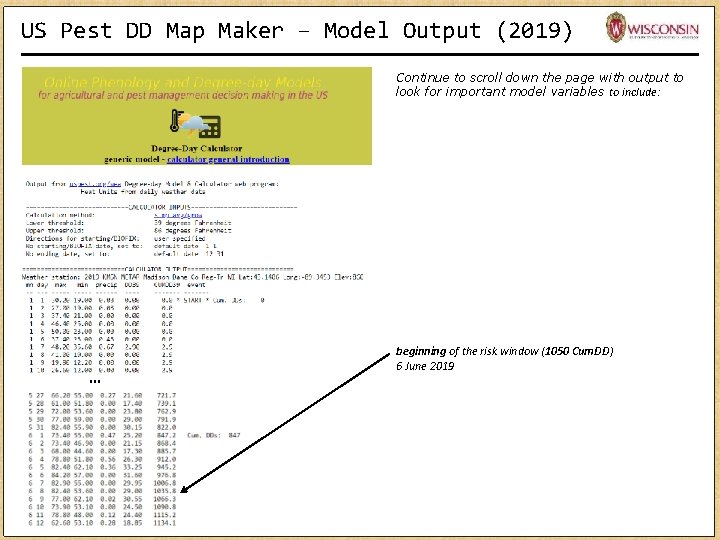
US Pest DD Map Maker – Model Output (2019) Continue to scroll down the page with output to look for important model variables to include: … beginning of the risk window (1050 Cum. DD) 6 June 2019
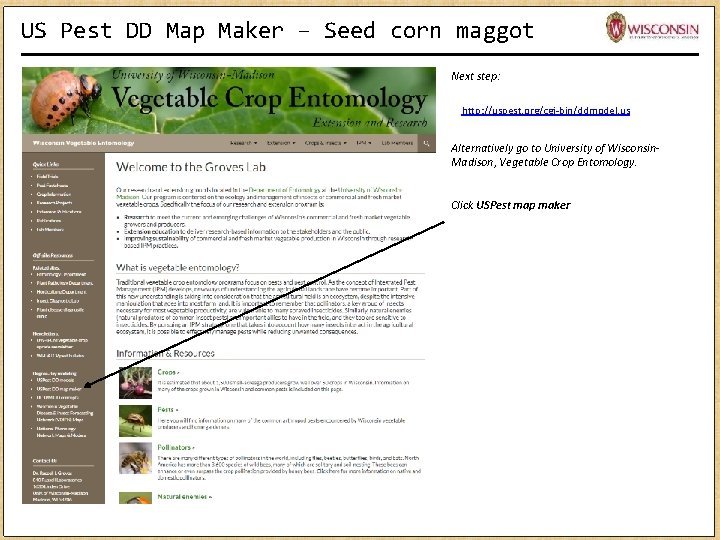
US Pest DD Map Maker – Seed corn maggot Next step: http: //uspest. org/cgi-bin/ddmodel. us Alternatively go to University of Wisconsin. Madison, Vegetable Crop Entomology. Click USPest map maker
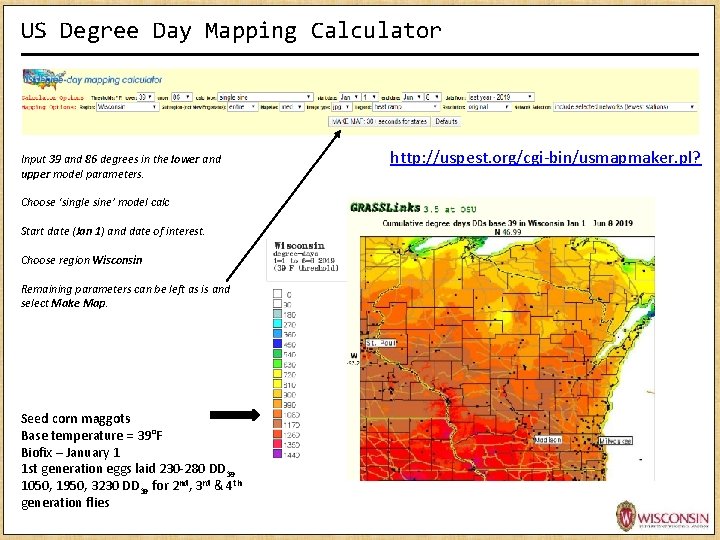
US Degree Day Mapping Calculator Input 39 and 86 degrees in the lower and upper model parameters. Choose ‘single sine’ model calc Start date (Jan 1) and date of interest. Choose region Wisconsin Remaining parameters can be left as is and select Make Map. Seed corn maggots Base temperature = 39°F Biofix – January 1 1 st generation eggs laid 230 -280 DD 39 1050, 1950, 3230 DD 39 for 2 nd, 3 rd & 4 th generation flies http: //uspest. org/cgi-bin/usmapmaker. pl?
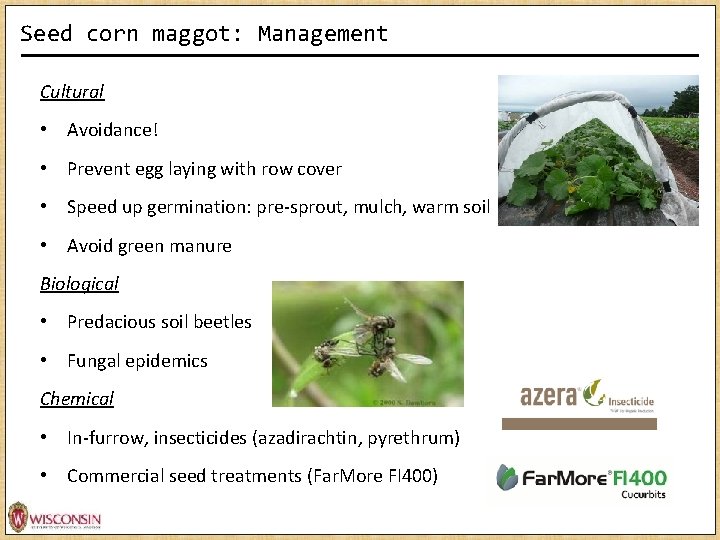
Seed corn maggot: Management Cultural • Avoidance! • Prevent egg laying with row cover • Speed up germination: pre-sprout, mulch, warm soil • Avoid green manure Biological • Predacious soil beetles • Fungal epidemics Chemical • In-furrow, insecticides (azadirachtin, pyrethrum) • Commercial seed treatments (Far. More FI 400)
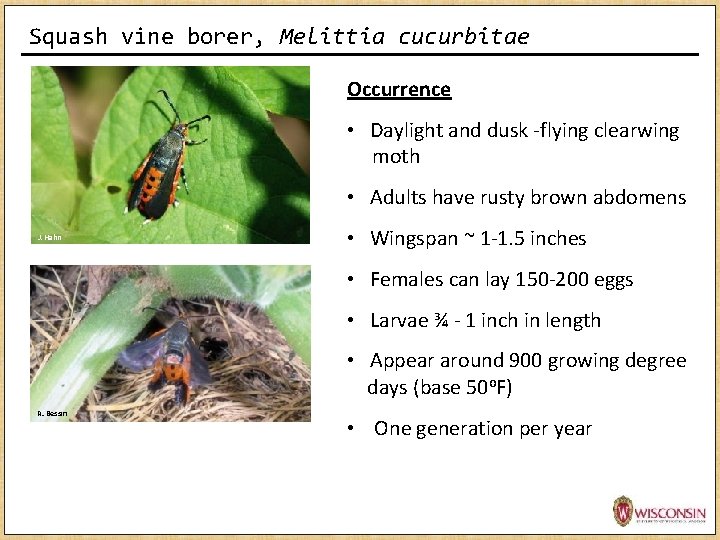
Squash vine borer, Melittia cucurbitae Occurrence • Daylight and dusk -flying clearwing moth • Adults have rusty brown abdomens J. Hahn • Wingspan ~ 1 -1. 5 inches • Females can lay 150 -200 eggs • Larvae ¾ - 1 inch in length • Appear around 900 growing degree days (base 50 o. F) R. Bessin • One generation per year
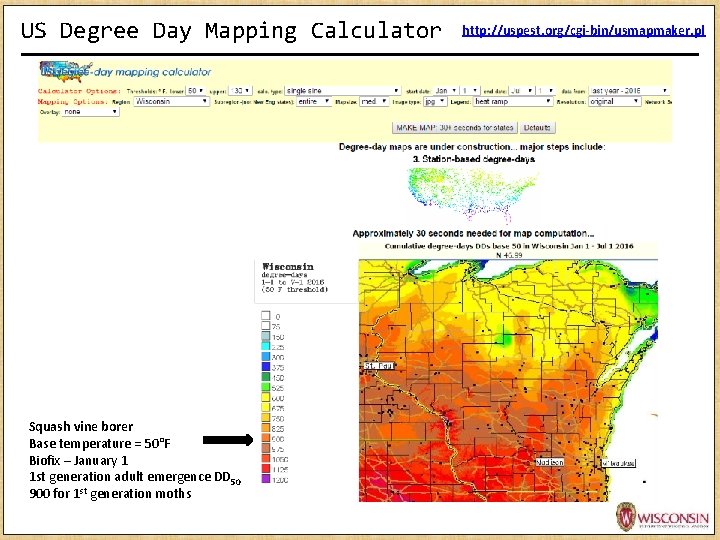
US Degree Day Mapping Calculator Squash vine borer Base temperature = 50°F Biofix – January 1 1 st generation adult emergence DD 50 900 for 1 st generation moths http: //uspest. org/cgi-bin/usmapmaker. pl
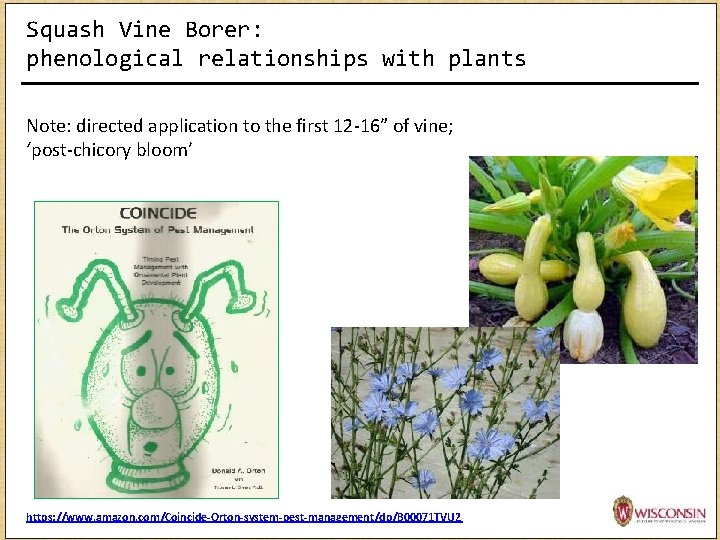
Squash Vine Borer: phenological relationships with plants Note: directed application to the first 12 -16” of vine; ‘post-chicory bloom’ https: //www. amazon. com/Coincide-Orton-system-pest-management/dp/B 00071 TVU 2
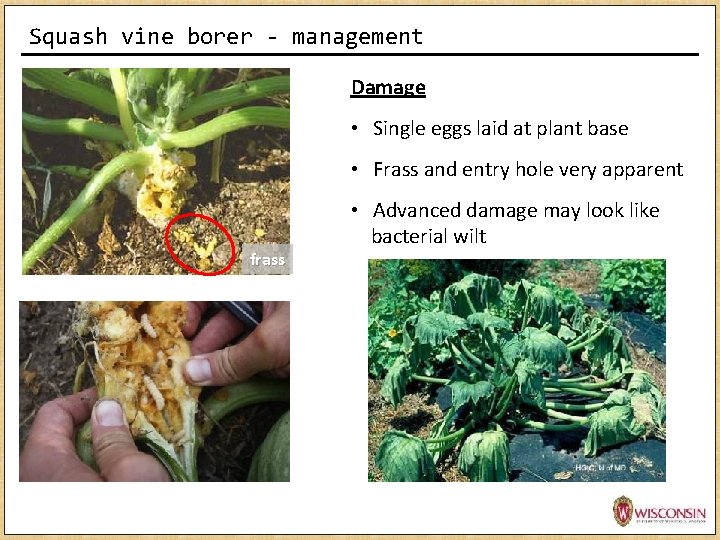
Squash vine borer - management Damage • Single eggs laid at plant base • Frass and entry hole very apparent frass • Advanced damage may look like bacterial wilt
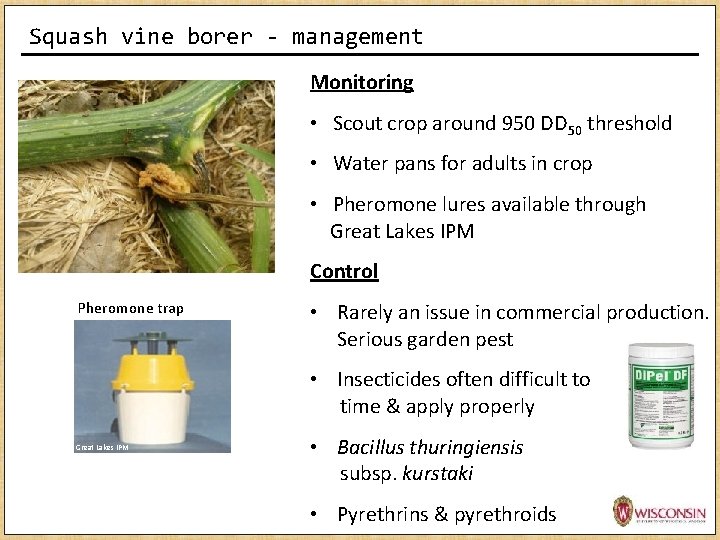
Squash vine borer - management Monitoring • Scout crop around 950 DD 50 threshold • Water pans for adults in crop • Pheromone lures available through Great Lakes IPM Control Pheromone trap • Rarely an issue in commercial production. Serious garden pest • Insecticides often difficult to time & apply properly Great Lakes IPM • Bacillus thuringiensis subsp. kurstaki • Pyrethrins & pyrethroids
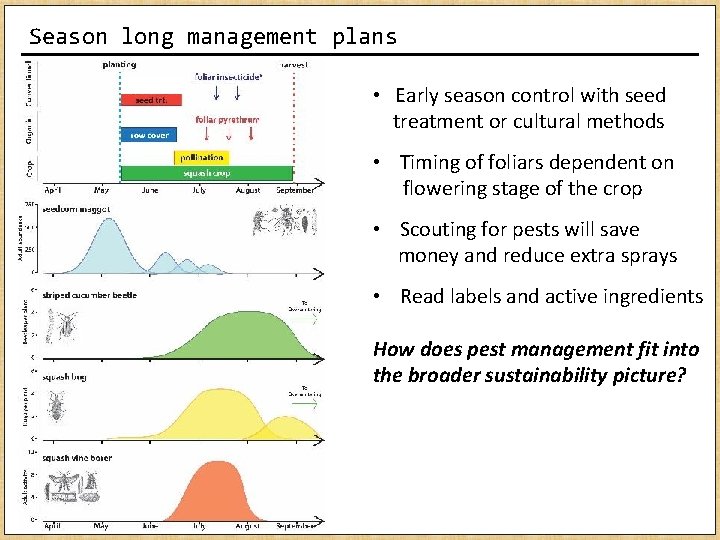
Season long management plans • Early season control with seed treatment or cultural methods • Timing of foliars dependent on flowering stage of the crop • Scouting for pests will save money and reduce extra sprays • Read labels and active ingredients How does pest management fit into the broader sustainability picture?
Presentation Outline • Cucurbit pests – cucumbers, melons, squash, pumpkins (seed maggots, cucumber beetle, squash vine borer) - avoidance in time (rotation, planting dates, phenology, and DD) - avoidance in space (rotation, trap crops) - varietal selection • Brassica pests – cabbage, cauliflower, broccoli, mustard greens (caterpillar pests, cabbage maggot, flea beetles, thrips) - biocontrol and natural enemies • Onion pests – (onion thrips, onion maggot) - anticipating a problem
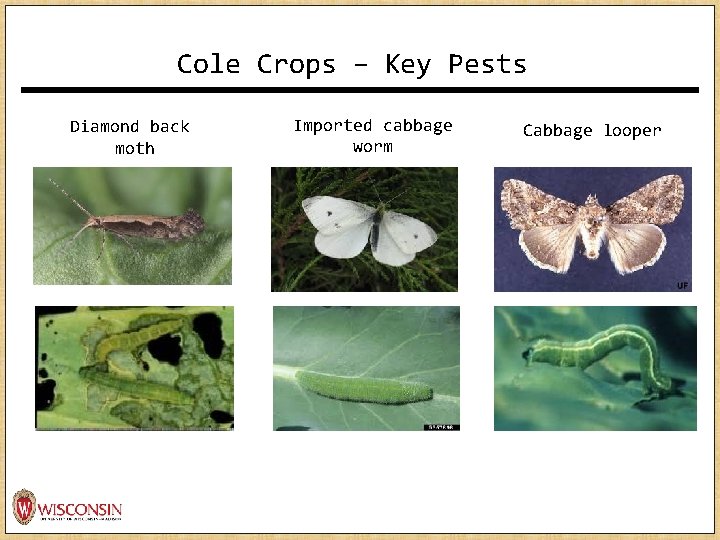
Cole Crops – Key Pests Diamond back moth Imported cabbage worm Cabbage looper
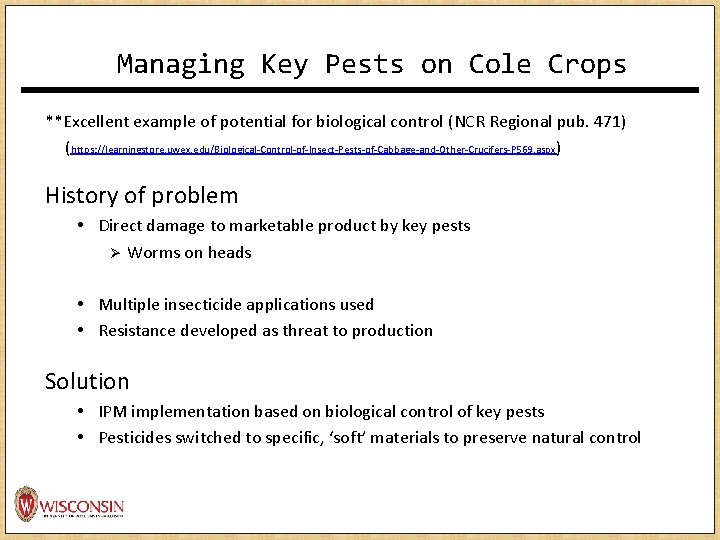
Managing Key Pests on Cole Crops **Excellent example of potential for biological control (NCR Regional pub. 471) (https: //learningstore. uwex. edu/Biological-Control-of-Insect-Pests-of-Cabbage-and-Other-Crucifers-P 569. aspx) History of problem • Direct damage to marketable product by key pests Ø Worms on heads • Multiple insecticide applications used • Resistance developed as threat to production Solution • IPM implementation based on biological control of key pests • Pesticides switched to specific, ‘soft’ materials to preserve natural control
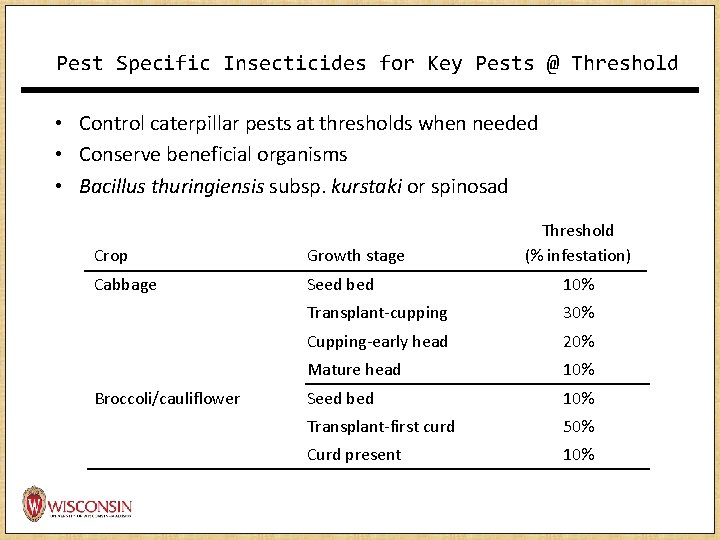
Pest Specific Insecticides for Key Pests @ Threshold • Control caterpillar pests at thresholds when needed • Conserve beneficial organisms • Bacillus thuringiensis subsp. kurstaki or spinosad Threshold (% infestation) Crop Growth stage Cabbage Seed bed 10% Transplant-cupping 30% Cupping-early head 20% Mature head 10% Seed bed 10% Transplant-first curd 50% Curd present 10% Broccoli/cauliflower
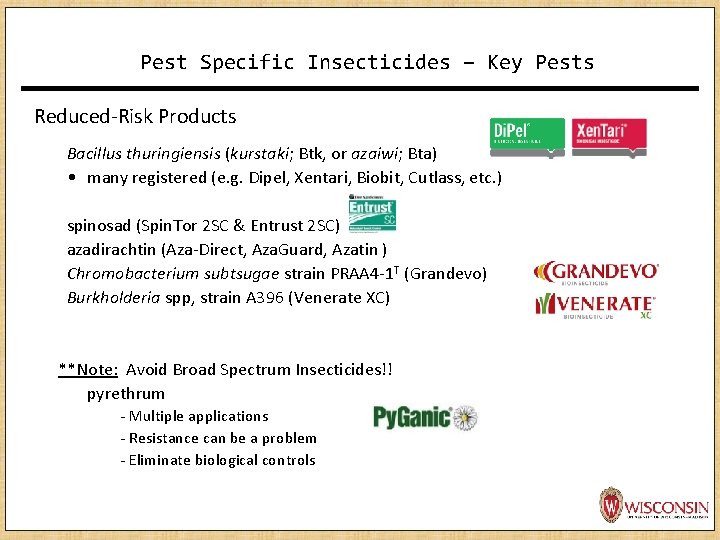
Pest Specific Insecticides – Key Pests Reduced-Risk Products Bacillus thuringiensis (kurstaki; Btk, or azaiwi; Bta) • many registered (e. g. Dipel, Xentari, Biobit, Cutlass, etc. ) spinosad (Spin. Tor 2 SC & Entrust 2 SC) azadirachtin (Aza-Direct, Aza. Guard, Azatin ) Chromobacterium subtsugae strain PRAA 4 -1 T (Grandevo) Burkholderia spp, strain A 396 (Venerate XC) **Note: Avoid Broad Spectrum Insecticides!! pyrethrum • - Multiple applications • - Resistance can be a problem • - Eliminate biological controls
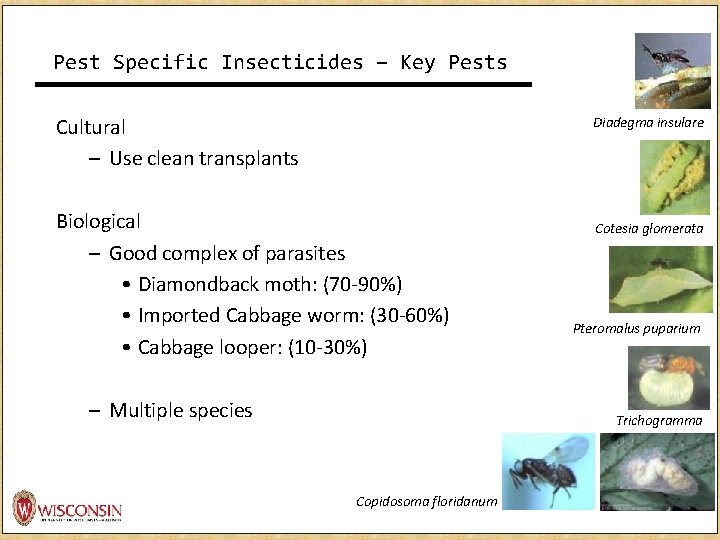
Pest Specific Insecticides – Key Pests Diadegma insulare Cultural – Use clean transplants Biological – Good complex of parasites • Diamondback moth: (70 -90%) • Imported Cabbage worm: (30 -60%) • Cabbage looper: (10 -30%) – Multiple species Cotesia glomerata Pteromalus puparium Trichogramma Copidosoma floridanum
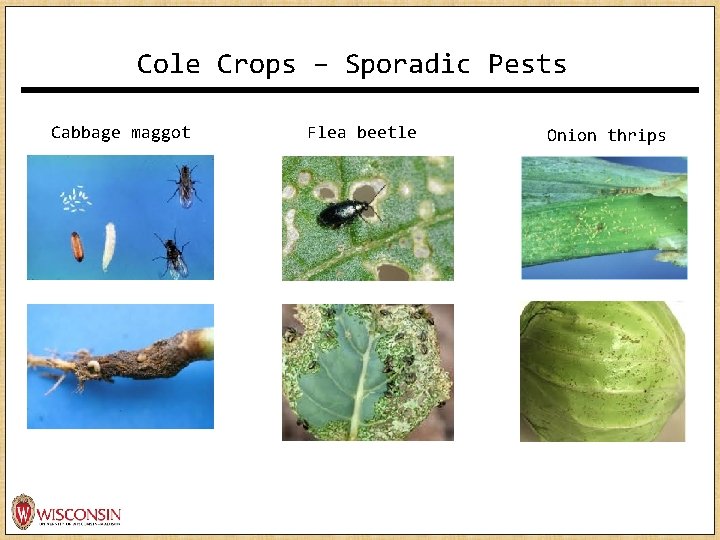
Cole Crops – Sporadic Pests Cabbage maggot Flea beetle Onion thrips
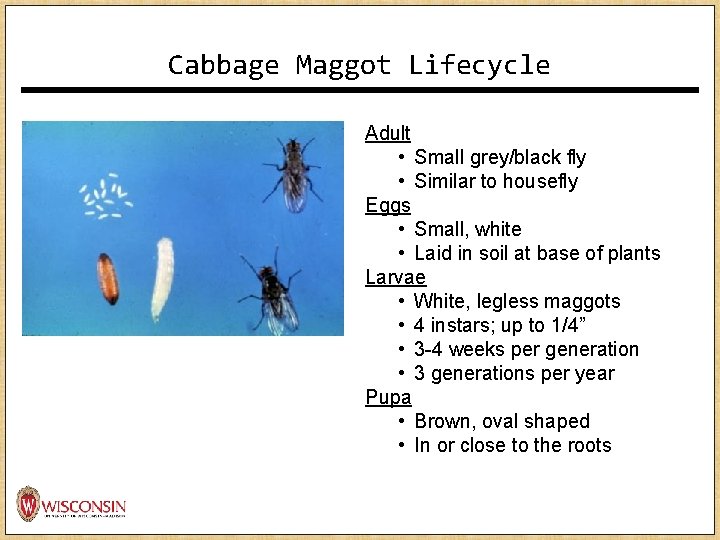
Cabbage Maggot Lifecycle Adult • Small grey/black fly • Similar to housefly Eggs • Small, white • Laid in soil at base of plants Larvae • White, legless maggots • 4 instars; up to 1/4” • 3 -4 weeks per generation • 3 generations per year Pupa • Brown, oval shaped • In or close to the roots
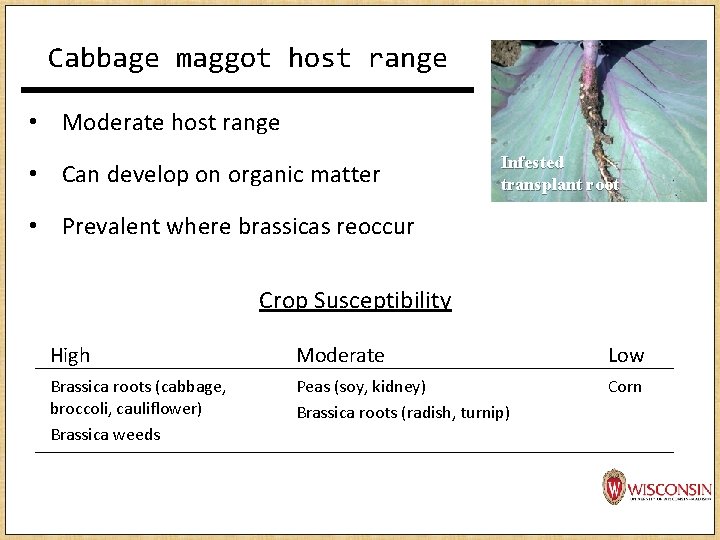
Cabbage maggot host range • Moderate host range • Can develop on organic matter Infested transplant root • Prevalent where brassicas reoccur Crop Susceptibility High Moderate Low Brassica roots (cabbage, broccoli, cauliflower) Brassica weeds Peas (soy, kidney) Brassica roots (radish, turnip) Corn
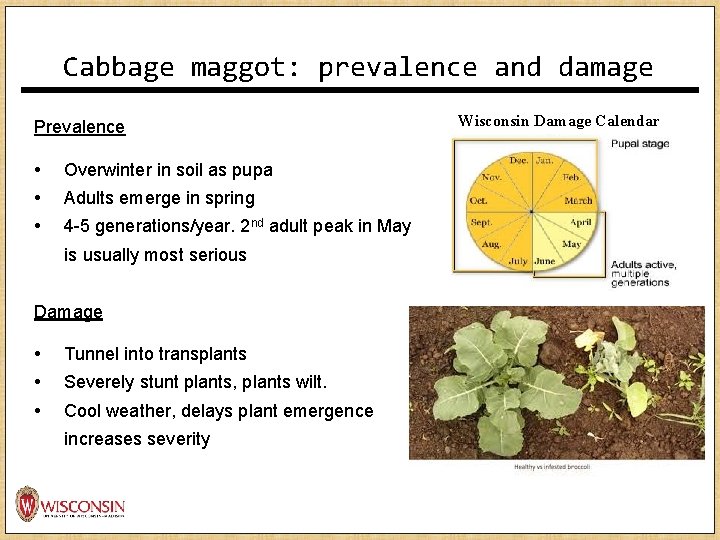
Cabbage maggot: prevalence and damage Prevalence • Overwinter in soil as pupa • Adults emerge in spring • 4 -5 generations/year. 2 nd adult peak in May is usually most serious Damage • Tunnel into transplants • Severely stunt plants, plants wilt. • Cool weather, delays plant emergence increases severity Wisconsin Damage Calendar
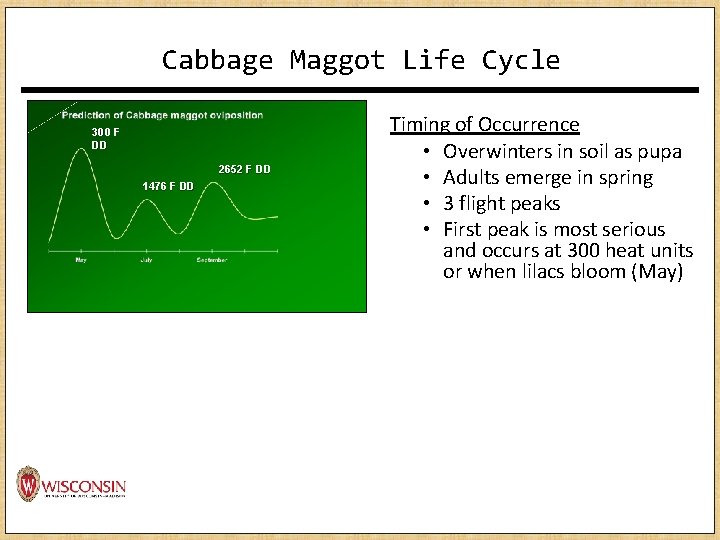
Cabbage Maggot Life Cycle 300 F DD 2652 F DD 1476 F DD Timing of Occurrence • Overwinters in soil as pupa • Adults emerge in spring • 3 flight peaks • First peak is most serious and occurs at 300 heat units or when lilacs bloom (May)
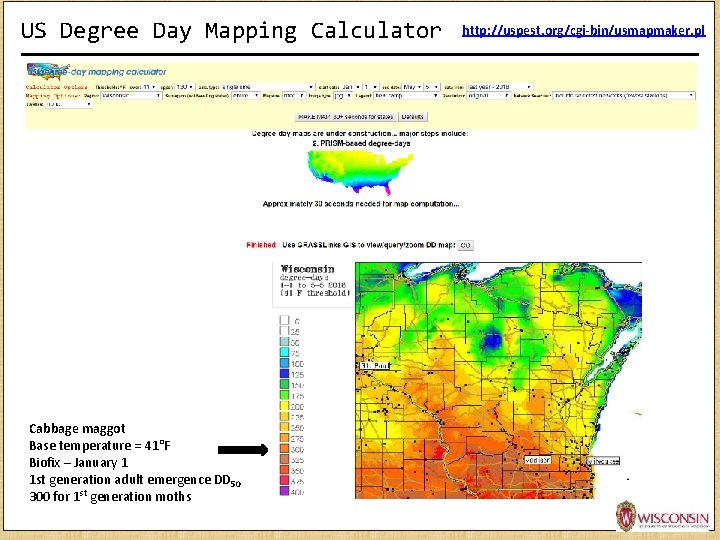
US Degree Day Mapping Calculator Cabbage maggot Base temperature = 41°F Biofix – January 1 1 st generation adult emergence DD 50 300 for 1 st generation moths http: //uspest. org/cgi-bin/usmapmaker. pl
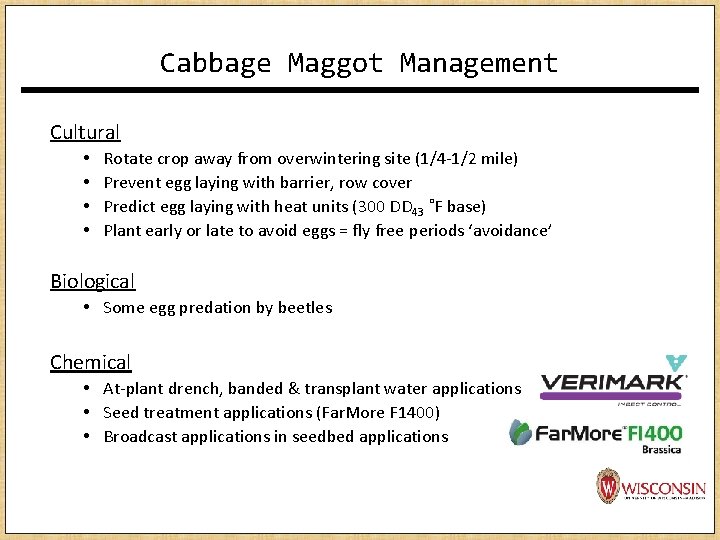
Cabbage Maggot Management Cultural • • Rotate crop away from overwintering site (1/4 -1/2 mile) Prevent egg laying with barrier, row cover Predict egg laying with heat units (300 DD 43 ˚F base) Plant early or late to avoid eggs = fly free periods ‘avoidance’ Biological • Some egg predation by beetles Chemical • At-plant drench, banded & transplant water applications • Seed treatment applications (Far. More F 1400) • Broadcast applications in seedbed applications
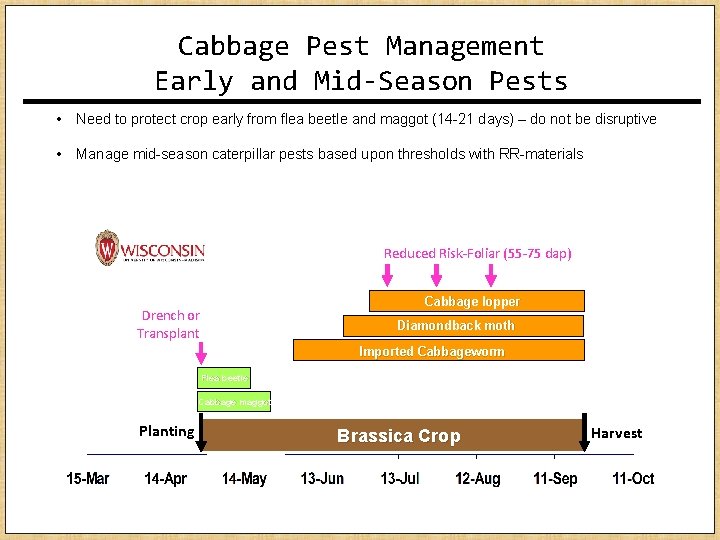
Cabbage Pest Management Early and Mid-Season Pests • Need to protect crop early from flea beetle and maggot (14 -21 days) – do not be disruptive • Manage mid-season caterpillar pests based upon thresholds with RR-materials Reduced Risk-Foliar (55 -75 dap) Cabbage lopper Drench or Transplant Diamondback moth Imported Cabbageworm Flea beetle Cabbage maggot Planting Brassica Crop Harvest
Vegetable IPM Resources o Vegetable Insect Mgmt Web-page http: //labs. russell. wisc. edu/vegento/ o Vegetable Disease Mgmt Web-page http: //www. plantpath. wisc. edu/wivegdis/contents_pages/veg_crop_updates. html o NCAT ATTRA https: //attra. ncat. org/publication. html o Wisconsin Pest Bulletin http: //datcpservices. wisconsin. gov/pb/index. jsp
Questions?