Adapter Design Pattern State Design Pattern C Sc
- Slides: 31
Adapter Design Pattern State Design Pattern C Sc 335 Rick Mercer 3 -
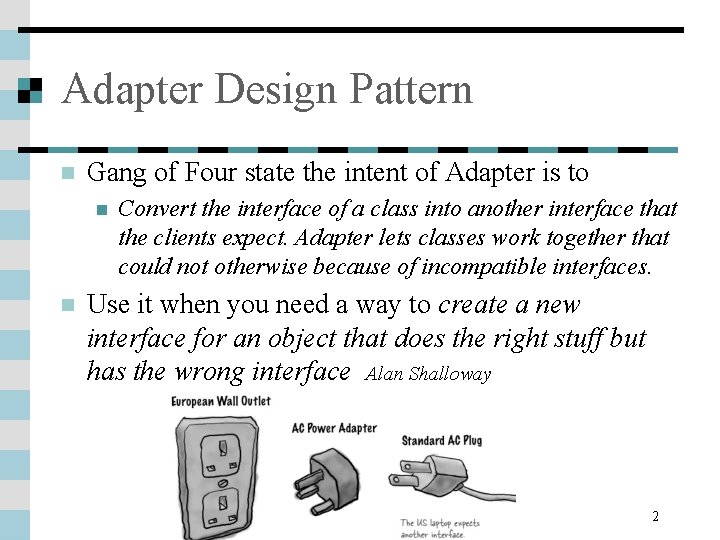
Adapter Design Pattern n Gang of Four state the intent of Adapter is to n n Convert the interface of a class into another interface that the clients expect. Adapter lets classes work together that could not otherwise because of incompatible interfaces. Use it when you need a way to create a new interface for an object that does the right stuff but has the wrong interface Alan Shalloway 2
Object Adapters n Before Java 5. 0, we often adapted an Array. List or Hash. Map to have an easier to use collection n Use a Containment Relationship: n n Put the cast in the method once instead of everywhere n n n http: //www. refactoring. com/catalog/encapsulate. Downcast. html Add Employees rather than Objects (type safe) Method names then mean more to the clients n n n A collection with Array. List or Hash. Map instance variable Employee get. Employee. With. ID (String) good Object get(int) bad Not a compelling example with Java generics n However, you might see some legacy code with 3
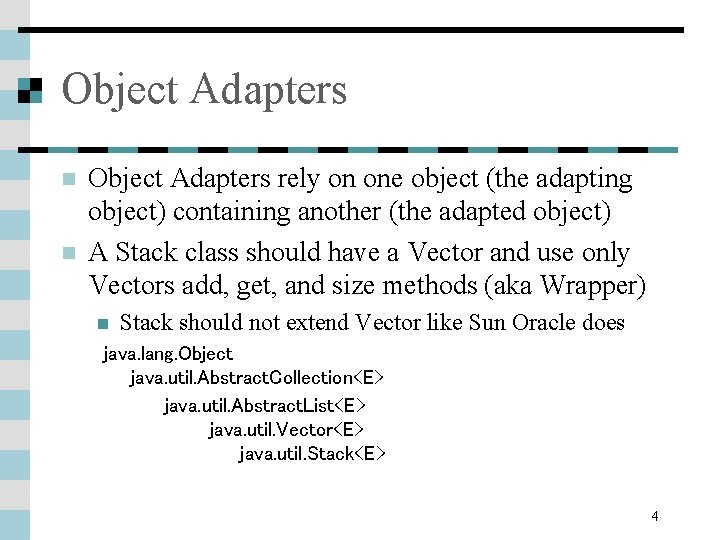
Object Adapters n n Object Adapters rely on one object (the adapting object) containing another (the adapted object) A Stack class should have a Vector and use only Vectors add, get, and size methods (aka Wrapper) n Stack should not extend Vector like Sun Oracle does java. lang. Object java. util. Abstract. Collection<E> java. util. Abstract. List<E> java. util. Vector<E> java. util. Stack<E> 4
Class Adapters n n Class Adapters also come about by extending a class or implementing an interface used by the client code You have used class adapters at least twice! n n Adapted your song collection so it could be stored in a List. Model object, which in turn was used by a JList to show a graphical view of the list elements JList needs the methods defined in the List. Model interface: get. Size() and get. Element. At(int)
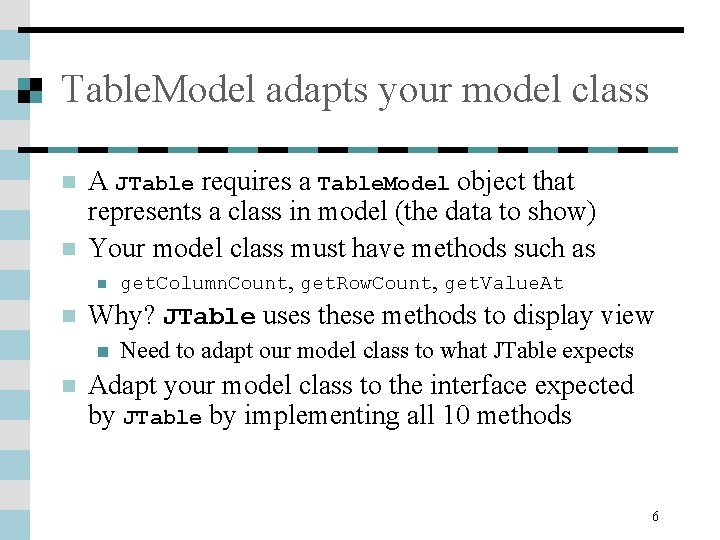
Table. Model adapts your model class n n A JTable requires a Table. Model object that represents a class in model (the data to show) Your model class must have methods such as n n Why? JTable uses these methods to display view n n get. Column. Count, get. Row. Count, get. Value. At Need to adapt our model class to what JTable expects Adapt your model class to the interface expected by JTable by implementing all 10 methods 6
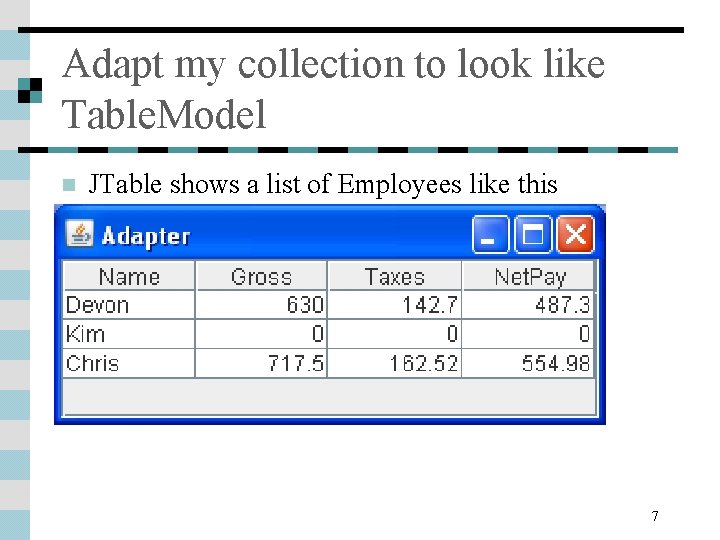
Adapt my collection to look like Table. Model n JTable shows a list of Employees like this 7
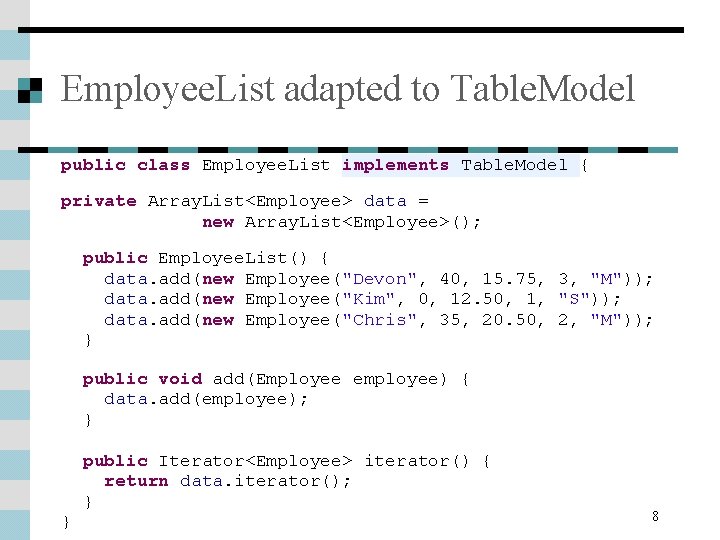
Employee. List adapted to Table. Model public class Employee. List implements Table. Model { private Array. List<Employee> data = new Array. List<Employee>(); public Employee. List() { data. add(new Employee("Devon", 40, 15. 75, 3, "M")); data. add(new Employee("Kim", 0, 12. 50, 1, "S")); data. add(new Employee("Chris", 35, 20. 50, 2, "M")); } public void add(Employee employee) { data. add(employee); } public Iterator<Employee> iterator() { return data. iterator(); } } 8
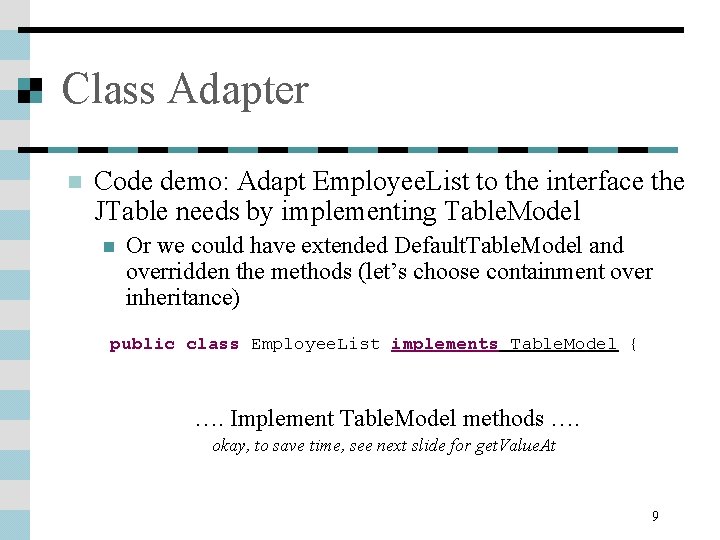
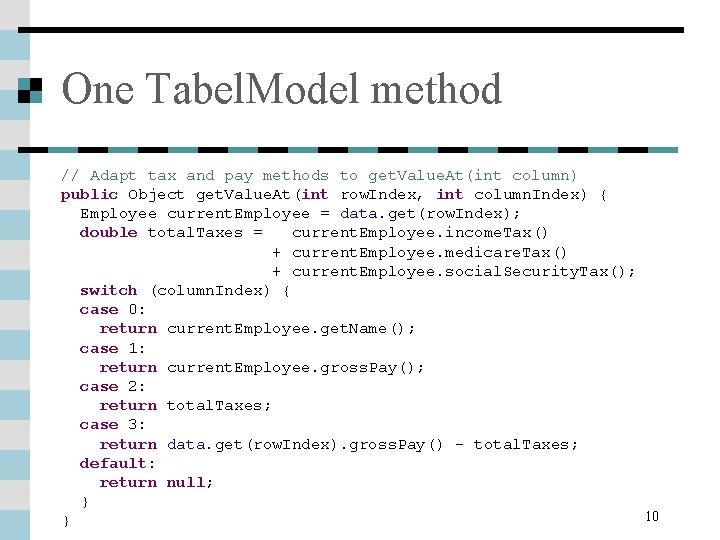
Class Adapter n Code demo: Adapt Employee. List to the interface the JTable needs by implementing Table. Model n Or we could have extended Default. Table. Model and overridden the methods (let’s choose containment over inheritance) public class Employee. List implements Table. Model { …. Implement Table. Model methods …. okay, to save time, see next slide for get. Value. At 9
One Tabel. Model method // Adapt tax and pay methods to get. Value. At(int column) public Object get. Value. At(int row. Index, int column. Index) { Employee current. Employee = data. get(row. Index); double total. Taxes = current. Employee. income. Tax() + current. Employee. medicare. Tax() + current. Employee. social. Security. Tax(); switch (column. Index) { case 0: return current. Employee. get. Name(); case 1: return current. Employee. gross. Pay(); case 2: return total. Taxes; case 3: return data. get(row. Index). gross. Pay() - total. Taxes; default: return null; } 10 }
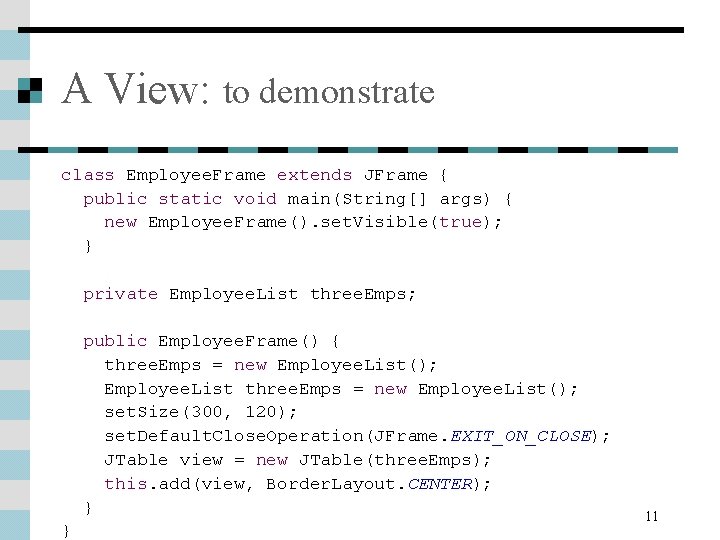
A View: to demonstrate class Employee. Frame extends JFrame { public static void main(String[] args) { new Employee. Frame(). set. Visible(true); } private Employee. List three. Emps; public Employee. Frame() { three. Emps = new Employee. List(); Employee. List three. Emps = new Employee. List(); set. Size(300, 120); set. Default. Close. Operation(JFrame. EXIT_ON_CLOSE); JTable view = new JTable(three. Emps); this. add(view, Border. Layout. CENTER); } } 11
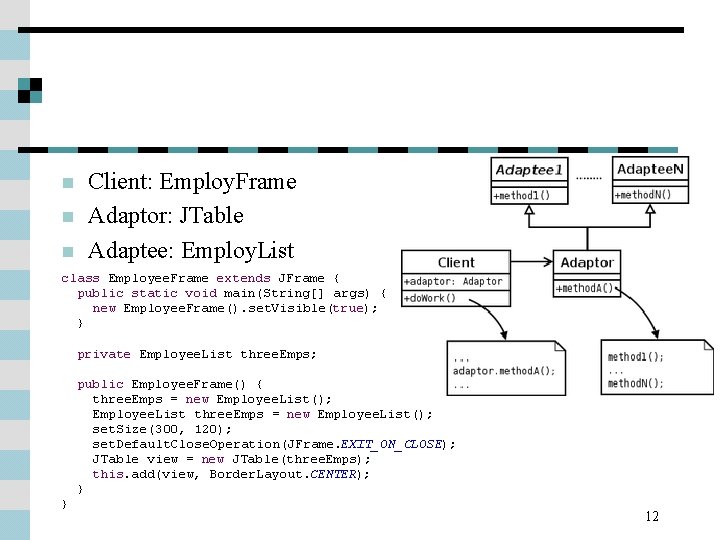
n n n Client: Employ. Frame Adaptor: JTable Adaptee: Employ. List class Employee. Frame extends JFrame { public static void main(String[] args) { new Employee. Frame(). set. Visible(true); } private Employee. List three. Emps; public Employee. Frame() { three. Emps = new Employee. List(); Employee. List three. Emps = new Employee. List(); set. Size(300, 120); set. Default. Close. Operation(JFrame. EXIT_ON_CLOSE); JTable view = new JTable(three. Emps); this. add(view, Border. Layout. CENTER); } } 12
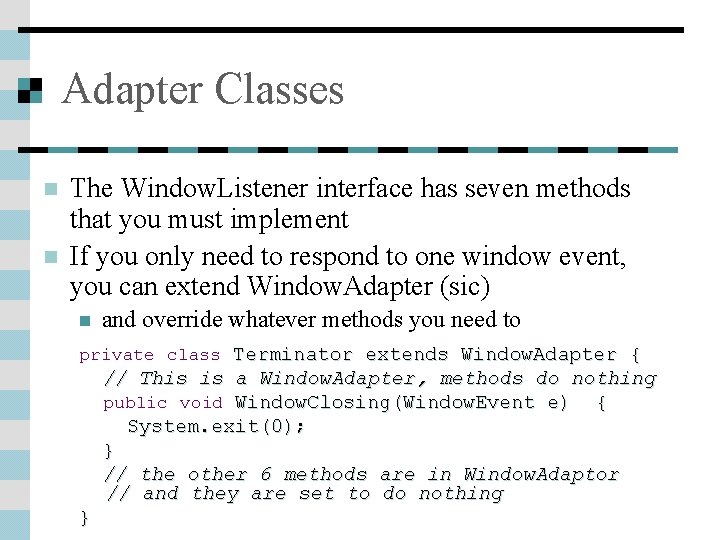
Adapter Classes n n The Window. Listener interface has seven methods that you must implement If you only need to respond to one window event, you can extend Window. Adapter (sic) n and override whatever methods you need to private class Terminator extends Window. Adapter { // This is a Window. Adapter, methods do nothing public void Window. Closing(Window. Event e) { System. exit(0); } // the other 6 methods are in Window. Adaptor // and they are set to do nothing }
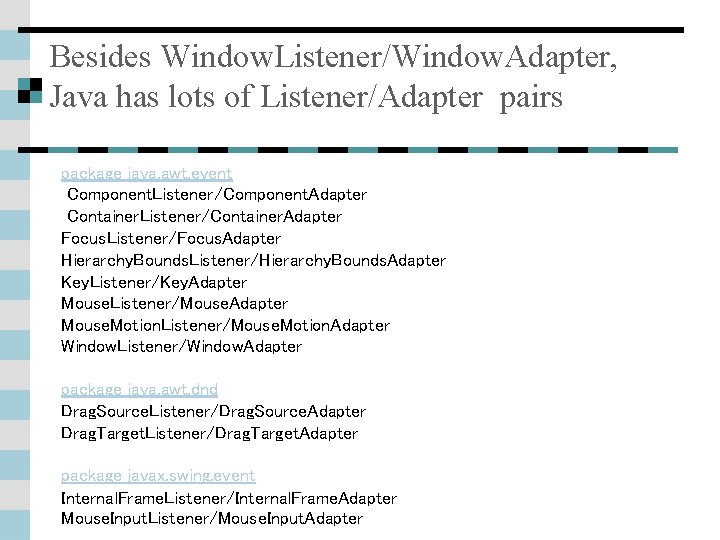
Besides Window. Listener/Window. Adapter, Java has lots of Listener/Adapter pairs package java. awt. event Component. Listener/Component. Adapter Container. Listener/Container. Adapter Focus. Listener/Focus. Adapter Hierarchy. Bounds. Listener/Hierarchy. Bounds. Adapter Key. Listener/Key. Adapter Mouse. Listener/Mouse. Adapter Mouse. Motion. Listener/Mouse. Motion. Adapter Window. Listener/Window. Adapter package java. awt. dnd Drag. Source. Listener/Drag. Source. Adapter Drag. Target. Listener/Drag. Target. Adapter package javax. swing. event Internal. Frame. Listener/Internal. Frame. Adapter Mouse. Input. Listener/Mouse. Input. Adapter
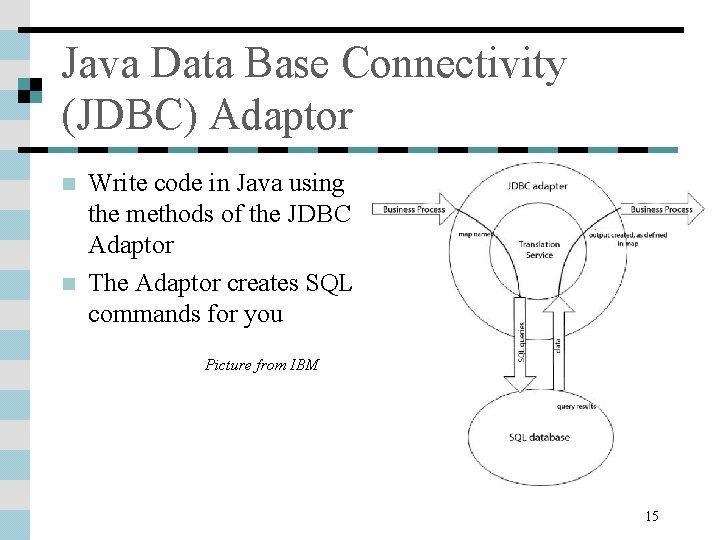
Java Data Base Connectivity (JDBC) Adaptor n n Write code in Java using the methods of the JDBC Adaptor The Adaptor creates SQL commands for you Picture from IBM 15
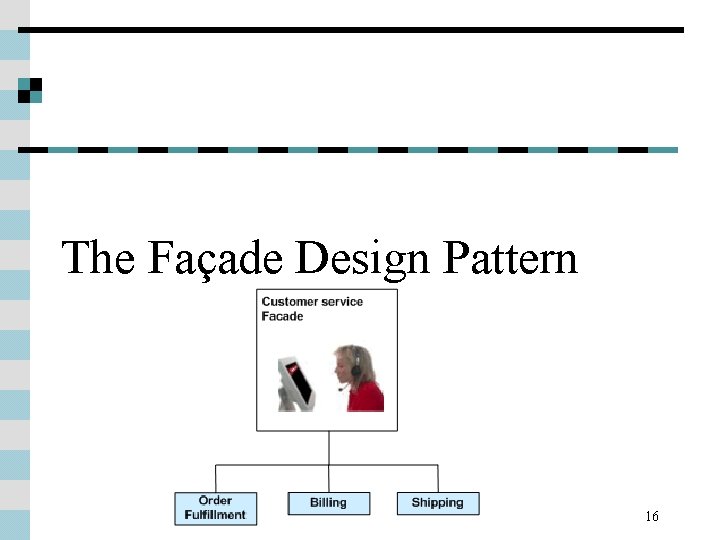
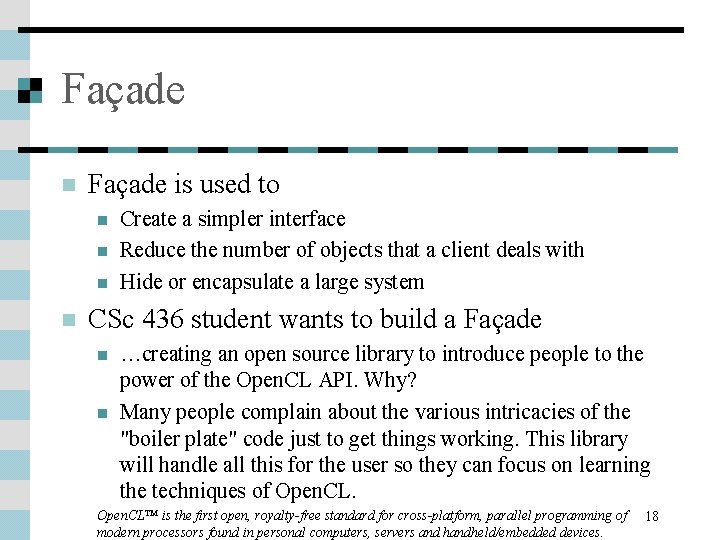
The Façade Design Pattern 16
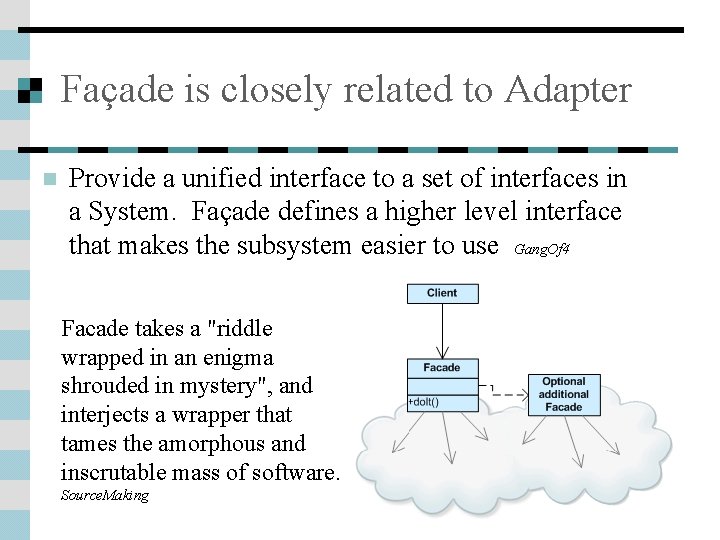
Façade is closely related to Adapter n Provide a unified interface to a set of interfaces in a System. Façade defines a higher level interface that makes the subsystem easier to use Gang. Of 4 Facade takes a "riddle wrapped in an enigma shrouded in mystery", and interjects a wrapper that tames the amorphous and inscrutable mass of software. Source. Making 17
Façade n Façade is used to n n Create a simpler interface Reduce the number of objects that a client deals with Hide or encapsulate a large system CSc 436 student wants to build a Façade n n …creating an open source library to introduce people to the power of the Open. CL API. Why? Many people complain about the various intricacies of the "boiler plate" code just to get things working. This library will handle all this for the user so they can focus on learning the techniques of Open. CL™ is the first open, royalty-free standard for cross-platform, parallel programming of modern processors found in personal computers, servers and handheld/embedded devices. 18
The State Design Pattern 19
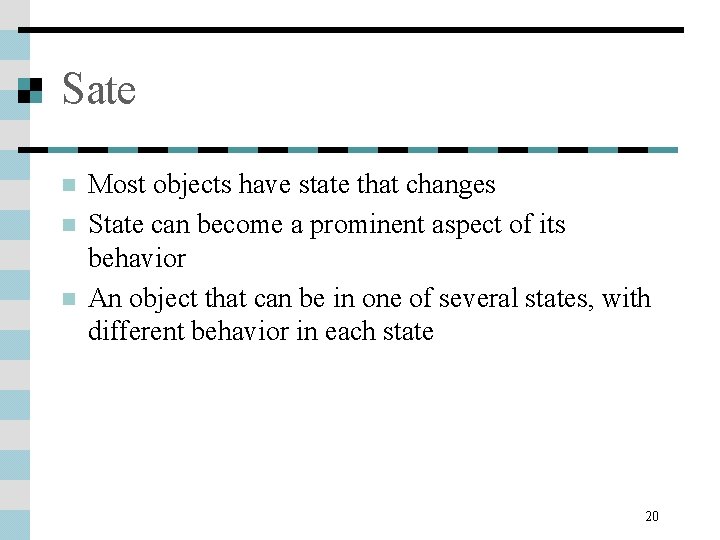
Sate n n n Most objects have state that changes State can become a prominent aspect of its behavior An object that can be in one of several states, with different behavior in each state 20
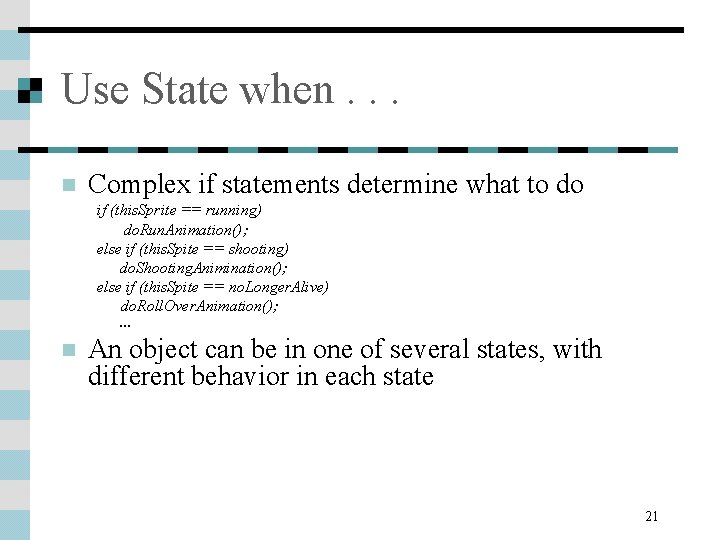
Use State when. . . n Complex if statements determine what to do if (this. Sprite == running) do. Run. Animation(); else if (this. Spite == shooting) do. Shooting. Animination(); else if (this. Spite == no. Longer. Alive) do. Roll. Over. Animation(); . . . n An object can be in one of several states, with different behavior in each state 21
State Design Pattern n State is one of the Behavioral patterns n n It is similar to Strategy Allows an object to alter its behavior when its internal state changes n The object will appear to change its class 22
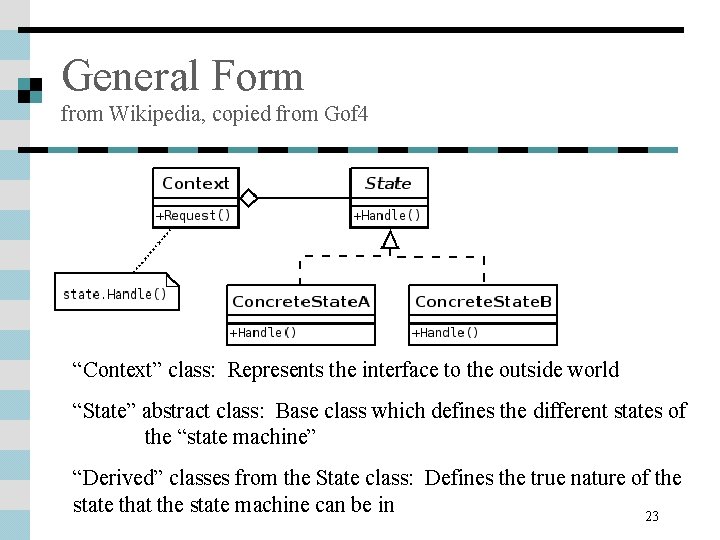
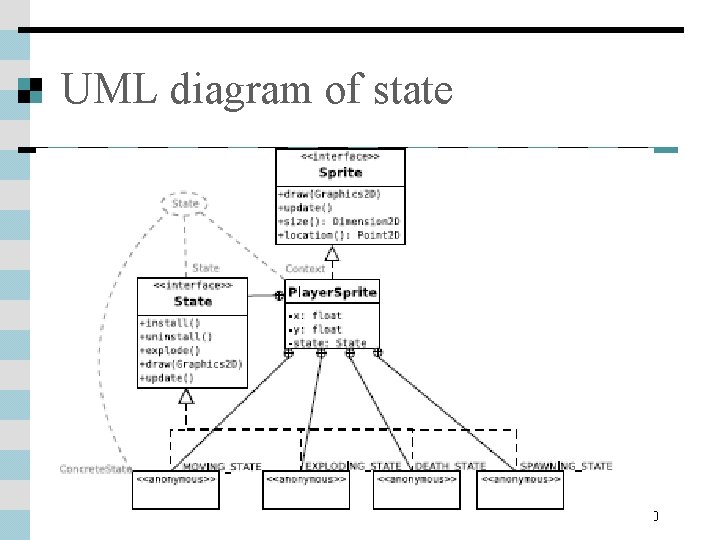
General Form from Wikipedia, copied from Gof 4 “Context” class: Represents the interface to the outside world “State” abstract class: Base class which defines the different states of the “state machine” “Derived” classes from the State class: Defines the true nature of the state that the state machine can be in 23
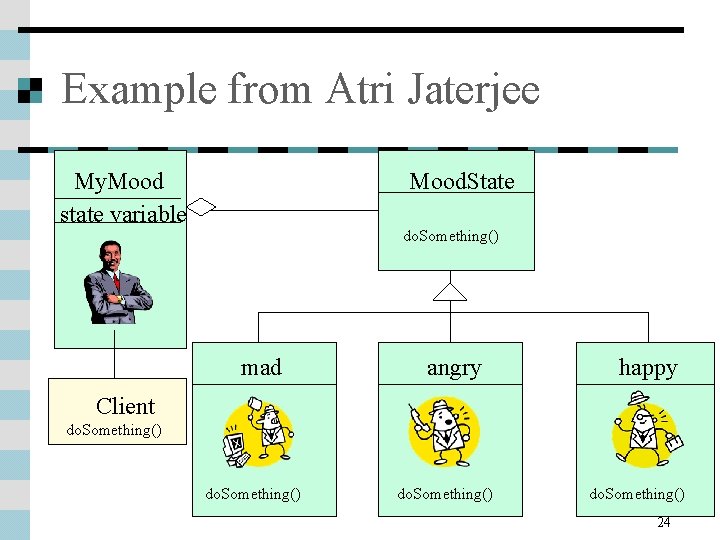
Example from Atri Jaterjee My. Mood state variable Mood. State do. Something() mad angry happy Client do. Something() 24
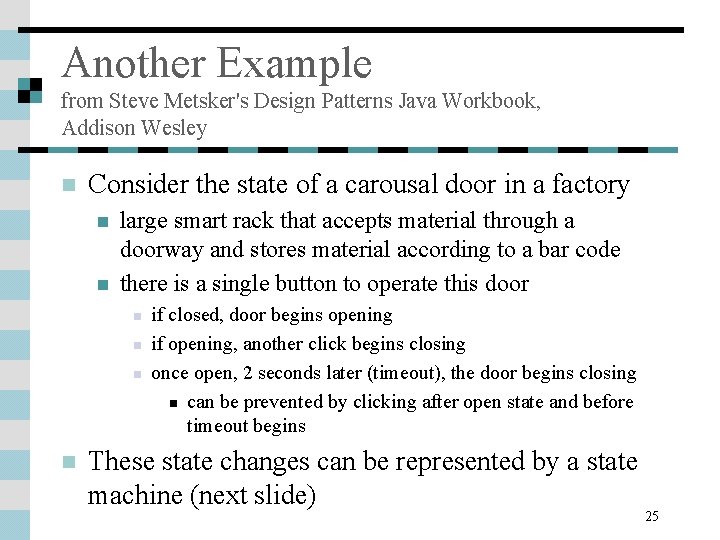
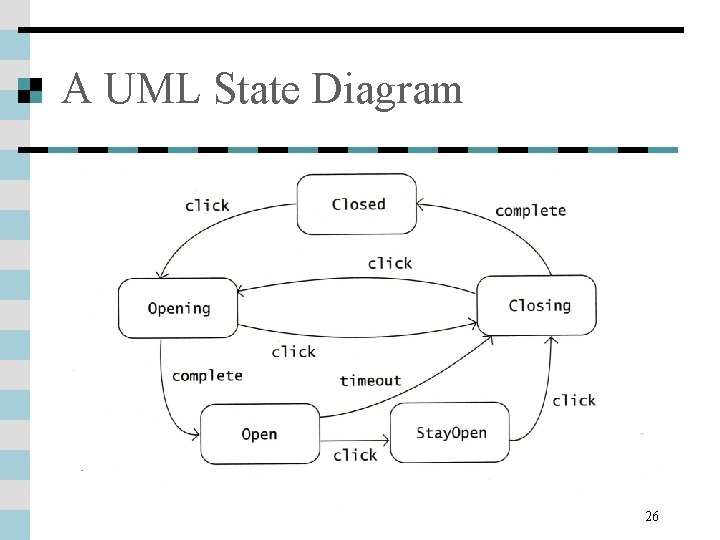
Another Example from Steve Metsker's Design Patterns Java Workbook, Addison Wesley n Consider the state of a carousal door in a factory n n large smart rack that accepts material through a doorway and stores material according to a bar code there is a single button to operate this door n n if closed, door begins opening if opening, another click begins closing once open, 2 seconds later (timeout), the door begins closing n can be prevented by clicking after open state and before timeout begins These state changes can be represented by a state machine (next slide) 25
A UML State Diagram 26
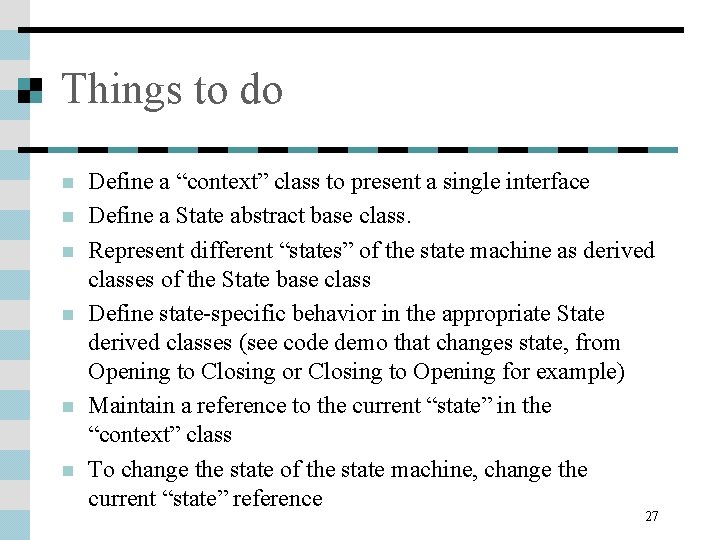
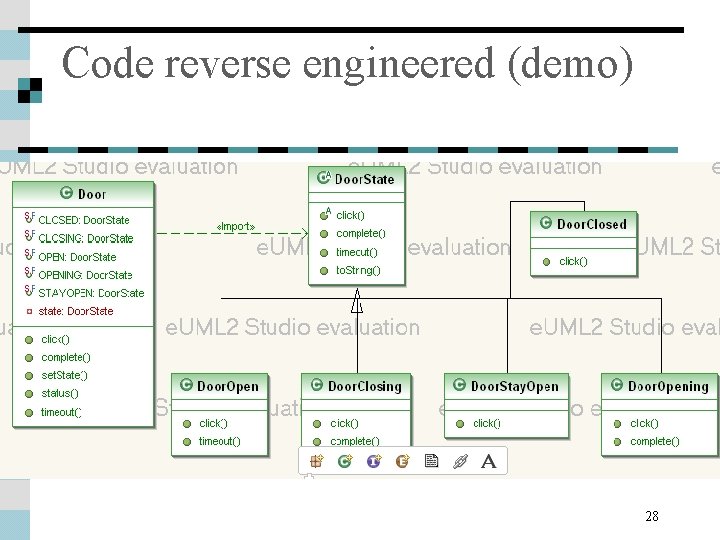
Things to do n n n Define a “context” class to present a single interface Define a State abstract base class. Represent different “states” of the state machine as derived classes of the State base class Define state-specific behavior in the appropriate State derived classes (see code demo that changes state, from Opening to Closing or Closing to Opening for example) Maintain a reference to the current “state” in the “context” class To change the state of the state machine, change the current “state” reference 27
Code reverse engineered (demo) 28
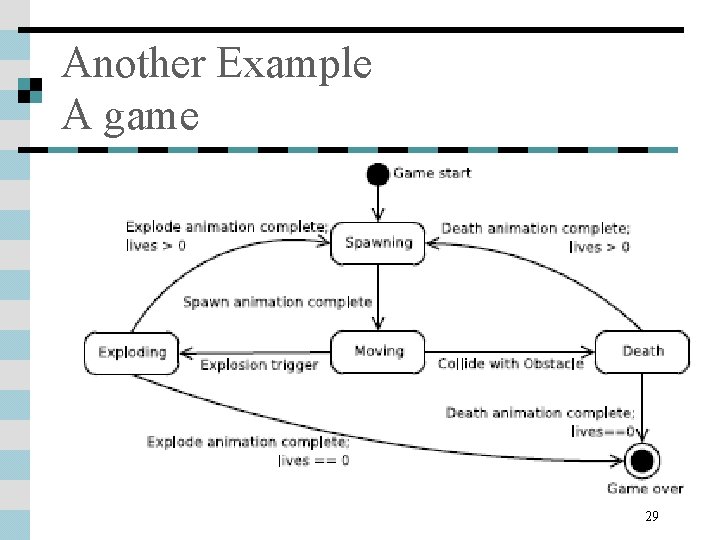
Another Example A game 29
UML diagram of state 30
Play a game n See EEClone for ideas about animations and using Strategy 31