7 2 Eukaryotic Cell Structure Slide 1 of

- Slides: 37
7 -2 Eukaryotic Cell Structure Slide 1 of 49 Copyright Pearson Prentice Hall End Show
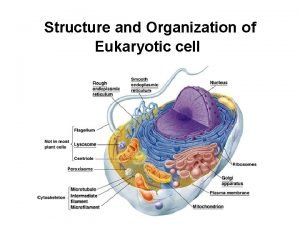
7 -2 Eukaryotic Cell Structures within a eukaryotic cell that perform important cellular functions are known as organelles. Cell biologists divide the eukaryotic cell into two major parts: the nucleus and the cytoplasm. The Cytoplasm is the portion of the cell outside the nucleus. Slide 2 of 49 Copyright Pearson Prentice Hall End Show
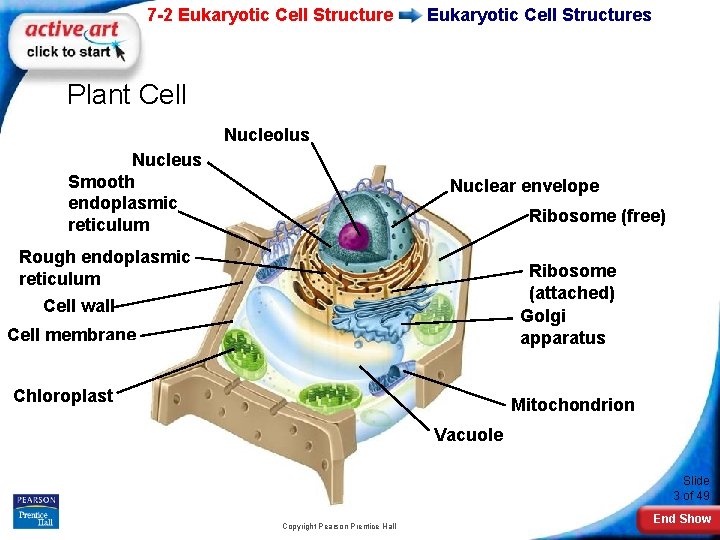
7 -2 Eukaryotic Cell Structures Plant Cell Nucleolus Nucleus Smooth endoplasmic reticulum Nuclear envelope Ribosome (free) Rough endoplasmic reticulum Ribosome (attached) Golgi apparatus Cell wall Cell membrane Chloroplast Mitochondrion Vacuole Slide 3 of 49 Copyright Pearson Prentice Hall End Show
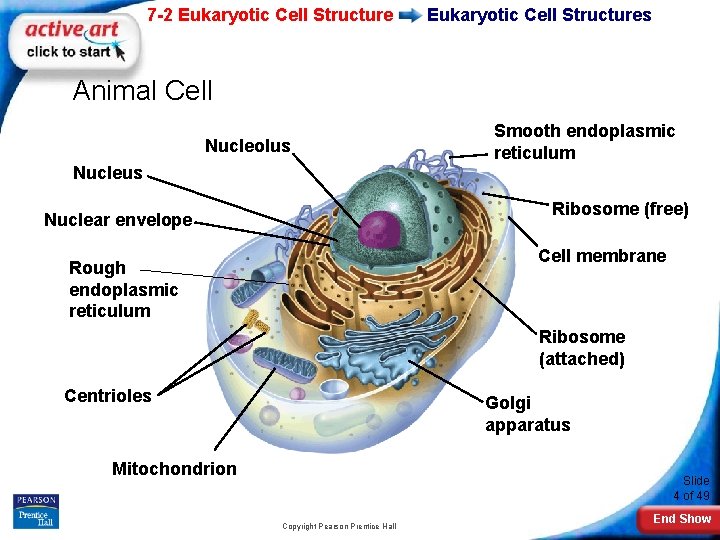
7 -2 Eukaryotic Cell Structures Animal Cell Nucleolus Nucleus Smooth endoplasmic reticulum Ribosome (free) Nuclear envelope Cell membrane Rough endoplasmic reticulum Ribosome (attached) Centrioles Golgi apparatus Mitochondrion Slide 4 of 49 Copyright Pearson Prentice Hall End Show
7 -2 Eukaryotic Cell Structure Nucleus What is the function of the nucleus? Slide 5 of 49 Copyright Pearson Prentice Hall End Show
7 -2 Eukaryotic Cell Structure Nucleus The nucleus is the control center of the cell. The nucleus contains nearly all the cell's DNA and with it the coded instructions for making proteins and other important molecules. Slide 6 of 49 Copyright Pearson Prentice Hall End Show
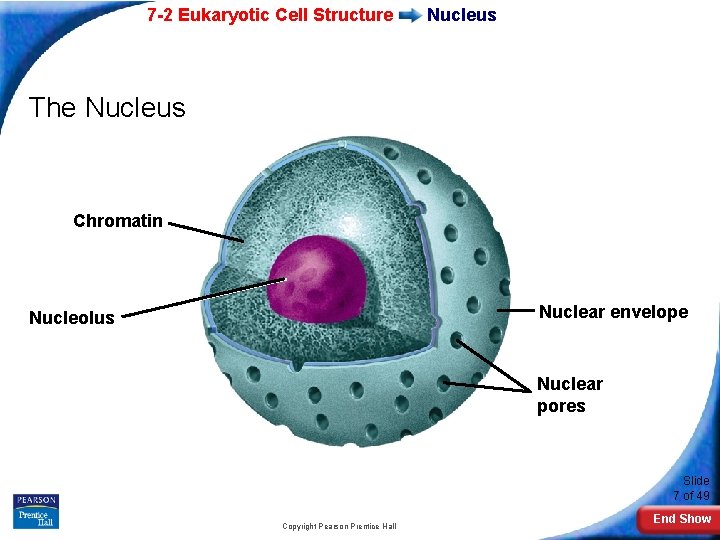
7 -2 Eukaryotic Cell Structure Nucleus The Nucleus Chromatin Nuclear envelope Nucleolus Nuclear pores Slide 7 of 49 Copyright Pearson Prentice Hall End Show
7 -2 Eukaryotic Cell Structure Ribosomes What is the function of the ribosomes? Slide 8 of 49 Copyright Pearson Prentice Hall End Show
7 -2 Eukaryotic Cell Structure Ribosomes One of the most important jobs carried out in the cell is making proteins. Proteins are assembled on ribosomes. Ribosomes are small particles of RNA and protein found throughout the cytoplasm. Slide 9 of 49 Copyright Pearson Prentice Hall End Show
7 -2 Eukaryotic Cell Structure Endoplasmic Reticulum What is the function of the endoplasmic reticulum? Slide 10 of 49 Copyright Pearson Prentice Hall End Show
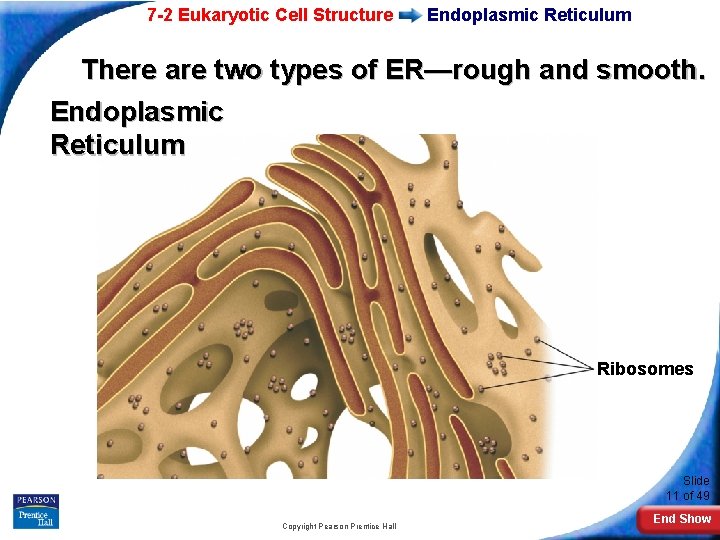
7 -2 Eukaryotic Cell Structure Endoplasmic Reticulum There are two types of ER—rough and smooth. Endoplasmic Reticulum Ribosomes Slide 11 of 49 Copyright Pearson Prentice Hall End Show
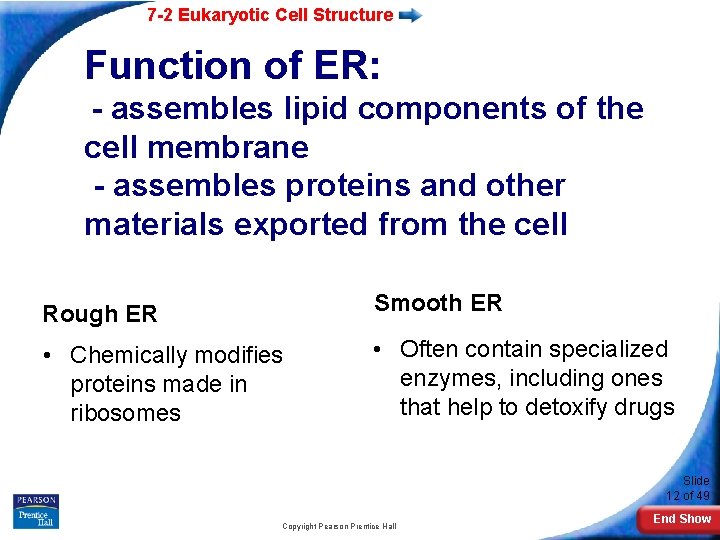
7 -2 Eukaryotic Cell Structure Function of ER: - assembles lipid components of the cell membrane - assembles proteins and other materials exported from the cell Rough ER Smooth ER • Chemically modifies proteins made in ribosomes • Often contain specialized enzymes, including ones that help to detoxify drugs Slide 12 of 49 Copyright Pearson Prentice Hall End Show
7 -2 Eukaryotic Cell Structure Golgi Apparatus What is the function of the Golgi apparatus? Slide 13 of 49 Copyright Pearson Prentice Hall End Show
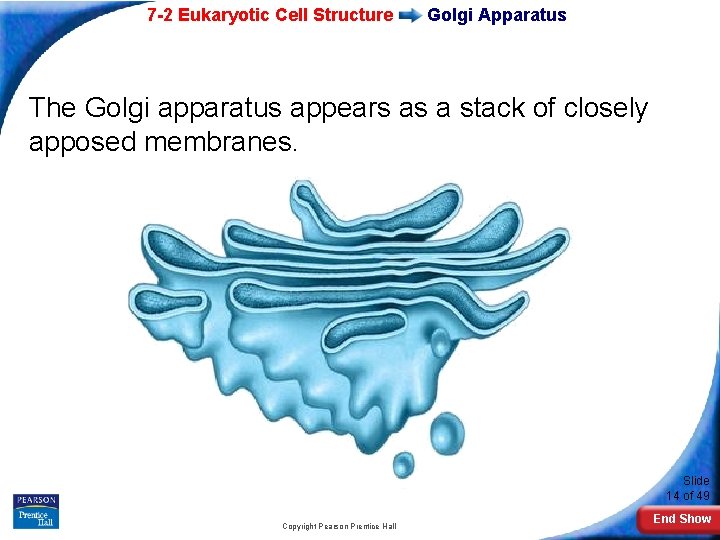
7 -2 Eukaryotic Cell Structure Golgi Apparatus The Golgi apparatus appears as a stack of closely apposed membranes. Slide 14 of 49 Copyright Pearson Prentice Hall End Show
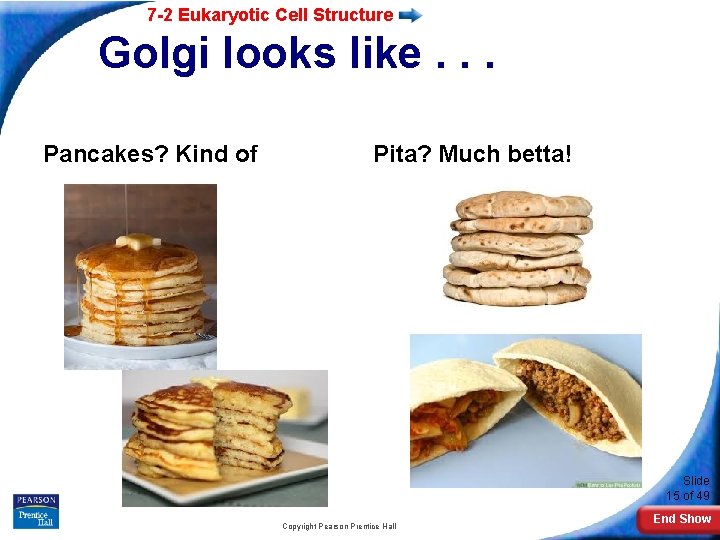
7 -2 Eukaryotic Cell Structure Golgi looks like. . . Pancakes? Kind of Pita? Much betta! Slide 15 of 49 Copyright Pearson Prentice Hall End Show
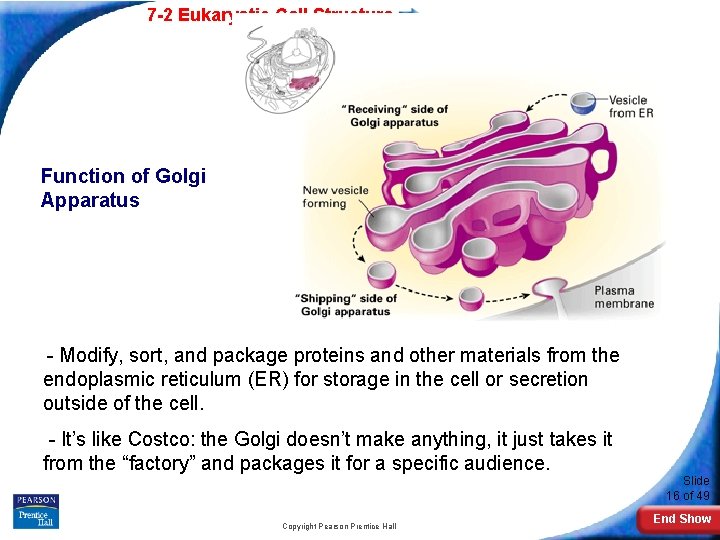
7 -2 Eukaryotic Cell Structure Function of Golgi Apparatus - Modify, sort, and package proteins and other materials from the endoplasmic reticulum (ER) for storage in the cell or secretion outside of the cell. - It’s like Costco: the Golgi doesn’t make anything, it just takes it from the “factory” and packages it for a specific audience. Slide 16 of 49 Copyright Pearson Prentice Hall End Show
7 -2 Eukaryotic Cell Structure Golgi Apparatus What is the function of lysosomes? Slide 17 of 49 Copyright Pearson Prentice Hall End Show
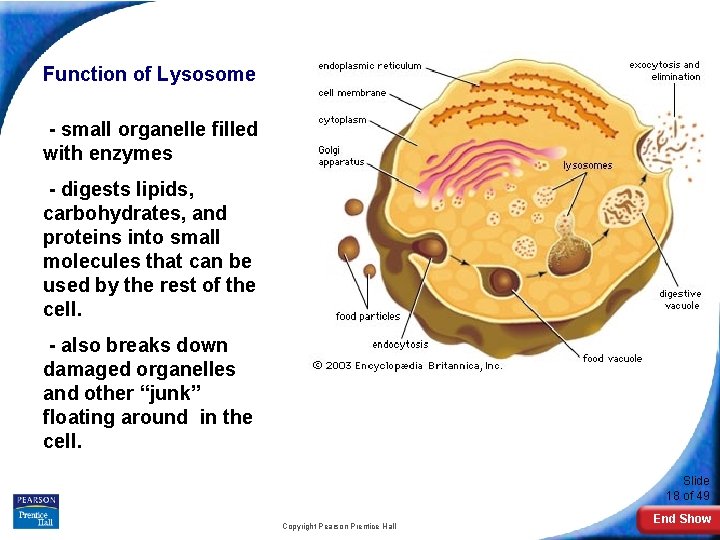
Function of Lysosome - small organelle filled with enzymes - digests lipids, carbohydrates, and proteins into small molecules that can be used by the rest of the cell. - also breaks down damaged organelles and other “junk” floating around in the cell. Slide 18 of 49 Copyright Pearson Prentice Hall End Show
7 -2 Eukaryotic Cell Structure Vacuoles What is the function of vacuoles? Slide 19 of 49 Copyright Pearson Prentice Hall End Show
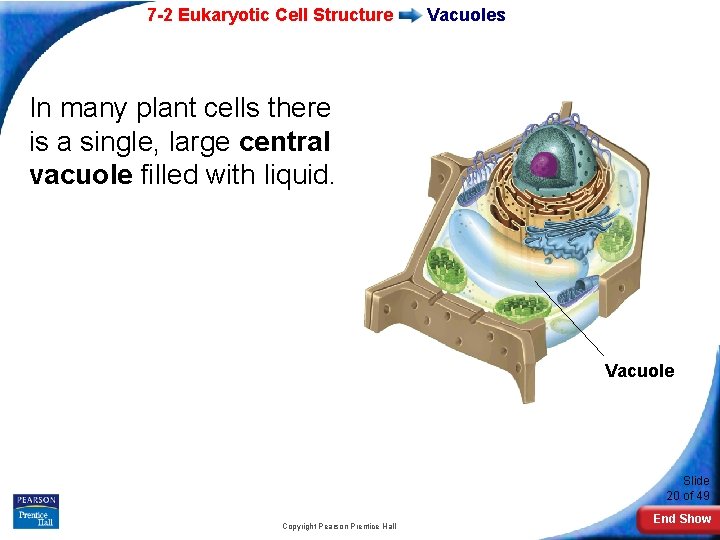
7 -2 Eukaryotic Cell Structure Vacuoles In many plant cells there is a single, large central vacuole filled with liquid. Vacuole Slide 20 of 49 Copyright Pearson Prentice Hall End Show
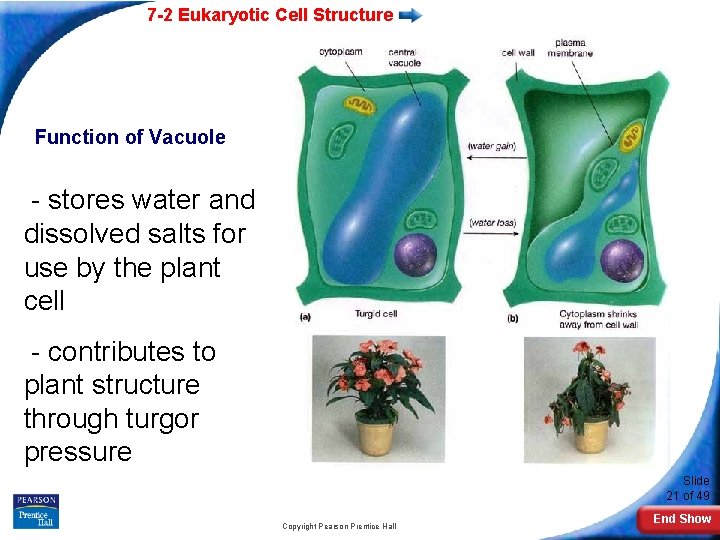
7 -2 Eukaryotic Cell Structure Function of Vacuole - stores water and dissolved salts for use by the plant cell - contributes to plant structure through turgor pressure Slide 21 of 49 Copyright Pearson Prentice Hall End Show
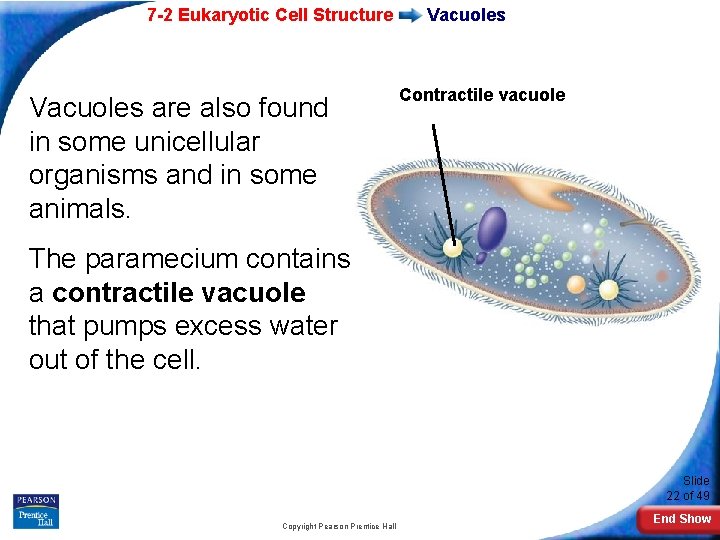
7 -2 Eukaryotic Cell Structure Vacuoles are also found in some unicellular organisms and in some animals. Vacuoles Contractile vacuole The paramecium contains a contractile vacuole that pumps excess water out of the cell. Slide 22 of 49 Copyright Pearson Prentice Hall End Show
7 -2 Eukaryotic Cell Structure Mitochondria and Chloroplasts What is the function of the mitochondria? Slide 23 of 49 Copyright Pearson Prentice Hall End Show
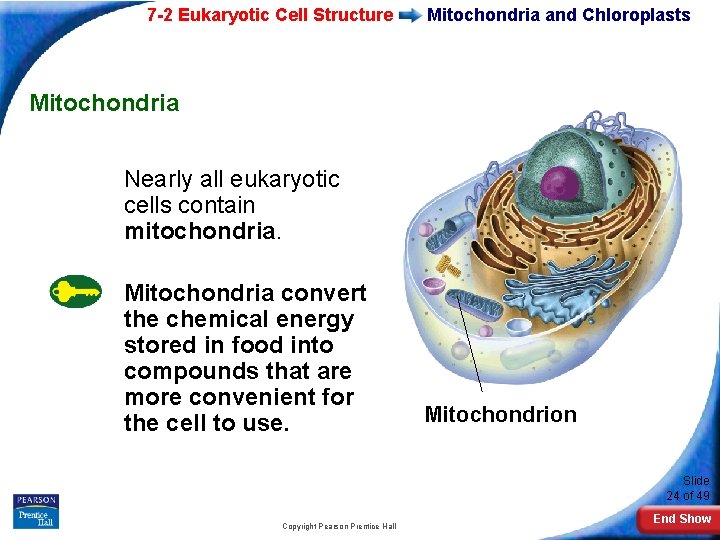
7 -2 Eukaryotic Cell Structure Mitochondria and Chloroplasts Mitochondria Nearly all eukaryotic cells contain mitochondria. Mitochondria convert the chemical energy stored in food into compounds that are more convenient for the cell to use. Mitochondrion Slide 24 of 49 Copyright Pearson Prentice Hall End Show
7 -2 Eukaryotic Cell Structure Mitochondria and Chloroplasts What is the function of chloroplasts? Slide 25 of 49 Copyright Pearson Prentice Hall End Show
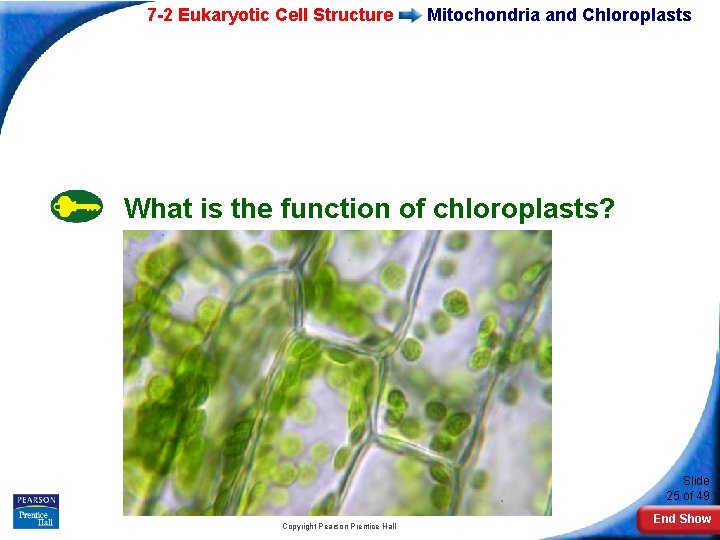
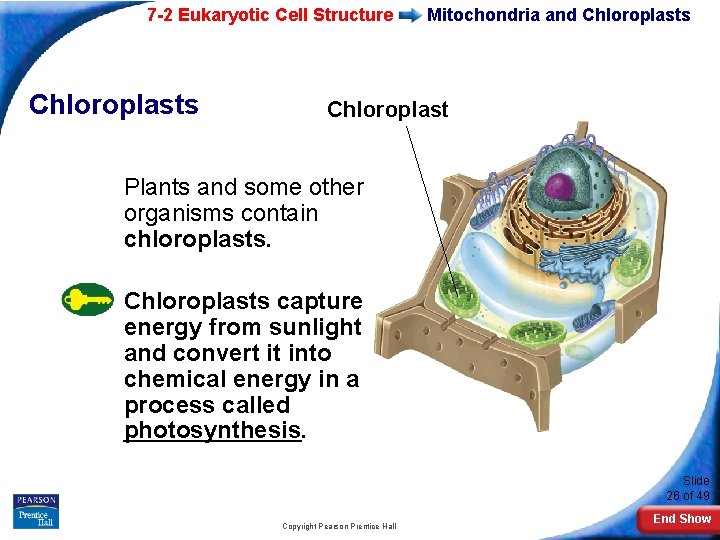
7 -2 Eukaryotic Cell Structure Chloroplasts Mitochondria and Chloroplasts Chloroplast Plants and some other organisms contain chloroplasts. Chloroplasts capture energy from sunlight and convert it into chemical energy in a process called photosynthesis. Slide 26 of 49 Copyright Pearson Prentice Hall End Show
7 -2 Eukaryotic Cell Structure Cytoskeleton What are the functions of the cytoskeleton? Slide 27 of 49 Copyright Pearson Prentice Hall End Show
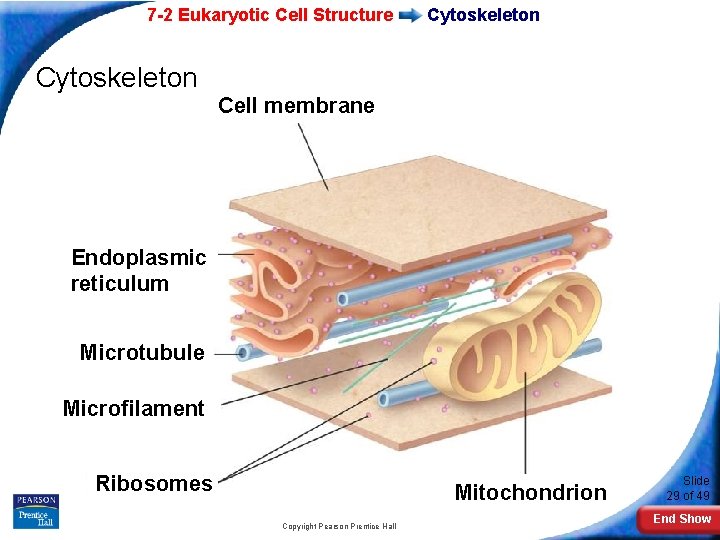
7 -2 Eukaryotic Cell Structure Cytoskeleton The cytoskeleton is a network of protein filaments that helps the cell to maintain its shape. The cytoskeleton is also involved in movement. The cytoskeleton is made up of: • microfilaments • microtubules Slide 28 of 49 Copyright Pearson Prentice Hall End Show
7 -2 Eukaryotic Cell Structure Cytoskeleton Cell membrane Endoplasmic reticulum Microtubule Microfilament Ribosomes Mitochondrion Copyright Pearson Prentice Hall Slide 29 of 49 End Show
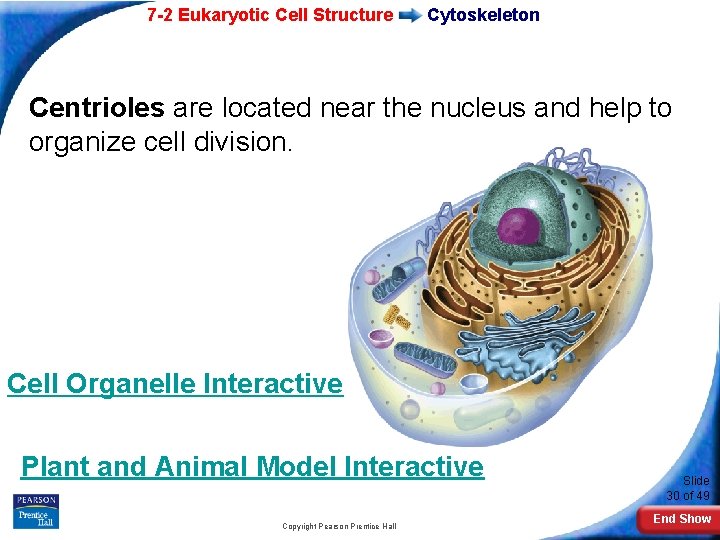
7 -2 Eukaryotic Cell Structure Cytoskeleton Centrioles are located near the nucleus and help to organize cell division. Cell Organelle Interactive Plant and Animal Model Interactive Copyright Pearson Prentice Hall Slide 30 of 49 End Show
7 -2 Click to Launch: Continue to: - or - Slide 31 of 49 End Show Copyright Pearson Prentice Hall
7 -2 In the nucleus of a cell, the DNA is usually visible as a. a dense region called the nucleolus. b. the nuclear envelope. c. granular material called chromatin. d. condensed bodies called chloroplasts. Slide 32 of 49 End Show Copyright Pearson Prentice Hall
7 -2 Two functions of vacuoles are storing materials and helping to a. break down organelles. b. assemble proteins. c. maintain homeostasis. d. make new organelles. Slide 33 of 49 End Show Copyright Pearson Prentice Hall
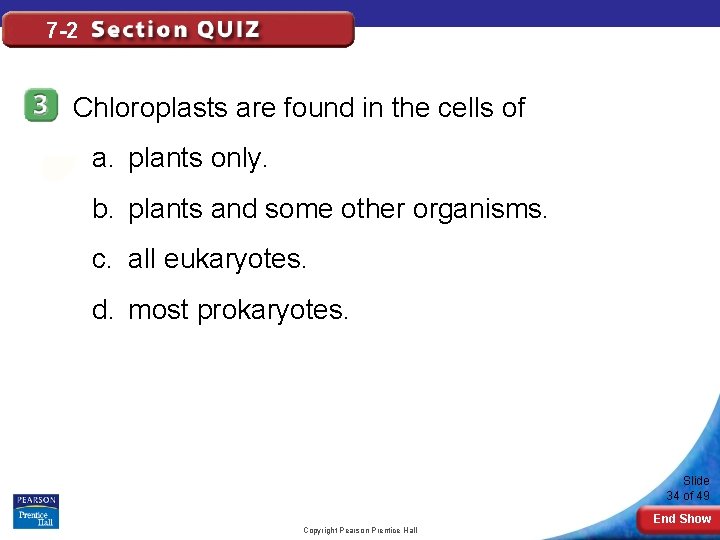
7 -2 Chloroplasts are found in the cells of a. plants only. b. plants and some other organisms. c. all eukaryotes. d. most prokaryotes. Slide 34 of 49 End Show Copyright Pearson Prentice Hall
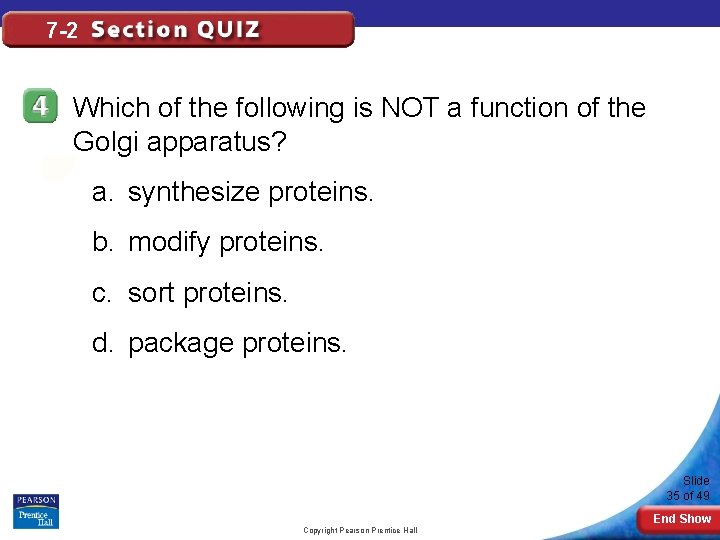
7 -2 Which of the following is NOT a function of the Golgi apparatus? a. synthesize proteins. b. modify proteins. c. sort proteins. d. package proteins. Slide 35 of 49 End Show Copyright Pearson Prentice Hall
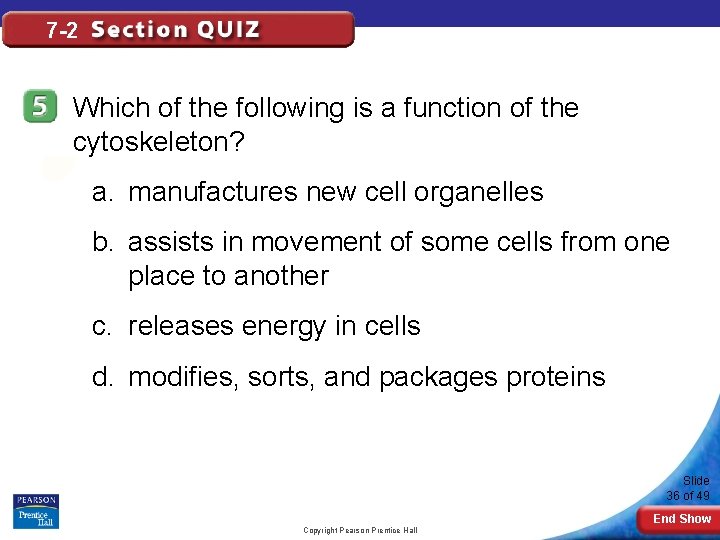
7 -2 Which of the following is a function of the cytoskeleton? a. manufactures new cell organelles b. assists in movement of some cells from one place to another c. releases energy in cells d. modifies, sorts, and packages proteins Slide 36 of 49 End Show Copyright Pearson Prentice Hall
END OF SECTION