6 1 Chapter 6 Inventories and Cost of
- Slides: 66
6 -1 Chapter 6 Inventories and Cost of Goods Sold © 2002 Prentice Hall Business Publishing Introduction to Financial Accounting, 8 th Edition Horngren, Sundem, and Elliott
6 -2 Learning Objectives After studying this chapter, you should be able to: u Link inventory valuation to gross profit. u Use both perpetual and periodic inventory systems. u Calculate the cost of merchandise acquired. u Choose one of the four principal inventory valuation methods. u Calculate the impact on net income of LIFO liquidations. © 2002 Prentice Hall Business Publishing Introduction to Financial Accounting, 8 th Edition Horngren, Sundem, and Elliott
6 -3 Learning Objectives After studying this chapter, you should be able to: u Use the lower-of-cost-or-market method to value inventories. u Show the effects of inventory errors on financial statements. u Evaluate the gross profit percentage and inventory turnover. © 2002 Prentice Hall Business Publishing Introduction to Financial Accounting, 8 th Edition Horngren, Sundem, and Elliott
Gross Profit and Cost of Goods Sold 6 -4 u An initial step in assessing profitability is gross profit (profit margin or gross margin), which is the difference between sales revenues and the costs of the goods sold. u Products being held for resale are reported as inventory, a current asset. • When the goods are sold, the costs of the inventory become an expense, Cost of Goods Sold. This expense is deducted from Net Sales to determine Gross Profit. © 2002 Prentice Hall Business Publishing Introduction to Financial Accounting, 8 th Edition Horngren, Sundem, and Elliott
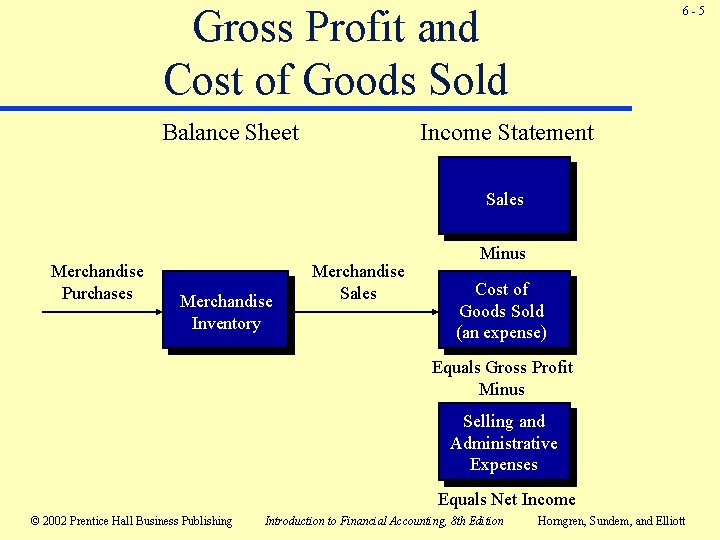
Gross Profit and Cost of Goods Sold Balance Sheet 6 -5 Income Statement Sales Merchandise Purchases Merchandise Inventory Merchandise Sales Minus Cost of Goods Sold (an expense) Equals Gross Profit Minus Selling and Administrative Expenses Equals Net Income © 2002 Prentice Hall Business Publishing Introduction to Financial Accounting, 8 th Edition Horngren, Sundem, and Elliott
The Basic Concept of Inventory Accounting 6 -6 u The key to calculating cost of goods sold is accounting for the remaining inventory at the end of the year. u Cost valuation - process of assigning specific historical costs to items counted in the physical inventory • Multiply the number of items in ending inventory times the cost of each item. © 2002 Prentice Hall Business Publishing Introduction to Financial Accounting, 8 th Edition Horngren, Sundem, and Elliott
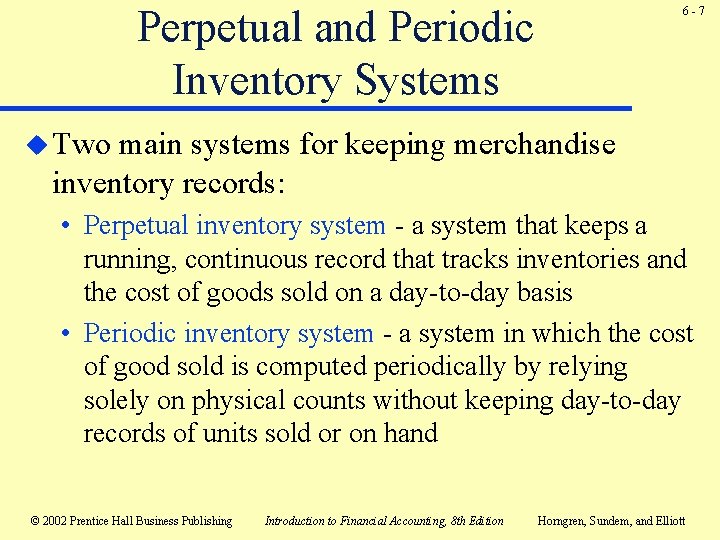
Perpetual and Periodic Inventory Systems 6 -7 u Two main systems for keeping merchandise inventory records: • Perpetual inventory system - a system that keeps a running, continuous record that tracks inventories and the cost of goods sold on a day-to-day basis • Periodic inventory system - a system in which the cost of good sold is computed periodically by relying solely on physical counts without keeping day-to-day records of units sold or on hand © 2002 Prentice Hall Business Publishing Introduction to Financial Accounting, 8 th Edition Horngren, Sundem, and Elliott
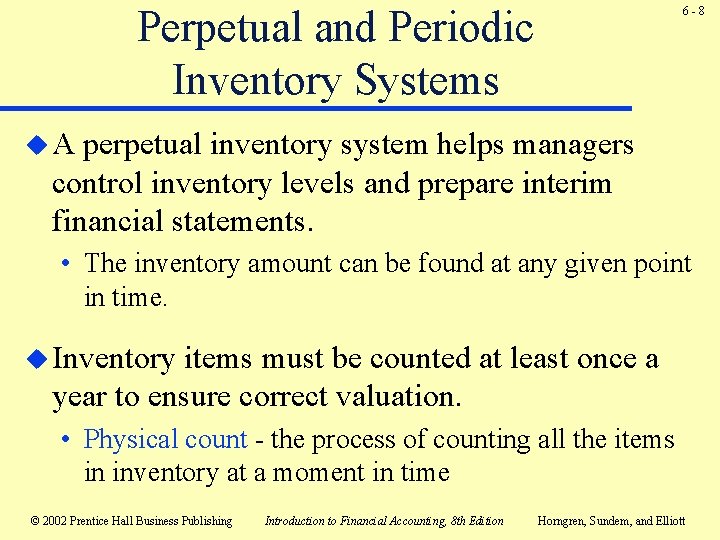
Perpetual and Periodic Inventory Systems 6 -8 u. A perpetual inventory system helps managers control inventory levels and prepare interim financial statements. • The inventory amount can be found at any given point in time. u Inventory items must be counted at least once a year to ensure correct valuation. • Physical count - the process of counting all the items in inventory at a moment in time © 2002 Prentice Hall Business Publishing Introduction to Financial Accounting, 8 th Edition Horngren, Sundem, and Elliott
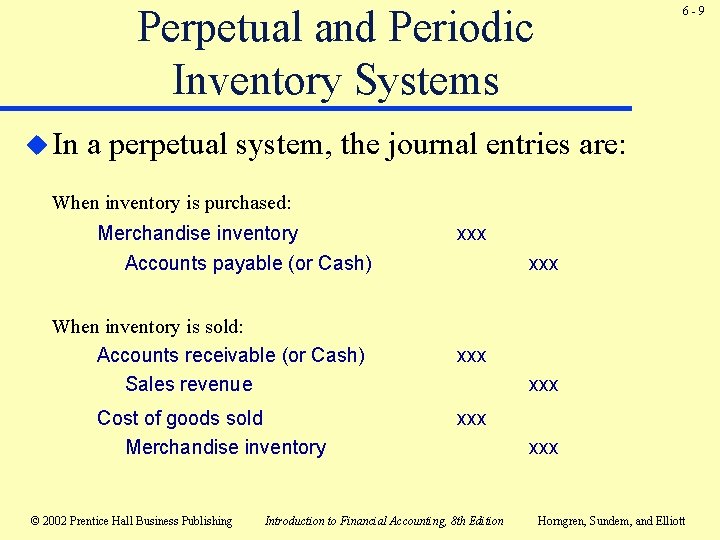
Perpetual and Periodic Inventory Systems u In 6 -9 a perpetual system, the journal entries are: When inventory is purchased: Merchandise inventory Accounts payable (or Cash) When inventory is sold: Accounts receivable (or Cash) Sales revenue Cost of goods sold Merchandise inventory © 2002 Prentice Hall Business Publishing xxx xxx xxx Introduction to Financial Accounting, 8 th Edition xxx Horngren, Sundem, and Elliott
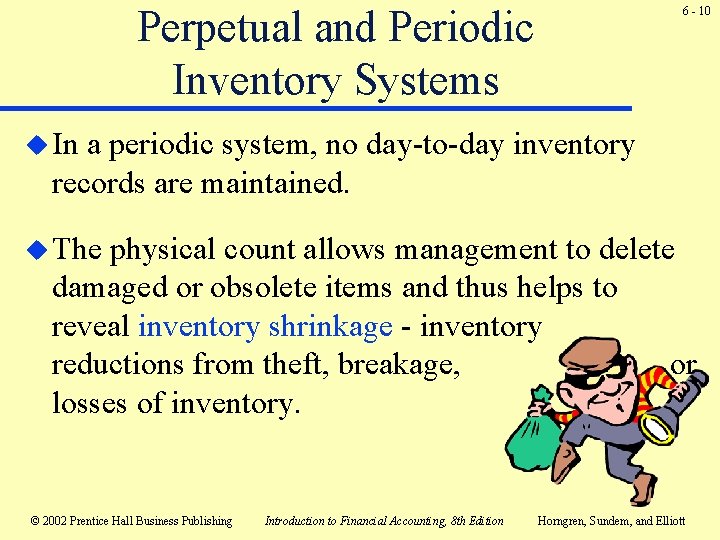
Perpetual and Periodic Inventory Systems 6 - 10 u In a periodic system, no day-to-day inventory records are maintained. u The physical count allows management to delete damaged or obsolete items and thus helps to reveal inventory shrinkage - inventory reductions from theft, breakage, or losses of inventory. © 2002 Prentice Hall Business Publishing Introduction to Financial Accounting, 8 th Edition Horngren, Sundem, and Elliott
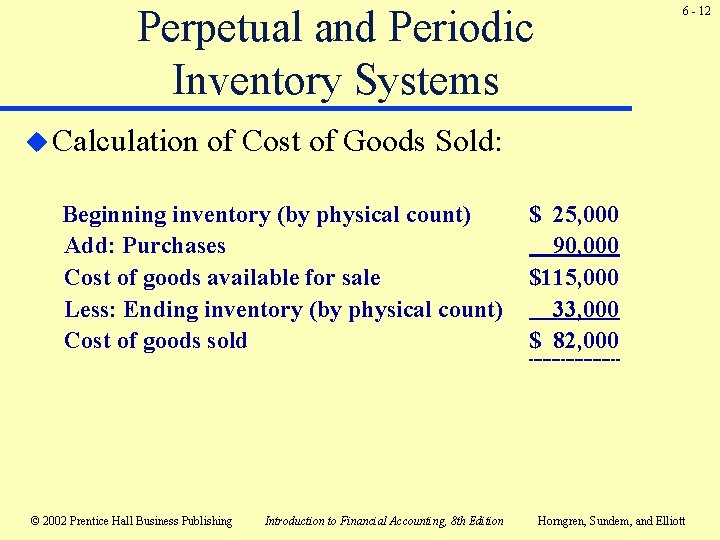
Perpetual and Periodic Inventory Systems 6 - 11 u Under the periodic system, calculations for cost of goods sold start with cost of goods available for sale, which is the sum of the beginning inventory plus current year purchases. u Under the perpetual system, cost of goods sold is kept on a day-to-day basis. © 2002 Prentice Hall Business Publishing Introduction to Financial Accounting, 8 th Edition Horngren, Sundem, and Elliott
Perpetual and Periodic Inventory Systems u Calculation 6 - 12 of Cost of Goods Sold: Beginning inventory (by physical count) Add: Purchases Cost of goods available for sale Less: Ending inventory (by physical count) Cost of goods sold $ 25, 000 90, 000 $115, 000 33, 000 $ 82, 000 ========== © 2002 Prentice Hall Business Publishing Introduction to Financial Accounting, 8 th Edition Horngren, Sundem, and Elliott
Perpetual and Periodic Inventory Systems 6 - 13 u Both methods produce the same cost of goods sold figure. • The perpetual system is more timely, but it is more costly to administer. • The perpetual system is less costly to administer because there is no day-to-day processing regarding inventory costs or cost of goods sold. © 2002 Prentice Hall Business Publishing Introduction to Financial Accounting, 8 th Edition Horngren, Sundem, and Elliott
6 - 14 Physical Inventory u In both periodic and perpetual inventory systems, a physical of each item being held inventory is required. count in u The physical count is extremely important in determining net income because inventory is included in the determination of cost of goods sold. © 2002 Prentice Hall Business Publishing Introduction to Financial Accounting, 8 th Edition Horngren, Sundem, and Elliott
6 - 15 Cost of Merchandise Acquired u Regardless of the inventory system used, the basis of inventory accounting is the cost of the merchandise a company purchases for resale. u What costs are included in the cost of the merchandise? • The cost of merchandise usually includes the invoice price plus any directly identifiable transportation charges less any offsetting discounts. © 2002 Prentice Hall Business Publishing Introduction to Financial Accounting, 8 th Edition Horngren, Sundem, and Elliott
6 - 16 Transportation Charges u The major cost of transporting merchandise is usually freight charges from the shipping point of the seller to the receiving point of the buyer. • If goods are shipped F. O. B. (free on board) destination, the seller pays the costs of shipping the goods to the buyer. • If goods are shipped F. O. B. shipping point, the buyer pays the freight costs of shipping the goods to the buyer. © 2002 Prentice Hall Business Publishing Introduction to Financial Accounting, 8 th Edition Horngren, Sundem, and Elliott
6 - 17 Transportation Charges u In theory, any costs of transportation borne by the buyer should be added to the cost of the inventory acquired. • However, transportation costs are not easy to trace to specific inventory items, so companies usually use a separate transportation cost account called Freight In, Transportation In, Inbound Transportation, Inward Transportation, etc. © 2002 Prentice Hall Business Publishing Introduction to Financial Accounting, 8 th Edition Horngren, Sundem, and Elliott
6 - 18 Transportation Charges u Freight in is usually shown in the purchases section on the income statement as an additional cost of the goods acquired. u Freight out represents the costs borne by the seller and is shown as an expense of selling the merchandise. • It is included with other selling expenses on the income statement. © 2002 Prentice Hall Business Publishing Introduction to Financial Accounting, 8 th Edition Horngren, Sundem, and Elliott
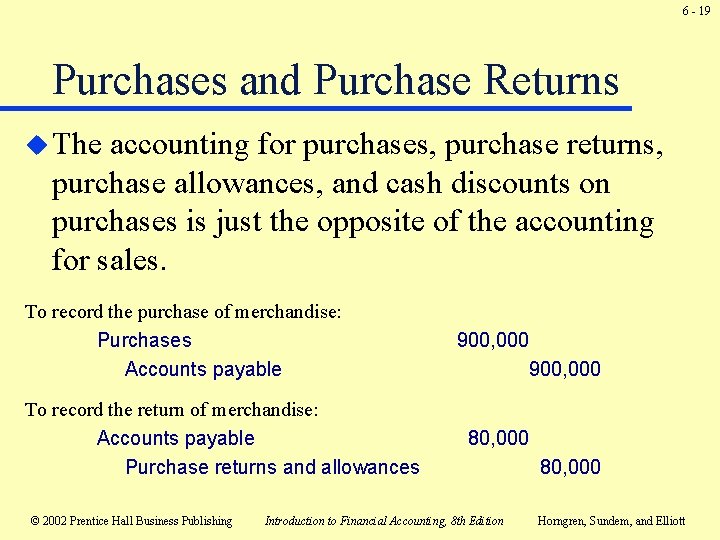
6 - 19 Purchases and Purchase Returns u The accounting for purchases, purchase returns, purchase allowances, and cash discounts on purchases is just the opposite of the accounting for sales. To record the purchase of merchandise: Purchases Accounts payable To record the return of merchandise: Accounts payable Purchase returns and allowances © 2002 Prentice Hall Business Publishing 900, 000 80, 000 Introduction to Financial Accounting, 8 th Edition 80, 000 Horngren, Sundem, and Elliott
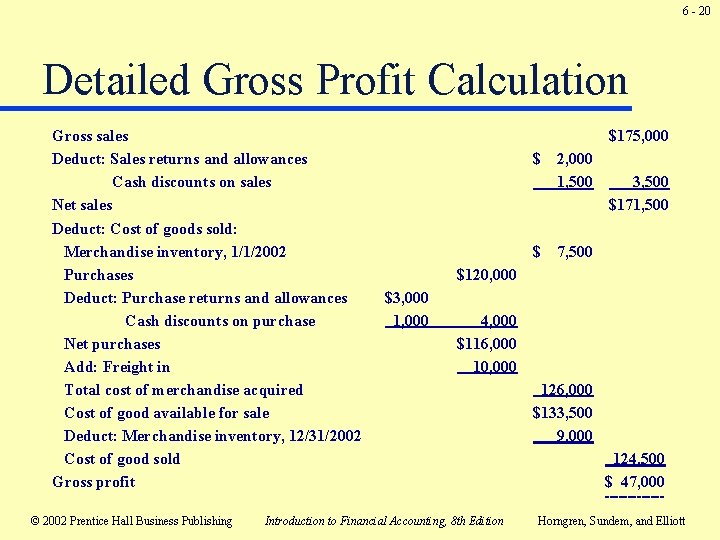
6 - 20 Detailed Gross Profit Calculation Gross sales Deduct: Sales returns and allowances Cash discounts on sales Net sales Deduct: Cost of goods sold: Merchandise inventory, 1/1/2002 Purchases Deduct: Purchase returns and allowances Cash discounts on purchase Net purchases Add: Freight in Total cost of merchandise acquired Cost of good available for sale Deduct: Merchandise inventory, 12/31/2002 Cost of good sold Gross profit $175, 000 $ $ 2, 000 1, 500 3, 500 $171, 500 7, 500 $120, 000 $3, 000 1, 000 4, 000 $116, 000 10, 000 126, 000 $133, 500 9, 000 124, 500 $ 47, 000 ======= © 2002 Prentice Hall Business Publishing Introduction to Financial Accounting, 8 th Edition Horngren, Sundem, and Elliott
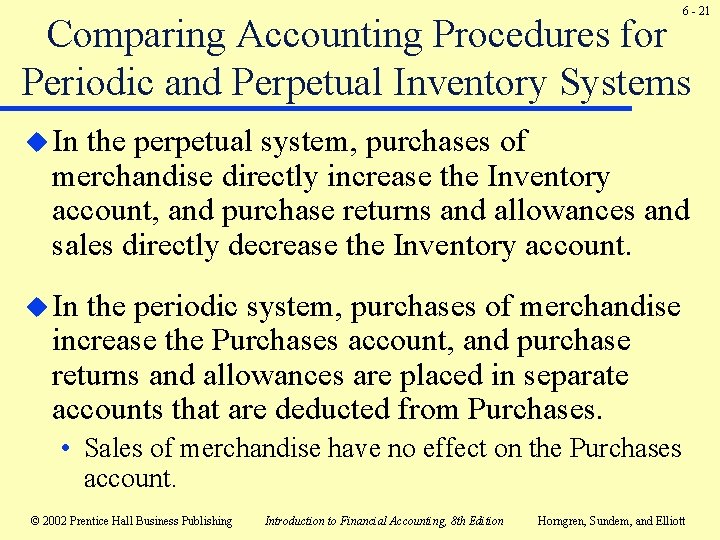
6 - 21 Comparing Accounting Procedures for Periodic and Perpetual Inventory Systems u In the perpetual system, purchases of merchandise directly increase the Inventory account, and purchase returns and allowances and sales directly decrease the Inventory account. u In the periodic system, purchases of merchandise increase the Purchases account, and purchase returns and allowances are placed in separate accounts that are deducted from Purchases. • Sales of merchandise have no effect on the Purchases account. © 2002 Prentice Hall Business Publishing Introduction to Financial Accounting, 8 th Edition Horngren, Sundem, and Elliott
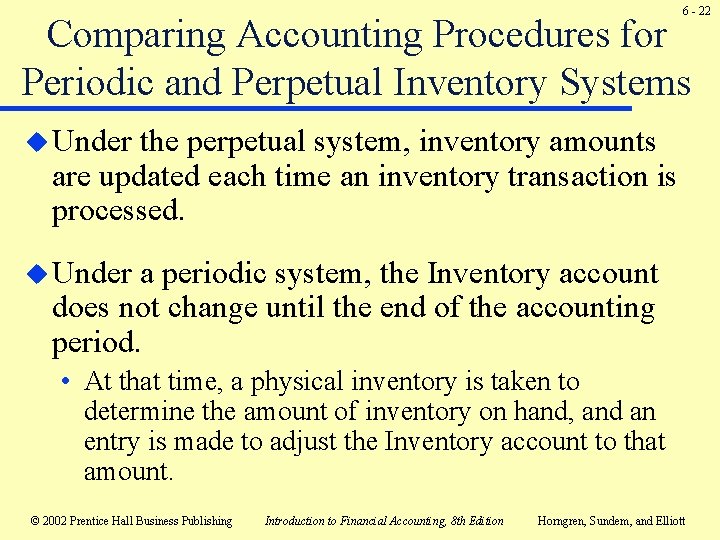
6 - 22 Comparing Accounting Procedures for Periodic and Perpetual Inventory Systems u Under the perpetual system, inventory amounts are updated each time an inventory transaction is processed. u Under a periodic system, the Inventory account does not change until the end of the accounting period. • At that time, a physical inventory is taken to determine the amount of inventory on hand, and an entry is made to adjust the Inventory account to that amount. © 2002 Prentice Hall Business Publishing Introduction to Financial Accounting, 8 th Edition Horngren, Sundem, and Elliott
Principal Inventory Valuation Methods 6 - 23 u Four inventory valuation systems have been generally accepted. • • Specific identification First in, first out (FIFO) Last in, first out (LIFO) Weighted average © 2002 Prentice Hall Business Publishing Introduction to Financial Accounting, 8 th Edition Horngren, Sundem, and Elliott
Principal Inventory Valuation Methods 6 - 24 u If unit prices and costs did not change, all four inventory valuation methods would show identical results. u Because prices change, cost of goods sold (income measurement) and inventories (asset measurement) are affected. • The choice of the inventory valuation method can significantly affect the amount reported as net income and ending inventory. © 2002 Prentice Hall Business Publishing Introduction to Financial Accounting, 8 th Edition Horngren, Sundem, and Elliott
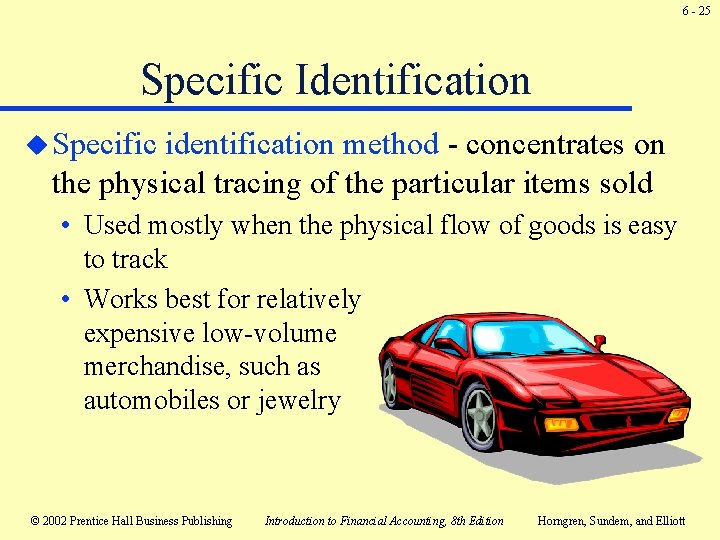
6 - 25 Specific Identification u Specific identification method - concentrates on the physical tracing of the particular items sold • Used mostly when the physical flow of goods is easy to track • Works best for relatively expensive low-volume merchandise, such as automobiles or jewelry © 2002 Prentice Hall Business Publishing Introduction to Financial Accounting, 8 th Edition Horngren, Sundem, and Elliott
6 - 26 FIFO u FIFO (first in, first out) method - assigns the cost of the earliest acquired units to cost of goods sold • This might not be the actual physical flow of goods within the company. • Under FIFO, the oldest units are deemed to be sold, regardless of which units are actually given to the customer. • The costs of the newer units in stock are included in ending inventory. © 2002 Prentice Hall Business Publishing Introduction to Financial Accounting, 8 th Edition Horngren, Sundem, and Elliott
6 - 27 FIFO u FIFO includes the most recent costs in ending inventory, so the inventory tends to closely approximate that actual market value of the inventory at the balance sheet date. u Also, in periods when prices are rising, FIFO leads to higher net income because the costs of the older, lower costing items are included in cost of goods sold. © 2002 Prentice Hall Business Publishing Introduction to Financial Accounting, 8 th Edition Horngren, Sundem, and Elliott
6 - 28 LIFO u LIFO (last in, first out) method - assigns the most recent costs to cost of goods sold • This might not be the actual physical flow of goods within the company. • Under LIFO, the newest units are deemed to be sold, regardless of which units are actually given to the customer. • The costs of the older units in stock are included in ending inventory. © 2002 Prentice Hall Business Publishing Introduction to Financial Accounting, 8 th Edition Horngren, Sundem, and Elliott
6 - 29 LIFO uses the oldest costs to value ending inventory, so that value may be significantly different from the actual market value of the inventory at the balance sheet date. u In periods when prices are rising, LIFO yields lower net income because the higher costs of more recent purchases are put into cost of goods sold first. © 2002 Prentice Hall Business Publishing Introduction to Financial Accounting, 8 th Edition Horngren, Sundem, and Elliott
6 - 30 LIFO u Because LIFO results in reduced net income, it also results in lower income taxes. • The Internal Revenue Code requires that if a company uses LIFO to compute its taxable income, the company must also use LIFO to compute its financial net income. • The result is lower income taxes and lower reported earnings figures to investors. © 2002 Prentice Hall Business Publishing Introduction to Financial Accounting, 8 th Edition Horngren, Sundem, and Elliott
6 - 31 LIFO u If LIFO is such a good deal, why do some companies still use FIFO? u For several reasons: • The costs of changing methods can be significant. • Management may be reluctant to decrease earnings and possibly salaries and bonuses. • Management might fear that lower income would hurt in loan negotiations with banks. • Lower earnings will often lower stock prices. © 2002 Prentice Hall Business Publishing Introduction to Financial Accounting, 8 th Edition Horngren, Sundem, and Elliott
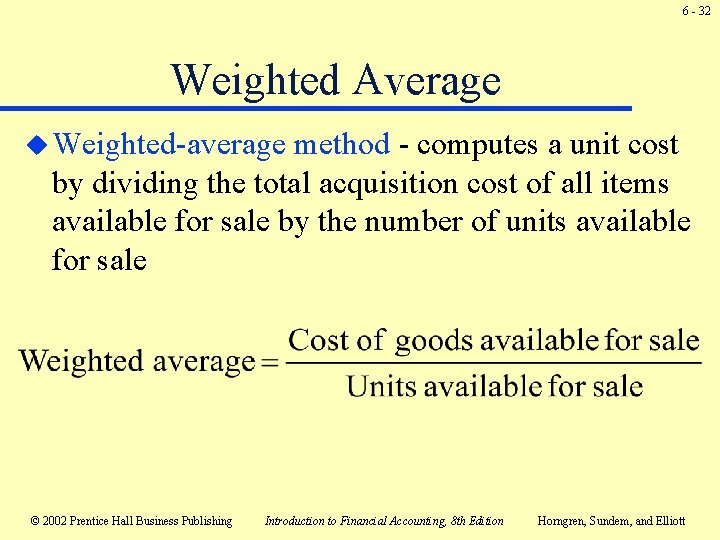
6 - 32 Weighted Average u Weighted-average method - computes a unit cost by dividing the total acquisition cost of all items available for sale by the number of units available for sale © 2002 Prentice Hall Business Publishing Introduction to Financial Accounting, 8 th Edition Horngren, Sundem, and Elliott
6 - 33 Weighted Average u The averaging in the weighted average must consider not only the price paid, but also the number of units purchased at each price. u The weighted-average method produces a gross profit somewhere between gross profit under FIFO and LIFO. © 2002 Prentice Hall Business Publishing Introduction to Financial Accounting, 8 th Edition Horngren, Sundem, and Elliott
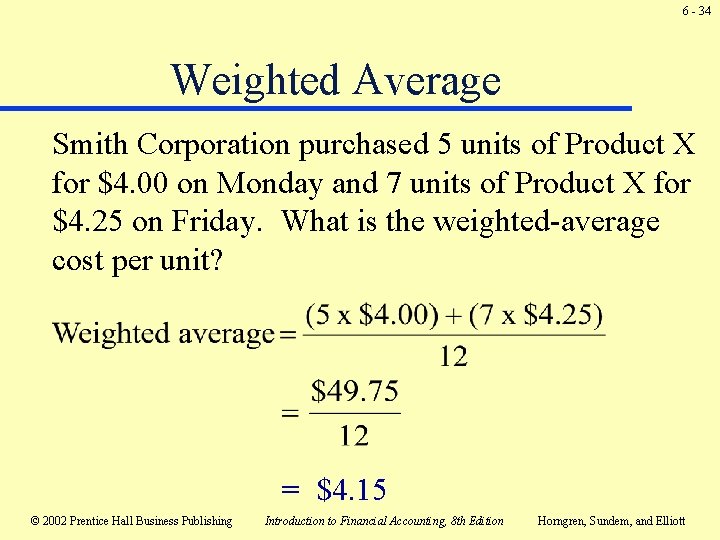
6 - 34 Weighted Average Smith Corporation purchased 5 units of Product X for $4. 00 on Monday and 7 units of Product X for $4. 25 on Friday. What is the weighted-average cost per unit? = $4. 15 © 2002 Prentice Hall Business Publishing Introduction to Financial Accounting, 8 th Edition Horngren, Sundem, and Elliott
6 - 35 Cost Flow Assumptions u The accounting profession has determined that companies may choose any of the four methods for valuing inventory. u The units are all the same, but their costs are different, so tracing the flow or assignment of those costs is more important than tracing where each specific unit actually goes. © 2002 Prentice Hall Business Publishing Introduction to Financial Accounting, 8 th Edition Horngren, Sundem, and Elliott
6 - 36 Cost Flow Assumptions u Because three out of the four methods are not linked to the physical flow of the goods, inventory valuation methods are often called cost flow assumptions. • No matter which cost flow assumption is picked, the cumulative gross profit over the life of a company remains the same. • The need to match particular costs to particular revenues makes the choice of cost flow assumptions important. © 2002 Prentice Hall Business Publishing Introduction to Financial Accounting, 8 th Edition Horngren, Sundem, and Elliott
6 - 37 Inventory Cost Relationships u The four cost flow assumptions affect inventory only; they do not affect purchases and liabilities for those purchases. u Note that in the detailed computation of gross profit, ending inventory affects cost of goods sold. • The lower the ending inventory, the higher the cost of goods sold. • The higher the ending inventory, the lower the cost of goods sold. © 2002 Prentice Hall Business Publishing Introduction to Financial Accounting, 8 th Edition Horngren, Sundem, and Elliott
6 - 38 The Consistency Convention u Although companies can choose any cost flow assumption, they have to be consistent over time. u Consistency - conformity from period to period with unchanging policies and procedures • Consistency makes year-to-year comparisons of financial information useful. • Companies may change inventory methods for justifiable reasons, such as changes in market conditions. © 2002 Prentice Hall Business Publishing Introduction to Financial Accounting, 8 th Edition Horngren, Sundem, and Elliott
Characteristics and Consequences of LIFO 6 - 39 u LIFO is widely used in the U. S. for reasons stated earlier; however, LIFO is a fairly uncommon inventory method. • Many countries do not allow its use. u The most popular method worldwide is weighted average, followed by FIFO. © 2002 Prentice Hall Business Publishing Introduction to Financial Accounting, 8 th Edition Horngren, Sundem, and Elliott
Holding Gains and Inventory Profits 6 - 40 u LIFO approximates a replacement cost view of transactions, and measures profit relative to newer costs. • Replacement cost - the cost at which an inventory item could be acquired today u In contrast, FIFO measures profit relative to older costs. © 2002 Prentice Hall Business Publishing Introduction to Financial Accounting, 8 th Edition Horngren, Sundem, and Elliott
Holding Gains and Inventory Profits 6 - 41 u The difference between profit measured under FIFO and LIFO is called a holding gain or an inventory profit. • The holding gain is also the difference between the historical cost under FIFO (older costs) and the historical cost under LIFO (newer costs). • LIFO ending inventory rarely has holding gains. • FIFO ending inventory often has holding gains. © 2002 Prentice Hall Business Publishing Introduction to Financial Accounting, 8 th Edition Horngren, Sundem, and Elliott
6 - 42 LIFO Layers u LIFO layer - a separately identifiable additional segment of LIFO inventory • Ending inventory under LIFO will have one total value, but it may contain prices from many different points in time. • As a company continues in business, the LIFO layers tend to pile on top of one another over the years. © 2002 Prentice Hall Business Publishing Introduction to Financial Accounting, 8 th Edition Horngren, Sundem, and Elliott
6 - 43 LIFO Layers u Many companies show inventories that have LIFO layers dating as far back as 1940, when LIFO was first used. • These inventories are probably far below the true market value or replacement cost of the inventory. u LIFO presents an economic reality on the income statement, but FIFO presents a more up-to-date valuation on the balance sheet. © 2002 Prentice Hall Business Publishing Introduction to Financial Accounting, 8 th Edition Horngren, Sundem, and Elliott
6 - 44 LIFO Inventory Liquidations u As stated before, in periods of rising prices, LIFO will produce a higher cost of goods sold and lower gross profit than FIFO. u Sometimes companies must “liquidate” some of their LIFO layers, that is, units in the older LIFO layers are sold. • In such a case, cost of goods sold decreases because very old costs are now included in cost of goods sold. When cost of goods sold decreases, gross profit increases. © 2002 Prentice Hall Business Publishing Introduction to Financial Accounting, 8 th Edition Horngren, Sundem, and Elliott
6 - 45 LIFO Inventory Liquidations u Security analysts often like to keep track of the effect of choosing LIFO over FIFO because the effect on net income can be significant. u LIFO reserve - the difference between a company’s inventory valued at LIFO and what it would be under FIFO • The balance in the LIFO reserve indicates the cumulative effect on gross profit over all prior years due to LIFO. © 2002 Prentice Hall Business Publishing Introduction to Financial Accounting, 8 th Edition Horngren, Sundem, and Elliott
6 - 46 Adjusting from LIFO to FIFO u When lower costs are used to calculate cost of goods sold under LIFO, cost of goods sold will be lower and net income will be higher. u The change in the LIFO reserve from one year to another answers the question “How much did this year’s LIFO cost of goods sold differ from the FIFO cost of goods sold? ” © 2002 Prentice Hall Business Publishing Introduction to Financial Accounting, 8 th Edition Horngren, Sundem, and Elliott
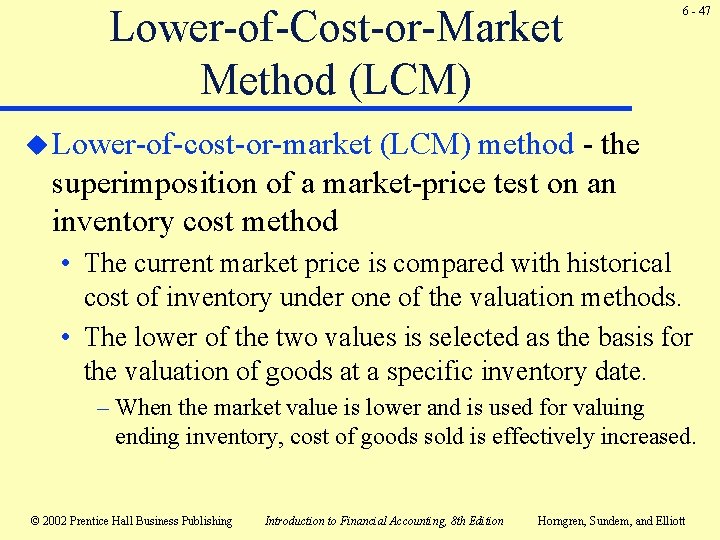
Lower-of-Cost-or-Market Method (LCM) 6 - 47 u Lower-of-cost-or-market (LCM) method - the superimposition of a market-price test on an inventory cost method • The current market price is compared with historical cost of inventory under one of the valuation methods. • The lower of the two values is selected as the basis for the valuation of goods at a specific inventory date. – When the market value is lower and is used for valuing ending inventory, cost of goods sold is effectively increased. © 2002 Prentice Hall Business Publishing Introduction to Financial Accounting, 8 th Edition Horngren, Sundem, and Elliott
Lower-of-Cost-or-Market Method (LCM) 6 - 48 u LCM is an example of conservatism, which means selecting the methods of measurement that yield lower net income, lower assets, and lower stockholders’ equity. • Erring in the direction of conservatism is better than erring in the direction of overstating assets and net income. © 2002 Prentice Hall Business Publishing Introduction to Financial Accounting, 8 th Edition Horngren, Sundem, and Elliott
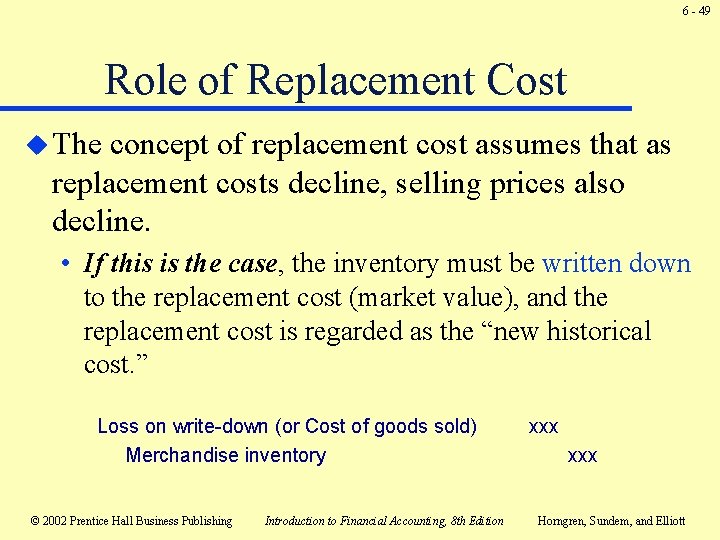
6 - 49 Role of Replacement Cost u The concept of replacement cost assumes that as replacement costs decline, selling prices also decline. • If this is the case, the inventory must be written down to the replacement cost (market value), and the replacement cost is regarded as the “new historical cost. ” Loss on write-down (or Cost of goods sold) Merchandise inventory © 2002 Prentice Hall Business Publishing Introduction to Financial Accounting, 8 th Edition xxx Horngren, Sundem, and Elliott
6 - 50 Conservatism in Action u The LCM method reports less net income in the period of decline in market value and more net income in the period of sale. • The LCM method affects how much income is reported in each year, but not the total income over the company’s life. © 2002 Prentice Hall Business Publishing Introduction to Financial Accounting, 8 th Edition Horngren, Sundem, and Elliott
6 - 51 Effects of Inventory Errors u An undiscovered inventory error usually affects two accounting periods. • Amounts are affected in the period in which the error occurred, but the effects will be counterbalanced by identical offsetting amounts in the following period. • The net effect on retained income across the two periods is zero. © 2002 Prentice Hall Business Publishing Introduction to Financial Accounting, 8 th Edition Horngren, Sundem, and Elliott
6 - 52 Effects of Inventory Errors u. A handy rule of thumb: • If ending inventory is understated, retained income is understated because cost of good sold is overstated. • If ending inventory is overstated, retained income is overstated because cost of goods sold is understated. © 2002 Prentice Hall Business Publishing Introduction to Financial Accounting, 8 th Edition Horngren, Sundem, and Elliott
Cutoff Errors and Inventory Valuation 6 - 53 u Cutoff errors - failure to record transactions in the correct time period u The general approach to recording purchases and sales is keyed to the legal transfer of ownership. • Inventory is counted only if it is owned by the company. © 2002 Prentice Hall Business Publishing Introduction to Financial Accounting, 8 th Edition Horngren, Sundem, and Elliott
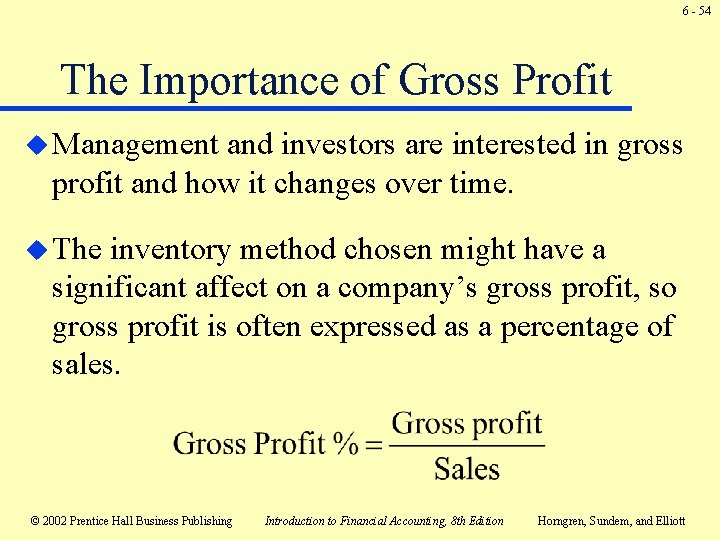
6 - 54 The Importance of Gross Profit u Management and investors are interested in gross profit and how it changes over time. u The inventory method chosen might have a significant affect on a company’s gross profit, so gross profit is often expressed as a percentage of sales. © 2002 Prentice Hall Business Publishing Introduction to Financial Accounting, 8 th Edition Horngren, Sundem, and Elliott
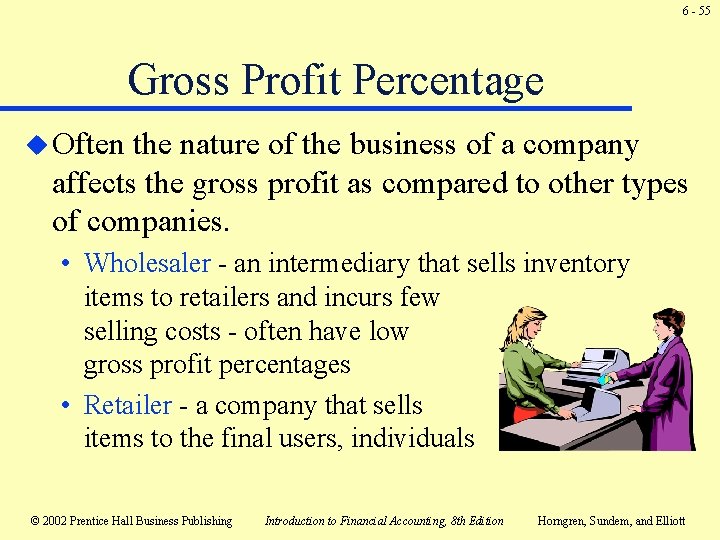
6 - 55 Gross Profit Percentage u Often the nature of the business of a company affects the gross profit as compared to other types of companies. • Wholesaler - an intermediary that sells inventory items to retailers and incurs few selling costs - often have low gross profit percentages • Retailer - a company that sells items to the final users, individuals © 2002 Prentice Hall Business Publishing Introduction to Financial Accounting, 8 th Edition Horngren, Sundem, and Elliott
Estimating Intraperiod Gross Profit and Inventory 6 - 56 u The gross profit percentage is very useful in estimating inventory amounts when related information is unavailable. • Companies that prepare interim financial statements cannot take physical inventories each period; therefore, they must rely on gross profit percentage or ratios to estimate inventory amounts. • For example, if a company knows its normal gross profit percentage, it can estimate its cost of goods sold based on its amount of sales. © 2002 Prentice Hall Business Publishing Introduction to Financial Accounting, 8 th Edition Horngren, Sundem, and Elliott
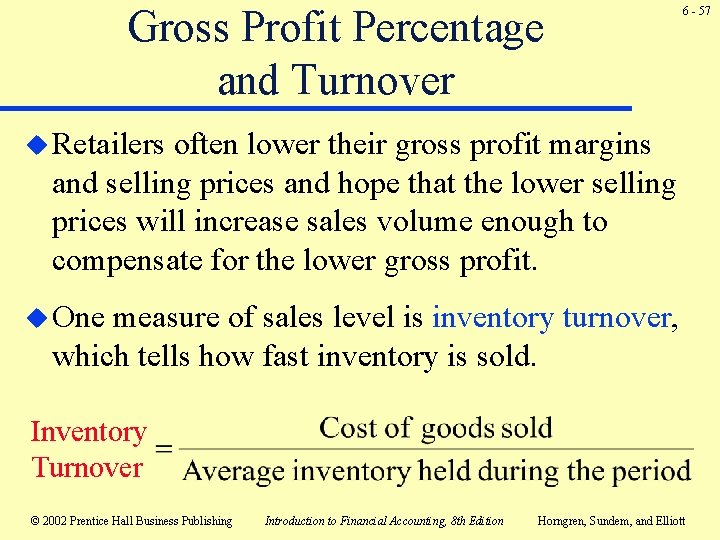
Gross Profit Percentage and Turnover 6 - 57 u Retailers often lower their gross profit margins and selling prices and hope that the lower selling prices will increase sales volume enough to compensate for the lower gross profit. u One measure of sales level is inventory turnover, which tells how fast inventory is sold. Inventory Turnover © 2002 Prentice Hall Business Publishing Introduction to Financial Accounting, 8 th Edition Horngren, Sundem, and Elliott
Gross Profit Percentage and Turnover 6 - 58 u Industries with higher gross profit percentages tend to have the lowest inventory turnover. • Inventory turnover is especially effective for assessing companies in the same industry. • A higher inventory turnover indicates an ability to use smaller inventory levels to attain a high sales level. © 2002 Prentice Hall Business Publishing Introduction to Financial Accounting, 8 th Edition Horngren, Sundem, and Elliott
Gross Profit Percentages and Accuracy of Records 6 - 59 u Auditors use the gross profit percentage to help satisfy themselves about the accuracy of records. • IRS auditors watch gross profit percentages of companies and compare them to those of other companies in the same industry as a clue that all sales might not have been reported. • Managers watch gross profit percentages to judge operational profitability. © 2002 Prentice Hall Business Publishing Introduction to Financial Accounting, 8 th Edition Horngren, Sundem, and Elliott
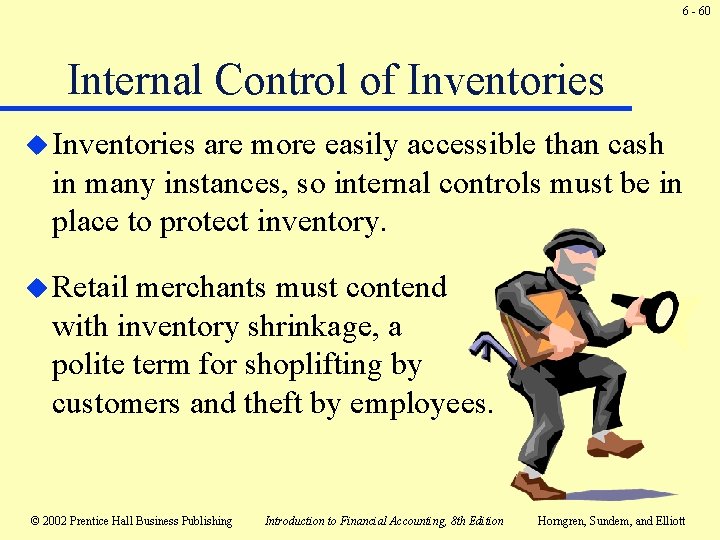
6 - 60 Internal Control of Inventories u Inventories are more easily accessible than cash in many instances, so internal controls must be in place to protect inventory. u Retail merchants must contend with inventory shrinkage, a polite term for shoplifting by customers and theft by employees. © 2002 Prentice Hall Business Publishing Introduction to Financial Accounting, 8 th Edition Horngren, Sundem, and Elliott
6 - 61 Internal Control of Inventories u Internal controls over inventory: • Alert employees at the point of sale • Sensitized tags on merchandise that set off an alarm as the item leaves the store • Surveillance cameras u Retailers must also watch their own employees. • Employees account for 30% to 40% of inventory shortages. © 2002 Prentice Hall Business Publishing Introduction to Financial Accounting, 8 th Edition Horngren, Sundem, and Elliott
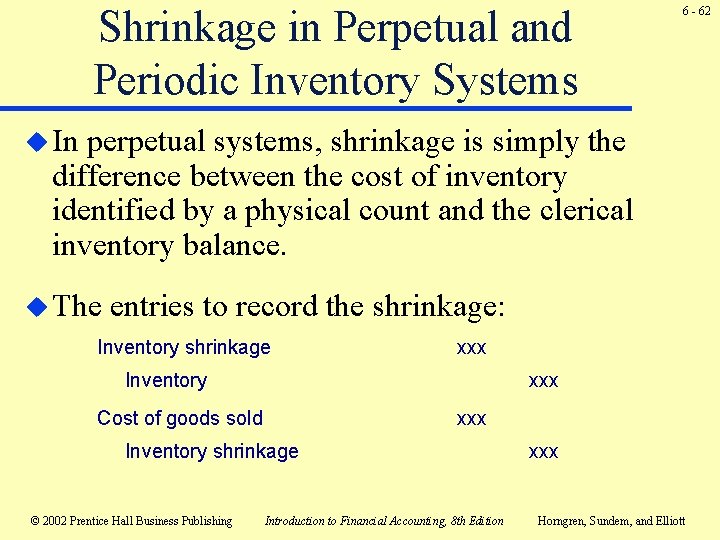
Shrinkage in Perpetual and Periodic Inventory Systems 6 - 62 u In perpetual systems, shrinkage is simply the difference between the cost of inventory identified by a physical count and the clerical inventory balance. u The entries to record the shrinkage: Inventory shrinkage xxx Inventory xxx Cost of goods sold xxx Inventory shrinkage © 2002 Prentice Hall Business Publishing Introduction to Financial Accounting, 8 th Edition xxx Horngren, Sundem, and Elliott
Shrinkage in Perpetual and Periodic Inventory Systems 6 - 63 u In periodic systems, no clerical balance of inventory exists. u Inventory shrinkage is automatically included in cost of goods sold. • Beginning inventory plus purchases less ending inventory measures all inventory that has flowed out, whether it was sold, stolen, or damaged. © 2002 Prentice Hall Business Publishing Introduction to Financial Accounting, 8 th Edition Horngren, Sundem, and Elliott
Inventory in a Manufacturing Environment 6 - 64 u When a company manufactures products, the cost of inventory is a combination of the cost of raw materials, the wages paid to workers who make the product, and an allocation of costs of space, energy, and equipment used by the workers to make the product. © 2002 Prentice Hall Business Publishing Introduction to Financial Accounting, 8 th Edition Horngren, Sundem, and Elliott
Inventory in a Manufacturing Environment 6 - 65 u Manufacturing firms have three types of inventory, each of which is in a different stage of completion. • Raw materials inventory - includes the cost of materials held for use in the manufacturing of a product • Work in process inventory - includes the cost incurred for partially completed items, including costs of raw materials, labor, and other costs • Finished goods inventory - the accumulated costs of manufacturing for goods that are complete and ready for sale © 2002 Prentice Hall Business Publishing Introduction to Financial Accounting, 8 th Edition Horngren, Sundem, and Elliott
6 - 66 Introduction to Financial Accounting 8 th Edition Power. Point Presentation Developed by: Eddie Metrejean, MTAX, CPA University of Mississippi Images provided by New Vision Technology 1 -800 -387 -0732 nvtech. com © 2002 Prentice Hall Business Publishing Introduction to Financial Accounting, 8 th Edition Horngren, Sundem, and Elliott