2 1 Convert 0 000459 to scientific notation

- Slides: 50
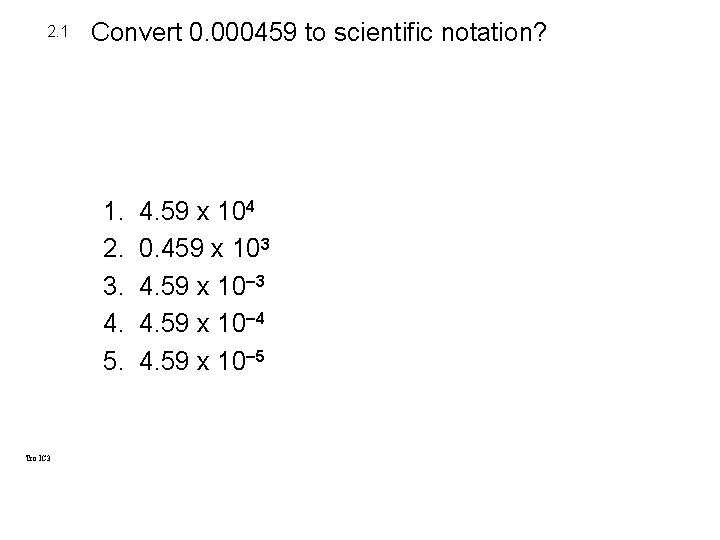
2. 1 Convert 0. 000459 to scientific notation? 1. 2. 3. 4. 5. Tro IC 3 4. 59 x 104 0. 459 x 103 4. 59 x 10– 4 4. 59 x 10– 5
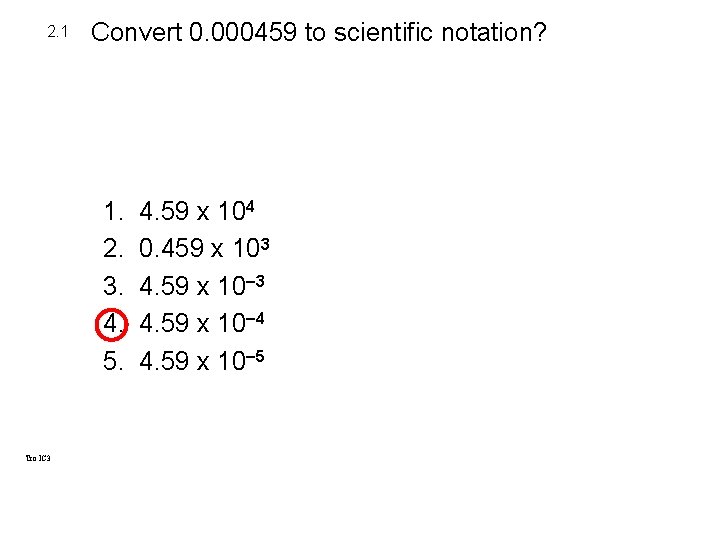
2. 1 Convert 0. 000459 to scientific notation? 1. 2. 3. 4. 5. Tro IC 3 4. 59 x 104 0. 459 x 103 4. 59 x 10– 4 4. 59 x 10– 5
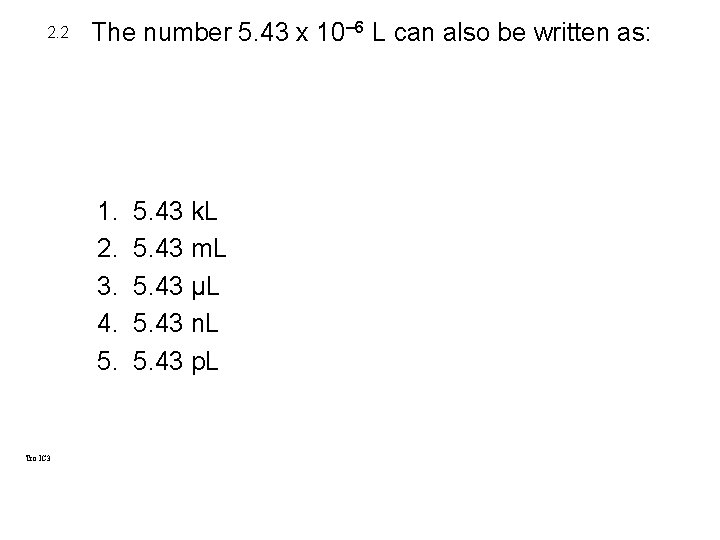
2. 2 The number 5. 43 x 10– 6 L can also be written as: 1. 2. 3. 4. 5. Tro IC 3 5. 43 k. L 5. 43 m. L 5. 43 µL 5. 43 n. L 5. 43 p. L
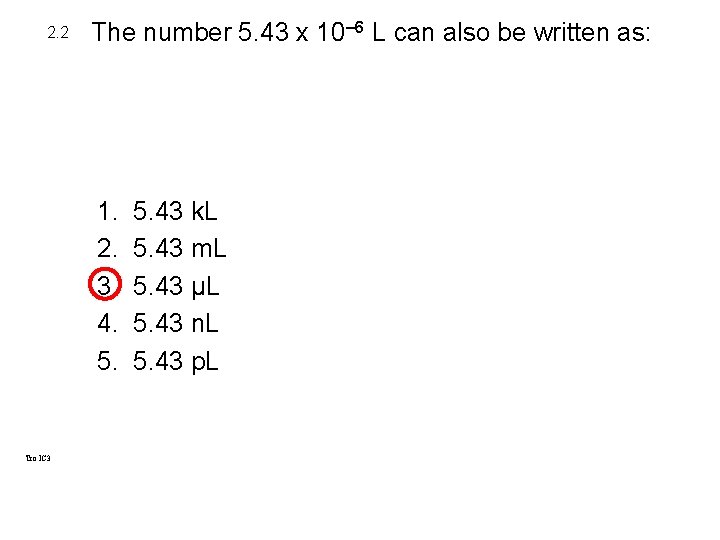
2. 2 The number 5. 43 x 10– 6 L can also be written as: 1. 2. 3. 4. 5. Tro IC 3 5. 43 k. L 5. 43 m. L 5. 43 µL 5. 43 n. L 5. 43 p. L
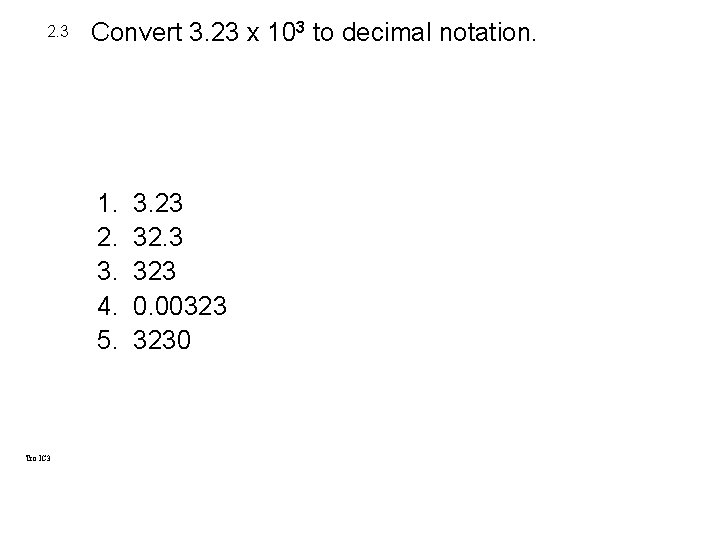
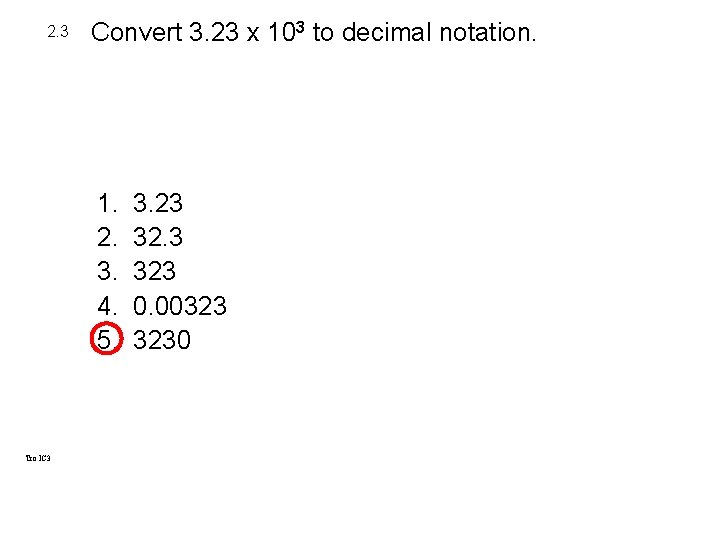
2. 3 Convert 3. 23 x 103 to decimal notation. 1. 2. 3. 4. 5. Tro IC 3 3. 23 323 0. 00323 3230
2. 3 Convert 3. 23 x 103 to decimal notation. 1. 2. 3. 4. 5. Tro IC 3 3. 23 323 0. 00323 3230
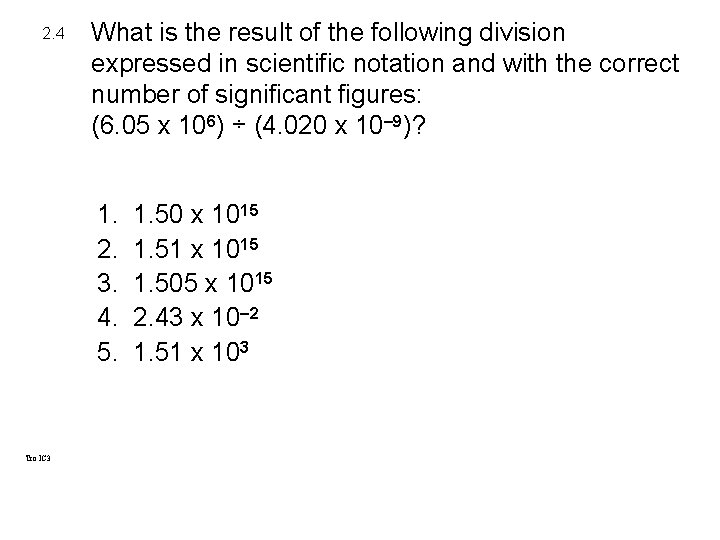
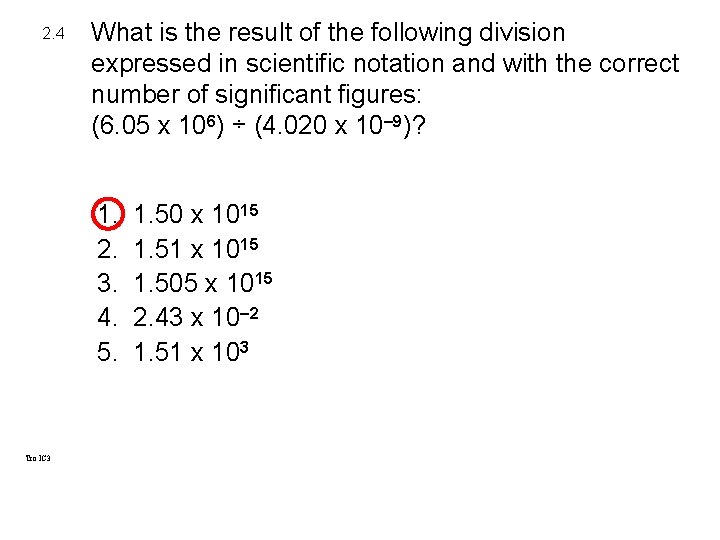
2. 4 What is the result of the following division expressed in scientific notation and with the correct number of significant figures: (6. 05 x 106) ÷ (4. 020 x 10– 9)? 1. 2. 3. 4. 5. Tro IC 3 1. 50 x 1015 1. 51 x 1015 1. 505 x 1015 2. 43 x 10– 2 1. 51 x 103
2. 4 What is the result of the following division expressed in scientific notation and with the correct number of significant figures: (6. 05 x 106) ÷ (4. 020 x 10– 9)? 1. 2. 3. 4. 5. Tro IC 3 1. 50 x 1015 1. 51 x 1015 1. 505 x 1015 2. 43 x 10– 2 1. 51 x 103
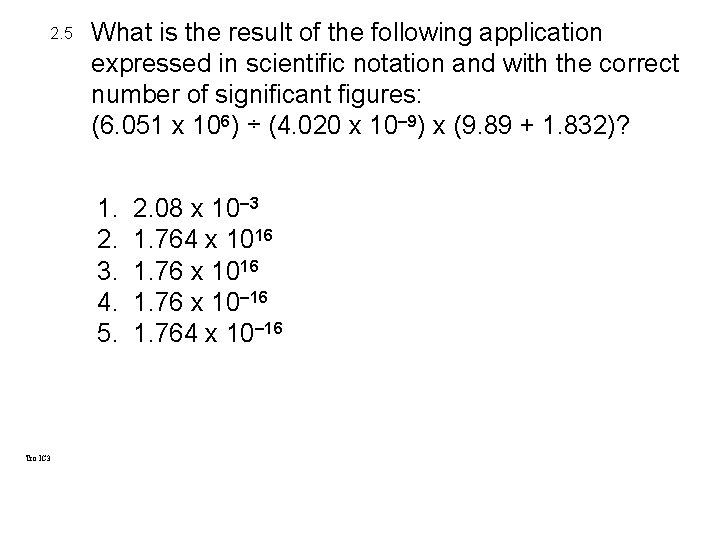
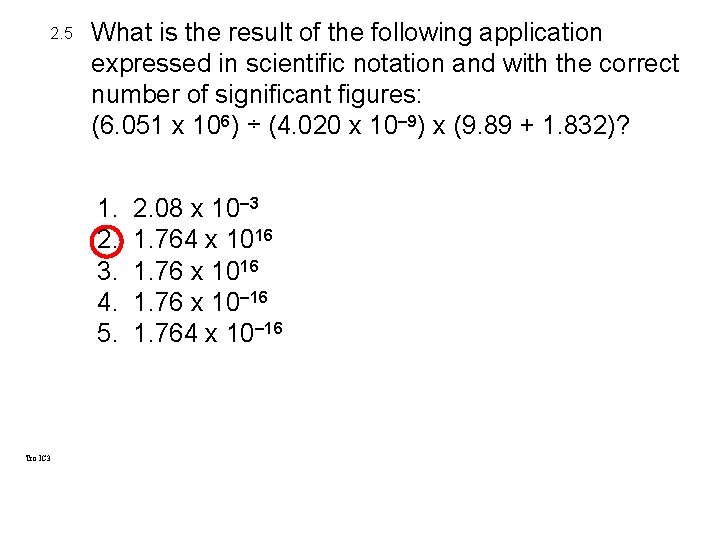
2. 5 What is the result of the following application expressed in scientific notation and with the correct number of significant figures: (6. 051 x 106) ÷ (4. 020 x 10– 9) x (9. 89 + 1. 832)? 1. 2. 3. 4. 5. Tro IC 3 2. 08 x 10– 3 1. 764 x 1016 1. 76 x 10– 16 1. 764 x 10– 16
2. 5 What is the result of the following application expressed in scientific notation and with the correct number of significant figures: (6. 051 x 106) ÷ (4. 020 x 10– 9) x (9. 89 + 1. 832)? 1. 2. 3. 4. 5. Tro IC 3 2. 08 x 10– 3 1. 764 x 1016 1. 76 x 10– 16 1. 764 x 10– 16
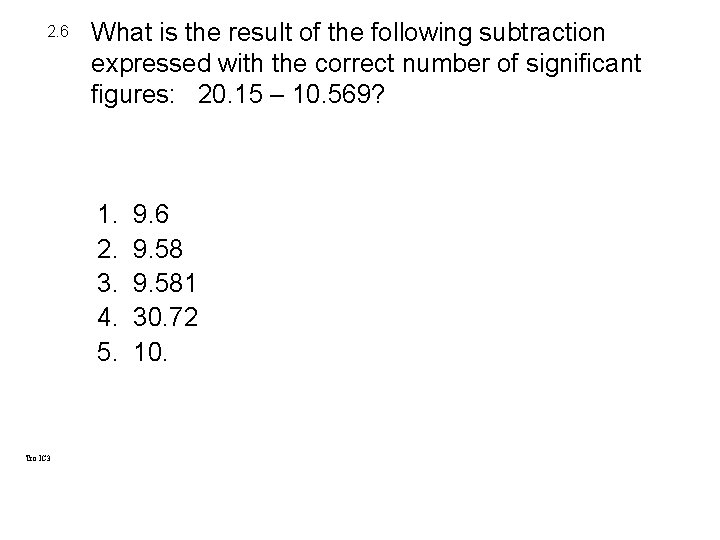
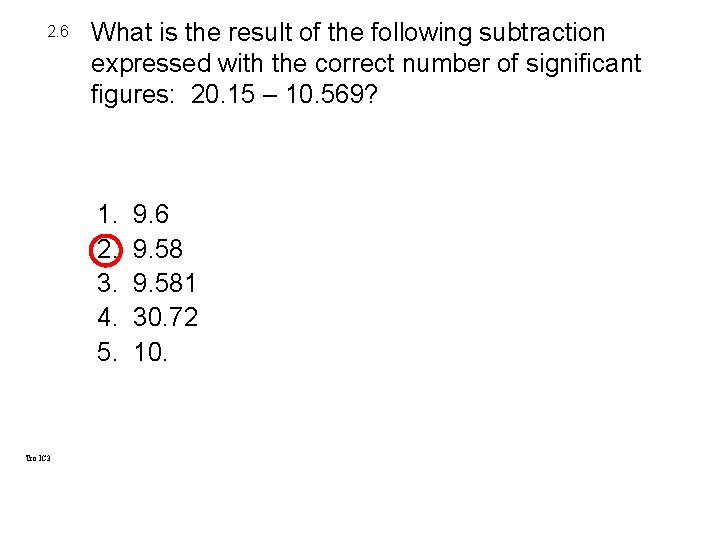
2. 6 What is the result of the following subtraction expressed with the correct number of significant figures: 20. 15 – 10. 569? 1. 2. 3. 4. 5. Tro IC 3 9. 6 9. 581 30. 72 10.
2. 6 What is the result of the following subtraction expressed with the correct number of significant figures: 20. 15 – 10. 569? 1. 2. 3. 4. 5. Tro IC 3 9. 6 9. 581 30. 72 10.
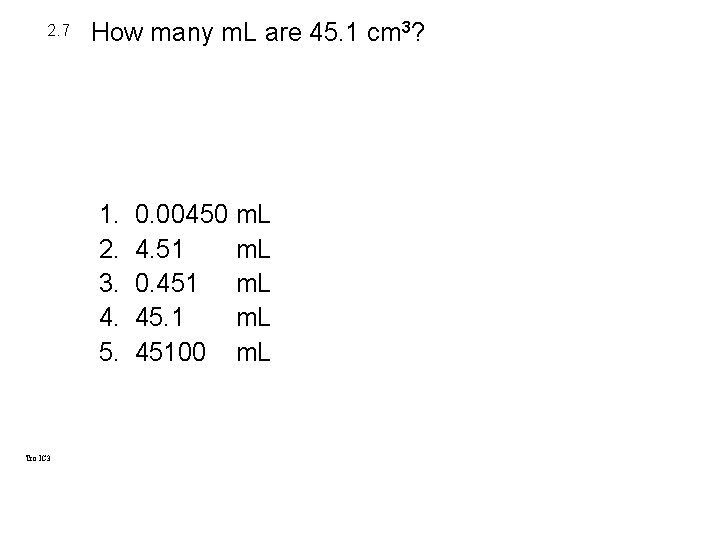
2. 7 How many m. L are 45. 1 cm 3? 1. 2. 3. 4. 5. Tro IC 3 0. 00450 m. L 4. 51 m. L 0. 451 m. L 45100 m. L
2. 7 How many m. L are 45. 1 cm 3? 1. 2. 3. 4. 5. Tro IC 3 0. 00450 m. L 4. 51 m. L 0. 451 m. L 45100 m. L
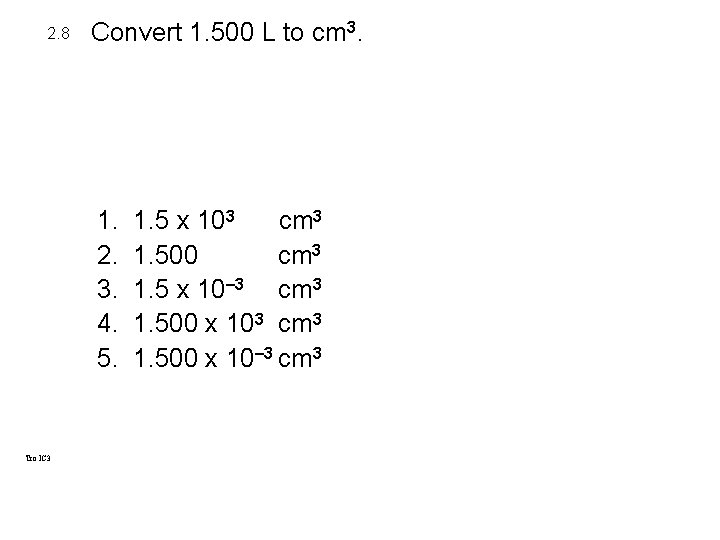
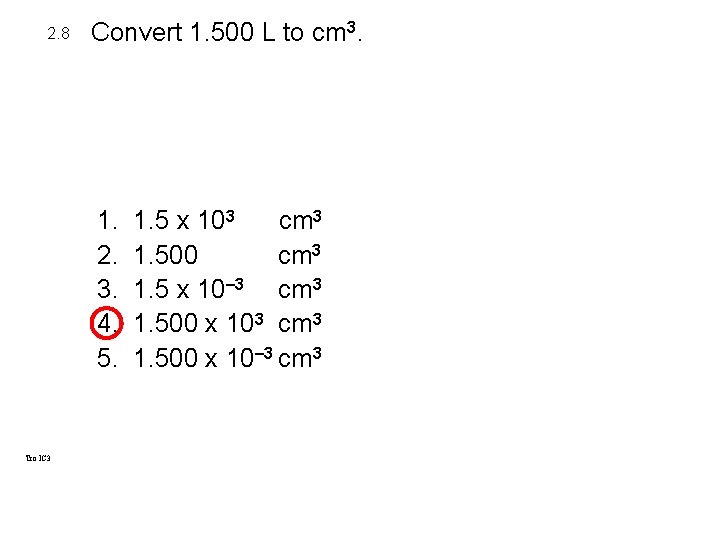
2. 8 Convert 1. 500 L to cm 3. 1. 2. 3. 4. 5. Tro IC 3 1. 5 x 103 cm 3 1. 500 cm 3 1. 5 x 10– 3 cm 3 1. 500 x 10– 3 cm 3
2. 8 Convert 1. 500 L to cm 3. 1. 2. 3. 4. 5. Tro IC 3 1. 5 x 103 cm 3 1. 500 cm 3 1. 5 x 10– 3 cm 3 1. 500 x 10– 3 cm 3
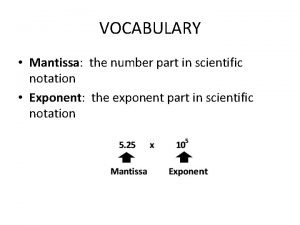
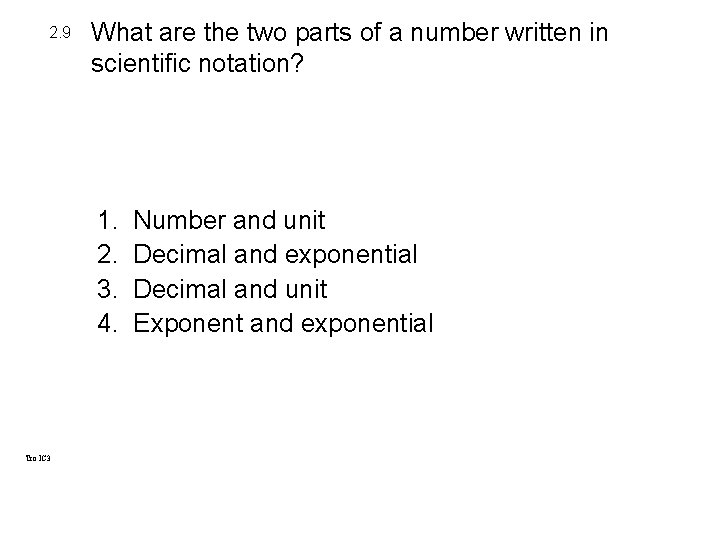
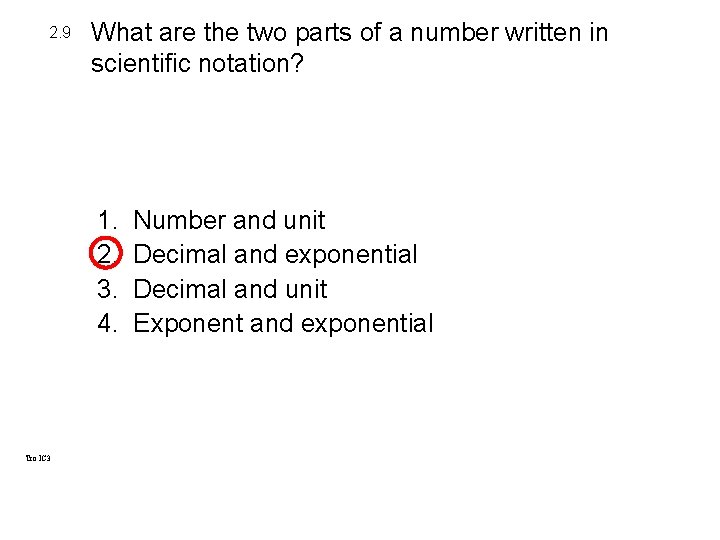
2. 9 What are the two parts of a number written in scientific notation? 1. 2. 3. 4. Tro IC 3 Number and unit Decimal and exponential Decimal and unit Exponent and exponential
2. 9 What are the two parts of a number written in scientific notation? 1. 2. 3. 4. Tro IC 3 Number and unit Decimal and exponential Decimal and unit Exponent and exponential
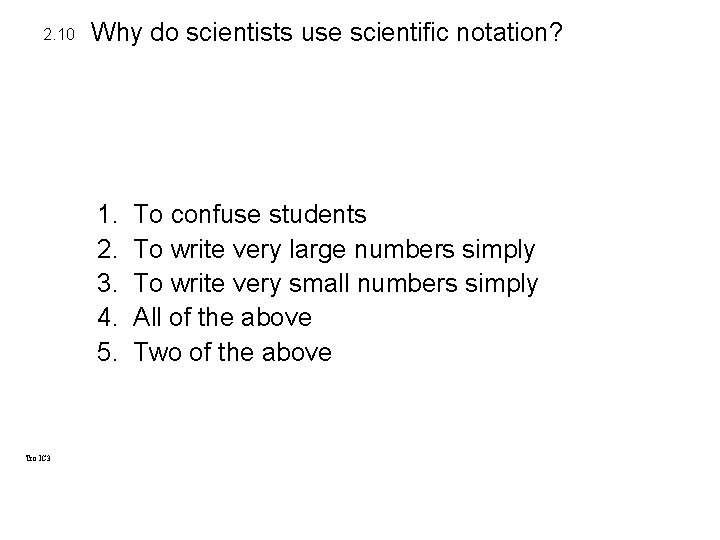
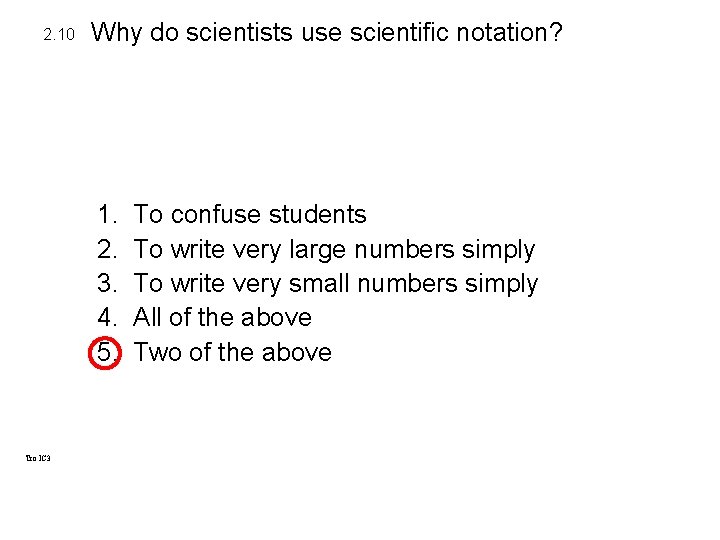
2. 10 Why do scientists use scientific notation? 1. 2. 3. 4. 5. Tro IC 3 To confuse students To write very large numbers simply To write very small numbers simply All of the above Two of the above
2. 10 Why do scientists use scientific notation? 1. 2. 3. 4. 5. Tro IC 3 To confuse students To write very large numbers simply To write very small numbers simply All of the above Two of the above
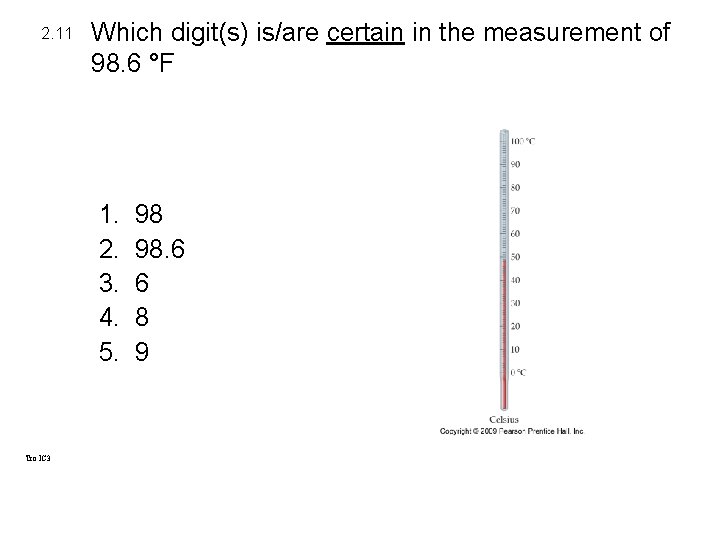
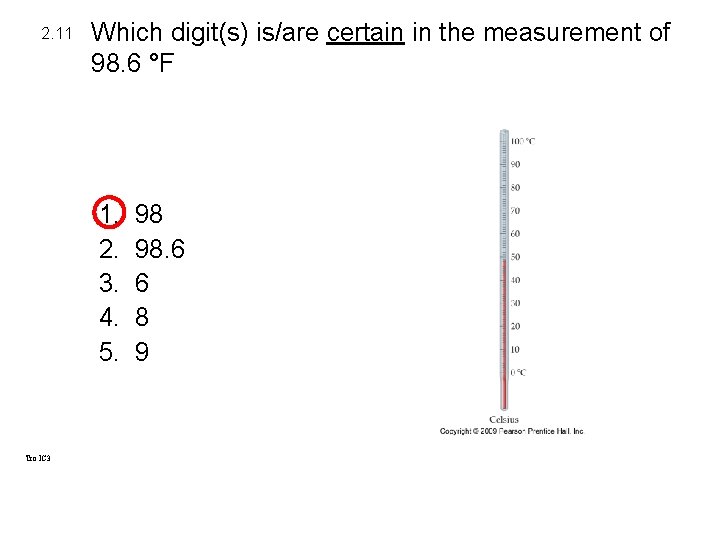
2. 11 Which digit(s) is/are certain in the measurement of 98. 6 °F 1. 2. 3. 4. 5. Tro IC 3 98 98. 6 6 8 9
2. 11 Which digit(s) is/are certain in the measurement of 98. 6 °F 1. 2. 3. 4. 5. Tro IC 3 98 98. 6 6 8 9
2. 12 How many significant figures are in 0. 00500670? 1. 2. 3. 4. 5. Tro IC 3 3 5 6 8 9
2. 12 How many significant figures are in 0. 00500670? 1. 2. 3. 4. 5. Tro IC 3 3 5 6 8 9
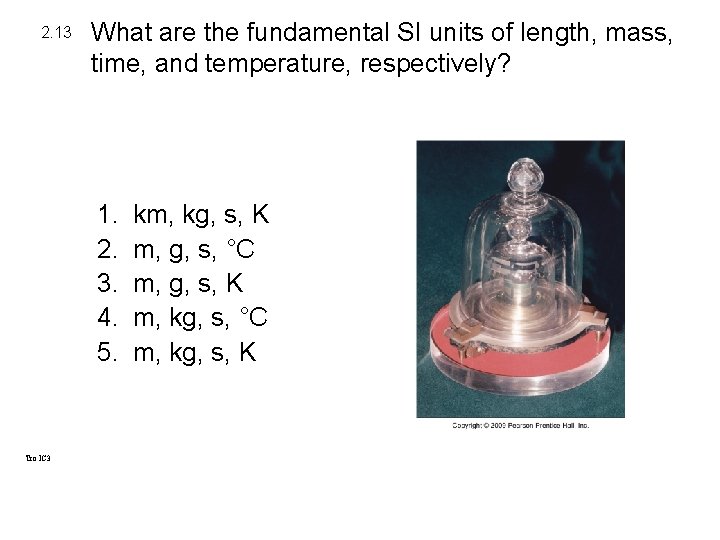
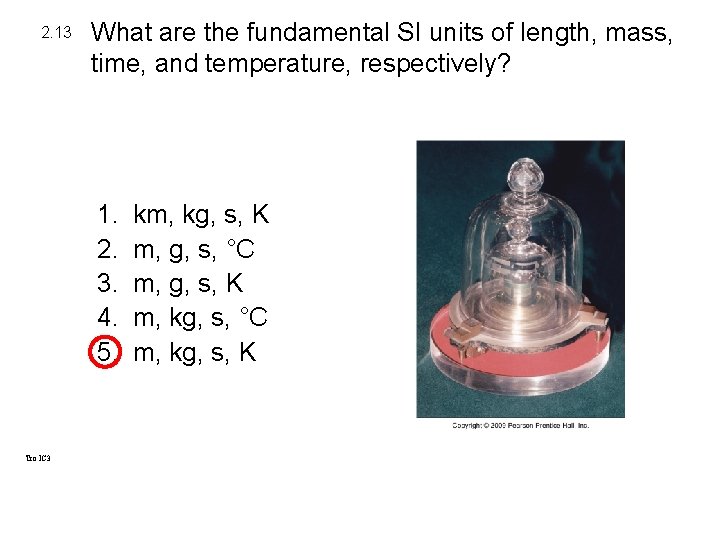
2. 13 What are the fundamental SI units of length, mass, time, and temperature, respectively? 1. 2. 3. 4. 5. Tro IC 3 km, kg, s, K m, g, s, °C m, g, s, K m, kg, s, °C m, kg, s, K
2. 13 What are the fundamental SI units of length, mass, time, and temperature, respectively? 1. 2. 3. 4. 5. Tro IC 3 km, kg, s, K m, g, s, °C m, g, s, K m, kg, s, °C m, kg, s, K
2. 14 What is the metric system prefix for the factor 10– 9? 1. 2. 3. 4. 5. Tro IC 3 c n p m μ
2. 14 What is the metric system prefix for the factor 10– 9? 1. 2. 3. 4. 5. Tro IC 3 c n p m μ
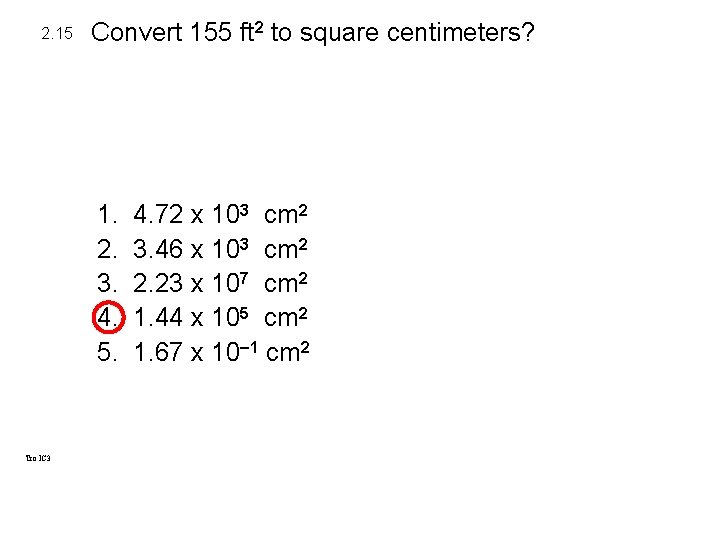
2. 15 Convert 155 ft 2 to square centimeters? 1. 2. 3. 4. 5. Tro IC 3 4. 72 x 103 cm 2 3. 46 x 103 cm 2 2. 23 x 107 cm 2 1. 44 x 105 cm 2 1. 67 x 10– 1 cm 2
2. 15 Convert 155 ft 2 to square centimeters? 1. 2. 3. 4. 5. Tro IC 3 4. 72 x 103 cm 2 3. 46 x 103 cm 2 2. 23 x 107 cm 2 1. 44 x 105 cm 2 1. 67 x 10– 1 cm 2
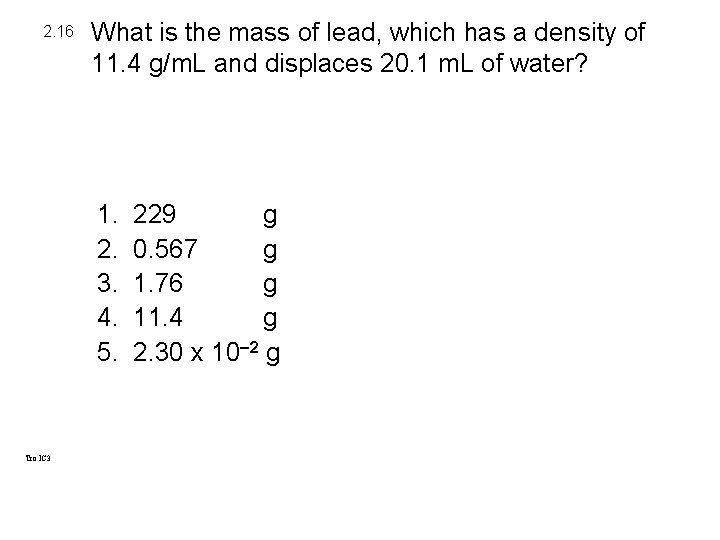
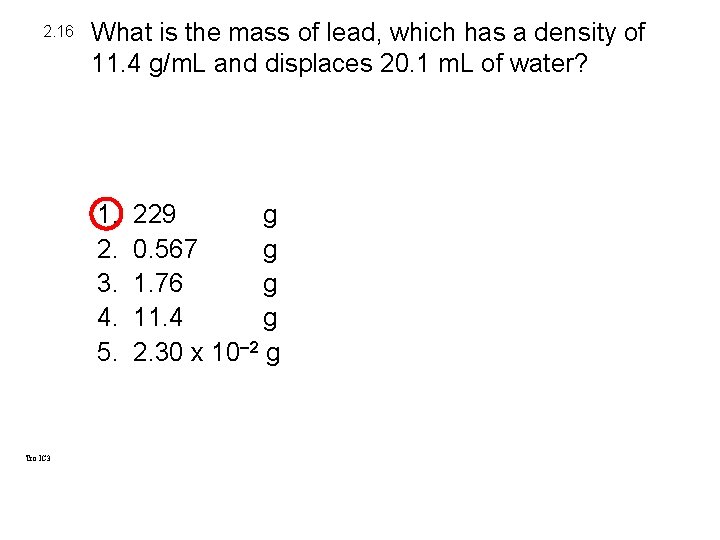
2. 16 What is the mass of lead, which has a density of 11. 4 g/m. L and displaces 20. 1 m. L of water? 1. 2. 3. 4. 5. Tro IC 3 229 g 0. 567 g 1. 76 g 11. 4 g 2. 30 x 10– 2 g
2. 16 What is the mass of lead, which has a density of 11. 4 g/m. L and displaces 20. 1 m. L of water? 1. 2. 3. 4. 5. Tro IC 3 229 g 0. 567 g 1. 76 g 11. 4 g 2. 30 x 10– 2 g
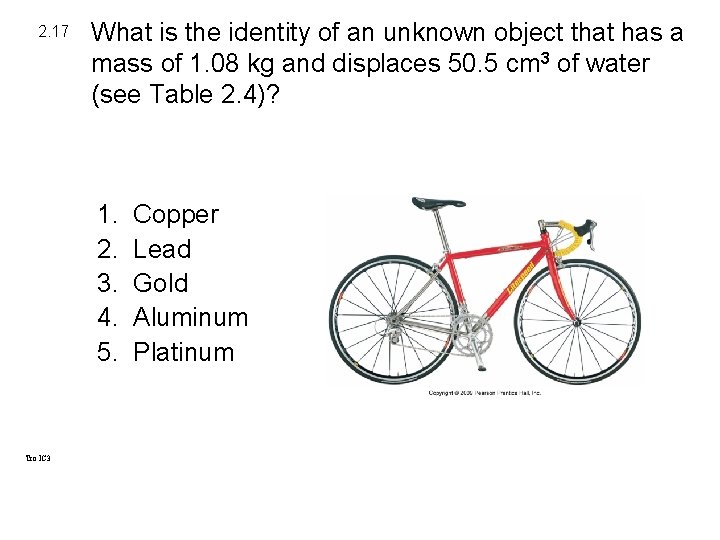
2. 17 What is the identity of an unknown object that has a mass of 1. 08 kg and displaces 50. 5 cm 3 of water (see Table 2. 4)? 1. 2. 3. 4. 5. Tro IC 3 Copper Lead Gold Aluminum Platinum
2. 17 What is the identity of an unknown object that has a mass of 1. 08 kg and displaces 50. 5 cm 3 of water (see Table 2. 4)? 1. 2. 3. 4. 5. Tro IC 3 Copper Lead Gold Aluminum Platinum
2. 18 Convert 1. 500 km 3 to liters. 1. 2. 3. 4. 5. Tro IC 3 1. 500 L 1. 500 x 1012 L 1. 500 x 109 L 1. 500 x 102 L 1. 500 x 10– 2 L
2. 18 Convert 1. 500 km 3 to liters. 1. 2. 3. 4. 5. Tro IC 3 1. 500 L 1. 500 x 1012 L 1. 500 x 109 L 1. 500 x 102 L 1. 500 x 10– 2 L
2. 19 Which of the following is a frequently used unit for the density of liquids and solids? 1. 2. 3. 4. 5. Tro IC 3 g/L kg/L g/m. L cm 3/m. L g/m 3
2. 19 Which of the following is a frequently used unit for the density of liquids and solids? 1. 2. 3. 4. 5. Tro IC 3 g/L kg/L g/m. L cm 3/m. L g/m 3
2. 20 What does the positive exponent tell you about the size of the number 6. 022 X 1023? 1. 2. 3. 4. 5. Tro IC 3 It is less than one. It is less than 6. 022. It is equal to zero. It is greater than 1. There is not enough information given for an answer.
2. 20 What does the positive exponent tell you about the size of the number 6. 022 X 1023? 1. 2. 3. 4. 5. Tro IC 3 It is less than one. It is less than 6. 022. It is equal to zero. It is greater than 1. There is not enough information given for an answer.
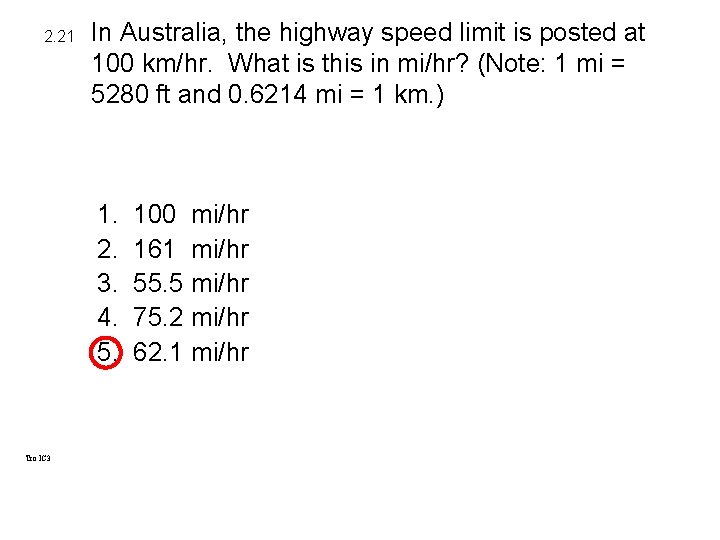
2. 21 In Australia, the highway speed limit is posted at 100 km/hr. What is this in mi/hr? (Note: 1 mi = 5280 ft and 0. 6214 mi = 1 km. ) 1. 2. 3. 4. 5. Tro IC 3 100 mi/hr 161 mi/hr 55. 5 mi/hr 75. 2 mi/hr 62. 1 mi/hr
2. 21 In Australia, the highway speed limit is posted at 100 km/hr. What is this in mi/hr? (Note: 1 mi = 5280 ft and 0. 6214 mi = 1 km. ) 1. 2. 3. 4. 5. Tro IC 3 100 mi/hr 161 mi/hr 55. 5 mi/hr 75. 2 mi/hr 62. 1 mi/hr
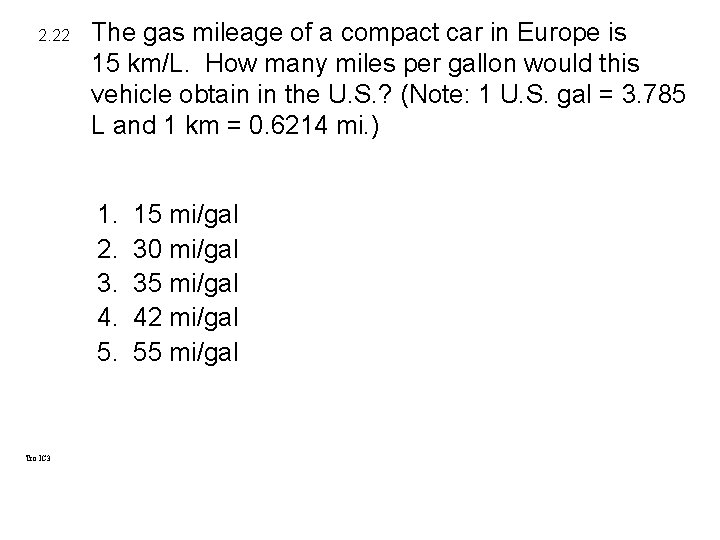
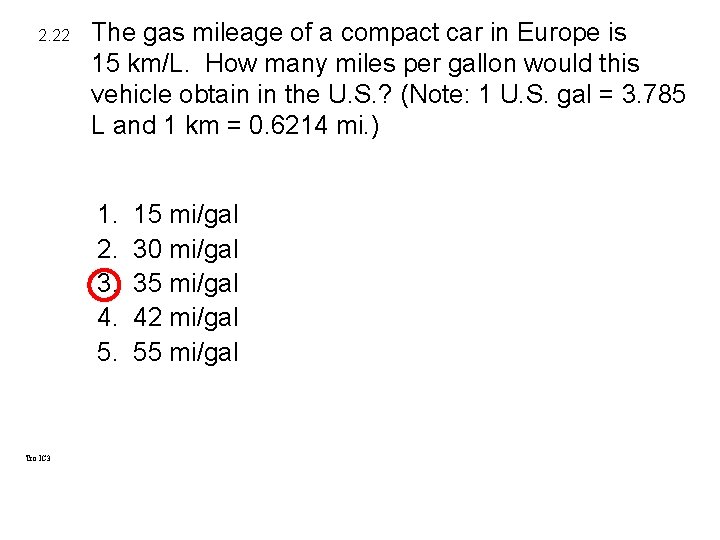
2. 22 The gas mileage of a compact car in Europe is 15 km/L. How many miles per gallon would this vehicle obtain in the U. S. ? (Note: 1 U. S. gal = 3. 785 L and 1 km = 0. 6214 mi. ) 1. 2. 3. 4. 5. Tro IC 3 15 mi/gal 30 mi/gal 35 mi/gal 42 mi/gal 55 mi/gal
2. 22 The gas mileage of a compact car in Europe is 15 km/L. How many miles per gallon would this vehicle obtain in the U. S. ? (Note: 1 U. S. gal = 3. 785 L and 1 km = 0. 6214 mi. ) 1. 2. 3. 4. 5. Tro IC 3 15 mi/gal 30 mi/gal 35 mi/gal 42 mi/gal 55 mi/gal
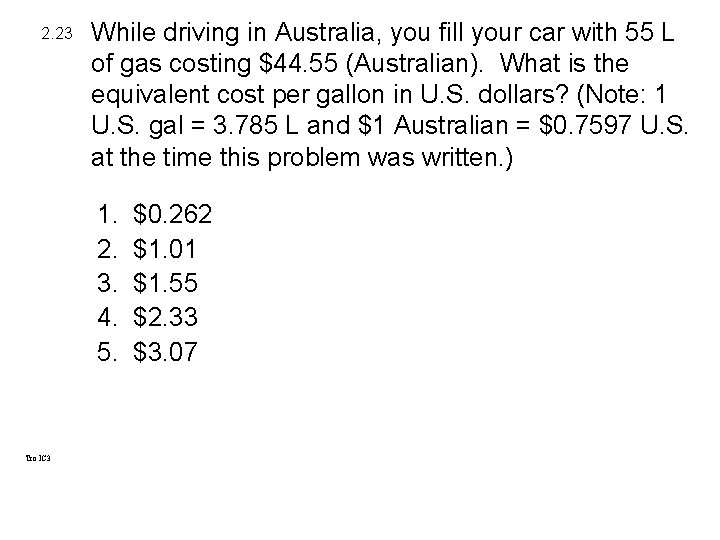
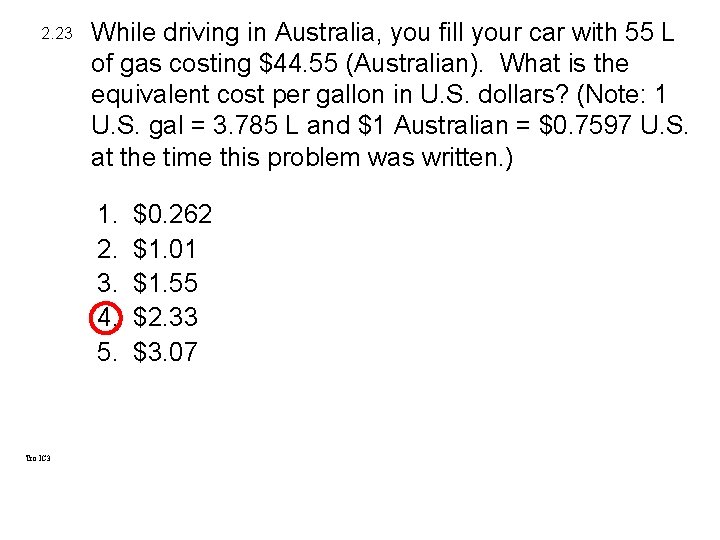
2. 23 While driving in Australia, you fill your car with 55 L of gas costing $44. 55 (Australian). What is the equivalent cost per gallon in U. S. dollars? (Note: 1 U. S. gal = 3. 785 L and $1 Australian = $0. 7597 U. S. at the time this problem was written. ) 1. 2. 3. 4. 5. Tro IC 3 $0. 262 $1. 01 $1. 55 $2. 33 $3. 07
2. 23 While driving in Australia, you fill your car with 55 L of gas costing $44. 55 (Australian). What is the equivalent cost per gallon in U. S. dollars? (Note: 1 U. S. gal = 3. 785 L and $1 Australian = $0. 7597 U. S. at the time this problem was written. ) 1. 2. 3. 4. 5. Tro IC 3 $0. 262 $1. 01 $1. 55 $2. 33 $3. 07
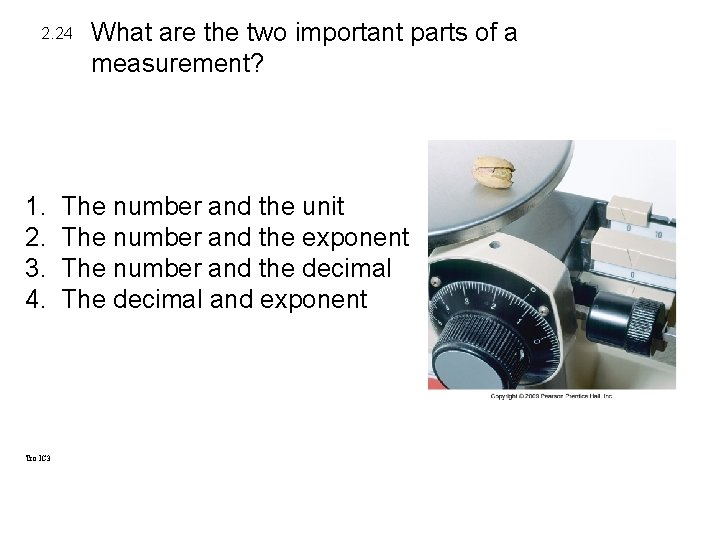
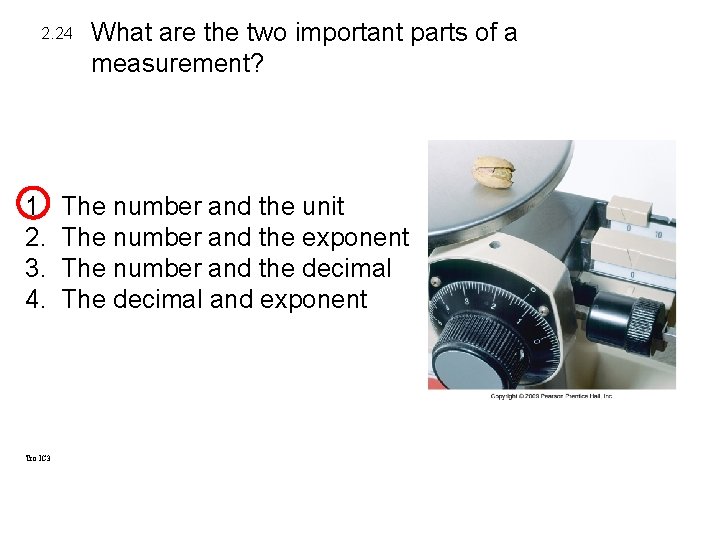
2. 24 1. 2. 3. 4. Tro IC 3 What are the two important parts of a measurement? The number and the unit The number and the exponent The number and the decimal The decimal and exponent
2. 24 1. 2. 3. 4. Tro IC 3 What are the two important parts of a measurement? The number and the unit The number and the exponent The number and the decimal The decimal and exponent
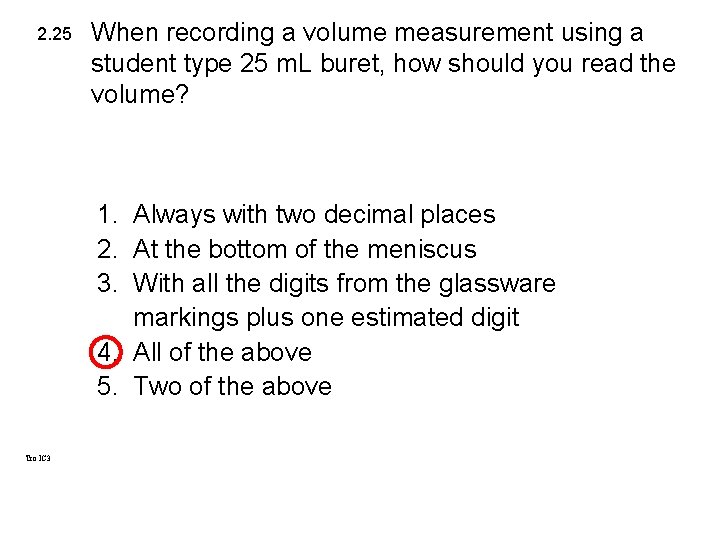
2. 25 When recording a volume measurement using a student type 25 m. L buret, how should you read the volume? 1. Always with two decimal places 2. At the bottom of the meniscus 3. With all the digits from the glassware markings plus one estimated digit 4. All of the above 5. Two of the above Tro IC 3
2. 25 When recording a volume measurement using a student type 25 m. L buret, how should you read the volume? 1. Always with two decimal places 2. At the bottom of the meniscus 3. With all the digits from the glassware markings plus one estimated digit 4. All of the above 5. Two of the above Tro IC 3