
Add Subtract with Scientific Notation Focus 11 Learning

Add & Subtract with Scientific Notation

Focus 11 - Learning Goal: The student will be able to work with integer exponents. 4 3 In addition to 3, The student will be able to work with able to go above integer exponents. and beyond by - Know and applying what the properties of they know about exponents. working with - Simplify integer exponents. numerical expressions with exponents. - Perform operations with scientific notation. 2 With no help the student has a partial understanding of integer exponents. - Is able to use scientific notation to estimate very large or very small numbers. - Interpret scientific notation generated by technology. 1 With help, the student may have a partial understanding of how to work with integer exponents. 0 Even with help, the student is unable to work with integer exponents.
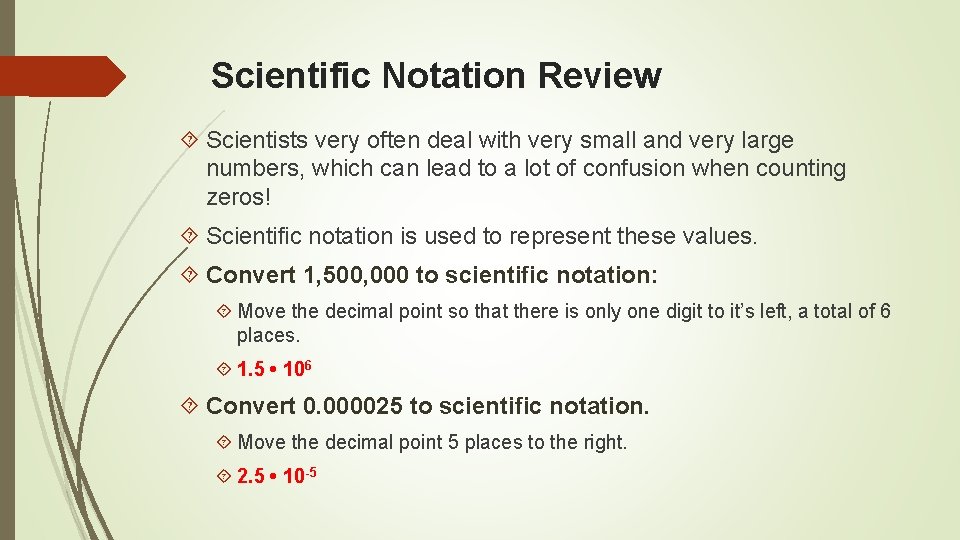
Scientific Notation Review Scientists very often deal with very small and very large numbers, which can lead to a lot of confusion when counting zeros! Scientific notation is used to represent these values. Convert 1, 500, 000 to scientific notation: Move the decimal point so that there is only one digit to it’s left, a total of 6 places. 1. 5 • 106 Convert 0. 000025 to scientific notation. Move the decimal point 5 places to the right. 2. 5 • 10 -5
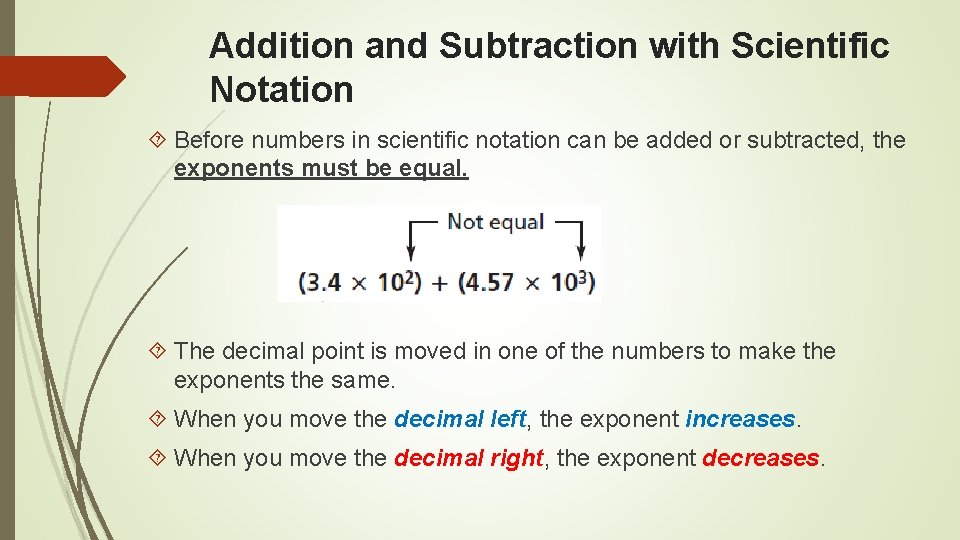
Addition and Subtraction with Scientific Notation Before numbers in scientific notation can be added or subtracted, the exponents must be equal. The decimal point is moved in one of the numbers to make the exponents the same. When you move the decimal left, the exponent increases. When you move the decimal right, the exponent decreases.
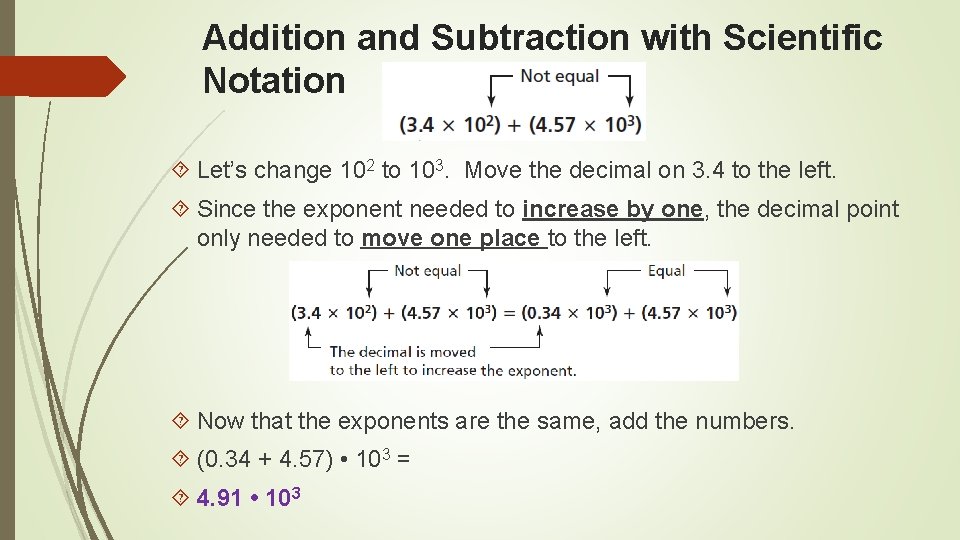
Addition and Subtraction with Scientific Notation Let’s change 102 to 103. Move the decimal on 3. 4 to the left. Since the exponent needed to increase by one, the decimal point only needed to move one place to the left. Now that the exponents are the same, add the numbers. (0. 34 + 4. 57) • 103 = 4. 91 • 103
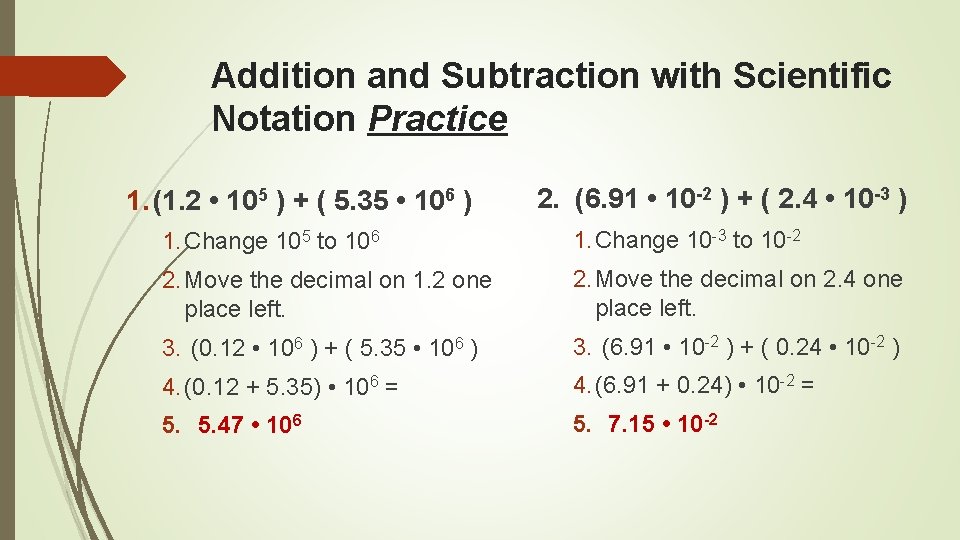
Addition and Subtraction with Scientific Notation Practice 1. (1. 2 • 105 ) + ( 5. 35 • 106 ) 2. (6. 91 • 10 -2 ) + ( 2. 4 • 10 -3 ) 1. Change 105 to 106 1. Change 10 -3 to 10 -2 2. Move the decimal on 1. 2 one place left. 2. Move the decimal on 2. 4 one place left. 3. (0. 12 • 106 ) + ( 5. 35 • 106 ) 3. (6. 91 • 10 -2 ) + ( 0. 24 • 10 -2 ) 4. (0. 12 + 5. 35) • 106 = 4. (6. 91 + 0. 24) • 10 -2 = 5. 47 • 106 5. 7. 15 • 10 -2
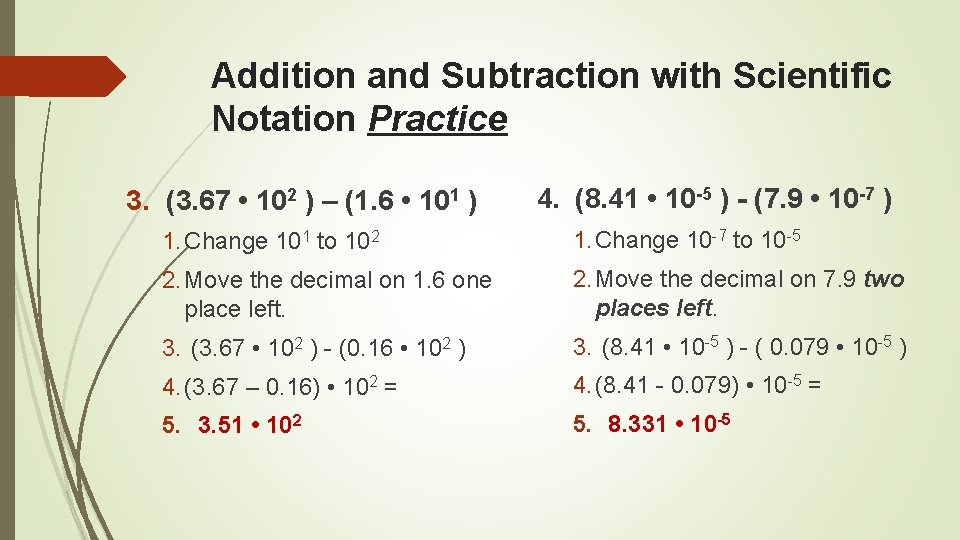
Addition and Subtraction with Scientific Notation Practice 3. (3. 67 • 102 ) – (1. 6 • 101 ) 4. (8. 41 • 10 -5 ) - (7. 9 • 10 -7 ) 1. Change 101 to 102 1. Change 10 -7 to 10 -5 2. Move the decimal on 1. 6 one place left. 2. Move the decimal on 7. 9 two places left. 3. (3. 67 • 102 ) - (0. 16 • 102 ) 3. (8. 41 • 10 -5 ) - ( 0. 079 • 10 -5 ) 4. (3. 67 – 0. 16) • 102 = 4. (8. 41 - 0. 079) • 10 -5 = 5. 3. 51 • 102 5. 8. 331 • 10 -5
- Slides: 7