
Lesson 5 3 Scientific Notation and significant digits
- Slides: 11
Lesson 5. 3 Scientific Notation and significant digits
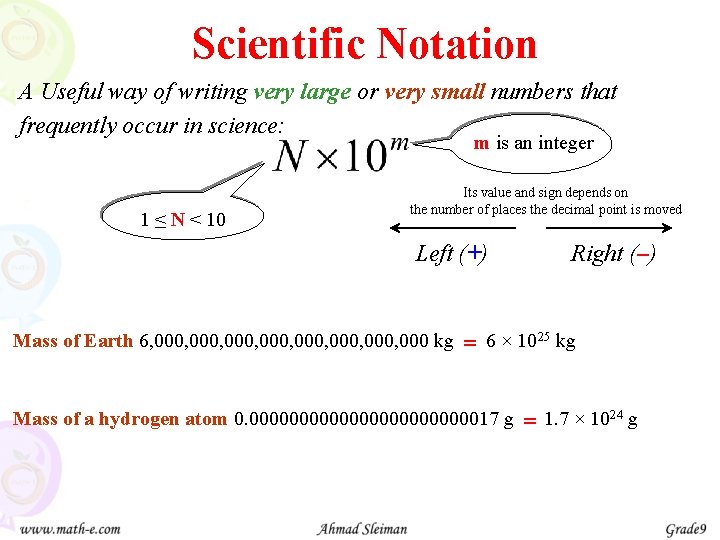
Scientific Notation A Useful way of writing very large or very small numbers that frequently occur in science: m is an integer 1 ≤ N < 10 Its value and sign depends on the number of places the decimal point is moved Left (+) Mass of Earth 6, 000, 000, 000 kg Right (–) = 6 × 1025 kg Mass of a hydrogen atom 0. 00000000000017 g = 1. 7 × 1024 g
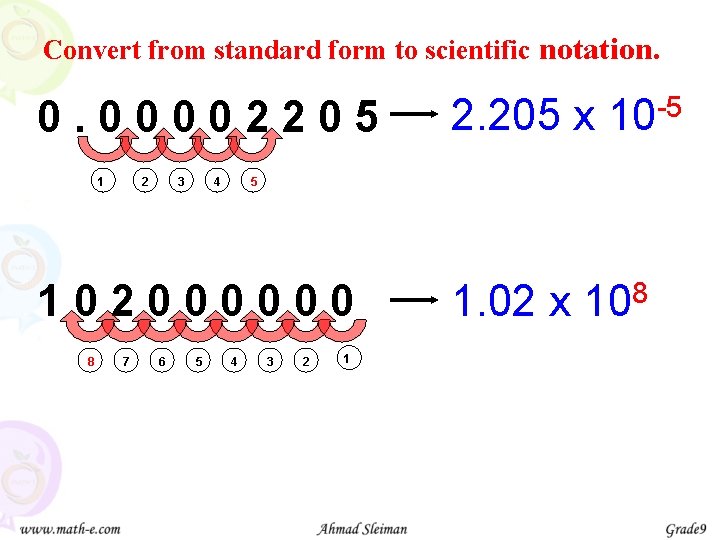
Convert from standard form to scientific notation. 0. 00002205 1 2 3 4 5 102000000 8 7 6 5 2. 205 x 10 -5 4 3 2 1 1. 02 x 8 10
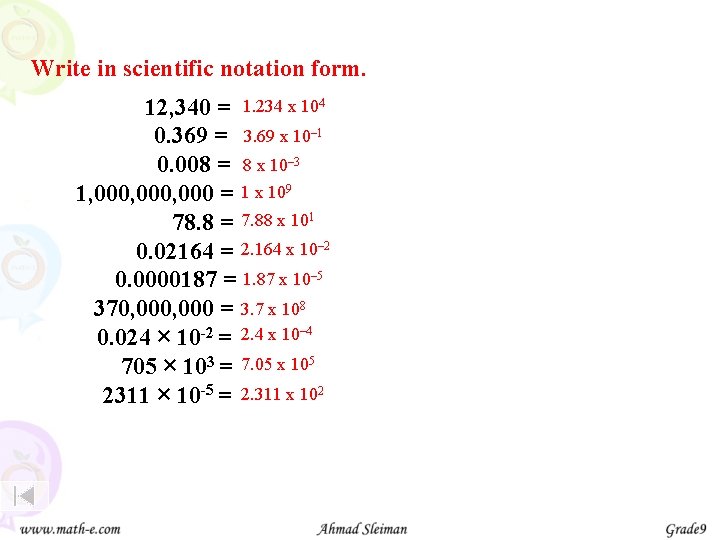
Write in scientific notation form. 12, 340 = 1. 234 x 104 0. 369 = 3. 69 x 10– 1 0. 008 = 8 x 10– 3 1, 000, 000 = 1 x 10⁹ 78. 8 = 7. 88 x 101 0. 02164 = 2. 164 x 10– 2 0. 0000187 = 1. 87 x 10– 5 370, 000 = 3. 7 x 10⁸ 0. 024 × 10 -2 = 2. 4 x 10– 4 705 × 103 = 7. 05 x 105 2311 × 10 -5 = 2. 311 x 102
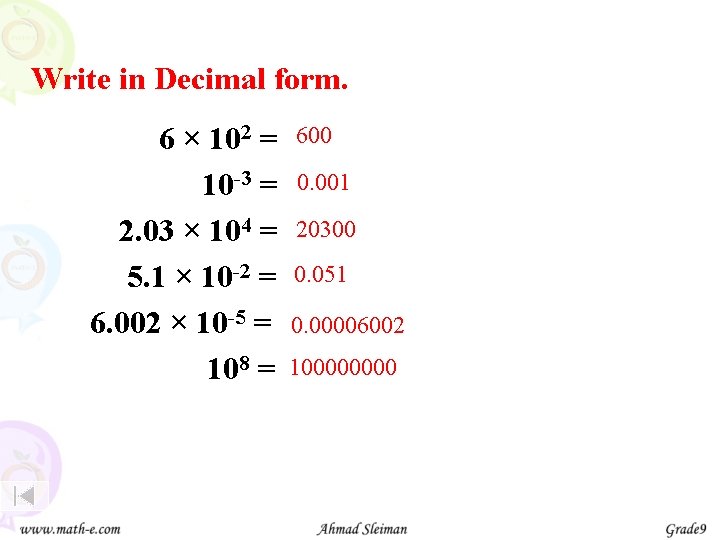
Write in Decimal form. 6 × 102 = 10 -3 = 2. 03 × 104 = 5. 1 × 10 -2 = 6. 002 × 10 -5 = 108 = 600 0. 001 20300 0. 051 0. 00006002 10000
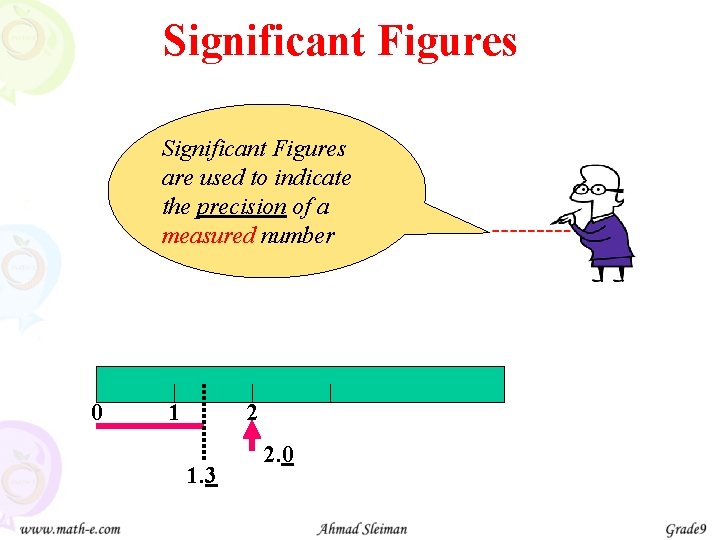
Significant Figures are used to indicate the precision of a measured number 0 1 2 1. 3 2. 0
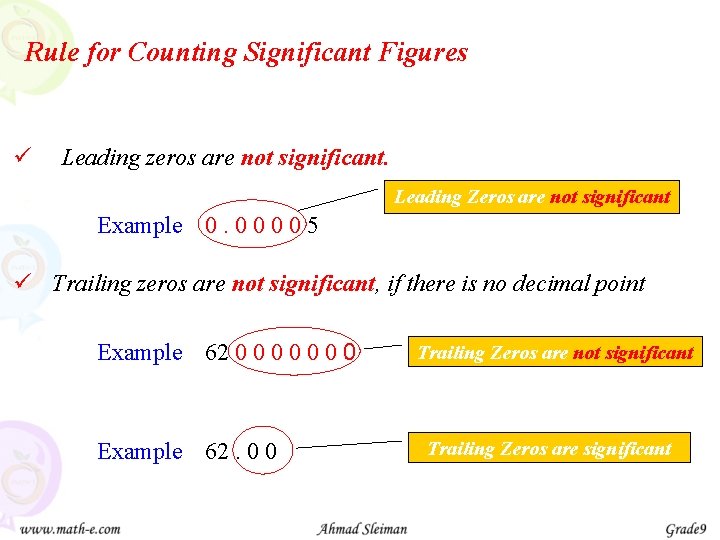
Rule for Counting Significant Figures ü Leading zeros are not significant. Leading Zeros are not significant Example 0. 0 0 5 ü Trailing zeros are not significant, if there is no decimal point Example 62 0 0 0 0 Example 62. 0 0 Trailing Zeros are not significant Trailing Zeros are significant
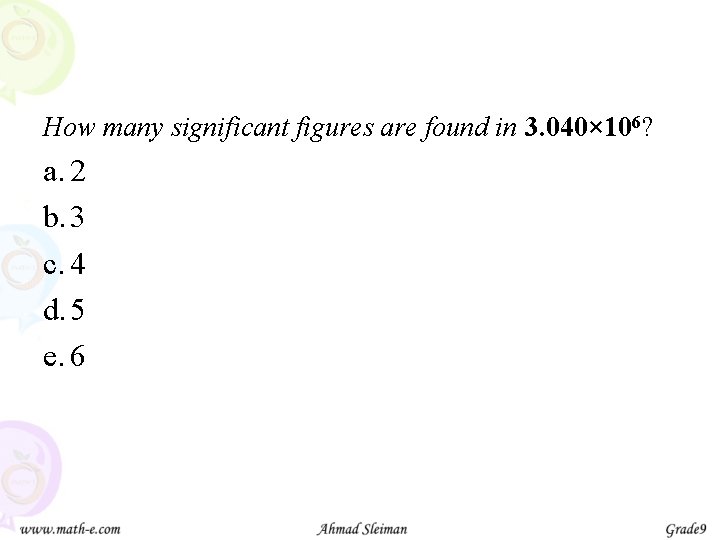
How many significant figures are found in 3. 040× 106? a. 2 b. 3 c. 4 d. 5 e. 6
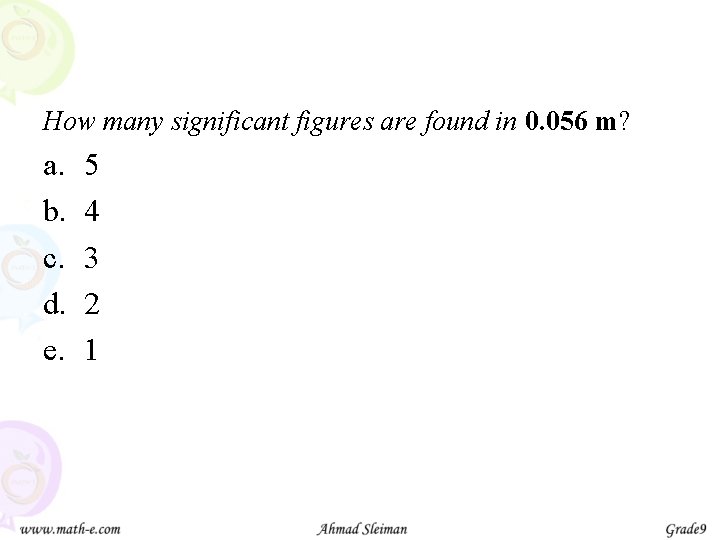
How many significant figures are found in 0. 056 m? a. b. c. d. e. 5 4 3 2 1
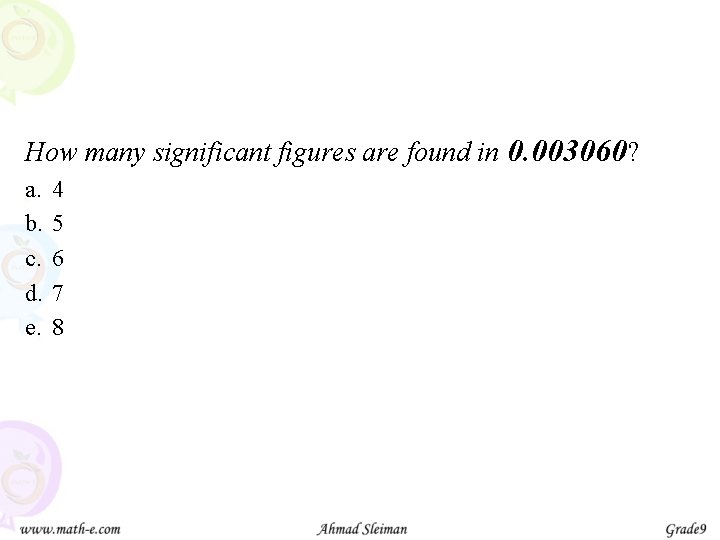
How many significant figures are found in 0. 003060? a. b. c. d. e. 4 5 6 7 8
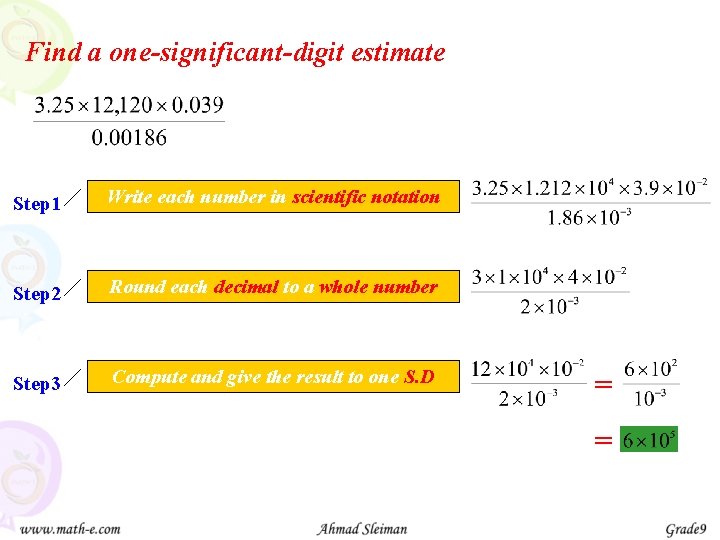
Find a one-significant-digit estimate Step 1 Write each number in scientific notation Step 2 Round each decimal to a whole number Step 3 Compute and give the result to one S. D = =