1 MSK PETITION FOR REPEAL or MODIFICATION OF


- Slides: 35
1
MSK PETITION FOR REPEAL or MODIFICATION OF THE PERFORMANCE BASED RATE Making PRICING METHODOLOGY PBR ERC CASE NO. 2015 -008 RM Public Consultations March 17, 22, 24, (Davao) 2017 Matuwid na Singil sa Kuryente Consumer Alliance Inc. (MSK) Davao Version – Presented 6 September 2019 2
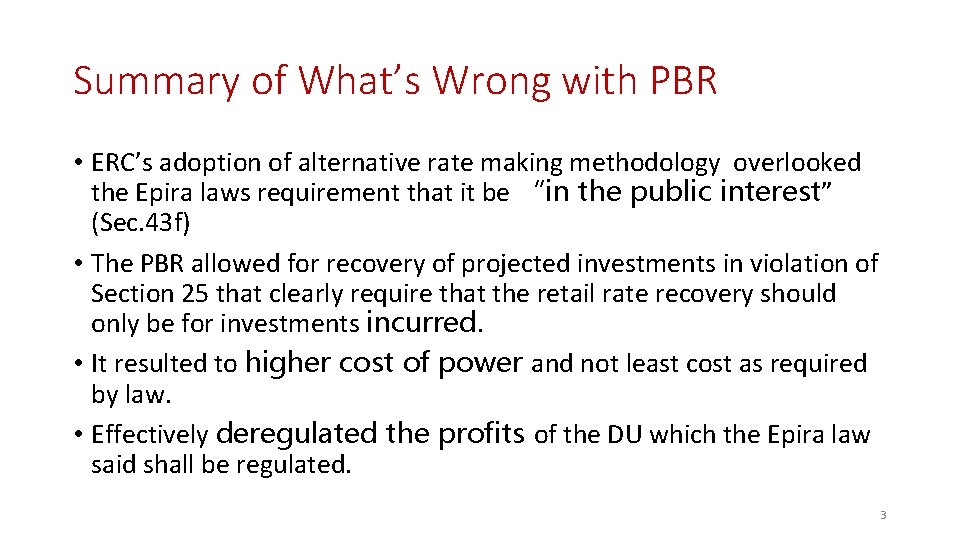
Summary of What’s Wrong with PBR • ERC’s adoption of alternative rate making methodology overlooked the Epira laws requirement that it be “in the public interest” (Sec. 43 f) • The PBR allowed for recovery of projected investments in violation of Section 25 that clearly require that the retail rate recovery should only be for investments incurred. • It resulted to higher cost of power and not least cost as required by law. • Effectively deregulated the profits of the DU which the Epira law said shall be regulated. 3
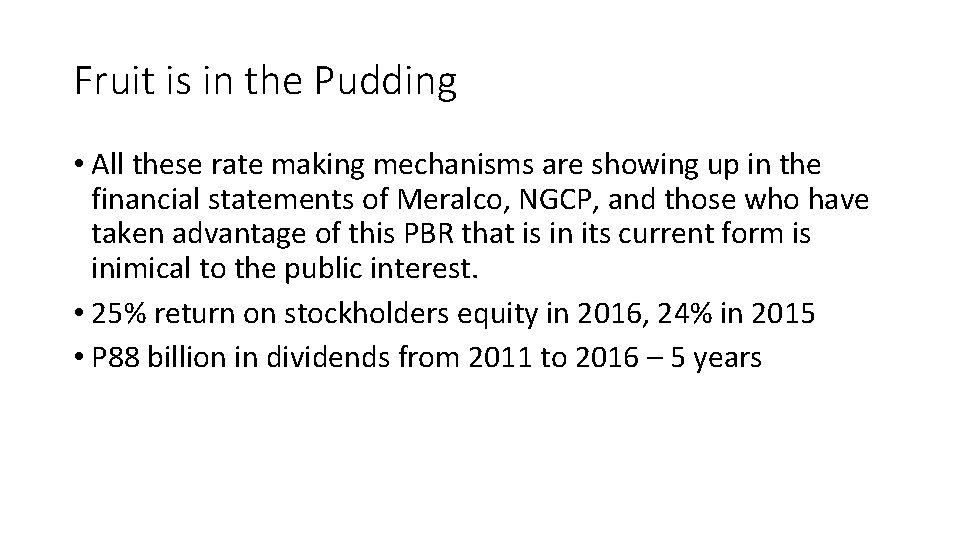
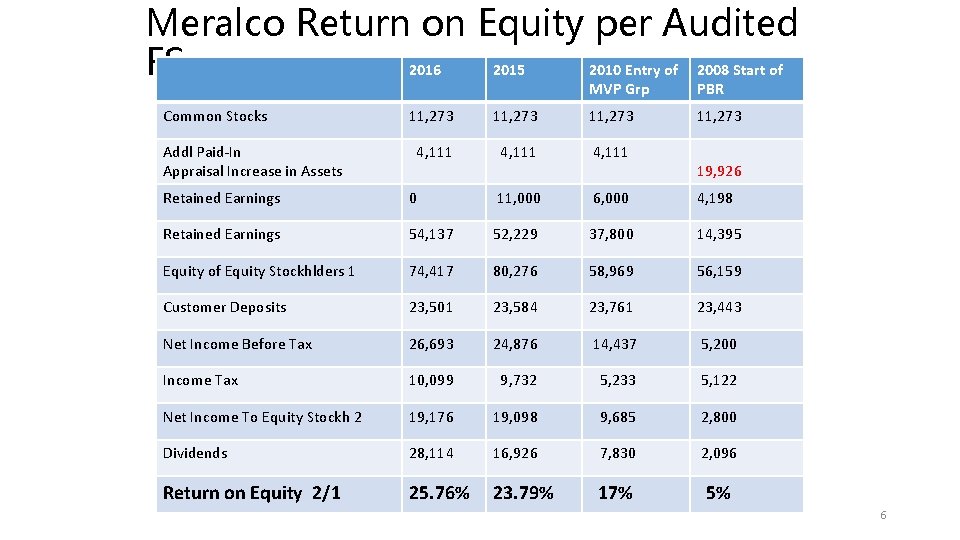
Fruit is in the Pudding • All these rate making mechanisms are showing up in the financial statements of Meralco, NGCP, and those who have taken advantage of this PBR that is in its current form is inimical to the public interest. • 25% return on stockholders equity in 2016, 24% in 2015 • P 88 billion in dividends from 2011 to 2016 – 5 years
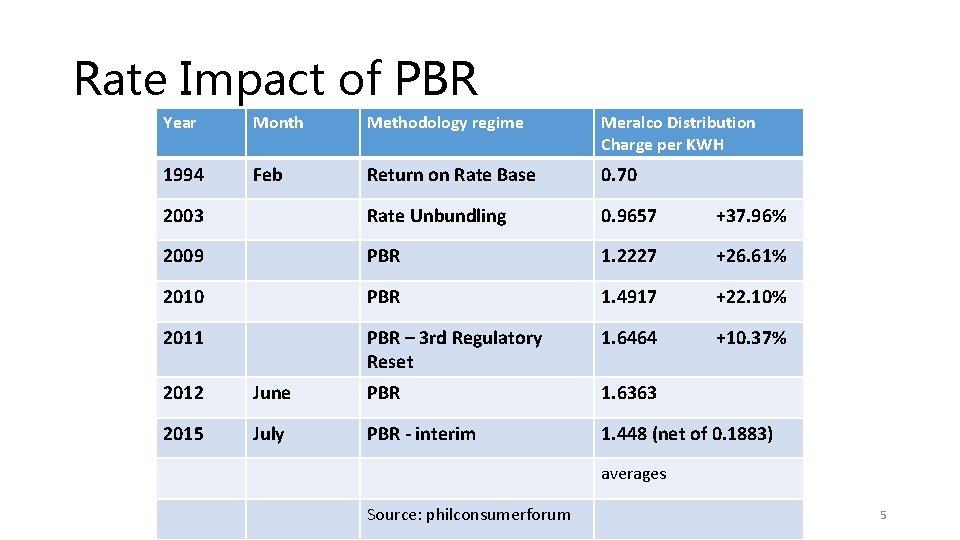
Rate Impact of PBR Year Month Methodology regime Meralco Distribution Charge per KWH 1994 Feb Return on Rate Base 0. 70 2003 Rate Unbundling 0. 9657 +37. 96% 2009 PBR 1. 2227 +26. 61% 2010 PBR 1. 4917 +22. 10% 2011 PBR – 3 rd Regulatory Reset 1. 6464 +10. 37% 2012 June PBR 1. 6363 2015 July PBR - interim 1. 448 (net of 0. 1883) averages Source: philconsumerforum 5
Meralco Return on Equity per Audited FS 2016 2015 2010 Entry of 2008 Start of Common Stocks Addl Paid-In Appraisal Increase in Assets MVP Grp PBR 11, 273 4, 111 19, 926 Retained Earnings 0 11, 000 6, 000 4, 198 Retained Earnings 54, 137 52, 229 37, 800 14, 395 Equity of Equity Stockhlders 1 74, 417 80, 276 58, 969 56, 159 Customer Deposits 23, 501 23, 584 23, 761 23, 443 Net Income Before Tax 26, 693 24, 876 14, 437 5, 200 Income Tax 10, 099 9, 732 5, 233 5, 122 Net Income To Equity Stockh 2 19, 176 19, 098 9, 685 2, 800 Dividends 28, 114 16, 926 7, 830 2, 096 Return on Equity 2/1 25. 76% 23. 79% 17% 5% 6
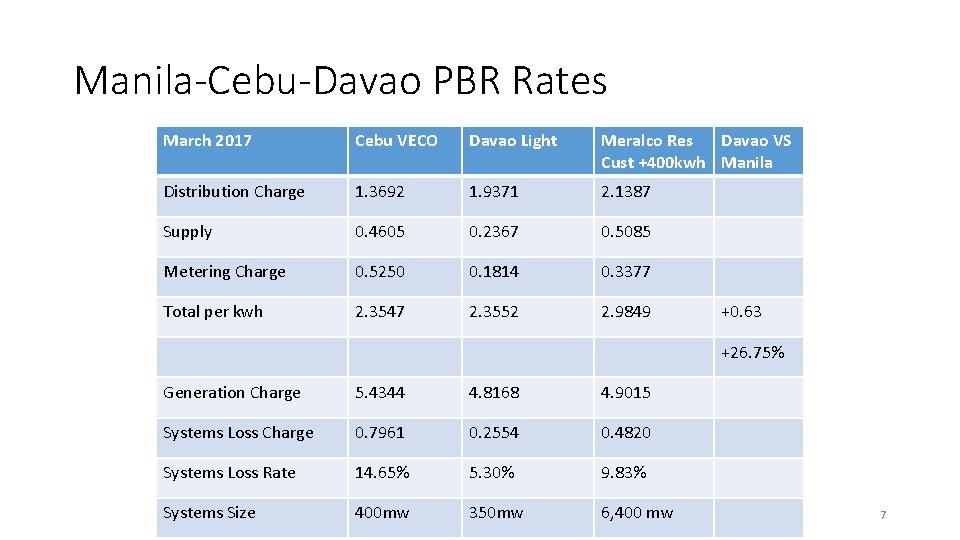
Manila-Cebu-Davao PBR Rates March 2017 Cebu VECO Davao Light Meralco Res Davao VS Cust +400 kwh Manila Distribution Charge 1. 3692 1. 9371 2. 1387 Supply 0. 4605 0. 2367 0. 5085 Metering Charge 0. 5250 0. 1814 0. 3377 Total per kwh 2. 3547 2. 3552 2. 9849 +0. 63 +26. 75% Generation Charge 5. 4344 4. 8168 4. 9015 Systems Loss Charge 0. 7961 0. 2554 0. 4820 Systems Loss Rate 14. 65% 5. 30% 9. 83% Systems Size 400 mw 350 mw 6, 400 mw 7
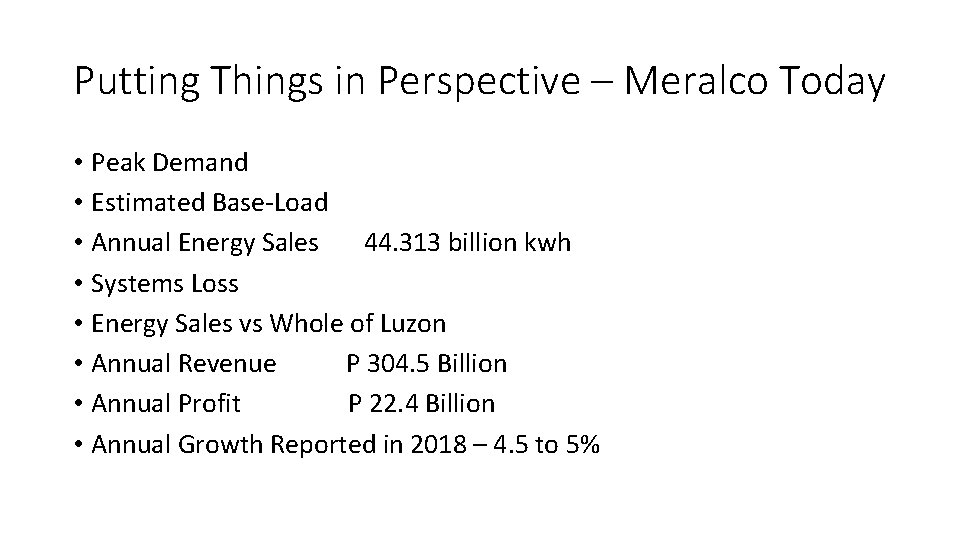
Putting Things in Perspective – Meralco Today • Peak Demand • Estimated Base-Load • Annual Energy Sales 44. 313 billion kwh • Systems Loss • Energy Sales vs Whole of Luzon • Annual Revenue P 304. 5 Billion • Annual Profit P 22. 4 Billion • Annual Growth Reported in 2018 – 4. 5 to 5%
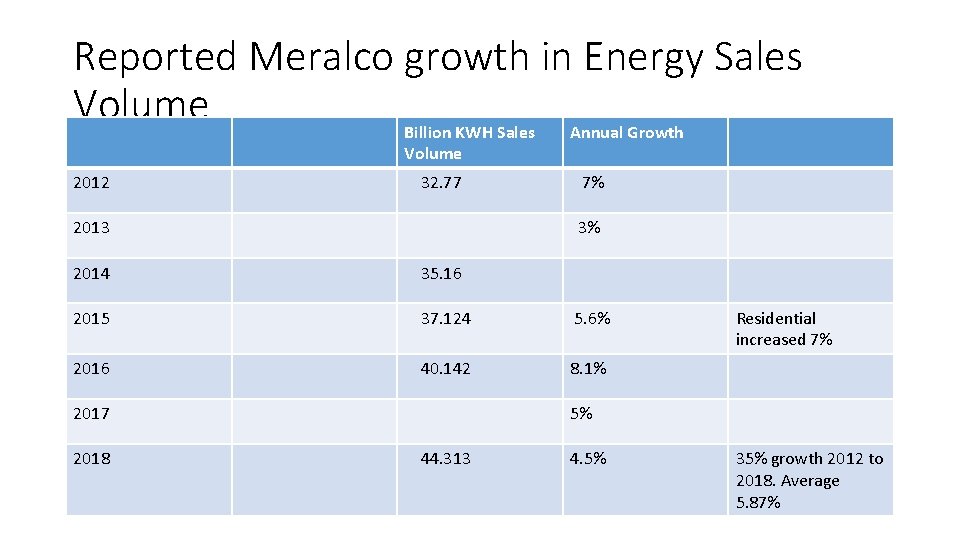
Reported Meralco growth in Energy Sales Volume Billion KWH Sales Annual Growth Volume 2012 32. 77 2013 7% 3% 2014 35. 16 2015 37. 124 5. 6% 2016 40. 142 8. 1% 2017 2018 Residential increased 7% 5% 44. 313 4. 5% 35% growth 2012 to 2018. Average 5. 87%
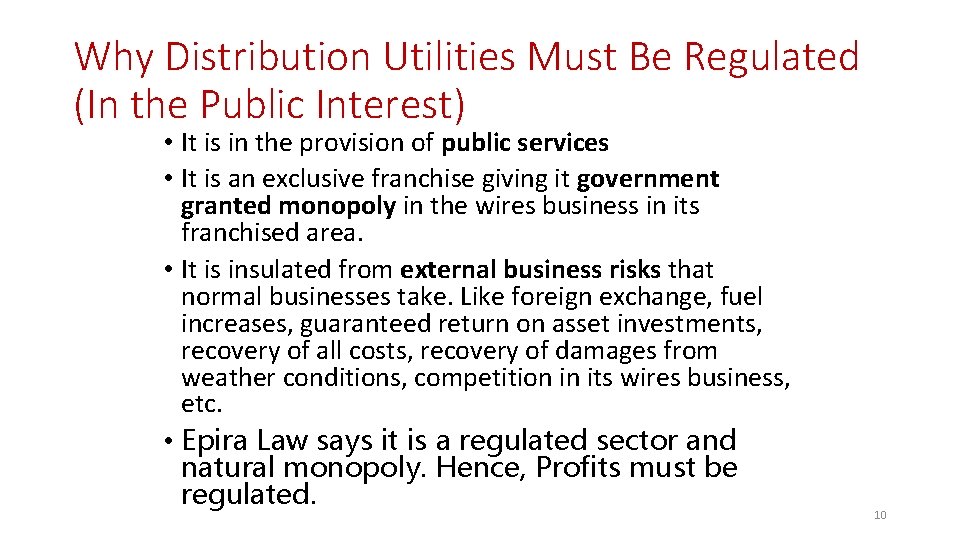
Why Distribution Utilities Must Be Regulated (In the Public Interest) • It is in the provision of public services • It is an exclusive franchise giving it government granted monopoly in the wires business in its franchised area. • It is insulated from external business risks that normal businesses take. Like foreign exchange, fuel increases, guaranteed return on asset investments, recovery of all costs, recovery of damages from weather conditions, competition in its wires business, etc. • Epira Law says it is a regulated sector and natural monopoly. Hence, Profits must be regulated. 10
Reasons Meralco’s rates should be lower • The economy has grown and its KWH energy sales have grown more than 6% per year since 2012 (as opposed to 3. 5% used in the projections) • The rise of central business districts and condominiums increased the density of consumers per square kilometer that should lead to lower cost to serve on per kwh basis • The improvement in its load factor and flatter demand curve due to the rise in power demand at night by call centers, POGO’s, malls. Manila is now a 24/7 economy. 11
Reiteration • We have gone over the presentations of ERC on how the PBR works and Meralco’s presentation on April 10, 2017. • We are afraid that consumers are lost in the esoteric technical language of these methodologies. • It might be a tantalizing process replete with soothing language. It is the end result that matters to the consumers. How much they pay. • Since PBR has been costing the consumers more than P 10 billion a year, they are entitled to understand why that is justified. • Let us give due respect to consumers by speaking to them in plain language that they would understand. Let us not talk over their heads. 12
Gut Issues on PBR in Layman’s Language • Advance Charging and profit recovery from projected investments - Euphemistically called “Forward looking”? • Does the PBR allow for advance charging to consumers of projected investments including the corresponding returns? • Is this not a violation of Section 25 of the Epira that require that retail rates must be based on investments incurred? • In the Public Interest? • Is the alternative methodology that is the PBR that was adopted by the ERC “in the public interest”? 13
Gut Issues in PBR in Layman’s Language • Service Performance and costs to Consumers 1) Is the improvement in service performance fair and reasonable compared to the Cost to the Consumers of such improvements? 2) Were there really improvements from 2005 to 2018 in the Performance Standards of Meralco since the PBR was adopted? What were the baseline figures? 2) How much of this service performance is actually Meralco’s basic service obligation under its distribution franchise? How do we justify the removal of limits on profits in return for Meralco delivering its service performance obligation. 3) Aren’t the cost of providing the services and the investments needed already 14 covered by the old RORB?
Assets Funded by Consumers • Is the ERC under current rules allowing Du’s like Meralco to recover and profit from asset investments funded by the consumer deposits amounting to P 23 billion? If so Why? • Under PBR, will Meralco recover and profit from the assets acquired with advance funding from consumers? 15
Fundamental Issues that need to be revisited before the rate methodologies are set • How much should a DU really be allowed to make on their equity? Should be it on their asset? What’s a fair and reasonable return on their investment? • Should the profit be after corporate tax? • Should they be allowed to earn a return on investments made with consumer deposits? • Should they be allowed to reappraise their asset value perpetually? • How do you define “investment”? Is it how much they put in the assets of the DU to provide services? Or is it the amount the new Owner paid to the old owner in buying the franchise DU?
Additional Issues to Address – Performance Standards and Distribution Rates • Are the service performance standards the same for ALL DU’s? (Meralco, VECO, Davao Light, Cepalco, Dagupan Electric? ) • If so, what accounts for the differences in their distribution rates? • For what reasons would the 6, 400 mw Meralco have much higher distribution charges than the much smaller VECO and Davao Light? (asked by a City Councilor of Davao City) 17
Newly Discovered Silent Profit Making Methodology • Windfall profits from growth in actual energy sales vs the forecasted energy volume used in computing kwh rates. • Meralco energy sales in kwh had been growing at 6% per year since 2012. Retail Rate was based on 3. 5% growth. We estimate 1. 1 Billion kwh a year or about P 3. 3 billion a year for 6 years. 6. 6 Billion kwh accumulated resulting to P 19. 8 billion a year in additional revenue in excess of ARR. • Is this true? If so, lets explain to consumers. 18
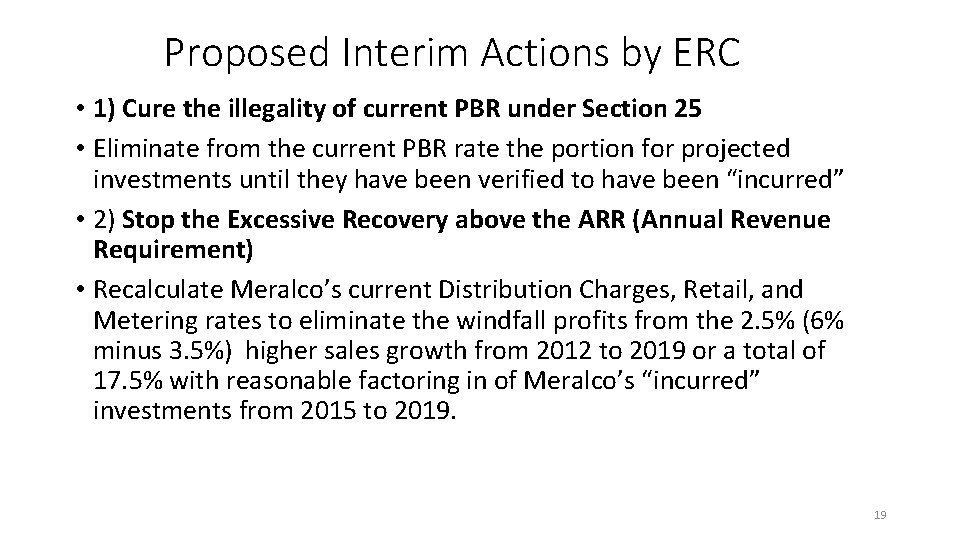
Proposed Interim Actions by ERC • 1) Cure the illegality of current PBR under Section 25 • Eliminate from the current PBR rate the portion for projected investments until they have been verified to have been “incurred” • 2) Stop the Excessive Recovery above the ARR (Annual Revenue Requirement) • Recalculate Meralco’s current Distribution Charges, Retail, and Metering rates to eliminate the windfall profits from the 2. 5% (6% minus 3. 5%) higher sales growth from 2012 to 2019 or a total of 17. 5% with reasonable factoring in of Meralco’s “incurred” investments from 2015 to 2019. 19
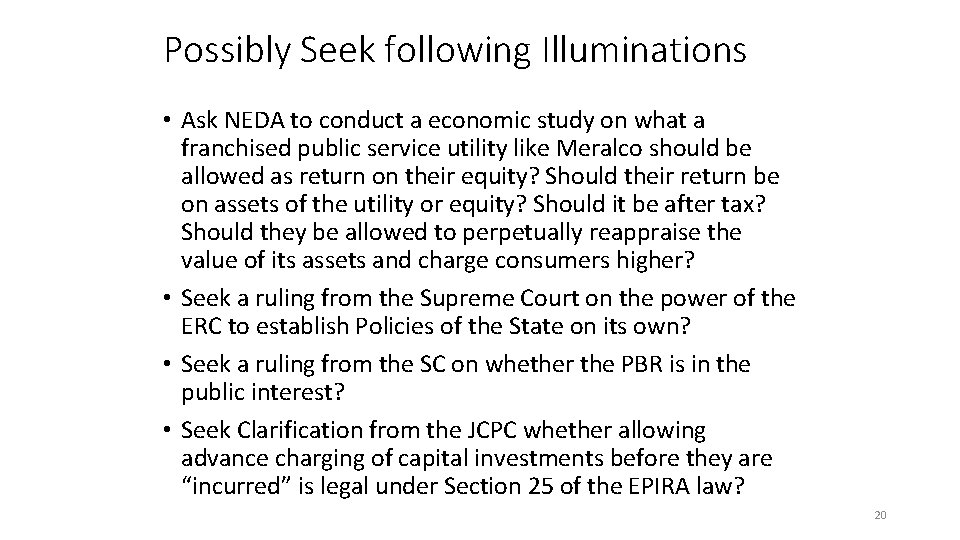
Possibly Seek following Illuminations • Ask NEDA to conduct a economic study on what a franchised public service utility like Meralco should be allowed as return on their equity? Should their return be on assets of the utility or equity? Should it be after tax? Should they be allowed to perpetually reappraise the value of its assets and charge consumers higher? • Seek a ruling from the Supreme Court on the power of the ERC to establish Policies of the State on its own? • Seek a ruling from the SC on whether the PBR is in the public interest? • Seek Clarification from the JCPC whether allowing advance charging of capital investments before they are “incurred” is legal under Section 25 of the EPIRA law? 20
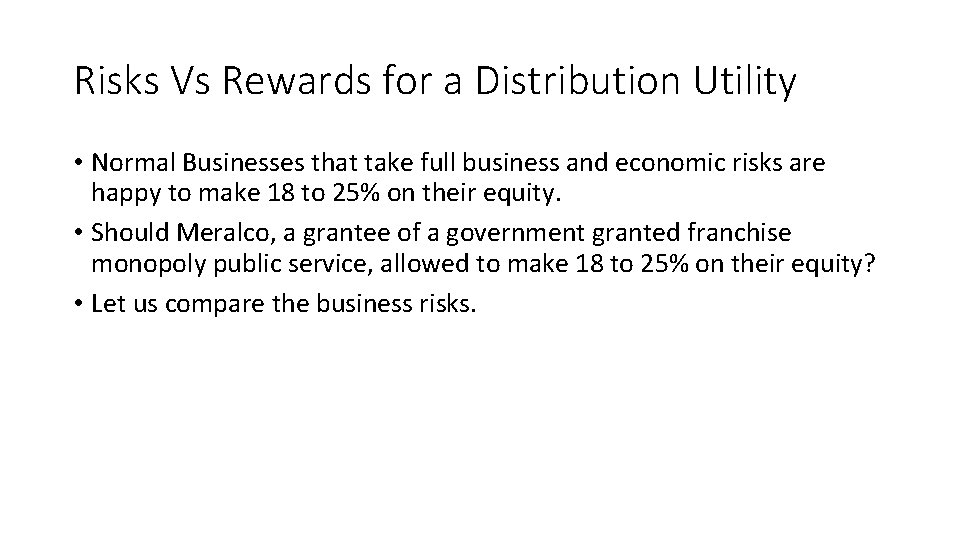
Risks Vs Rewards for a Distribution Utility • Normal Businesses that take full business and economic risks are happy to make 18 to 25% on their equity. • Should Meralco, a grantee of a government granted franchise monopoly public service, allowed to make 18 to 25% on their equity? • Let us compare the business risks.
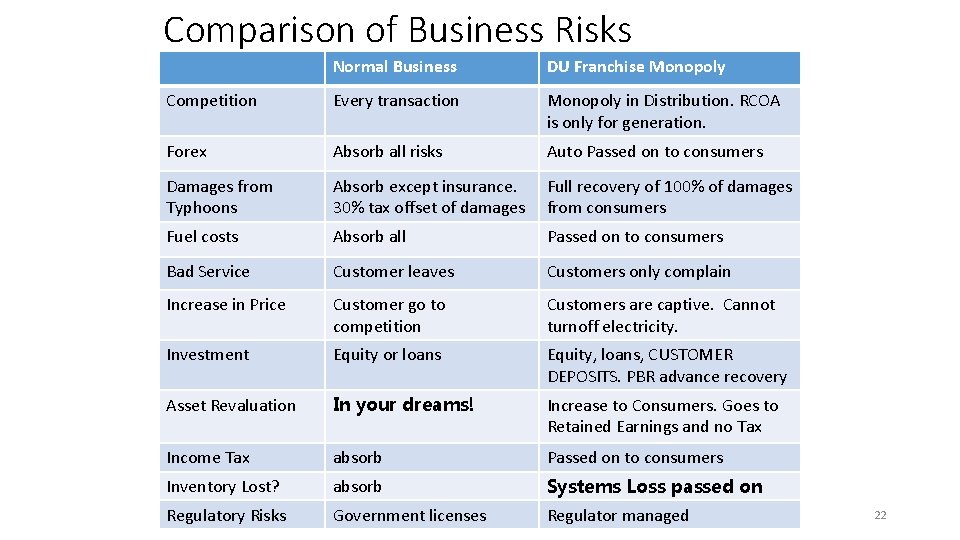
Comparison of Business Risks Normal Business DU Franchise Monopoly Competition Every transaction Monopoly in Distribution. RCOA is only for generation. Forex Absorb all risks Auto Passed on to consumers Damages from Typhoons Absorb except insurance. 30% tax offset of damages Full recovery of 100% of damages from consumers Fuel costs Absorb all Passed on to consumers Bad Service Customer leaves Customers only complain Increase in Price Customer go to competition Customers are captive. Cannot turnoff electricity. Investment Equity or loans Equity, loans, CUSTOMER DEPOSITS. PBR advance recovery Asset Revaluation In your dreams! Increase to Consumers. Goes to Retained Earnings and no Tax Income Tax absorb Passed on to consumers Inventory Lost? absorb Systems Loss passed on Regulatory Risks Government licenses Regulator managed 22
Rate Making Reform – a Win-Win Solution • Establish clear government policy on those basic economic fundamentals for public services – Guideposts for rate making. • Make clear, transparent, and simplified rate setting methodologies • (Create One for the Philippines, Why does it always have to be “internationally accepted” that in fact is only by name and we have a knack for implementing it terribly against the Filipinos…. by Filipinos! Thanks to the lobbyists! Are we playing on the colonial mentality of the Filipinos? )
RORB vs PBR • Existing Rate Base is the same • In RORB, investments must be made first and validated by the DU and its auditors or consultants • In PBR, • 1) investments are forecasted for the next four years (a regulatory period) and • 2) factored into the rate for the next four years whether they make the investments or not. • 3) True up every four years. • 4) Meralco profits allowed to be deregulated
A Modified and Simplified PBR • Establish the new rate base as of 2015 and add the approved, incurred, and verified capex up to 2019. Reduce the value of the assets financed with consumer deposits or at least pay the consumers the same interest as Meralco’s bank rates plus a premium for “forced investments” • Make Meralco apply for its Capex program for every two years and approve the corresponding incremental rate when those are incurred. • Every year, update the kwh rate by dividing the Approved Revenue Requirement by the actual energy sales for the year plus an updated forecast of growth (kwh sales) for the coming year. • Determine ova provisional errecovery and underrecovery every year to avoid excessive accumulation of amounts into problematic proportions. Then finalize the figures within one year.
Improve the Rate Making Process and Timeliness • Strengthen the capability of the ERC in administering, monitoring, adjudicating the Rate making process by creating a special unit at ERC dedicated to PBR who will provide professional support to the appointed Commissioner in charge of PBR. Upgrade the salary scales and create a conducive career environment. • Whatever methodology is chosen, it must be implemented to maintain regulation of the annual return on equity of the DU as established as a policy of the state. • Provide procurement guideline of Capex and Opex to assure competition and prevent overpricing of capex investments.
Questions that the ERC should be able to Answer Readily on PBR? • Under PBR, Meralco is allowed to include in its rate its projected future capital investments “to improve performance”. Question: • Under PBR, does the ERC need to verify if those projected investments are Actually incurred by Meralco if theoretically they meet the PIS performance standards? • In other words, Does Meralco really need to make those projected investments that have been charged to the consumers?
Easy Question No. 2 • After establishing the ARR (Annual Revenue Requirement), this is translated to a per kwh rate by dividing it with the projected annual energy sales (KWH) of Meralco. • Question: • In projecting the annual energy sales what annual growth rate is used in calculating the year to year energy sales? Is it true that Meralco and ERC uses a 3. 5% annual growth rate? If Meralco energy sales grew by 7%, is Meralco allowed to keep the additional revenue as attested to under oath by a Meralco official? • From 2012 to 2019, 7 yrs @3. 5% totals 24. 5% in excess revenue using the old per kwh rate. 28
Easy Question No. 3 • Kindly disclose the true up and rate rebasing process currently being used for the 4 th and 5 th regulatory reset.
Moving Forward • We agree to the application of new rules prospectively. However, the proper interpretation of old rules and the excess charges and profits thereof must be determined and returned to consumers. • In fact, it is incumbent upon the new ERC to undertake an extensive audit of the Capex and Rate recoveries of Meralco for 2012 to 2019 specially the windfall profits resulting for excess growth in the energy sales of 4. 67% to 7% per year.
Advisory • All these questions, ideas, and suggestions are not designed to be the replacement of the current PBR but are intended by MSK to trigger a rethinking of our Rate Making Process, the correction of their illegalities, the elimination of their arithmetical defects, and a revisiting of our national policies that should be the guideposts for a rate setting methodology. • It is the ERC (with perhaps a policy guideline from the DOE) that can reconfigure our Rate Making Methodology into something truly fair and reasonable. And in accordance with a duly established national policy.
Things the PBR and its Implementation should not be • It should not be illegal. • 1) Retail rates should be based on investments incurred and • 2) the return on equity of the DU should be Regulated as provided for by the EPIRA law of 2001. • 3) the rate setting change from RORB to PBR should be in the public interest. • It should not allow for undeserved profits due to miscomputation of CAPEX and OPEX and translation to kwh rate. • It should not be misadministered by allowing windfall profits from overrecovery of ARR year to year. • It should not allow the ballooning of overrecovery and underrecovery to unmanageable proportions.
We are Grateful • We hope that our input and observations on the current PBR methodology can be useful to the ERC as they go about their “motu proprio” mandate (on own motion) to look after the public interest, to seek least cost power, and promote improvement in electric delivery services at fair and reasonable price. • After all the exotic and tantalizing rules, the bottom line still needs to be asked: does it serve the public interest? Is it fair and reasonable? Does it promote the global competitiveness of the country? 33
Regulators are Like Lighthouses Alfred Parker • this quotation reported to have been spoken by an aged west coast Indian sitting on a rock and looking out to sea. It reads as follows: • Lighthouse, him no good for fog. Lighthouse, him whistle, him • blow, him ring bell, him flash light, him raise hell; but fog come in • just the same. ' • Today's federal and state regulatory commissions can be likened to the "lighthouse. " • These regulatory commissions have not proved to be really adequate as a substitute for competition in fulfilling its functions of preventing monopoly prices and profits, checking price discrimination, reducing costs, inducing technical progress, and promoting wider use of utility services while providing a fair return to investors. • But as in the case of the lighthouse, this failure is no cause for destruction or elimination. The electric Consumers need you. • Please be the best lighthouse that you can be. Thank you 34
If not by you, Whom? If not Now, When? Salamat Po • Matuwid na Singil sa Kuryente Consumer Alliance Inc. • Advocates for Consumer Protection in Power and Regulatory Reforms • Matuwid. org MSK Humbly Presented by David Celestra Tan, Co-convenor 35