MSK Sheffield Improving MSK care with an integrated



- Slides: 31
MSK Sheffield Improving MSK care with an integrated approach “MSK Sheffield”
MSK Sheffield Outline – the concept and the reasons • • • Commissioner view History of MSK commissioning in Sheffield What problems we were trying to solve Conclusions and reflections What we did – why partnership Lessons learned and the future
MSK Sheffield History of MSK commissioning in Sheffield • • • Developed pathways (joint specific & service) Procedures of Limited Clinical Value Implementation of surgical thresholds Developed a community MSK and podiatric surgery services Developed close and effective partnerships & working relationships with clinical leads across all MSK services
MSK Sheffield What problems we were trying to solve • Concerns that our pathways had created silos and reducing integration frustrating both patients & clinicians • Concerns around variation in GP referral (timing, paper or electronic and relative MSK expertise) • Concerns that our protocols and thresholds had reduced expert clinical autonomy • Concerns of the above reducing flexibility of services to meet patients needs/deliver best outcomes • Concerns for sustainability of services with rising demand
MSK Sheffield Conclusions – recognition that we needed: • A new approach focussing on delivering outcomes through a fully integrated service rather than units of activity within individual directorates • A balance of robust referral pathways but also clinical autonomy and flexibility • To work much more closely with Sheffield’s patients to understand their needs and outcomes required • To address these by harnessing the expertise of local clinical experts those in Primary, Community and Acute care who best know the city and its patients’ needs to redesign MSK services citywide
MSK Sheffield What we did – why partnership? Significant local assurance process Hugely complex change – never been tried before in Sheffield Vast numbers of ‘known unknowns’ & ‘unknowns’ Recognition that culture and iterative change rather than ‘big bang’ was key to ensuring long term sustainability • Recognition that the clinical expertise to deliver the change successfully was within our core local provider • Potential impact on other critical clinical services such as Sheffield’s regional trauma centre • •
MSK Sheffield Lessons learned and the future • Takes significant time to build structures, capabilities and trust – this is new for Sheffield • Partnership working has been absolutely key and moved things forward faster and at the same time harnessed fantastic and considered thinking and expertise (clinical and management) • Iterative process but the service is all the better for it • Still masses to do but have we addressed our concerns and are we positive about the future - absolutely!
MSK Sheffield Outline – the changes • Sheffield Context – the beginning • What is the “MSK Sheffield” model? • Operational detail and data so far • What next?
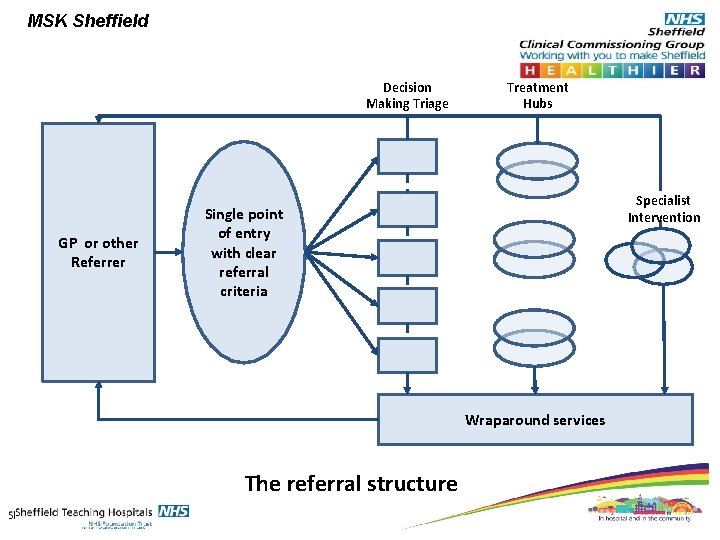
MSK Sheffield The beginning • CCG asked for a outcomes based, integrated MSK service • Sheffield Teaching Hospitals (STH) response – Co-design a model with patients – Single point of access model with aligned services • Re-organising services across whole city for all care – Measuring and reporting on outcomes – Build on what we have already; Spinal pathway, integrated community and hospital service
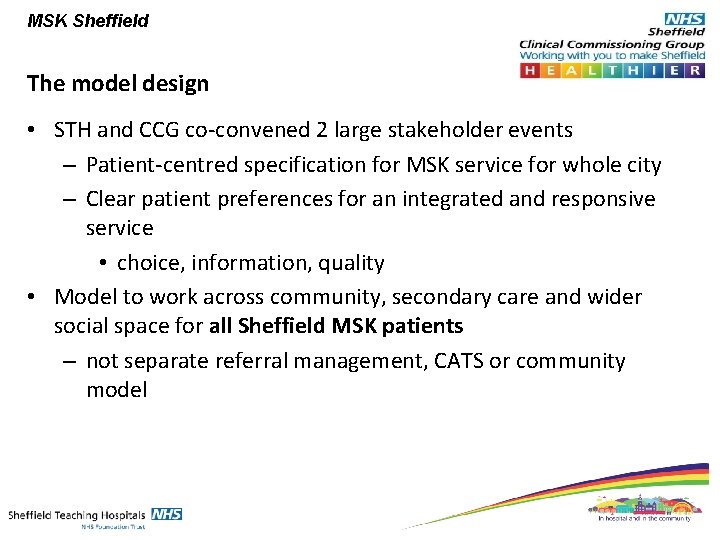
MSK Sheffield The model design • STH and CCG co-convened 2 large stakeholder events – Patient-centred specification for MSK service for whole city – Clear patient preferences for an integrated and responsive service • choice, information, quality • Model to work across community, secondary care and wider social space for all Sheffield MSK patients – not separate referral management, CATS or community model
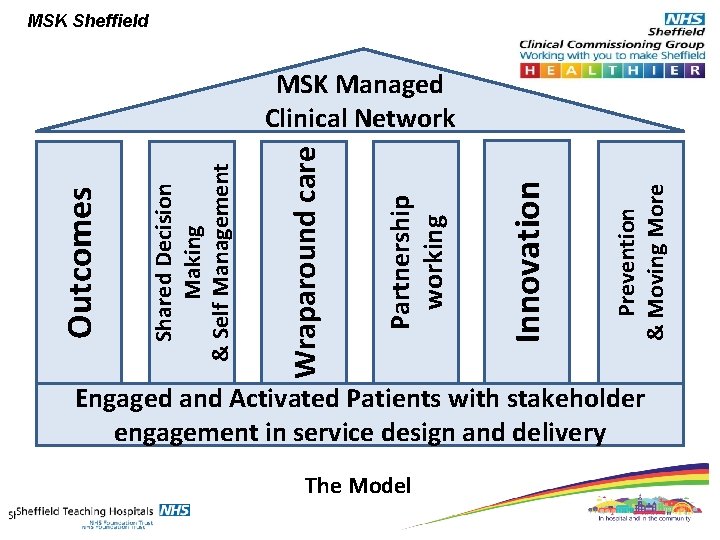
MSK Sheffield Prevention & Moving More Innovation Partnership working Wraparound care Shared Decision Making & Self Management Outcomes MSK Managed Clinical Network Engaged and Activated Patients with stakeholder engagement in service design and delivery The Model
MSK Sheffield Decision Making Triage GP or other Referrer Treatment Hubs Specialist Intervention Single point of entry with clear referral criteria Wraparound services The referral structure
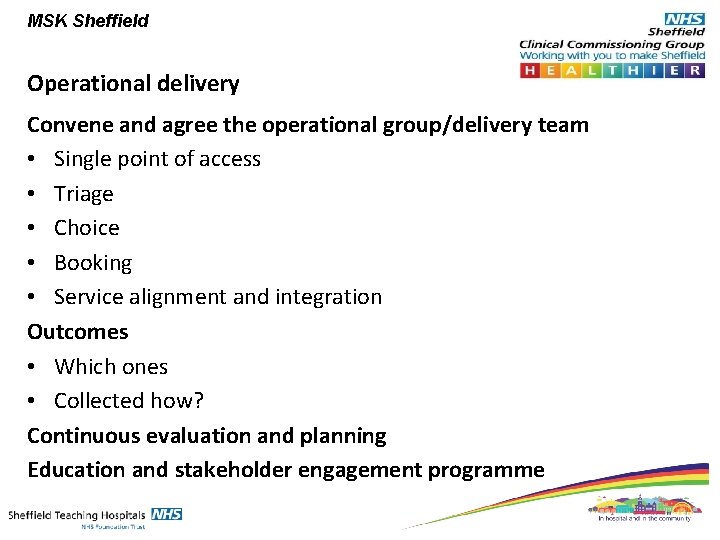
MSK Sheffield Operational delivery Convene and agree the operational group/delivery team • Single point of access • Triage • Choice • Booking • Service alignment and integration Outcomes • Which ones • Collected how? Continuous evaluation and planning Education and stakeholder engagement programme
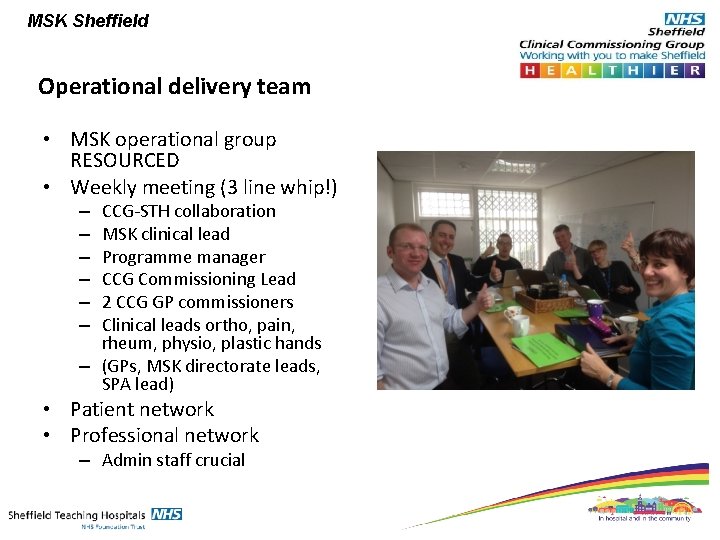
MSK Sheffield Operational delivery team • MSK operational group RESOURCED • Weekly meeting (3 line whip!) CCG-STH collaboration MSK clinical lead Programme manager CCG Commissioning Lead 2 CCG GP commissioners Clinical leads ortho, pain, rheum, physio, plastic hands – (GPs, MSK directorate leads, SPA lead) – – – • Patient network • Professional network – Admin staff crucial
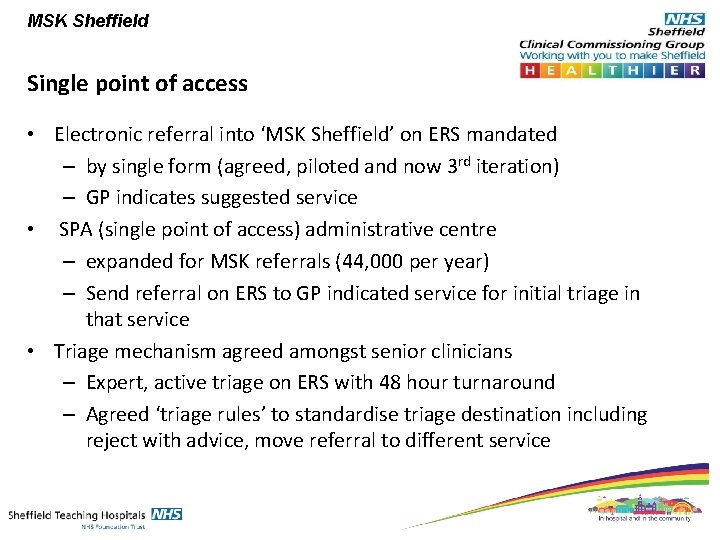
MSK Sheffield Single point of access • Electronic referral into ‘MSK Sheffield’ on ERS mandated – by single form (agreed, piloted and now 3 rd iteration) – GP indicates suggested service • SPA (single point of access) administrative centre – expanded for MSK referrals (44, 000 per year) – Send referral on ERS to GP indicated service for initial triage in that service • Triage mechanism agreed amongst senior clinicians – Expert, active triage on ERS with 48 hour turnaround – Agreed ‘triage rules’ to standardise triage destination including reject with advice, move referral to different service
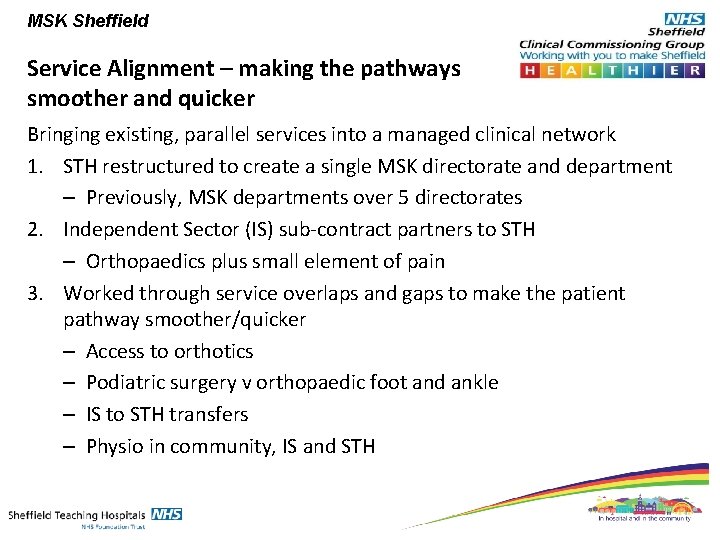
MSK Sheffield Service Alignment – making the pathways smoother and quicker Bringing existing, parallel services into a managed clinical network 1. STH restructured to create a single MSK directorate and department – Previously, MSK departments over 5 directorates 2. Independent Sector (IS) sub-contract partners to STH – Orthopaedics plus small element of pain 3. Worked through service overlaps and gaps to make the patient pathway smoother/quicker – Access to orthotics – Podiatric surgery v orthopaedic foot and ankle – IS to STH transfers – Physio in community, IS and STH
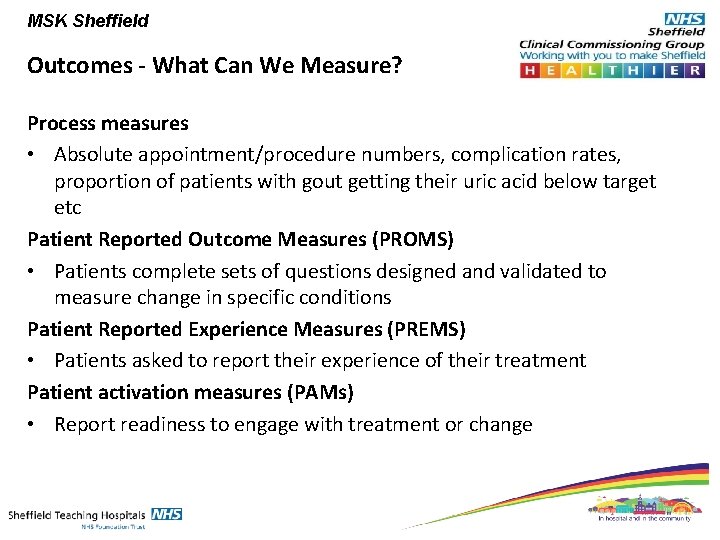
MSK Sheffield Outcomes - What Can We Measure? Process measures • Absolute appointment/procedure numbers, complication rates, proportion of patients with gout getting their uric acid below target etc Patient Reported Outcome Measures (PROMS) • Patients complete sets of questions designed and validated to measure change in specific conditions Patient Reported Experience Measures (PREMS) • Patients asked to report their experience of their treatment Patient activation measures (PAMs) • Report readiness to engage with treatment or change
MSK Sheffield The outcomes ‘how’ • Embed PROM collection into routine clinical care (44, 000 new patient referrals each year) • Quickly realised that we couldn’t collect, analyse and report this information on paper without employing a small army of people • Trial IT solution – With commitment to parallel non-IT solution next • Negotiated for this to be properly funded • Designed initial specification for, went to tender
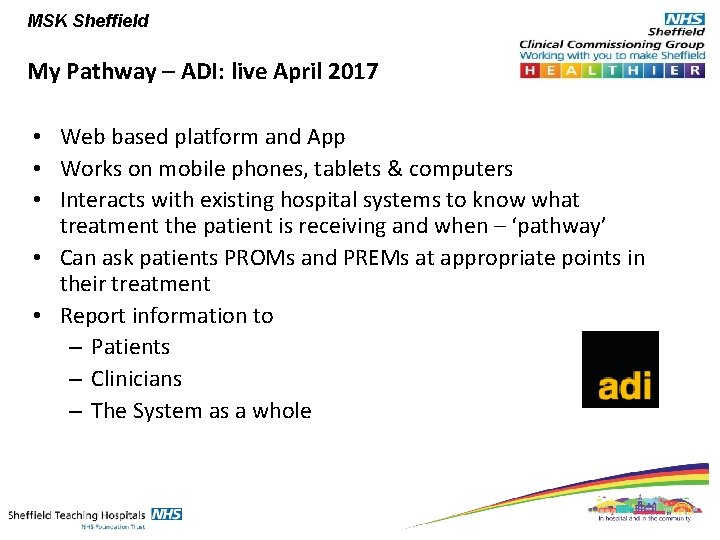
MSK Sheffield My Pathway – ADI: live April 2017 • Web based platform and App • Works on mobile phones, tablets & computers • Interacts with existing hospital systems to know what treatment the patient is receiving and when – ‘pathway’ • Can ask patients PROMs and PREMs at appropriate points in their treatment • Report information to – Patients – Clinicians – The System as a whole
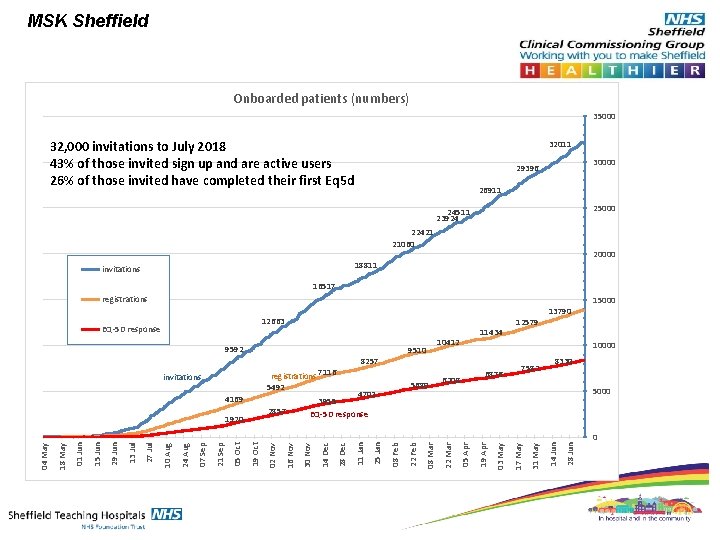
MSK Sheffield Onboarded patients (numbers) 35000 32011 32, 000 invitations to July 2018 43% of those invited sign up and are active users 26% of those invited have completed their first Eq 5 d 30000 29396 26911 25000 24511 23924 22421 21060 20000 18811 invitations 16517 registrations 15000 13790 12663 6208 6876 7582 8330 28 Jun 14 Jun 03 May 19 Apr 5000 05 Apr 08 Mar 22 Feb 08 Feb 25 Jan 11 Jan 28 Dec 14 Dec 16 Nov 19 Oct 05 Oct 21 Sep 07 Sep 24 Aug 10 Aug 27 Jul 13 Jul 29 Jun 15 Jun 01 Jun 18 May 04 May 02 Nov 2857 1920 5680 4701 3955 EQ-5 D response 30 Nov 4169 10000 8257 registrations 7116 5492 invitations 10412 12579 31 May 9510 11434 17 May 9592 22 Mar EQ-5 D response 0
MSK Sheffield Change impact
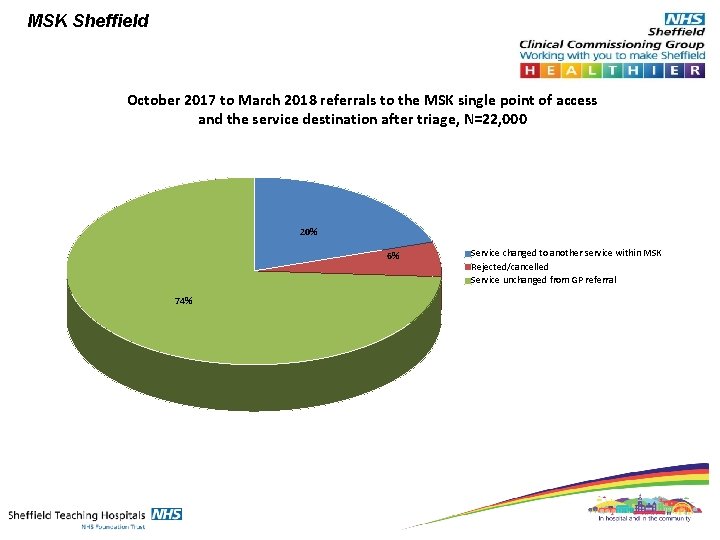
MSK Sheffield October 2017 to March 2018 referrals to the MSK single point of access and the service destination after triage, N=22, 000 20% 6% 74% Service changed to another service within MSK Rejected/cancelled Service unchanged from GP referral
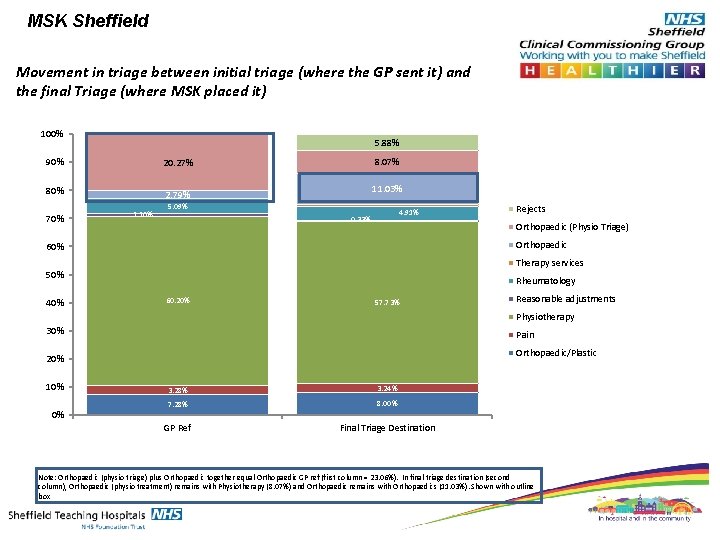
MSK Sheffield Movement in triage between initial triage (where the GP sent it) and the final Triage (where MSK placed it) 100% 5. 88% 90% 20. 27% 80% 2. 79% 70% 1. 10% 8. 07% 11. 03% 5. 09% 4. 91% 0. 33% Orthopaedic (Physio Triage) Orthopaedic 60% Therapy services 50% 40% Rejects Rheumatology 60. 20% 57. 73% Reasonable adjustments Physiotherapy 30% Pain Orthopaedic/Plastic 20% 10% 0% 3. 28% 3. 24% 7. 28% 8. 00% GP Ref Final Triage Destination Note: Orthopaedic (physio triage) plus Orthopaedic together equal Orthopaedic GP ref (first column = 23. 06%). In final triage destination (second column), Orthopaedic (physio treatment) remains with Physiotherapy (8. 07%) and Orthopaedic remains with Orthopaedics (11. 03%). Shown with outline box
MSK Sheffield Patient choice offer - Orthopaedics All patients offered choice of appropriate appointment after clinical triage ‘Appropriate’ = post triage, so only to the right clinic/clinician/provider ‘Choice’ = Time and location (where appropriate)
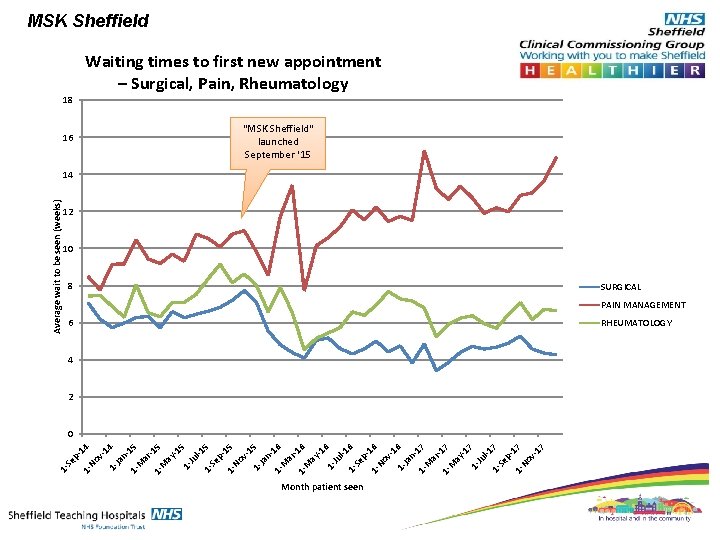
1 - 14 No v 14 1 Ja n 1 - 15 M ar 1 - 15 M ay -1 1 - 5 Ju l-1 5 1 Se p 1 - 15 No v 15 1 Ja n 1 - 16 M ar 1 - 16 M ay -1 1 - 6 Ju l-1 6 1 Se p 1 - 16 No v 16 1 Ja n 1 - 17 M ar 1 - 17 M ay -1 1 - 7 Ju l-1 7 1 Se p 1 - 17 No v 17 Se p 1 - Average wait to be seen (weeks) MSK Sheffield Waiting times to first new appointment – Surgical, Pain, Rheumatology 18 16 "MSK Sheffield" launched September ‘ 15 14 12 10 8 SURGICAL PAIN MANAGEMENT 6 RHEUMATOLOGY 4 2 0 Month patient seen
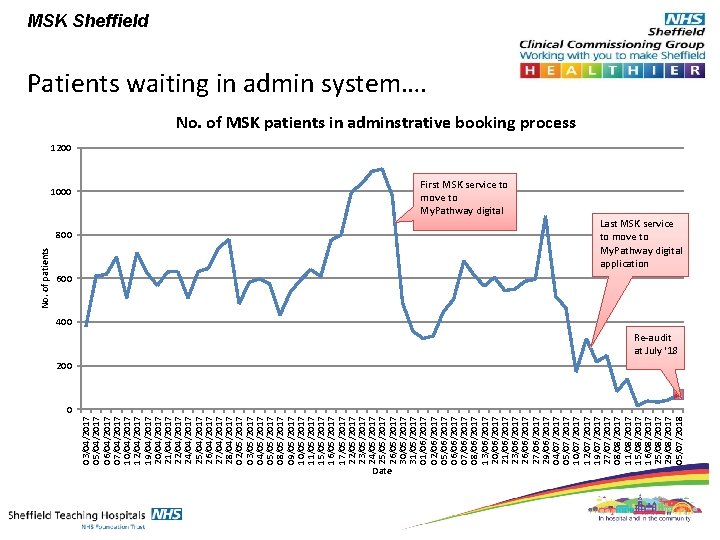
03/04/2017 05/04/2017 06/04/2017 07/04/2017 10/04/2017 12/04/2017 19/04/2017 20/04/2017 21/04/2017 22/04/2017 24/04/2017 25/04/2017 26/04/2017 27/04/2017 28/04/2017 02/05/2017 03/05/2017 04/05/2017 05/05/2017 08/05/2017 09/05/2017 10/05/2017 11/05/2017 15/05/2017 16/05/2017 17/05/2017 22/05/2017 23/05/2017 24/05/2017 25/05/2017 26/05/2017 30/05/2017 31/05/2017 01/06/2017 02/06/2017 05/06/2017 06/06/2017 07/06/2017 08/06/2017 13/06/2017 20/06/2017 21/06/2017 23/06/2017 26/06/2017 27/06/2017 29/06/2017 04/07/2017 05/07/2017 10/07/2017 12/07/2017 19/07/2017 27/07/2017 08/08/2017 11/08/2017 15/08/2017 16/08/2017 25/08/2017 29/08/2017 05/07/2018 No. of patients MSK Sheffield Patients waiting in admin system…. No. of MSK patients in adminstrative booking process 1200 1000 First MSK service to move to My. Pathway digital 800 Date Last MSK service to move to My. Pathway digital application 600 400 Re-audit at July '18 200 0
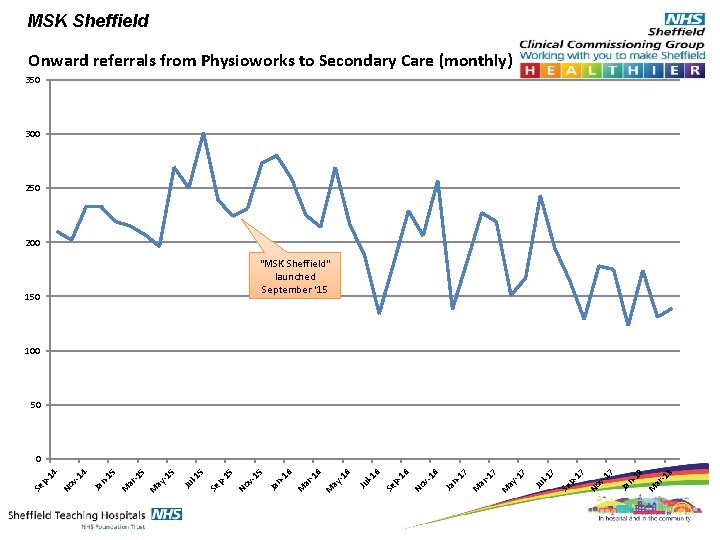
ar M -1 8 18 n- Ja v 17 No 7 17 p- Se l-1 Ju -1 7 ay M ar M 17 n- Ja v 16 No 6 16 p- Se l-1 Ju -1 6 ay M ar M 16 n- 150 Ja 15 v- No 5 15 p- Se l-1 Ju -1 5 ay M ar M 15 n- Ja v 14 No 14 p- Se MSK Sheffield Onward referrals from Physioworks to Secondary Care (monthly) 350 300 250 200 "MSK Sheffield" launched September '15 100 50 0
MSK Sheffield Outcome data collection and use of the app • 10, 755 MSK new patients new using the My. Pathway digital app • Use of outcomes data to change clinical pathways – introduced orthopaedic virtual clinics • Data being collected to establish Sheffield baseline – Eq 5 d, Back pain , Pain baseline assessment, Ankylo Spondylitis • 75 more pathways to develop and establish baseline outcomes! • Add self help and information for each patient relevant to their condition
MSK Sheffield Key learning - Positive • Change Process – Clinical leadership and decision making – Putting what is right for the patient first – Resourced properly (clinical leaders, patients and programme management time) – Co-designed with patients with meaningful patient engagement – Test, change, test, change………. . • Cultural collaboration – Within STH, primary care, CCG and IS MSK – Barriers less where outcomes are the focus • Educational gains: across system and across MSK clinicians • Governance – Move from competition to collaboration, better for MSK patient • MSK entire system solution – Better for patient, smoother pathways, can resolve pathway overlaps/variations easier
MSK Sheffield Key learning points – Better if • Set robust base line data first – especially if merging different organisations activity (and data) • Agree plan for evaluation • Prospective/responsive plan to resource shift • More robust communications strategy with stakeholders • Better provision in contract for pump priming – eg. outcomes platform
MSK Sheffield Summary • Described a collaborative, whole system, outcomes-based approach to delivering patient centred, patient focused, integrated MSK care • Described the operational detail and challenges • Described the benefits of clinician led, collaborative CCG-Trust working where every step is co-designed by patients and each part of the process starts with the question of: Right Person, Right Place, Right Time……….