You need Clean paper 2 pencil Apr 30


- Slides: 59
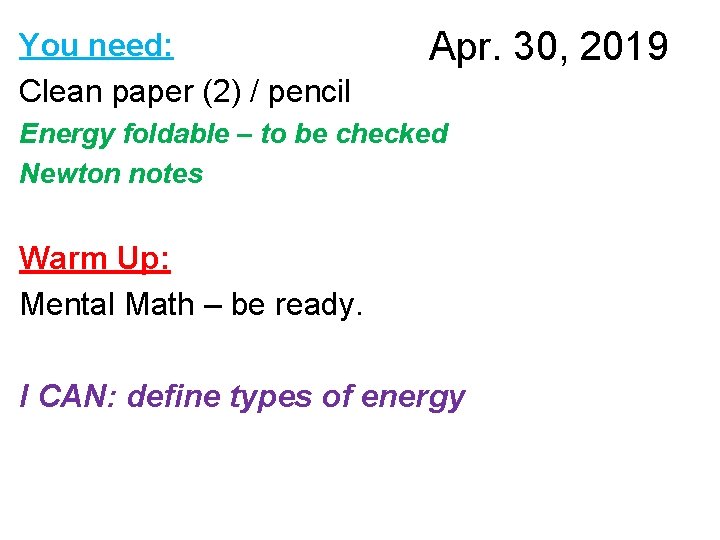
You need: Clean paper (2) / pencil Apr. 30, 2019 Energy foldable – to be checked Newton notes Warm Up: Mental Math – be ready. I CAN: define types of energy
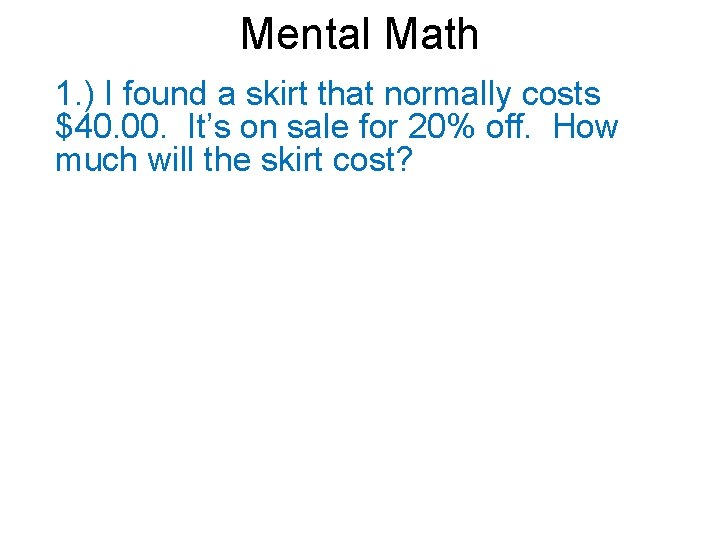
Mental Math 1. ) I found a skirt that normally costs $40. 00. It’s on sale for 20% off. How much will the skirt cost?
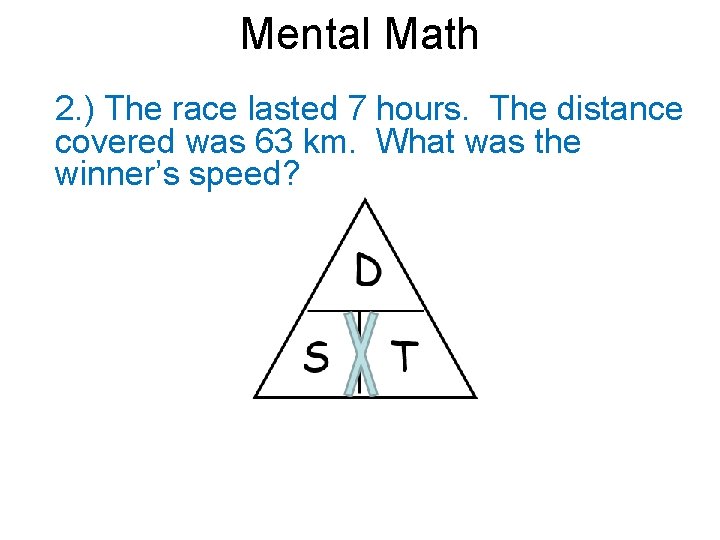
Mental Math 2. ) The race lasted 7 hours. The distance covered was 63 km. What was the winner’s speed?
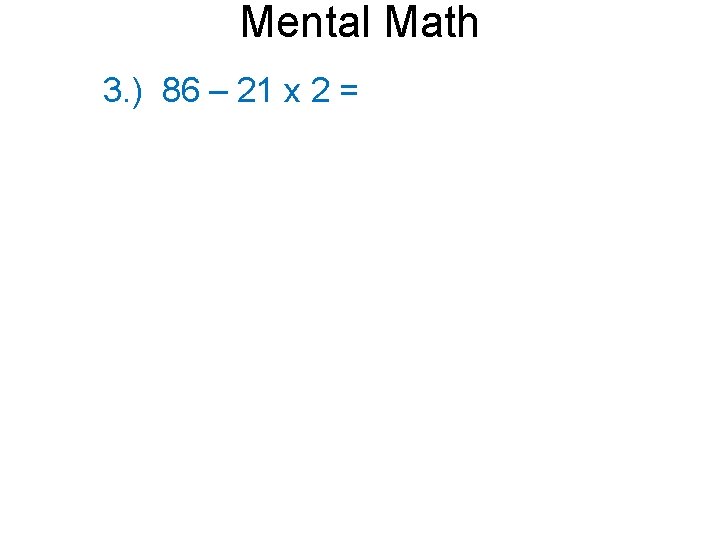
Mental Math 3. ) 86 – 21 x 2 =
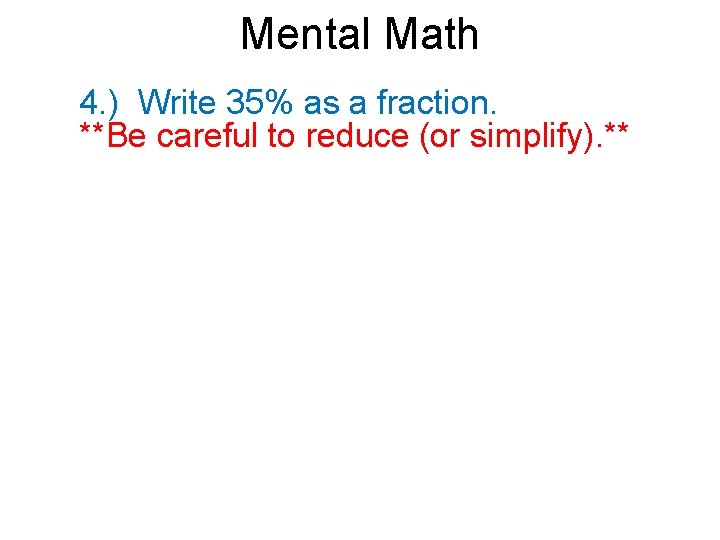
Mental Math 4. ) Write 35% as a fraction. **Be careful to reduce (or simplify). **
Mental Math 5. ) 398 dm = _____ hm *Be careful to show decimal
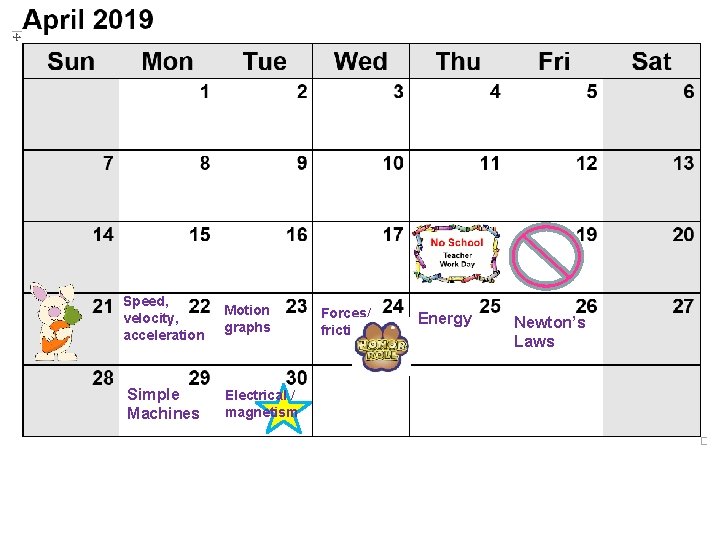
Speed, velocity, acceleration Simple Machines Motion graphs Electrical / magnetism Forces/ friction Energy Newton’s Laws
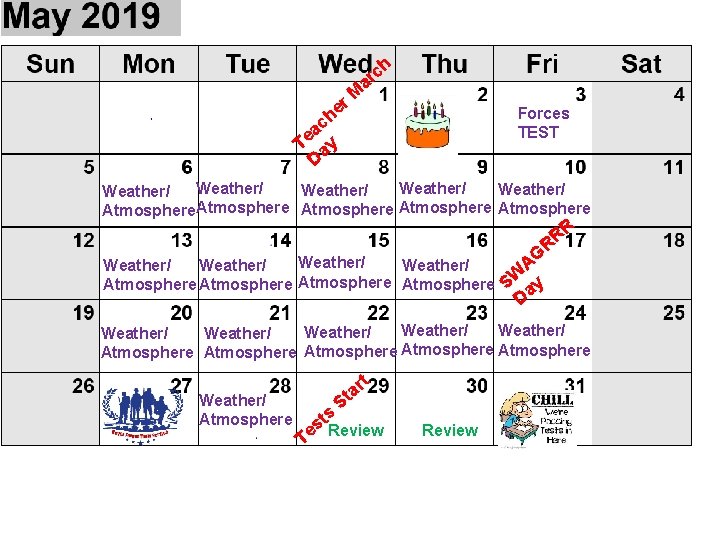
h er h c c ar M Forces TEST a Te ay D Weather/ Weather/ Atmosphere Weather/ AG Weather/ W Atmosphere S ay R R R D Weather/ Weather/ Atmosphere Atmosphere t Weather/ Atmosphere ts r ta S s Review e T Review
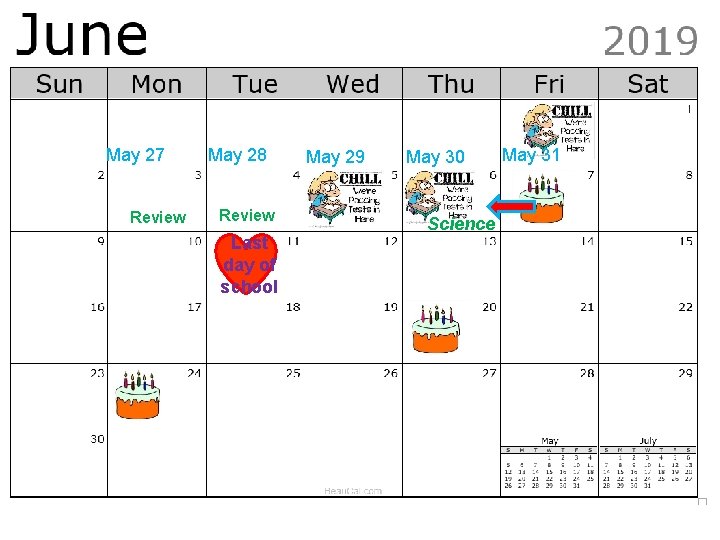
May 27 Review May 28 Review Last day of school May 29 May 30 Science May 31
FRICTION
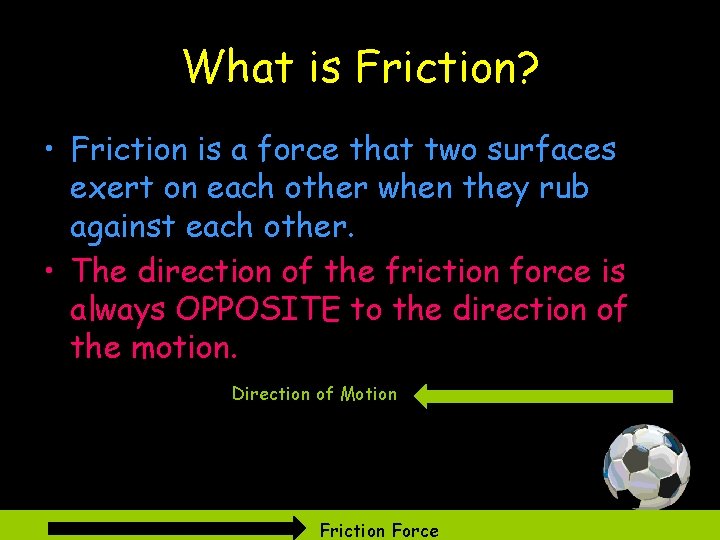
What is Friction? • Friction is a force that two surfaces exert on each other when they rub against each other. • The direction of the friction force is always OPPOSITE to the direction of the motion. Direction of Motion Friction Force
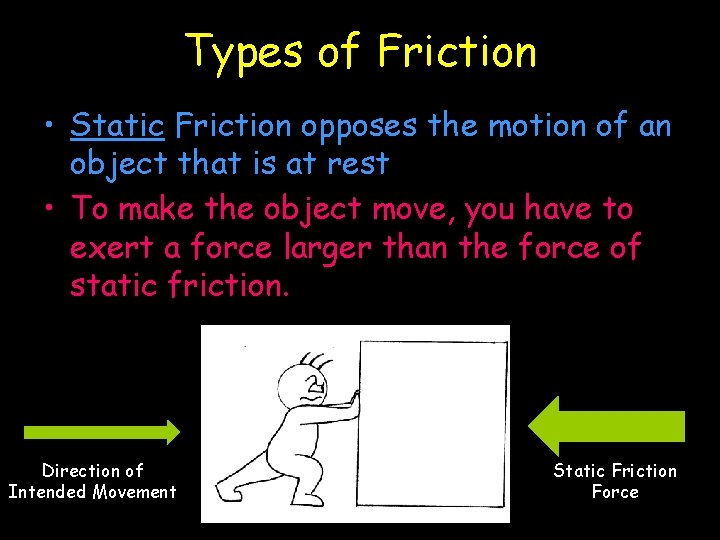
Types of Friction • Static Friction opposes the motion of an object that is at rest • To make the object move, you have to exert a force larger than the force of static friction. Direction of Intended Movement Static Friction Force
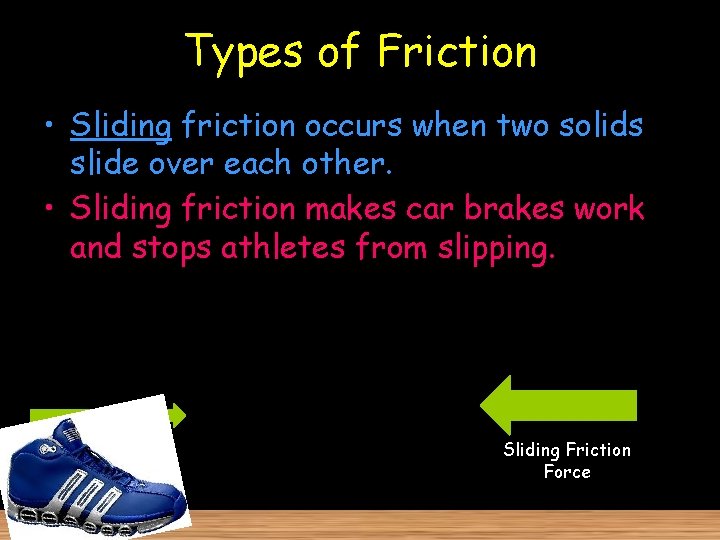
Types of Friction • Sliding friction occurs when two solids slide over each other. • Sliding friction makes car brakes work and stops athletes from slipping. Direction of Slide Sliding Friction Force
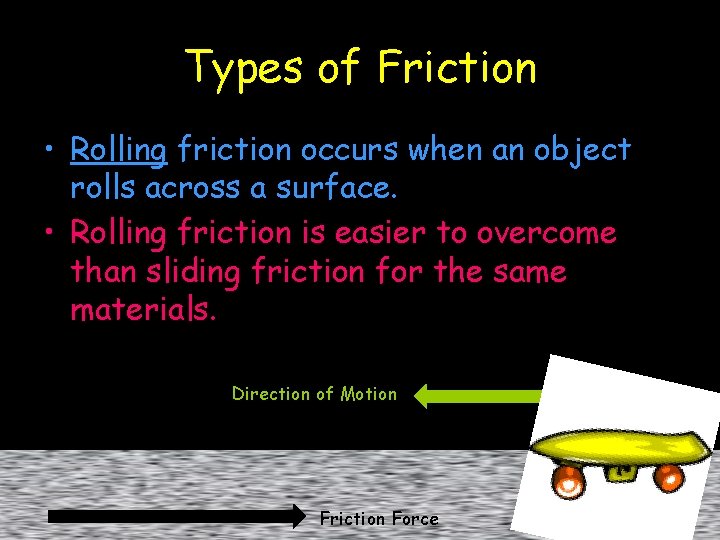
Types of Friction • Rolling friction occurs when an object rolls across a surface. • Rolling friction is easier to overcome than sliding friction for the same materials. Direction of Motion Friction Force
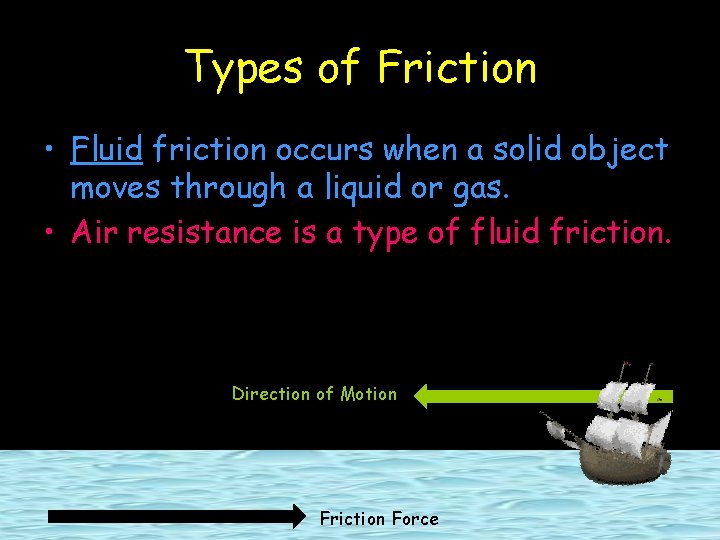
Types of Friction • Fluid friction occurs when a solid object moves through a liquid or gas. • Air resistance is a type of fluid friction. Direction of Motion Friction Force
Review of Friction Forces
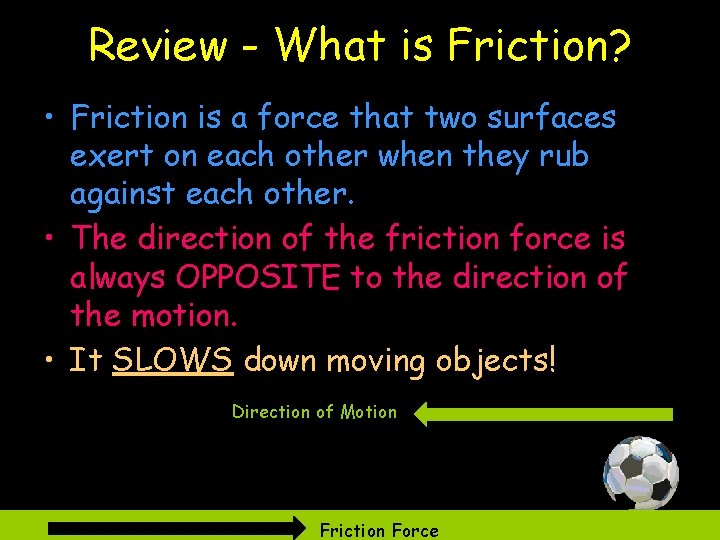
Review - What is Friction? • Friction is a force that two surfaces exert on each other when they rub against each other. • The direction of the friction force is always OPPOSITE to the direction of the motion. • It SLOWS down moving objects! Direction of Motion Friction Force
GRAVITY & AIR RESISTANCE The physics of falling
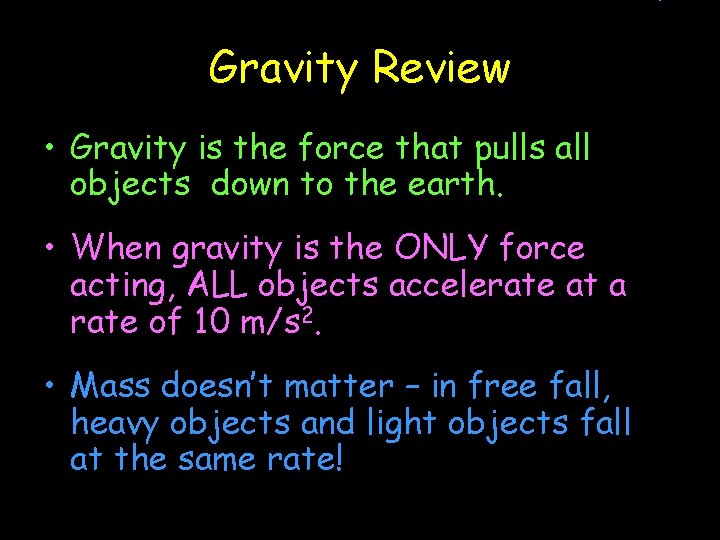
Gravity Review • Gravity is the force that pulls all objects down to the earth. • When gravity is the ONLY force acting, ALL objects accelerate at a rate of 10 m/s 2. • Mass doesn’t matter – in free fall, heavy objects and light objects fall at the same rate!
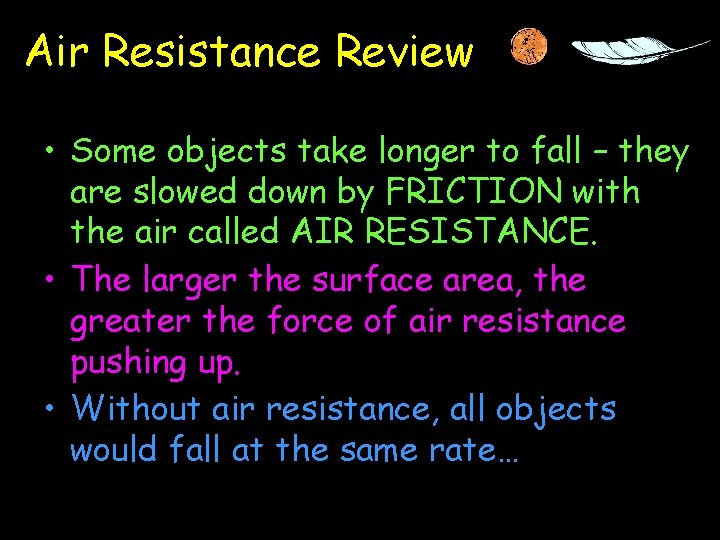
Air Resistance Review • Some objects take longer to fall – they are slowed down by FRICTION with the air called AIR RESISTANCE. • The larger the surface area, the greater the force of air resistance pushing up. • Without air resistance, all objects would fall at the same rate…
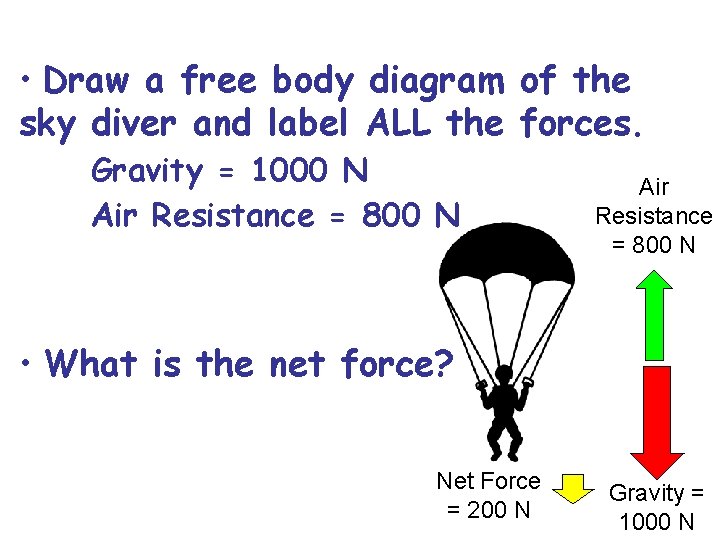
• Draw a free body diagram of the sky diver and label ALL the forces. Gravity = 1000 N Air Resistance = 800 N • What is the net force? Net Force = 200 N Gravity = 1000 N
Work, Power & Simple Machines (Making work easier…phew!)
What is WORK? ■ If you put a lot of effort into doing something and are worn out at the end, you think you’ve done a lot of WORK, right? Not necessarily…. ■ If you haven’t exerted a force AND moved an object some distance, you haven’t done any WORK at all!
What is WORK? In scientific terms, you do WORK when you exert a FORCE that causes an object to move some DISTANCE in the SAME DIRECTION of the force. Examples: Pushing a lawn mower Lifting books out of your bag Pulling a suitcase on wheels
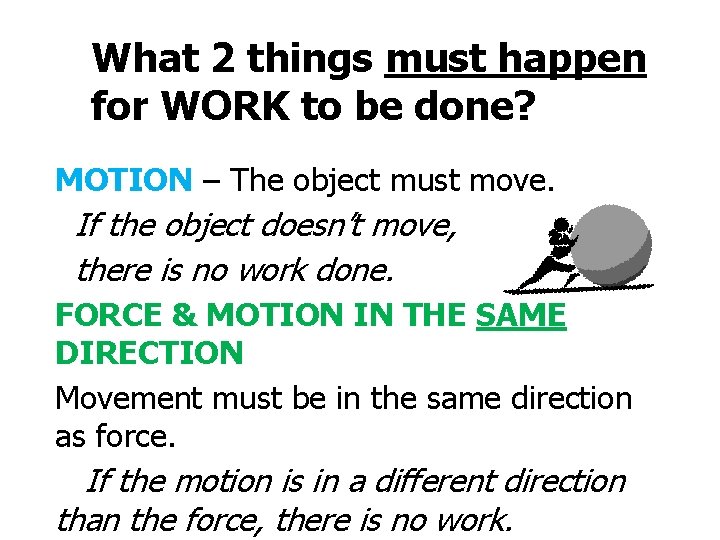
What 2 things must happen for WORK to be done? MOTION – The object must move. If the object doesn’t move, there is no work done. FORCE & MOTION IN THE SAME DIRECTION Movement must be in the same direction as force. If the motion is in a different direction than the force, there is no work.
Is WORK being done? Pushing a car that’s stuck in snow. NO! (No work because the car doesn’t move). Lifting a baby out of his stroller. YES! (Baby moves in same direction as you lift) Carrying your bookbag to class. NO! (Force is pulling up, but motion is sideways) Pushing a lawn mower. YES! (Mower goes in same direction as you push)
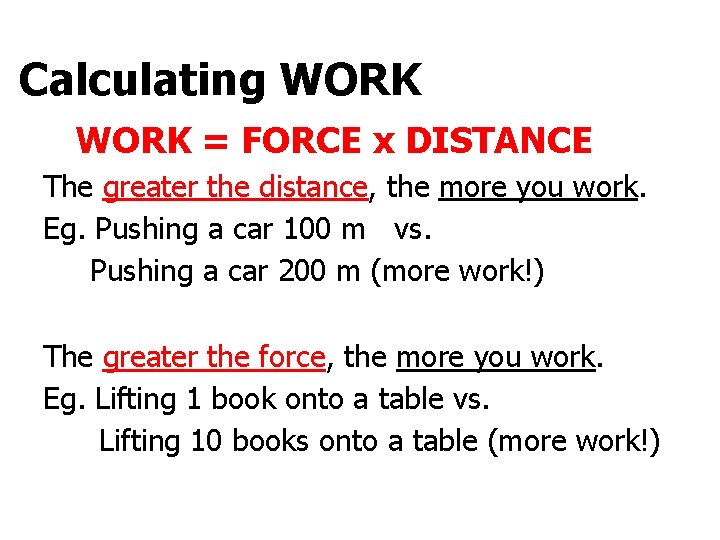
Calculating WORK = FORCE x DISTANCE The greater the distance, the more you work. Eg. Pushing a car 100 m vs. Pushing a car 200 m (more work!) The greater the force, the more you work. Eg. Lifting 1 book onto a table vs. Lifting 10 books onto a table (more work!)
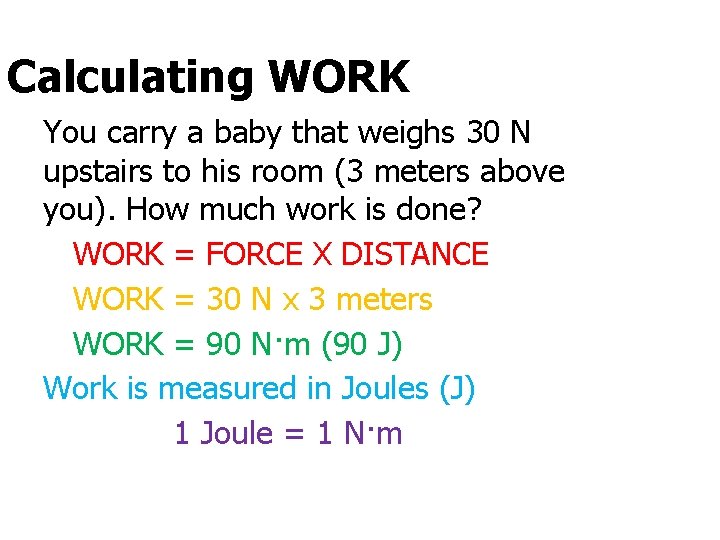
Calculating WORK You carry a baby that weighs 30 N upstairs to his room (3 meters above you). How much work is done? WORK = FORCE X DISTANCE WORK = 30 N x 3 meters WORK = 90 N·m (90 J) Work is measured in Joules (J) 1 Joule = 1 N·m
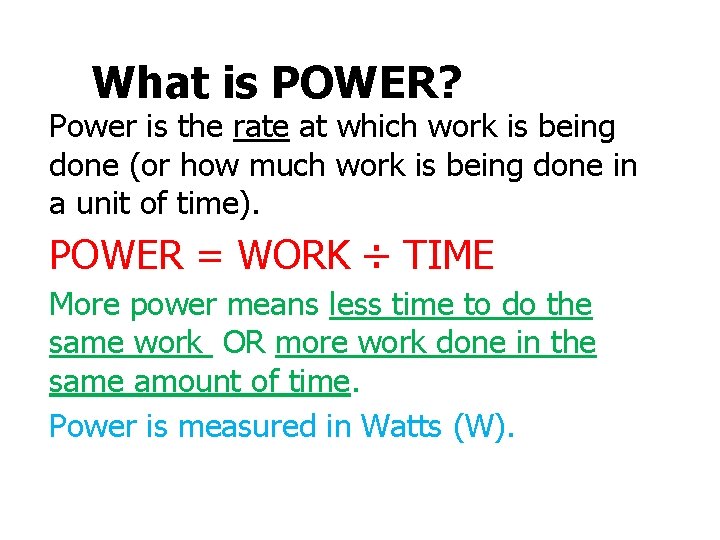
What is POWER? Power is the rate at which work is being done (or how much work is being done in a unit of time). POWER = WORK ÷ TIME More power means less time to do the same work OR more work done in the same amount of time. Power is measured in Watts (W).
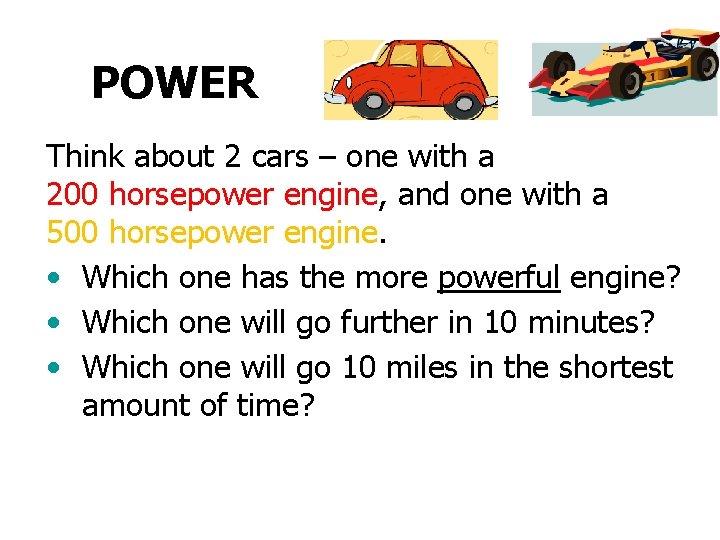
POWER Think about 2 cars – one with a 200 horsepower engine, and one with a 500 horsepower engine. • Which one has the more powerful engine? • Which one will go further in 10 minutes? • Which one will go 10 miles in the shortest amount of time?
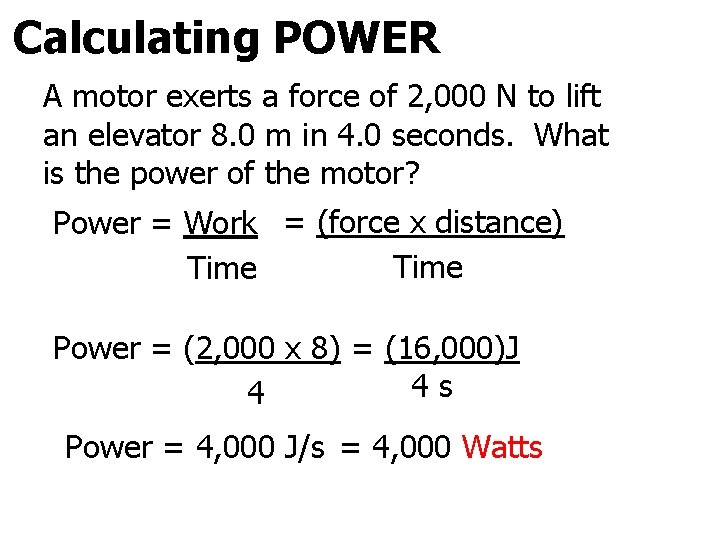
Calculating POWER A motor exerts a force of 2, 000 N to lift an elevator 8. 0 m in 4. 0 seconds. What is the power of the motor? Power = Work = (force x distance) Time Power = (2, 000 x 8) = (16, 000)J 4 s 4 Power = 4, 000 J/s = 4, 000 Watts
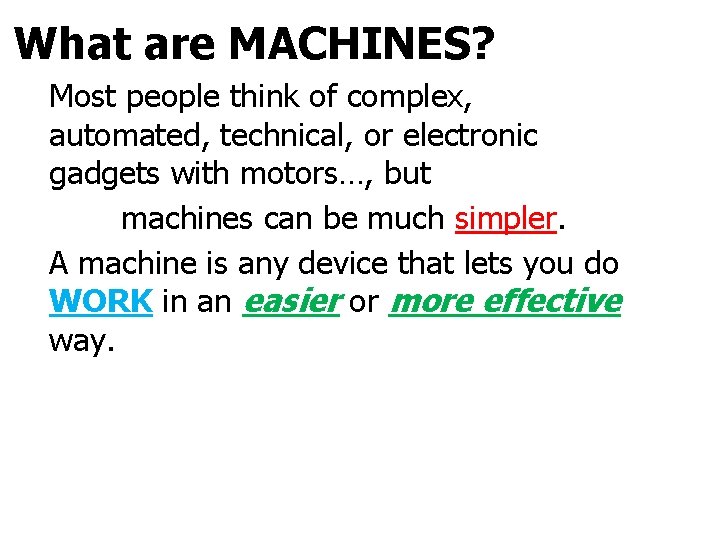
What are MACHINES? Most people think of complex, automated, technical, or electronic gadgets with motors…, but machines can be much simpler. A machine is any device that lets you do WORK in an easier or more effective way.
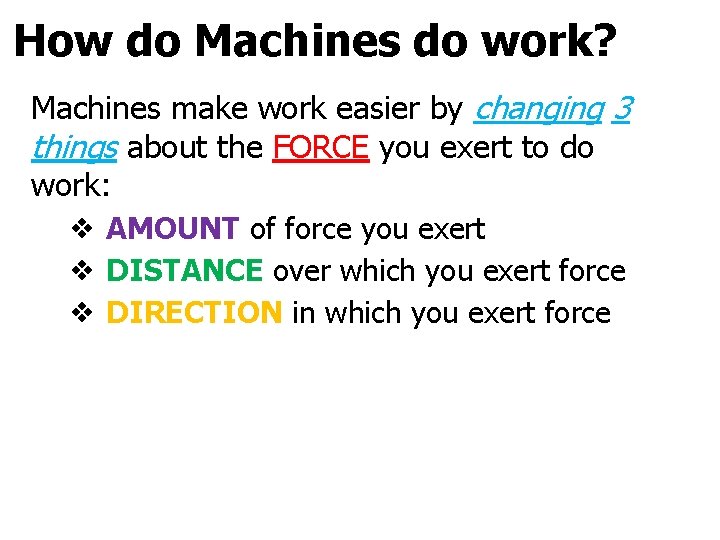
How do Machines do work? Machines make work easier by changing 3 things about the FORCE you exert to do work: ❖ AMOUNT of force you exert ❖ DISTANCE over which you exert force ❖ DIRECTION in which you exert force
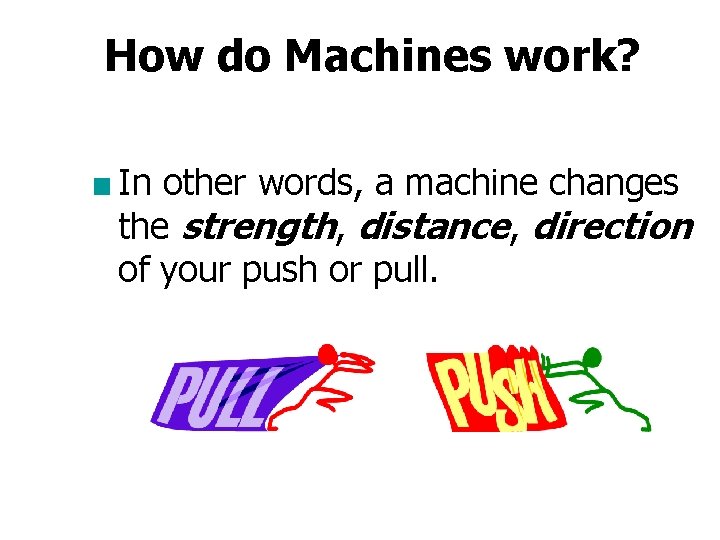
How do Machines work? ■ In other words, a machine changes the strength, distance, direction of your push or pull.
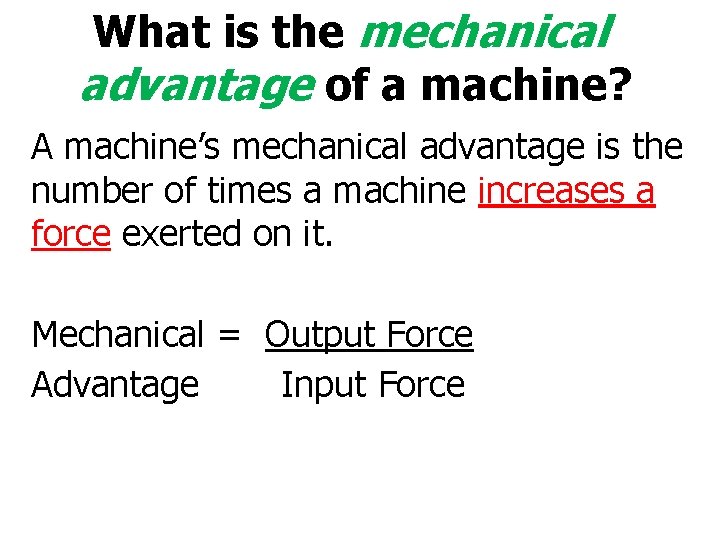
What is the mechanical advantage of a machine? A machine’s mechanical advantage is the number of times a machine increases a force exerted on it. Mechanical = Output Force Advantage Input Force
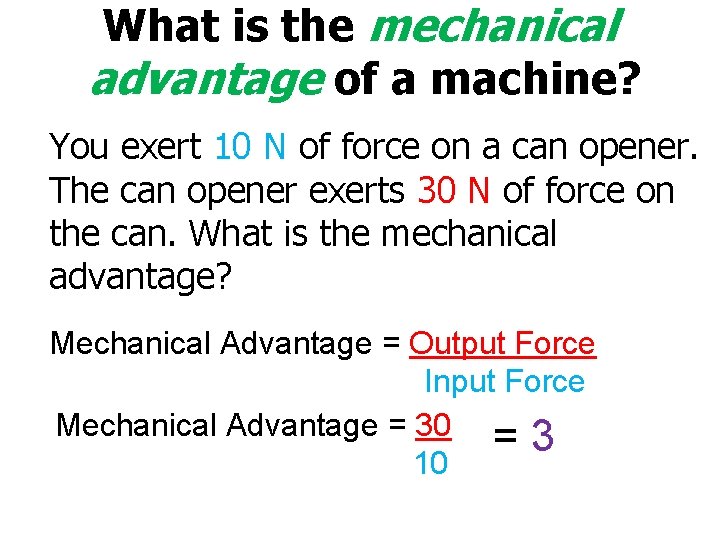
What is the mechanical advantage of a machine? You exert 10 N of force on a can opener. The can opener exerts 30 N of force on the can. What is the mechanical advantage? Mechanical Advantage = Output Force Input Force Mechanical Advantage = 30 = 3 10
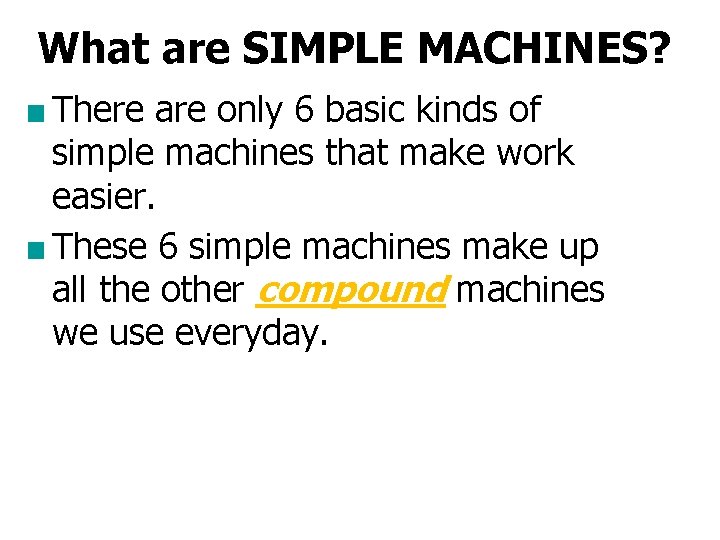
What are SIMPLE MACHINES? ■ There are only 6 basic kinds of simple machines that make work easier. ■ These 6 simple machines make up all the other compound machines we use everyday.
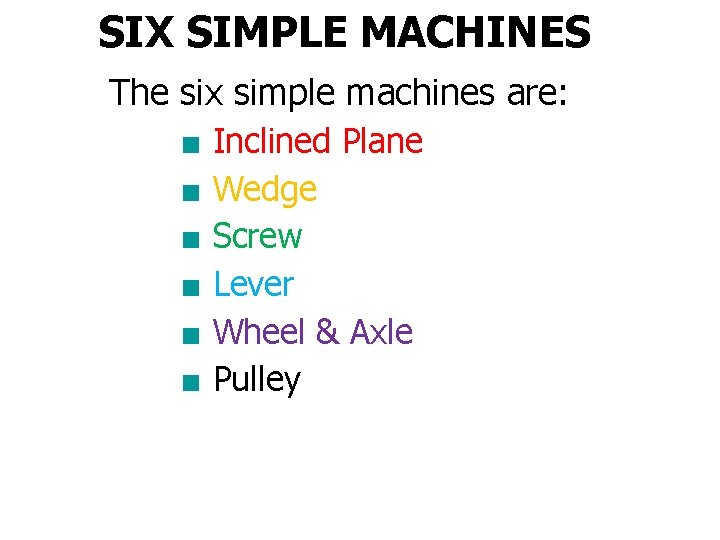
SIX SIMPLE MACHINES The six simple machines are: ■ Inclined Plane ■ Wedge ■ Screw ■ Lever ■ Wheel & Axle ■ Pulley
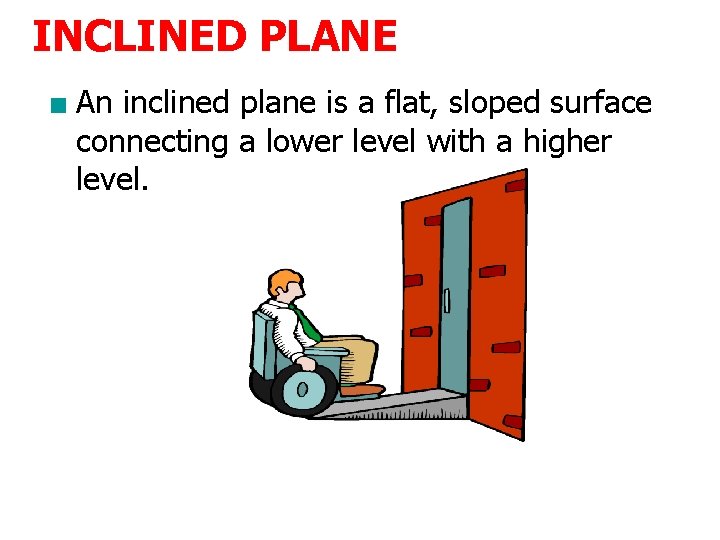
INCLINED PLANE ■ An inclined plane is a flat, sloped surface connecting a lower level with a higher level.
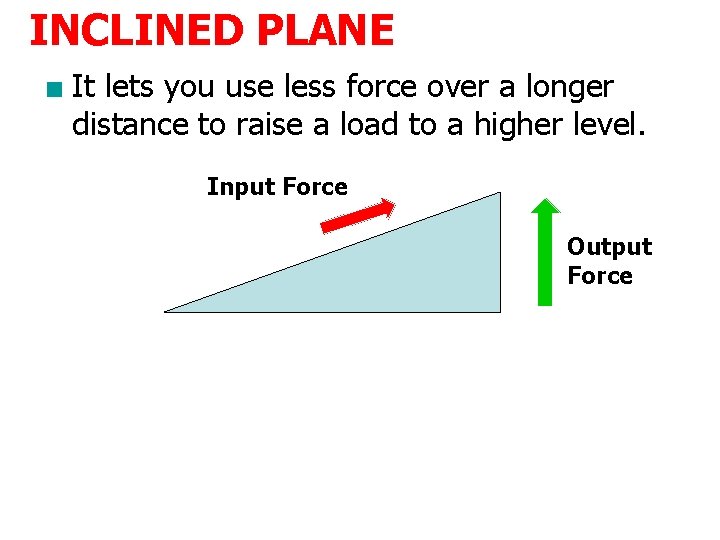
INCLINED PLANE ■ It lets you use less force over a longer distance to raise a load to a higher level. Input Force Output Force
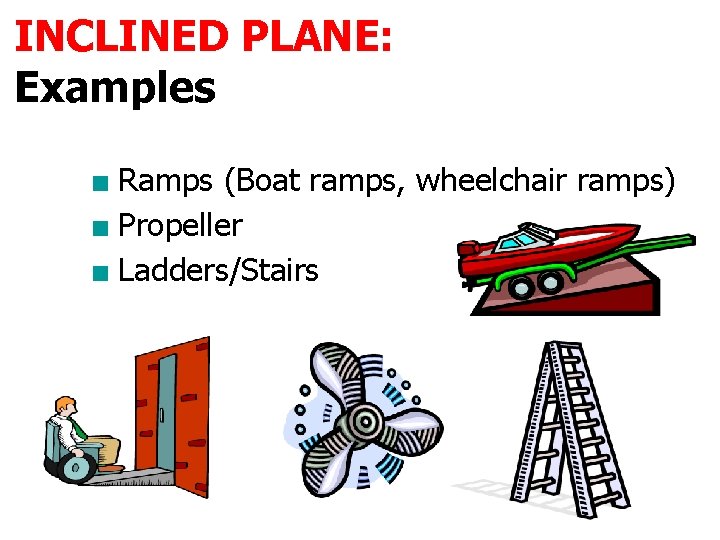
INCLINED PLANE: Examples ■ Ramps (Boat ramps, wheelchair ramps) ■ Propeller ■ Ladders/Stairs
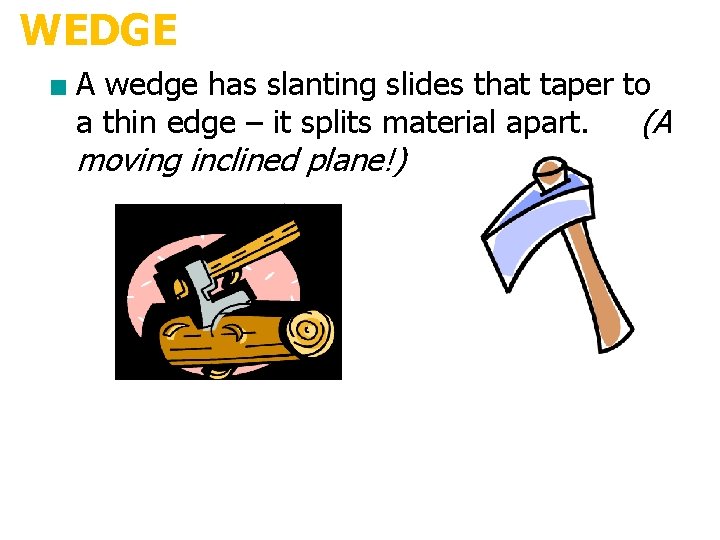
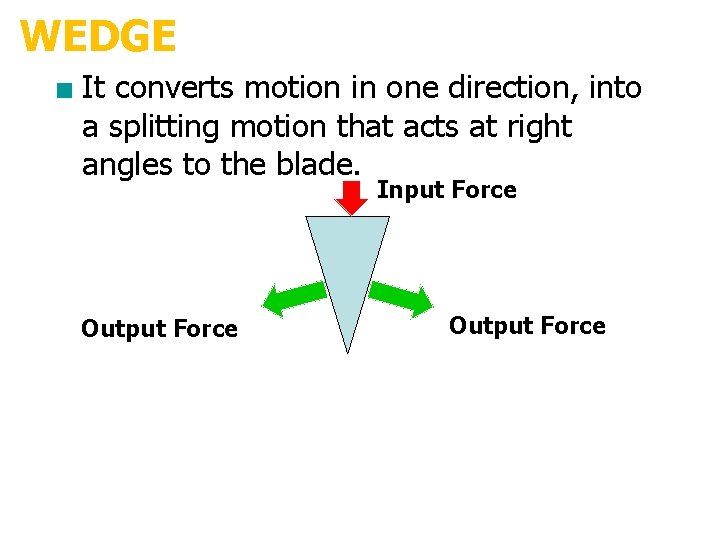
WEDGE ■ A wedge has slanting slides that taper to a thin edge – it splits material apart. (A moving inclined plane!)
WEDGE ■ It converts motion in one direction, into a splitting motion that acts at right angles to the blade. Input Force Output Force
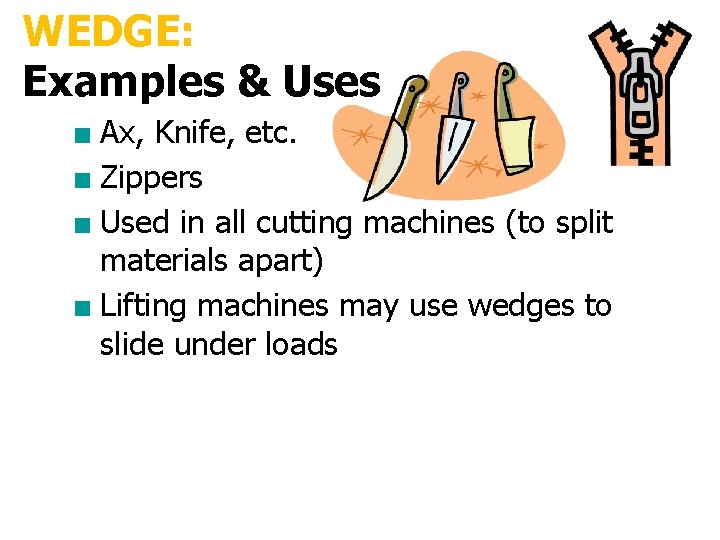
WEDGE: Examples & Uses ■ Ax, Knife, etc. ■ Zippers ■ Used in all cutting machines (to split materials apart) ■ Lifting machines may use wedges to slide under loads
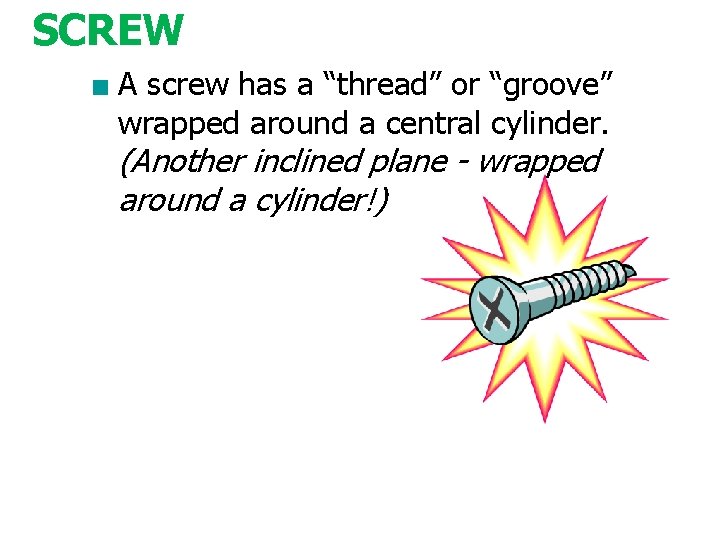
SCREW ■ A screw has a “thread” or “groove” wrapped around a central cylinder. (Another inclined plane - wrapped around a cylinder!)
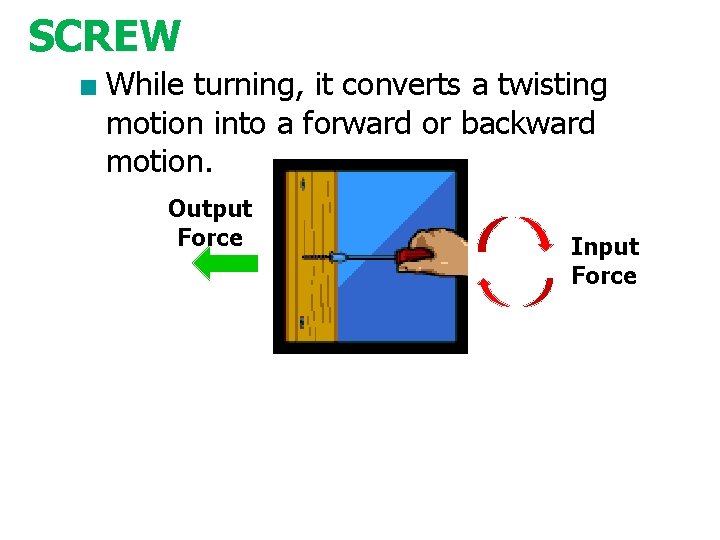
SCREW ■ While turning, it converts a twisting motion into a forward or backward motion. Output Force Input Force
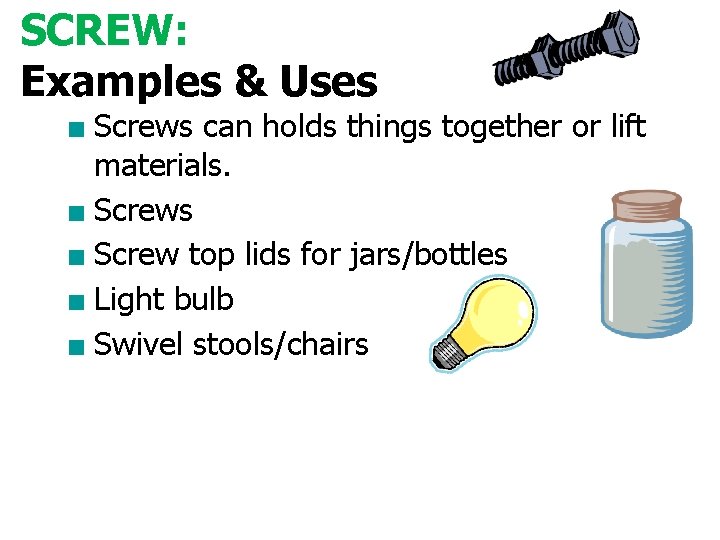
SCREW: Examples & Uses ■ Screws can holds things together or lift materials. ■ Screws ■ Screw top lids for jars/bottles ■ Light bulb ■ Swivel stools/chairs
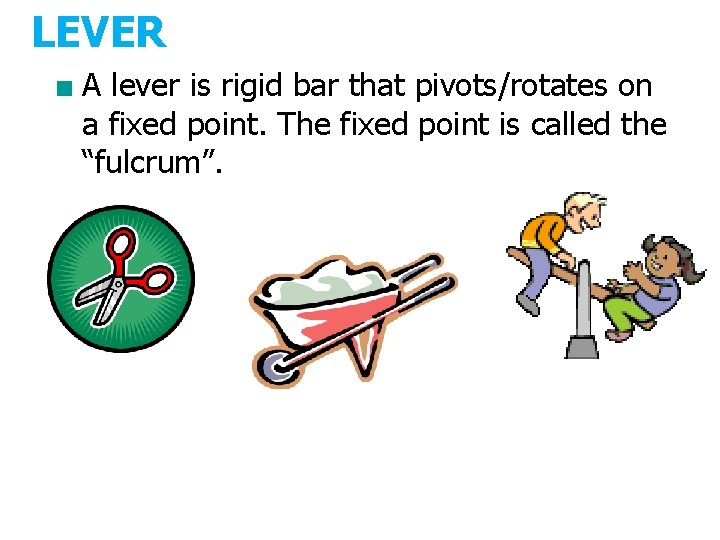
LEVER ■ A lever is rigid bar that pivots/rotates on a fixed point. The fixed point is called the “fulcrum”.
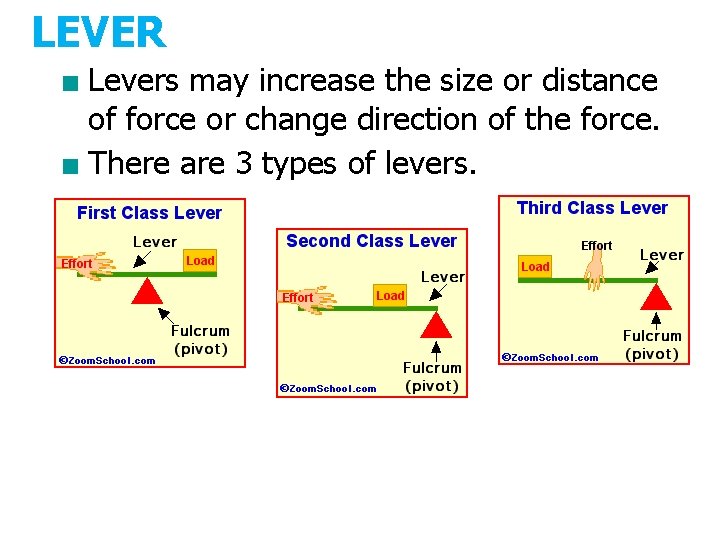
LEVER ■ Levers may increase the size or distance of force or change direction of the force. ■ There are 3 types of levers.
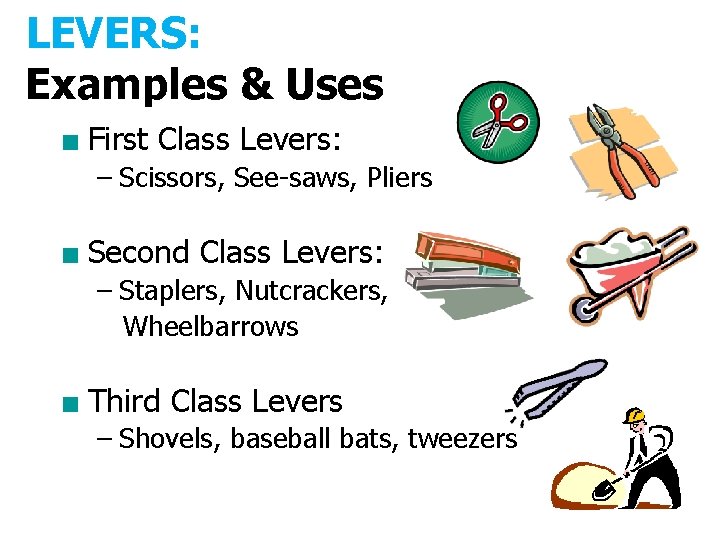
LEVERS: Examples & Uses ■ First Class Levers: – Scissors, See-saws, Pliers ■ Second Class Levers: – Staplers, Nutcrackers, Wheelbarrows ■ Third Class Levers – Shovels, baseball bats, tweezers
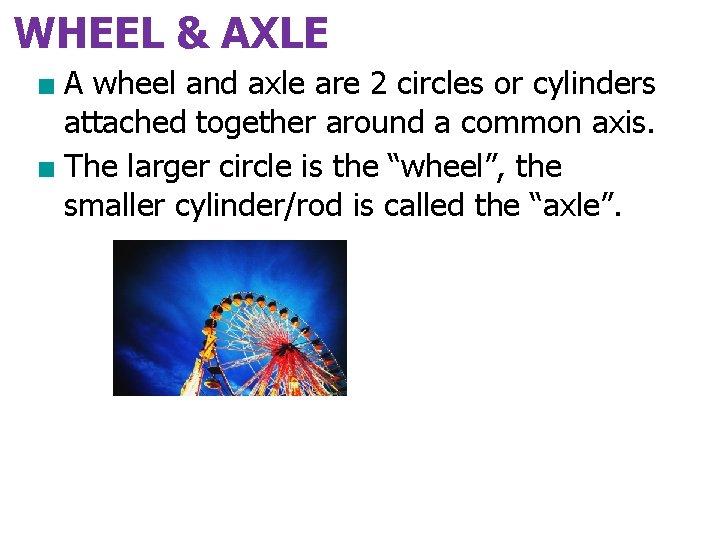
WHEEL & AXLE ■ A wheel and axle are 2 circles or cylinders attached together around a common axis. ■ The larger circle is the “wheel”, the smaller cylinder/rod is called the “axle”.
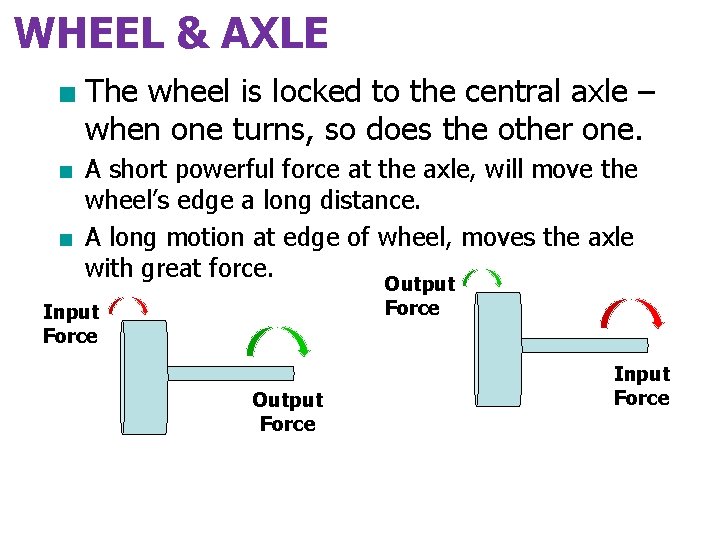
WHEEL & AXLE ■ The wheel is locked to the central axle – when one turns, so does the other one. ■ A short powerful force at the axle, will move the wheel’s edge a long distance. ■ A long motion at edge of wheel, moves the axle with great force. Output Force Input Force
WHEEL & AXLE: Examples & Uses ■ Screwdriver ■ Windmill ■ Cars/Bicycles ■ Rolling Pin ■ Door Knob ■ Fan
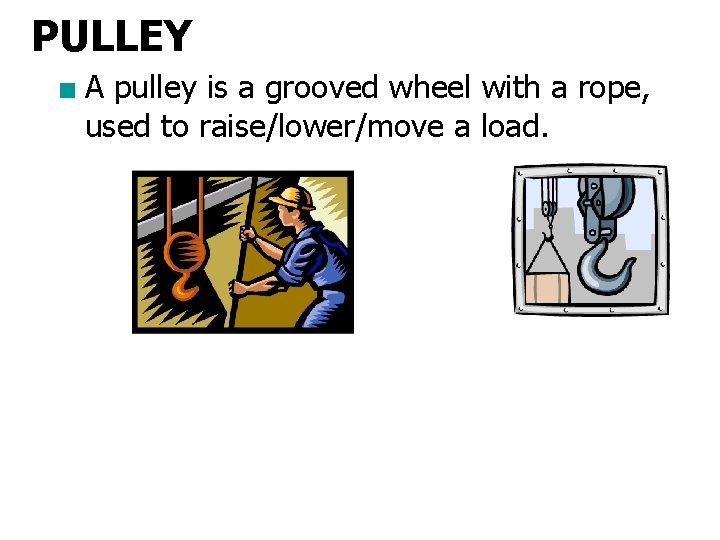
PULLEY ■ A pulley is a grooved wheel with a rope, used to raise/lower/move a load.
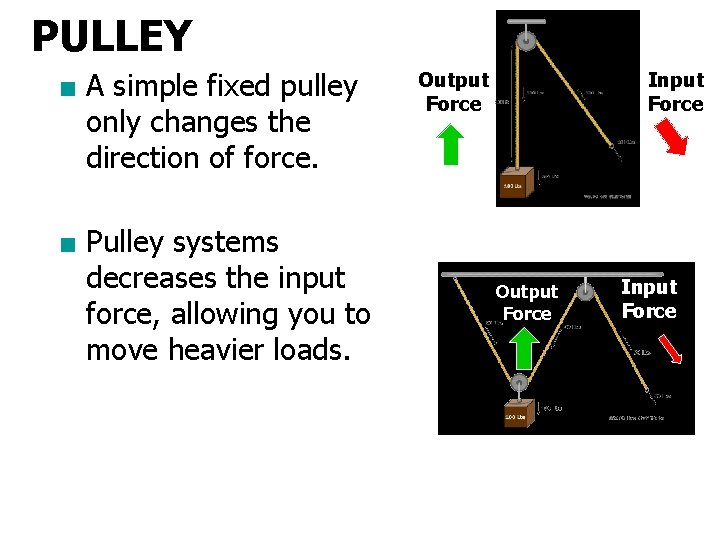
PULLEY ■ A simple fixed pulley only changes the direction of force. ■ Pulley systems decreases the input force, allowing you to move heavier loads. Output Force Input Force
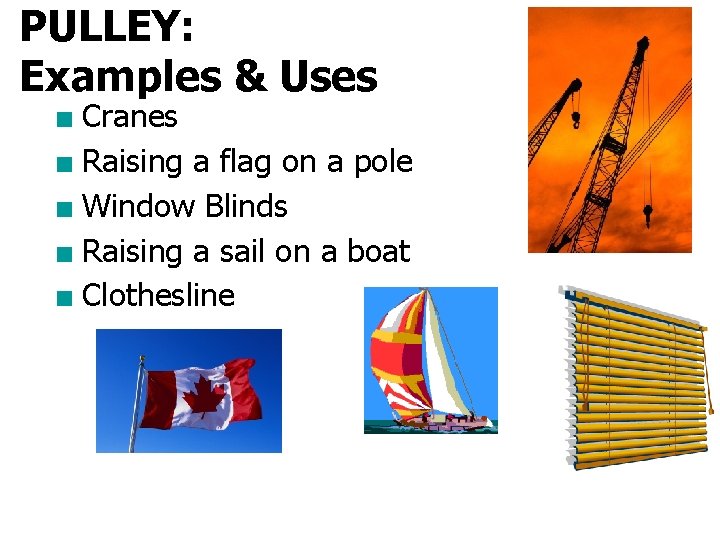
PULLEY: Examples & Uses ■ Cranes ■ Raising a flag on a pole ■ Window Blinds ■ Raising a sail on a boat ■ Clothesline
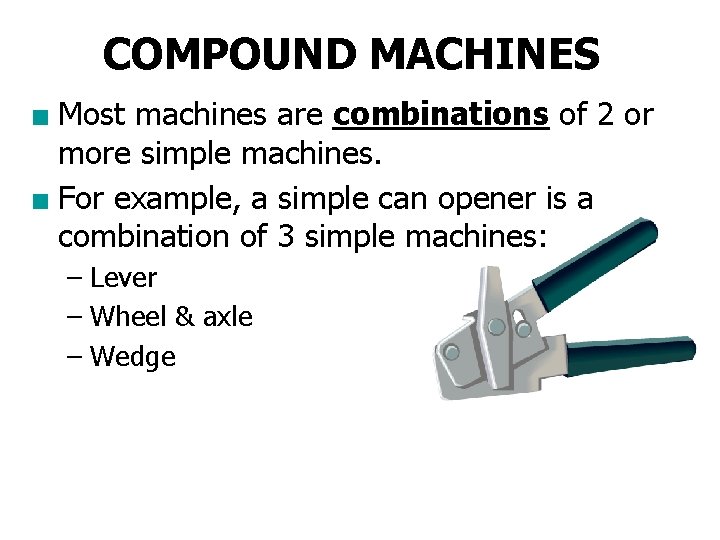
COMPOUND MACHINES ■ Most machines are combinations of 2 or more simple machines. ■ For example, a simple can opener is a combination of 3 simple machines: – Lever – Wheel & axle – Wedge
Review…Work – transfer of energy that occurs when a force makes an object move. - distance must be included - force and motion must be in the same direction When work is done, a transfer of energy always occurs.
Work = Force x Distance Work = Force (in Newtons) x Distance (in meters) Work = Newton-meters Work = JOULES 1 Newton-meter = 1 JOULE