Yogurt A form of fermented milk produced in

- Slides: 35
Yogurt A form of fermented milk produced in most countries where fresh milk is drunk.
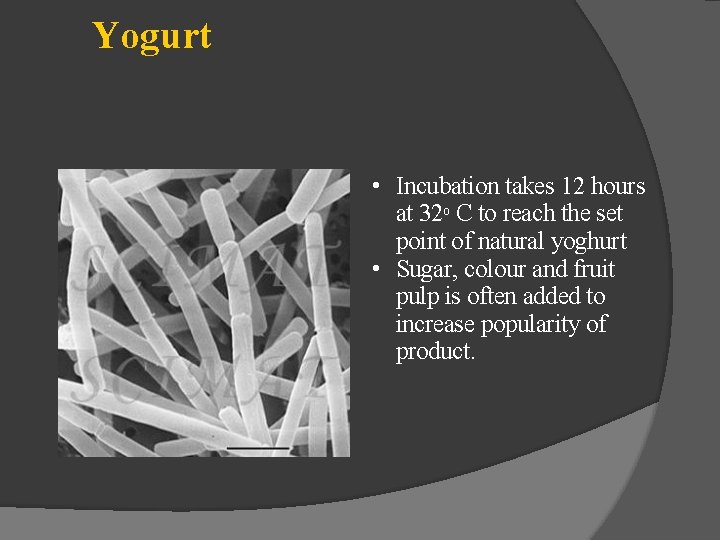
Yogurt • Yogurt is produced by the controlled fermentation of milk by two species of bacteria Lactobacillus bulgaricus and Lactotococcus thermophilus (also known as Streptococcus thermophilus)
Lactose fermenting yeast can also be used. ◉ Fermentation of lactose in milk produces lactic acid. ◉ Lactic acid acts on milk proteins giving yogurt its texture and characteristics. ◉
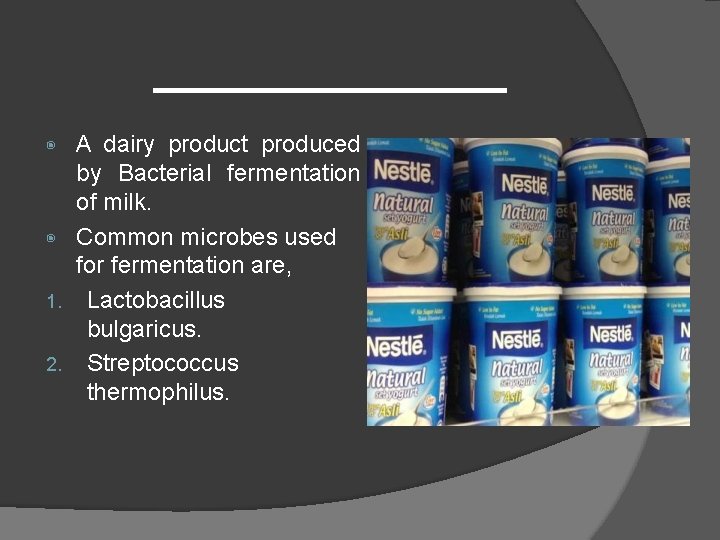
A dairy product produced by Bacterial fermentation of milk. ◉ Common microbes used for fermentation are, 1. Lactobacillus bulgaricus. 2. Streptococcus thermophilus. ◉
INGREDIENTS OF YOGURT ◉ ◉ 1. 2. 3. ◉ Main ingredient in yogurt is milk. Type of milk used depends on type of yogurt. Whole milk for full fat yogurt. Low fat milk for low fat yogurt. Skimmed milk for non fat yogurt. Sweeteners, flavors and fruit preparations are used in yogurt to provide variety to the consumer.
Yogurt • The sugar in milk (called lactose) is fermented to acid (lactic acid) and it is that causes the characteristic curd to form.
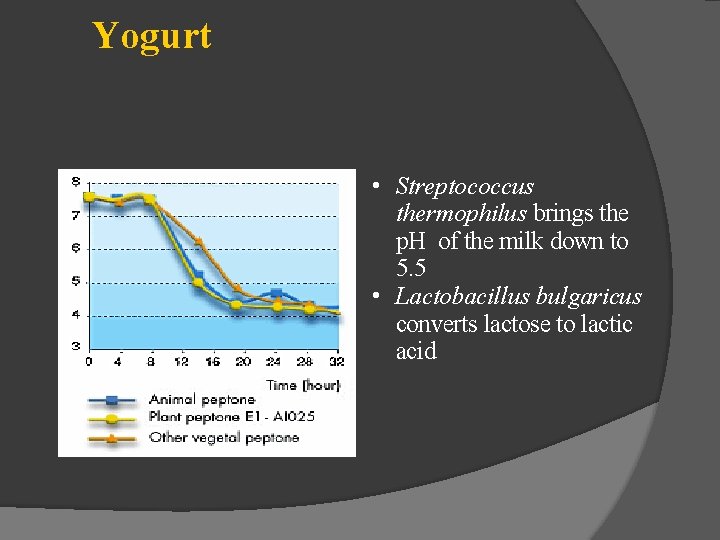
Yogurt • Streptococcus thermophilus brings the p. H of the milk down to 5. 5 • Lactobacillus bulgaricus converts lactose to lactic acid
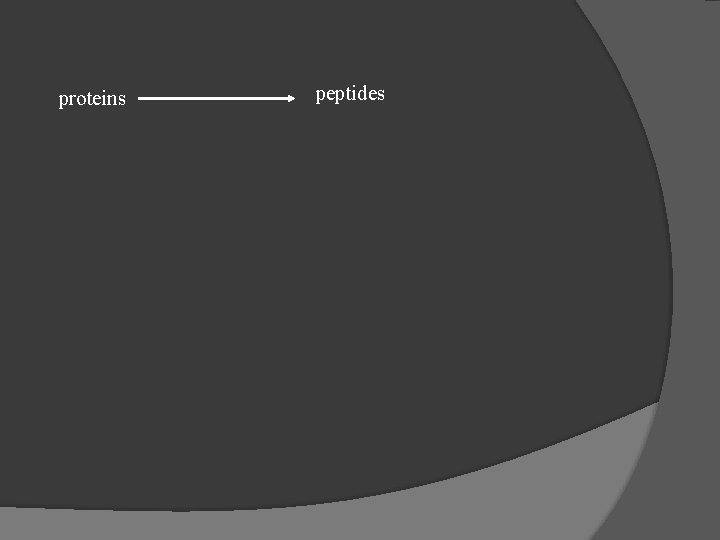
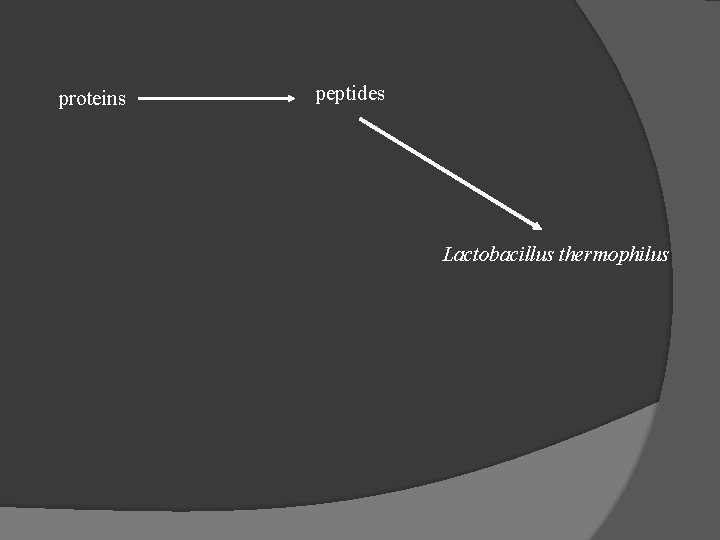
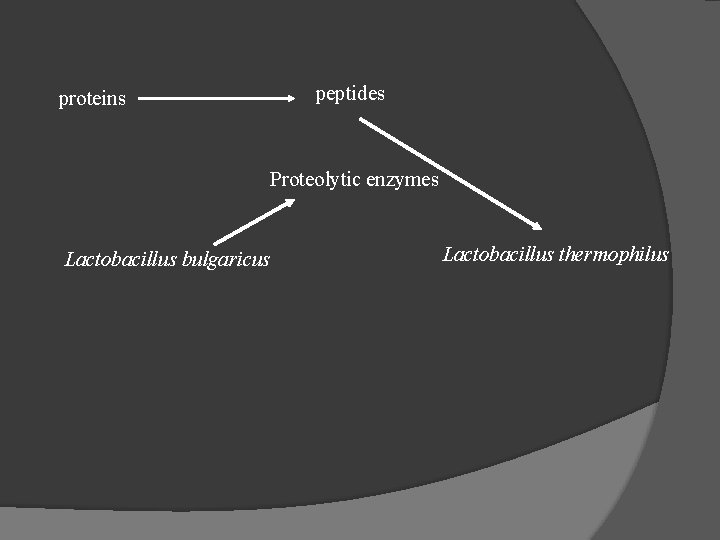
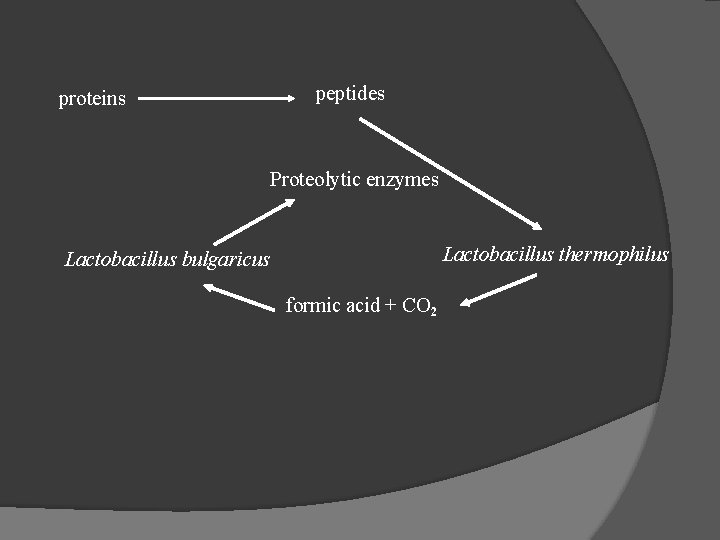
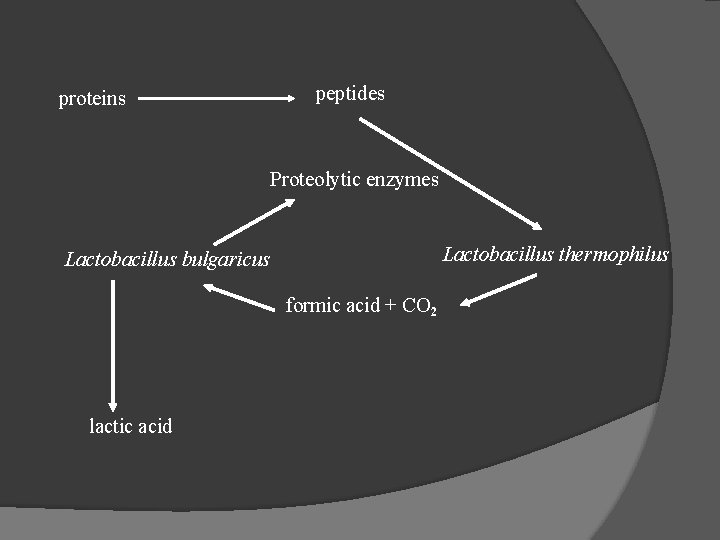
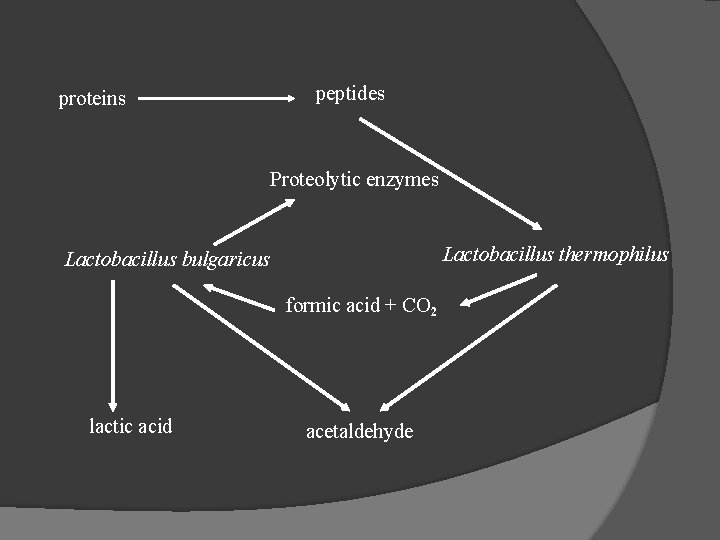
Yogurt • The two bacteria have a mutually stimulating effect on one another. • Proteolytic enzymes from L. bulgaricus break down milk proteins into peptides.
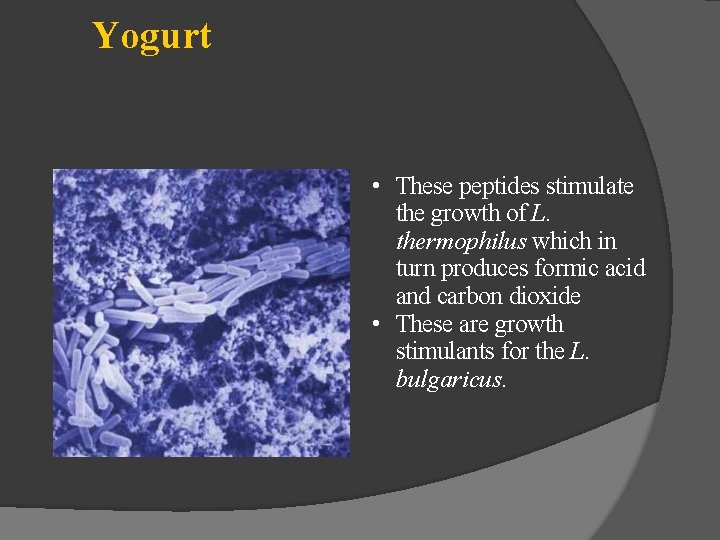
Yogurt • These peptides stimulate the growth of L. thermophilus which in turn produces formic acid and carbon dioxide • These are growth stimulants for the L. bulgaricus.
Yogurt • At the end of the incubation p. H may fall to as low as 4. 2 – 4. 4 • The lactic acid coagulates the remaining milk proteins, causing the yoghurt to thicken.
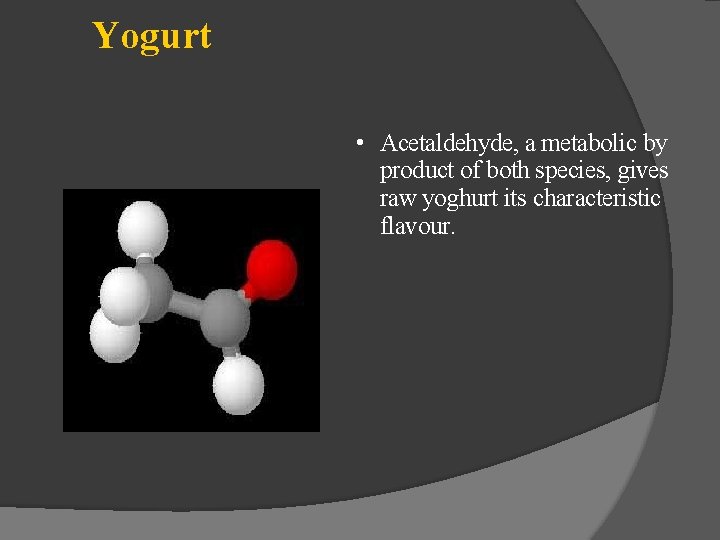
Yogurt • Acetaldehyde, a metabolic by product of both species, gives raw yoghurt its characteristic flavour.
Yogurt • Incubation takes 12 hours at 32 o C to reach the set point of natural yoghurt • Sugar, colour and fruit pulp is often added to increase popularity of product.
Yogurt • Some yoghurts may receive additional heat treatment to kill off any living bacteria before or after packaging for the consumer
proteins peptides
proteins peptides Lactobacillus thermophilus
proteins peptides Proteolytic enzymes Lactobacillus bulgaricus Lactobacillus thermophilus
proteins peptides Proteolytic enzymes Lactobacillus thermophilus Lactobacillus bulgaricus formic acid + CO 2
proteins peptides Proteolytic enzymes Lactobacillus thermophilus Lactobacillus bulgaricus formic acid + CO 2 lactic acid
proteins peptides Proteolytic enzymes Lactobacillus thermophilus Lactobacillus bulgaricus formic acid + CO 2 lactic acid acetaldehyde
Raw milk
Raw milk pasteurisation Pasteurised Milk
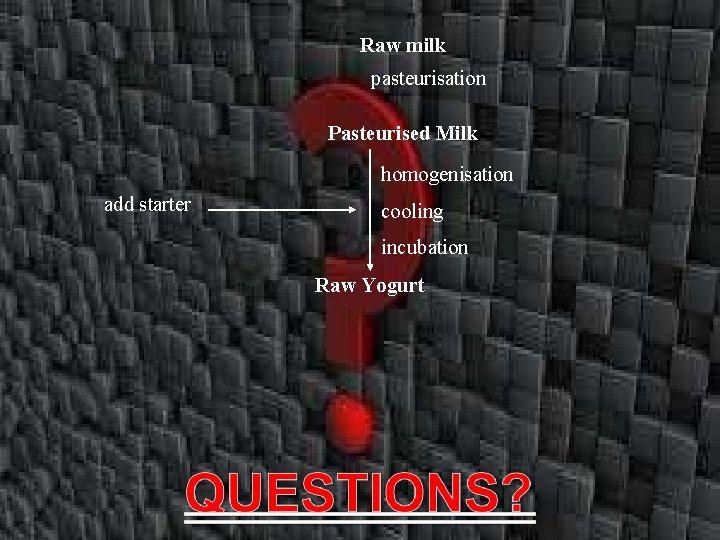
Raw milk pasteurisation Pasteurised Milk homogenisation add starter cooling incubation Raw Yogurt
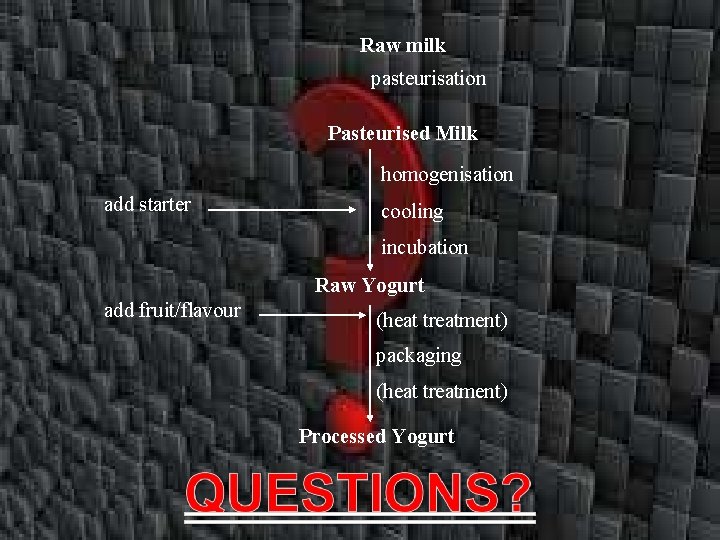
Raw milk pasteurisation Pasteurised Milk homogenisation add starter cooling incubation Raw Yogurt add fruit/flavour (heat treatment) packaging (heat treatment) Processed Yogurt
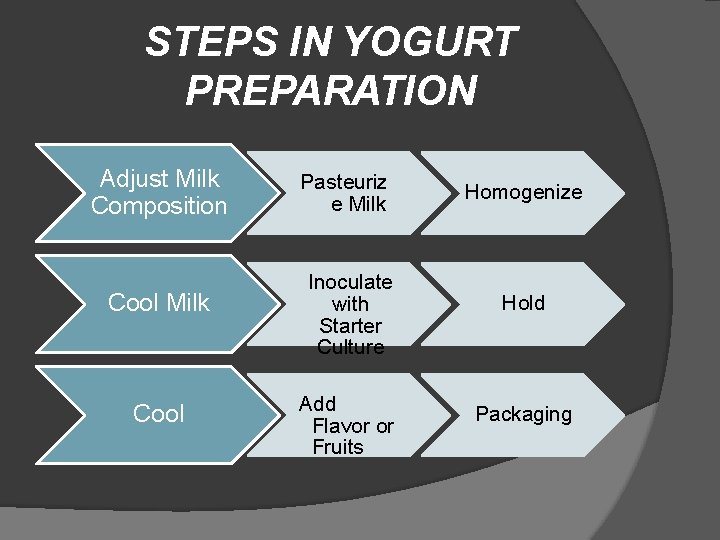
STEPS IN YOGURT PREPARATION Adjust Milk Composition Cool Milk Cool Pasteuriz e Milk Inoculate with Starter Culture Add Flavor or Fruits Homogenize Hold Packaging
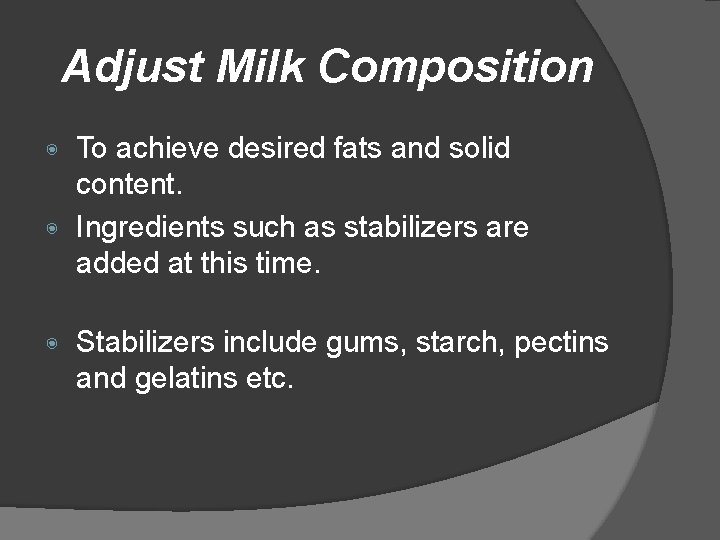
Adjust Milk Composition To achieve desired fats and solid content. ◉ Ingredients such as stabilizers are added at this time. ◉ ◉ Stabilizers include gums, starch, pectins and gelatins etc.
Pasteurize Milk At 85°C for 30 minutes or 95°C for 10 minutes. ◉ A high heat treatment is used to denature the whey (serum) proteins. ◉ The high heat treatment reduces the number of spoilage organisms in the milk and provide a better environment for the starter cultures to grow. ◉
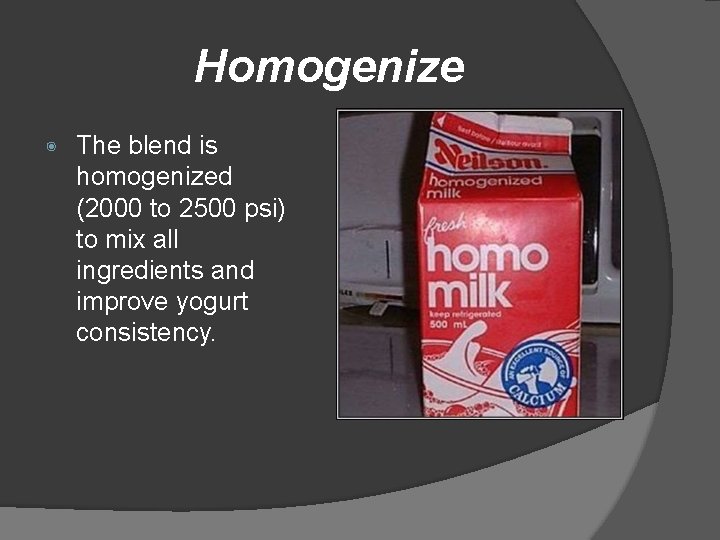
Homogenize ◉ The blend is homogenized (2000 to 2500 psi) to mix all ingredients and improve yogurt consistency.
Cool Milk Homogenization is followed by cooling milk. ◉ Milk is cooled to 42°C. ◉ Cooling is required in order to provide ideal growth temperature for starter culture. ◉
Inoculate With Starter Culture Starter culture is important for initiation fermentation process. ◉ Starter culture is added into the cooled milk. ◉ Microbes in the culture converts Lactose into Lactic acid. ◉
Hold The milk is held at 42°C until its p. H reaches 4. 5. ◉ This temperature is suitable for starter culture. ◉ This process can take several hours. ◉
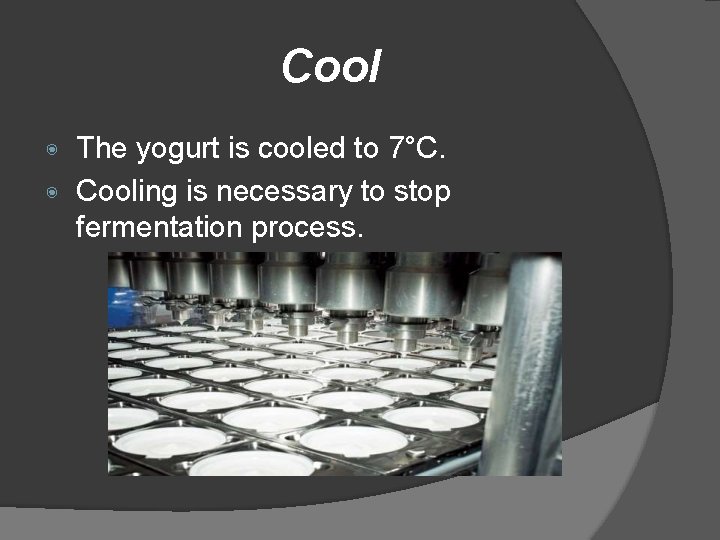
Cool The yogurt is cooled to 7°C. ◉ Cooling is necessary to stop fermentation process. ◉
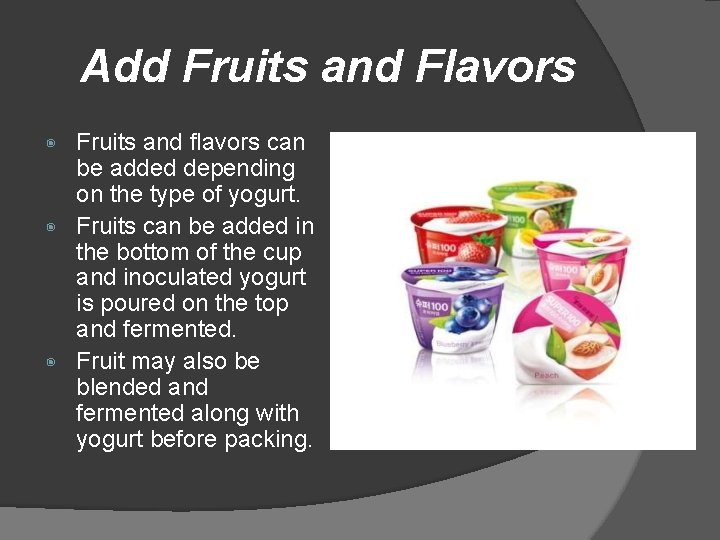
Add Fruits and Flavors Fruits and flavors can be added depending on the type of yogurt. ◉ Fruits can be added in the bottom of the cup and inoculated yogurt is poured on the top and fermented. ◉ Fruit may also be blended and fermented along with yogurt before packing. ◉
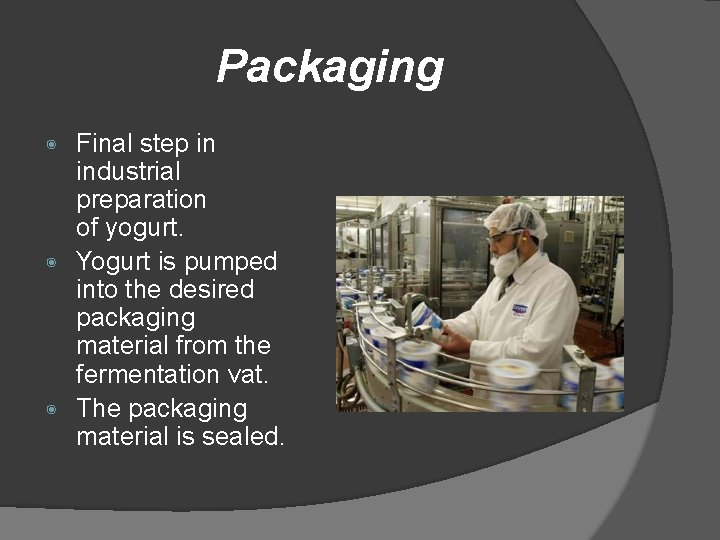
Packaging Final step in industrial preparation of yogurt. ◉ Yogurt is pumped into the desired packaging material from the fermentation vat. ◉ The packaging material is sealed. ◉