WRITING FLUENTLY Writing an English text response essay



- Slides: 36
WRITING FLUENTLY Writing an English text response essay at Year 12
BEFORE WE START, LET’S BUILD ARAFT! Role: Refers to the persona you take on as a writer and connects to your purpose (eg: why you are writing) Are you writing ‘in character’ or as yourself? Are you writing to explore, persuade, entertain, analyse, evaluate? Audience: Refers to who you are writing for. This will determine what language you use. Are you writing for your peers, an older academic audience, men, women, scientists, a group affected by a particular issue, teachers? Be selective. Form: Refers to the format and text type you will be creating and using. This will also determine the language you will use. Are you writing a text-response essay, a persuasive speech, a reflective expository article, an imaginative short story? What does this look like? Topic: Refers to the topic you are writing about. This is what you need to connect back to throughout your entire piece so you don’t go off track Eg: Climate change, Australia’s asylum seeker policy, the nature of inner conflict, Adichie’s use of narrative voice, the nature of alienation that the characters in the text experience, whether or not strong male characters have all the power in the text, etc.
WHAT DOES THIS MEAN? The text response essay: Role: Textual analyst and evaluator. Writing about your reasoned interpretation ‘from a distance’ (No use of first-person ‘I think…’ or ‘I believe…’ or second-person ‘you’ or ‘we’) Audience: Academic audience of teachers who are very familiar with the text. This means you will be writing in a formal style using sophisticated, academic language, will try and find original examples and evidence that are not just obvious or drawn from study guides and will consider different interpretations of the text before forming your own Form: Text response essay. This means you will be writing an essay about the text with an introduction, body (usually between 3 -5 TEEEL or METER paragraphs) and a conclusion Topic: Your topic question. Ensure you have defined all the key words and understand the whole topic and what you need to do with it before you write about it
SO, WHAT ARE THE RULES? Here is a checklist drawn from the RAFT of some of the language conventions or ‘rules’ of a text response essay: Written in third person narrative voice (No “I” or “you”) Uses formal, sophisticated and academic language Uses metalanguage to describe the structures and features of the text (eg: symbol, metaphor, flashback, framed narrative, characterisation) Has an introduction, body and conclusion Body paragraphs have clear topic sentences, evidence, explanations and links Uses evidence (quotes, specific descriptions) Contains linking words
ESSAY WRITING AT YEAR 12 –A FORMAT TEEEEEEL
THE INTRODUCTION –THE BASICS 3 -step introduction: BASE –Background, State, Elaborate 1. Write a background statement including the author’s name, text title, text type and key ideas connected to the question. You might want to discuss genre, if you have space. Eg: ‘Chimamanda Ngozi Adichie’s collection of short stories The Thing Around Your Neck explores…’ 2. State your contention –what you think or believe about the topic. You might want to define some key words first or interweave this into your statement by using synonyms (words with similar meaning) Eg: ‘In the collection…. ’ ‘Adichie explores…’ ‘Throughout the stories…’ 3. Elaborate on your contention further by explaining key terms and outlining key points –interweave a ‘preview’ of what you will be talking about into your discussion Eg: ‘Through…Adichie…’ ‘By…. Adichie suggests…’ ‘In this sense, the characters…’
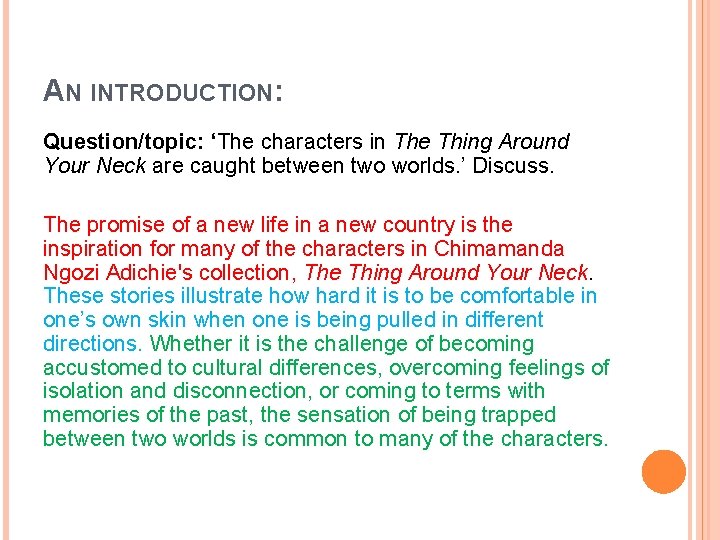
AN INTRODUCTION: Question/topic: ‘The characters in The Thing Around Your Neck are caught between two worlds. ’ Discuss. The promise of a new life in a new country is the inspiration for many of the characters in Chimamanda Ngozi Adichie's collection, The Thing Around Your Neck. These stories illustrate how hard it is to be comfortable in one’s own skin when one is being pulled in different directions. Whether it is the challenge of becoming accustomed to cultural differences, overcoming feelings of isolation and disconnection, or coming to terms with memories of the past, the sensation of being trapped between two worlds is common to many of the characters.
THE INTRODUCTION: ADDING COMPLEXITY To add more complexity, you might want to replace some basic, repetitive words/phrases with more formal, sophisticated, specific ones and add some more specific comments to your introduction
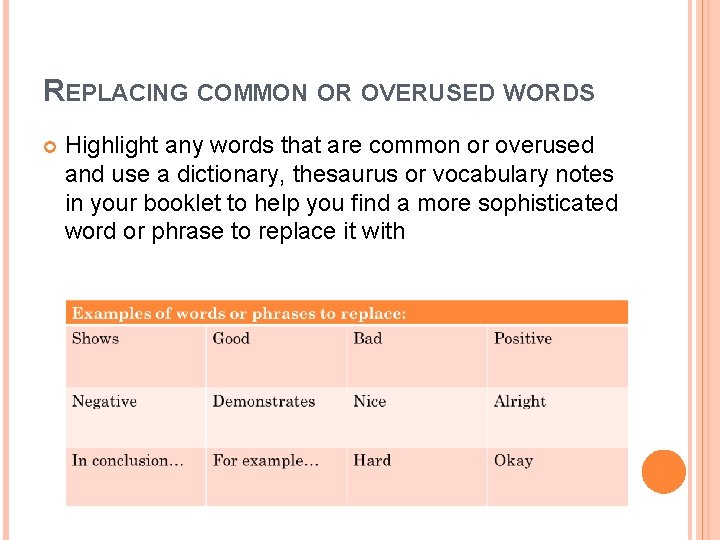
REPLACING COMMON OR OVERUSED WORDS Highlight any words that are common or overused and use a dictionary, thesaurus or vocabulary notes in your booklet to help you find a more sophisticated word or phrase to replace it with
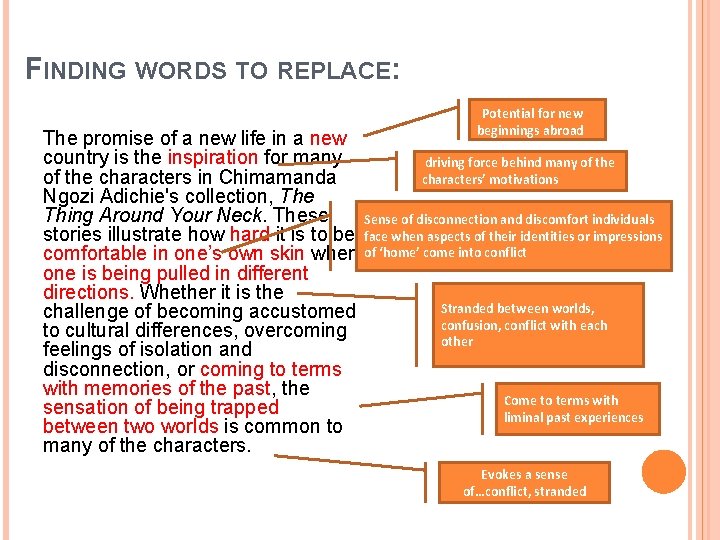
FINDING WORDS TO REPLACE: Potential for new beginnings abroad The promise of a new life in a new country is the inspiration for many driving force behind many of the characters in Chimamanda characters’ motivations Ngozi Adichie's collection, The Thing Around Your Neck. These Sense of disconnection and discomfort individuals stories illustrate how hard it is to be face when aspects of their identities or impressions comfortable in one’s own skin when of ‘home’ come into conflict one is being pulled in different directions. Whether it is the Stranded between worlds, challenge of becoming accustomed confusion, conflict with each to cultural differences, overcoming other feelings of isolation and disconnection, or coming to terms with memories of the past, the Come to terms with sensation of being trapped liminal past experiences between two worlds is common to many of the characters. Evokes a sense of…conflict, stranded
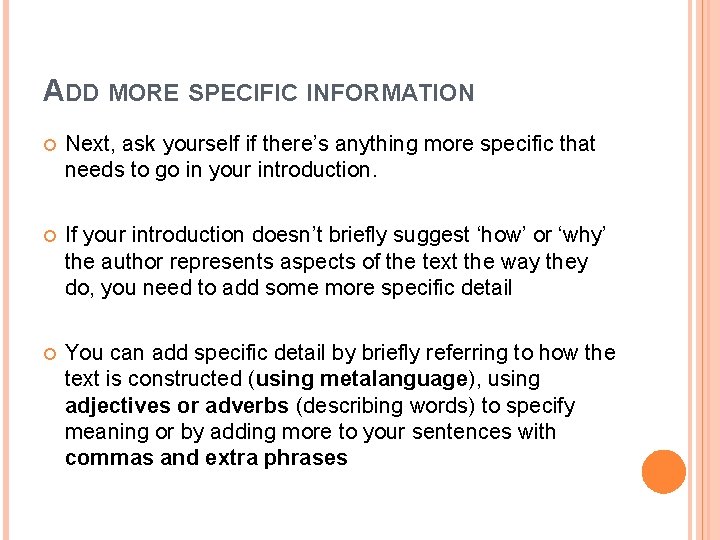
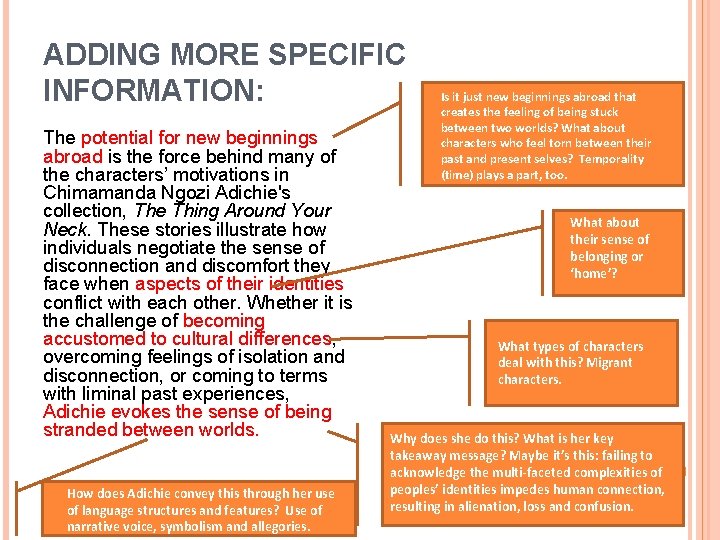
ADD MORE SPECIFIC INFORMATION Next, ask yourself if there’s anything more specific that needs to go in your introduction. If your introduction doesn’t briefly suggest ‘how’ or ‘why’ the author represents aspects of the text the way they do, you need to add some more specific detail You can add specific detail by briefly referring to how the text is constructed (using metalanguage), using adjectives or adverbs (describing words) to specify meaning or by adding more to your sentences with commas and extra phrases
ADDING MORE SPECIFIC INFORMATION: The potential for new beginnings abroad is the force behind many of the characters’ motivations in Chimamanda Ngozi Adichie's collection, The Thing Around Your Neck. These stories illustrate how individuals negotiate the sense of disconnection and discomfort they face when aspects of their identities conflict with each other. Whether it is the challenge of becoming accustomed to cultural differences, overcoming feelings of isolation and disconnection, or coming to terms with liminal past experiences, Adichie evokes the sense of being stranded between worlds. How does Adichie convey this through her use of language structures and features? Use of narrative voice, symbolism and allegories. Is it just new beginnings abroad that creates the feeling of being stuck between two worlds? What about characters who feel torn between their past and present selves? Temporality (time) plays a part, too. What about their sense of belonging or ‘home’? What types of characters deal with this? Migrant characters. Why does she do this? What is her key takeaway message? Maybe it’s this: failing to acknowledge the multi-faceted complexities of peoples’ identities impedes human connection, resulting in alienation, loss and confusion.
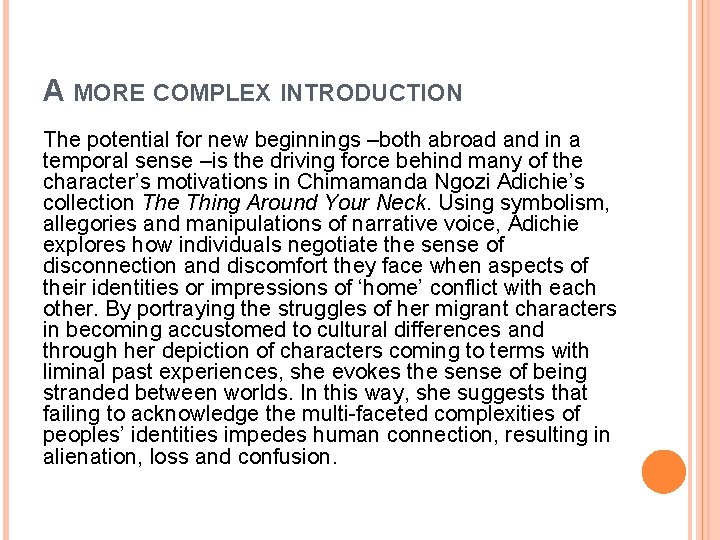
A MORE COMPLEX INTRODUCTION The potential for new beginnings –both abroad and in a temporal sense –is the driving force behind many of the character’s motivations in Chimamanda Ngozi Adichie’s collection The Thing Around Your Neck. Using symbolism, allegories and manipulations of narrative voice, Adichie explores how individuals negotiate the sense of disconnection and discomfort they face when aspects of their identities or impressions of ‘home’ conflict with each other. By portraying the struggles of her migrant characters in becoming accustomed to cultural differences and through her depiction of characters coming to terms with liminal past experiences, she evokes the sense of being stranded between worlds. In this way, she suggests that failing to acknowledge the multi-faceted complexities of peoples’ identities impedes human connection, resulting in alienation, loss and confusion.
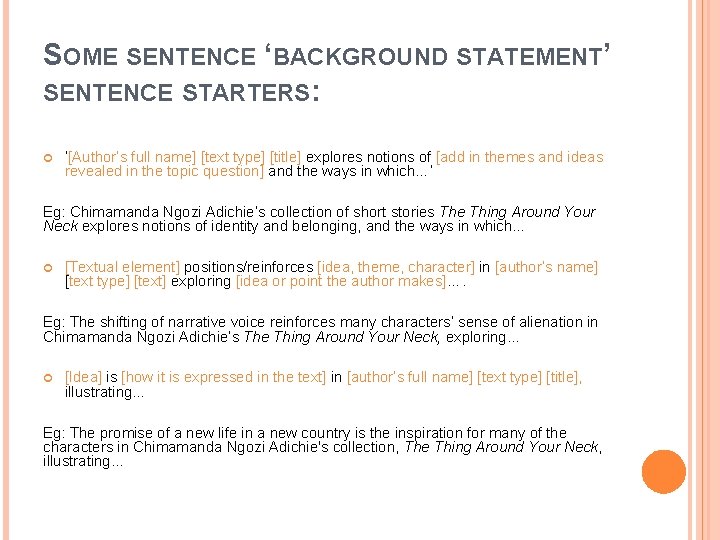
SOME SENTENCE ‘BACKGROUND STATEMENT’ SENTENCE STARTERS: ‘[Author’s full name] [text type] [title] explores notions of [add in themes and ideas revealed in the topic question] and the ways in which…’ Eg: Chimamanda Ngozi Adichie’s collection of short stories The Thing Around Your Neck explores notions of identity and belonging, and the ways in which… [Textual element] positions/reinforces [idea, theme, character] in [author’s name] [text type] [text] exploring [idea or point the author makes]…. Eg: The shifting of narrative voice reinforces many characters’ sense of alienation in Chimamanda Ngozi Adichie’s The Thing Around Your Neck, exploring… [Idea] is [how it is expressed in the text] in [author’s full name] [text type] [title], illustrating… Eg: The promise of a new life in a new country is the inspiration for many of the characters in Chimamanda Ngozi Adichie's collection, The Thing Around Your Neck, illustrating…
OTHER SENTENCE STARTERS AND LINKING PHRASES: Using [metalanguage] [author]… By portraying… Through representing… In this way… Hence… Reinforces… [Author] evokes a sense of…
REVISION CHECKLIST FOR INTRODUCTION: When you have written your introduction, ask yourself, have I: Written a clear background statement with the author’s name, text type, text title and key ideas connected to the question? Stated my contention in a clear manner? Elaborated on my contention (given a ‘preview’ of what will be discussed)? Added complexity by finding and replacing common or overused words? Added complexity by inserting more specific details into my introduction?
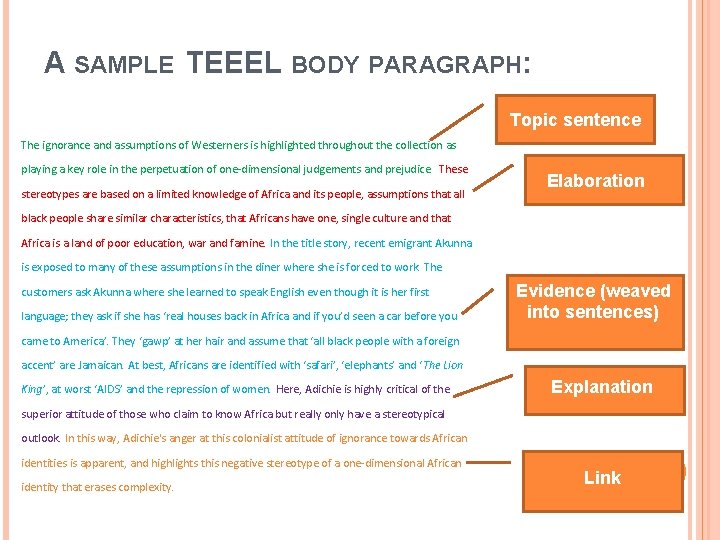
THE BODY PARAGRAPH: THE BASICS You are probably used to working with variations of TEEEL when writing body paragraphs. TOPIC SENTENCE: This is the introductory sentence to your body paragraph. It tells the reader what your main idea is and how it connects to the topic. Topic words + ideas words = topic sentence Question: ‘Adichie's collection successfully dispels stereotypes. Do you agree? ’ Eg: The ignorance and assumptions of Westerners is highlighted throughout the collection as playing a key role in the perpetuation of one-dimensional judgements and prejudice. ELABORATION: This is a follow-up sentence that elaborates on aspects of your topic sentence in more detail. Eg: These stereotypes are based on a limited knowledge of Africa and its people, assumptions that all black people share similar characteristics, that Africans have one, single culture and that Africa is a land of poor education, war and famine.
THE BODY PARAGRAPH: THE BASICS EVIDENCE: Quotations, specific descriptions or specific references to language features and structures that support the point you are making Eg: . In the title story, recent emigrant Akunna is exposed to many of these assumptions in the diner where she is forced to work. The customers ask Akunna where she learned to speak English even though it is her first language; they ask if she has ‘real houses back in Africa and if you’d seen a car before you came to America’. They ‘gawp’ at her hair and assume that ‘all black people with a foreign accent’ are Jamaican. At best, Africans are identified with ‘safari’, ‘elephants’ and ‘The Lion King’, at worst ‘AIDS’ and the repression of women. EXPLANATION: This is where you explain why the evidence is important and what it shows. You can use linking words to help. Eg: Here, Adichie is highly critical of the superior attitude of those who claim to know Africa but really only have a stereotypical outlook. LINK: This is where you link back to the main topic. Ask yourself ‘So what? Overall, what is the author really getting at? What is their purpose in representing this? ’ Eg: In this way, Adichie's anger at this colonialist attitude of ignorance towards African identities is apparent, and highlights this negative stereotype of a one-dimensional, pan-African identity that erases complexity.
A SAMPLE TEEEL BODY PARAGRAPH: Topic sentence The ignorance and assumptions of Westerners is highlighted throughout the collection as playing a key role in the perpetuation of one-dimensional judgements and prejudice. These stereotypes are based on a limited knowledge of Africa and its people, assumptions that all Elaboration black people share similar characteristics, that Africans have one, single culture and that Africa is a land of poor education, war and famine. In the title story, recent emigrant Akunna is exposed to many of these assumptions in the diner where she is forced to work. The customers ask Akunna where she learned to speak English even though it is her first language; they ask if she has ‘real houses back in Africa and if you’d seen a car before you Evidence (weaved into sentences) came to America’. They ‘gawp’ at her hair and assume that ‘all black people with a foreign accent’ are Jamaican. At best, Africans are identified with ‘safari’, ‘elephants’ and ‘The Lion King’, at worst ‘AIDS’ and the repression of women. Here, Adichie is highly critical of the Explanation superior attitude of those who claim to know Africa but really only have a stereotypical outlook. In this way, Adichie's anger at this colonialist attitude of ignorance towards African identities is apparent, and highlights this negative stereotype of a one-dimensional African identity that erases complexity. Link
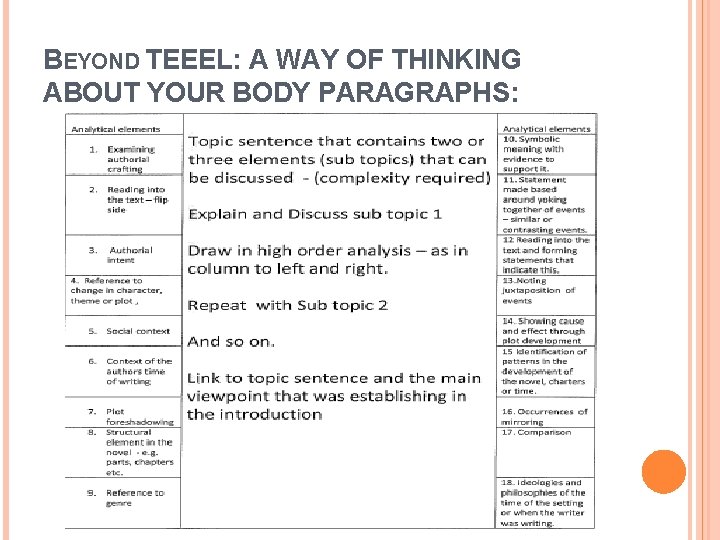
BEYOND TEEEL: A WAY OF THINKING ABOUT YOUR BODY PARAGRAPHS:
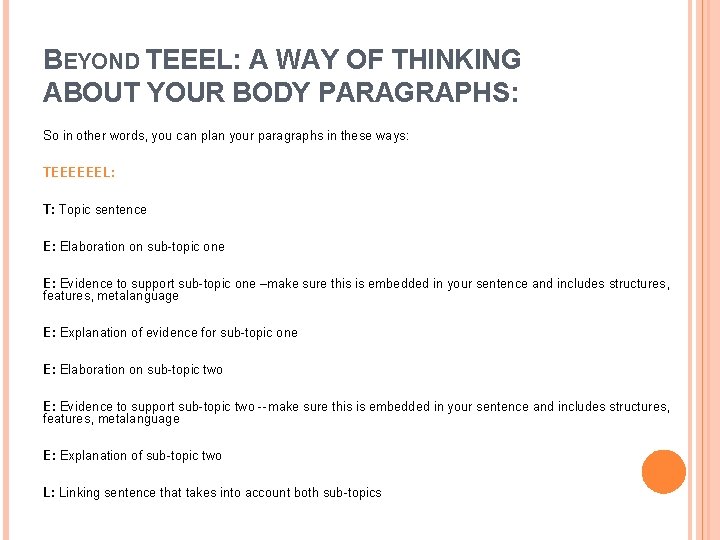
BEYOND TEEEL: A WAY OF THINKING ABOUT YOUR BODY PARAGRAPHS: So in other words, you can plan your paragraphs in these ways: TEEEEEEL: T: Topic sentence E: Elaboration on sub-topic one E: Evidence to support sub-topic one –make sure this is embedded in your sentence and includes structures, features, metalanguage E: Explanation of evidence for sub-topic one E: Elaboration on sub-topic two E: Evidence to support sub-topic two --make sure this is embedded in your sentence and includes structures, features, metalanguage E: Explanation of sub-topic two L: Linking sentence that takes into account both sub-topics
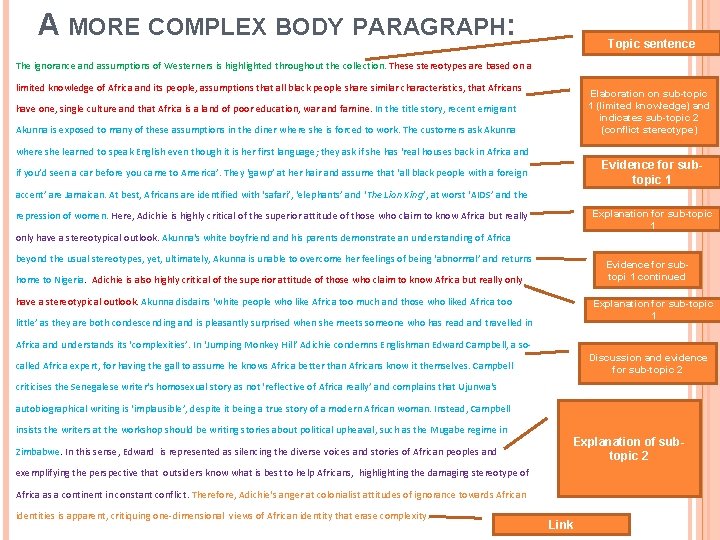
A MORE COMPLEX BODY PARAGRAPH: Topic sentence The ignorance and assumptions of Westerners is highlighted throughout the collection. These stereotypes are based on a limited knowledge of Africa and its people, assumptions that all black people share similar characteristics, that Africans Elaboration on sub-topic 1 (limited knowledge) and indicates sub-topic 2 (conflict stereotype) have one, single culture and that Africa is a land of poor education, war and famine. In the title story, recent emigrant Akunna is exposed to many of these assumptions in the diner where she is forced to work. The customers ask Akunna where she learned to speak English even though it is her first language; they ask if she has ‘real houses back in Africa and Evidence for subtopic 1 if you’d seen a car before you came to America’. They ‘gawp’ at her hair and assume that ‘all black people with a foreign accent’ are Jamaican. At best, Africans are identified with ‘safari’, ‘elephants’ and ‘The Lion King’, at worst ‘AIDS’ and the Explanation for sub-topic 1 repression of women. Here, Adichie is highly critical of the superior attitude of those who claim to know Africa but really only have a stereotypical outlook. Akunna's white boyfriend and his parents demonstrate an understanding of Africa beyond the usual stereotypes, yet, ultimately, Akunna is unable to overcome her feelings of being ‘abnormal’ and returns Evidence for subtopi 1 continued home to Nigeria. Adichie is also highly critical of the superior attitude of those who claim to know Africa but really only have a stereotypical outlook. Akunna disdains ‘white people who like Africa too much and those who liked Africa too Explanation for sub-topic 1 little’ as they are both condescending and is pleasantly surprised when she meets someone who has read and travelled in Africa and understands its ‘complexities’. In ‘Jumping Monkey Hill’ Adichie condemns Englishman Edward Campbell, a so- Discussion and evidence for sub-topic 2 called Africa expert, for having the gall to assume he knows Africa better than Africans know it themselves. Campbell criticises the Senegalese writer's homosexual story as not ‘reflective of Africa really’ and complains that Ujunwa's autobiographical writing is ‘implausible’, despite it being a true story of a modern African woman. Instead, Campbell insists the writers at the workshop should be writing stories about political upheaval, such as the Mugabe regime in Zimbabwe. In this sense, Edward is represented as silencing the diverse voices and stories of African peoples and Explanation of subtopic 2 exemplifying the perspective that outsiders know what is best to help Africans, highlighting the damaging stereotype of Africa as a continent in constant conflict. Therefore, Adichie's anger at colonialist attitudes of ignorance towards African identities is apparent, critiquing one-dimensional views of African identity that erase complexity. Link
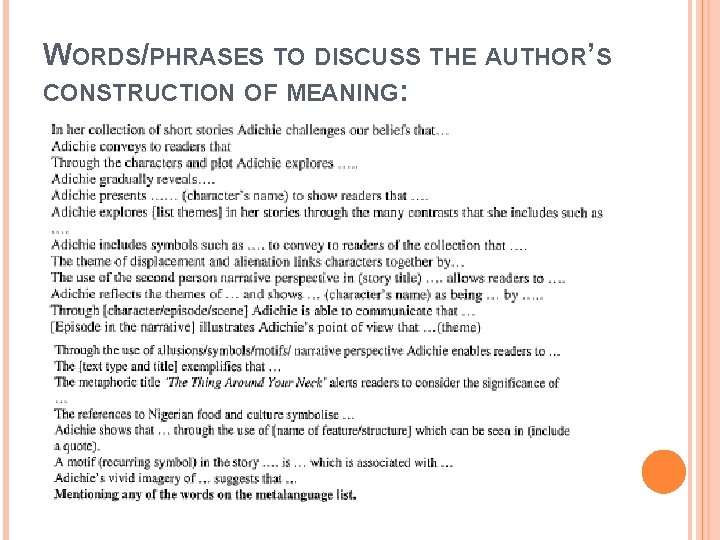
WORDS/PHRASES TO DISCUSS THE AUTHOR’S CONSTRUCTION OF MEANING:
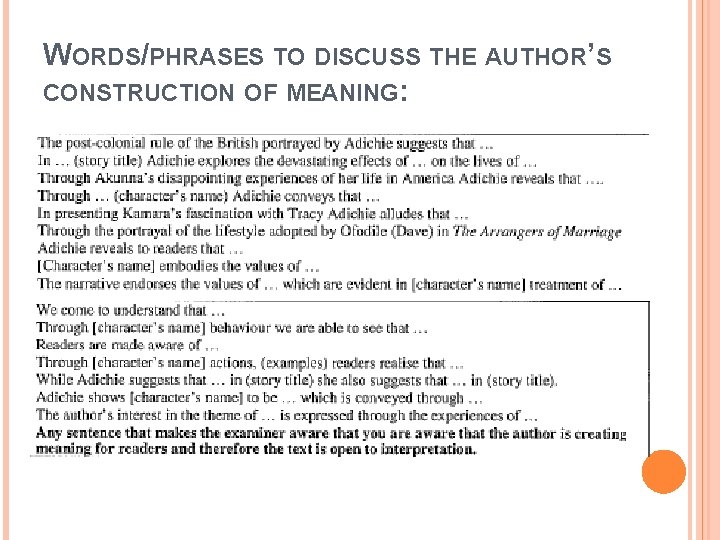
WORDS/PHRASES TO DISCUSS THE AUTHOR’S CONSTRUCTION OF MEANING:
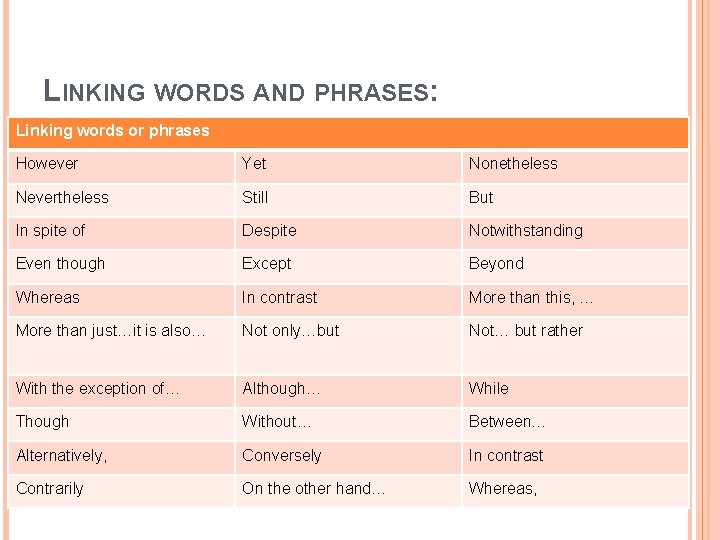
LINKING WORDS AND PHRASES: Linking words or phrases However Yet Nonetheless Nevertheless Still But In spite of Despite Notwithstanding Even though Except Beyond Whereas In contrast More than this, … More than just…it is also… Not only…but Not… but rather With the exception of… Although… While Though Without… Between… Alternatively, Conversely In contrast Contrarily On the other hand… Whereas,
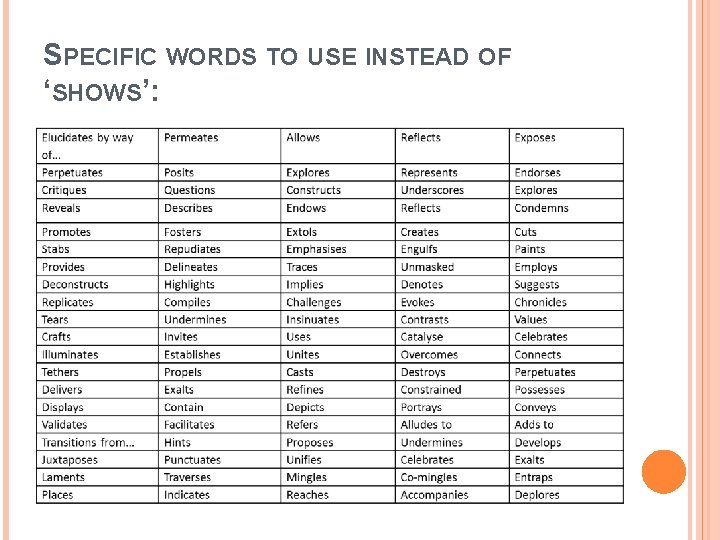
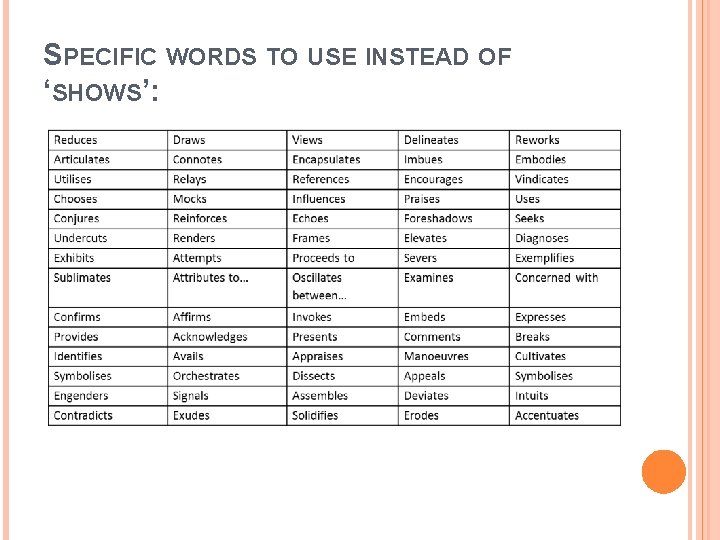
SPECIFIC WORDS TO USE INSTEAD OF ‘SHOWS’:
SPECIFIC WORDS TO USE INSTEAD OF ‘SHOWS’:
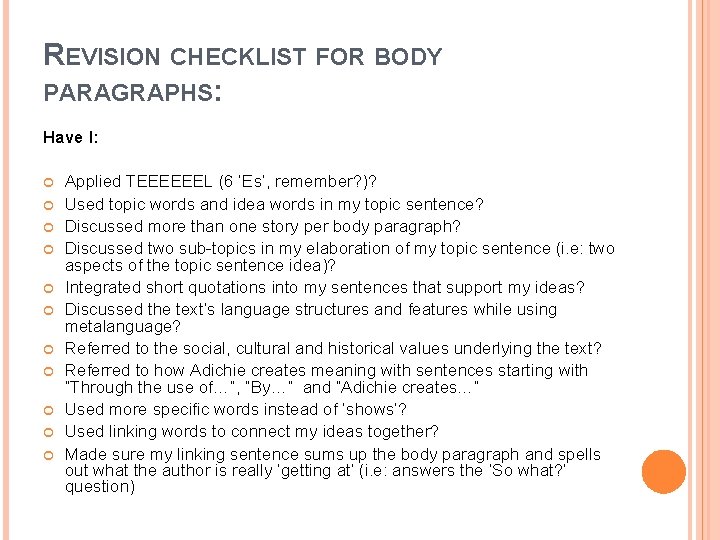
REVISION CHECKLIST FOR BODY PARAGRAPHS: Have I: Applied TEEEEEEL (6 ‘Es’, remember? )? Used topic words and idea words in my topic sentence? Discussed more than one story per body paragraph? Discussed two sub-topics in my elaboration of my topic sentence (i. e: two aspects of the topic sentence idea)? Integrated short quotations into my sentences that support my ideas? Discussed the text’s language structures and features while using metalanguage? Referred to the social, cultural and historical values underlying the text? Referred to how Adichie creates meaning with sentences starting with “Through the use of…”, “By…” and “Adichie creates…” Used more specific words instead of ‘shows’? Used linking words to connect my ideas together? Made sure my linking sentence sums up the body paragraph and spells out what the author is really ‘getting at’ (i. e: answers the ‘So what? ’ question)
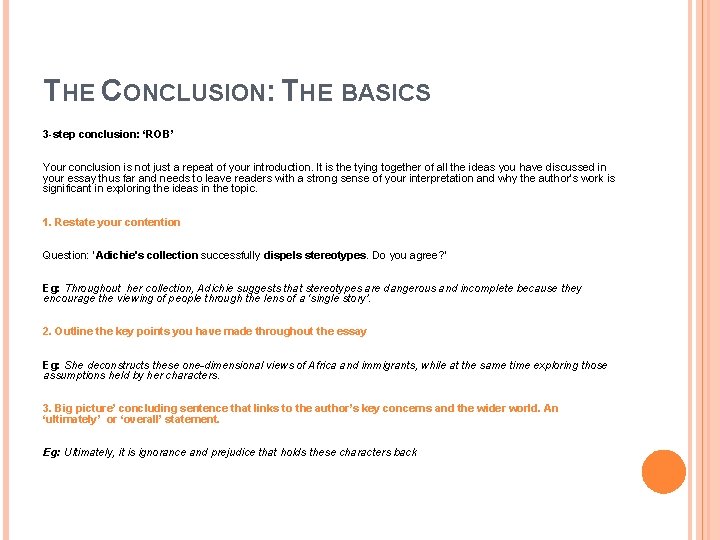
THE CONCLUSION: THE BASICS 3 -step conclusion: ‘ROB’ Your conclusion is not just a repeat of your introduction. It is the tying together of all the ideas you have discussed in your essay thus far and needs to leave readers with a strong sense of your interpretation and why the author’s work is significant in exploring the ideas in the topic. 1. Restate your contention Question: ‘Adichie's collection successfully dispels stereotypes. Do you agree? ’ Eg: Throughout her collection, Adichie suggests that stereotypes are dangerous and incomplete because they encourage the viewing of people through the lens of a ‘single story’. 2. Outline the key points you have made throughout the essay Eg: She deconstructs these one-dimensional views of Africa and immigrants, while at the same time exploring those assumptions held by her characters. 3. Big picture’ concluding sentence that links to the author’s key concerns and the wider world. An ‘ultimately’ or ‘overall’ statement. Eg: Ultimately, it is ignorance and prejudice that holds these characters back
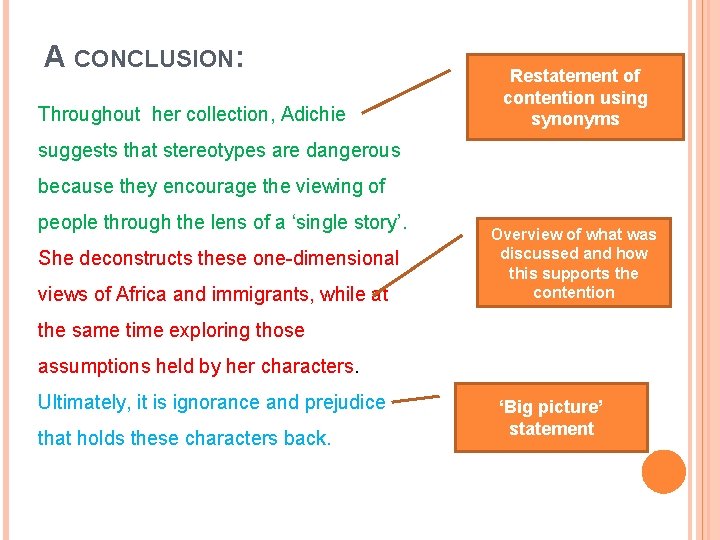
A CONCLUSION: Throughout her collection, Adichie Restatement of contention using synonyms suggests that stereotypes are dangerous because they encourage the viewing of people through the lens of a ‘single story’. She deconstructs these one-dimensional views of Africa and immigrants, while at Overview of what was discussed and how this supports the contention the same time exploring those assumptions held by her characters. Ultimately, it is ignorance and prejudice that holds these characters back. ‘Big picture’ statement
THE CONCLUSION: ADDING COMPLEXITY You can add complexity to your conclusion by replacing common or overused words and adding more specific information to your sentences, just like you did with your introduction
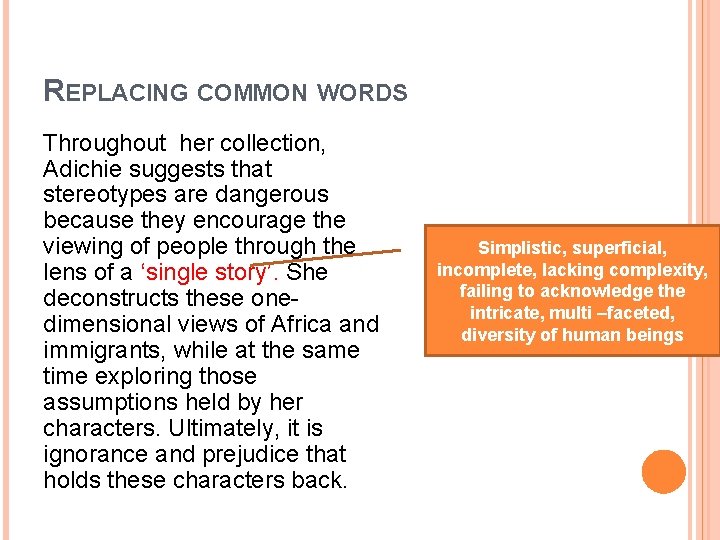
REPLACING COMMON WORDS Throughout her collection, Adichie suggests that stereotypes are dangerous because they encourage the viewing of people through the lens of a ‘single story’. She deconstructs these onedimensional views of Africa and immigrants, while at the same time exploring those assumptions held by her characters. Ultimately, it is ignorance and prejudice that holds these characters back. Simplistic, superficial, incomplete, lacking complexity, failing to acknowledge the intricate, multi –faceted, diversity of human beings
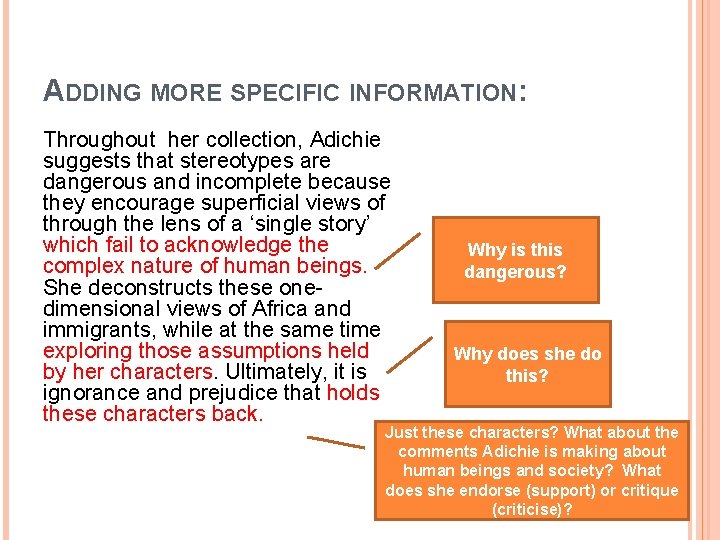
ADDING MORE SPECIFIC INFORMATION: Throughout her collection, Adichie suggests that stereotypes are dangerous and incomplete because they encourage superficial views of through the lens of a ‘single story’ which fail to acknowledge the complex nature of human beings. She deconstructs these onedimensional views of Africa and immigrants, while at the same time exploring those assumptions held by her characters. Ultimately, it is ignorance and prejudice that holds these characters back. Why is this dangerous? Why does she do this? Just these characters? What about the comments Adichie is making about human beings and society? What does she endorse (support) or critique (criticise)?
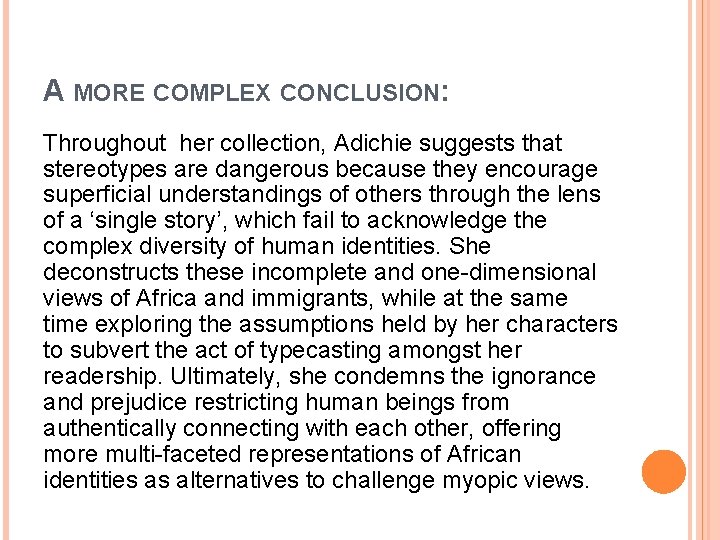
A MORE COMPLEX CONCLUSION: Throughout her collection, Adichie suggests that stereotypes are dangerous because they encourage superficial understandings of others through the lens of a ‘single story’, which fail to acknowledge the complex diversity of human identities. She deconstructs these incomplete and one-dimensional views of Africa and immigrants, while at the same time exploring the assumptions held by her characters to subvert the act of typecasting amongst her readership. Ultimately, she condemns the ignorance and prejudice restricting human beings from authentically connecting with each other, offering more multi-faceted representations of African identities as alternatives to challenge myopic views.
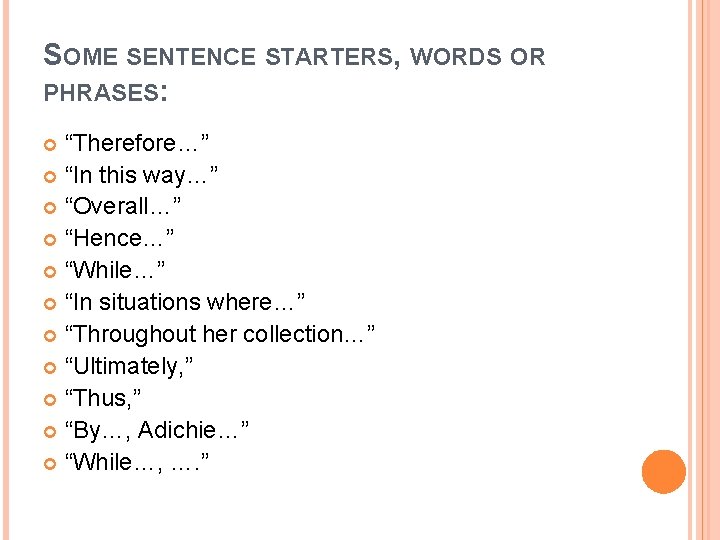
SOME SENTENCE STARTERS, WORDS OR PHRASES: “Therefore…” “In this way…” “Overall…” “Hence…” “While…” “In situations where…” “Throughout her collection…” “Ultimately, ” “Thus, ” “By…, Adichie…” “While…, …. ”
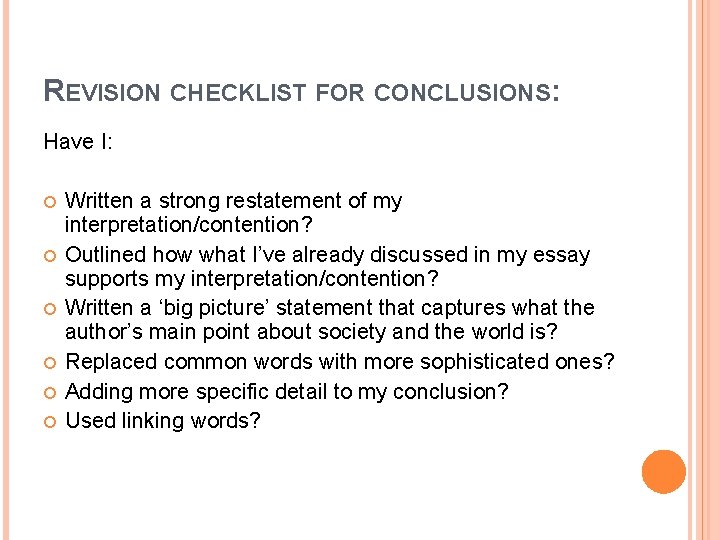
REVISION CHECKLIST FOR CONCLUSIONS: Have I: Written a strong restatement of my interpretation/contention? Outlined how what I’ve already discussed in my essay supports my interpretation/contention? Written a ‘big picture’ statement that captures what the author’s main point about society and the world is? Replaced common words with more sophisticated ones? Adding more specific detail to my conclusion? Used linking words?