
Writing a Creative Response Year 12 English AOS

- Slides: 11
Writing a Creative Response Year 12 English AOS 1: Outcome 1 (Creative Response)
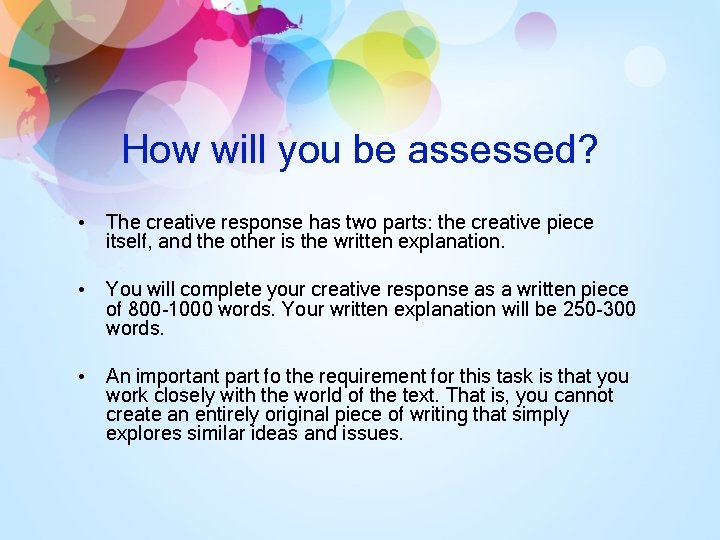
How will you be assessed? • The creative response has two parts: the creative piece itself, and the other is the written explanation. • You will complete your creative response as a written piece of 800 -1000 words. Your written explanation will be 250 -300 words. • An important part fo the requirement for this task is that you work closely with the world of the text. That is, you cannot create an entirely original piece of writing that simply explores similar ideas and issues.
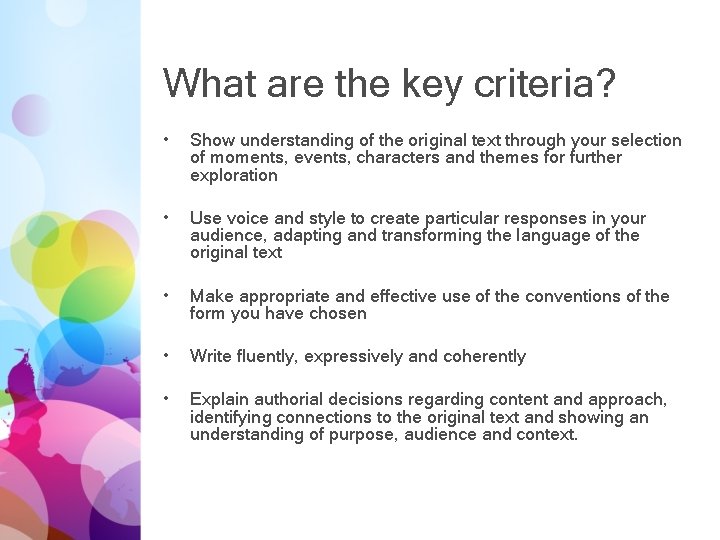
What are the key criteria? • Show understanding of the original text through your selection of moments, events, characters and themes for further exploration • Use voice and style to create particular responses in your audience, adapting and transforming the language of the original text • Make appropriate and effective use of the conventions of the form you have chosen • Write fluently, expressively and coherently • Explain authorial decisions regarding content and approach, identifying connections to the original text and showing an understanding of purpose, audience and context.
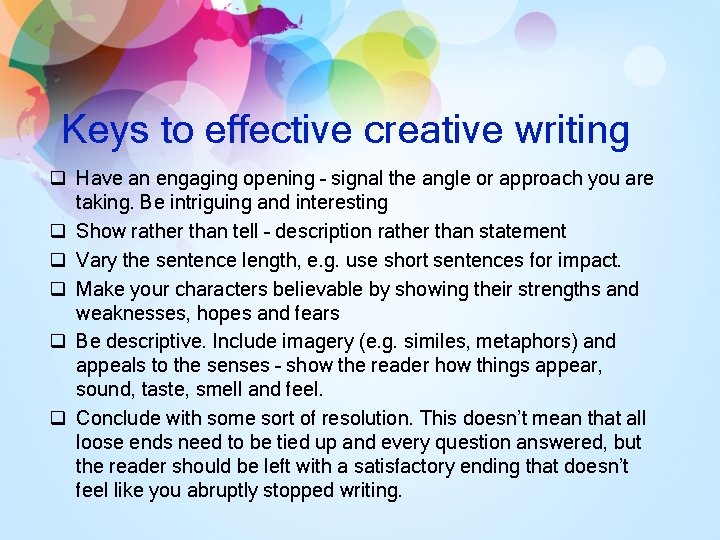
Keys to effective creative writing q Have an engaging opening – signal the angle or approach you are taking. Be intriguing and interesting q Show rather than tell – description rather than statement q Vary the sentence length, e. g. use short sentences for impact. q Make your characters believable by showing their strengths and weaknesses, hopes and fears q Be descriptive. Include imagery (e. g. similes, metaphors) and appeals to the senses – show the reader how things appear, sound, taste, smell and feel. q Conclude with some sort of resolution. This doesn’t mean that all loose ends need to be tied up and every question answered, but the reader should be left with a satisfactory ending that doesn’t feel like you abruptly stopped writing.
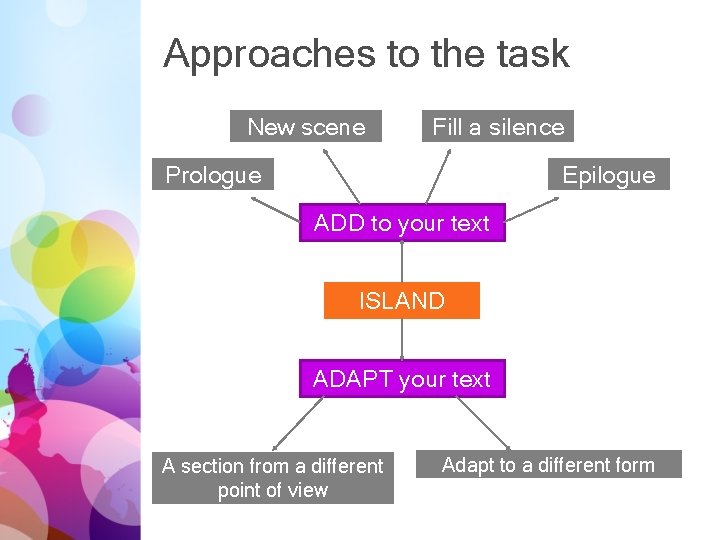
Approaches to the task New scene Fill a silence Prologue Epilogue ADD to your text ISLAND ADAPT your text A section from a different point of view Adapt to a different form
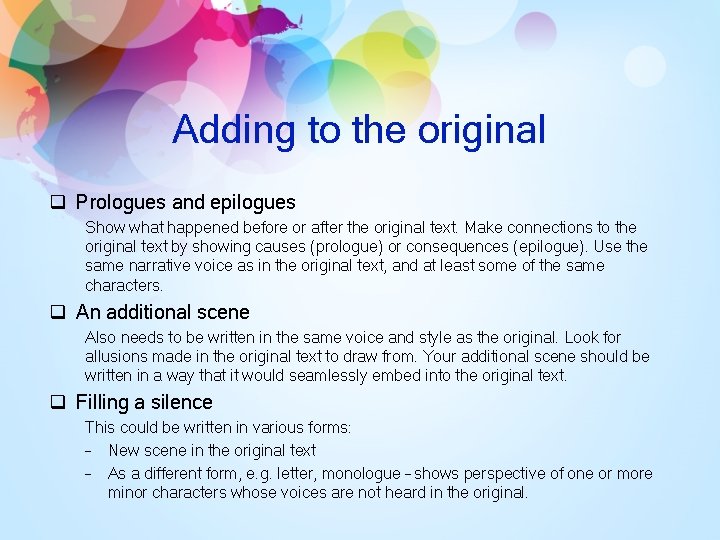
Adding to the original q Prologues and epilogues Show what happened before or after the original text. Make connections to the original text by showing causes (prologue) or consequences (epilogue). Use the same narrative voice as in the original text, and at least some of the same characters. q An additional scene Also needs to be written in the same voice and style as the original. Look for allusions made in the original text to draw from. Your additional scene should be written in a way that it would seamlessly embed into the original text. q Filling a silence This could be written in various forms: – New scene in the original text – As a different form, e. g. letter, monologue – shows perspective of one or more minor characters whose voices are not heard in the original.
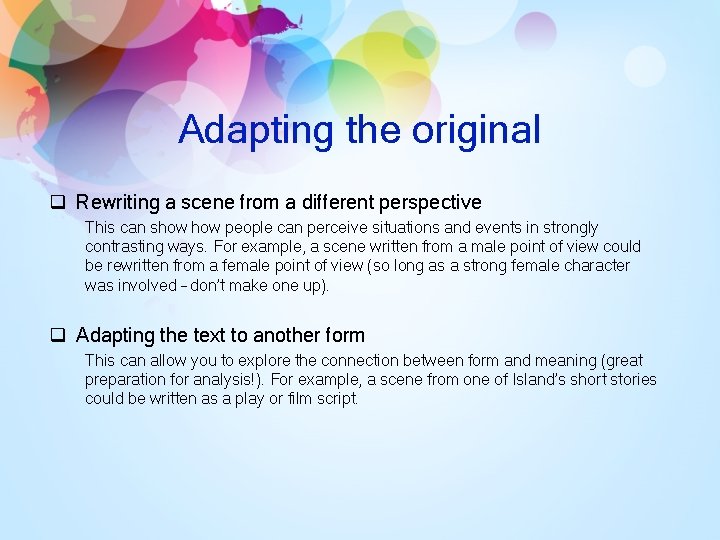
Adapting the original q Rewriting a scene from a different perspective This can show people can perceive situations and events in strongly contrasting ways. For example, a scene written from a male point of view could be rewritten from a female point of view (so long as a strong female character was involved – don’t make one up). q Adapting the text to another form This can allow you to explore the connection between form and meaning (great preparation for analysis!). For example, a scene from one of Island’s short stories could be written as a play or film script.
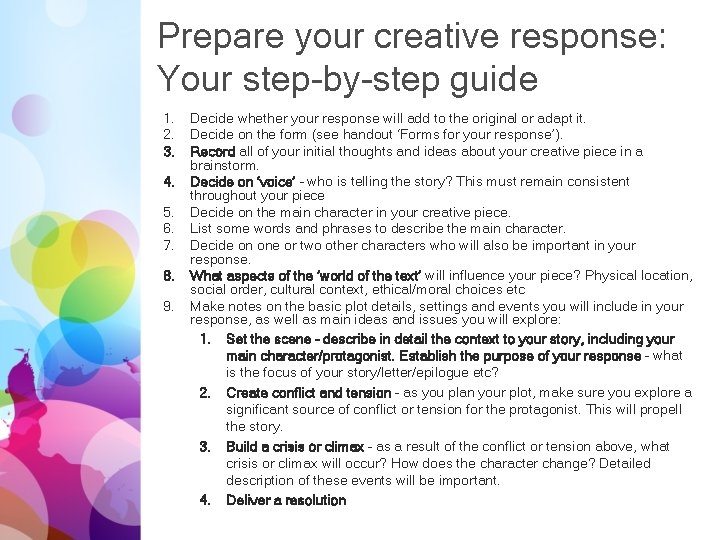
Prepare your creative response: Your step-by-step guide 1. 2. 3. 4. 5. 6. 7. 8. 9. Decide whether your response will add to the original or adapt it. Decide on the form (see handout ‘Forms for your response’). Record all of your initial thoughts and ideas about your creative piece in a brainstorm. Decide on ‘voice’ – who is telling the story? This must remain consistent throughout your piece Decide on the main character in your creative piece. List some words and phrases to describe the main character. Decide on one or two other characters who will also be important in your response. What aspects of the ‘world of the text’ will influence your piece? Physical location, social order, cultural context, ethical/moral choices etc Make notes on the basic plot details, settings and events you will include in your response, as well as main ideas and issues you will explore: 1. Set the scene – describe in detail the context to your story, including your main character/protagonist. Establish the purpose of your response – what is the focus of your story/letter/epilogue etc? 2. Create conflict and tension – as you plan your plot, make sure you explore a significant source of conflict or tension for the protagonist. This will propell the story. 3. Build a crisis or climax – as a result of the conflict or tension above, what crisis or climax will occur? How does the character change? Detailed description of these events will be important. 4. Deliver a resolution
The written explanation You will need to explain and justify the choice you made and connections between your response and original text. Your written explanation should be a detailed, fluent and coherent paragraph (or two). It is usually written in first person and past tense (‘I decided to…’) Include discussion of how you have ised or address the following: • The FORM– aim to refer to one or two conventions of this form (e. g. dialogue and rising tension in a short story). • LANGUAGE – comment on tone, style and any features of characters’ speech you have incorporated. • AUDIENCE – explain your intended audience and how you are appealing to their interests. • PURPOSE – describe the impact you hope your piece will have on your intended audience, or the point of view you want them to consider. • CONTEXT – consider and explain your choices around the context for the piece (e. g. historical, social, cultural context and how you have used form and language to suit the audience, purpose and context).
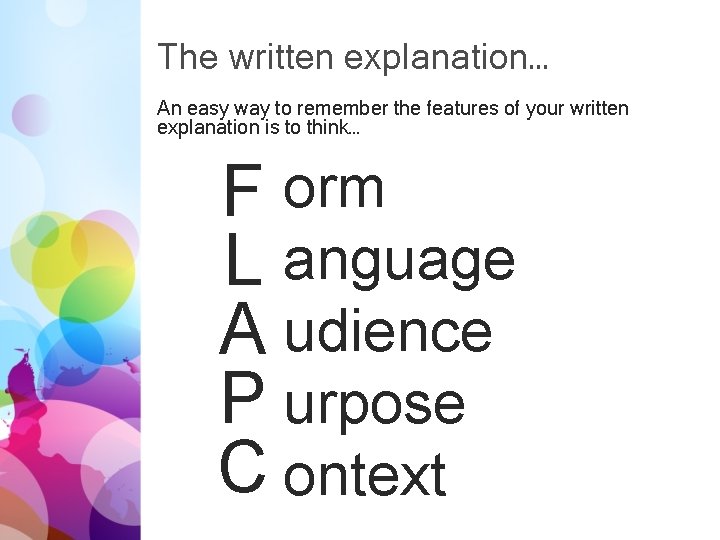
The written explanation… An easy way to remember the features of your written explanation is to think… F orm L anguage A udience P urpose C ontext
Questions ?