Writing Critiques Critiques require that students also learn

- Slides: 12
Writing Critiques
• Critiques require that students also learn to express their evaluative comments within their field’s accepted standards of judgment. • Critiques need to be “fair and reasonable”. “Fair” means that criteria are reasonable in one field should not be applied to another field where they would be unreasonable. • Different fields are likely to impose different emphases on critiques. • Book reviews can be a “direct, public, and often critical encounter with a text and therefore its author, who must be considered as a primary audience for the review (Hyland, 2000).
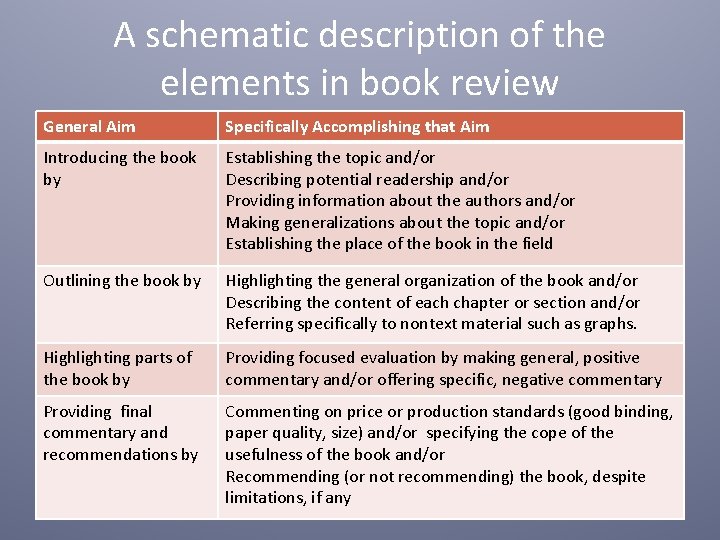
A schematic description of the elements in book review General Aim Specifically Accomplishing that Aim Introducing the book by Establishing the topic and/or Describing potential readership and/or Providing information about the authors and/or Making generalizations about the topic and/or Establishing the place of the book in the field Outlining the book by Highlighting the general organization of the book and/or Describing the content of each chapter or section and/or Referring specifically to nontext material such as graphs. Highlighting parts of the book by Providing focused evaluation by making general, positive commentary and/or offering specific, negative commentary Providing final commentary and recommendations by Commenting on price or production standards (good binding, paper quality, size) and/or specifying the cope of the usefulness of the book and/or Recommending (or not recommending) the book, despite limitations, if any
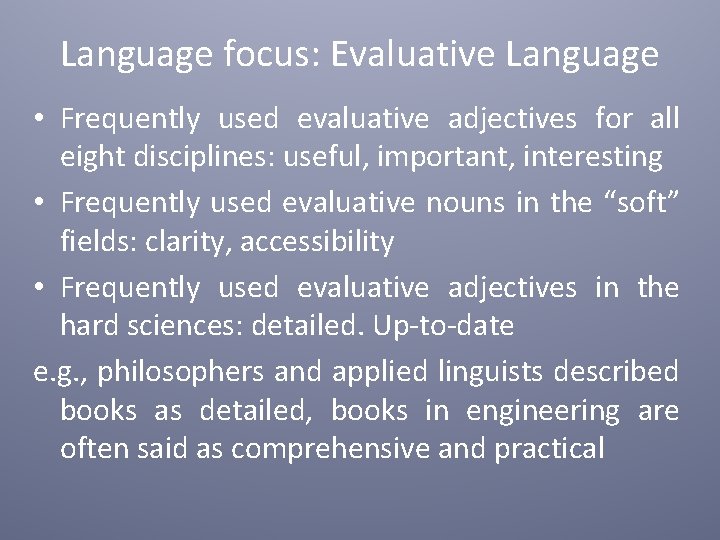
Language focus: Evaluative Language • Frequently used evaluative adjectives for all eight disciplines: useful, important, interesting • Frequently used evaluative nouns in the “soft” fields: clarity, accessibility • Frequently used evaluative adjectives in the hard sciences: detailed. Up-to-date e. g. , philosophers and applied linguists described books as detailed, books in engineering are often said as comprehensive and practical
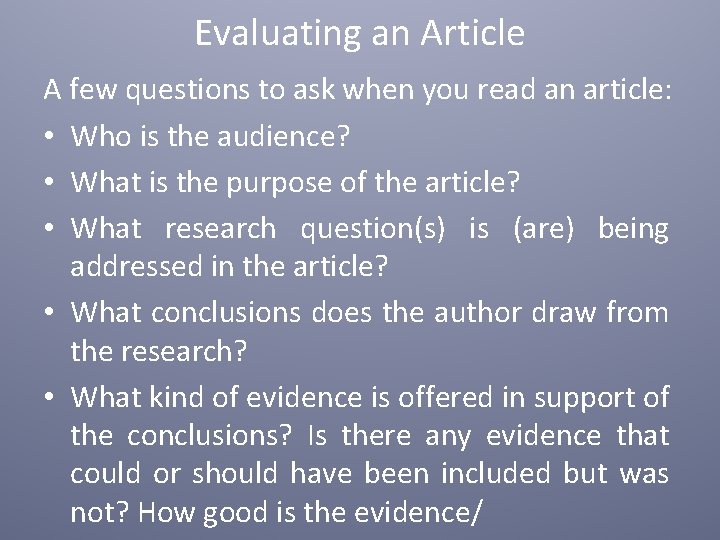
Evaluating an Article A few questions to ask when you read an article: • Who is the audience? • What is the purpose of the article? • What research question(s) is (are) being addressed in the article? • What conclusions does the author draw from the research? • What kind of evidence is offered in support of the conclusions? Is there any evidence that could or should have been included but was not? How good is the evidence/
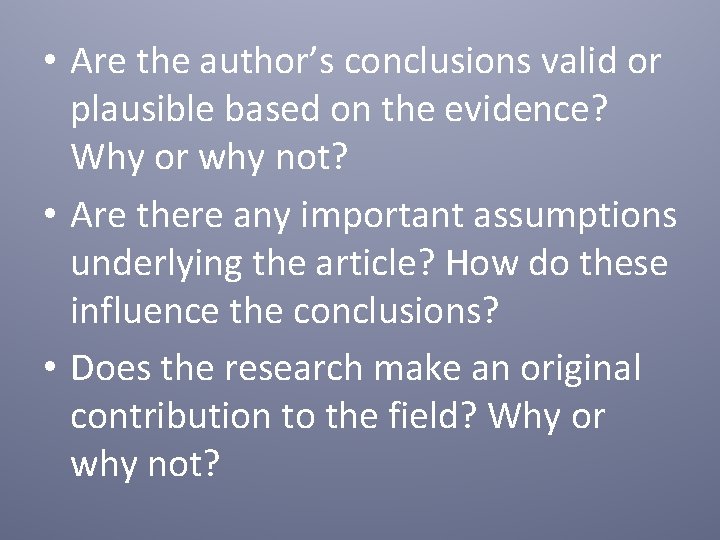
• Are the author’s conclusions valid or plausible based on the evidence? Why or why not? • Are there any important assumptions underlying the article? How do these influence the conclusions? • Does the research make an original contribution to the field? Why or why not?
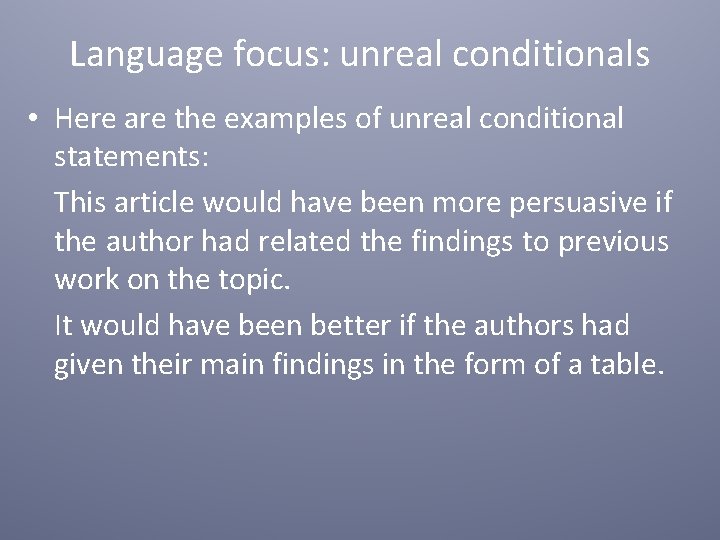
Language focus: unreal conditionals • Here are the examples of unreal conditional statements: This article would have been more persuasive if the author had related the findings to previous work on the topic. It would have been better if the authors had given their main findings in the form of a table.
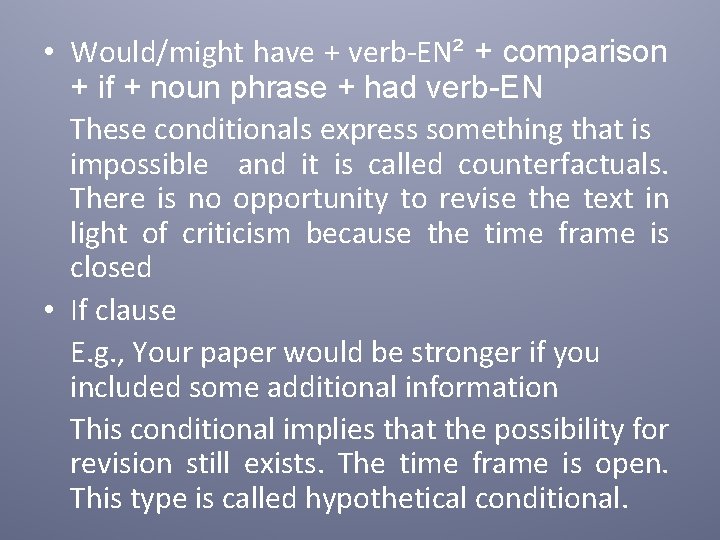
• Would/might have + verb-EN² + comparison + if + noun phrase + had verb-EN These conditionals express something that is impossible and it is called counterfactuals. There is no opportunity to revise the text in light of criticism because the time frame is closed • If clause E. g. , Your paper would be stronger if you included some additional information This conditional implies that the possibility for revision still exists. The time frame is open. This type is called hypothetical conditional.
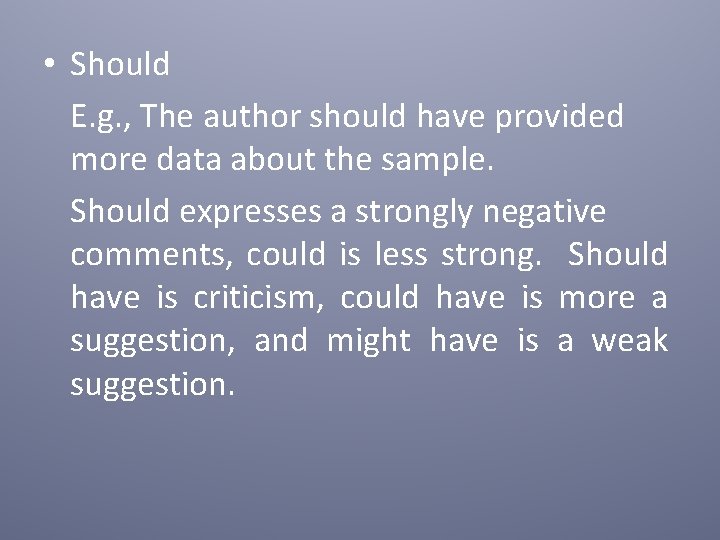
• Should E. g. , The author should have provided more data about the sample. Should expresses a strongly negative comments, could is less strong. Should have is criticism, could have is more a suggestion, and might have is a weak suggestion.
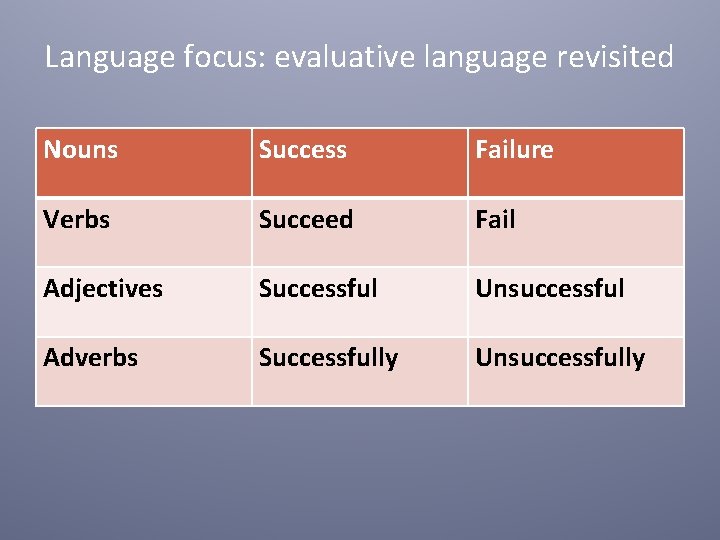
Language focus: evaluative language revisited Nouns Success Failure Verbs Succeed Fail Adjectives Successful Unsuccessful Adverbs Successfully Unsuccessfully
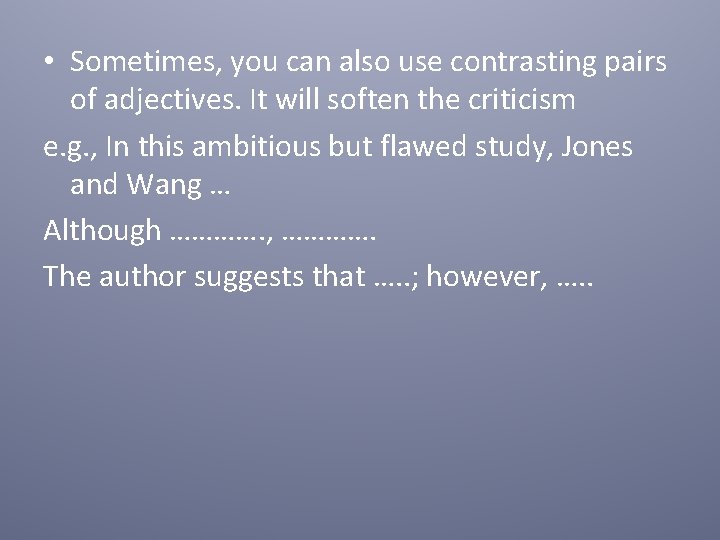
• Sometimes, you can also use contrasting pairs of adjectives. It will soften the criticism e. g. , In this ambitious but flawed study, Jones and Wang … Although …………. , …………. The author suggests that …. . ; however, …. .