Workplace Violence in the Emergency Department Screening with



- Slides: 17
Workplace Violence in the Emergency Department: Screening with the STAMP Assessment ADRIENNE WILSON NURS 5382: CAPSTONE UNIVERSITY OF TEXAS AT TYLER AUGUST 2020
Rationale Healthcare workers are four times more likely to experience workplace violence (WPV) than workers in any other industry (Arnetz et al. , 2017). WPV is a worldwide issue in healthcare, with even higher rates in Emergency Departments (EDs) (Hassankhani et al. , 2017). After a violent event, 94% of nurses experienced one or more symptoms of post-traumatic stress disorder, which have a significant relationship with work productivity (Gates et al. , 2011). WPV events are linked to poor staff retention, poor quality of care, increased staff burnout, and patient/visitor dissatisfaction (Renker et al. , 2013).
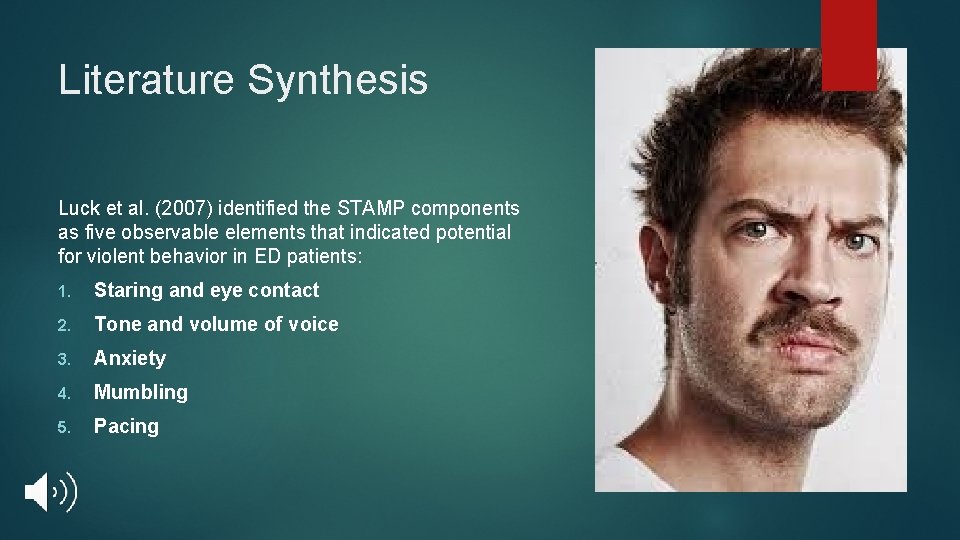
Literature Synthesis Luck et al. (2007) identified the STAMP components as five observable elements that indicated potential for violent behavior in ED patients: 1. Staring and eye contact 2. Tone and volume of voice 3. Anxiety 4. Mumbling 5. Pacing
Literature Synthesis (cont. ) The STAMP assessment is quick and easy to use, and it requires no knowledge about the history of the patient being assessed. Weeks et al. , 2013 It allows staff to take early action to prevent escalation of potentially violent patients and protect the agitated patient, staff, and other patients from harm.
Stakeholders Emergency Department staff Patients with a positive STAMP screening Patients with a negative STAMP screening (who could be bystanders in a violent event) Police and psychiatric services would also be impacted by a lower rate of WPV incidents in the ED.
Implementation 1. Gather facility-specific data through the police department and safety center to obtain “control” numbers for WPV incidents that will provide a baseline amount of incidents. 2. Work with Information Technology team to add a yes/no STAMP screening button to the triage assessment of Electronic Medical Record (EMR) with a set go-live date. A positive screening on a patient should also be indicated to staff on their Epic track board with an orange color. 3. Email ED nursing staff with information regarding current WPV data and implementation of new STAMP assessment including go-live date. 4. Reinforce upcoming go-live date of triage screening to staff during shift reports and staff meetings.
Implementation (cont. ) 5. Implementation begins on go-live date. 6. Monitor use of screening tool by triage nursing staff and amount of positive screenings throughout implementation for adherence. 7. Send out biweekly and monthly updates encouraging staff to continue adhering to new screening and sharing improvements with workplace violence incidents. Provide opportunity throughout for staff feedback. 8. At 6 months from go-live date, evaluate effectiveness of intervention and share results with staff. Provide opportunity for feedback from staff regarding adjustments and relevant interventions for future.
STAMP Assessment in the EMR
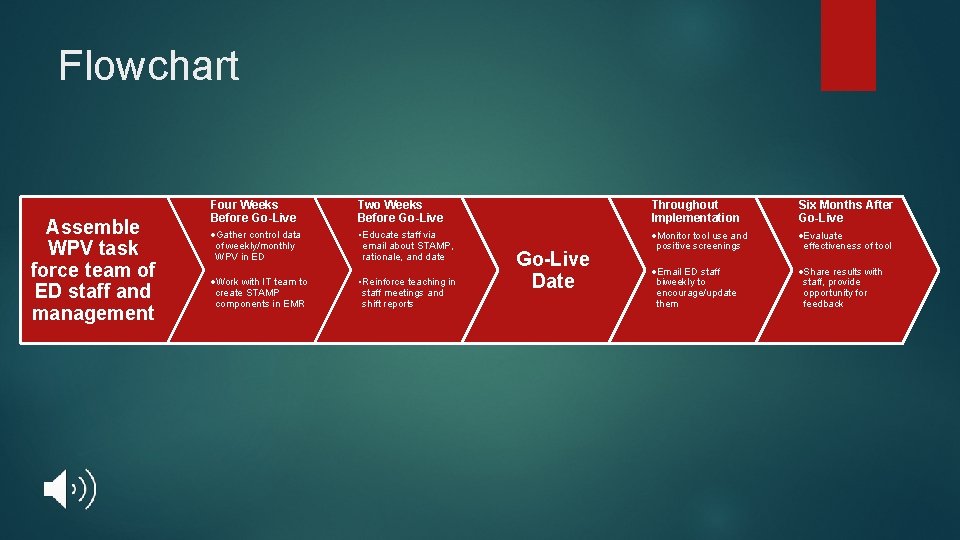
Flowchart Assemble WPV task force team of ED staff and management Four Weeks Before Go-Live Two Weeks Before Go-Live Throughout Implementation Six Months After Go-Live Gather control data of weekly/monthly WPV in ED • Educate staff via email about STAMP, rationale, and date Monitor tool use and positive screenings Evaluate effectiveness of tool Work with IT team to create STAMP components in EMR • Reinforce teaching in staff meetings and shift reports Email ED staff biweekly to encourage/update them Share results with staff, provide opportunity for feedback Go-Live Date
Data Collection/Methods The most important part of the evaluation process for the STAMP screening is to determine if it contributes to a safer environment for staff and patients in the Emergency Department. In order to evaluate for effectiveness of the STAMP assessment, one could compare data pre-implementation and six months after implementation using violent events in the ED reported via police reports and safety posts, likely employing descriptive statistics and a paired t-test for data analysis. A simple paired t-test may be the best way to analyze for a significant decrease in the amount of WPV events before and after implementation, and analysis could be broken down further into types of violent events (i. e. verbal, physical, sexual) if relevant.
Cost/Benefit Discussion Cost of implementing the STAMP assessment would be minimal if any: Addition of STAMP assessment to triage and STAMP column to track board Training of staff via email with reinforcement in staff meetings and shift reports Meanwhile, the cost of WPV is significant: Poor staff retention Poor quality of care Increased staff burnout Decreased patient/visitor satisfaction (Renker et al. , 2013)
Because this project was not actually implemented due to the COVID-19 crisis, results of the study are a hypothetical discussion. The goal of implementing a STAMP assessment to screen patients in the Parkland Hospital Emergency Department (ED) for potentially violent behavior would be to reduce incidents of workplace violence (WPV). A significant decrease in WPV incidents would be the picture of success for this project, indicating a safer environment for staff and patients as a result of implementation of the STAMP assessment. Overall Discussion/Results
Recommendations This project could not be implemented in Parkland Emergency Departmeat this time due to the COVID-19 pandemic. If implemented, the STAMP assessment could provide a safer environment for staff and patients alike. Ultimately, the goal to be attained would be a less violent Emergency Department, where staff can help and patients can heal.
References Angland, S. , Dowling, M. , & Casey, D. (2013). Nurses’ perceptions of the factors which cause violence and aggression in the emergency department: A qualitative study. International Emergency Nursing, 22, pp. 134 -139. DOI: 10. 1016/j. ienj. 2013. 09. 005 Arnetz, J. , Hamblin, L. , Russell, J. , Upfal, M. , Luborsky, M. , Janisse, J. , & Essenmacher, L. (2017). Preventing patient-to-worker violence in hospitals: Outcome of a randomized controlled intervention. J Occup Environ Med, 59(1), pp. 18 -27. DOI: 10. 1097/JOM. 0000000909 Copeland, D. & Henry, M. (2017). Workplace violence and perceptions of safety among emergency department staff members: Experiences, expectations, tolerance, reporting, and recommendations. Journal of Trauma Nursing, 24(2), pp. 65 -77. DOI: 10. 1097/JTN. 0000000269 D’Ettorre, G. , Caroli, A. , Pellicani, V. , & Ceccarelli, G. (2020). Preliminary risk assessment of workplace violence in hospital emergency departments. Ann Ig, 32(2), pp. 99 -108. DOI: 10. 7416/ai. 2020. 2334 Ferri, P. , Stifani, S. , Accoto, A. , Bonetti, L. , Rubbi, I. , & Lorenzo, R. (2020). Violence against nurses in the triage area: A mixed-methods study. Journal of Emergency Nursing, 46(3), pp. 384 -397. DOI: 10. 1016/j. jen. 2020. 02. 013
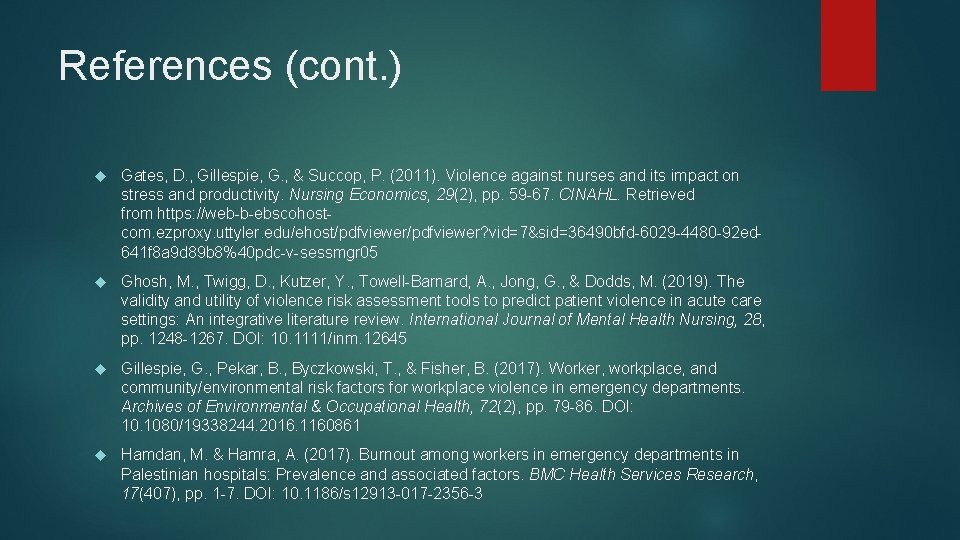
References (cont. ) Gates, D. , Gillespie, G. , & Succop, P. (2011). Violence against nurses and its impact on stress and productivity. Nursing Economics, 29(2), pp. 59 -67. CINAHL. Retrieved from https: //web-b-ebscohostcom. ezproxy. uttyler. edu/ehost/pdfviewer? vid=7&sid=36490 bfd-6029 -4480 -92 ed 641 f 8 a 9 d 89 b 8%40 pdc-v-sessmgr 05 Ghosh, M. , Twigg, D. , Kutzer, Y. , Towell-Barnard, A. , Jong, G. , & Dodds, M. (2019). The validity and utility of violence risk assessment tools to predict patient violence in acute care settings: An integrative literature review. International Journal of Mental Health Nursing, 28, pp. 1248 -1267. DOI: 10. 1111/inm. 12645 Gillespie, G. , Pekar, B. , Byczkowski, T. , & Fisher, B. (2017). Worker, workplace, and community/environmental risk factors for workplace violence in emergency departments. Archives of Environmental & Occupational Health, 72(2), pp. 79 -86. DOI: 10. 1080/19338244. 2016. 1160861 Hamdan, M. & Hamra, A. (2017). Burnout among workers in emergency departments in Palestinian hospitals: Prevalence and associated factors. BMC Health Services Research, 17(407), pp. 1 -7. DOI: 10. 1186/s 12913 -017 -2356 -3
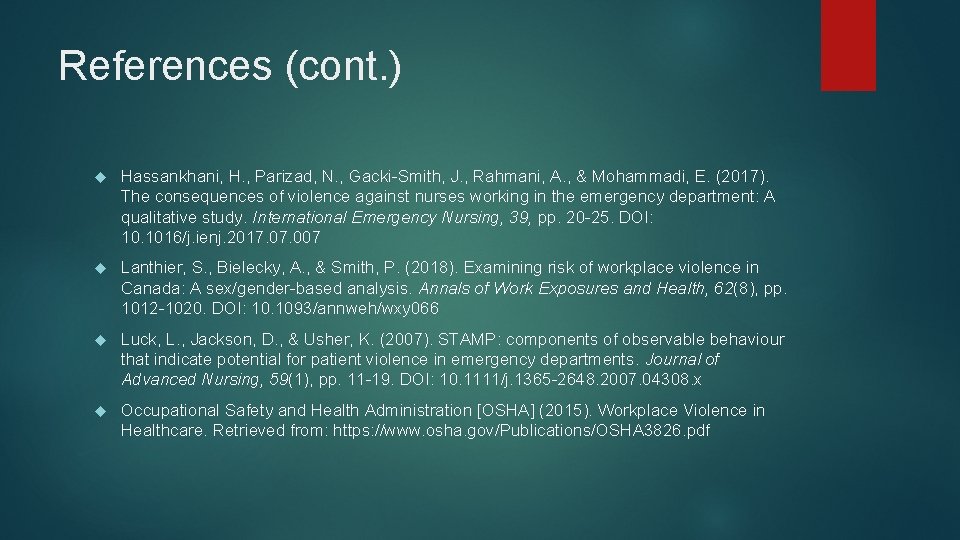
References (cont. ) Hassankhani, H. , Parizad, N. , Gacki-Smith, J. , Rahmani, A. , & Mohammadi, E. (2017). The consequences of violence against nurses working in the emergency department: A qualitative study. International Emergency Nursing, 39, pp. 20 -25. DOI: 10. 1016/j. ienj. 2017. 007 Lanthier, S. , Bielecky, A. , & Smith, P. (2018). Examining risk of workplace violence in Canada: A sex/gender-based analysis. Annals of Work Exposures and Health, 62(8), pp. 1012 -1020. DOI: 10. 1093/annweh/wxy 066 Luck, L. , Jackson, D. , & Usher, K. (2007). STAMP: components of observable behaviour that indicate potential for patient violence in emergency departments. Journal of Advanced Nursing, 59(1), pp. 11 -19. DOI: 10. 1111/j. 1365 -2648. 2007. 04308. x Occupational Safety and Health Administration [OSHA] (2015). Workplace Violence in Healthcare. Retrieved from: https: //www. osha. gov/Publications/OSHA 3826. pdf
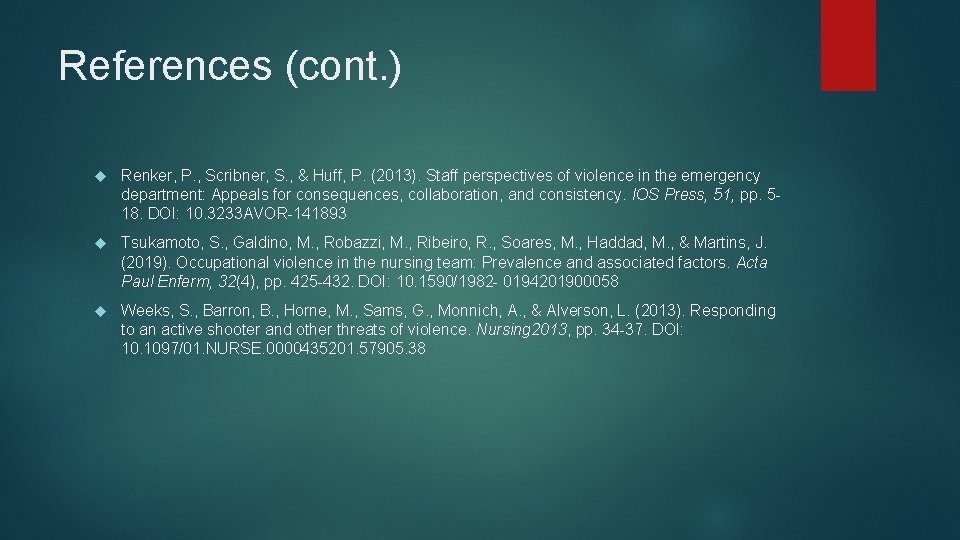
References (cont. ) Renker, P. , Scribner, S. , & Huff, P. (2013). Staff perspectives of violence in the emergency department: Appeals for consequences, collaboration, and consistency. IOS Press, 51, pp. 518. DOI: 10. 3233 AVOR-141893 Tsukamoto, S. , Galdino, M. , Robazzi, M. , Ribeiro, R. , Soares, M. , Haddad, M. , & Martins, J. (2019). Occupational violence in the nursing team: Prevalence and associated factors. Acta Paul Enferm, 32(4), pp. 425 -432. DOI: 10. 1590/1982 - 0194201900058 Weeks, S. , Barron, B. , Horne, M. , Sams, G. , Monnich, A. , & Alverson, L. (2013). Responding to an active shooter and other threats of violence. Nursing 2013, pp. 34 -37. DOI: 10. 1097/01. NURSE. 0000435201. 57905. 38