
Workplace Violence What To Know What To Do

- Slides: 59
Workplace Violence: What To Know What To Do Hawai’I Employers’ Mutual Insurance Company, Inc.
What Is Workplace Violence? • Workplace violence • Any act of physical violence – overt aggression – Homicide, physical and sexual assault • Workplace aggression – emotional toll – Expressions of hostility • Gestures, facial expressions and verbal assaults – Threats of physical violence – Harassment, intimidation, bullying • Ostracism/shunning – Obstructionism • Passive/aggressive behaviors that impede job performance or achievement of organizational objectives Source: Joel Neuman, Journal of Management, May/June, 1998
Workplace Violence Can… • Be inflicted by a stranger with criminal intent, or • Be inflicted by an abusive – Employee, supervisor or manager – Client, patient or customer – Former employee, manager or supervisor – Family member or significant other
Workplace Violence Can… • Affect or involve – Employees – Visitors, customers, patients or clients – contractors
Why the Increase in Workplace Violence? • Increase in societal tolerance of violence – Acceptance of violence as a form of communication • Increased accessibility to weapons • Less control over work environment • Lack of careers, commitment and loyalty – Job vs. career • Downsizing, Reengineering – Do more with less – Loss of middle management
Why the Increase in Workplace Violence? (con’t) • Substance abuse • Psychological factors – Increasing stress – Breakdown of support systems • Nuclear families • Extended families • Sense of neighborhood/community • Change – The increasing pace of change – Ability to cope with pace of organizational change
Why the Increase in Workplace Violence? (con’t) • Insatiable electronic media demands – 24/7 TV news – The Internet • Government and government workers easy targets for angry citizens – Changes in government benefits and services – Entitlement philosophy
How Big Is The Problem? • Source of the statistics needs to be kept in mind • Two general sources of data – Crime statistics – Occupational injury statistics • OSHA • Bureau of Labor Statistics Annual Survey • National Traumatic Occupational Fatalities Surveillance System - NIOSH
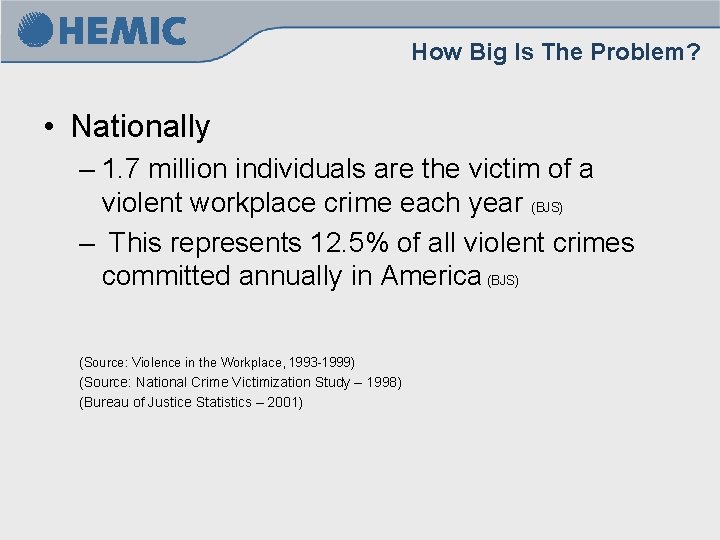
How Big Is The Problem? • Nationally – 1. 7 million individuals are the victim of a violent workplace crime each year (BJS) – This represents 12. 5% of all violent crimes committed annually in America (BJS) (Source: Violence in the Workplace, 1993 -1999) (Source: National Crime Victimization Study – 1998) (Bureau of Justice Statistics – 2001)
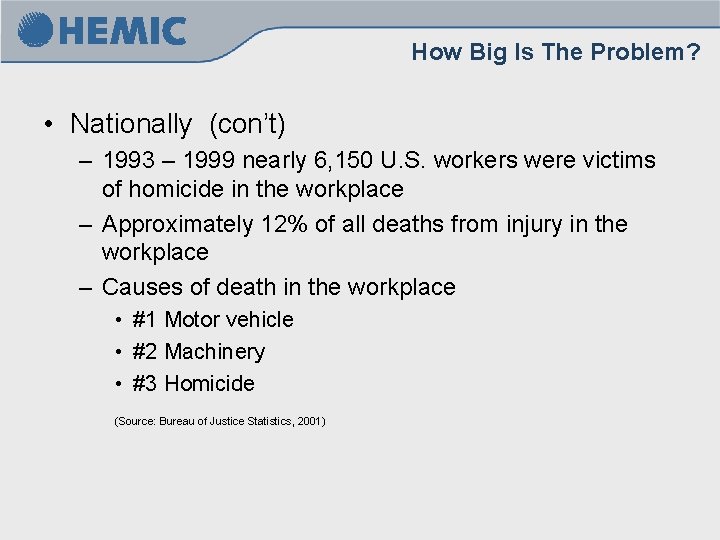
How Big Is The Problem? • Nationally (con’t) – 1993 – 1999 nearly 6, 150 U. S. workers were victims of homicide in the workplace – Approximately 12% of all deaths from injury in the workplace – Causes of death in the workplace • #1 Motor vehicle • #2 Machinery • #3 Homicide (Source: Bureau of Justice Statistics, 2001)
How Big Is The Problem? • Nationally (con’t) • Overall workplace homicide has remained the third most frequent cause of fatalities in the workplace
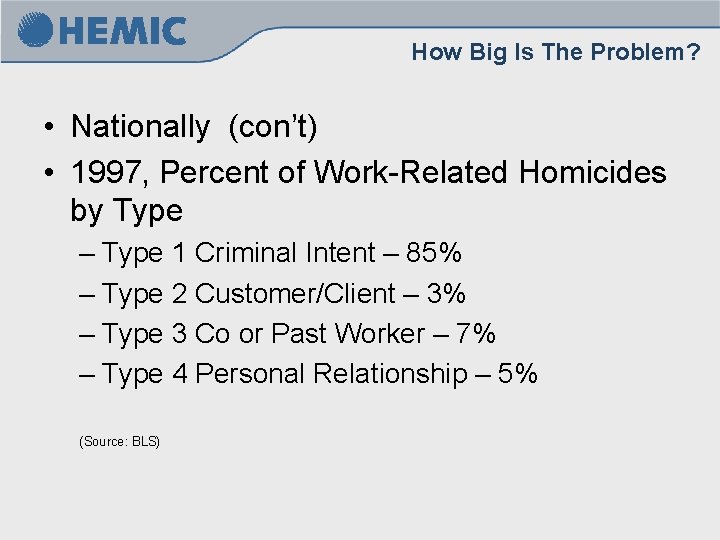
How Big Is The Problem? • Nationally (con’t) • 1997, Percent of Work-Related Homicides by Type – Type 1 Criminal Intent – 85% – Type 2 Customer/Client – 3% – Type 3 Co or Past Worker – 7% – Type 4 Personal Relationship – 5% (Source: BLS)
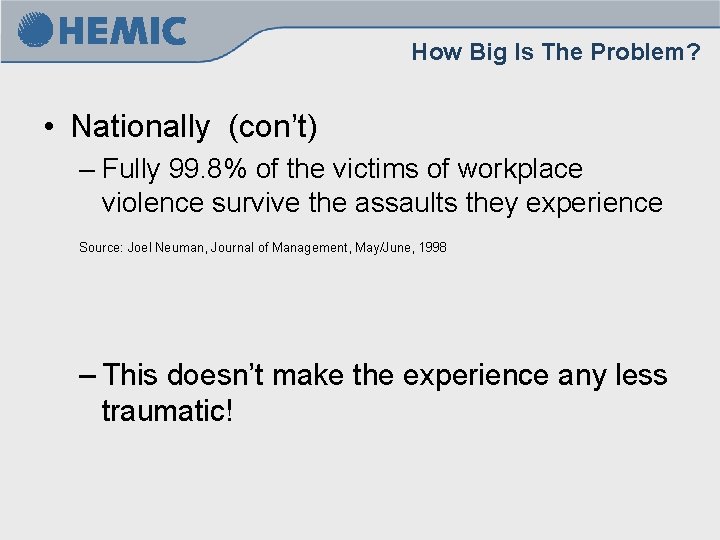
How Big Is The Problem? • Nationally (con’t) – Fully 99. 8% of the victims of workplace violence survive the assaults they experience Source: Joel Neuman, Journal of Management, May/June, 1998 – This doesn’t make the experience any less traumatic!
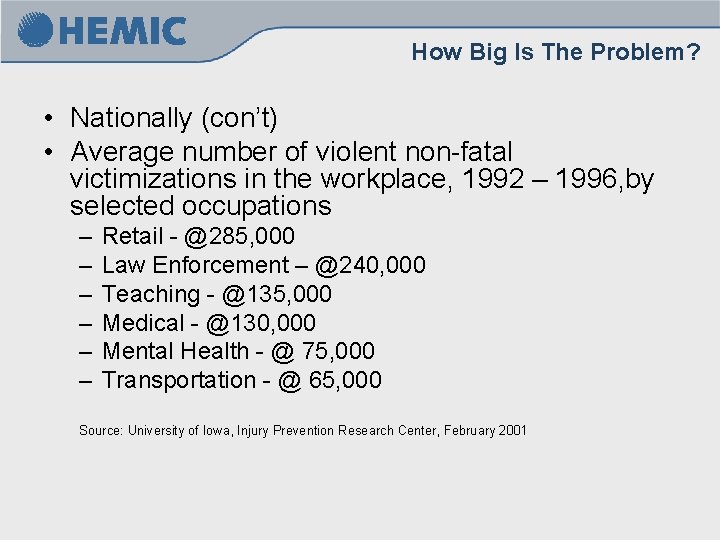
How Big Is The Problem? • Nationally (con’t) • Average number of violent non-fatal victimizations in the workplace, 1992 – 1996, by selected occupations – – – Retail - @285, 000 Law Enforcement – @240, 000 Teaching - @135, 000 Medical - @130, 000 Mental Health - @ 75, 000 Transportation - @ 65, 000 Source: University of Iowa, Injury Prevention Research Center, February 2001
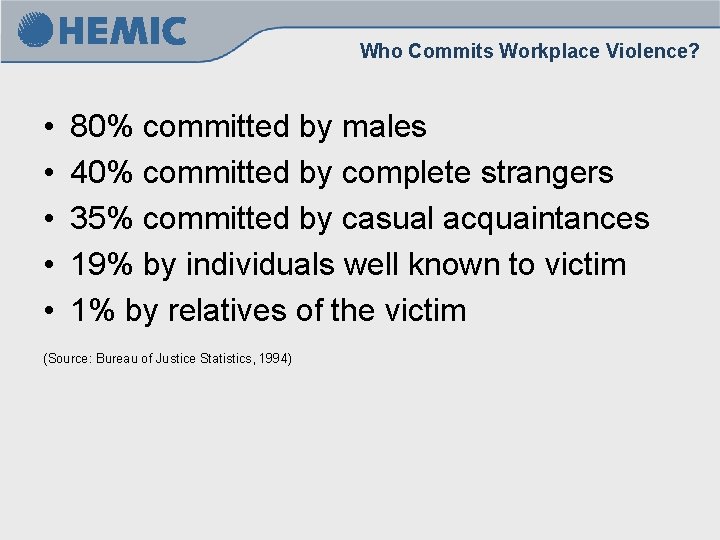
Who Commits Workplace Violence? • • • 80% committed by males 40% committed by complete strangers 35% committed by casual acquaintances 19% by individuals well known to victim 1% by relatives of the victim (Source: Bureau of Justice Statistics, 1994)
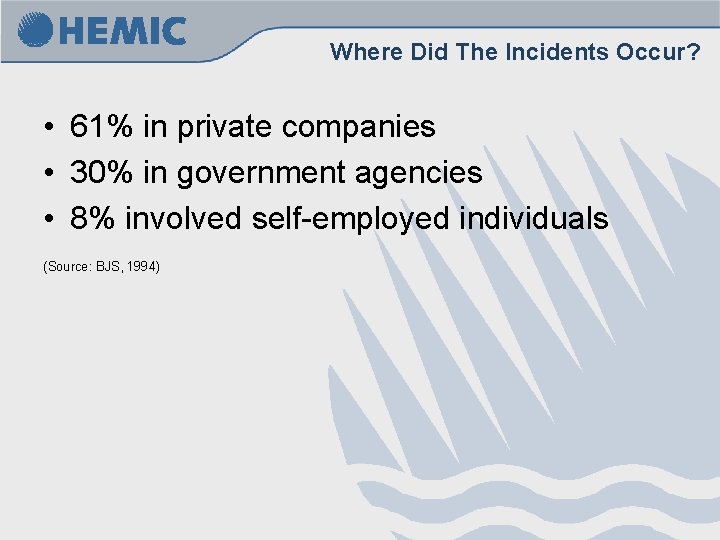
Where Did The Incidents Occur? • 61% in private companies • 30% in government agencies • 8% involved self-employed individuals (Source: BJS, 1994)
What Does Workplace Violence Cost? • The Economics of Workplace Violence – Three most affected areas are: • Costly litigation – – Negligent hiring Negligent retention Negligent supervision Inadequate security • Lost productivity – > 80% for 2 weeks post incident » CISD, investigations, PTSD » Increased turnover » Decreased morale
What Does Workplace Violence Cost? • The Economics of Workplace Violence (Continued) – Damage Control • Tangible – Customer buying decisions • Intangible – Media exposure – Community relations – Corporate image (Source: Workplace Violence Research Institute)
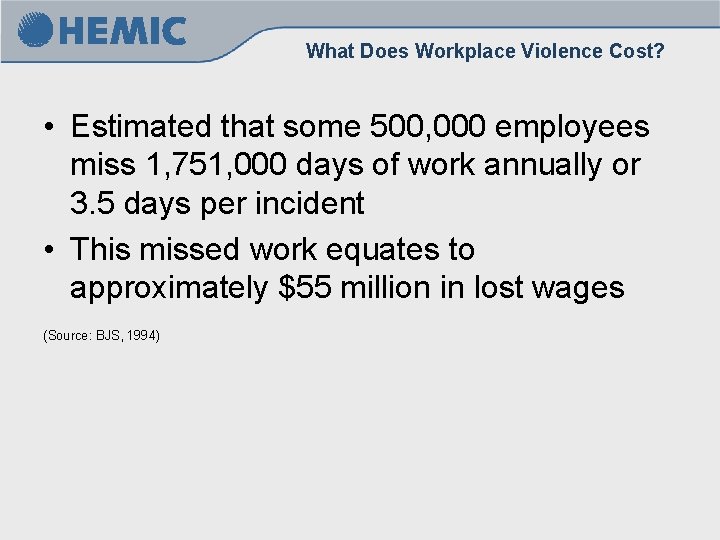
What Does Workplace Violence Cost? • Estimated that some 500, 000 employees miss 1, 751, 000 days of work annually or 3. 5 days per incident • This missed work equates to approximately $55 million in lost wages (Source: BJS, 1994)
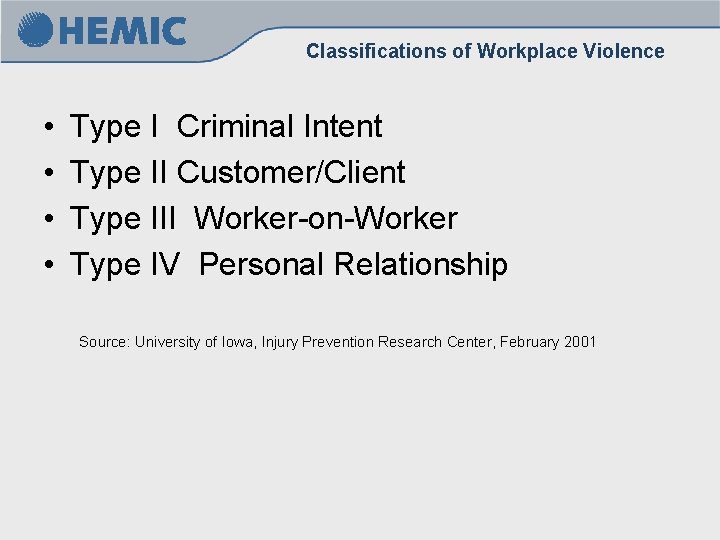
Classifications of Workplace Violence • • Type I Criminal Intent Type II Customer/Client Type III Worker-on-Worker Type IV Personal Relationship Source: University of Iowa, Injury Prevention Research Center, February 2001
Classifications of Workplace Violence • Type I – Criminal Intent – Perpetrator has no legitimate relationship to the organization or its employees – A crime is usually being committed in conjunction with the violence • Robbery, shoplifting, criminal trespassing
Classifications of Workplace Violence (con’t) • Type II – Customer/Client – The perpetrator has a legitimate relationship with the organization – The recipient or object of services provided by the affected workplace or victim – This category includes customers, clients, patients, students, inmates, etc.
Classifications of Workplace Violence (con’t) • Type III – Worker-on-Worker – The perpetrator is an employee or past employee of the organization who attacks or threatens fellow past or present employees – May be seeking revenge for what is perceived as unfair treatment – Includes employees, supervisors and managers
Classifications of Workplace Violence (con’t) • Type IV – Personal Relationship – The perpetrator usually does not have a legitimate relationship with the organization, but has or has had a personal relationship with the intended victim – May involve a current or former spouse, lover, relative, friend, or acquaintance – Domestic violence carried out at the workplace – The perpetrator is motivated by perceived difficulties in the relationship or by psychosocial factors that are specific to the perpetrator
What Are Possible Risk Factors? • • • Exchange of money with the public Working alone or in small numbers Working late night or early morning Working in high crime areas Guarding valuable property or possessions Working in community settings – (e. g. taxicab drivers, retail clerks, police)
What Are Possible Risk Factors? (con’t) • Where alcohol/drugs sold or dispensed • Exposure to unstable or volatile persons? (e. g. health care, social services, criminal justice settings) • Employees deciding on benefits, or in some way controlling a person’s future, well-being or freedom? (Such as a government agency does) (Source: NIOSH)
Conditions Allowing Workplace Violence • Individual Characteristics • Precipitating Events or Conditions • System Characteristics Source: Workplace Solutions, 1997
Conditions Allowing Workplace Violence (con’t) • Individual Characteristics – Paranoid personality and thinking – Drug and/or alcohol problem – Life stressor – divorce/separation, illness, helplessness, loss or control, isolation
Conditions Allowing Workplace Violence (con’t) • Precipitating events or conditions – Termination – Job changes – Harassment by co-workers or supervisors
Conditions Allowing Workplace Violence (con’t) • System Characteristics – Not recognizing or ignoring early warning signs – Indifference to the needs of employees – Poor management of downsizings, terminations and accidents – Punishing or terminating impaired or deviant employees – Poor or non-existent communication between labor and management
Conditions Allowing Workplace Violence (con’t) • System Characteristics (con’t) – Information that could signal problems is not shared – Lack of commitment and involvement by top management
Indicators of Potential Workplace Violence • Intimidating, harassing, bullying, belligerent or other inappropriate and aggressive behavior • Numerous conflicts with customers, coworkers or supervisors • Bringing a weapon to the workplace (unless job related) • Making inappropriate references to guns
Indicators of Potential Workplace Violence (con’t) • Making threats or idle threats about using a weapon to harm someone • Making statements showing a fascination with incidents of workplace violence • Making statements indicating approval of the use of violence to resolve a problem
Indicators of Potential Workplace Violence (con’t) • Making statements indicating the identification with perpetrators of workplace homicides • Statements indicating desperation over family, financial or other types of personal problems • Statements about contemplating suicide
Indicators of Potential Workplace Violence (con’t) • Direct or veiled threats of harm • Substance abuse • Extreme changes in normal behavior Source: U. S. Department of Agriculture, 1998
Profile of the Most Likely Type III Perpetrator • • • A male, aged 25 to 40 years Has a history of violence Tends to be a loner Owns several weapons Has requested some form of assistance in the past • Exhibits frequent anger • Has a history of conflict with others
Profile of the Most Likely Type III Perpetrator (con’t) • Has a history of family or marital problems • After periods of verbalizing anger, will become withdrawn • Is paranoid • Exhibits self-destructive behavior such as alcohol and/or drug use Remember, don’t take profile too literally Source: www. svn. net/mikekell/v 3. html
Behavior Warning Signs of Potential Violence and Their Probability of Occurrence • • Male (80% or better) White (75% or better) Working age (90% or better) Will display one or more of the following behaviors (90% or better) – A history of violence – Evidence of psychosis – Evidence of abnormally strong sexual desire (erotomania)
Behavior Warning Signs of Potential Violence and Their Probability of Occurrence (con’t) – Evidence of drug and/or alcohol dependence – Evidence of depression and withdrawal – A pattern of pathological blaming – Evidence of impaired neurological functioning – An elevated frustration level – An interest/fascination in weapons – Evidence of a personality disorder
Behavior Warning Signs of Potential Violence and Their Probability of Occurrence (con’t) – Unexplained increase in absenteeism – Noticeable decrease in attention to appearance and personal hygiene – Has a plan to “solve all problems” – Resistance and over reaction to changes in policies or procedures – repeated violations of the organization’s policies
Behavior Warning Signs of Potential Violence and Their Probability of Occurrence (con’t) • The following behaviors are commonly exhibited, but have an uncertain probability: – Will vocalize or otherwise act out, violent intentions prior to committing a violent act – Over a sustained period of time, will exhibit behaviors that are interpreted as insignificant, strange, bizarre or threatening by coworkers and supervisors Remember: These are general guidelines. Exceptions will always occur Source: Workplace Violence Research Institute
Preventing Workplace Violence • Three general approaches to prevention – Environmental – Administrative/Organizational – Behavioral/Interpersonal Source: University of Iowa, Injury Prevention Research Center, February 2001
Preventing Workplace Violence (con’t) • Environmental – Adequate inside and outside lighting – Secure entrances and exits – Security hardware • • Turnstiles Key cards Smart cards Biometric systems – Physical barriers
Preventing Workplace Violence (con’t) • Environmental (con’t) – Metal and Explosives Detectors – Security Forces • Uniformed vs. Business Attire • Armed vs. unarmed – Specialized customer/client meeting rooms – Other engineering controls
Preventing Workplace Violence (con’t) • Administrative/Organizational – Programs • Workplace Violence Plan • Threat Assessment Team • EAP – Policies • Harassment • Workplace violence • SOPs
Preventing Workplace Violence (con’t) • Administrative/Organizational (con’t) – Hiring and Termination Practices • Hiring – Corroborate information on applications/resumes (42% contain intentional misstatements of material facts) – Interview – Use of open-ended questions » Looking for a pattern of aggressive behavior – Conduct background investigation • Firing – Consider the possibility of violent response – Plan out – script out the procedure
Preventing Workplace Violence (con’t) • Administrative/Organizational (con’t) – Work Practice Controls - Work practices aimed at maintaining a safe working environment – Written procedures and guidelines
Preventing Workplace Violence (con’t) • Behavioral/Interpersonal – Changing employee attitudes toward security – It won’t happen to me – Staff training – Train staff to anticipate, recognize and respond to conflict and potential violence in the workplace • • • Personal security techniques Non-violent crisis intervention techniques De-escalation techniques Communication techniques How to report violent, inappropriate, disruptive or threatening behavior
Preventing Workplace Violence (con’t) – Supervisor/manager training – in addition to the staff level training, supervisors and managers should receive training in: • Creating a positive work culture/climate that supports employees • Developing skills for displaying compassion, concern and support for employees – employee trust is critical • How to best utilize the EAP
Preventing Workplace Violence (con’t) • Supervisor/manager training (con’t) – Performance management – Administering progressive discipline – Contract management/grievance handling – Employee counseling/coaching
Special Considerations For Managers/Supervisors • What are the workplace violence risks at the worksites you run? • Indicators that employees need immediate intervention – Excessive tardiness or absences – An increased need for supervisory attention or supervision – Reduced productivity – Inconsistent work habits – Strained workplace relationships
Special Considerations For Managers/Supervisors (con’t) – Inability to concentrate – Violation of safety procedures • New, sudden involvement in accidents or violations – – Changes in health or hygiene Unusual or sudden behavioral change Fascination with weapons Alcohol and/or drug abuse
Special Considerations For Managers/Supervisors (con’t) – Stress – Excuses and Blaming – Depression
Responding to Workplace Violence • • • Facility Emergency Action Plan Threat Assessment Team Emergency Response Team CISD (Critical Incident Stress Debriefings) EAP Media Contact • Organizational Recovery/Continued Operation Plan
Special Issues for Field Employees • Need to develop specific safety guidelines to employee’s specific situation and the problems they are likely to encounter • Preparation of daily work plans/itinerary (e. g. flight plan) • Maintaining periodic contact throughout the day
• Case Studies What Happen Who Was Involved Where It Happened When It Happened Why It Happened How It Happened
Special Issues for Field Employees (con’t) • Use of a buddy system • Need to recognize potentially dangerous situations ahead of time, so back-up can be secured/started or a strategy implemented so the employee does not go in alone Source: U. S. Department of Agriculture, 1998
Weapons Used • WORKPLACE HOMICIDES, 1990 -1989 – Guns – 75% – Knives etc. – 14% (Source, NIOSH, 1993) • In 62% of the violent crimes the perpetrator was not armed; in 30% of the violent crimes the perpetrator was armed with a handgun (Source: BJS, 1994)