WORKING CAPITAL CAPLINE PROGRAM 7 A LOAN GUARANTY


- Slides: 48
WORKING CAPITAL CAPLINE PROGRAM 7 A LOAN GUARANTY PROGRAM Flexible financing for your small business customers Quality Circle Workshop February 15, 2018 Presenter - Bill Reed 1
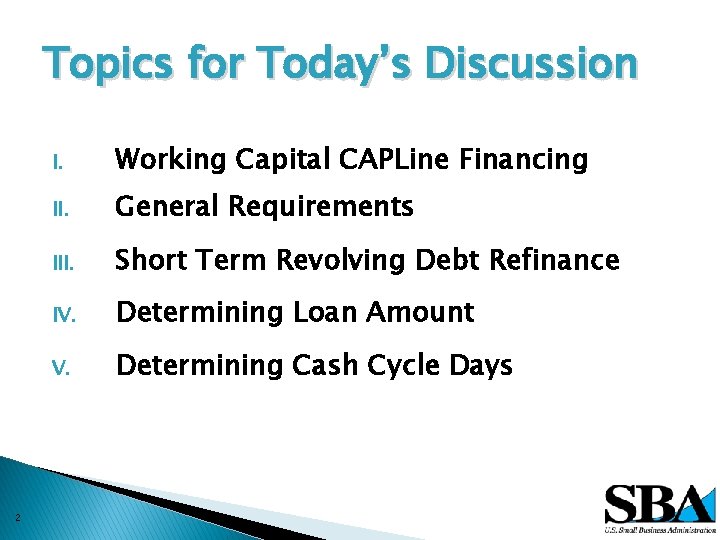
Topics for Today’s Discussion 2 I. Working Capital CAPLine Financing II. General Requirements III. Short Term Revolving Debt Refinance IV. Determining Loan Amount V. Determining Cash Cycle Days
Topics for Today’s Discussion 3 VI. Collateral Requirements VII. Determining Disbursement Amount VIII. Principal & Interest Payments IX. Level of Funds Control and Monitoring X. Application Process
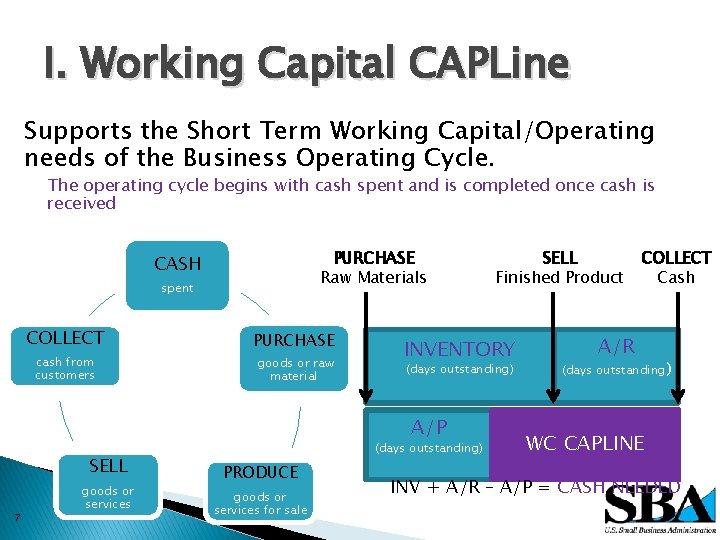
I. Working Capital CAPLine Financing A program designed to meet the Short Term Working Capital needs of a business � For those Small Businesses that Sell their Goods and/or Services on Credit � Businesses that need to replenish the inventory and raw materials they purchase to support future sales 4
I. Working Capital CAPLine Financing Working Capital CAPLine Key Features � Program With Specific Requirements for the payment of Principal to be tied to when the business receives payments from their customers � Not Like Any Express Loan where Interest Only Can be Used until Maturity 5
I. Working Capital CAPLine Financing Working Capital CAPLine Key Features � � � 6 Loan Amount Based on Need Analysis Disbursements Based on Existing Assets, Either A/R & Inv or All Collateral Repayment Tied to Cash and Accounts Receivable collections, not a Once a Month P&I Payment
I. Working Capital CAPLine Supports the Short Term Working Capital/Operating needs of the Business Operating Cycle. The operating cycle begins with cash spent and is completed once cash is received PURCHASE Raw Materials CASH spent COLLECT PURCHASE cash from customers goods or raw material INVENTORY (days outstanding) A/P SELL 7 goods or services (days outstanding) PRODUCE goods or services for sale SELL Finished Product COLLECT Cash A/R (days outstanding) WC CAPLINE INV + A/R – A/P = CASH NEEDED
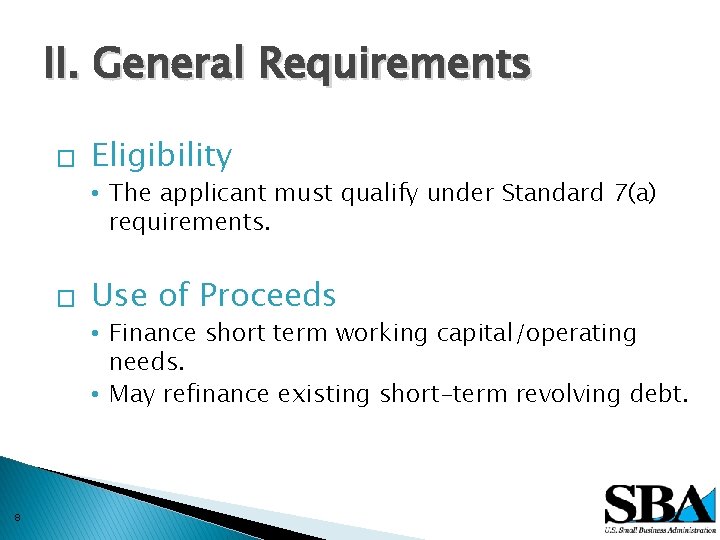
II. General Requirements � Eligibility • The applicant must qualify under Standard 7(a) requirements. � Use of Proceeds • Finance short term working capital/operating needs. • May refinance existing short-term revolving debt. 8
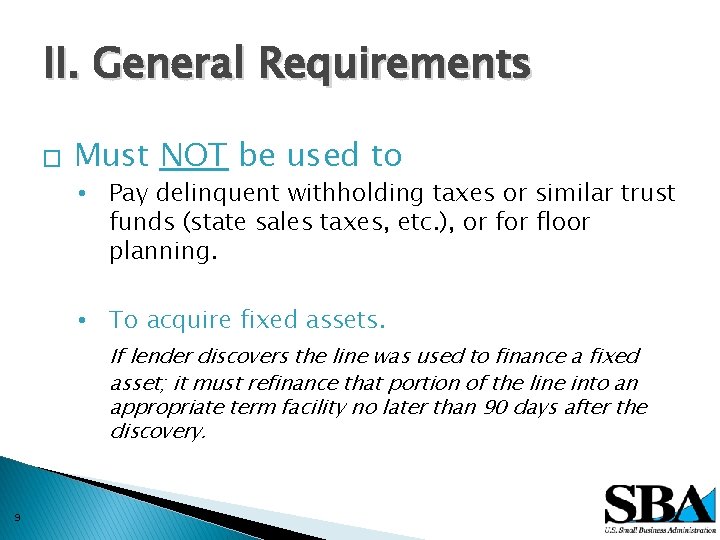
II. General Requirements � Must NOT be used to • Pay delinquent withholding taxes or similar trust funds (state sales taxes, etc. ), or floor planning. • To acquire fixed assets. If lender discovers the line was used to finance a fixed asset; it must refinance that portion of the line into an appropriate term facility no later than 90 days after the discovery. 9
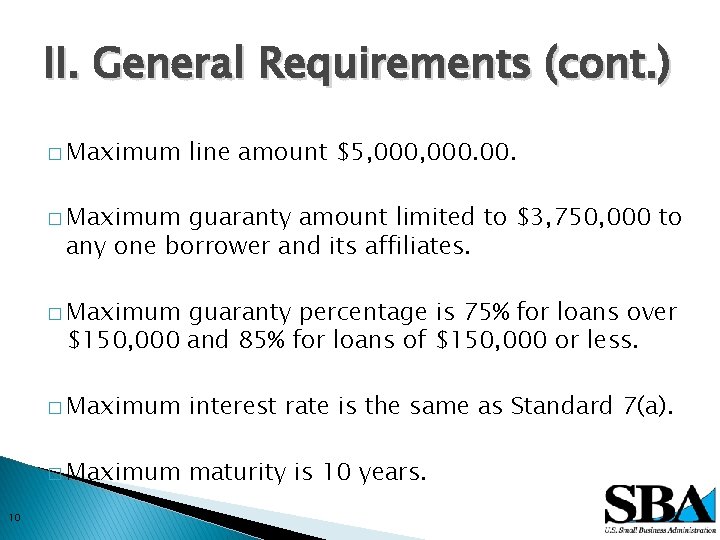
II. General Requirements (cont. ) � Maximum line amount $5, 000. 00. � Maximum guaranty amount limited to $3, 750, 000 to any one borrower and its affiliates. � Maximum guaranty percentage is 75% for loans over $150, 000 and 85% for loans of $150, 000 or less. 10 � Maximum interest rate is the same as Standard 7(a). � Maximum maturity is 10 years.
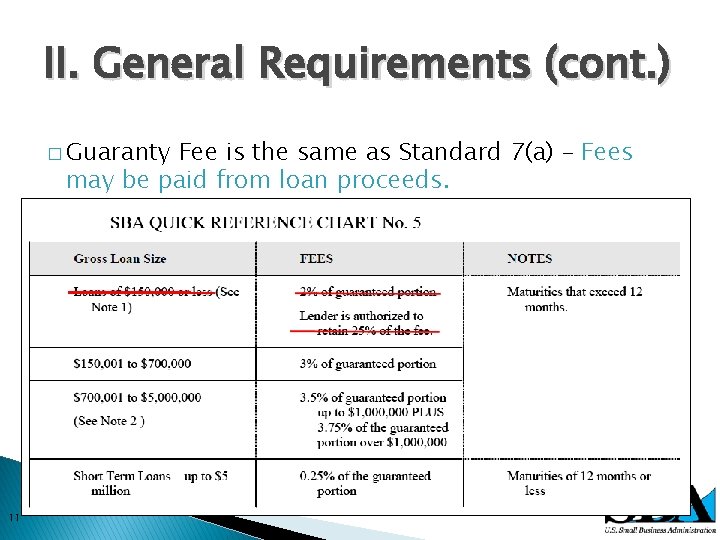
II. General Requirements (cont. ) � Guaranty Fee is the same as Standard 7(a) – Fees may be paid from loan proceeds. 11
II. General Requirements (cont. ) � Lender Agreements must include SBA Form 750 B (Short Term Loans) and SBA Form 750. PLP lenders must have Supplemental Guaranty Agreement for PLP. � Lender has the option of using their own note and guaranty agreements rather than SBA’s versions (SBA Forms 147, 148 and 148 L). 12
III. Short Term Revolving Debt Refinance Requirements 1. 2. 3. 4. 13 The short-term revolving debt must be terminated after it is paid off with the CAPLine. The refinancing does not put SBA in a position to sustain a loss which the existing lender is presently facing. The borrower has either a BBC or Collateral sufficient to support the Working Capital CAPLine plus any other short-term debt that is not being refinanced. The refinancing is specifically identified in the Use of Proceeds section of the Authorization.
III. Short Term Revolving Debt Refinance Requirements 14 5. If refinancing Same Institution Debt (SID) – the application must be submitted to the Loan Guaranty Processing Center (LGPC) and may not be processed under Delegated Authority. 6. If the application includes the refinancing of sameinstitution, SBA-guaranteed short-term revolving debt, in addition to the requirements of (1) through (5) above, the lender’s exposure to the applicant will not be reduced.
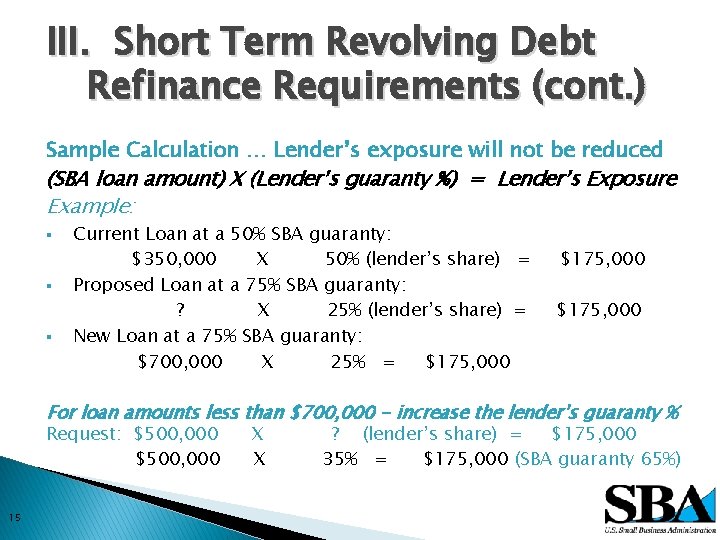
III. Short Term Revolving Debt Refinance Requirements (cont. ) Sample Calculation … Lender’s exposure will not be reduced (SBA loan amount) X (Lender’s guaranty %) = Lender’s Exposure Example: § § § Current Loan at a 50% SBA guaranty: $350, 000 X 50% (lender’s share) = Proposed Loan at a 75% SBA guaranty: ? X 25% (lender’s share) = New Loan at a 75% SBA guaranty: $700, 000 X 25% = $175, 000 For loan amounts less than $700, 000 - increase the lender’s guaranty % Request: $500, 000 15 X X ? (lender’s share) = $175, 000 35% = $175, 000 (SBA guaranty 65%)
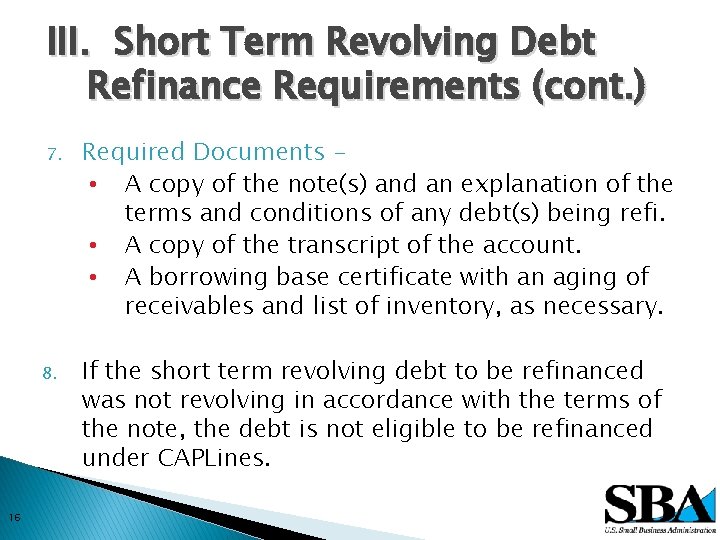
III. Short Term Revolving Debt Refinance Requirements (cont. ) 16 7. Required Documents • A copy of the note(s) and an explanation of the terms and conditions of any debt(s) being refi. • A copy of the transcript of the account. • A borrowing base certificate with an aging of receivables and list of inventory, as necessary. 8. If the short term revolving debt to be refinanced was not revolving in accordance with the terms of the note, the debt is not eligible to be refinanced under CAPLines.
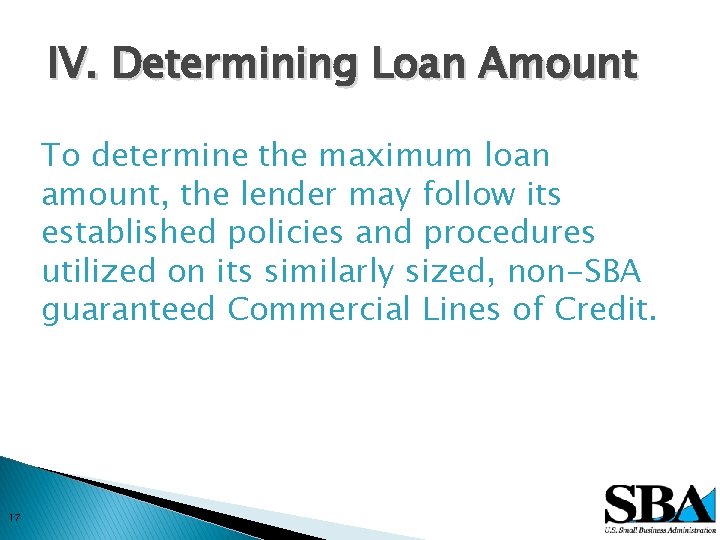
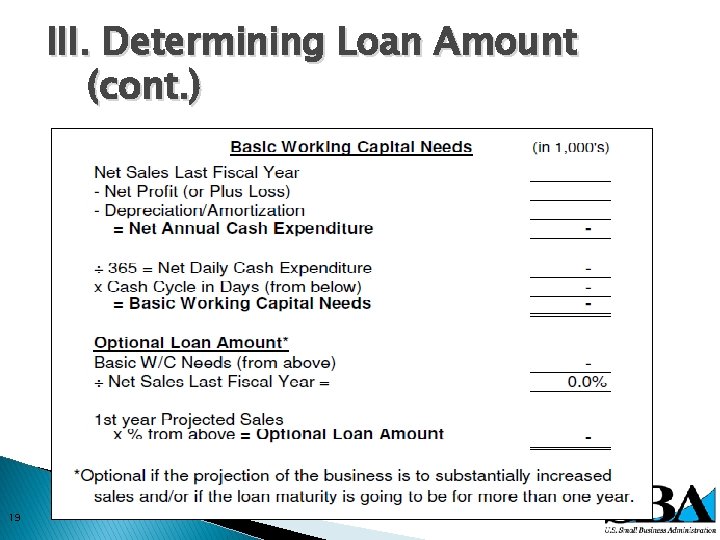
IV. Determining Loan Amount To determine the maximum loan amount, the lender may follow its established policies and procedures utilized on its similarly sized, non-SBA guaranteed Commercial Lines of Credit. 17
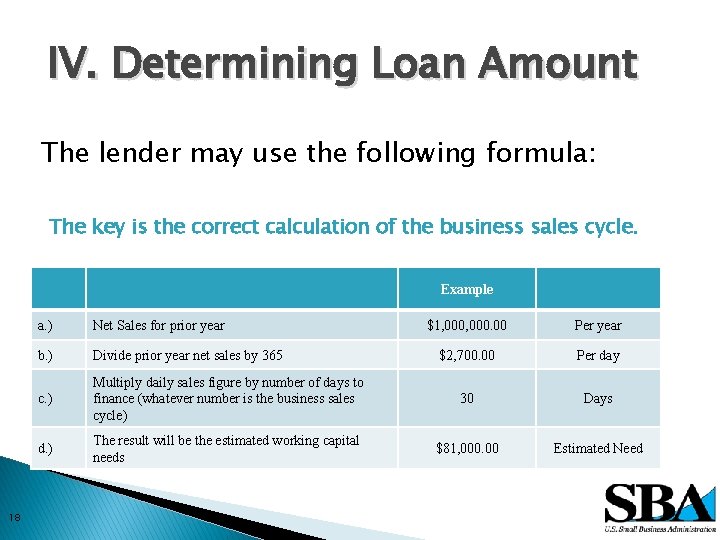
IV. Determining Loan Amount The lender may use the following formula: The key is the correct calculation of the business sales cycle. Example 18 a. ) Net Sales for prior year $1, 000. 00 Per year b. ) Divide prior year net sales by 365 $2, 700. 00 Per day c. ) Multiply daily sales figure by number of days to finance (whatever number is the business sales cycle) 30 Days d. ) The result will be the estimated working capital needs $81, 000. 00 Estimated Need
III. Determining Loan Amount (cont. ) 19
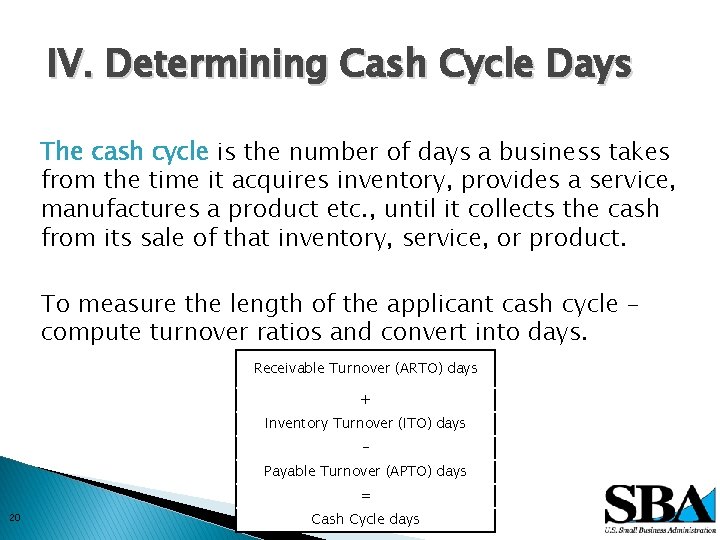
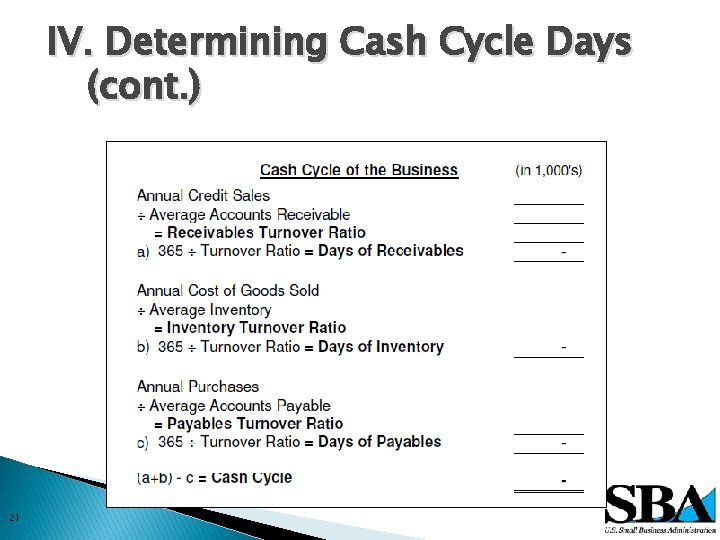
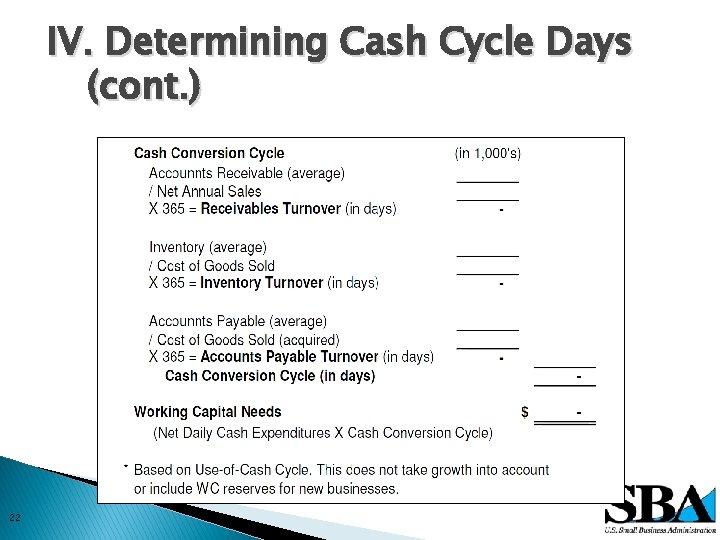
IV. Determining Cash Cycle Days The cash cycle is the number of days a business takes from the time it acquires inventory, provides a service, manufactures a product etc. , until it collects the cash from its sale of that inventory, service, or product. To measure the length of the applicant cash cycle – compute turnover ratios and convert into days. Receivable Turnover (ARTO) days + Inventory Turnover (ITO) days Payable Turnover (APTO) days = 20 Cash Cycle days
IV. Determining Cash Cycle Days (cont. ) 21
IV. Determining Cash Cycle Days (cont. ) 22
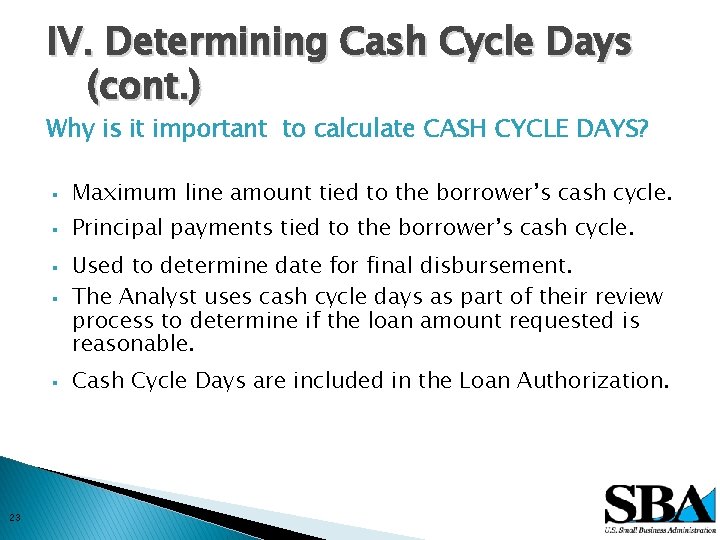
IV. Determining Cash Cycle Days (cont. ) Why is it important to calculate CASH CYCLE DAYS? § Maximum line amount tied to the borrower’s cash cycle. § Principal payments tied to the borrower’s cash cycle. § Used to determine date for final disbursement. The Analyst uses cash cycle days as part of their review process to determine if the loan amount requested is reasonable. § Cash Cycle Days are included in the Loan Authorization. § 23
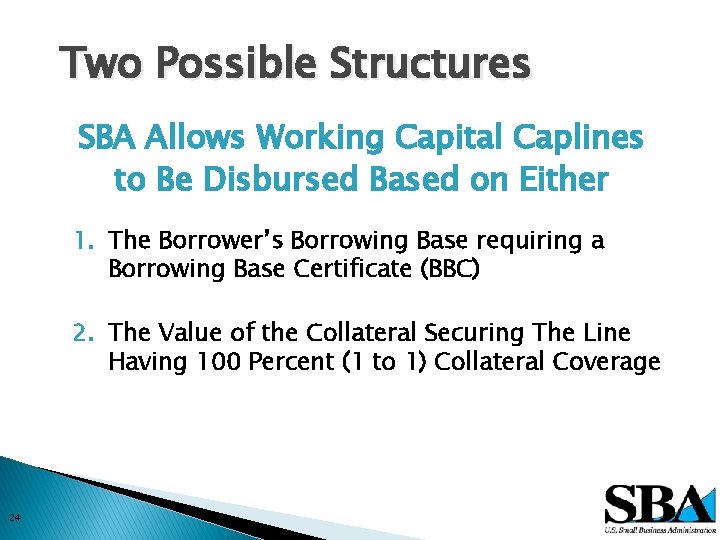
Two Possible Structures SBA Allows Working Capital Caplines to Be Disbursed Based on Either 1. The Borrower’s Borrowing Base requiring a Borrowing Base Certificate (BBC) 2. The Value of the Collateral Securing The Line Having 100 Percent (1 to 1) Collateral Coverage 24
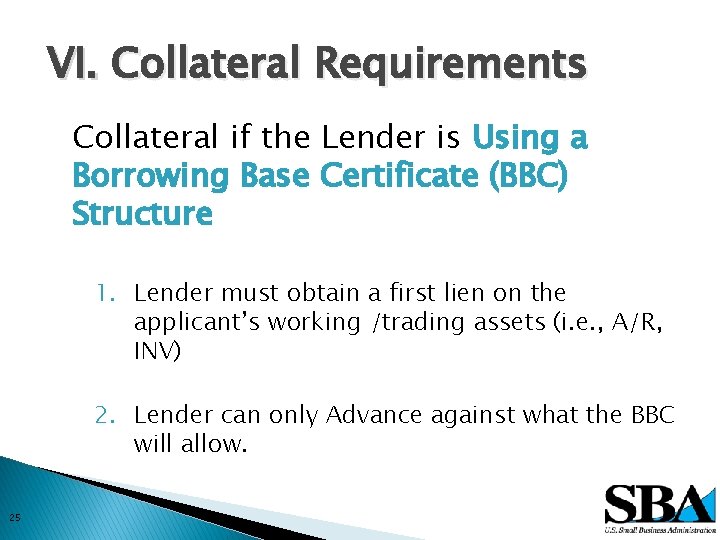
VI. Collateral Requirements Collateral if the Lender is Using a Borrowing Base Certificate (BBC) Structure 1. Lender must obtain a first lien on the applicant’s working /trading assets (i. e. , A/R, INV) 2. Lender can only Advance against what the BBC will allow. 25
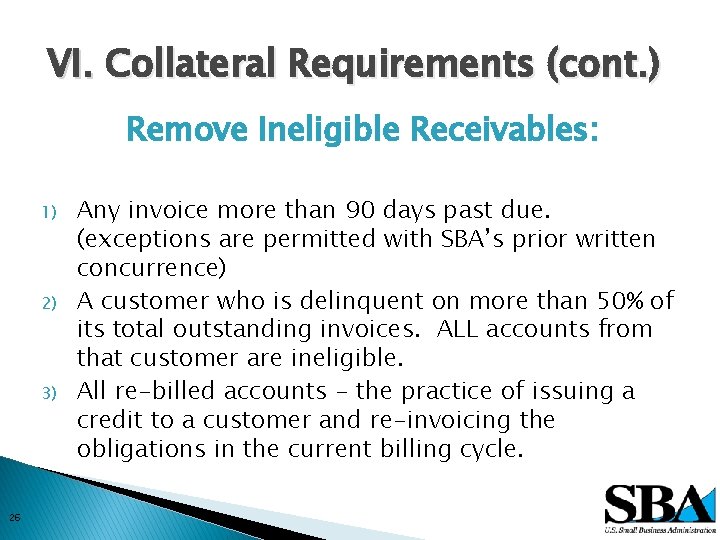
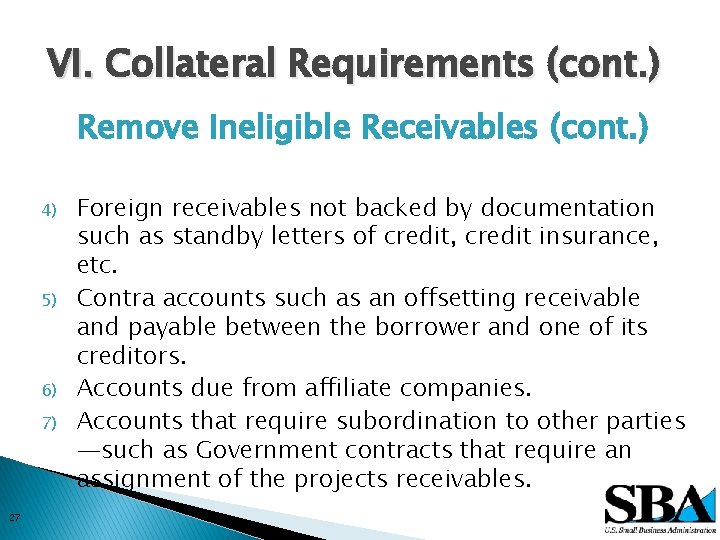
VI. Collateral Requirements (cont. ) Remove Ineligible Receivables: 1) 2) 3) 26 Any invoice more than 90 days past due. (exceptions are permitted with SBA’s prior written concurrence) A customer who is delinquent on more than 50% of its total outstanding invoices. ALL accounts from that customer are ineligible. All re-billed accounts - the practice of issuing a credit to a customer and re-invoicing the obligations in the current billing cycle.
VI. Collateral Requirements (cont. ) Remove Ineligible Receivables (cont. ) 4) 5) 6) 7) 27 Foreign receivables not backed by documentation such as standby letters of credit, credit insurance, etc. Contra accounts such as an offsetting receivable and payable between the borrower and one of its creditors. Accounts due from affiliate companies. Accounts that require subordination to other parties —such as Government contracts that require an assignment of the projects receivables.
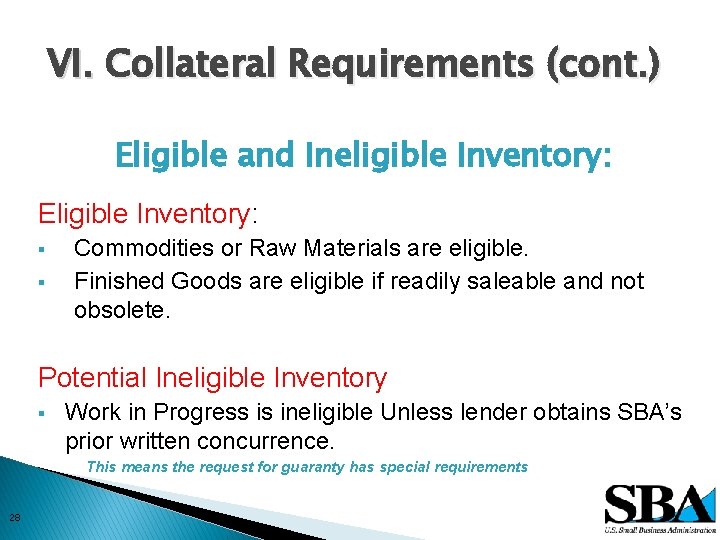
VI. Collateral Requirements (cont. ) Eligible and Ineligible Inventory: Eligible Inventory: § § Commodities or Raw Materials are eligible. Finished Goods are eligible if readily saleable and not obsolete. Potential Ineligible Inventory § Work in Progress is ineligible Unless lender obtains SBA’s prior written concurrence. This means the request for guaranty has special requirements 28
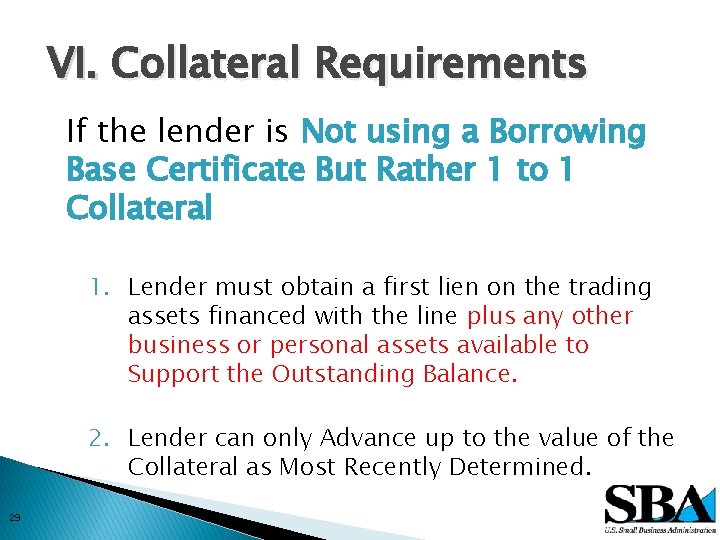
VI. Collateral Requirements If the lender is Not using a Borrowing Base Certificate But Rather 1 to 1 Collateral 1. Lender must obtain a first lien on the trading assets financed with the line plus any other business or personal assets available to Support the Outstanding Balance. 2. Lender can only Advance up to the value of the Collateral as Most Recently Determined. 29
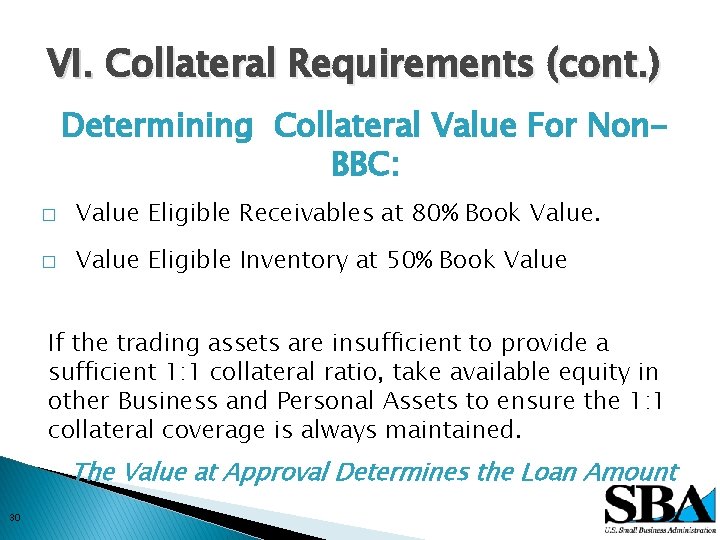
VI. Collateral Requirements (cont. ) Determining Collateral Value For Non. BBC: � Value Eligible Receivables at 80% Book Value. � Value Eligible Inventory at 50% Book Value If the trading assets are insufficient to provide a sufficient 1: 1 collateral ratio, take available equity in other Business and Personal Assets to ensure the 1: 1 collateral coverage is always maintained. The Value at Approval Determines the Loan Amount 30
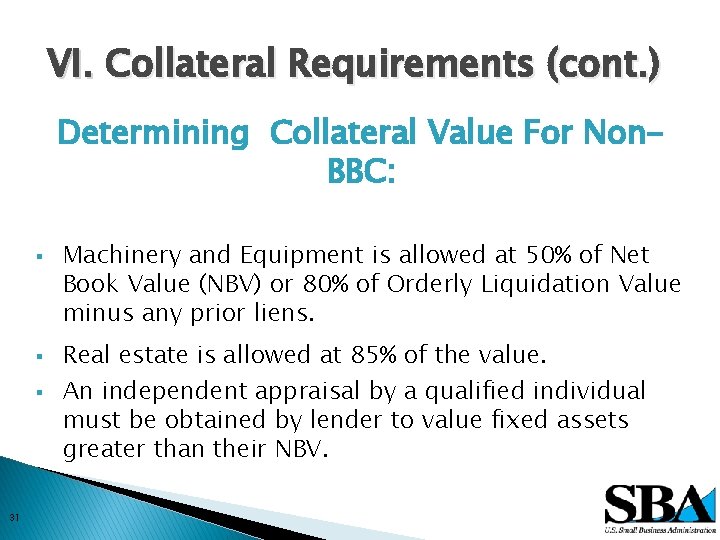
VI. Collateral Requirements (cont. ) Determining Collateral Value For Non. BBC: § § § 31 Machinery and Equipment is allowed at 50% of Net Book Value (NBV) or 80% of Orderly Liquidation Value minus any prior liens. Real estate is allowed at 85% of the value. An independent appraisal by a qualified individual must be obtained by lender to value fixed assets greater than their NBV.
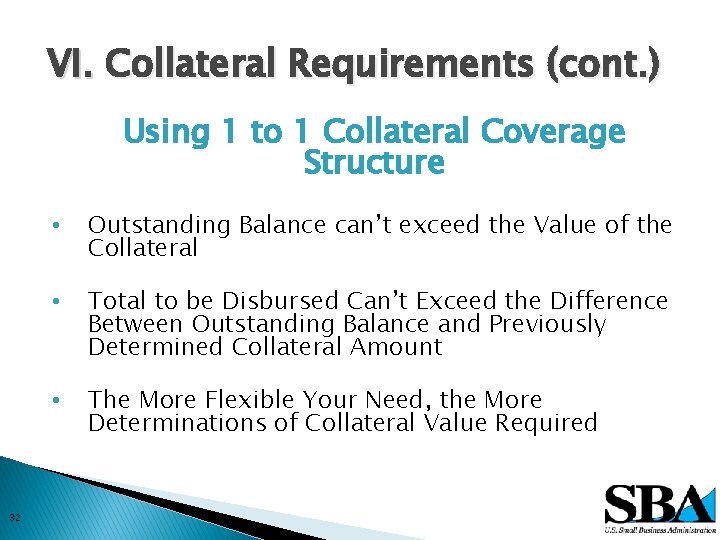
VI. Collateral Requirements (cont. ) Using 1 to 1 Collateral Coverage Structure 32 • Outstanding Balance can’t exceed the Value of the Collateral • Total to be Disbursed Can’t Exceed the Difference Between Outstanding Balance and Previously Determined Collateral Amount • The More Flexible Your Need, the More Determinations of Collateral Value Required
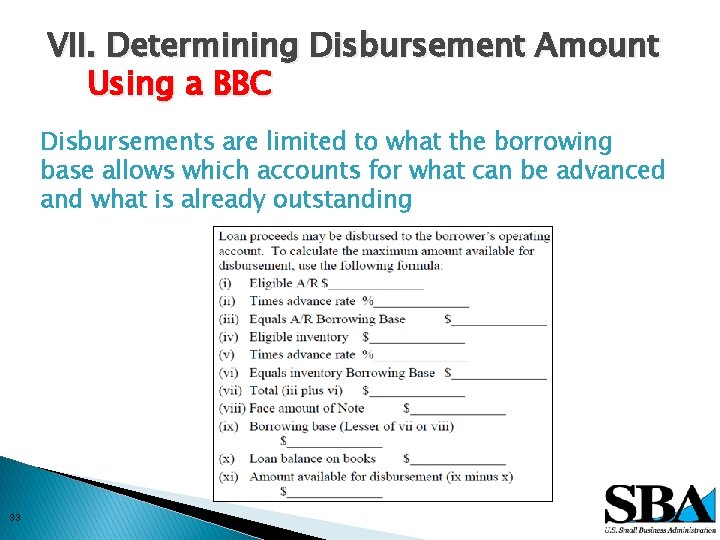
VII. Determining Disbursement Amount Using a BBC Disbursements are limited to what the borrowing base allows which accounts for what can be advanced and what is already outstanding 33
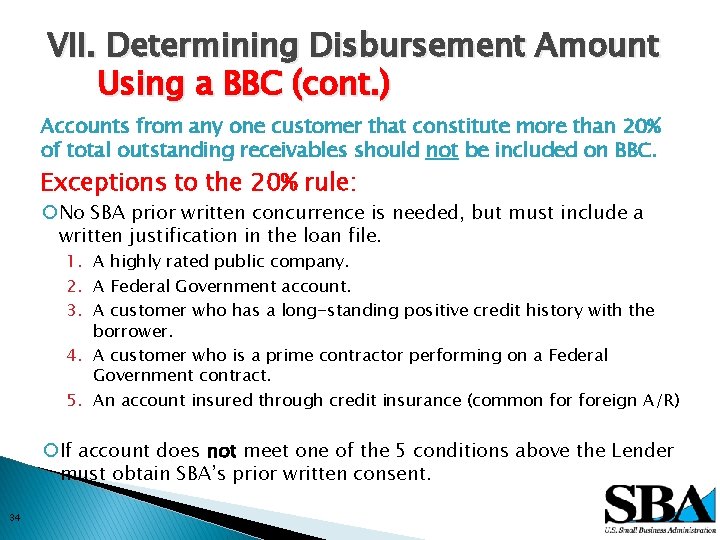
VII. Determining Disbursement Amount Using a BBC (cont. ) Accounts from any one customer that constitute more than 20% of total outstanding receivables should not be included on BBC. Exceptions to the 20% rule: No SBA prior written concurrence is needed, but must include a written justification in the loan file. 1. A highly rated public company. 2. A Federal Government account. 3. A customer who has a long-standing positive credit history with the borrower. 4. A customer who is a prime contractor performing on a Federal Government contract. 5. An account insured through credit insurance (common foreign A/R) If account does not meet one of the 5 conditions above the Lender must obtain SBA’s prior written consent. 34
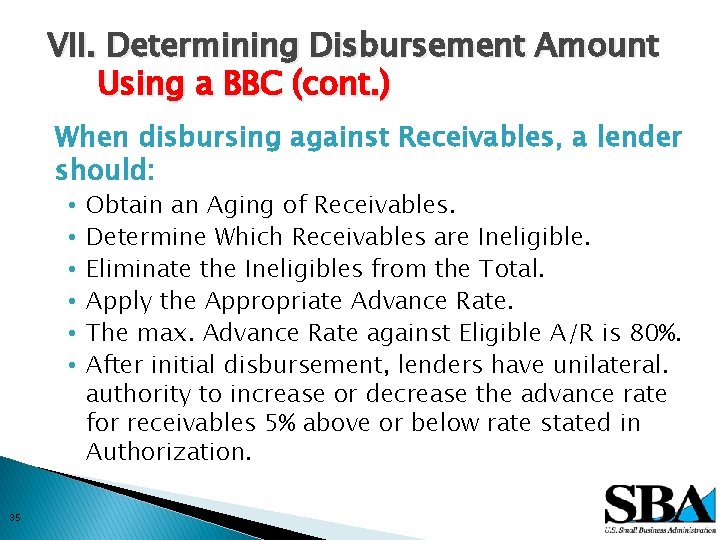
VII. Determining Disbursement Amount Using a BBC (cont. ) When disbursing against Receivables, a lender should: • • • 35 Obtain an Aging of Receivables. Determine Which Receivables are Ineligible. Eliminate the Ineligibles from the Total. Apply the Appropriate Advance Rate. The max. Advance Rate against Eligible A/R is 80%. After initial disbursement, lenders have unilateral. authority to increase or decrease the advance rate for receivables 5% above or below rate stated in Authorization.
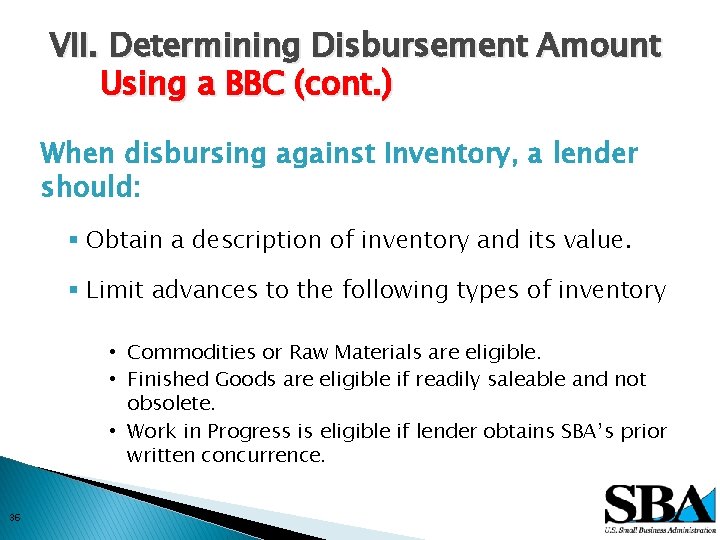
VII. Determining Disbursement Amount Using a BBC (cont. ) When disbursing against Inventory, a lender should: § Obtain a description of inventory and its value. § Limit advances to the following types of inventory • Commodities or Raw Materials are eligible. • Finished Goods are eligible if readily saleable and not obsolete. • Work in Progress is eligible if lender obtains SBA’s prior written concurrence. 36
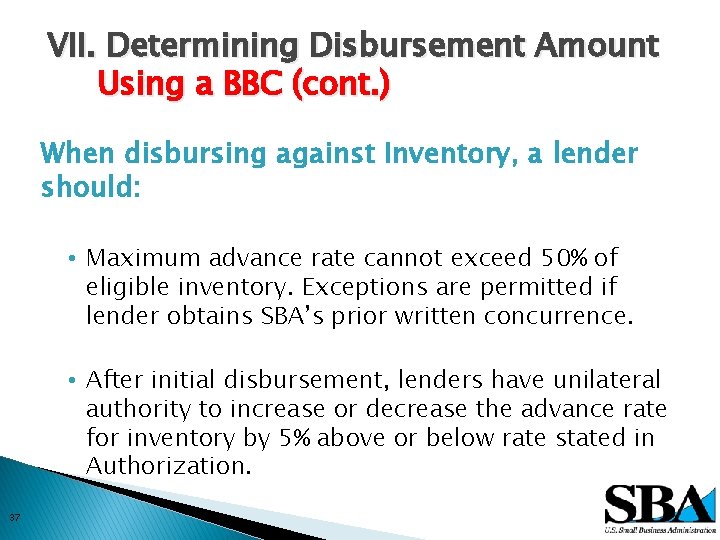
VII. Determining Disbursement Amount Using a BBC (cont. ) When disbursing against Inventory, a lender should: • Maximum advance rate cannot exceed 50% of eligible inventory. Exceptions are permitted if lender obtains SBA’s prior written concurrence. • After initial disbursement, lenders have unilateral authority to increase or decrease the advance rate for inventory by 5% above or below rate stated in Authorization. 37
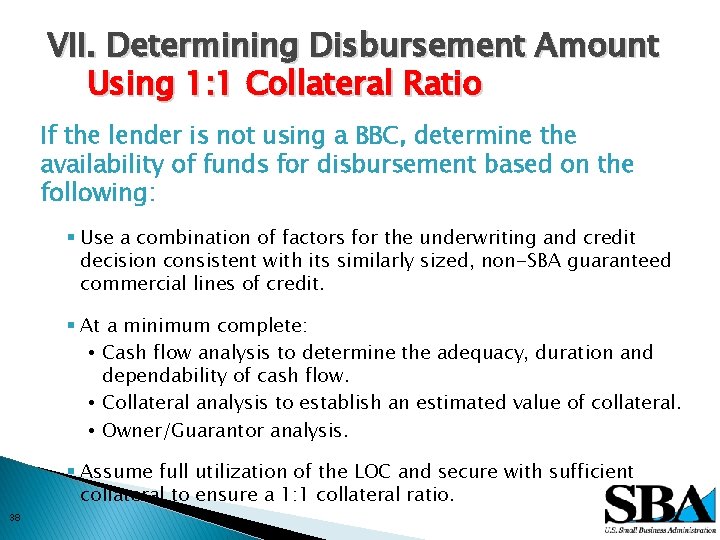
VII. Determining Disbursement Amount Using 1: 1 Collateral Ratio If the lender is not using a BBC, determine the availability of funds for disbursement based on the following: § Use a combination of factors for the underwriting and credit decision consistent with its similarly sized, non-SBA guaranteed commercial lines of credit. § At a minimum complete: • Cash flow analysis to determine the adequacy, duration and dependability of cash flow. • Collateral analysis to establish an estimated value of collateral. • Owner/Guarantor analysis. § Assume full utilization of the LOC and secure with sufficient collateral to ensure a 1: 1 collateral ratio. 38
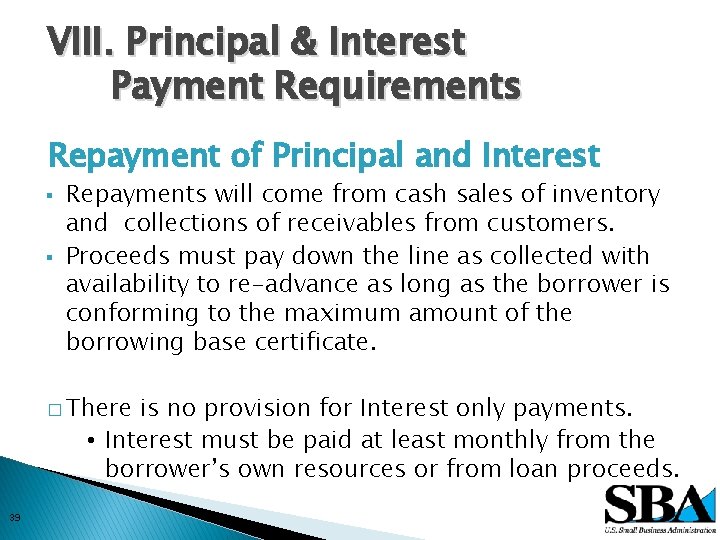
VIII. Principal & Interest Payment Requirements Repayment of Principal and Interest § § Repayments will come from cash sales of inventory and collections of receivables from customers. Proceeds must pay down the line as collected with availability to re-advance as long as the borrower is conforming to the maximum amount of the borrowing base certificate. � There is no provision for Interest only payments. • Interest must be paid at least monthly from the borrower’s own resources or from loan proceeds. 39
II. General Requirements Never Stop Asking Yourself How Is Principal Going To Get Repaid? What Must We Do To Assure Ourselves that Principal Will Get Repaid As Anticipated? 40
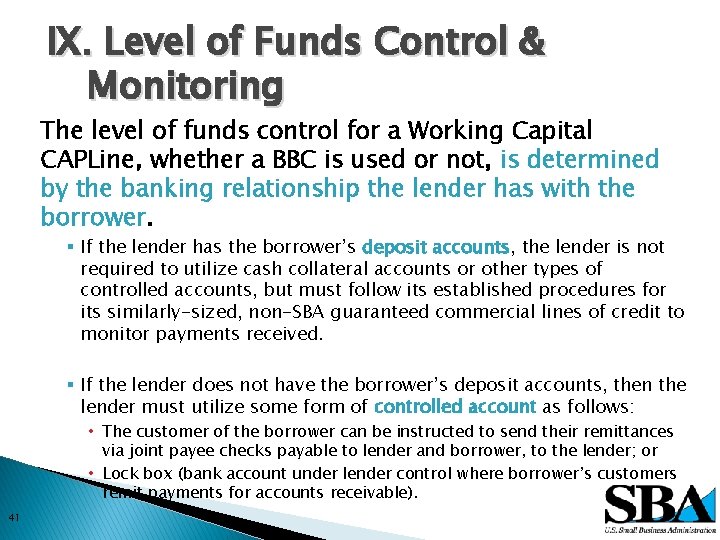
IX. Level of Funds Control & Monitoring The level of funds control for a Working Capital CAPLine, whether a BBC is used or not, is determined by the banking relationship the lender has with the borrower. § If the lender has the borrower’s deposit accounts, the lender is not required to utilize cash collateral accounts or other types of controlled accounts, but must follow its established procedures for its similarly-sized, non-SBA guaranteed commercial lines of credit to monitor payments received. § If the lender does not have the borrower’s deposit accounts, then the lender must utilize some form of controlled account as follows: • The customer of the borrower can be instructed to send their remittances via joint payee checks payable to lender and borrower, to the lender; or • Lock box (bank account under lender control where borrower’s customers remit payments for accounts receivable). 41
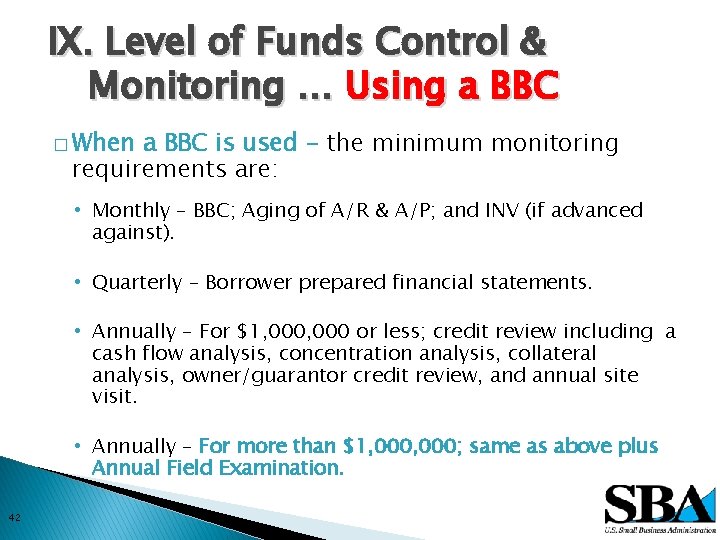
IX. Level of Funds Control & Monitoring … Using a BBC � When a BBC is used - the minimum monitoring requirements are: • Monthly – BBC; Aging of A/R & A/P; and INV (if advanced against). • Quarterly – Borrower prepared financial statements. • Annually – For $1, 000 or less; credit review including a cash flow analysis, concentration analysis, collateral analysis, owner/guarantor credit review, and annual site visit. • Annually – For more than $1, 000; same as above plus Annual Field Examination. 42
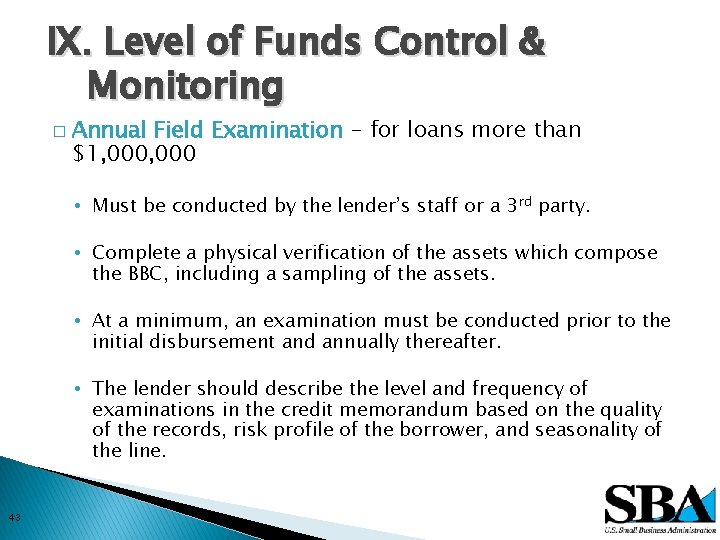
IX. Level of Funds Control & Monitoring � Annual Field Examination - for loans more than $1, 000 • Must be conducted by the lender’s staff or a 3 rd party. • Complete a physical verification of the assets which compose the BBC, including a sampling of the assets. • At a minimum, an examination must be conducted prior to the initial disbursement and annually thereafter. • The lender should describe the level and frequency of examinations in the credit memorandum based on the quality of the records, risk profile of the borrower, and seasonality of the line. 43
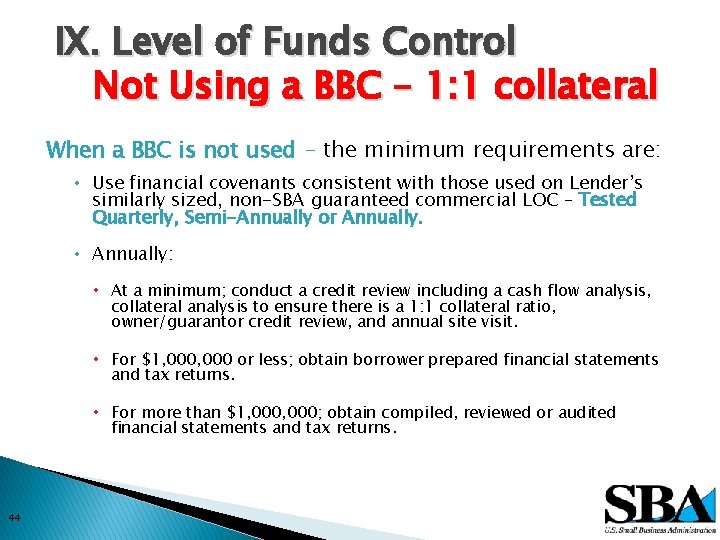
IX. Level of Funds Control Not Using a BBC – 1: 1 collateral When a BBC is not used - the minimum requirements are: • Use financial covenants consistent with those used on Lender’s similarly sized, non-SBA guaranteed commercial LOC – Tested Quarterly, Semi-Annually or Annually. • Annually: • At a minimum; conduct a credit review including a cash flow analysis, collateral analysis to ensure there is a 1: 1 collateral ratio, owner/guarantor credit review, and annual site visit. • For $1, 000 or less; obtain borrower prepared financial statements and tax returns. • For more than $1, 000; obtain compiled, reviewed or audited financial statements and tax returns. 44
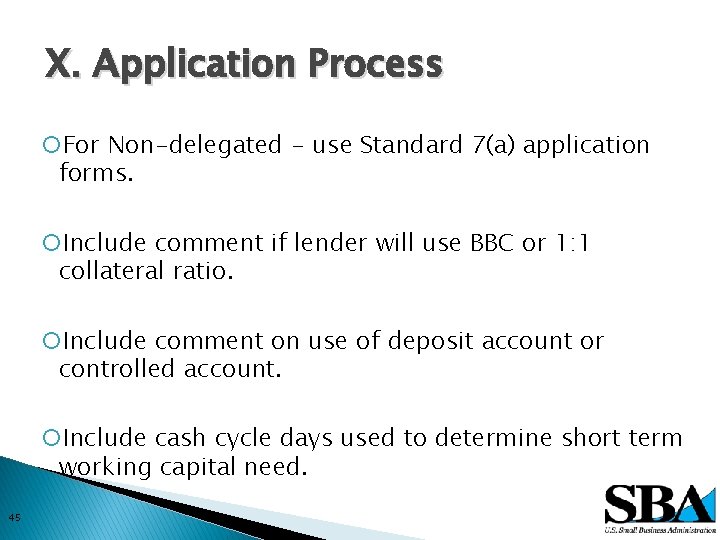
X. Application Process For Non-delegated - use Standard 7(a) application forms. Include comment if lender will use BBC or 1: 1 collateral ratio. Include comment on use of deposit account or controlled account. Include cash cycle days used to determine short term working capital need. 45
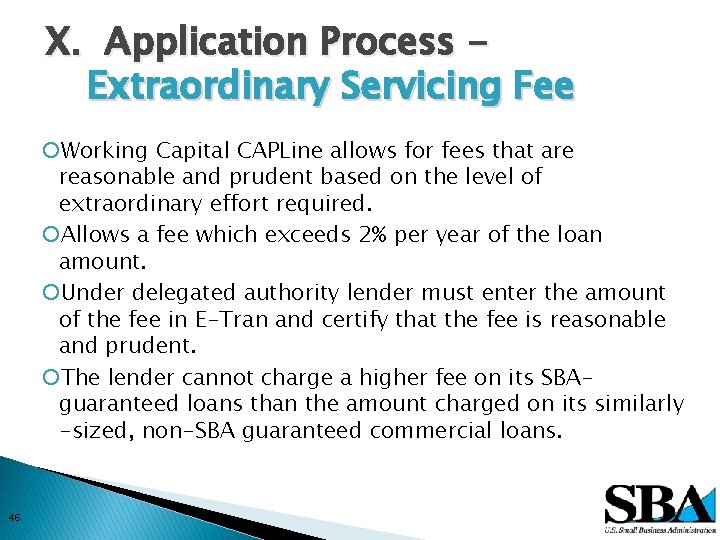
X. Application Process Extraordinary Servicing Fee Working Capital CAPLine allows for fees that are reasonable and prudent based on the level of extraordinary effort required. Allows a fee which exceeds 2% per year of the loan amount. Under delegated authority lender must enter the amount of the fee in E-Tran and certify that the fee is reasonable and prudent. The lender cannot charge a higher fee on its SBAguaranteed loans than the amount charged on its similarly -sized, non-SBA guaranteed commercial loans. 46
7 A LOAN GUARANTY PROCESSING CENTER (LGPC) LOCATIONS 6501 Sylvan Road Suite 122 Citrus Heights, CA 95610 Phone: 877 -475 -2435 General Questions: Loan Mods (prior to first disbursement): 47 262 Black Gold Blvd Hazard, KY 41701 Phone: 606 -436 -0801 Phone: 877 -475 -2435 7 a. Questions@sba. gov 7 a. Loan. Mod@sba. gov Contacting the LGPC
48