Chapter 8 Overview of Working Capital Management 8
- Slides: 26
Chapter 8 Overview of Working Capital Management 8 -1 © Pearson Education Limited 2004 Fundamentals of Financial Management, 12/e Created by: Gregory A. Kuhlemeyer, Ph. D. Carroll College, Waukesha, WI
After studying Chapter 8, you should be able to: u u u u 8 -2 Explain how the definition of "working capital" differs between financial analysts and accountants. Understand the two fundamental decision issues in working capital management -- and the trade-offs involved in making these decisions. Discuss how to determine the optimal level of current assets. Describe the relationship between profitability, liquidity, and risk in the management of working capital. Explain how to classify working capital according to its “components” and according to “time” (i. e. , either permanent or temporary). Describe the hedging (maturity matching) approach to financing and the advantages/disadvantages of short- versus long-term financing. Explain how the financial manager combines the current asset decision with the liability structure decision.
Overview of Working Capital Management u. Working Capital Concepts u. Working Capital Issues u. Financing Current Assets: Short-Term and Long-Term Mix u. Combining Liability Structure and Current Asset Decisions 8 -3
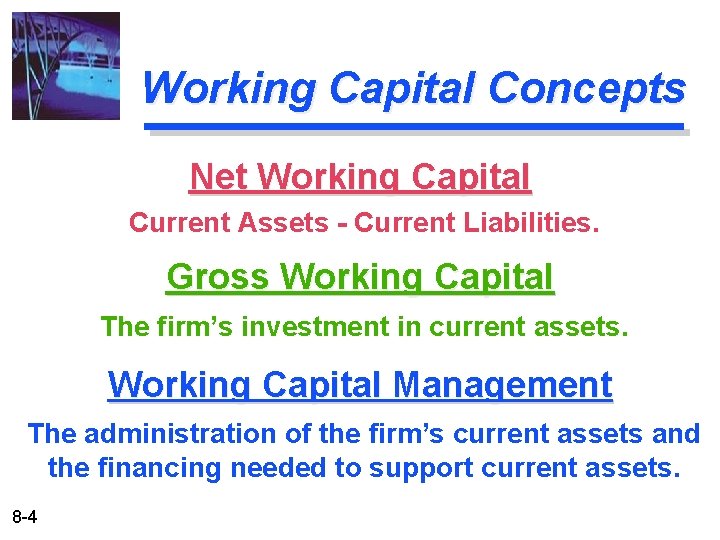
Working Capital Concepts Net Working Capital Current Assets - Current Liabilities. Gross Working Capital The firm’s investment in current assets. Working Capital Management The administration of the firm’s current assets and the financing needed to support current assets. 8 -4
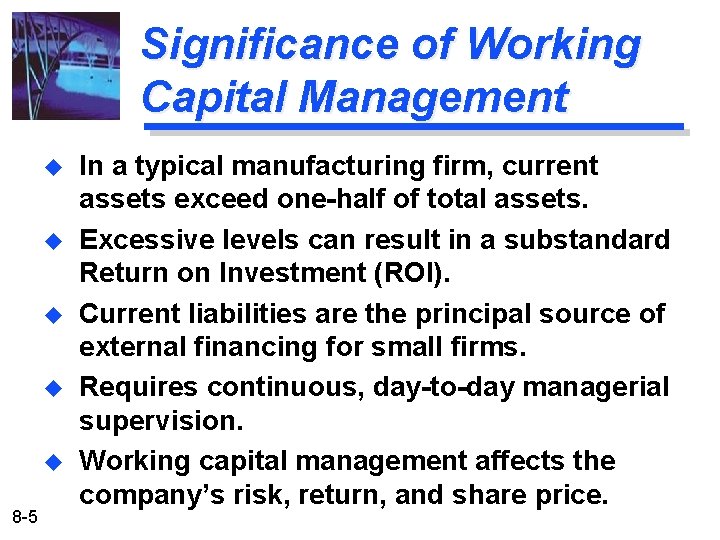
Significance of Working Capital Management u u u 8 -5 In a typical manufacturing firm, current assets exceed one-half of total assets. Excessive levels can result in a substandard Return on Investment (ROI). Current liabilities are the principal source of external financing for small firms. Requires continuous, day-to-day managerial supervision. Working capital management affects the company’s risk, return, and share price.
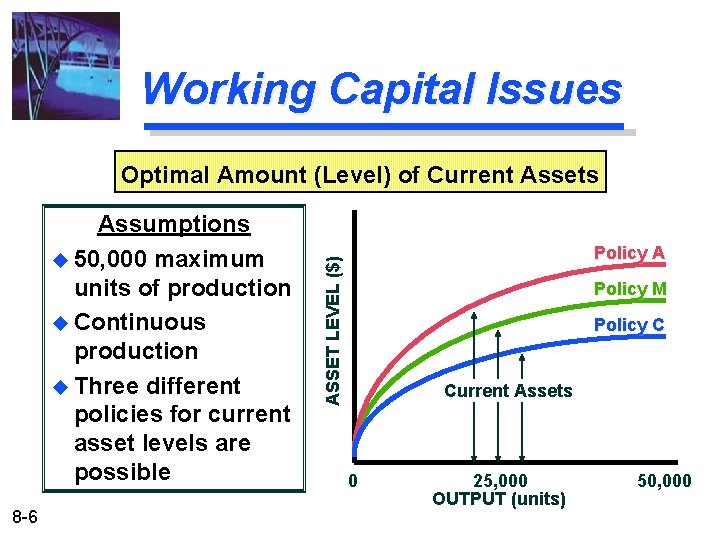
Working Capital Issues Optimal Amount (Level) of Current Assets 8 -6 Policy A ASSET LEVEL ($) Assumptions u 50, 000 maximum units of production u Continuous production u Three different policies for current asset levels are possible Policy M Policy C Current Assets 0 25, 000 OUTPUT (units) 50, 000
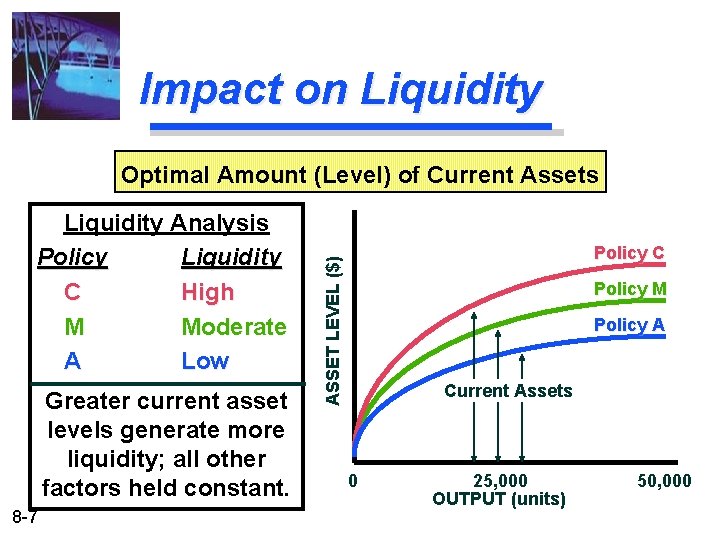
Impact on Liquidity Optimal Amount (Level) of Current Assets Greater current asset levels generate more liquidity; all other factors held constant. 8 -7 Policy C ASSET LEVEL ($) Liquidity Analysis Policy Liquidity C High M Moderate A Low Policy M Policy A Current Assets 0 25, 000 OUTPUT (units) 50, 000
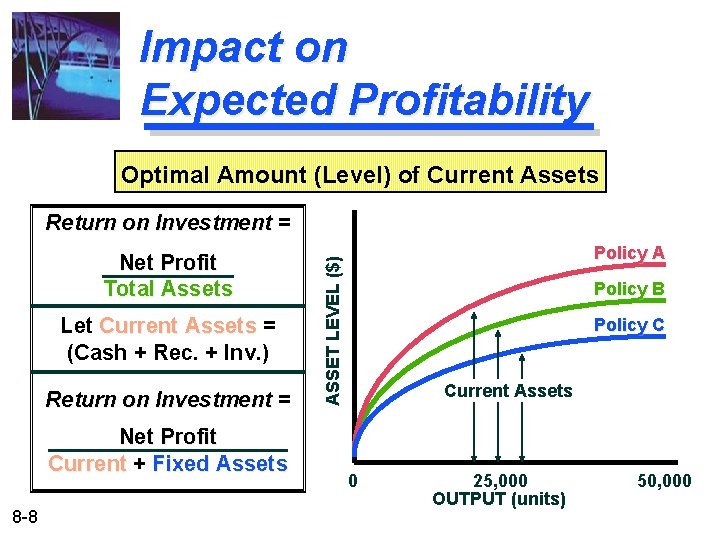
Impact on Expected Profitability Optimal Amount (Level) of Current Assets Return on Investment = Let Current Assets = (Cash + Rec. + Inv. ) Return on Investment = Net Profit Current + Fixed Assets 8 -8 Policy A ASSET LEVEL ($) Net Profit Total Assets Policy B Policy C Current Assets 0 25, 000 OUTPUT (units) 50, 000
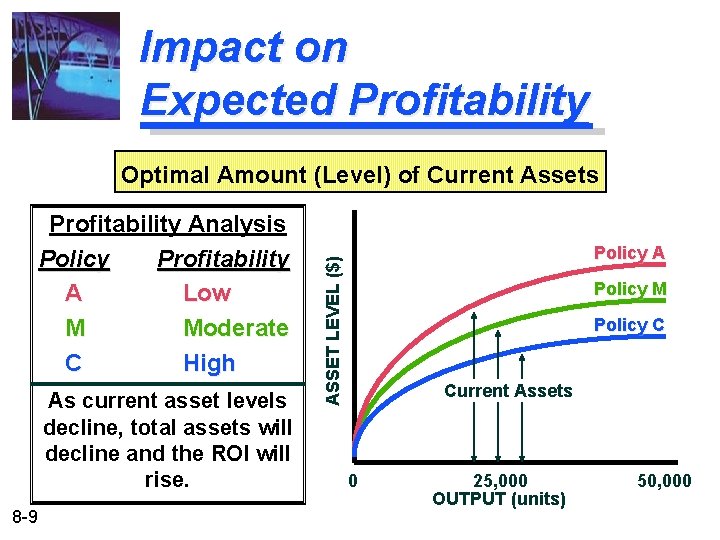
Impact on Expected Profitability Optimal Amount (Level) of Current Assets As current asset levels decline, total assets will decline and the ROI will rise. 8 -9 Policy A ASSET LEVEL ($) Profitability Analysis Policy Profitability A Low M Moderate C High Policy M Policy C Current Assets 0 25, 000 OUTPUT (units) 50, 000
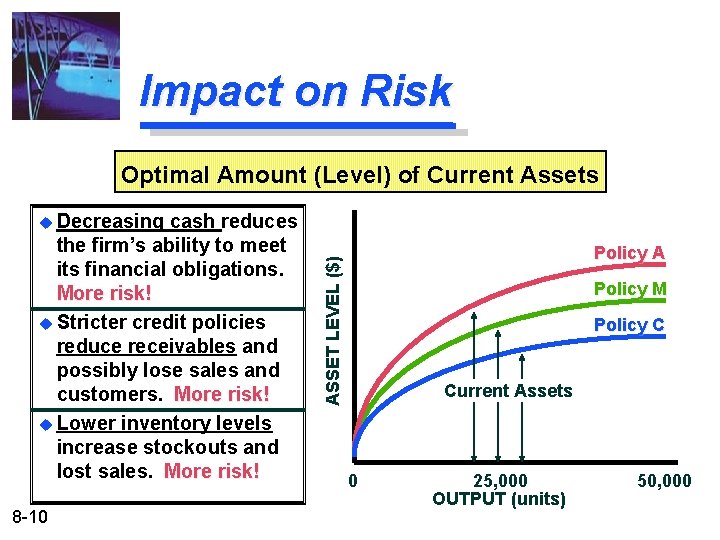
Impact on Risk Optimal Amount (Level) of Current Assets u Decreasing 8 -10 Policy A ASSET LEVEL ($) cash reduces the firm’s ability to meet its financial obligations. More risk! u Stricter credit policies reduce receivables and possibly lose sales and customers. More risk! u Lower inventory levels increase stockouts and lost sales. More risk! Policy M Policy C Current Assets 0 25, 000 OUTPUT (units) 50, 000
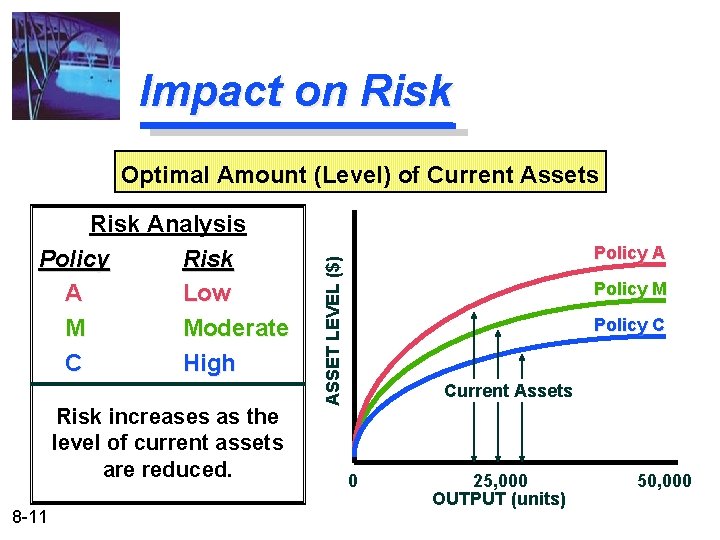
Impact on Risk Optimal Amount (Level) of Current Assets Risk increases as the level of current assets are reduced. 8 -11 Policy A ASSET LEVEL ($) Risk Analysis Policy Risk A Low M Moderate C High Policy M Policy C Current Assets 0 25, 000 OUTPUT (units) 50, 000
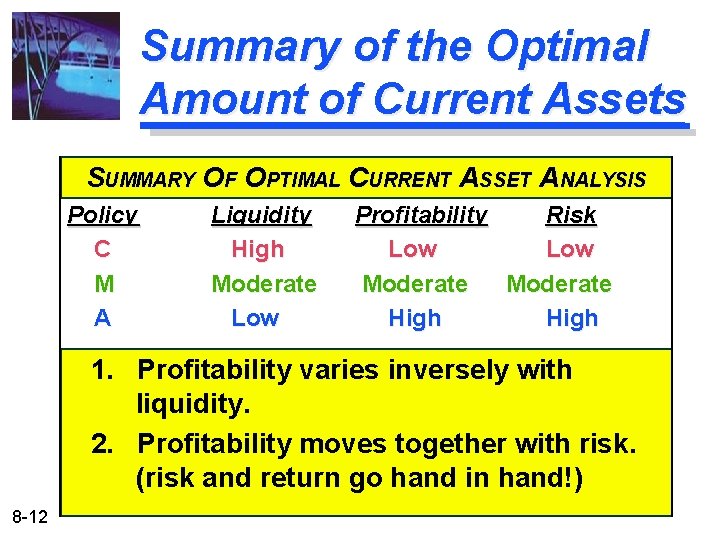
Summary of the Optimal Amount of Current Assets SUMMARY OF OPTIMAL CURRENT ASSET ANALYSIS Policy C M A Liquidity High Moderate Low Profitability Risk Low Moderate High 1. Profitability varies inversely with liquidity. 2. Profitability moves together with risk. (risk and return go hand in hand!) 8 -12
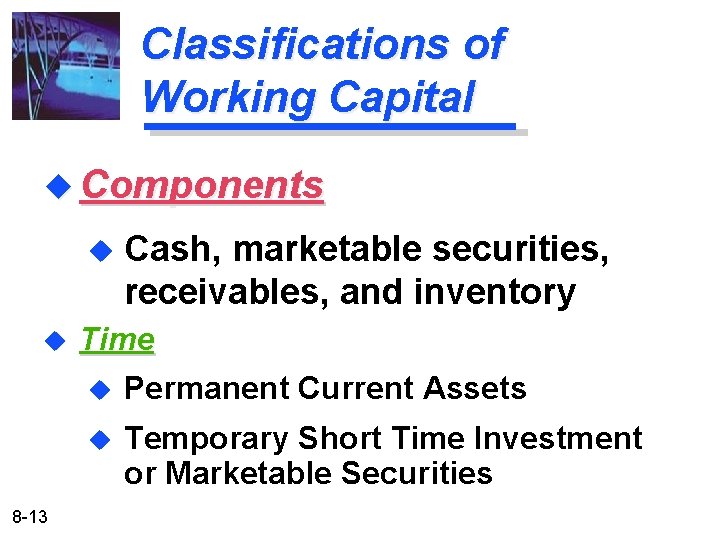
Classifications of Working Capital u Components u u 8 -13 Cash, marketable securities, receivables, and inventory Time u Permanent Current Assets u Temporary Short Time Investment or Marketable Securities
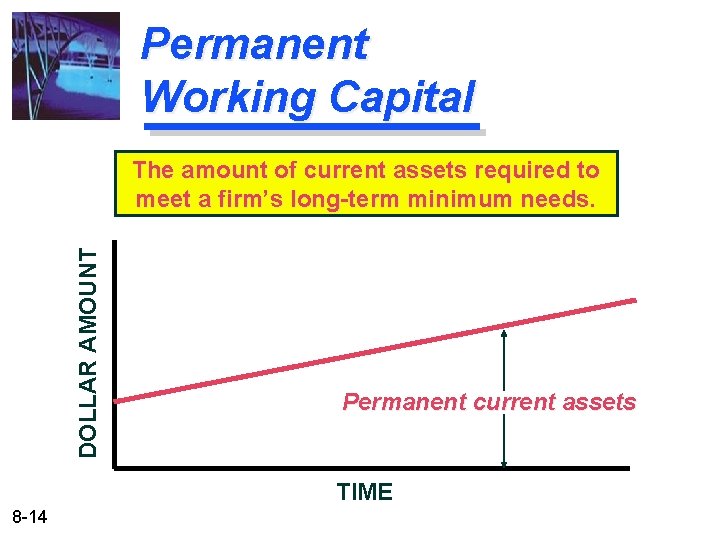
Permanent Working Capital DOLLAR AMOUNT The amount of current assets required to meet a firm’s long-term minimum needs. Permanent current assets TIME 8 -14
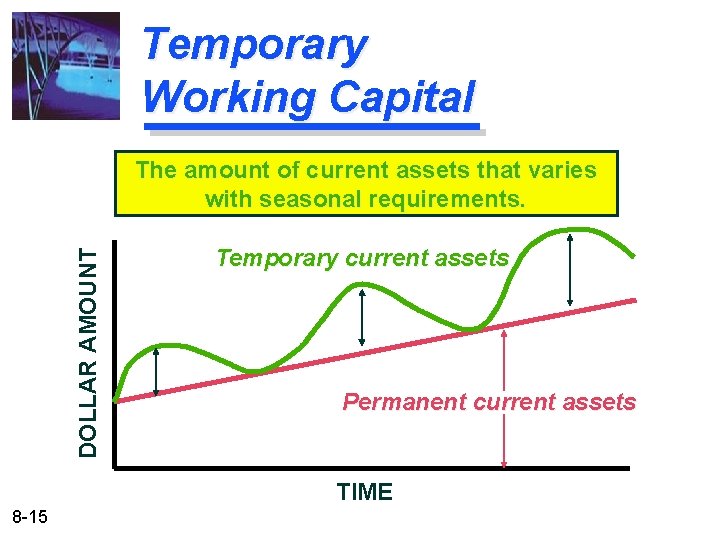
Temporary Working Capital DOLLAR AMOUNT The amount of current assets that varies with seasonal requirements. Temporary current assets Permanent current assets TIME 8 -15
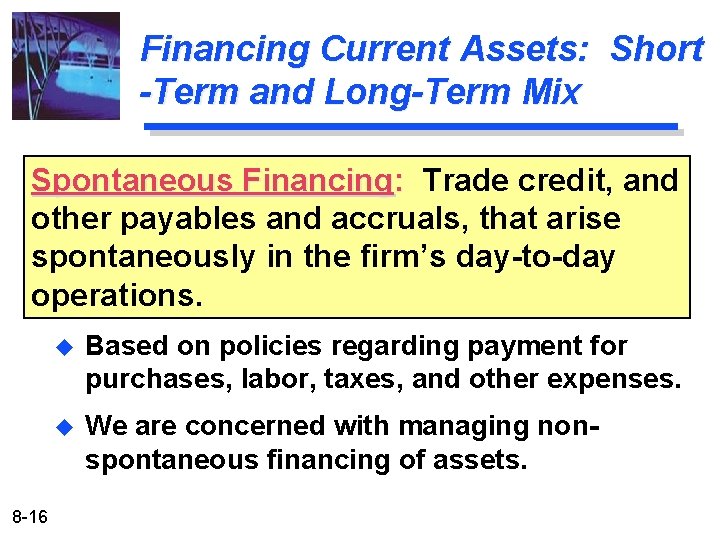
Financing Current Assets: Short -Term and Long-Term Mix Spontaneous Financing: Trade credit, and other payables and accruals, that arise spontaneously in the firm’s day-to-day operations. 8 -16 u Based on policies regarding payment for purchases, labor, taxes, and other expenses. u We are concerned with managing nonspontaneous financing of assets.
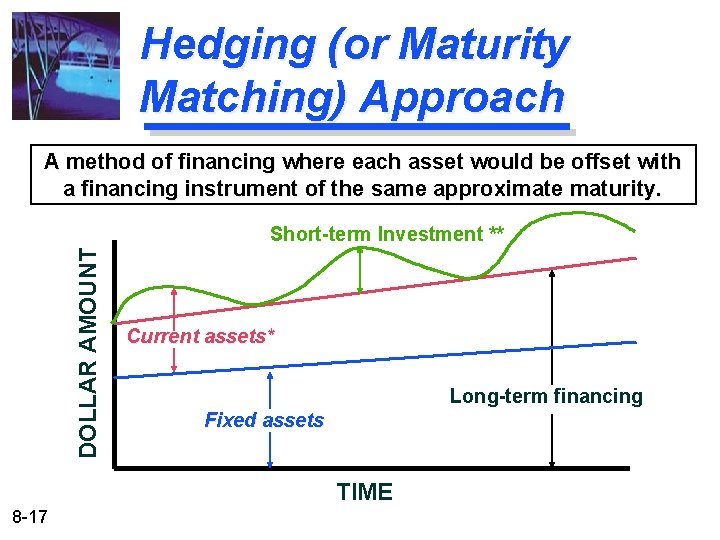
Hedging (or Maturity Matching) Approach A method of financing where each asset would be offset with a financing instrument of the same approximate maturity. DOLLAR AMOUNT Short-term Investment ** Current assets* Long-term financing Fixed assets TIME 8 -17
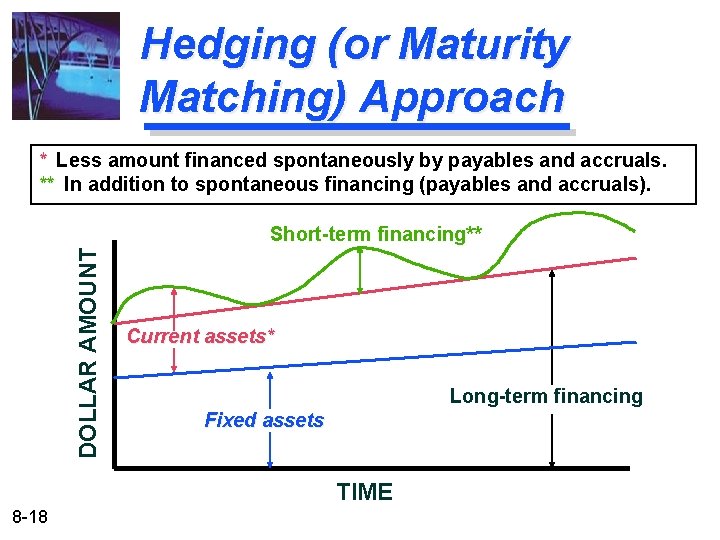
Hedging (or Maturity Matching) Approach * Less amount financed spontaneously by payables and accruals. ** In addition to spontaneous financing (payables and accruals). DOLLAR AMOUNT Short-term financing** Current assets* Long-term financing Fixed assets TIME 8 -18
Financing Needs and the Hedging Approach 8 -19 u Fixed assets and the non-seasonal portion of current assets are financed with longterm debt and equity (long-term profitability of assets to cover the long-term financing costs of the firm). u Seasonal needs are financed with shortterm loans (under normal operations sufficient cash flow is expected to cover the short-term financing cost).
Self-Liquidating Nature of Short-Term Loans u u u 8 -20 Seasonal orders require the purchase of inventory beyond current levels. Increased inventory is used to meet the increased demand for the final product. Sales become receivables. Receivables are collected and become cash. The resulting cash funds can be used to pay off the seasonal short-term loan and cover associated long-term financing costs.
Risks vs. Costs Trade-Off (Conservative Approach) u Long-Term Financing Benefits u u u Long-Term Financing Risks u u u Borrowing more than what is necessary Borrowing at a higher overall cost (usually) Result u 8 -21 Less worry in refinancing short-term obligations Less uncertainty regarding future interest costs Manager accepts less expected profits in exchange for taking less risk.
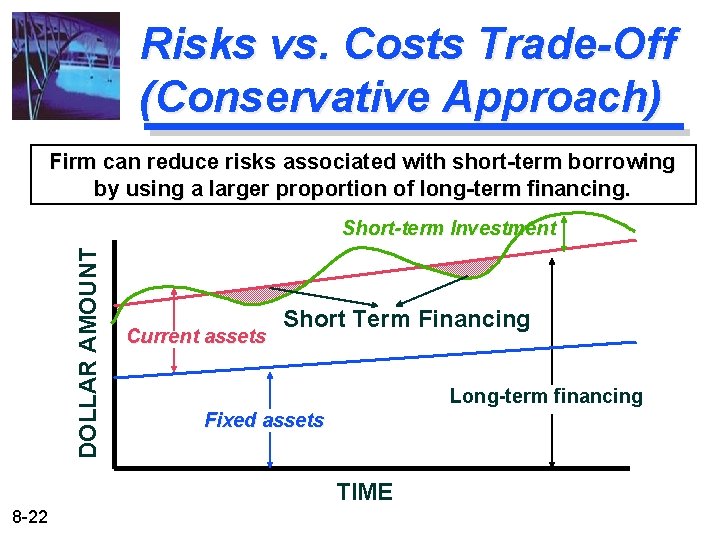
Risks vs. Costs Trade-Off (Conservative Approach) Firm can reduce risks associated with short-term borrowing by using a larger proportion of long-term financing. DOLLAR AMOUNT Short-term Investment Current assets Short Term Financing Long-term financing Fixed assets TIME 8 -22
Comparison with an Aggressive Approach u Short-Term Financing Benefits u u u Short-Term Financing Risks u u u Refinancing short-term obligations in the future Uncertain future interest costs Result u 8 -23 Financing long-term needs with a lower interest cost than short-term debt Borrowing only what is necessary Manager accepts greater expected profits in exchange for taking greater risk.
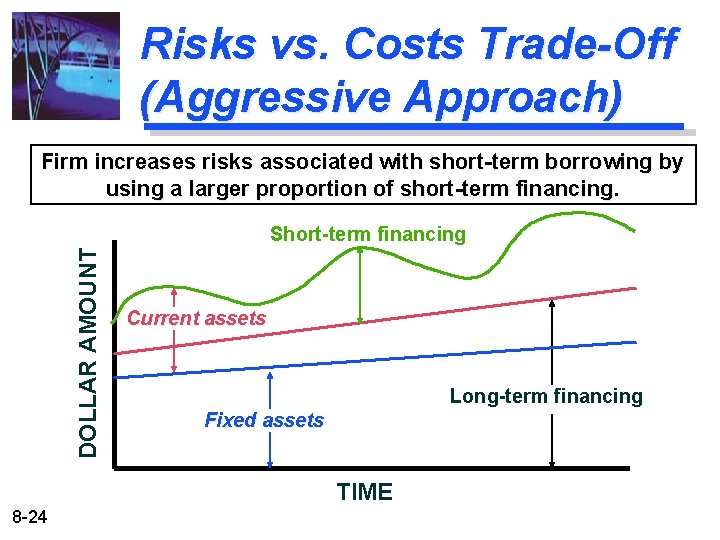
Risks vs. Costs Trade-Off (Aggressive Approach) Firm increases risks associated with short-term borrowing by using a larger proportion of short-term financing. DOLLAR AMOUNT Short-term financing Current assets Long-term financing Fixed assets TIME 8 -24
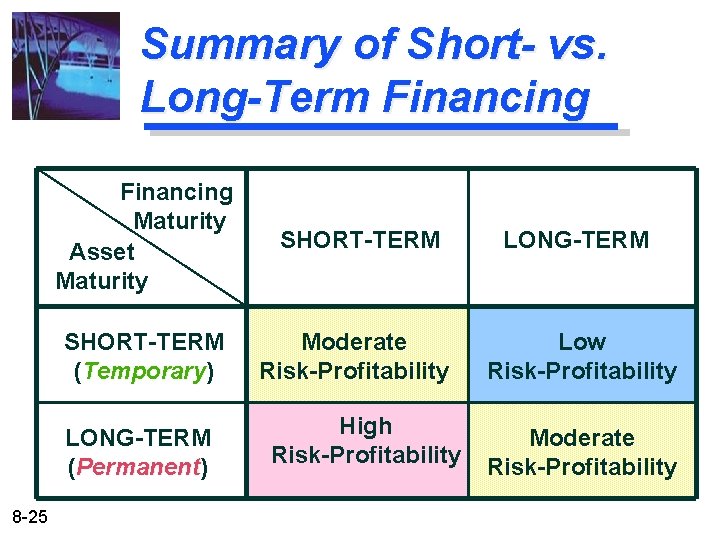
Summary of Short- vs. Long-Term Financing Maturity Asset Maturity SHORT-TERM LONG-TERM SHORT-TERM (Temporary) Temporary Moderate Risk-Profitability Low Risk-Profitability LONG-TERM (Permanent) Permanent 8 -25 High Risk-Profitability Moderate Risk-Profitability
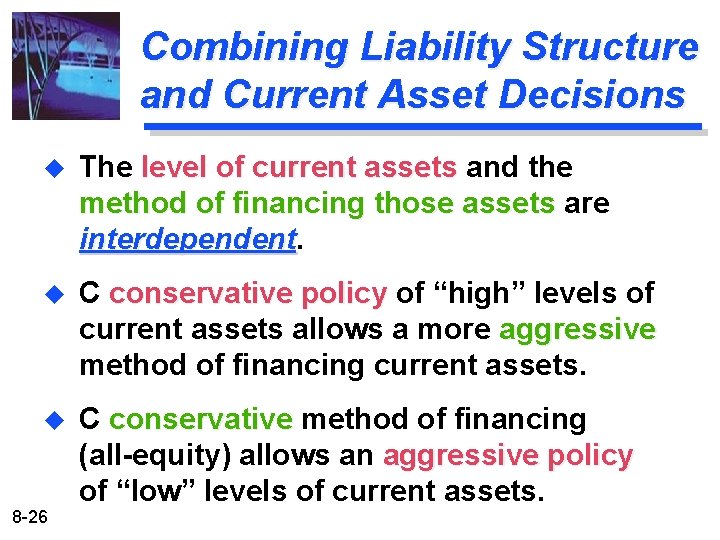
Combining Liability Structure and Current Asset Decisions u The level of current assets and the method of financing those assets are interdependent u C conservative policy of “high” levels of current assets allows a more aggressive method of financing current assets. u C conservative method of financing (all-equity) allows an aggressive policy of “low” levels of current assets. 8 -26