
Working Capital Management Working Capital refers to that

- Slides: 29
Working Capital Management
Working Capital refers to that part of the firm’s capital, which is required for financing short-term or current assets such a cash marketable securities, debtors and inventories. Funds thus, invested in current assets keep revolving fast and are constantly converted into cash and this cash flow out again in exchange for other current assets. Working Capital is also known as revolving or circulating capital or shortterm capital.
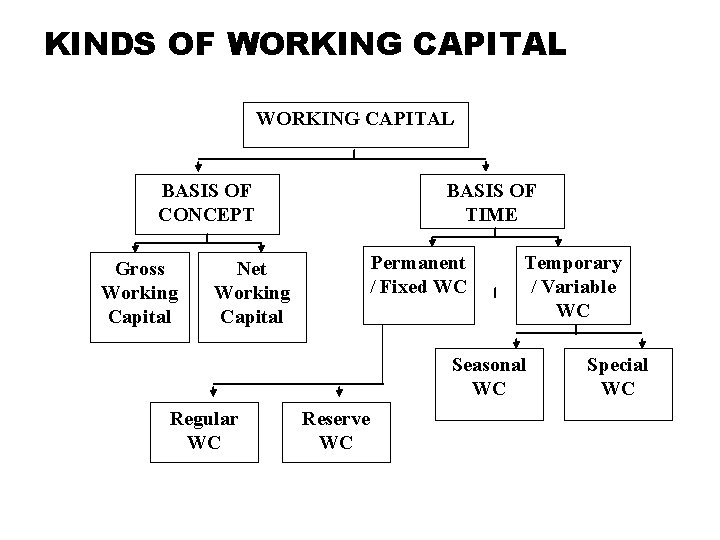
KINDS OF WORKING CAPITAL BASIS OF CONCEPT Gross Working Capital Net Working Capital BASIS OF TIME Permanent / Fixed WC Temporary / Variable WC Seasonal WC Regular WC Reserve WC Special WC
Significance of Gross WC • Optimum investment in CA Investment in CA must be adequate CA investment should not be inadequate or excessive inadequate WC can disturb production and can also threaten the solvency of firm , if it fails to meet its current obligation excessive investment in CA should be avoided , since it impairs firms profitability • Financing of CA Need for WC arises due to increasing level of business activity & it is to provided quickly some time surplus fund may arises which should be invested in Short term securities , they should not be kept idle
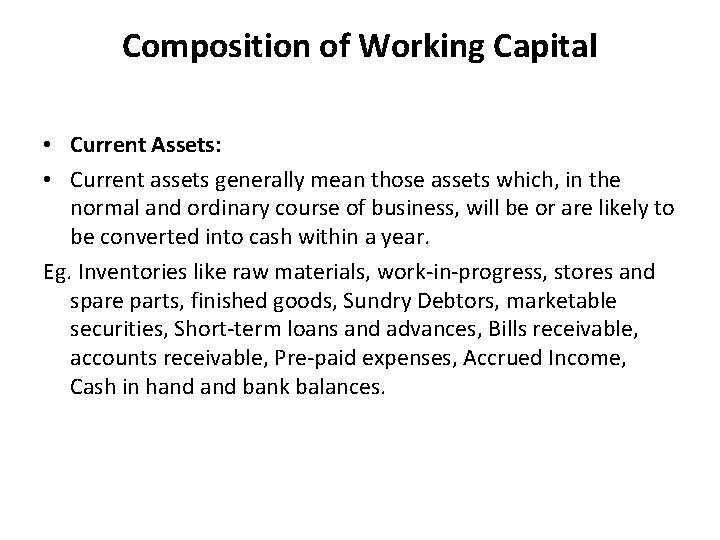
Composition of Working Capital • Current Assets: • Current assets generally mean those assets which, in the normal and ordinary course of business, will be or are likely to be converted into cash within a year. Eg. Inventories like raw materials, work-in-progress, stores and spare parts, finished goods, Sundry Debtors, marketable securities, Short-term loans and advances, Bills receivable, accounts receivable, Pre-paid expenses, Accrued Income, Cash in hand bank balances.
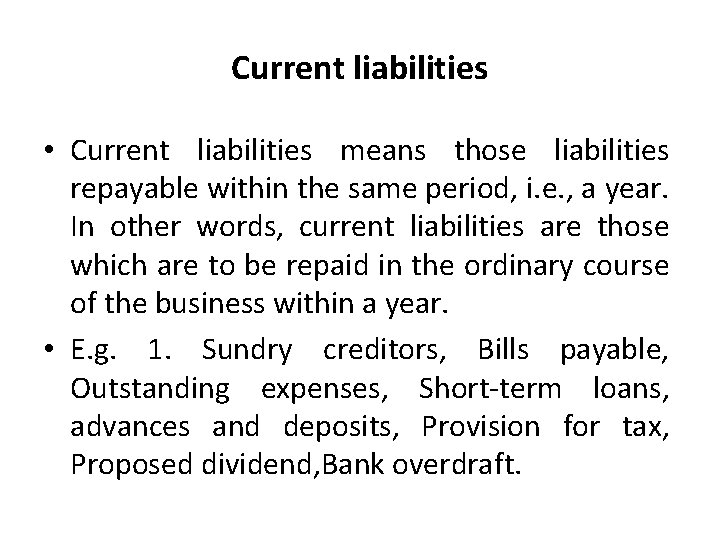
Current liabilities • Current liabilities means those liabilities repayable within the same period, i. e. , a year. In other words, current liabilities are those which are to be repaid in the ordinary course of the business within a year. • E. g. 1. Sundry creditors, Bills payable, Outstanding expenses, Short-term loans, advances and deposits, Provision for tax, Proposed dividend, Bank overdraft.
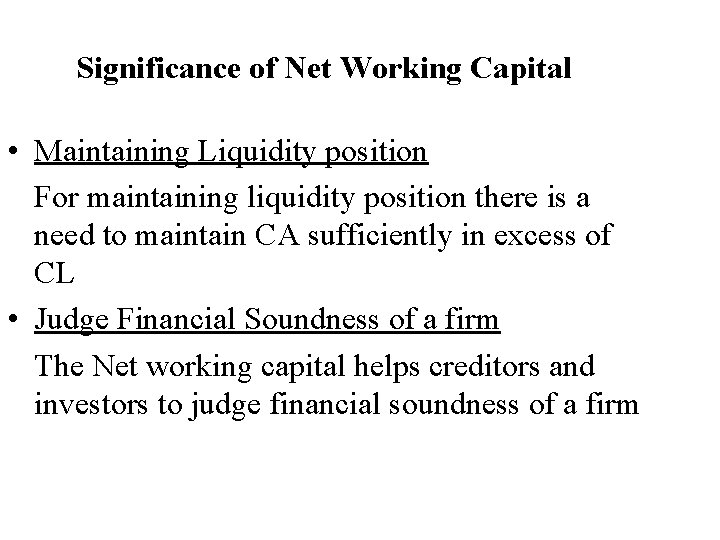
Significance of Net Working Capital • Maintaining Liquidity position For maintaining liquidity position there is a need to maintain CA sufficiently in excess of CL • Judge Financial Soundness of a firm The Net working capital helps creditors and investors to judge financial soundness of a firm
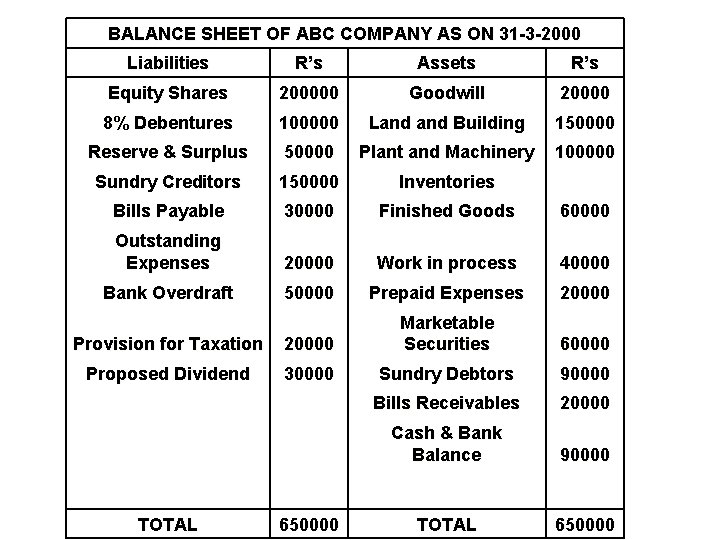
BALANCE SHEET OF ABC COMPANY AS ON 31 -3 -2000 Liabilities R’s Assets R’s Equity Shares 200000 Goodwill 20000 8% Debentures 100000 Land Building 150000 Reserve & Surplus 50000 Plant and Machinery 100000 Sundry Creditors 150000 Inventories Bills Payable 30000 Finished Goods 60000 Outstanding Expenses 20000 Work in process 40000 Bank Overdraft 50000 Prepaid Expenses 20000 Provision for Taxation 20000 Marketable Securities 60000 Proposed Dividend 30000 Sundry Debtors 90000 Bills Receivables 20000 Cash & Bank Balance 90000 TOTAL 650000
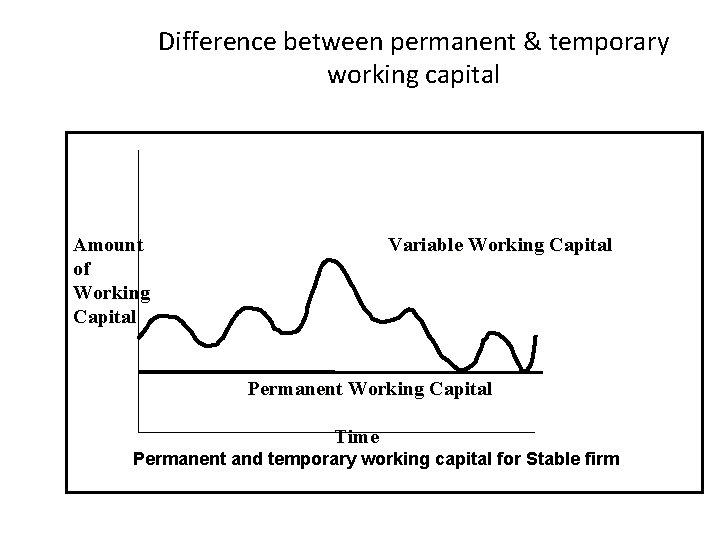
Difference between permanent & temporary working capital Amount of Working Capital Variable Working Capital Permanent Working Capital Time Permanent and temporary working capital for Stable firm
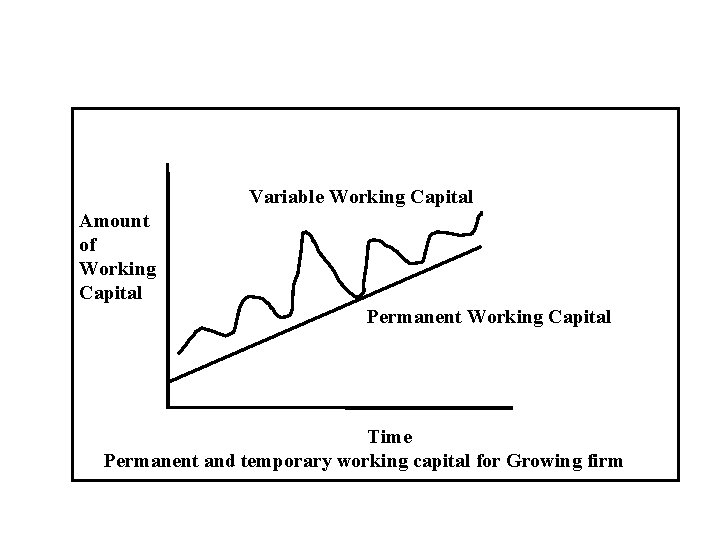
Variable Working Capital Amount of Working Capital Permanent Working Capital Time Permanent and temporary working capital for Growing firm
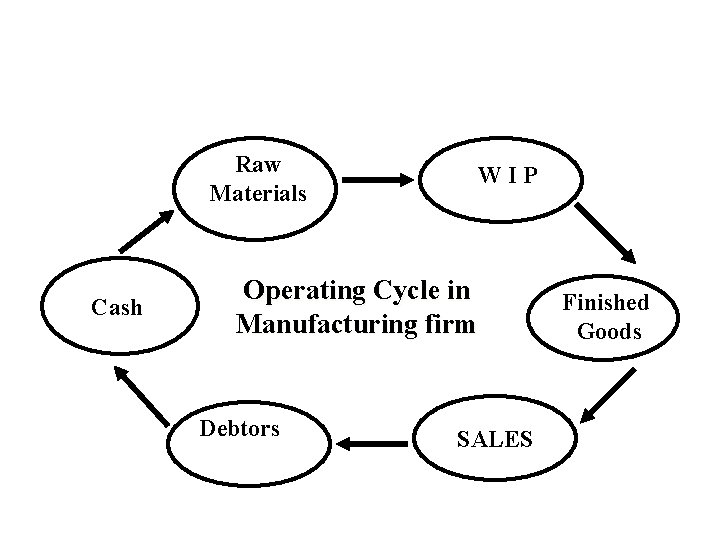
• Operating cycle concept • Maximization of share holder’s wealth of a firm is possible only when there are sufficient return from the operations • Successful sales activity is necessary for earning profit sales do not convert into cash immediately • There is invisible time lap between the sale of good and receipt of cash • The time taken to convert raw material into cash is known as operating cycle • Conversion of cash into raw material • Conversion of raw material into work in progress • Conversion of Work in progress into finished goods • Conversion of finished good into Sales ( Debtors and cash )
Raw Materials Cash WIP Operating Cycle in Manufacturing firm Debtors SALES Finished Goods
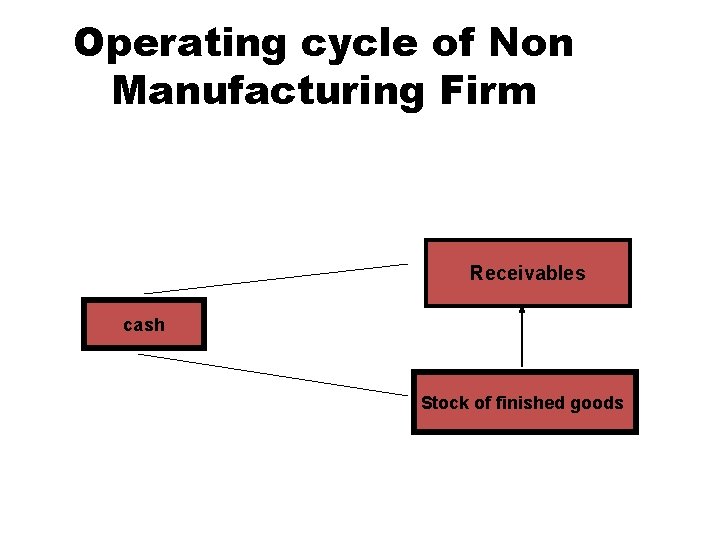
Operating cycle of Non Manufacturing Firm Receivables cash Stock of finished goods
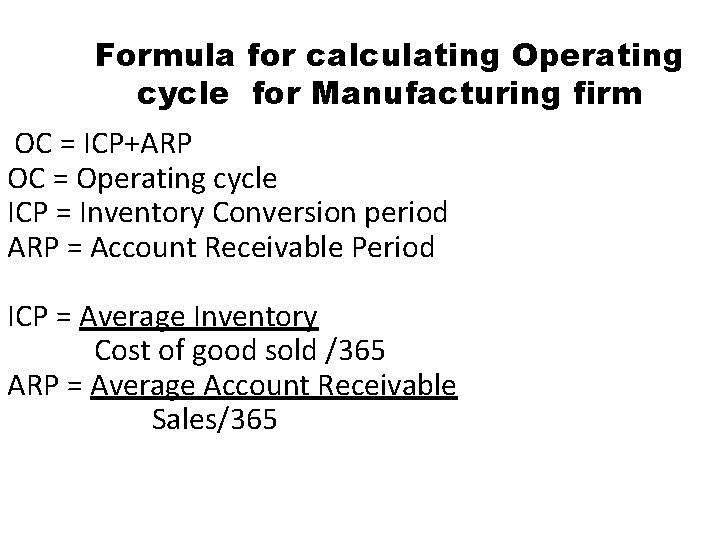
Formula for calculating Operating cycle for Manufacturing firm OC = ICP+ARP OC = Operating cycle ICP = Inventory Conversion period ARP = Account Receivable Period ICP = Average Inventory Cost of good sold /365 ARP = Average Account Receivable Sales/365
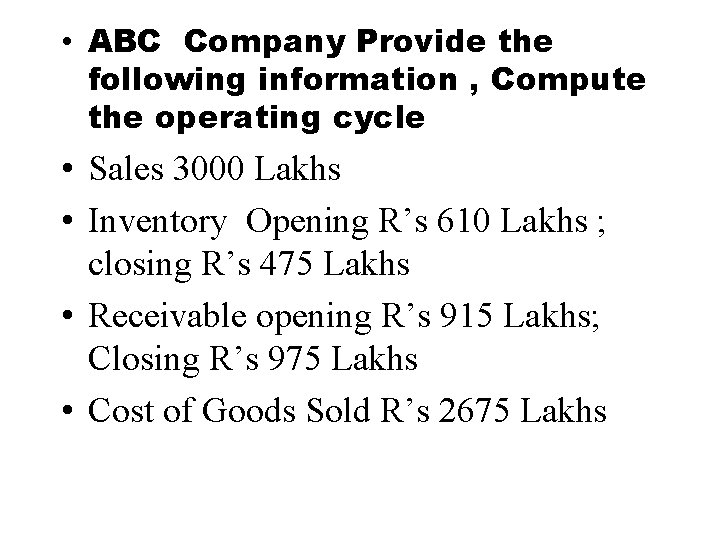
• ABC Company Provide the following information , Compute the operating cycle • Sales 3000 Lakhs • Inventory Opening R’s 610 Lakhs ; closing R’s 475 Lakhs • Receivable opening R’s 915 Lakhs; Closing R’s 975 Lakhs • Cost of Goods Sold R’s 2675 Lakhs
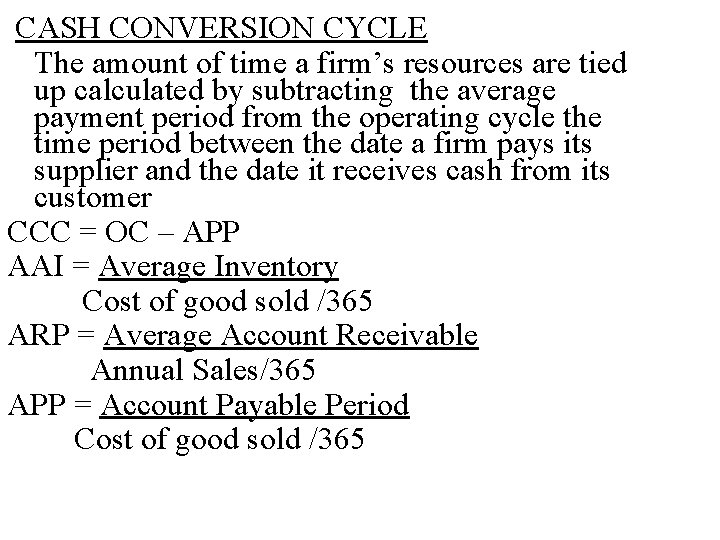
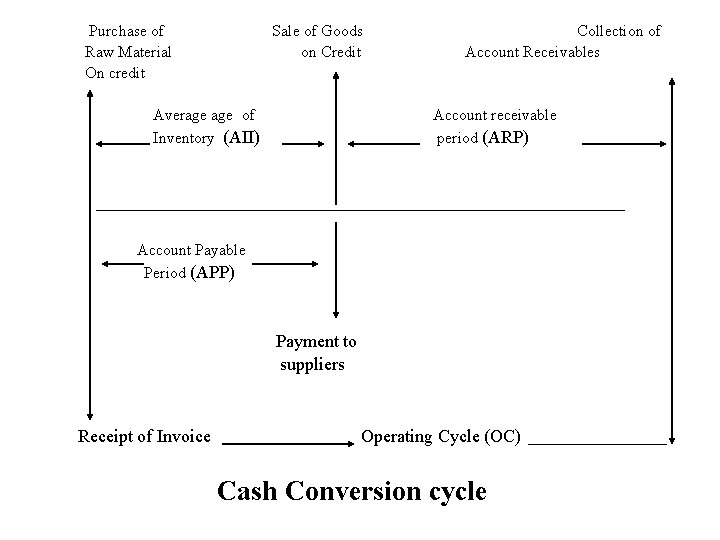
CASH CONVERSION CYCLE The amount of time a firm’s resources are tied up calculated by subtracting the average payment period from the operating cycle the time period between the date a firm pays its supplier and the date it receives cash from its customer CCC = OC – APP AAI = Average Inventory Cost of good sold /365 ARP = Average Account Receivable Annual Sales/365 APP = Account Payable Period Cost of good sold /365
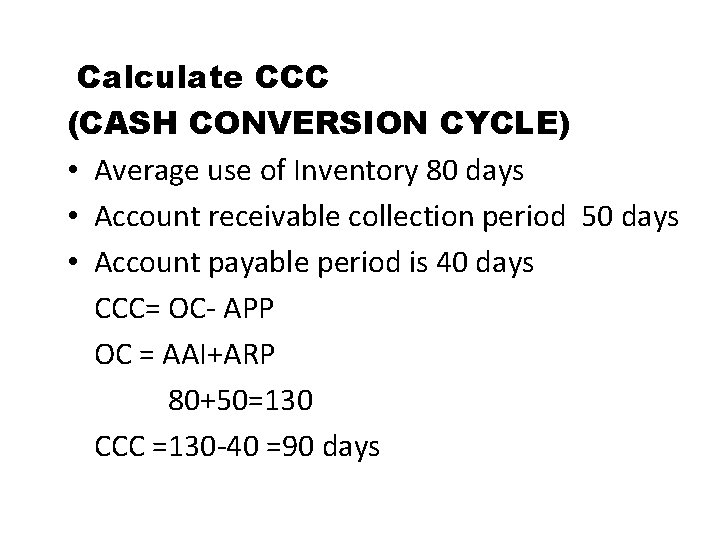
Calculate CCC (CASH CONVERSION CYCLE) • Average use of Inventory 80 days • Account receivable collection period 50 days • Account payable period is 40 days CCC= OC- APP OC = AAI+ARP 80+50=130 CCC =130 -40 =90 days
Purchase of Raw Material On credit Sale of Goods on Credit Average of Inventory (AII) Collection of Account Receivables Account receivable period (ARP) Account Payable Period (APP) Payment to suppliers Receipt of Invoice Operating Cycle (OC) Cash Conversion cycle
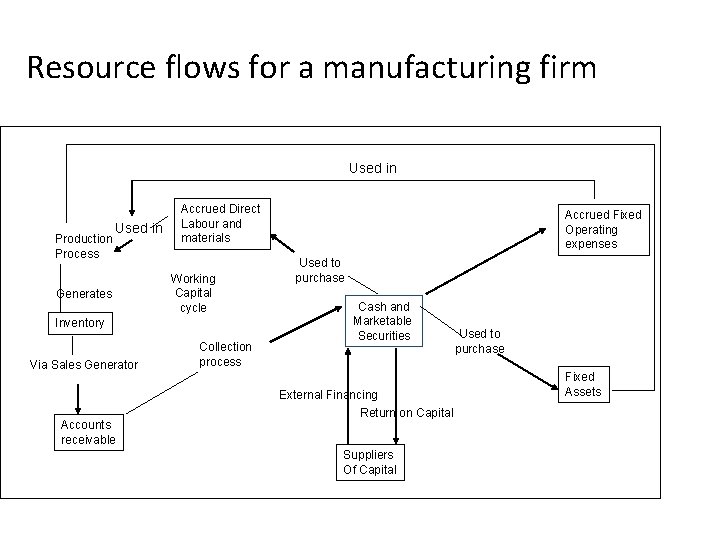
Resource flows for a manufacturing firm Used in Production Process Used in Generates Accrued Direct Labour and materials Working Capital cycle Inventory Via Sales Generator Accounts receivable Collection process Accrued Fixed Operating expenses Used to purchase Cash and Marketable Securities External Financing Return on Capital Suppliers Of Capital Used to purchase Fixed Assets
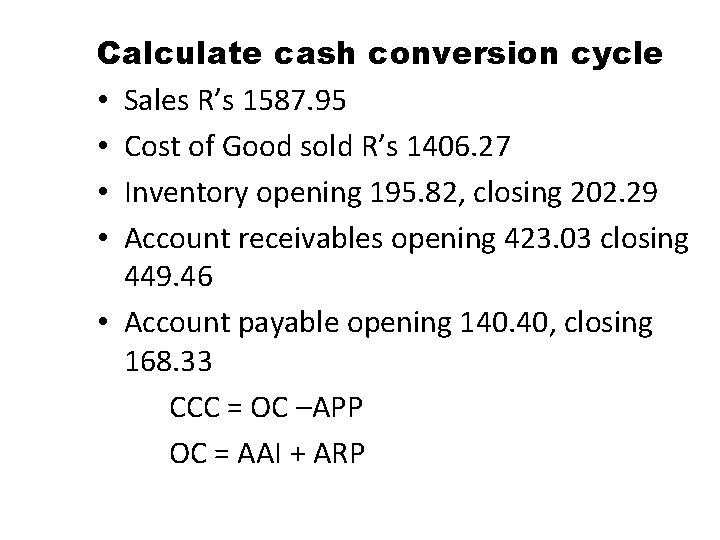
Calculate cash conversion cycle • Sales R’s 1587. 95 • Cost of Good sold R’s 1406. 27 • Inventory opening 195. 82, closing 202. 29 • Account receivables opening 423. 03 closing 449. 46 • Account payable opening 140. 40, closing 168. 33 CCC = OC –APP OC = AAI + ARP
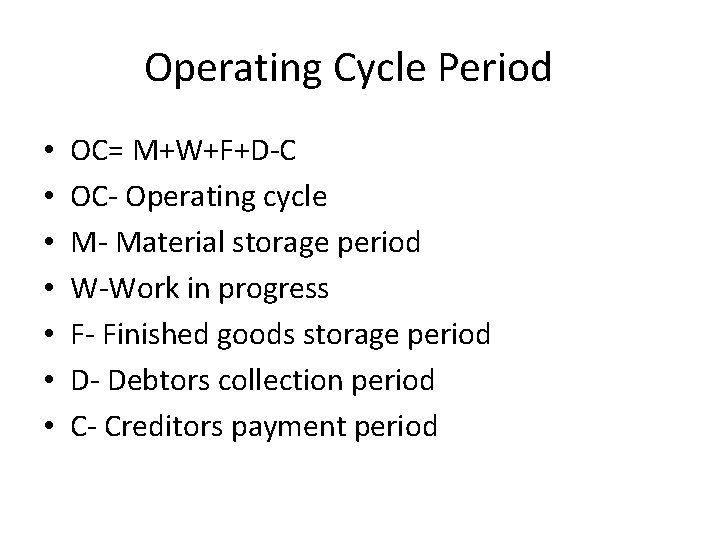
Operating Cycle Period • • OC= M+W+F+D-C OC- Operating cycle M- Material storage period W-Work in progress F- Finished goods storage period D- Debtors collection period C- Creditors payment period
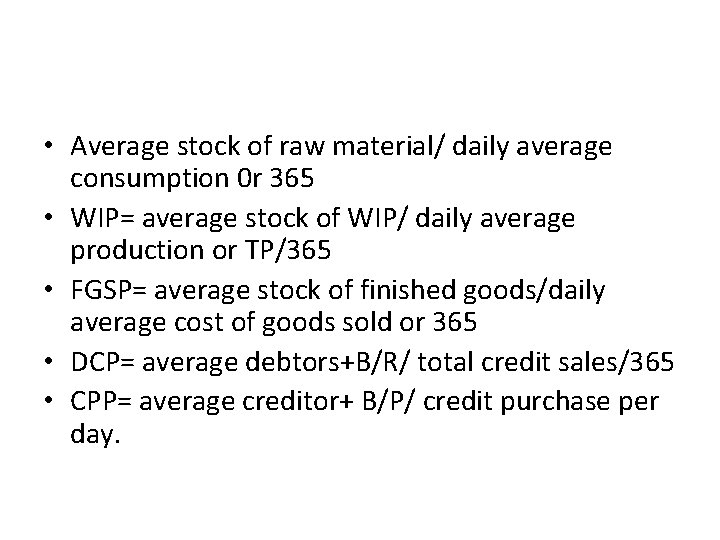
• Average stock of raw material/ daily average consumption 0 r 365 • WIP= average stock of WIP/ daily average production or TP/365 • FGSP= average stock of finished goods/daily average cost of goods sold or 365 • DCP= average debtors+B/R/ total credit sales/365 • CPP= average creditor+ B/P/ credit purchase per day.
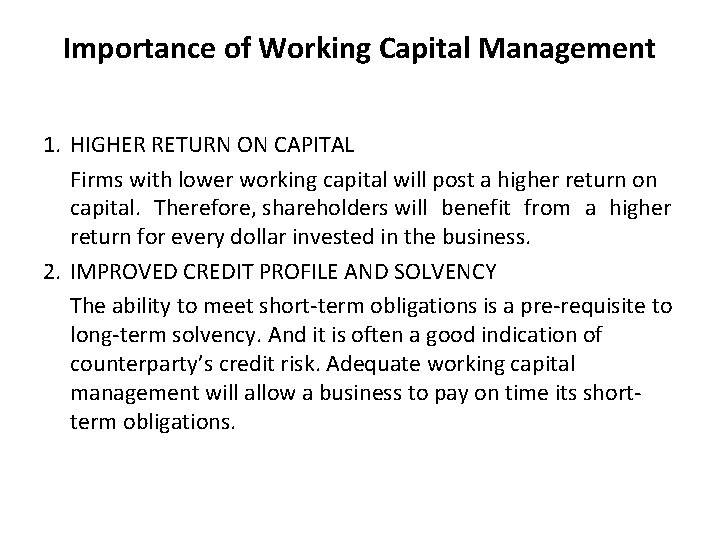
Importance of Working Capital Management 1. HIGHER RETURN ON CAPITAL Firms with lower working capital will post a higher return on capital. Therefore, shareholders will benefit from a higher return for every dollar invested in the business. 2. IMPROVED CREDIT PROFILE AND SOLVENCY The ability to meet short-term obligations is a pre-requisite to long-term solvency. And it is often a good indication of counterparty’s credit risk. Adequate working capital management will allow a business to pay on time its shortterm obligations.
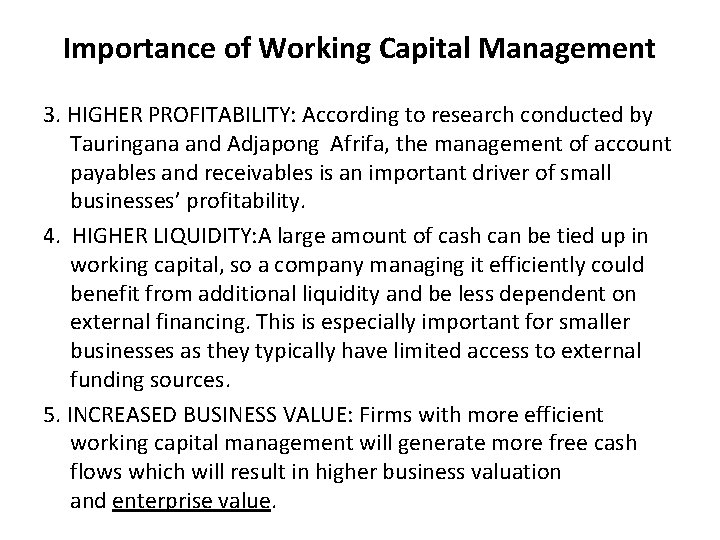
Importance of Working Capital Management 3. HIGHER PROFITABILITY: According to research conducted by Tauringana and Adjapong Afrifa, the management of account payables and receivables is an important driver of small businesses’ profitability. 4. HIGHER LIQUIDITY: A large amount of cash can be tied up in working capital, so a company managing it efficiently could benefit from additional liquidity and be less dependent on external financing. This is especially important for smaller businesses as they typically have limited access to external funding sources. 5. INCREASED BUSINESS VALUE: Firms with more efficient working capital management will generate more free cash flows which will result in higher business valuation and enterprise value.
6. FAVORABLE FINANCING CONDITIONS: A firm with a good relationship with its trade partners and paying its suppliers on time will benefit from favorable financing terms such as discount payments from its suppliers and banking partners. 7. UNINTERRUPTED PRODUCTION: A firm paying its suppliers on time will also benefit from a regular flow of raw materials, ensuring that the production remains uninterrupted and clients receive their goods on time.
• ABILITY TO FACE SHOCKS AND PEAK DEMAND • Efficient working capital management will help a firm to survive through a crisis or ramp up production in case of an unexpectedly large order. • COMPETITIVE ADVANTAGE • Firms with an efficient supply chain will often be able to sell their products at a discount versus similar firms with inefficient sourcing
Determinants of WC • • • Nature of business Size of business Length of operating cycle Seasonal nature of the business Firms credit policy Terms of purchase and sales Business cycle Growth rate of business WC turnover Profit margin Dividend policy
FORECASTING / ESTIMATION OF WORKING CAPITAL REQUIREMENTS • • • Factors to be considered Total costs incurred on materials, wages and overheads The length of time for which raw materials remain in stores before they are issued to production. The length of the production cycle or WIP, i. e. , the time taken for conversion of RM into FG. The length of the Sales Cycle during which FG are to be kept waiting for sales. The average period of credit allowed to customers. The amount of cash required to pay day-to-day expenses of the business. The amount of cash required for advance payments if any. The average period of credit to be allowed by suppliers. Time – lag in the payment of wages and other overheads
Thx