Who really invests in CEE Magdolna Sass MTA


- Slides: 28
Who really invests in CEE? Magdolna Sass, MTA KRTK and BGE A Magyar Regionális Tudományi Társaság XVI. vándorgyűlése, Kecskemét, 2018. október 18. 19.
Outline � Background � Theory and empirics � Data � Statistical and econometric analysis � Conclusion A Magyar Regionális Tudományi Társaság XVI. vándorgyűlése, Kecskemét, 2018. október 18. -19.
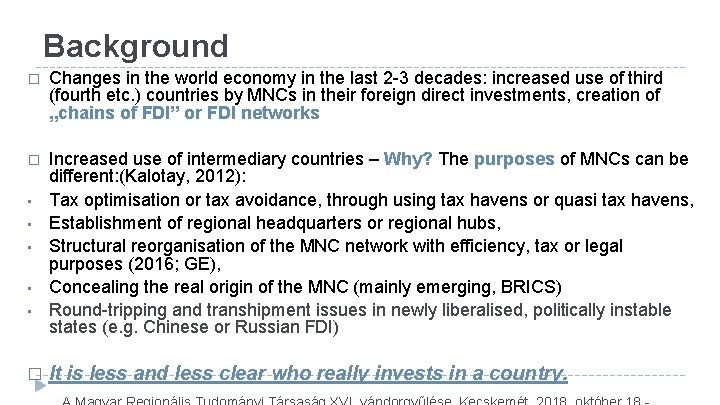
Background � Changes in the world economy in the last 2 -3 decades: increased use of third (fourth etc. ) countries by MNCs in their foreign direct investments, creation of „chains of FDI” or FDI networks � Increased use of intermediary countries – Why? The purposes of MNCs can be different: (Kalotay, 2012): Tax optimisation or tax avoidance, through using tax havens or quasi tax havens, Establishment of regional headquarters or regional hubs, Structural reorganisation of the MNC network with efficiency, tax or legal purposes (2016; GE), Concealing the real origin of the MNC (mainly emerging, BRICS) Round-tripping and transhipment issues in newly liberalised, politically instable states (e. g. Chinese or Russian FDI) • • • � It is less and less clear who really invests in a country.
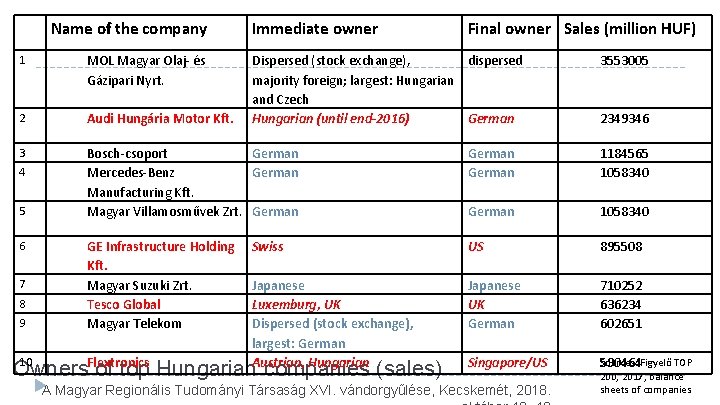
Name of the company 1 MOL Magyar Olaj- és Gázipari Nyrt. 2 Audi Hungária Motor Kft. 3 4 Bosch-csoport German Mercedes-Benz German Manufacturing Kft. Magyar Villamosművek Zrt. German 1184565 1058340 German 1058340 GE Infrastructure Holding Kft. Magyar Suzuki Zrt. Tesco Global Magyar Telekom Swiss US 895508 Japanese Luxemburg, UK Dispersed (stock exchange), largest: German Austrian, Hungarian Japanese UK German 710252 636234 602651 Singapore/US Sources: Figyelő TOP 590464 200, 2017, balance sheets of companies 5 6 7 8 9 Immediate owner Final owner Sales (million HUF) Dispersed (stock exchange), dispersed majority foreign; largest: Hungarian and Czech Hungarian (until end-2016) German 10 Flextronics Owners of top Hungarian companies (sales) A Magyar Regionális Tudományi Társaság XVI. vándorgyűlése, Kecskemét, 2018. 3553005 2349346
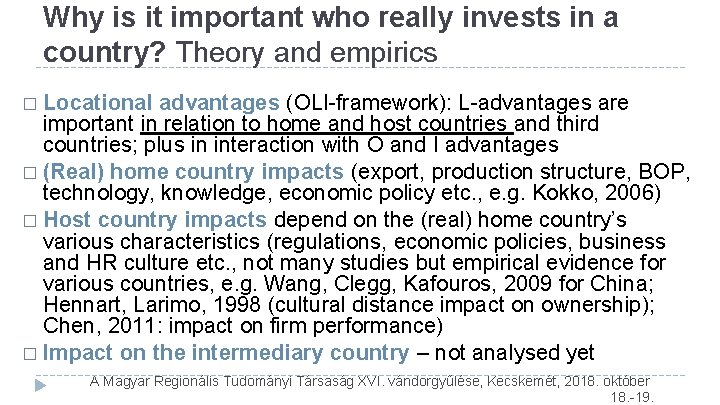
Why is it important who really invests in a country? Theory and empirics � Locational advantages (OLI-framework): L-advantages are important in relation to home and host countries and third countries; plus in interaction with O and I advantages � (Real) home country impacts (export, production structure, BOP, technology, knowledge, economic policy etc. , e. g. Kokko, 2006) � Host country impacts depend on the (real) home country’s various characteristics (regulations, economic policies, business and HR culture etc. , not many studies but empirical evidence for various countries, e. g. Wang, Clegg, Kafouros, 2009 for China; Hennart, Larimo, 1998 (cultural distance impact on ownership); Chen, 2011: impact on firm performance) � Impact on the intermediary country – not analysed yet A Magyar Regionális Tudományi Társaság XVI. vándorgyűlése, Kecskemét, 2018. október 18. -19.
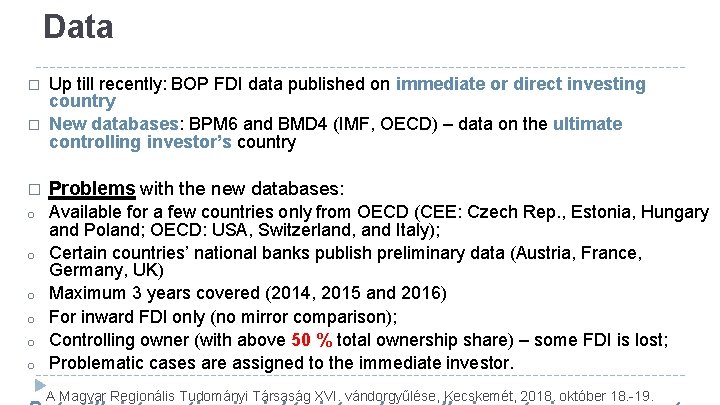
Data � � Up till recently: BOP FDI data published on immediate or direct investing country New databases: BPM 6 and BMD 4 (IMF, OECD) – data on the ultimate controlling investor’s country � Problems with the new databases: o Available for a few countries only from OECD (CEE: Czech Rep. , Estonia, Hungary and Poland; OECD: USA, Switzerland, and Italy); Certain countries’ national banks publish preliminary data (Austria, France, Germany, UK) Maximum 3 years covered (2014, 2015 and 2016) For inward FDI only (no mirror comparison); Controlling owner (with above 50 % total ownership share) – some FDI is lost; Problematic cases are assigned to the immediate investor. o o o A Magyar Regionális Tudományi Társaság XVI. vándorgyűlése, Kecskemét, 2018. október 18. -19.
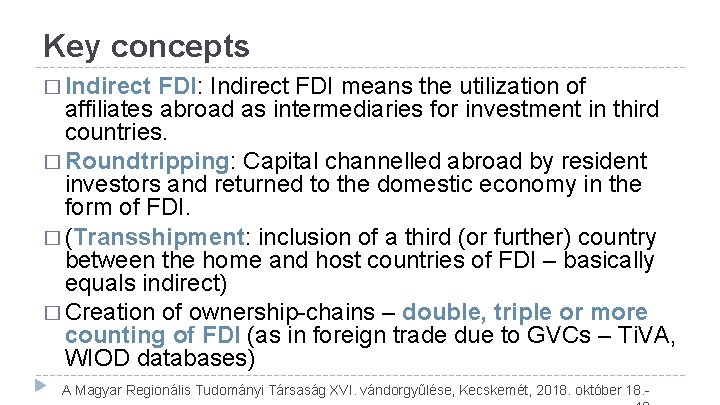
Key concepts � Indirect FDI: Indirect FDI means the utilization of affiliates abroad as intermediaries for investment in third countries. � Roundtripping: Capital channelled abroad by resident investors and returned to the domestic economy in the form of FDI. � (Transshipment: inclusion of a third (or further) country between the home and host countries of FDI – basically equals indirect) � Creation of ownership-chains – double, triple or more counting of FDI (as in foreign trade due to GVCs – Ti. VA, WIOD databases) A Magyar Regionális Tudományi Társaság XVI. vándorgyűlése, Kecskemét, 2018. október 18. -
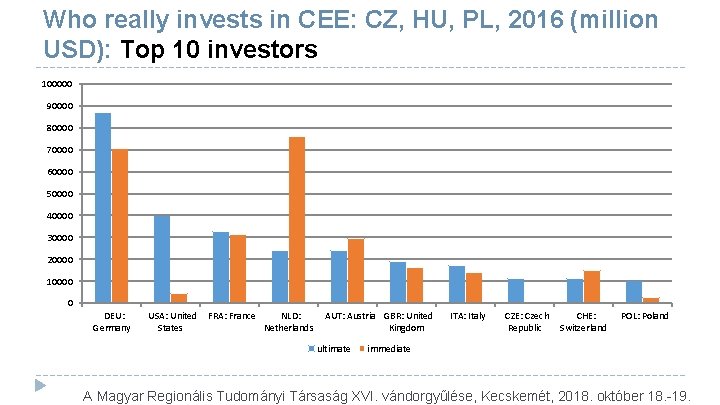
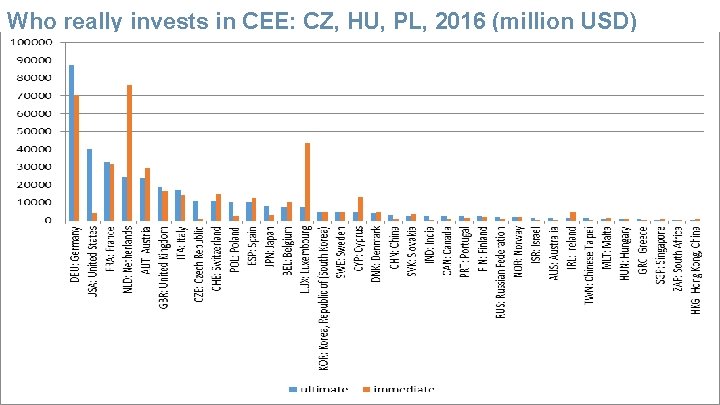
Who really invests in CEE: CZ, HU, PL, 2016 (million USD): Top 10 investors 100000 90000 80000 70000 60000 50000 40000 30000 20000 10000 0 DEU: Germany USA: United FRA: France NLD: AUT: Austria GBR: United ITA: Italy States Netherlands Kingdom ultimate CZE: Czech CHE: POL: Poland Republic Switzerland immediate A Magyar Regionális Tudományi Társaság XVI. vándorgyűlése, Kecskemét, 2018. október 18. -19.
Who really invests in CEE: CZ, HU, PL, 2016 (million USD) A Magyar Regionális Tudományi Társaság XVI. vándorgyűlése, Kecskemét, 2018.
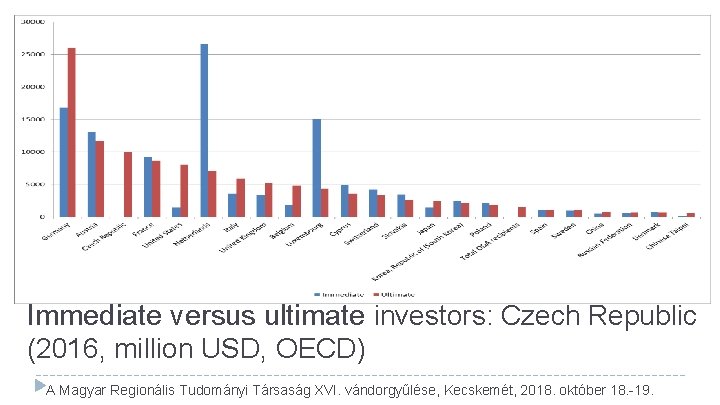
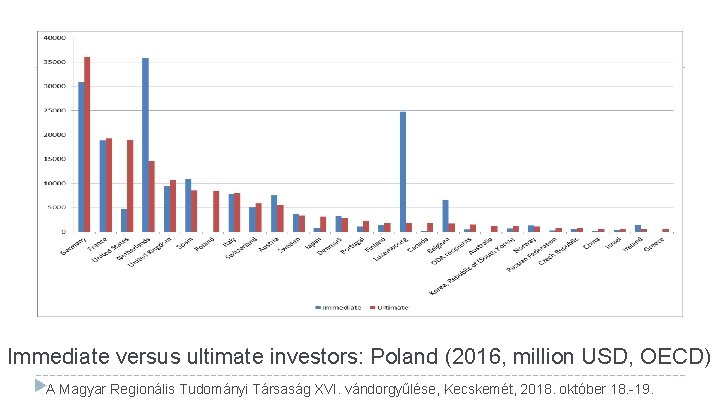
Who really invests in CEE? � Germany is by far the most important, partly indirectly � US: much more important, mainly indirectly � More even distribution (based on ultimate) for other EUmembers (esp. France, Netherlands, Austria, UK, Italy, Switzerland, Spain) � Higher share of extra-EU: especially Japan, China, India, Chinese Taipei (Korea: no) � Higher share of CEE regional FDI (except for Hungary: intermediary country), but main reason: roundtripping � Minor, but higher share than immediate: Canada, Russia, Australia A Magyar Regionális Tudományi Társaság XVI. vándorgyűlése, Kecskemét, 2018. október 18. -19.
Who has not invested so much in CEE compared to what we thought previously? � Certain o o o EU-members, (not outside-EU offshore centers) especially: Netherlands („Dutch sandwich”) (CZ, HU, PL) Luxemburg (CZ, PL) Austria (mainly HU) Ireland („Irish double”) (HU, PL) Less important: Belgium, Cyprus (Russian FDI, especially PL) A Magyar Regionális Tudományi Társaság XVI. vándorgyűlése, Kecskemét, 2018. október 18. -
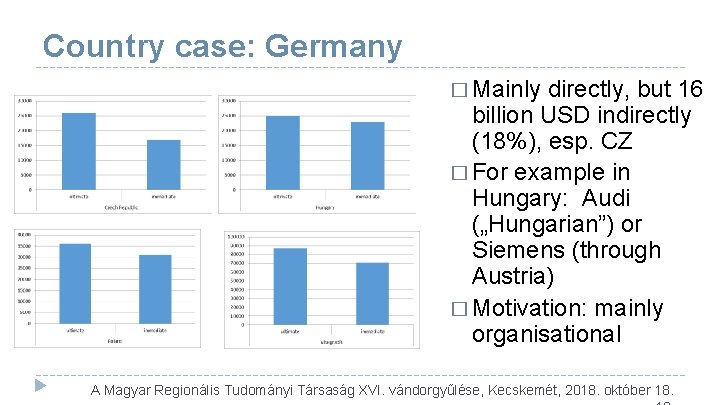
Country case: Germany � Mainly directly, but 16 billion USD indirectly (18%), esp. CZ � For example in Hungary: Audi („Hungarian”) or Siemens (through Austria) � Motivation: mainly organisational A Magyar Regionális Tudományi Társaság XVI. vándorgyűlése, Kecskemét, 2018. október 18.
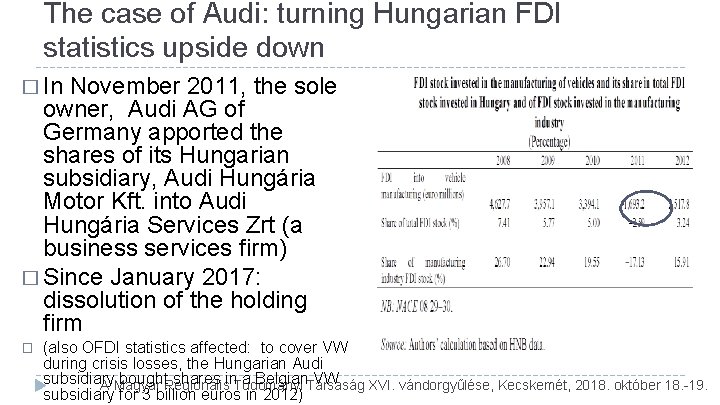
The case of Audi: turning Hungarian FDI statistics upside down � In November 2011, the sole owner, Audi AG of Germany apported the shares of its Hungarian subsidiary, Audi Hungária Motor Kft. into Audi Hungária Services Zrt (a business services firm) � Since January 2017: dissolution of the holding firm � (also OFDI statistics affected: to cover VW during crisis losses, the Hungarian Audi subsidiary bought. Regionális shares in. Tudományi a Belgian. Társaság VW A Magyar XVI. vándorgyűlése, Kecskemét, 2018. október 18. -19. subsidiary for 3 billion euros in 2012)
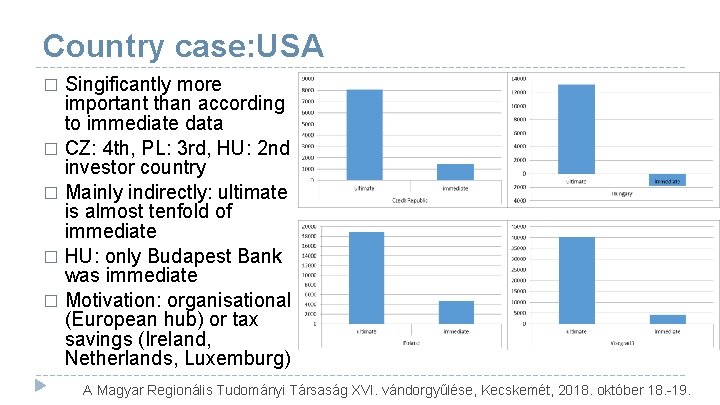
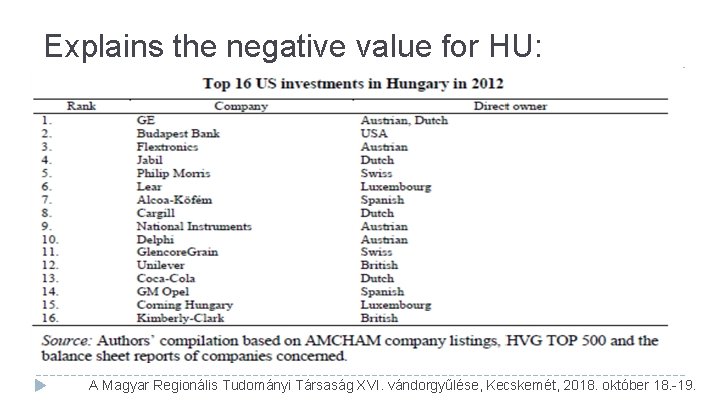
Country case: USA Singificantly more important than according to immediate data � CZ: 4 th, PL: 3 rd, HU: 2 nd investor country � Mainly indirectly: ultimate is almost tenfold of immediate � HU: only Budapest Bank was immediate � Motivation: organisational (European hub) or tax savings (Ireland, Netherlands, Luxemburg) � A Magyar Regionális Tudományi Társaság XVI. vándorgyűlése, Kecskemét, 2018. október 18. -19.
Explains the negative value for HU: A Magyar Regionális Tudományi Társaság XVI. vándorgyűlése, Kecskemét, 2018. október 18. -19.
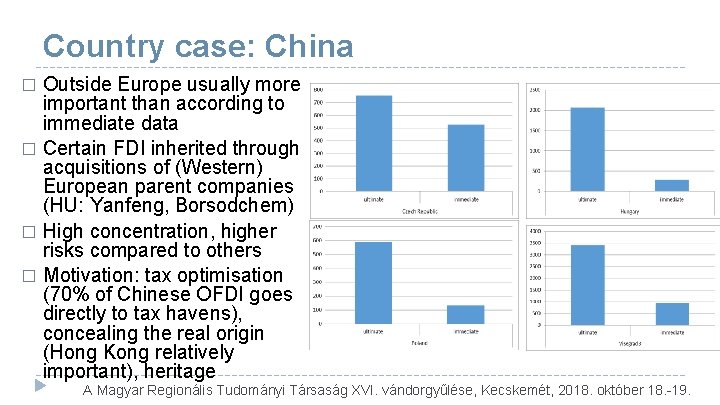
Country case: China Outside Europe usually more important than according to immediate data � Certain FDI inherited through acquisitions of (Western) European parent companies (HU: Yanfeng, Borsodchem) � High concentration, higher risks compared to others � Motivation: tax optimisation (70% of Chinese OFDI goes directly to tax havens), concealing the real origin (Hong Kong relatively important), heritage � A Magyar Regionális Tudományi Társaság XVI. vándorgyűlése, Kecskemét, 2018. október 18. -19.
The case of Hungary: selected Chinese FDI projects A Magyar Regionális Tudományi Társaság XVI. vándorgyűlése, Kecskemét, 2018. október 18. -19.
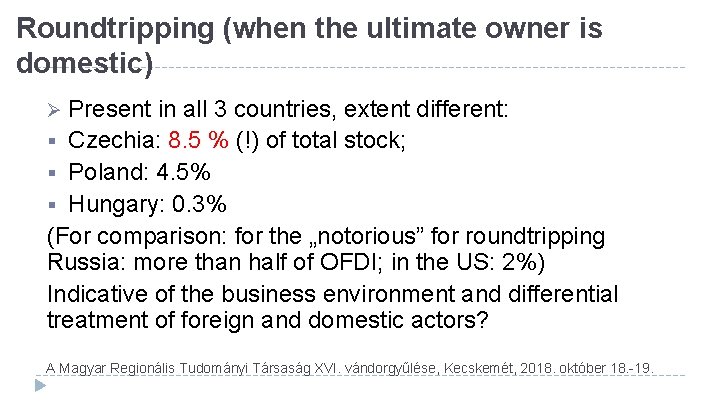
Roundtripping (when the ultimate owner is domestic) Present in all 3 countries, extent different: § Czechia: 8. 5 % (!) of total stock; § Poland: 4. 5% § Hungary: 0. 3% (For comparison: for the „notorious” for roundtripping Russia: more than half of OFDI; in the US: 2%) Indicative of the business environment and differential treatment of foreign and domestic actors? Ø A Magyar Regionális Tudományi Társaság XVI. vándorgyűlése, Kecskemét, 2018. október 18. -19.
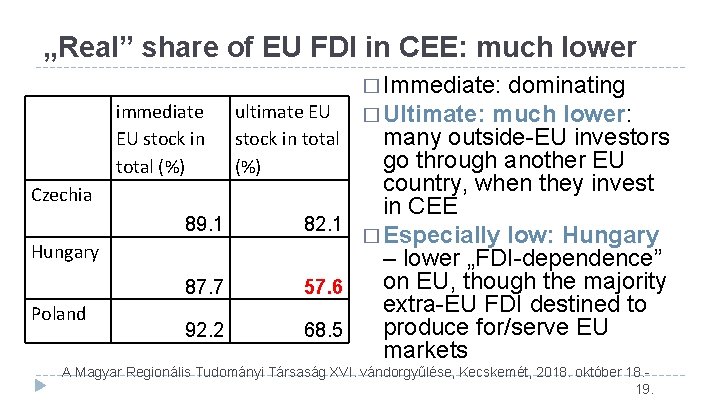
„Real” share of EU FDI in CEE: much lower � Immediate: immediate EU stock in total (%) ultimate EU stock in total (%) Czechia 89. 1 82. 1 87. 7 57. 6 92. 2 68. 5 Hungary Poland dominating � Ultimate: much lower: many outside-EU investors go through another EU country, when they invest in CEE � Especially low: Hungary – lower „FDI-dependence” on EU, though the majority extra-EU FDI destined to produce for/serve EU markets A Magyar Regionális Tudományi Társaság XVI. vándorgyűlése, Kecskemét, 2018. október 18. 19.
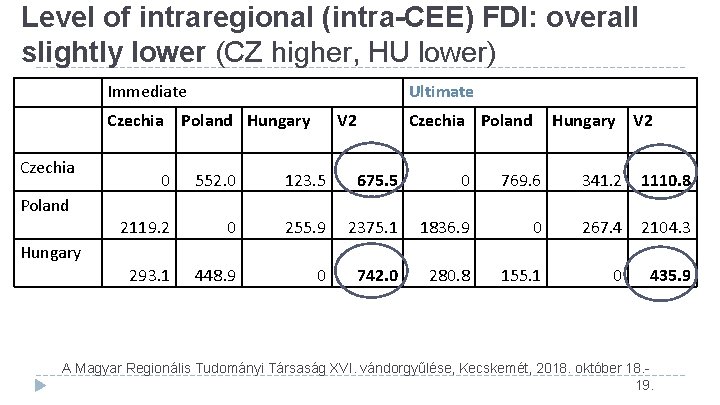
Level of intraregional (intra-CEE) FDI: overall slightly lower (CZ higher, HU lower) Immediate Czechia Poland Hungary Czechia Ultimate V 2 Czechia Poland Hungary V 2 0 552. 0 123. 5 675. 5 0 769. 6 341. 2 1110. 8 2119. 2 0 255. 9 2375. 1 1836. 9 0 267. 4 2104. 3 293. 1 448. 9 0 742. 0 280. 8 155. 1 0 435. 9 Poland Hungary A Magyar Regionális Tudományi Társaság XVI. vándorgyűlése, Kecskemét, 2018. október 18. 19.
Econometric analysis (work in progress, preliminary) �A simple test (whether the ultimate controlling owner data perform better than the immediate) - Hungary � Ln. FDIstock (2016)= GDPhome+GDPpercapitahome+DISTcapitals + Dummy 1(common border) + Dummy 2 (EU) � Results with immediate FDI: Rsquared: 0. 387, adj. Rsquared: 0. 327; F: 6. 439, significant variables: per capita GDP and EU � Results with ultimate FDI: Rsquared: 0. 416, adj. Rsquared: 0. 358; F: 7. 258; significant variables: GDP, per capita GDP and EU A Magyar Regionális Tudományi Társaság XVI. vándorgyűlése, Kecskemét, 2018. október 18. -19.
� Tax optimisation/evasion; restructuring of the network of MNCs, concealing the real origin of the investor etc. increased the share of FDI in total going through third (fourth, fifth etc. ) countries � FDI breakdown data by nationality of investor, sector and activity yields decreasing amounts of useable information � It has become less and less clear who really invests in a country � Efforts of IMF and OECD to improve statistics, including FDI to reflect new economic realities � BPM 6 and BMD 4 provide a useful tool – new data according to the ultimate owner of FDI Conclusions and consequences for policy A Magyar Regionális Tudományi Társaság XVI. vándorgyűlése, Kecskemét, 2018. október 18. 19.
� According to the new data and to the comparison of immediate and ultimate owner nationality data � Differences in main investor countries (Germany, US dominates, and more „even” distribution among others, extra. EU overall higher; lower share of EU, esp. for HU and PL) � Certain EU-countries mainly „intermediates” (Netherlands, Luxemburg, Austria, Ireland) � Consequences for economic policy (influence of which country’s policies/changes in the business environment; considerations for FDI promotion etc. ) � (International: fighting fiscal erosion due to tax optimisation may be easier than previously thought – as the concentration is quite high…. ) A Magyar Regionális Tudományi Társaság XVI. vándorgyűlése, Kecskemét, 2018. október 18. -19.
Future research � Impact on intermediary countries (HU…) � Impact depending on real home countries � Motivations � Econometric models using data according to immediate and final/ultimate owner countries – work in progress; Other variables included (tax haven, HDI, relative measures of GDP, GDP per capita…) � Web of FDI with double, triple… counting in the world economy – Ti. VA-type approach? A Magyar Regionális Tudományi Társaság XVI. vándorgyűlése, Kecskemét, 2018. október 18. -19.
Thank you for your attention! A Magyar Regionális Tudományi Társaság XVI. vándorgyűlése, Kecskemét, 2018. október 18. 19.
Immediate versus ultimate investors: Czech Republic (2016, million USD, OECD) A Magyar Regionális Tudományi Társaság XVI. vándorgyűlése, Kecskemét, 2018. október 18. -19.
rm -5000 an y US Au A st r No Fr ia t i an de ce nt ifi Un ed ite d Ita Ki ng ly do m Ne Ja p th an er la nd s In di a Sw Ch itz ina er la nd Ko r Be ea Lu lgiu xe m m bu r Cy g pr De us nm ar k Sp ai n Isr ae No l rw Uk ay ra in Cz e ec M h al Re ta pu b Ca lic na Hu da ng a Sw ry ed e Ta n iw a Ru n ss Ire ia la n Lie Po d ch lan te d ns te M in Ho exic ng o ko ng Ge 30000 25000 20000 15000 10000 5000 0 Ultimate Immediate versus ultimate investors: Hungary (2016, million USD - HNB) A Magyar Regionális Tudományi Társaság XVI. vándorgyűlése, Kecskemét, 2018. október 18. -
Immediate versus ultimate investors: Poland (2016, million USD, OECD) A Magyar Regionális Tudományi Társaság XVI. vándorgyűlése, Kecskemét, 2018. október 18. -19.