Weather Information for Pilots Captain Steve Jangelis Aviation


- Slides: 16
Weather Information for Pilots Captain Steve Jangelis Aviation Safety Chairman Air Safety Organization Air Line Pilots Association, International Weather User Panel – Needs and Shortfalls Washington, DC July 12, 2017 Air Line Pilots Association, Int’l
Agenda ØSurface Observations § § When Do Pilots Use Them? What Do Pilots Do with Them? Accuracy and Validity of the Data What Happens if They Are Missing? ØPIREPs ØTurbulence Information Air Line Pilots Association, Int’l
When Do Pilots Use Surface Observation? ØTakeoff and Landing Phase; Weather Packet must include § § § Departure Observations Destination TAF Alternate Airport(s) Observations (if required) Alternate Airport(s) TAF(s) (if required) Any hazard to flight identified by the Dispatcher as relevant to the safe operation of the flight. (Volcanic eruption, Mountain waves, etc) Air Line Pilots Association, Int’l
What do Pilots do with Surface Observations? ØCompute aircraft performance, often known as Takeoff and Landing Data (TOLD) ØDetermine which runway is in use, if Control Tower closed ØDetermine if airport is equipped for the operation due to weather (Category II or III Approach) Air Line Pilots Association, Int’l
Accurate and Valid Surface Observations ØPilots need to trust surface data for the purpose of computing aircraft performance § It’s critical for pilots when receiving surface information that the data is accurate § A safe takeoff or landing depend on accurate data ØPilots Consider the Source of the Data § Tower, ATIS, Weather Observer, ASOS Air Line Pilots Association, Int’l
Reports ØWhether VMC or IMC, Pilots will not takeoff or conduct approaches to any airport without a valid report of airport weather conditions. ØDispatch IS allowed without a report IF a valid weather report can be obtained prior to commencing the approach. Air Line Pilots Association, Int’l
Validity ØReports obtained from ATIS, AWOS/ASOS, FSS, VOLMET, the Dispatcher or any Air Traffic Controller are considered valid. ØReport must contain the following: § § § Time of the observation Wind direction/Speed Visibility Ceiling Temperature/ Dew point Altimeter setting Air Line Pilots Association, Int’l
Validity-Missing Items ØDew point can be missing if it is not needed for MEL/Performance requirements. ØThe NWS Real-Time Mesoscale Analysis (RTMA) product may be used for missing temperature and if previously approved by the FAA, used for other missing variables. Air Line Pilots Association, Int’l
Validity-Approved Source ØUS National Weather Service ØCompany Meteorology Department ØA weather facility approved by the NWS/FAA ØAny other nation’s weather service Air Line Pilots Association, Int’l
PIREP Information ØWhen are PIREPs Needed: § During Takeoff and Climb Phase: • Windshear, Turbulence, Icing, Wildlife § During Enroute Phase: • Turbulence, Precipitation § During Approach and Landing Phase: • Windshear, Turbulence, Icing, Precipitation, Braking Action Reports, and Wildlife Air Line Pilots Association, Int’l
PIREP Information ØPIREPs need to be precise and accurate ØPilots need to be able to trust PIREP data, so it’s critical for pilots when giving and receiving PIREP information that the data is accurate. ØFor Example: Braking Action Reports • • • Different airplanes yield different braking abilities ATC should transmit ALL braking actions less than good, if the runway has not been tended to by the airport Airports should monitor all PIREPS Air Line Pilots Association, Int’l
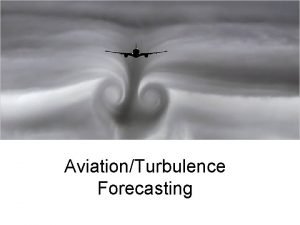
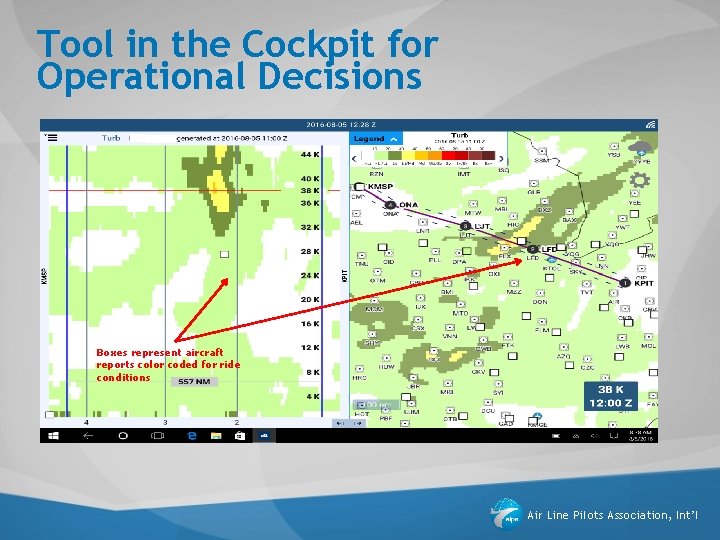
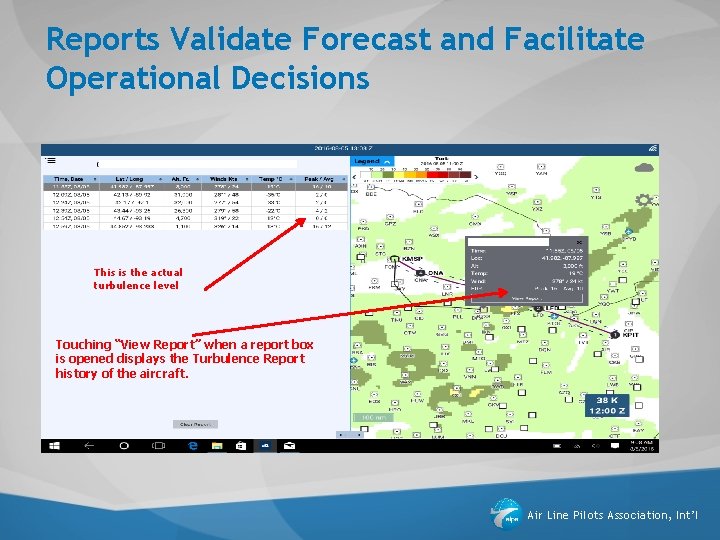
Turbulence Information ØPredicting the where, when and intensity of turbulence is notoriously difficult to do. But Delta has developed a new, industryleading app that’s helping pilots better spot and avoid it. ØDelta’s Flight Weather Viewer app provides pilots with real-time graphics of turbulence observations and forecasts on the flight deck. Air Line Pilots Association, Int’l
Tool in the Cockpit for Operational Decisions Boxes represent aircraft reports color coded for ride conditions Air Line Pilots Association, Int’l
Reports Validate Forecast and Facilitate Operational Decisions This is the actual turbulence level Touching “View Report” when a report box is opened displays the Turbulence Report history of the aircraft. Air Line Pilots Association, Int’l
Summary ØSurface Observations are critical to pilots with specific meteorological information to help compute aircraft performance for takeoff and landing ØSurface data needs to be precise, accurate and current from a reliable approved source ØPIREP data helps pilots with detailed information for each phase of flight ØTurbulence information helps find smooth air and reduce passenger/FA injuries. Air Line Pilots Association, Int’l
Together we are making a difference THANK YOU Steve. Jangelis@alpa. org Air Line Pilots Association, Int’l 16