
Aviation Weather Theory Overview Nature of the Atmospheric

- Slides: 17
Aviation Weather Theory
Overview • • Nature of the Atmospheric Circulation and Jet Stream Thunderstorms Wind Shear Microbursts Icing Fog Turbulence © 2015 Coast Flight Training. All Rights Reserved.
Composition of Atmosphere • 78% Nitrogen • 21% Oxygen • 1% Other gasses • Moisture content will shift proportions slightly © 2015 Coast Flight Training. All Rights Reserved.
Structure of Atmosphere • Structure • Made up of molecules which have weight • At sea level the atmosphere exerts 14. 7 psi on the body • At 18, 000’ the atmosphere weighs 7. 35 psi • Layers of The Atmosphere • Atmosphere is broken into layers based on lapse rate © 2015 Coast Flight Training. All Rights Reserved.
Troposphere – Lowest Layer • Where the weather happens • Most of the moisture in the atmosphere exists here • Extends from surface to 20, 000 feet at the poles and 65, 000 at the equator • Lapse rate for temperature is a decrease of 2⁰C per every 1000 feet increase in altitude © 2015 Coast Flight Training. All Rights Reserved.
Tropopause • Boundary between the top of the troposphere and the bottom of the stratosphere • Varies with seasonal change • Altitude where the jet stream is found • Lapse rate ceases at this point © 2015 Coast Flight Training. All Rights Reserved.
Stratosphere • Layer above the troposphere and tropopause • Very little change in temperature with altitude • Slight warming trend towards the top • Extends 26 -30 miles above the tropopause • Very little moisture = very little weather © 2015 Coast Flight Training. All Rights Reserved.
Pressure Change • As altitude increases, for every one-thousand feet, the ambient air pressure decreases 1 inch Hg • Air composition does not change • Humans require a certain pressure to diffuse oxygen across the lungs into the blood stream • As altitude increases it gets harder to breathe • Pressure is also what determines atmospheric stability and potential for bad weather © 2015 Coast Flight Training. All Rights Reserved.
Atmospheric Circulation • All weather is based on the circulation of heat, moisture and pressure within the atmosphere • Multiple factors that influence air movement © 2015 Coast Flight Training. All Rights Reserved.
Wind Patterns • Differences in heating on the earth’s surface • Wind flows from high pressure to low pressure • Ground heats surface air and then it rises • As it rises it begins to cool and fall back down © 2015 Coast Flight Training. All Rights Reserved.
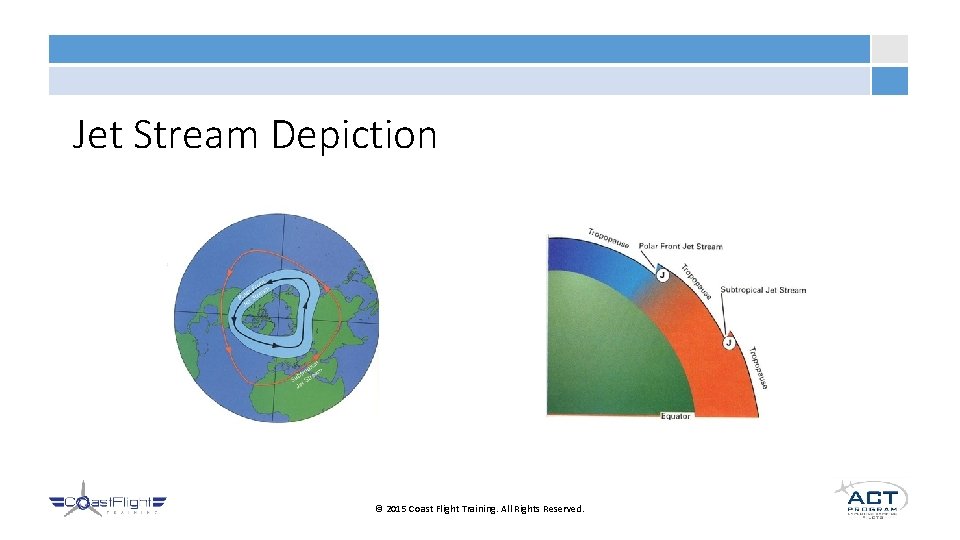
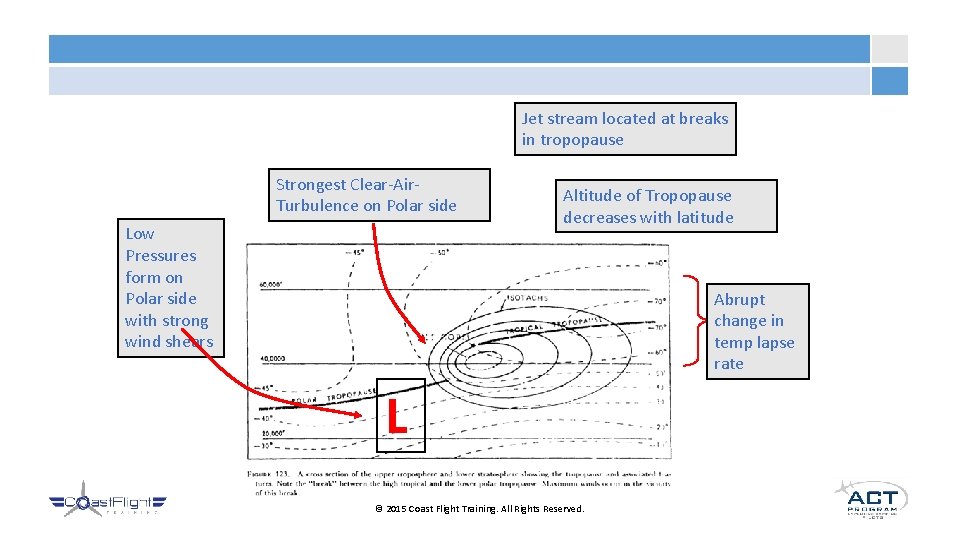
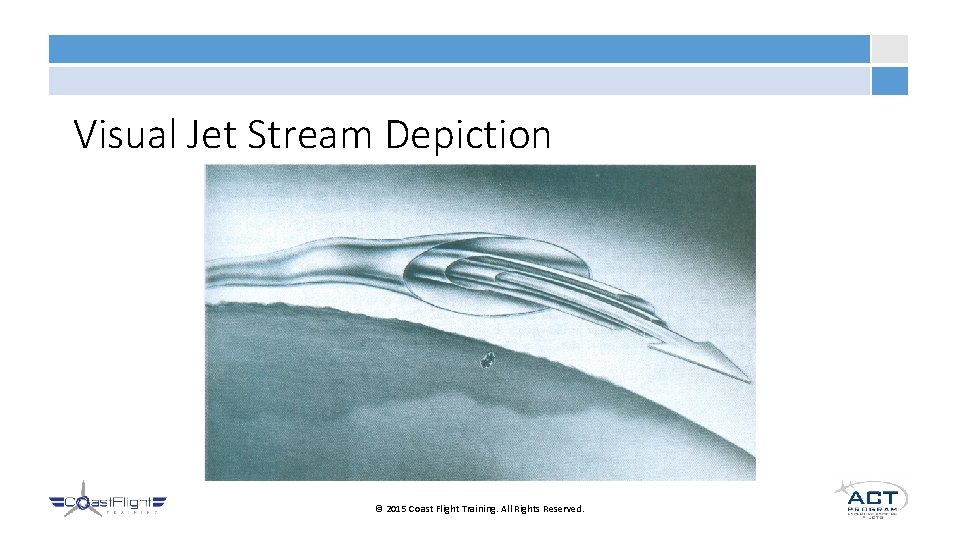
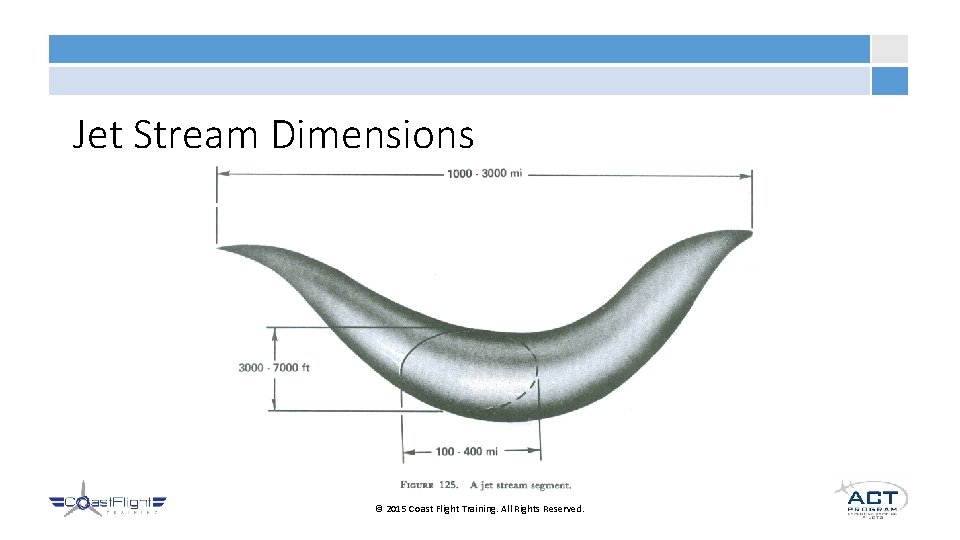
Jet Stream • The jet stream is a narrow band of strong winds meandering through the atmosphere near the top of the troposphere • Strong temperature and pressure gradients exist in this region. • The jet stream occurs at breaks in the tropopause as it descends in step-wise fashion from polar to tropical • A jet at mid latitudes is generally stronger than one at or near the tropics • Greater than 50 kts winds define a jet stream • Stronger winds in winter because of temperature gradient • It also shifts farther south in winter © 2015 Coast Flight Training. All Rights Reserved.
Jet Stream Depiction © 2015 Coast Flight Training. All Rights Reserved.
Jet stream located at breaks in tropopause Strongest Clear-Air. Turbulence on Polar side Low Pressures form on Polar side with strong wind shears Altitude of Tropopause decreases with latitude Abrupt change in temp lapse rate L © 2015 Coast Flight Training. All Rights Reserved.
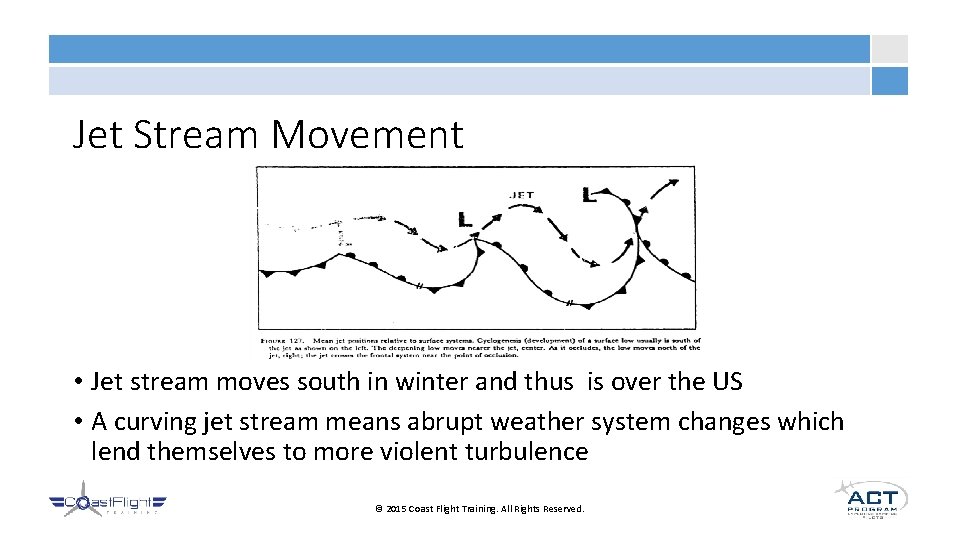
Jet Stream Movement • Jet stream moves south in winter and thus is over the US • A curving jet stream means abrupt weather system changes which lend themselves to more violent turbulence © 2015 Coast Flight Training. All Rights Reserved.
Visual Jet Stream Depiction © 2015 Coast Flight Training. All Rights Reserved.
Jet Stream Dimensions © 2015 Coast Flight Training. All Rights Reserved.
Jet Stream • The jet stream is a narrow band of strong winds meandering through the atmosphere near the top of the troposphere • Strong temperature and pressure gradients exist in this region. • The jet stream occurs at breaks in the tropopause as it descends in step-wise fashion from polar to tropical • A jet at mid latitudes is generally stronger than one at or near the tropics • Greater than 50 kts winds define a jet stream • Stronger winds in winter because of temperature gradient • It also shifts farther south in winter © 2015 Coast Flight Training. All Rights Reserved.