Warm Up Clear your desk and get ready




- Slides: 32
Warm Up Clear your desk and get ready for your quiz!
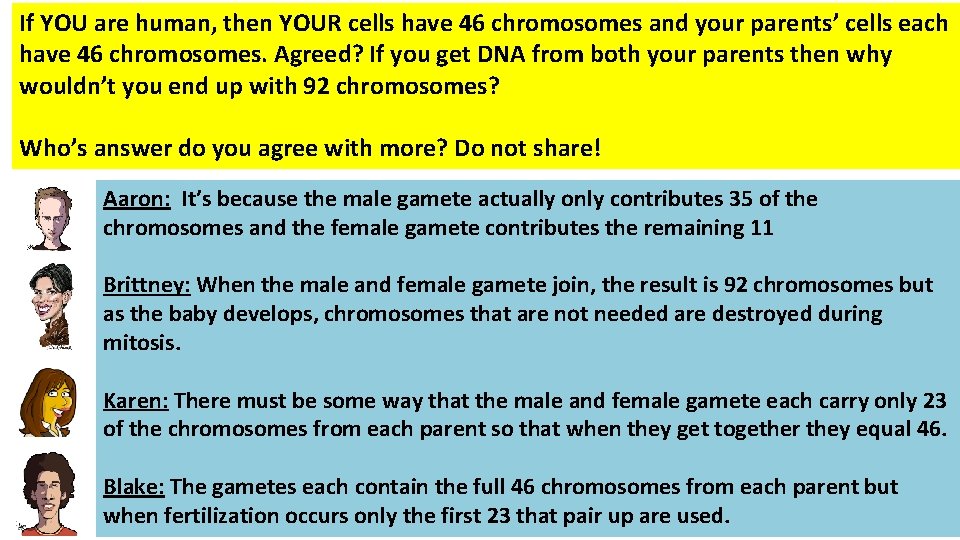
If YOU are human, then YOUR cells have 46 chromosomes and your parents’ cells each have 46 chromosomes. Agreed? If you get DNA from both your parents then why wouldn’t you end up with 92 chromosomes? Who’s answer do you agree with more? Do not share! Aaron: It’s because the male gamete actually only contributes 35 of the chromosomes and the female gamete contributes the remaining 11 Brittney: When the male and female gamete join, the result is 92 chromosomes but as the baby develops, chromosomes that are not needed are destroyed during mitosis. Karen: There must be some way that the male and female gamete each carry only 23 of the chromosomes from each parent so that when they get together they equal 46. Blake: The gametes each contain the full 46 chromosomes from each parent but when fertilization occurs only the first 23 that pair up are used.
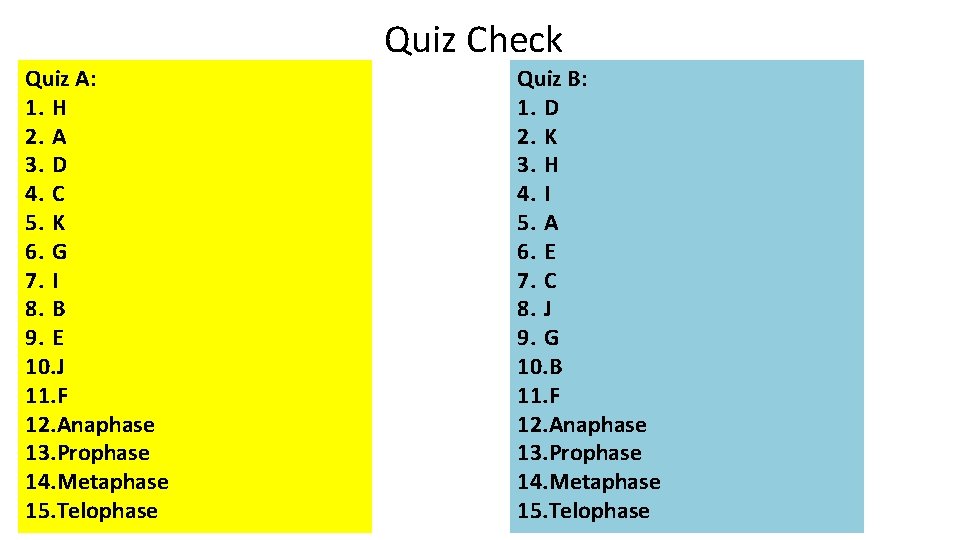
Quiz Check Quiz A: 1. H 2. A 3. D 4. C 5. K 6. G 7. I 8. B 9. E 10. J 11. F 12. Anaphase 13. Prophase 14. Metaphase 15. Telophase Quiz B: 1. D 2. K 3. H 4. I 5. A 6. E 7. C 8. J 9. G 10. B 11. F 12. Anaphase 13. Prophase 14. Metaphase 15. Telophase
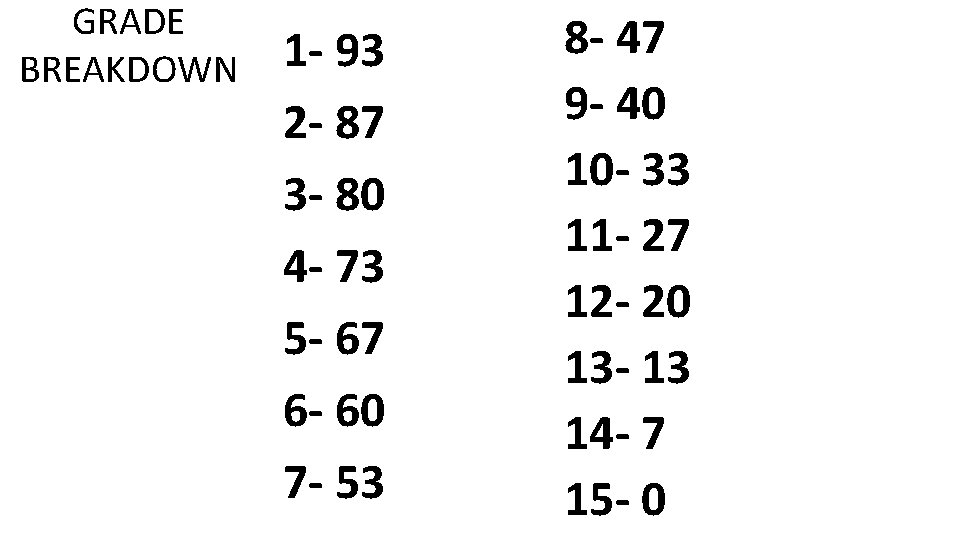
GRADE BREAKDOWN 1 - 93 2 - 87 3 - 80 4 - 73 5 - 67 6 - 60 7 - 53 8 - 47 9 - 40 10 - 33 11 - 27 12 - 20 13 - 13 14 - 7 15 - 0
Prepare your Journals for Cornell Notes • Page: 40 • Title: Meiosis • Essential Question: What is the significance of meiosis to sexual reproduction?
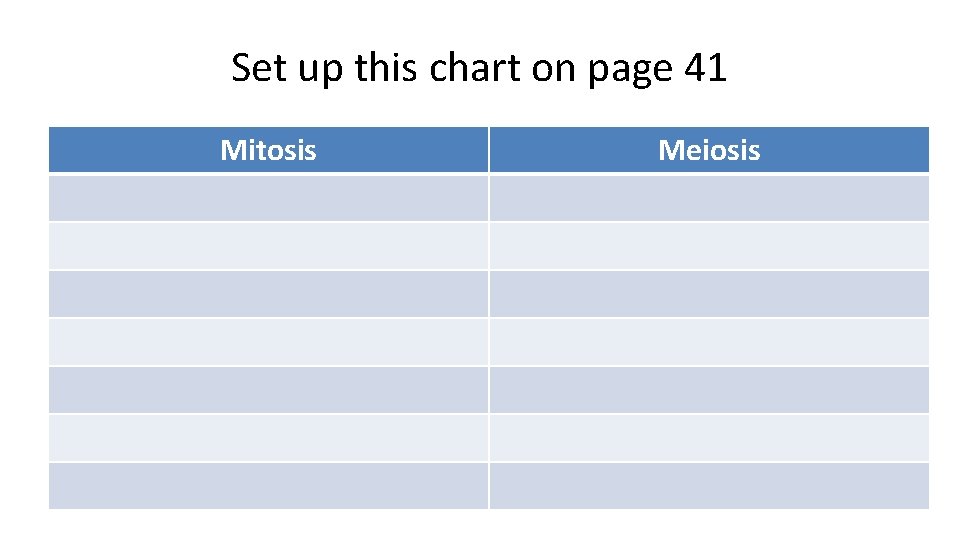
Set up this chart on page 41 Mitosis Meiosis
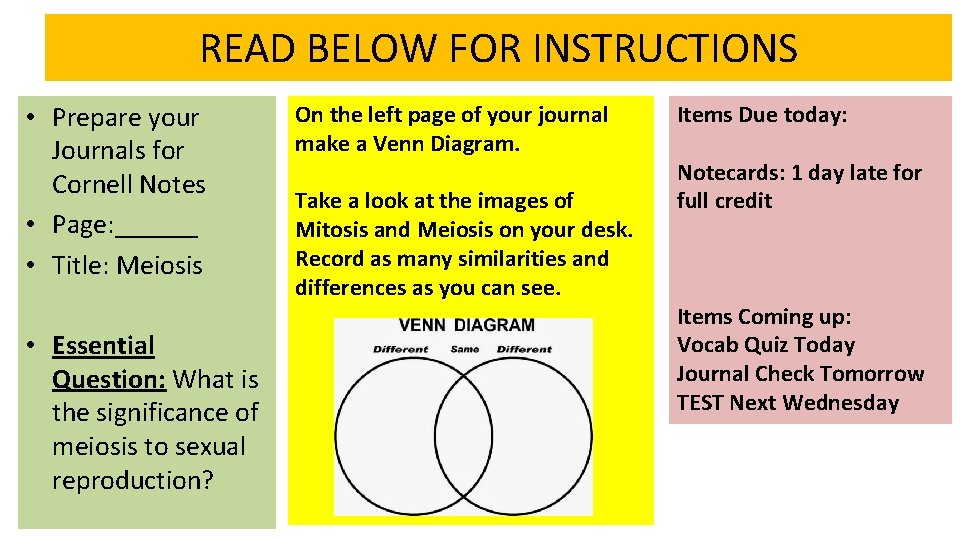
READ BELOW FOR INSTRUCTIONS • Prepare your Journals for Cornell Notes • Page: ______ • Title: Meiosis • Essential Question: What is the significance of meiosis to sexual reproduction? On the left page of your journal make a Venn Diagram. Take a look at the images of Mitosis and Meiosis on your desk. Record as many similarities and differences as you can see. Items Due today: Notecards: 1 day late for full credit Items Coming up: Vocab Quiz Today Journal Check Tomorrow TEST Next Wednesday
• What are some of the similarities we spotted? • What are some of the differences we spotted?
Standard: (B. 6 G) The student will recognize the significance of meiosis in sexual reproduction
Recap: What are Chromosomes?
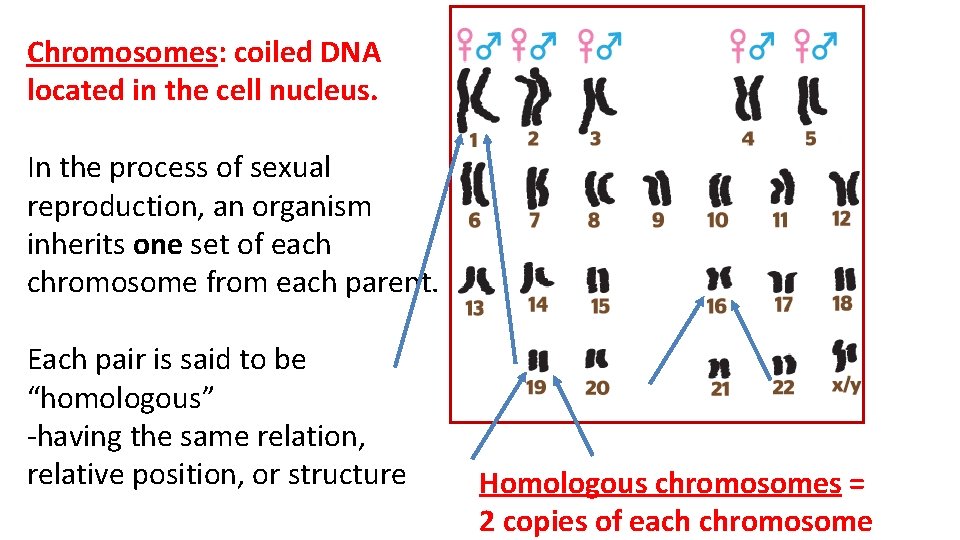
Chromosomes: coiled DNA located in the cell nucleus. In the process of sexual reproduction, an organism inherits one set of each chromosome from each parent. Each pair is said to be “homologous” -having the same relation, relative position, or structure Homologous chromosomes = 2 copies of each chromosome
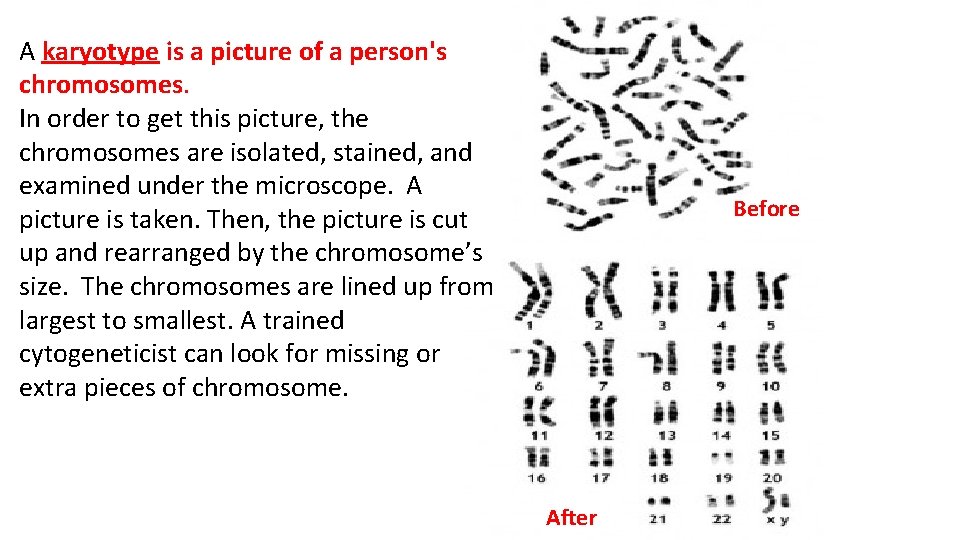
A karyotype is a picture of a person's chromosomes. In order to get this picture, the chromosomes are isolated, stained, and examined under the microscope. A picture is taken. Then, the picture is cut up and rearranged by the chromosome’s size. The chromosomes are lined up from largest to smallest. A trained cytogeneticist can look for missing or extra pieces of chromosome. Before After
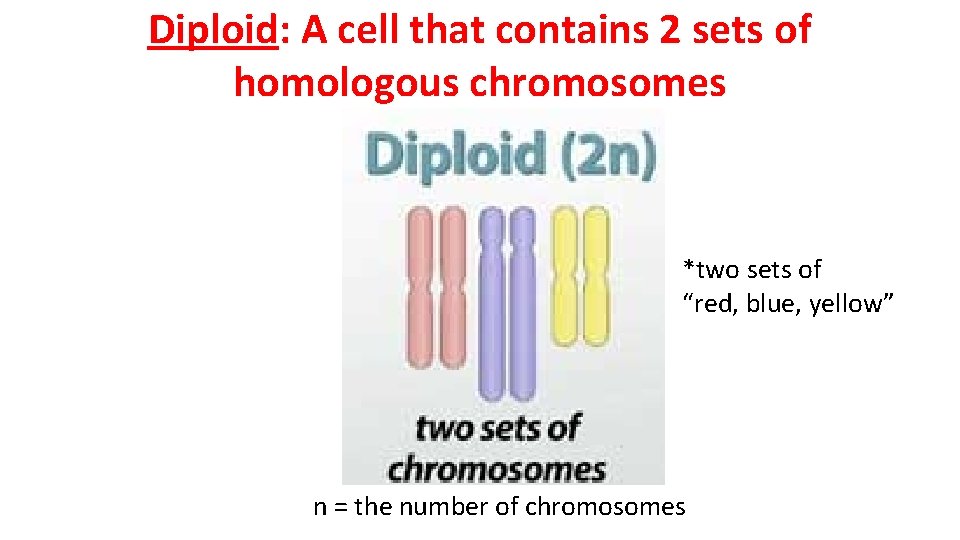
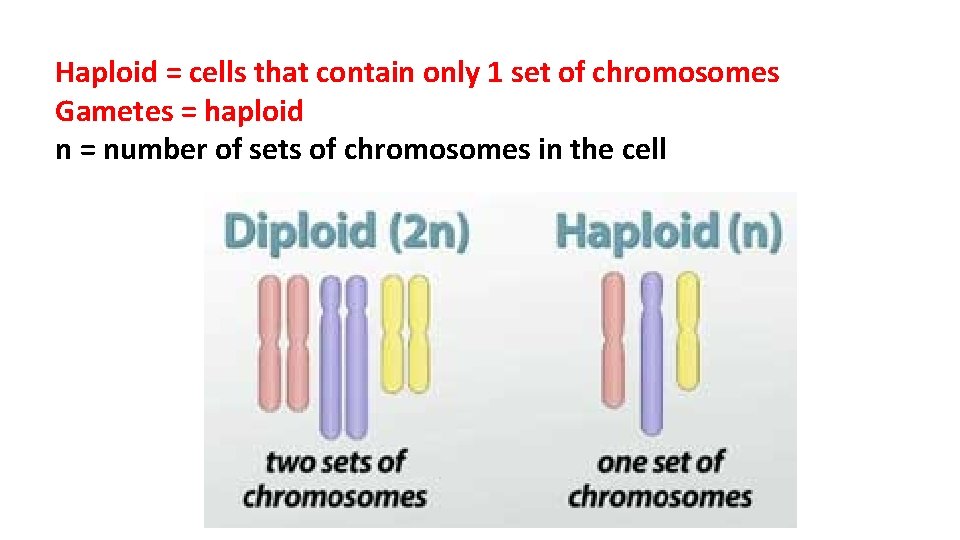
Diploid: A cell that contains 2 sets of homologous chromosomes *two sets of “red, blue, yellow” n = the number of chromosomes
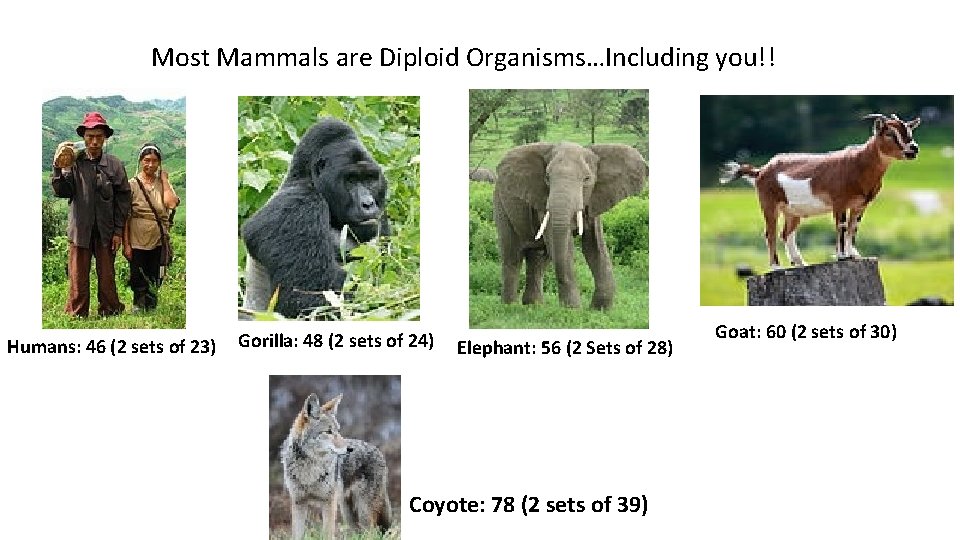
Most Mammals are Diploid Organisms…Including you!! Humans: 46 (2 sets of 23) Gorilla: 48 (2 sets of 24) Elephant: 56 (2 Sets of 28) Coyote: 78 (2 sets of 39) Goat: 60 (2 sets of 30)
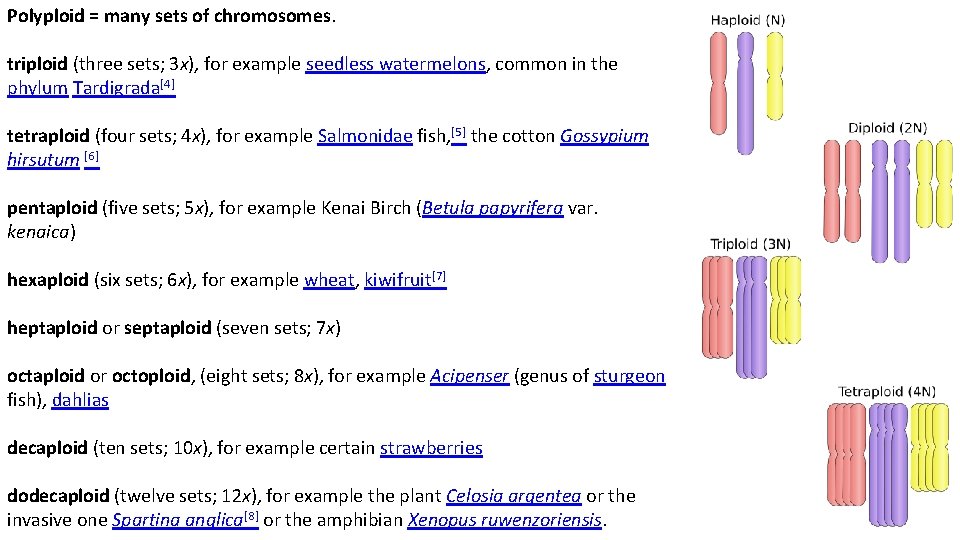
Polyploid = many sets of chromosomes. triploid (three sets; 3 x), for example seedless watermelons, common in the phylum Tardigrada[4] tetraploid (four sets; 4 x), for example Salmonidae fish, [5] the cotton Gossypium hirsutum [6] pentaploid (five sets; 5 x), for example Kenai Birch (Betula papyrifera var. kenaica) hexaploid (six sets; 6 x), for example wheat, kiwifruit[7] heptaploid or septaploid (seven sets; 7 x) octaploid or octoploid, (eight sets; 8 x), for example Acipenser (genus of sturgeon fish), dahlias decaploid (ten sets; 10 x), for example certain strawberries dodecaploid (twelve sets; 12 x), for example the plant Celosia argentea or the invasive one Spartina anglica[8] or the amphibian Xenopus ruwenzoriensis.
Sexual Reproduction & Our Cells
On a cellular level, what happens during sex? Biologically speaking, what’s the point of sex?
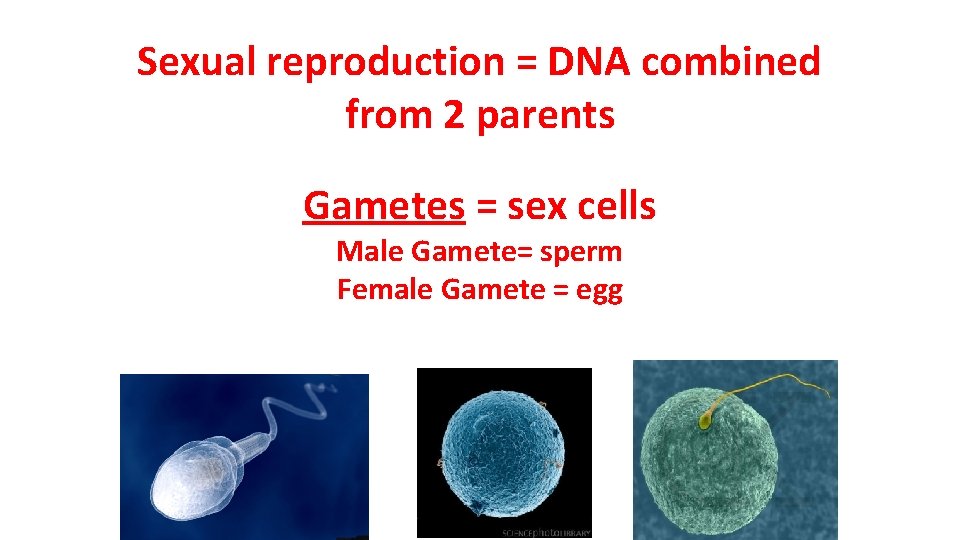
Sexual reproduction = DNA combined from 2 parents Gametes = sex cells Male Gamete= sperm Female Gamete = egg
Bellwork Re-Visited… • Which answer did you agree with more?
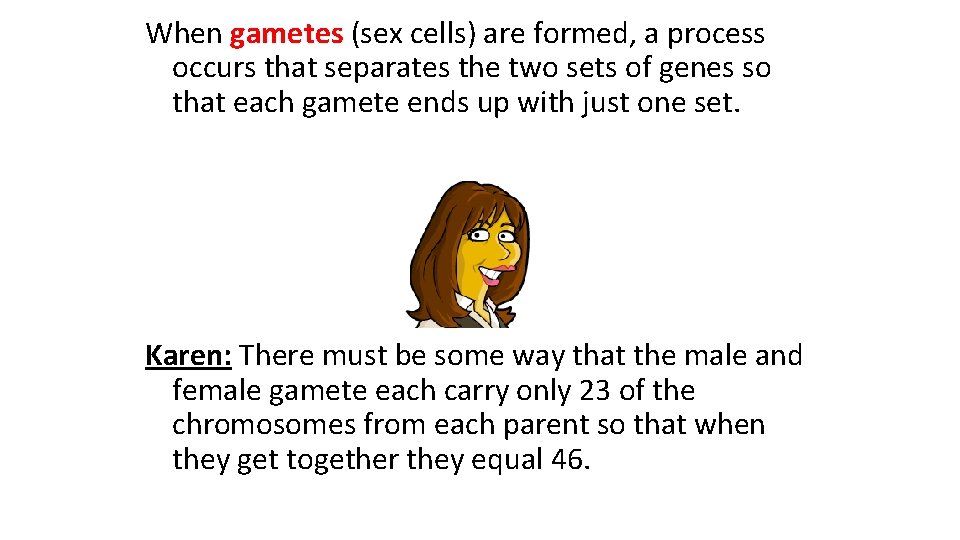
When gametes (sex cells) are formed, a process occurs that separates the two sets of genes so that each gamete ends up with just one set. Karen: There must be some way that the male and female gamete each carry only 23 of the chromosomes from each parent so that when they get together they equal 46.
3. Meiosis
Haploid = cells that contain only 1 set of chromosomes Gametes = haploid n = number of sets of chromosomes in the cell
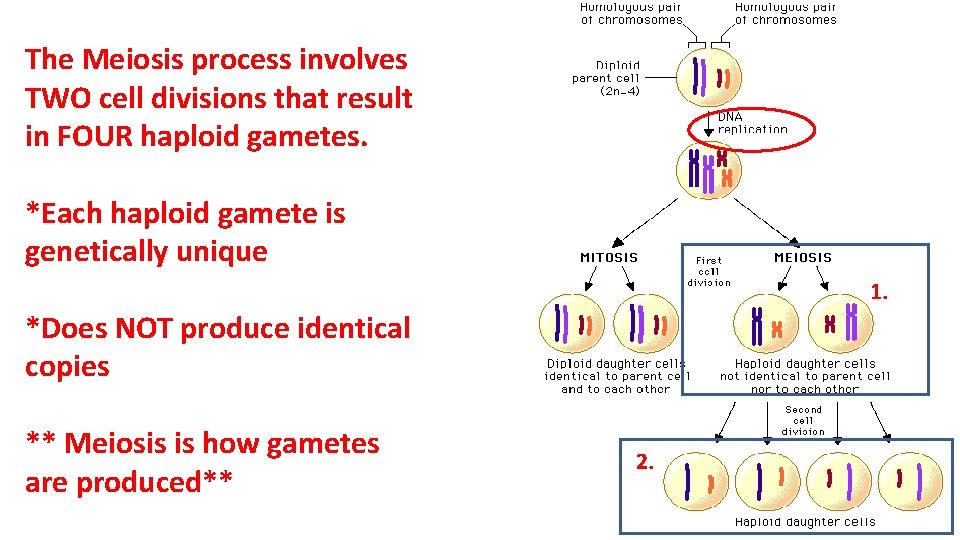
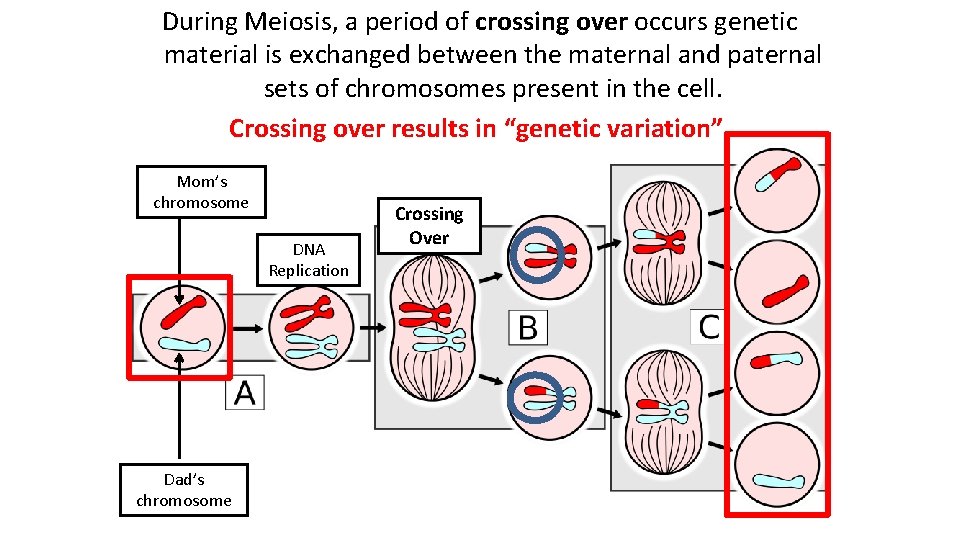
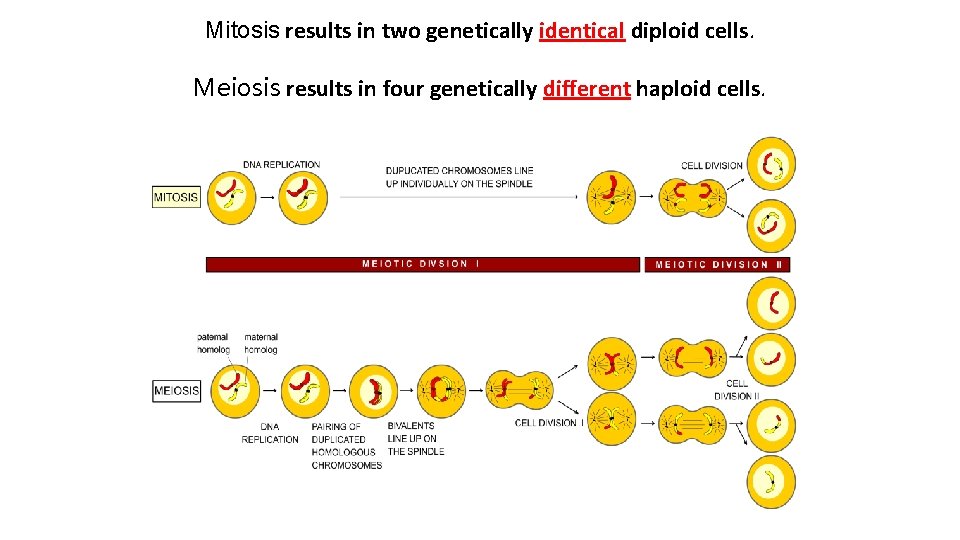
The Meiosis process involves TWO cell divisions that result in FOUR haploid gametes. *Each haploid gamete is genetically unique 1. *Does NOT produce identical copies ** Meiosis is how gametes are produced** 2.
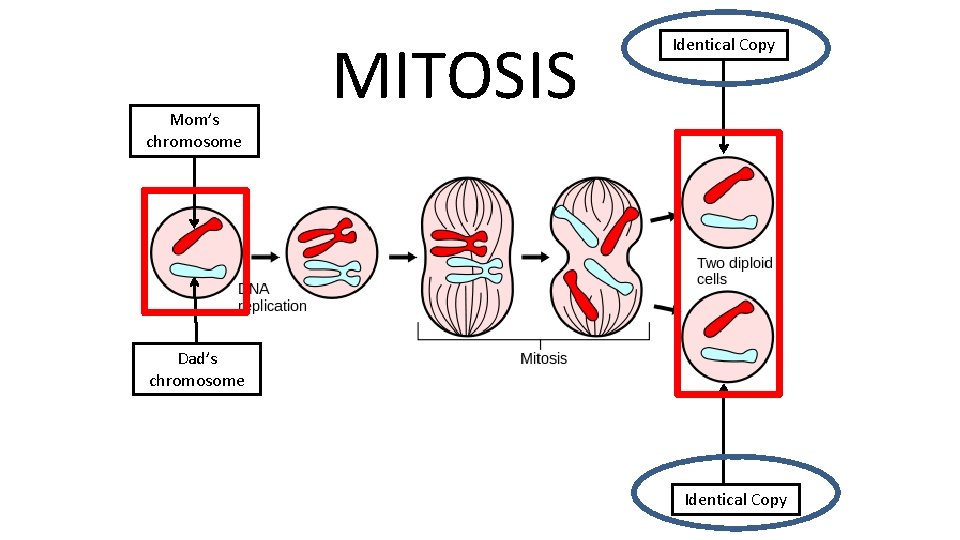
Mom’s chromosome MITOSIS Identical Copy Dad’s chromosome Identical Copy
During Meiosis, a period of crossing over occurs genetic material is exchanged between the maternal and paternal sets of chromosomes present in the cell. Crossing over results in “genetic variation”. Mom’s chromosome DNA Replication Dad’s chromosome Crossing Over
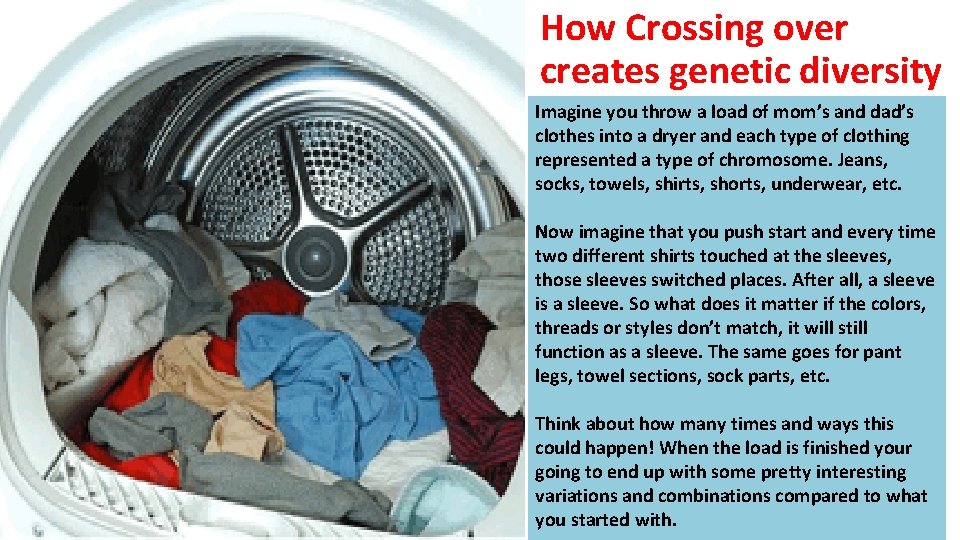
How Crossing over creates genetic diversity Imagine you throw a load of mom’s and dad’s clothes into a dryer and each type of clothing represented a type of chromosome. Jeans, socks, towels, shirts, shorts, underwear, etc. Now imagine that you push start and every time two different shirts touched at the sleeves, those sleeves switched places. After all, a sleeve is a sleeve. So what does it matter if the colors, threads or styles don’t match, it will still function as a sleeve. The same goes for pant legs, towel sections, sock parts, etc. Think about how many times and ways this could happen! When the load is finished your going to end up with some pretty interesting variations and combinations compared to what you started with.
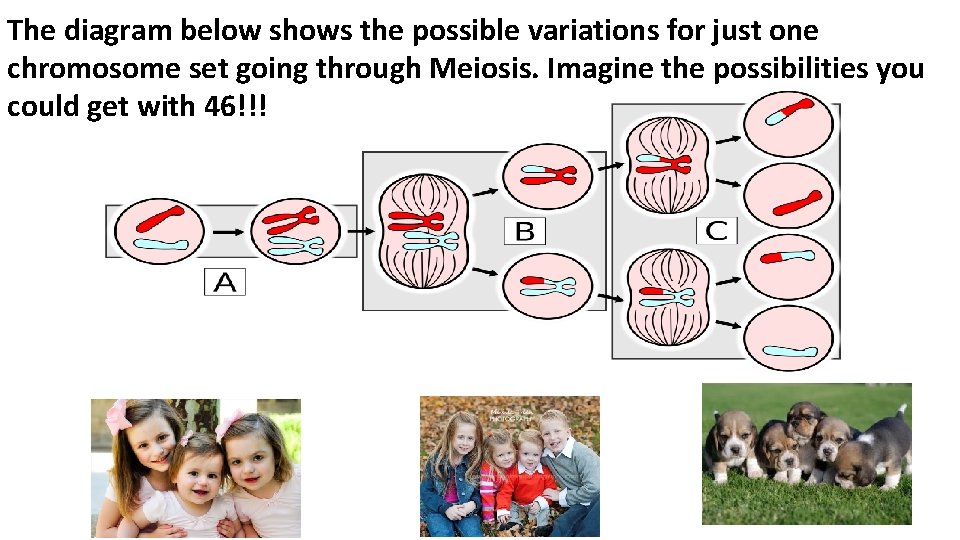
The diagram below shows the possible variations for just one chromosome set going through Meiosis. Imagine the possibilities you could get with 46!!!
Mitosis vs. Meiosis
Mitosis vs Meiosis MITOSIS MEIOSIS REVISIT THE VENN DIAGRAM FROM EARLIER AND ADD ANY NEW INFORMATION.
Mitosis results in two genetically identical diploid cells. Meiosis results in four genetically different haploid cells.
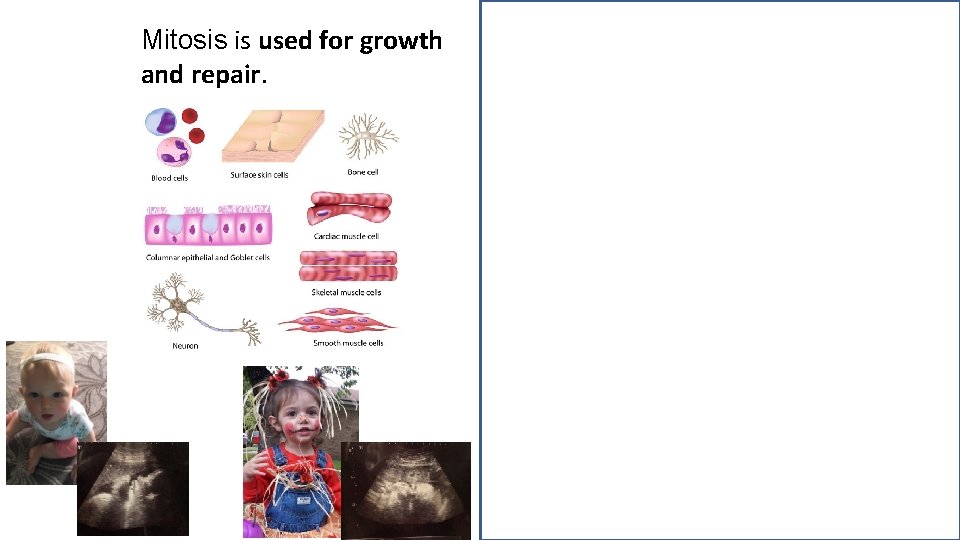
Mitosis is used for growth and repair. Meiosis is used for gamete production and increased genetic variation.
Need Points in your Extra Credit Account? • Meiosis The Great Divide by: the Amoeba Sisters • Meiosis by: Bozeman Science