VISCOSITY MEASUREMENT DR KADRYE ZLEM HAMALOLU 22 10
- Slides: 22
VISCOSITY MEASUREMENT DR. KADRİYE ÖZLEM HAMALOĞLU 22. 10. 2018
WHAT IS VISCOSITY? • Rheology Deformation and flow of matter under the influence of applied stress Viscosity, elasticity, and plasticity • Viscosity Measure of the resistance to deformation of a fluid under shear stress Viscosity is a quantitative measure of a fluid’s resistance to flow. Dynamic (or Absolute) Viscosity: The dynamic viscosity(η) of a fluid is a measure of the resistance it offers to relative shearing motion. Kinematic Viscosity : It is defined as the ratio of absolute viscosity to the density of fluid. DR. KADRİYE ÖZLEM HAMALOĞLU 05. 11. 2018
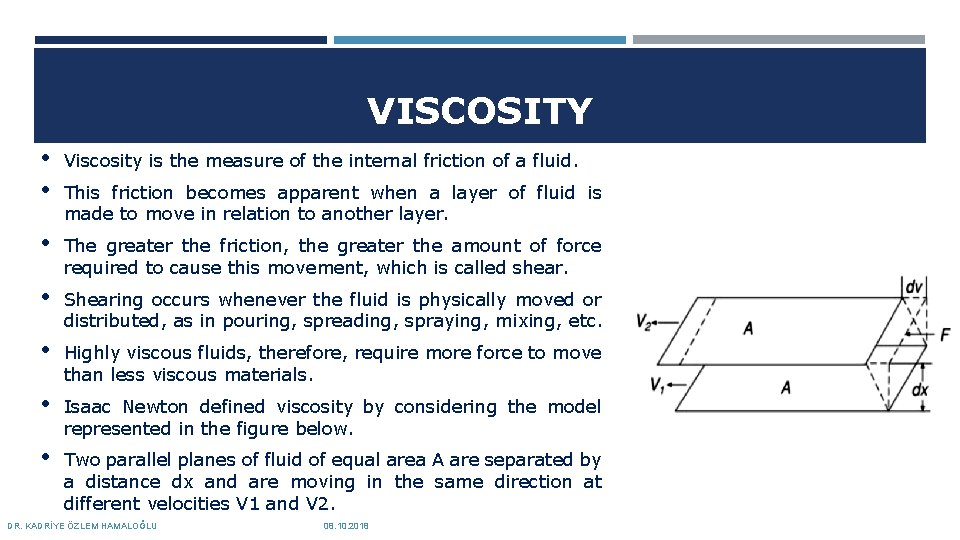
VISCOSITY • • Viscosity is the measure of the internal friction of a fluid. • The greater the friction, the greater the amount of force required to cause this movement, which is called shear. • Shearing occurs whenever the fluid is physically moved or distributed, as in pouring, spreading, spraying, mixing, etc. • Highly viscous fluids, therefore, require more force to move than less viscous materials. • Isaac Newton defined viscosity by considering the model represented in the figure below. • Two parallel planes of fluid of equal area A are separated by a distance dx and are moving in the same direction at different velocities V 1 and V 2. This friction becomes apparent when a layer of fluid is made to move in relation to another layer. DR. KADRİYE ÖZLEM HAMALOĞLU 08. 10. 2018
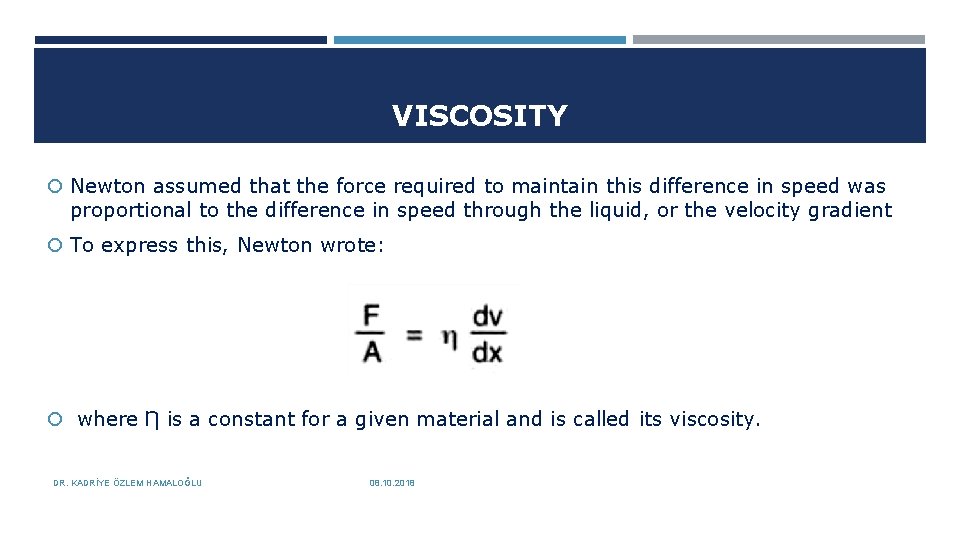
VISCOSITY Newton assumed that the force required to maintain this difference in speed was proportional to the difference in speed through the liquid, or the velocity gradient To express this, Newton wrote: where Ƞ is a constant for a given material and is called its viscosity. DR. KADRİYE ÖZLEM HAMALOĞLU 08. 10. 2018
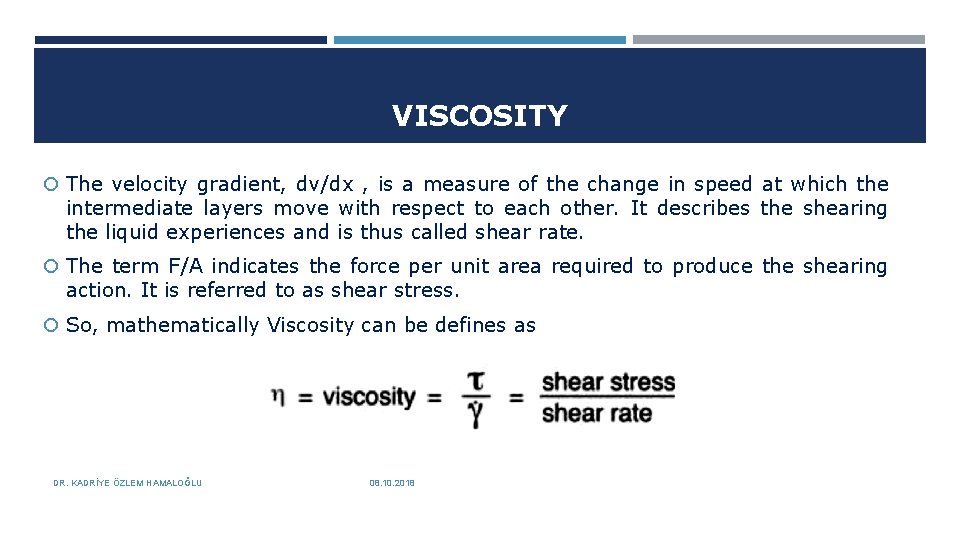
VISCOSITY The velocity gradient, dv/dx , is a measure of the change in speed at which the intermediate layers move with respect to each other. It describes the shearing the liquid experiences and is thus called shear rate. The term F/A indicates the force per unit area required to produce the shearing action. It is referred to as shear stress. So, mathematically Viscosity can be defines as DR. KADRİYE ÖZLEM HAMALOĞLU 08. 10. 2018
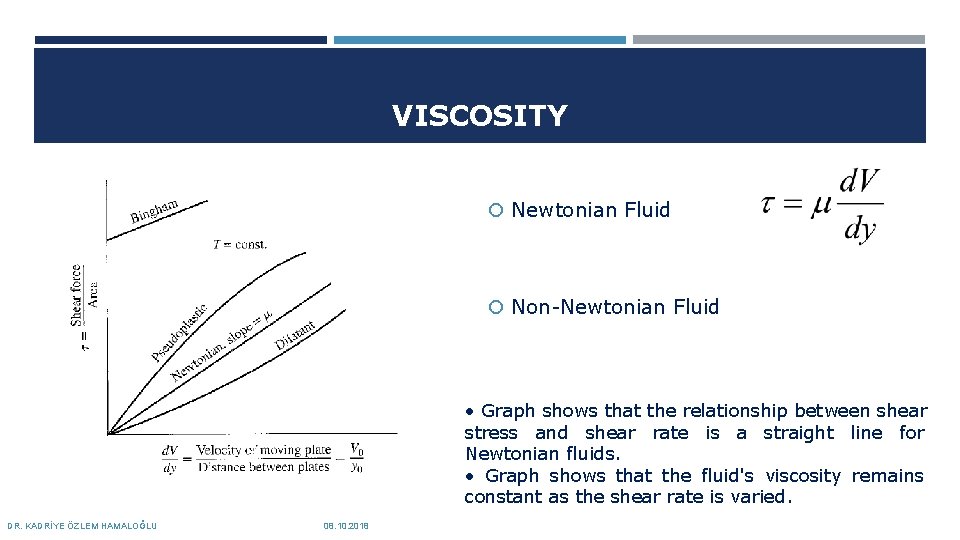
VISCOSITY Newtonian Fluid Non-Newtonian Fluid • Graph shows that the relationship between shear stress and shear rate is a straight line for Newtonian fluids. • Graph shows that the fluid's viscosity remains constant as the shear rate is varied. DR. KADRİYE ÖZLEM HAMALOĞLU 08. 10. 2018
NON-NEWTONIAN FLUIDS A non-Newtonian fluid is broadly defined as one for which the relationship is not a constant. It means that there is non-linear relationship between shear rate & shear stress. In other words, when the shear rate is varied, the shear stress doesn't vary in the same proportion (or even necessarily in the same direction). E. g. Soap Solutions & cosmetics, Food such as butter, jam, cheese, soup, yogurt, natural substances such as lava, gums, etc. DR. KADRİYE ÖZLEM HAMALOĞLU 08. 10. 2018
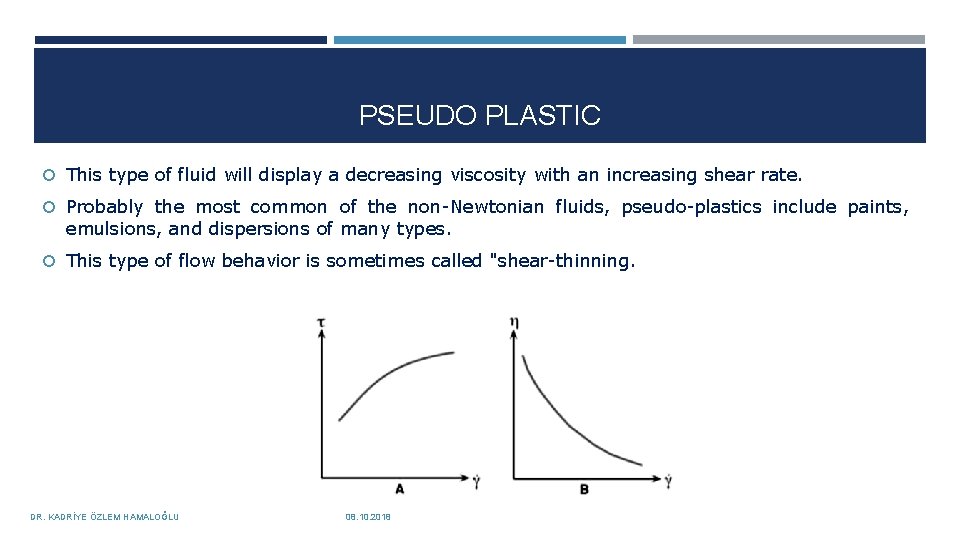
PSEUDO PLASTIC This type of fluid will display a decreasing viscosity with an increasing shear rate. Probably the most common of the non-Newtonian fluids, pseudo-plastics include paints, emulsions, and dispersions of many types. This type of flow behavior is sometimes called "shear-thinning. DR. KADRİYE ÖZLEM HAMALOĞLU 08. 10. 2018
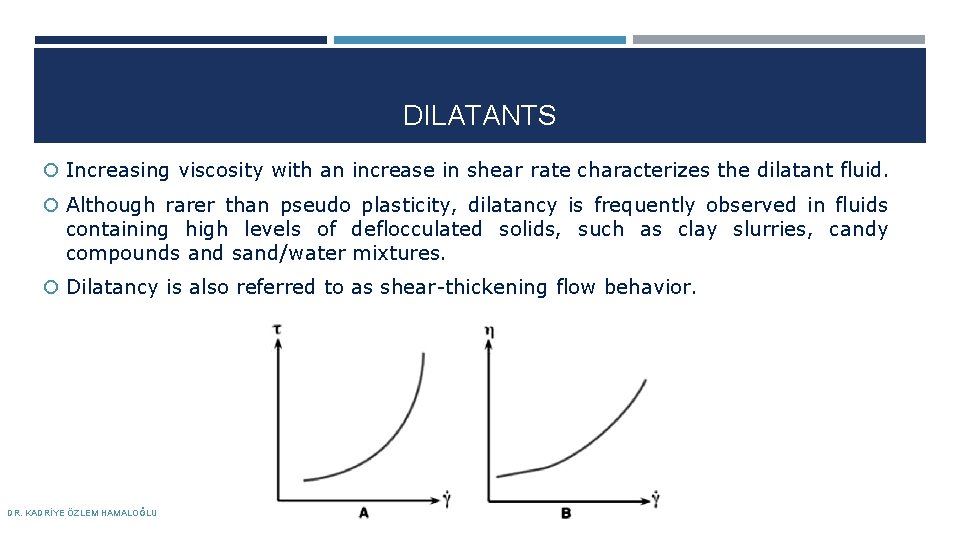
DILATANTS Increasing viscosity with an increase in shear rate characterizes the dilatant fluid. Although rarer than pseudo plasticity, dilatancy is frequently observed in fluids containing high levels of deflocculated solids, such as clay slurries, candy compounds and sand/water mixtures. Dilatancy is also referred to as shear-thickening flow behavior. DR. KADRİYE ÖZLEM HAMALOĞLU 08. 10. 2018
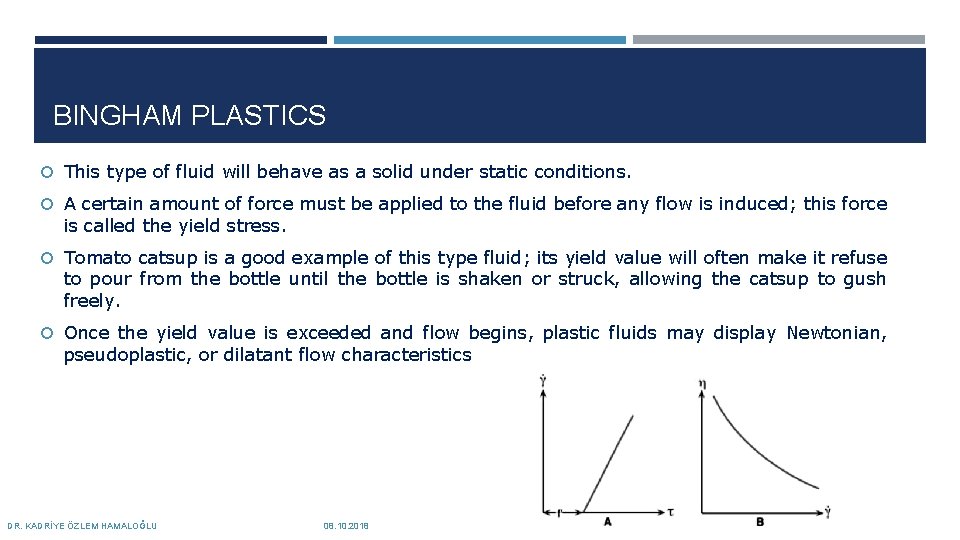
BINGHAM PLASTICS This type of fluid will behave as a solid under static conditions. A certain amount of force must be applied to the fluid before any flow is induced; this force is called the yield stress. Tomato catsup is a good example of this type fluid; its yield value will often make it refuse to pour from the bottle until the bottle is shaken or struck, allowing the catsup to gush freely. Once the yield value is exceeded and flow begins, plastic fluids may display Newtonian, pseudoplastic, or dilatant flow characteristics DR. KADRİYE ÖZLEM HAMALOĞLU 08. 10. 2018
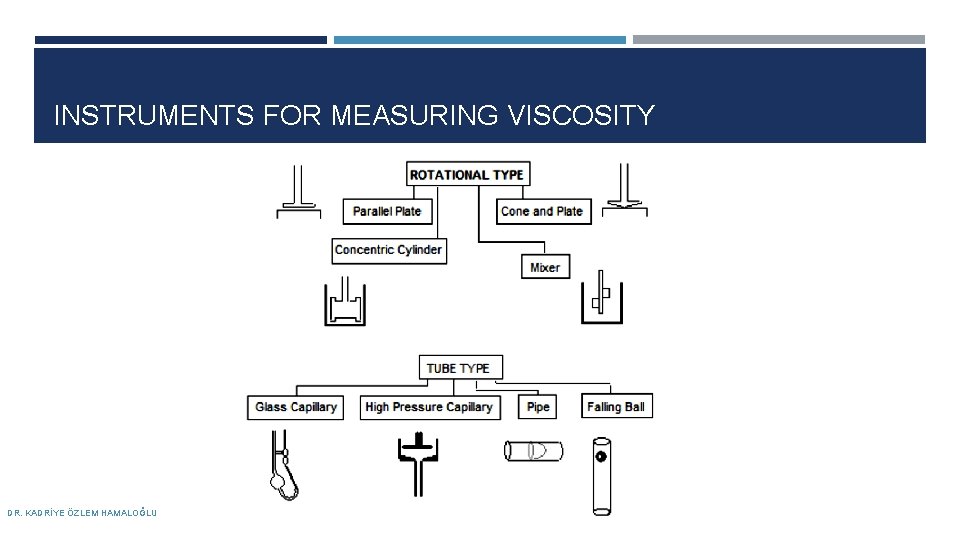
INSTRUMENTS FOR MEASURING VISCOSITY DR. KADRİYE ÖZLEM HAMALOĞLU 08. 10. 2018
MEASUREMENT OF SHEAR VISCOSITY Depends upon dynamics of shear force acting upon fluid either Newtonian / non- Newtonian. Instruments which measures the viscosity are called as Viscometers only measures under one flow condition. Most popular viscometers to measure shear viscosity are 1. Capillary flow viscometer 2. Circular couette flow viscometer 3. Cone & plate flow viscometer 4. Parallel plate flow viscometer DR. KADRİYE ÖZLEM HAMALOĞLU 08. 10. 2018
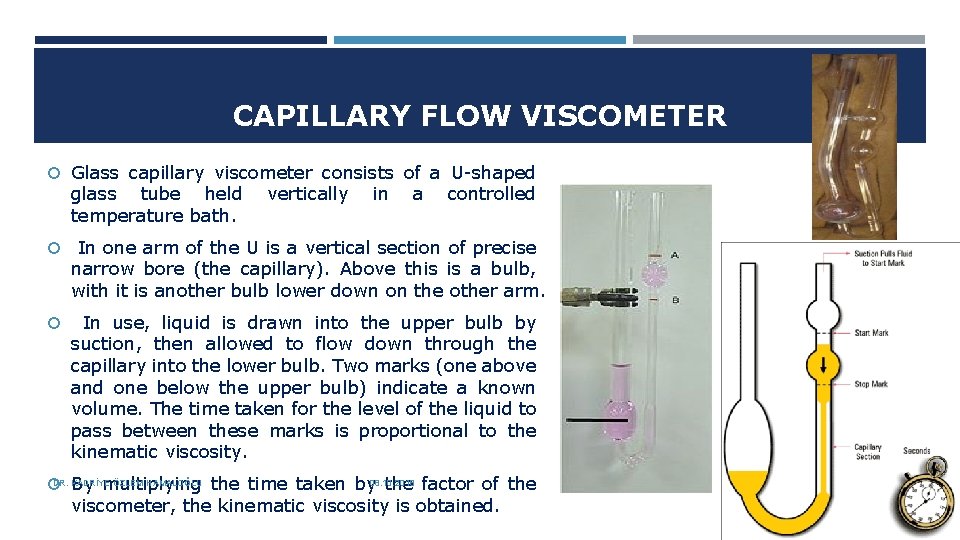
CAPILLARY FLOW VISCOMETER Glass capillary viscometer consists of a U-shaped glass tube held temperature bath. vertically in a controlled In one arm of the U is a vertical section of precise narrow bore (the capillary). Above this is a bulb, with it is another bulb lower down on the other arm. In use, liquid is drawn into the upper bulb by suction, then allowed to flow down through the capillary into the lower bulb. Two marks (one above and one below the upper bulb) indicate a known volume. The time taken for the level of the liquid to pass between these marks is proportional to the kinematic viscosity. DR. KADRİYE ÖZLEM HAMALOĞLU the time taken by 08. 10. 2018 By multiplying the factor of the viscometer, the kinematic viscosity is obtained.
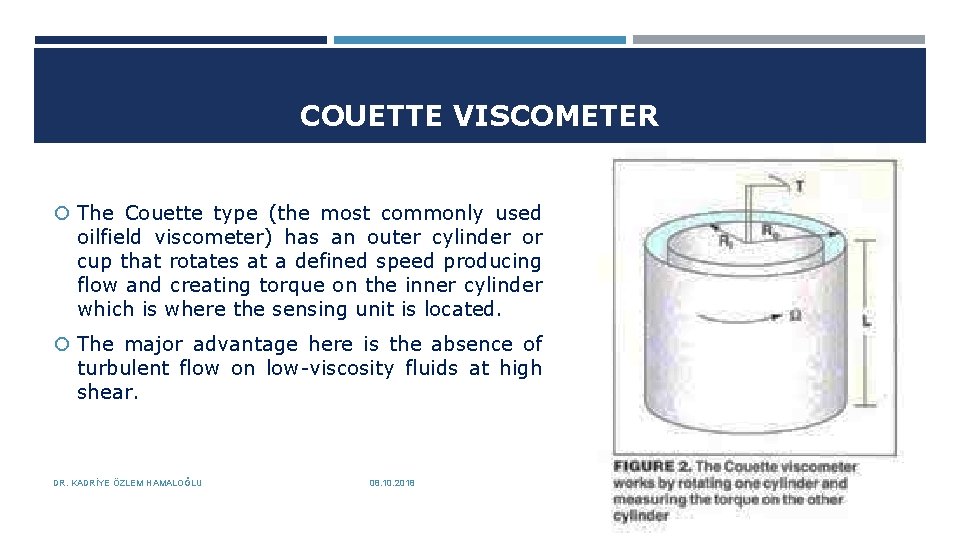
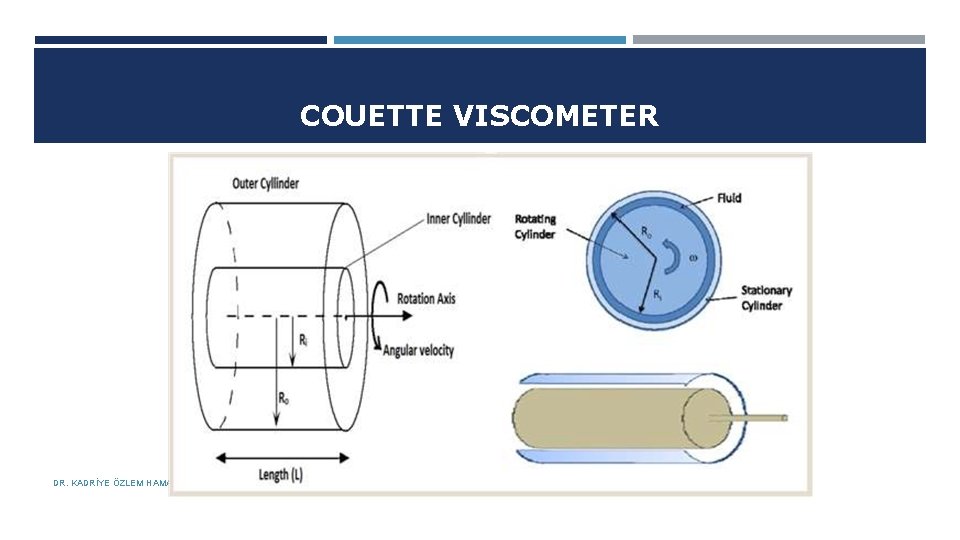
COUETTE VISCOMETER The Couette type (the most commonly used oilfield viscometer) has an outer cylinder or cup that rotates at a defined speed producing flow and creating torque on the inner cylinder which is where the sensing unit is located. The major advantage here is the absence of turbulent flow on low-viscosity fluids at high shear. DR. KADRİYE ÖZLEM HAMALOĞLU 08. 10. 2018
COUETTE VISCOMETER DR. KADRİYE ÖZLEM HAMALOĞLU 08. 10. 2018
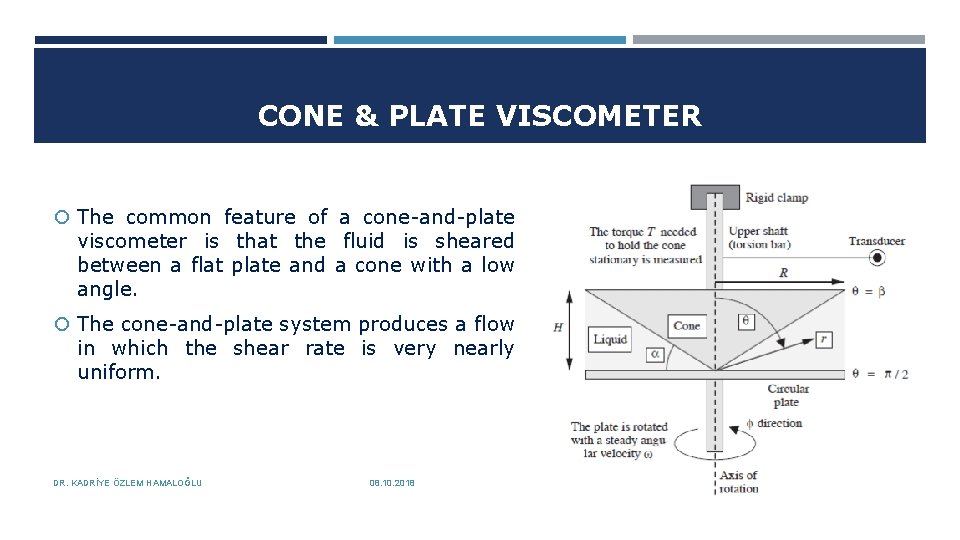
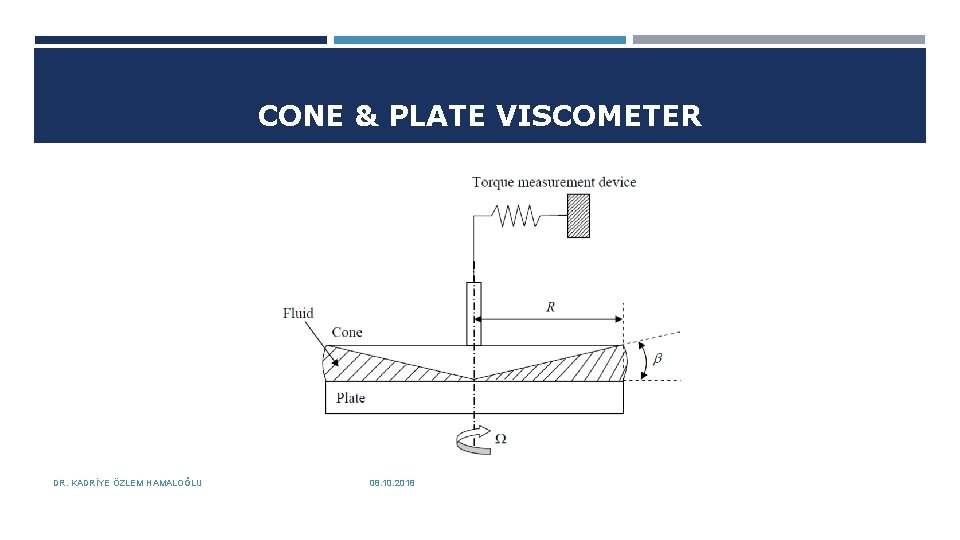
CONE & PLATE VISCOMETER The common feature of a cone-and-plate viscometer is that the fluid is sheared between a flat plate and a cone with a low angle. The cone-and-plate system produces a flow in which the shear rate is very nearly uniform. DR. KADRİYE ÖZLEM HAMALOĞLU 08. 10. 2018
CONE & PLATE VISCOMETER DR. KADRİYE ÖZLEM HAMALOĞLU 08. 10. 2018
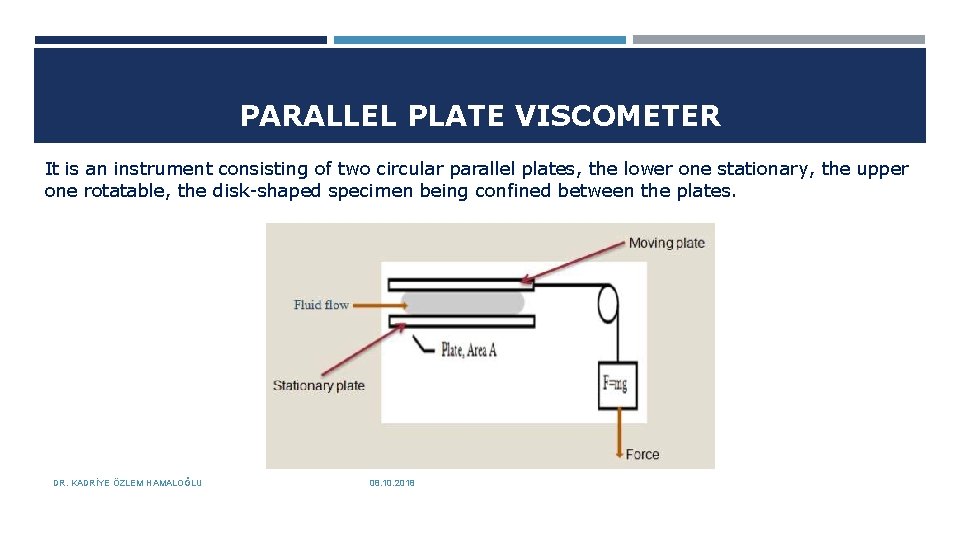
PARALLEL PLATE VISCOMETER It is an instrument consisting of two circular parallel plates, the lower one stationary, the upper one rotatable, the disk-shaped specimen being confined between the plates. DR. KADRİYE ÖZLEM HAMALOĞLU 08. 10. 2018
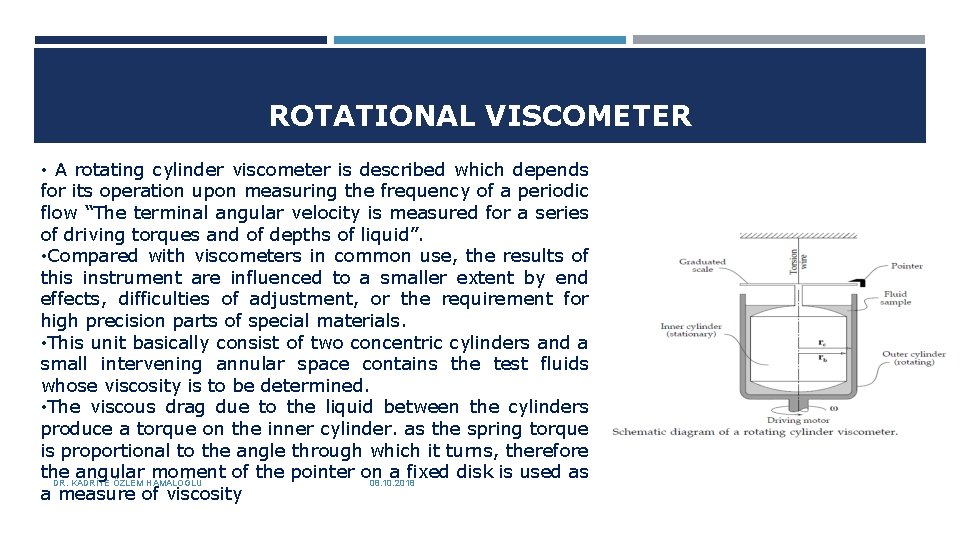
ROTATIONAL VISCOMETER • A rotating cylinder viscometer is described which depends for its operation upon measuring the frequency of a periodic flow “The terminal angular velocity is measured for a series of driving torques and of depths of liquid”. • Compared with viscometers in common use, the results of this instrument are influenced to a smaller extent by end effects, difficulties of adjustment, or the requirement for high precision parts of special materials. • This unit basically consist of two concentric cylinders and a small intervening annular space contains the test fluids whose viscosity is to be determined. • The viscous drag due to the liquid between the cylinders produce a torque on the inner cylinder. as the spring torque is proportional to the angle through which it turns, therefore the angular moment of the pointer on a fixed disk is used as DR. KADRİYE ÖZLEM HAMALOĞLU 08. 10. 2018 a measure of viscosity
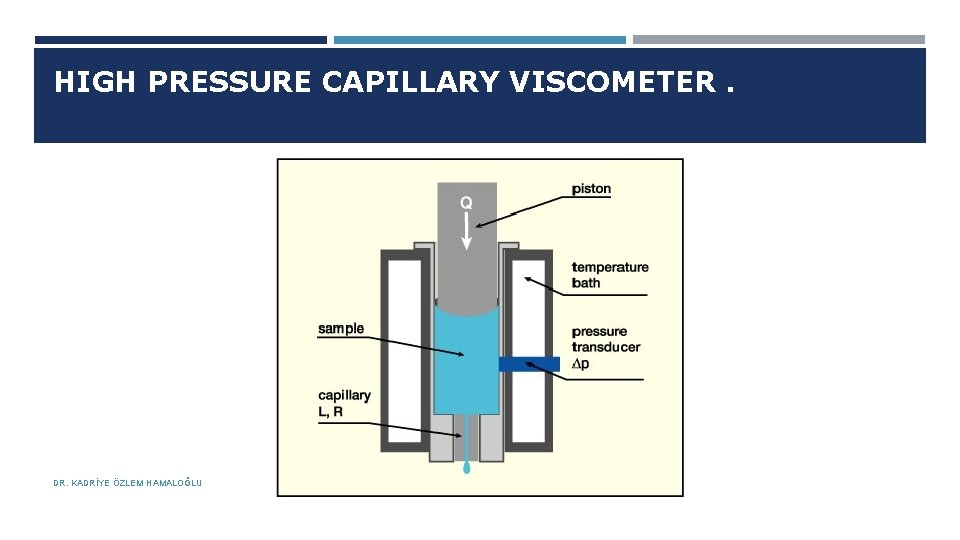
HIGH PRESSURE CAPILLARY VISCOMETER. DR. KADRİYE ÖZLEM HAMALOĞLU 08. 10. 2018
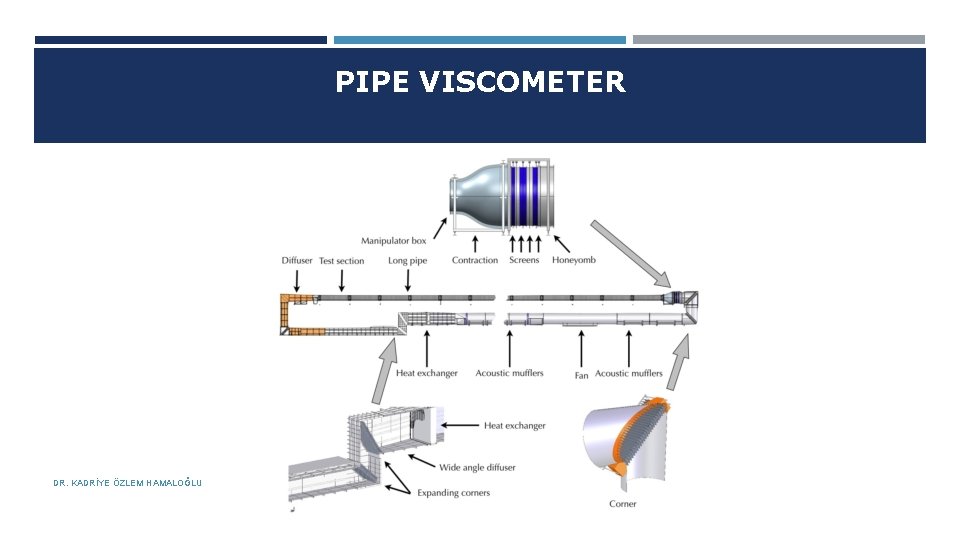
PIPE VISCOMETER DR. KADRİYE ÖZLEM HAMALOĞLU 08. 10. 2018
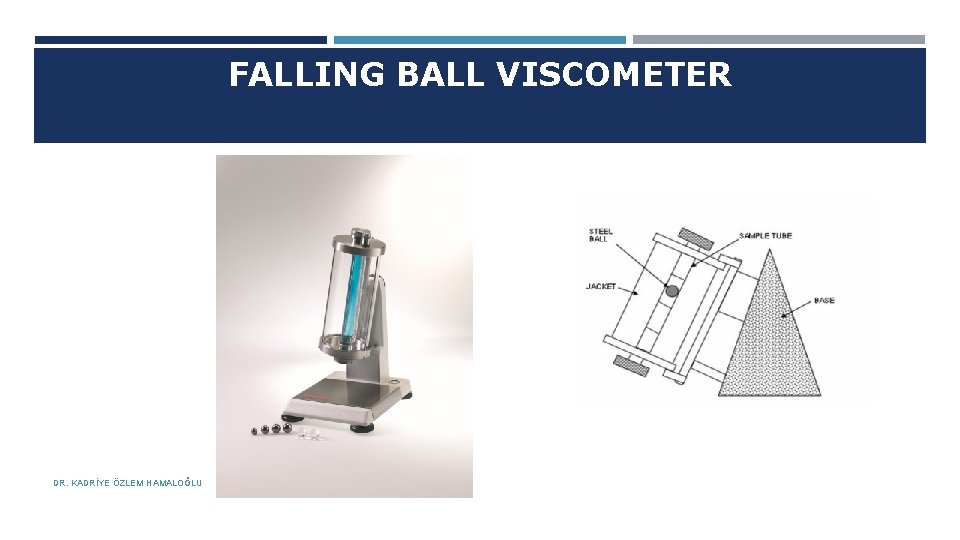
FALLING BALL VISCOMETER DR. KADRİYE ÖZLEM HAMALOĞLU 08. 10. 2018