
Lecture 2 Viscosity Measurement of viscosity Rheochor Refractive


- Slides: 22
Lecture 2 • Viscosity • Measurement of viscosity • Rheochor • Refractive Index • Measurement of refractive index • Specific and molar refractivity
Viscosity The resistance that one part of the liquid moving with one velocity offers to another part of liquid moving with another velocity is known as viscosity.
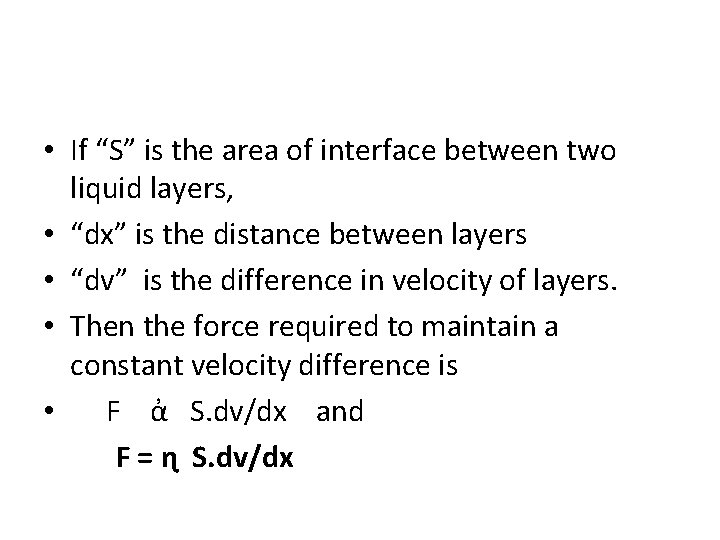
• If “S” is the area of interface between two liquid layers, • “dx” is the distance between layers • “dv” is the difference in velocity of layers. • Then the force required to maintain a constant velocity difference is • F ἀ S. dv/dx and F = ɳ S. dv/dx
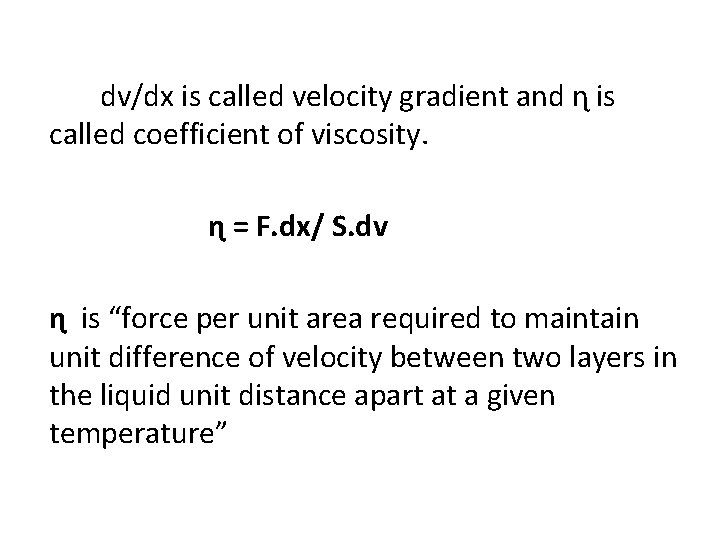
dv/dx is called velocity gradient and ɳ is called coefficient of viscosity. ɳ = F. dx/ S. dv ɳ is “force per unit area required to maintain unit difference of velocity between two layers in the liquid unit distance apart at a given temperature”
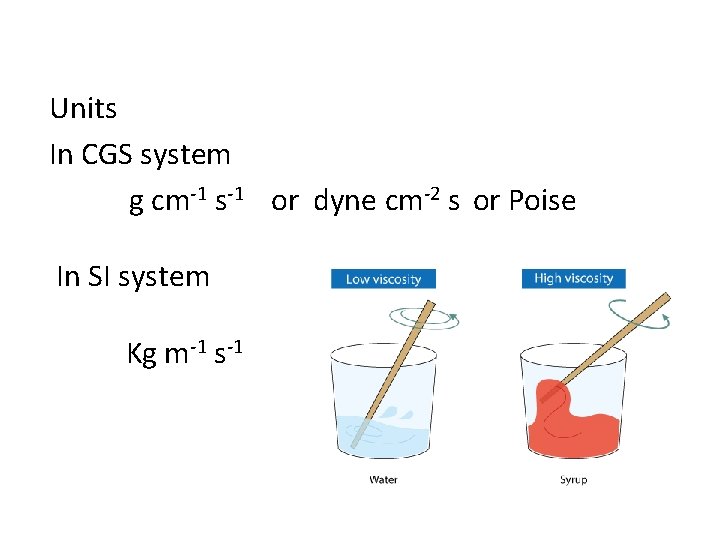
Units In CGS system g cm-1 s-1 or dyne cm-2 s or Poise In SI system Kg m-1 s-1
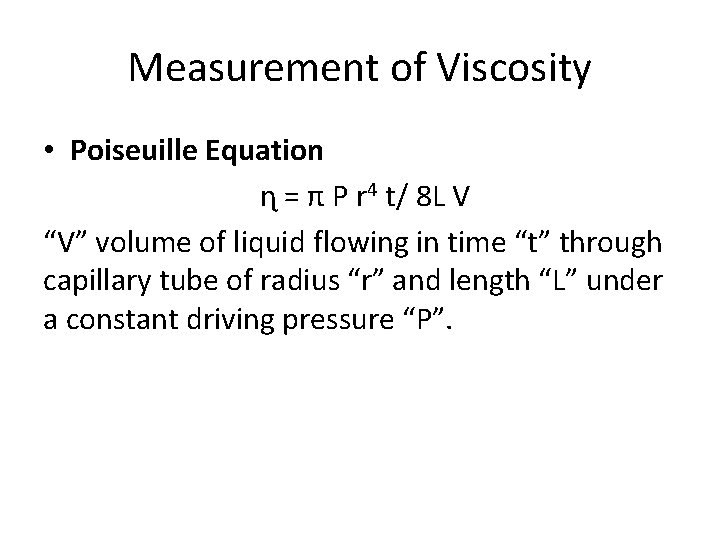
Measurement of Viscosity • Poiseuille Equation ɳ = π P r 4 t/ 8 L V “V” volume of liquid flowing in time “t” through capillary tube of radius “r” and length “L” under a constant driving pressure “P”.
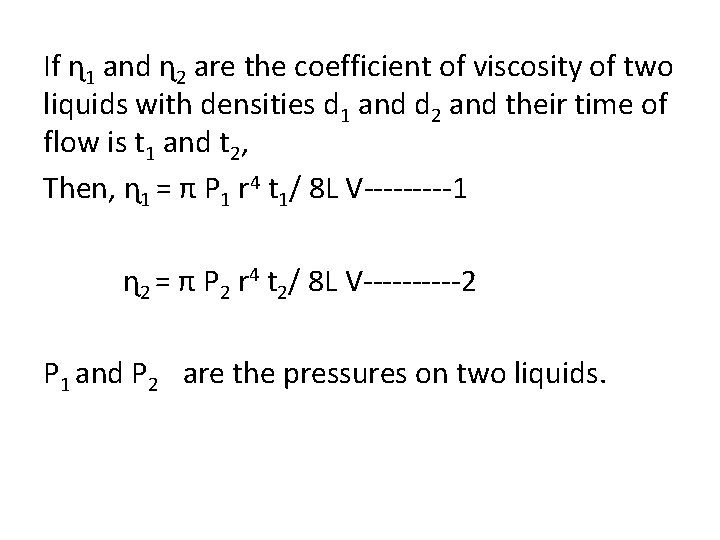
If ɳ 1 and ɳ 2 are the coefficient of viscosity of two liquids with densities d 1 and d 2 and their time of flow is t 1 and t 2, Then, ɳ 1 = π P 1 r 4 t 1/ 8 L V-----1 ɳ 2 = π P 2 r 4 t 2/ 8 L V-----2 P 1 and P 2 are the pressures on two liquids.
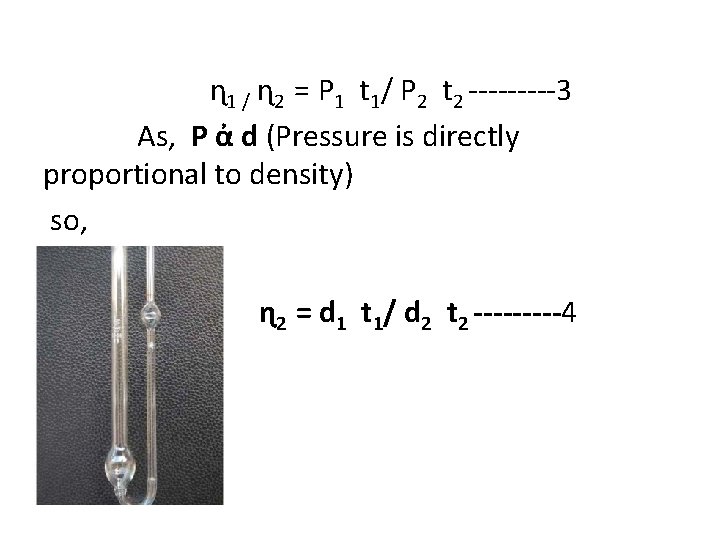
ɳ 1 / ɳ 2 = P 1 t 1/ P 2 t 2 -----3 As, P ἀ d (Pressure is directly proportional to density) so, ɳ 1 / ɳ 2 = d 1 t 1/ d 2 t 2 -----4
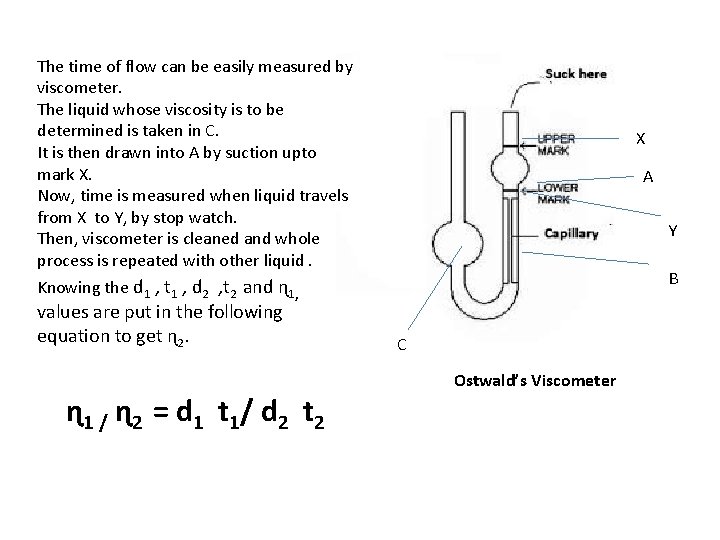
The time of flow can be easily measured by viscometer. The liquid whose viscosity is to be determined is taken in C. It is then drawn into A by suction upto mark X. Now, time is measured when liquid travels from X to Y, by stop watch. Then, viscometer is cleaned and whole process is repeated with other liquid. X A Y B Knowing the d 1 , t 1 , d 2 , t 2 and ɳ 1, values are put in the following equation to get ɳ 2. ɳ 1 / ɳ 2 = d 1 t 1/ d 2 t 2 C Ostwald’s Viscometer
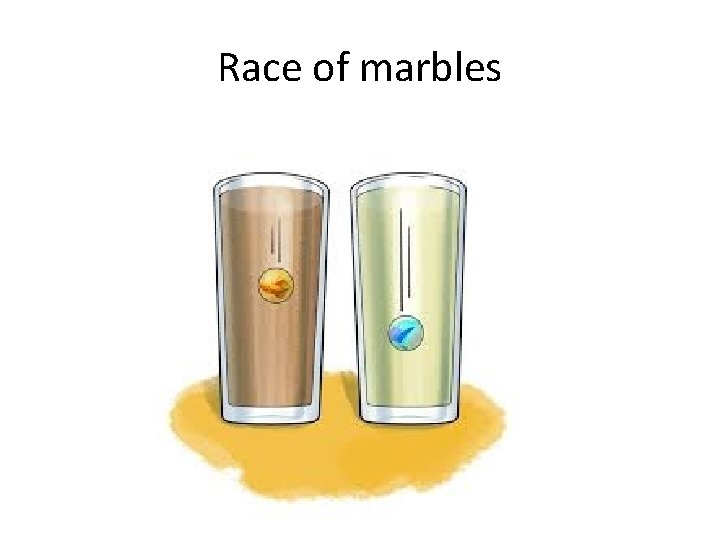
Race of marbles
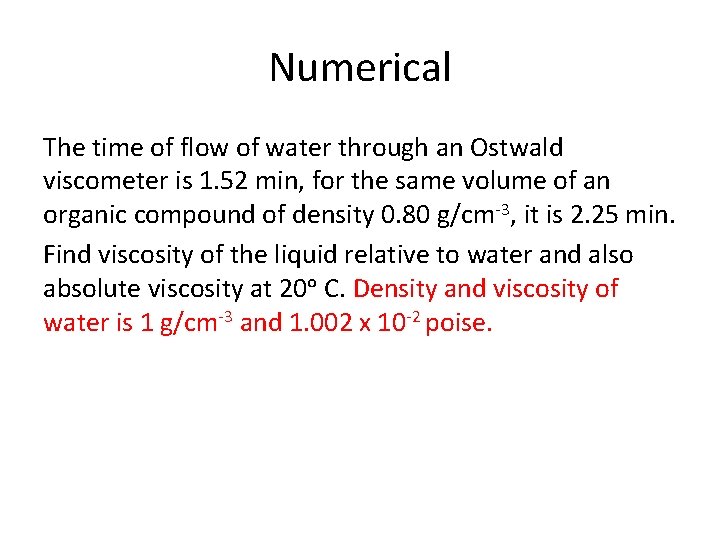
Numerical The time of flow of water through an Ostwald viscometer is 1. 52 min, for the same volume of an organic compound of density 0. 80 g/cm-3, it is 2. 25 min. Find viscosity of the liquid relative to water and also absolute viscosity at 20ᵒ C. Density and viscosity of water is 1 g/cm-3 and 1. 002 x 10 -2 poise.
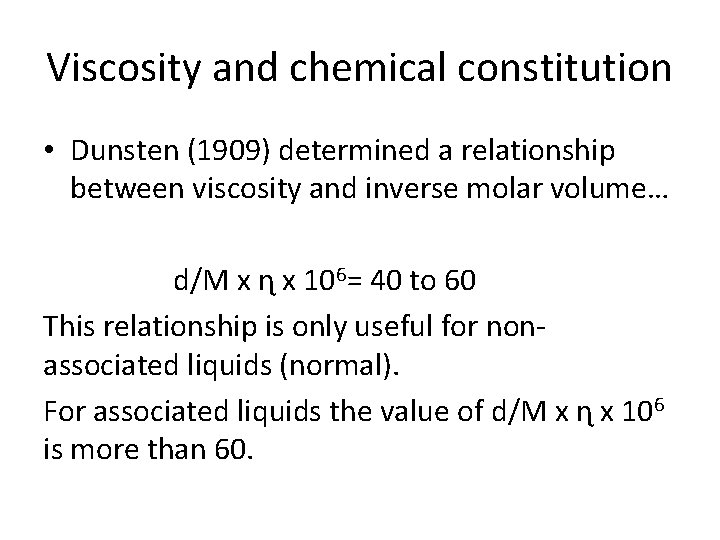
Viscosity and chemical constitution • Dunsten (1909) determined a relationship between viscosity and inverse molar volume… d/M x ɳ x 106= 40 to 60 This relationship is only useful for nonassociated liquids (normal). For associated liquids the value of d/M x ɳ x 106 is more than 60.
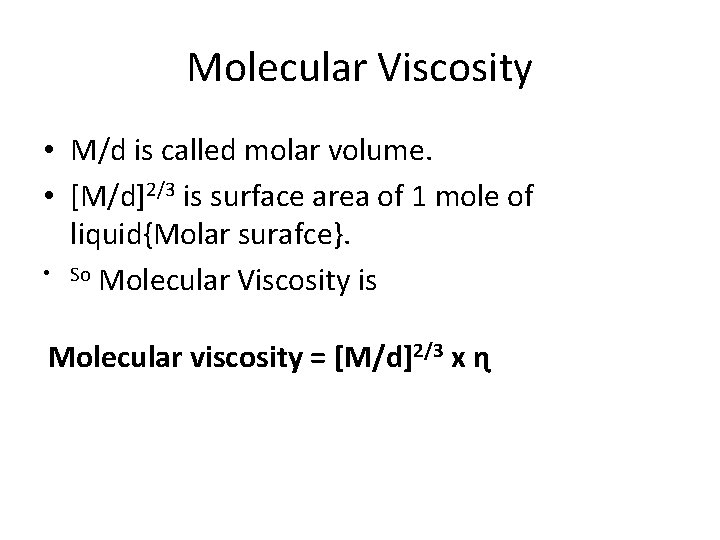
Molecular Viscosity • M/d is called molar volume. • [M/d]2/3 is surface area of 1 mole of liquid{Molar surafce}. • So Molecular Viscosity is Molecular viscosity = [M/d]2/3 x ɳ
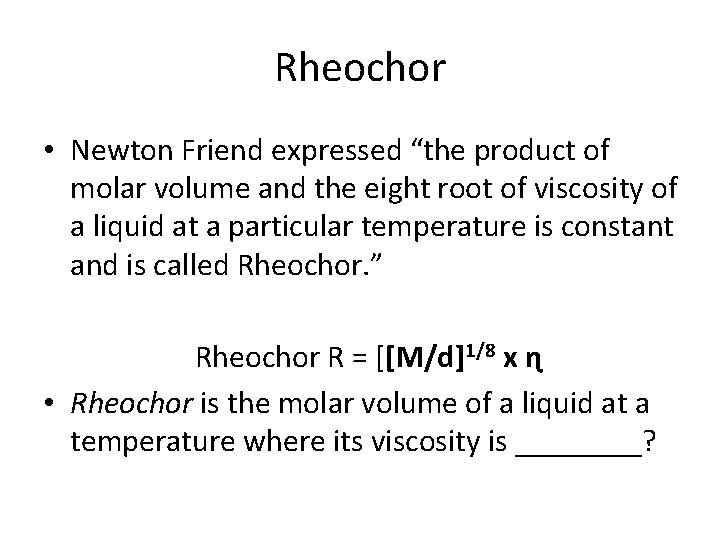
Rheochor • Newton Friend expressed “the product of molar volume and the eight root of viscosity of a liquid at a particular temperature is constant and is called Rheochor. ” Rheochor R = [[M/d]1/8 x ɳ • Rheochor is the molar volume of a liquid at a temperature where its viscosity is ____?
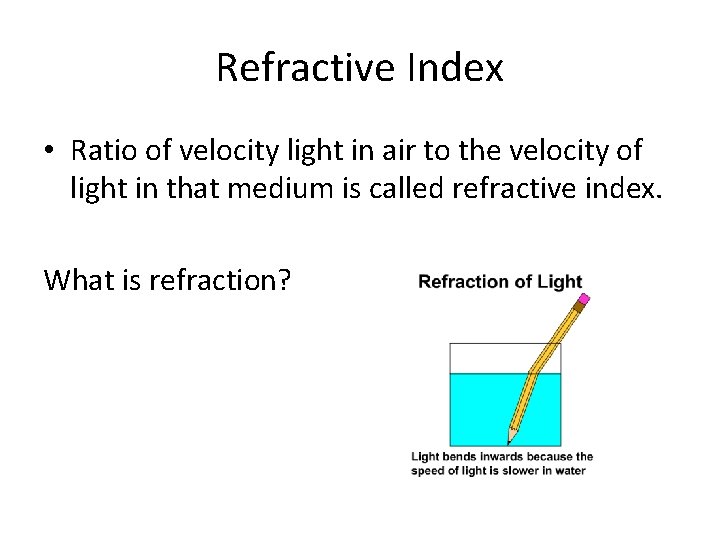
Refractive Index • Ratio of velocity light in air to the velocity of light in that medium is called refractive index. What is refraction?
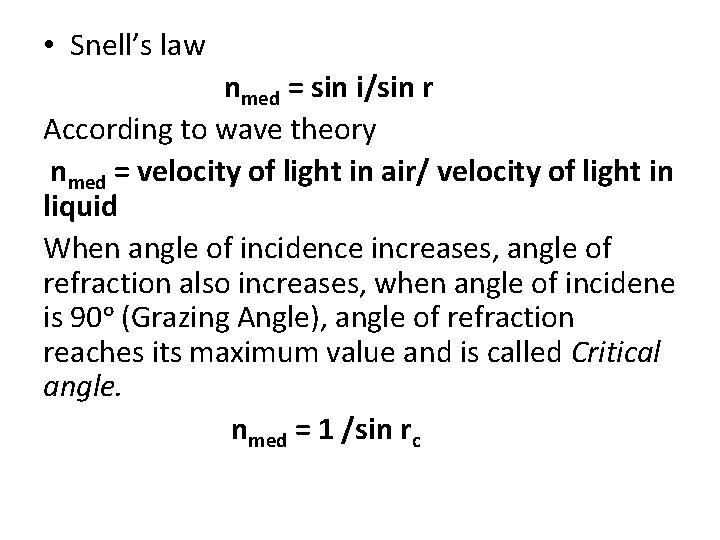
• Snell’s law nmed = sin i/sin r According to wave theory nmed = velocity of light in air/ velocity of light in liquid When angle of incidence increases, angle of refraction also increases, when angle of incidene is 90ᵒ (Grazing Angle), angle of refraction reaches its maximum value and is called Critical angle. nmed = 1 /sin rc
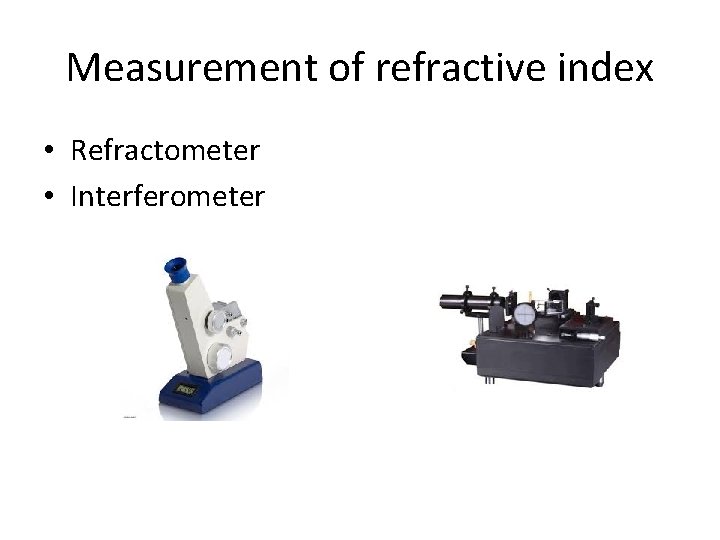
Measurement of refractive index • Refractometer • Interferometer
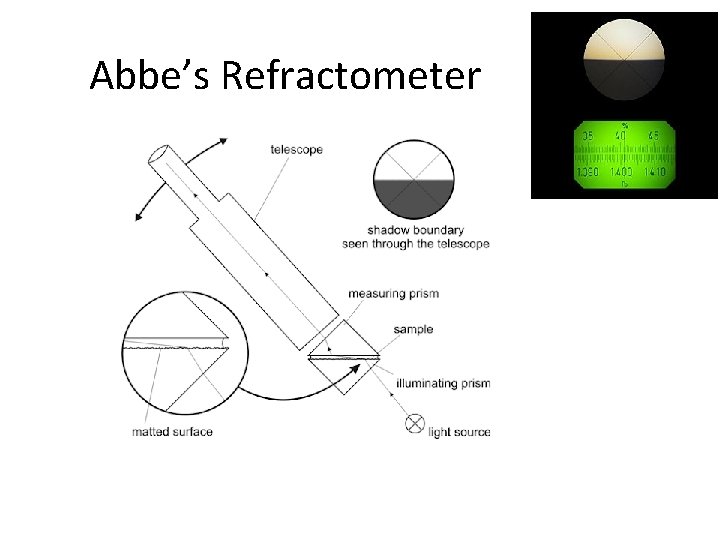
Abbe’s Refractometer
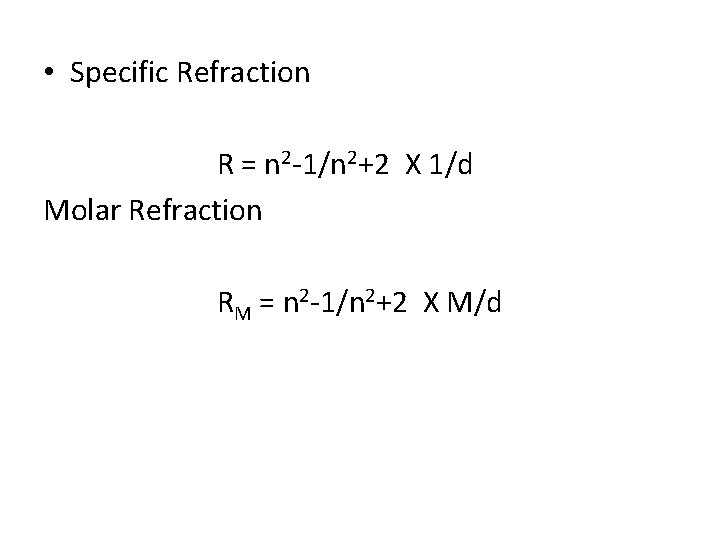
• Specific Refraction R = n 2 -1/n 2+2 X 1/d Molar Refraction RM = n 2 -1/n 2+2 X M/d
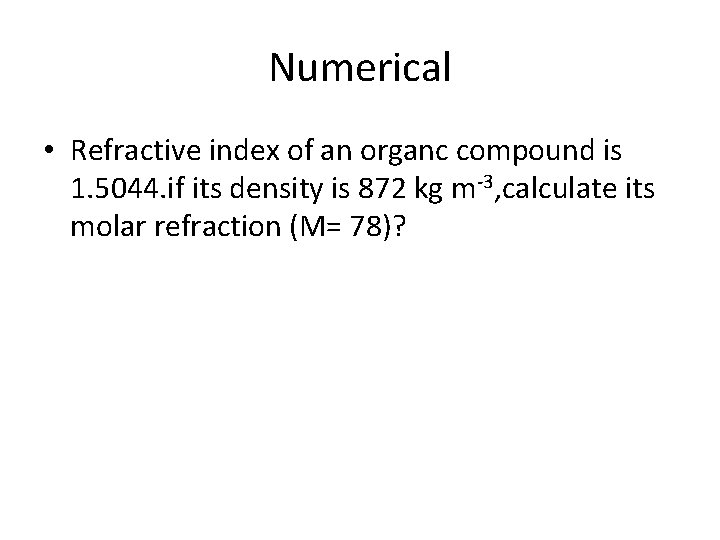
Numerical • Refractive index of an organc compound is 1. 5044. if its density is 872 kg m-3, calculate its molar refraction (M= 78)?