
Physical pharmacy Lab 6 Viscosity Viscosity is an
Physical pharmacy Lab (6) Viscosity
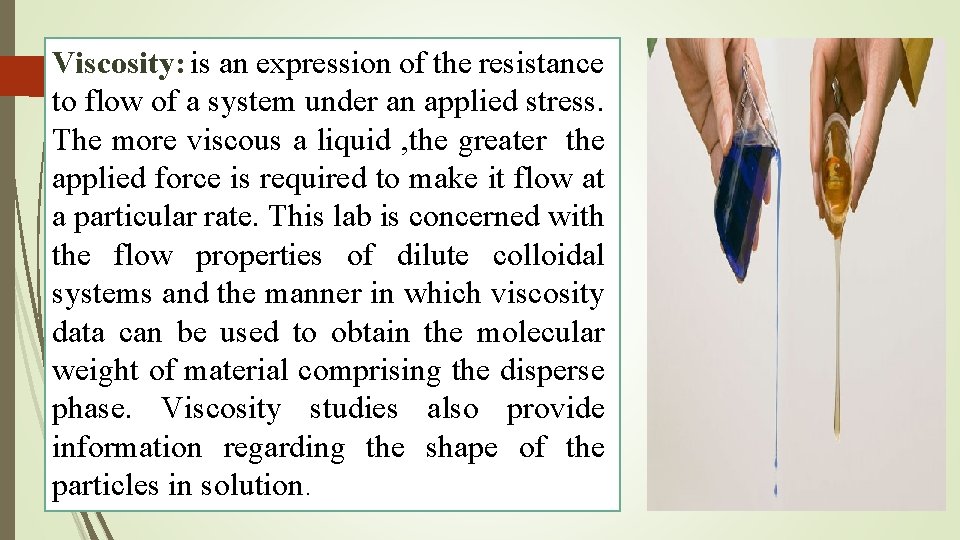
Viscosity: is an expression of the resistance to flow of a system under an applied stress. The more viscous a liquid , the greater the applied force is required to make it flow at a particular rate. This lab is concerned with the flow properties of dilute colloidal systems and the manner in which viscosity data can be used to obtain the molecular weight of material comprising the disperse phase. Viscosity studies also provide information regarding the shape of the particles in solution.
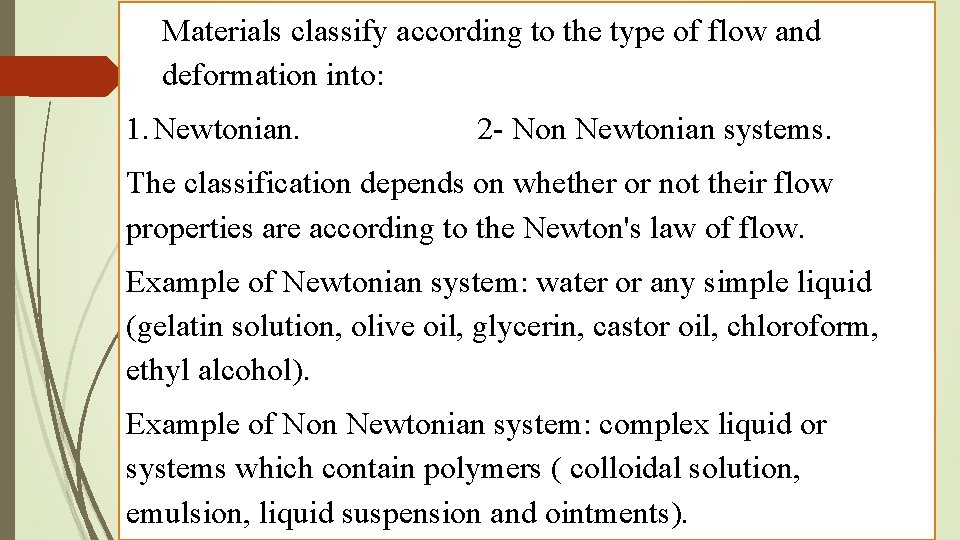
Materials classify according to the type of flow and deformation into: 1. Newtonian. 2 - Non Newtonian systems. The classification depends on whether or not their flow properties are according to the Newton's law of flow. Example of Newtonian system: water or any simple liquid (gelatin solution, olive oil, glycerin, castor oil, chloroform, ethyl alcohol). Example of Non Newtonian system: complex liquid or systems which contain polymers ( colloidal solution, emulsion, liquid suspension and ointments).
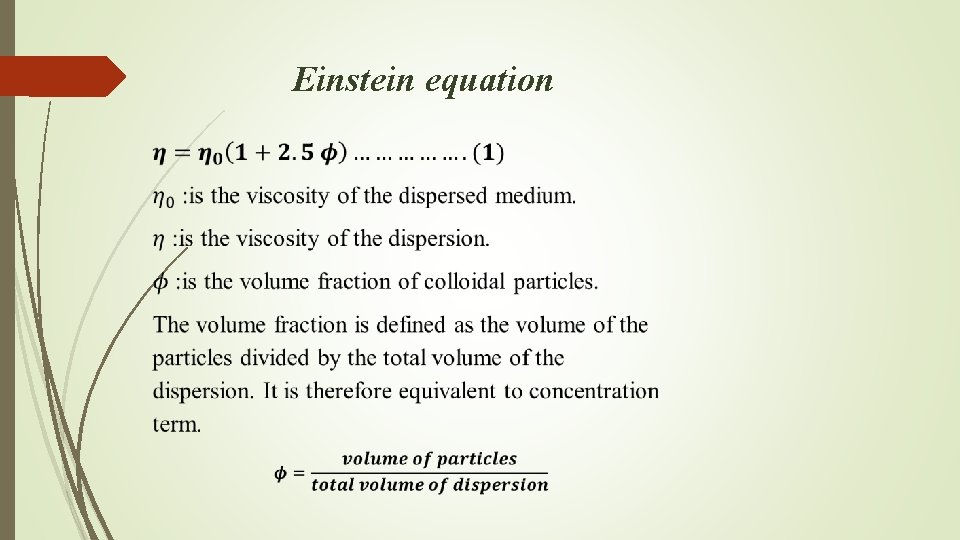
Einstein equation

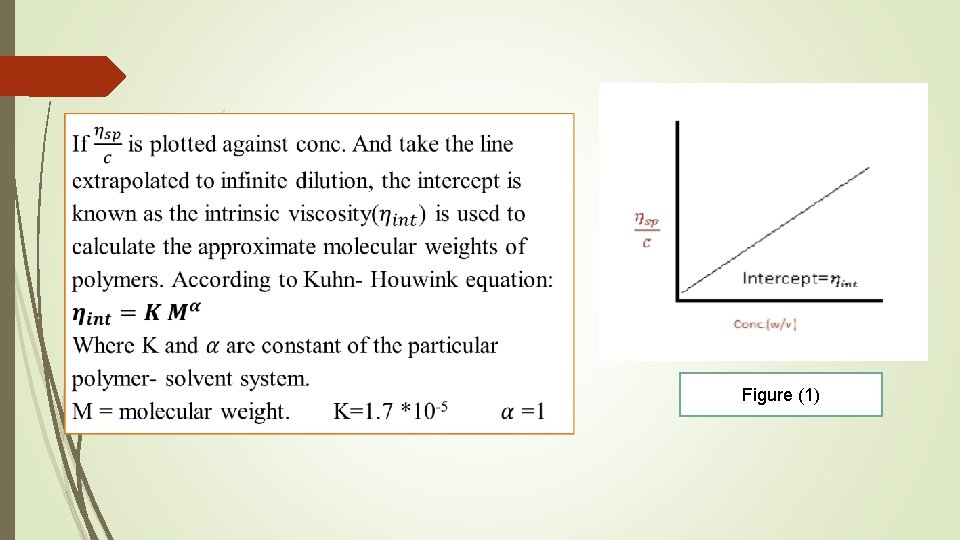
Figure (1)
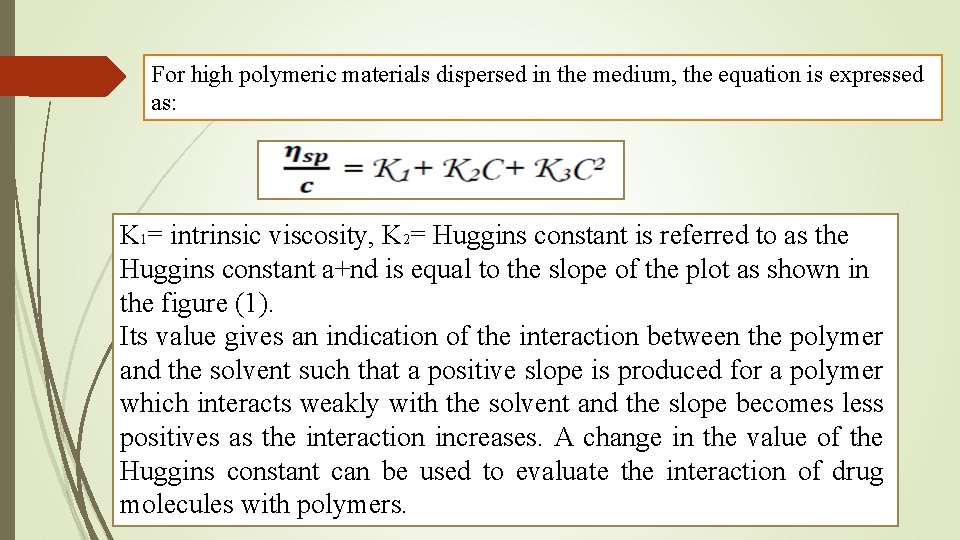
For high polymeric materials dispersed in the medium, the equation is expressed as: K 1= intrinsic viscosity, K 2= Huggins constant is referred to as the Huggins constant a+nd is equal to the slope of the plot as shown in the figure (1). Its value gives an indication of the interaction between the polymer and the solvent such that a positive slope is produced for a polymer which interacts weakly with the solvent and the slope becomes less positives as the interaction increases. A change in the value of the Huggins constant can be used to evaluate the interaction of drug molecules with polymers.
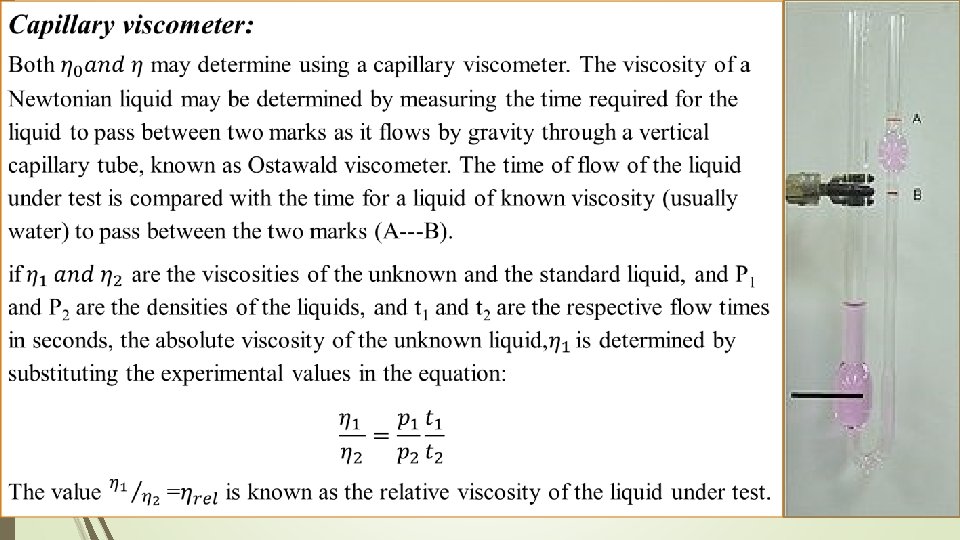
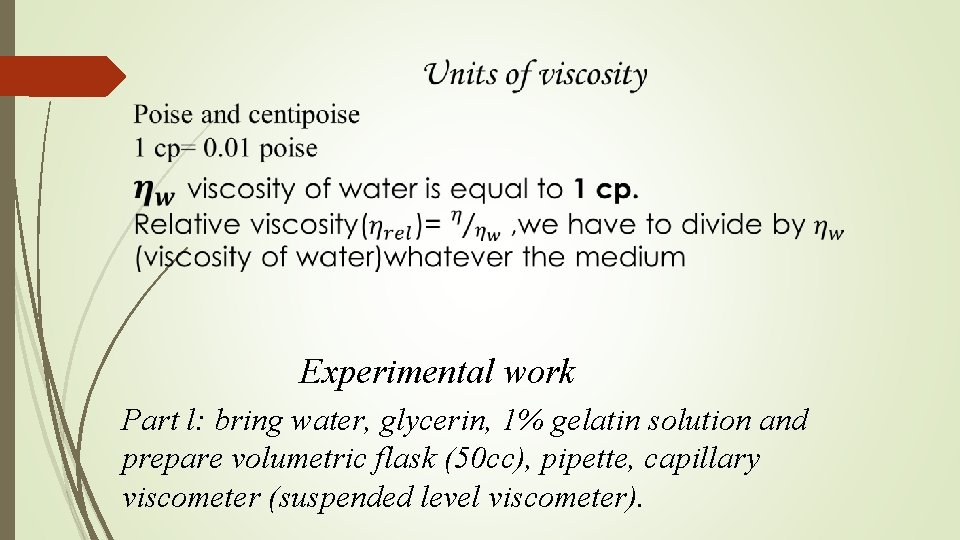
Experimental work Part l: bring water, glycerin, 1% gelatin solution and prepare volumetric flask (50 cc), pipette, capillary viscometer (suspended level viscometer).
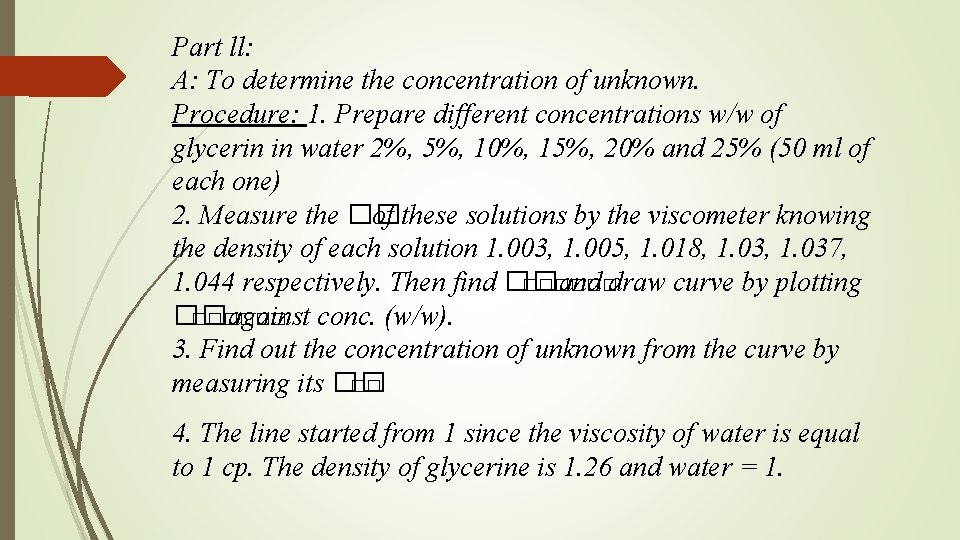
Part ll: A: To determine the concentration of unknown. Procedure: 1. Prepare different concentrations w/w of glycerin in water 2%, 5%, 10%, 15%, 20% and 25% (50 ml of each one) 2. Measure the �� of these solutions by the viscometer knowing the density of each solution 1. 003, 1. 005, 1. 018, 1. 037, 1. 044 respectively. Then find �� ������ and draw curve by plotting �� ������ against conc. (w/w). 3. Find out the concentration of unknown from the curve by measuring its �� �� 4. The line started from 1 since the viscosity of water is equal to 1 cp. The density of glycerine is 1. 26 and water = 1.
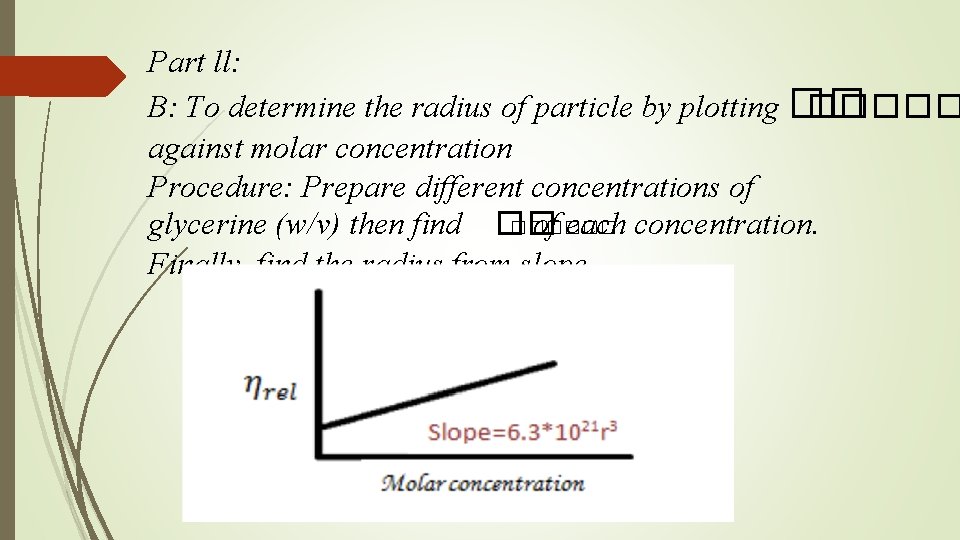
Part ll: B: To determine the radius of particle by plotting �� ����� against molar concentration Procedure: Prepare different concentrations of glycerine (w/v) then find �� ������ of each concentration. Finally, find the radius from slope.
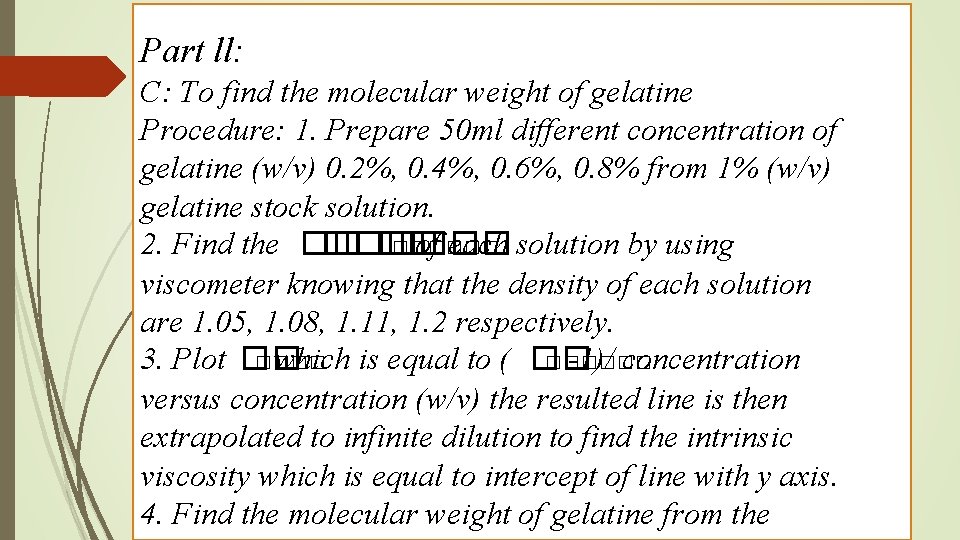
Part ll: C: To find the molecular weight of gelatine Procedure: 1. Prepare 50 ml different concentration of gelatine (w/v) 0. 2%, 0. 4%, 0. 6%, 0. 8% from 1% (w/v) gelatine stock solution. 2. Find the �� ������ of each solution by using viscometer knowing that the density of each solution are 1. 05, 1. 08, 1. 11, 1. 2 respectively. 3. Plot �� ���� which is equal to ( �� ������ -1)/ concentration versus concentration (w/v) the resulted line is then extrapolated to infinite dilution to find the intrinsic viscosity which is equal to intercept of line with y axis. 4. Find the molecular weight of gelatine from the
- Slides: 12