
T 207 Tutorial block 4 Please check your

T 207 – Tutorial block 4 Please check your headphone and microphones and adjust them for sound levels Check your audio settings by running the Audio Setup Wizard: either press the icon in the 'Audio and Video' panel, or navigate to Tools > Audio Setup Wizard and follow the on-screen instructions. https: //learn 1. open. ac. uk/mod/oucontent/view. php? i d=8322

T 207 – Tutorial 04 Rotational equations and calculations Water Energy and Power UNITS Fluid flow calculations Converting litres Water jets Lubrication- dynamic and kinematic viscosity Hydrodymanic lubrication Petrov’s equation
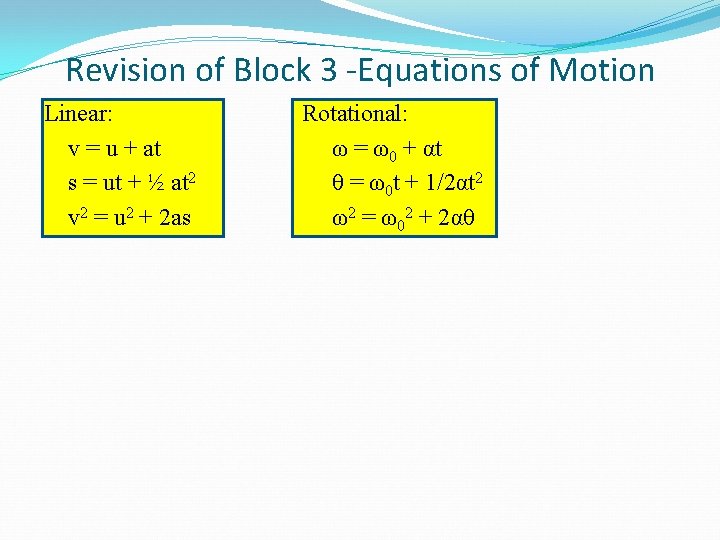
Revision of Block 3 -Equations of Motion Linear: Rotational: v = u + at ω = ω0 + αt s = ut + ½ at 2 θ = ω0 t + 1/2αt 2 v 2 = u 2 + 2 as ω2 = ω02 + 2αθ
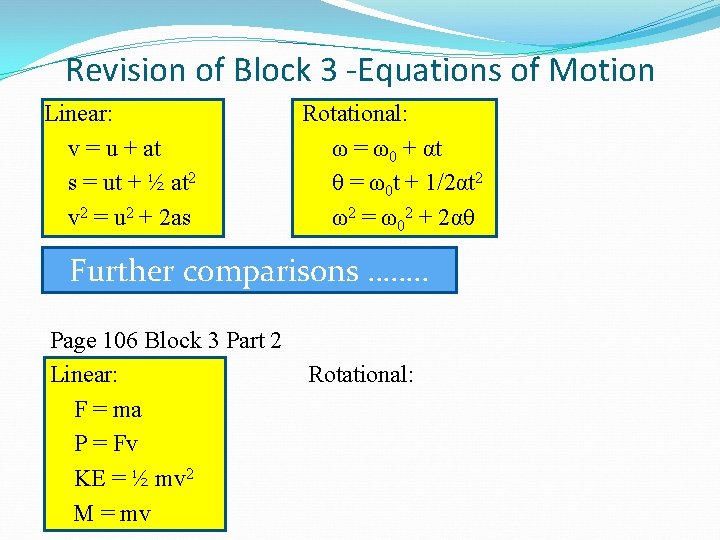
Revision of Block 3 -Equations of Motion Linear: Rotational: v = u + at ω = ω0 + αt s = ut + ½ at 2 θ = ω0 t + 1/2αt 2 v 2 = u 2 + 2 as ω2 = ω02 + 2αθ Further comparisons ……. . Page 106 Block 3 Part 2 Linear: Rotational: F = ma P = Fv KE = ½ mv 2 M = mv
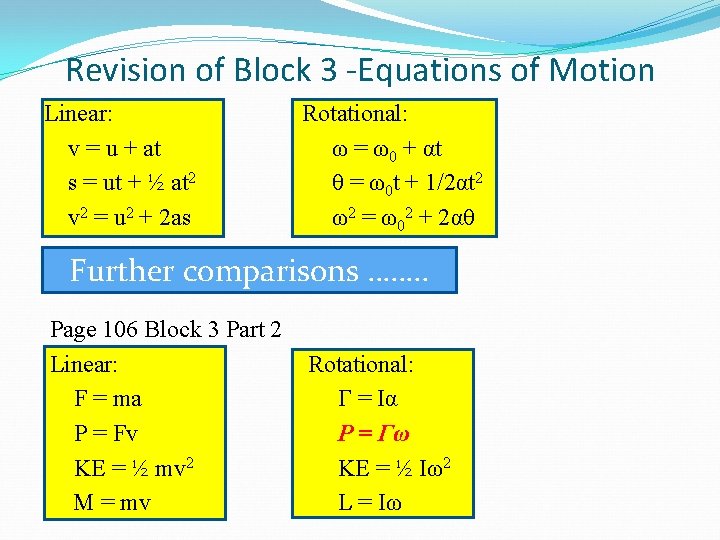
Revision of Block 3 -Equations of Motion Linear: Rotational: v = u + at ω = ω0 + αt s = ut + ½ at 2 θ = ω0 t + 1/2αt 2 v 2 = u 2 + 2 as ω2 = ω02 + 2αθ Further comparisons ……. . Page 106 Block 3 Part 2 Linear: Rotational: F = ma Γ = Iα P = Fv P = Γω KE = ½ mv 2 KE = ½ Iω2 M = mv L = Iω

Power and efficiency Efficiency, η = Output / Input

Power and efficiency Efficiency, η = Output / Input Power requirement, Pout = η x Pin = Pout / η

Power and efficiency Efficiency, η = Output / Input Power requirement, Pout = η x Pin = Pout / η How do inefficiencies occur?
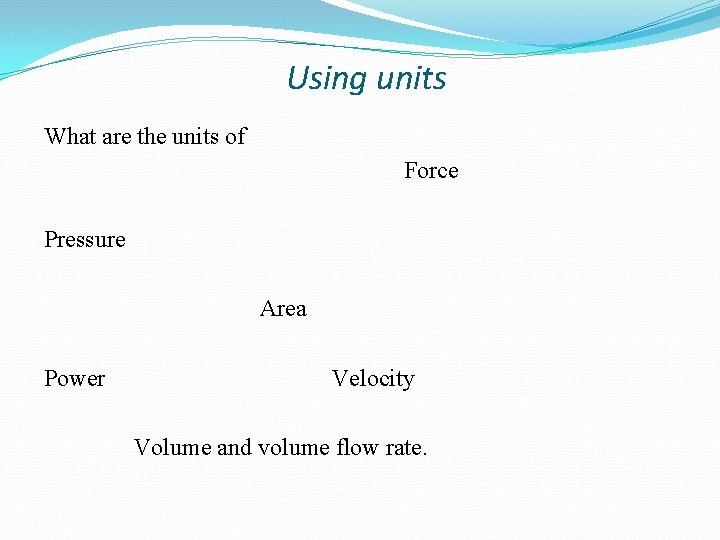
Using units What are the units of Force Pressure Area Power Velocity Volume and volume flow rate.
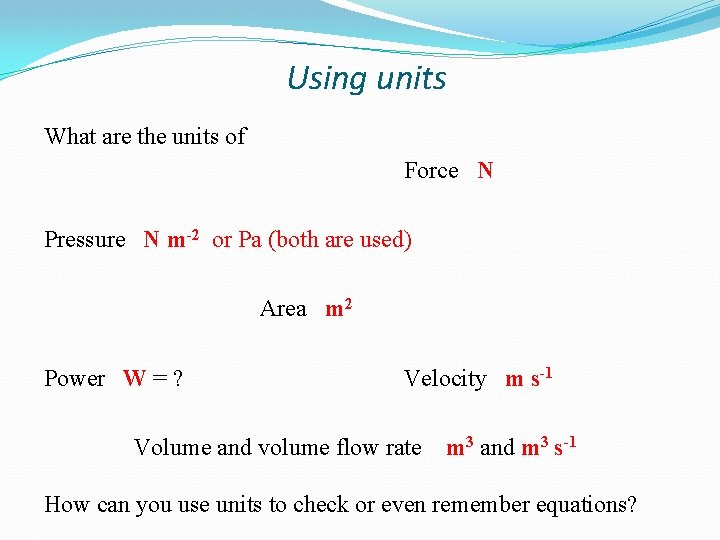
Using units What are the units of Force N Pressure N m-2 or Pa (both are used) Area m 2 Power W = ? Velocity m s-1 Volume and volume flow rate m 3 and m 3 s-1 How can you use units to check or even remember equations?

Using units F P A P V Q N N m-2 m 2 W (N m s-1) m s-1 m 3 s-1 How many equations can you think of? Write them here.
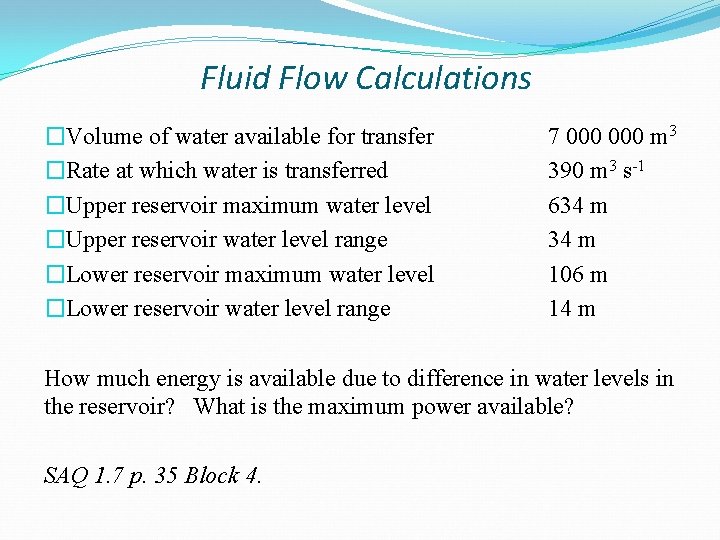
Fluid Flow Calculations �Volume of water available for transfer �Rate at which water is transferred �Upper reservoir maximum water level �Upper reservoir water level range �Lower reservoir maximum water level �Lower reservoir water level range 7 000 m 3 390 m 3 s-1 634 m 106 m 14 m How much energy is available due to difference in water levels in the reservoir? What is the maximum power available? SAQ 1. 7 p. 35 Block 4.
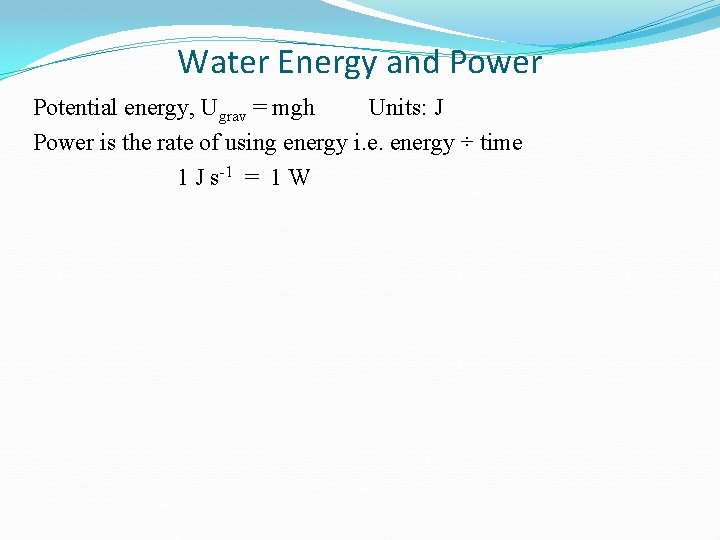
Water Energy and Power Potential energy, Ugrav = mgh Units: J Power is the rate of using energy i. e. energy ÷ time 1 J s-1 = 1 W
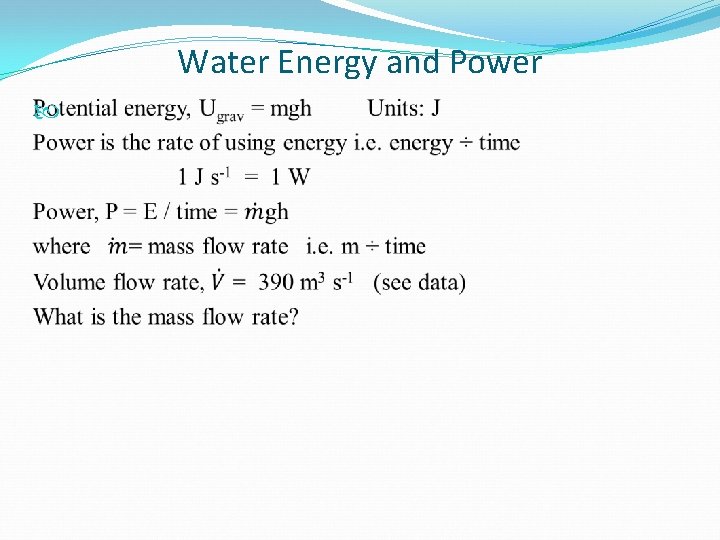
Water Energy and Power
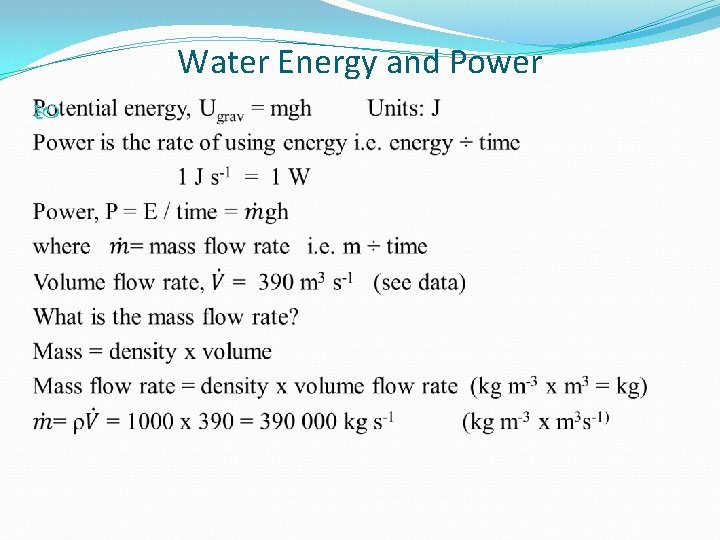
Water Energy and Power
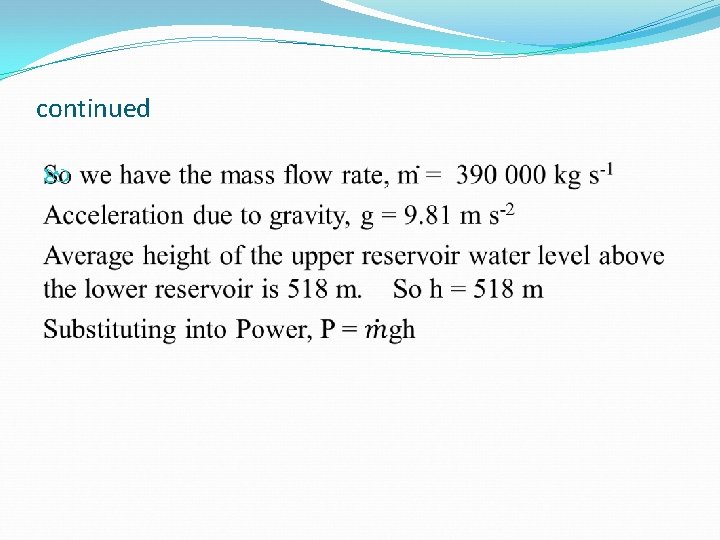
continued
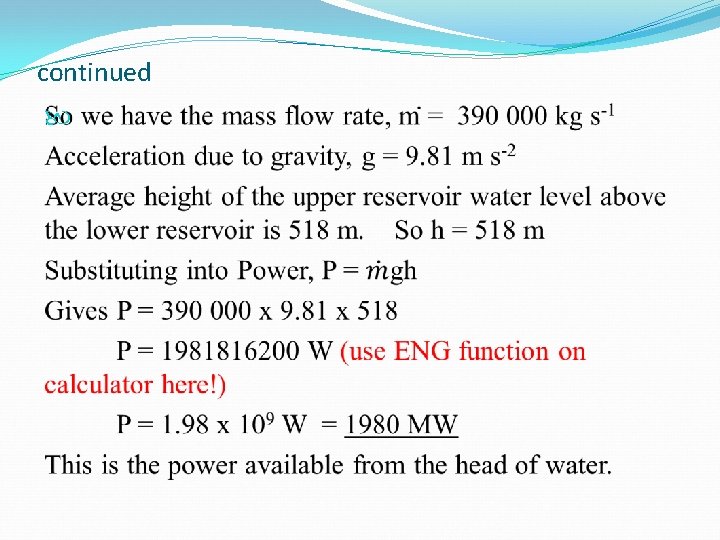
continued
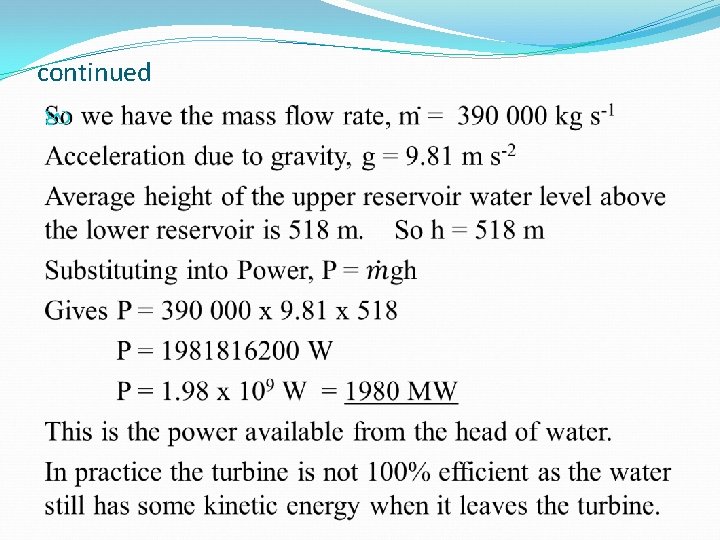
continued
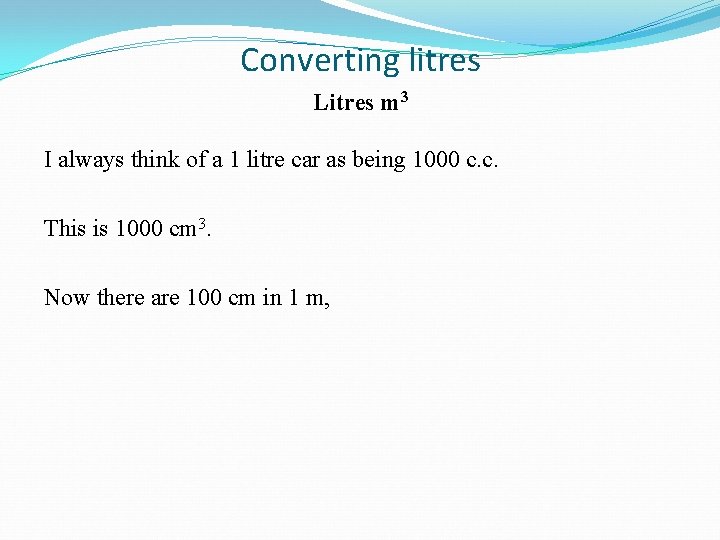
Converting litres Litres m 3 I always think of a 1 litre car as being 1000 c. c. This is 1000 cm 3. Now there are 100 cm in 1 m,
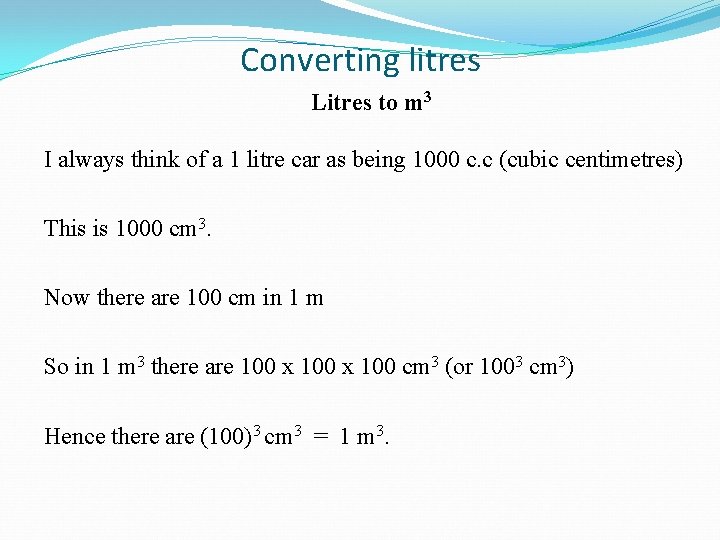
Converting litres Litres to m 3 I always think of a 1 litre car as being 1000 c. c (cubic centimetres) This is 1000 cm 3. Now there are 100 cm in 1 m So in 1 m 3 there are 100 x 100 cm 3 (or 1003 cm 3) Hence there are (100)3 cm 3 = 1 m 3.
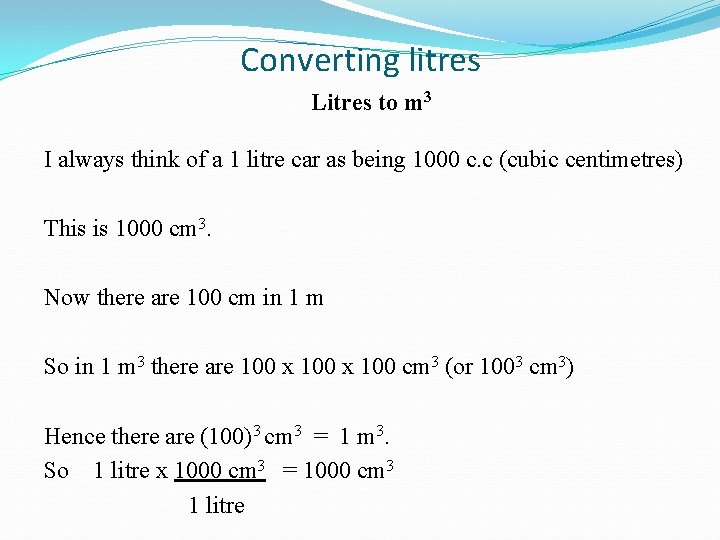
Converting litres Litres to m 3 I always think of a 1 litre car as being 1000 c. c (cubic centimetres) This is 1000 cm 3. Now there are 100 cm in 1 m So in 1 m 3 there are 100 x 100 cm 3 (or 1003 cm 3) Hence there are (100)3 cm 3 = 1 m 3. So 1 litre x 1000 cm 3 = 1000 cm 3 1 litre

Converting litres Now 1 litre = 1000 cm 3 1 litre = 1000 cm 3 x m 3 . = 10 -3 m 3 (100)3 cm 3 So 1 litre = 10 -3 m 3 or 1000 litres = 1 m 3 ALSO 1 litre of water has an approximate mass of 1 kg at 20 o. C. This is the reason why there is a standard kg mass in the SI system that all other masses around the world are compared to, as the density of water varies with temperature. When first defined 1 kg was the mass of 1 litre of water
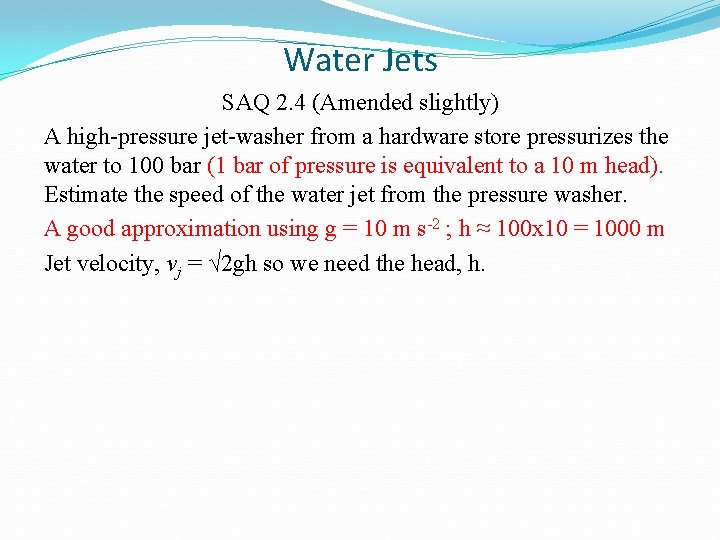
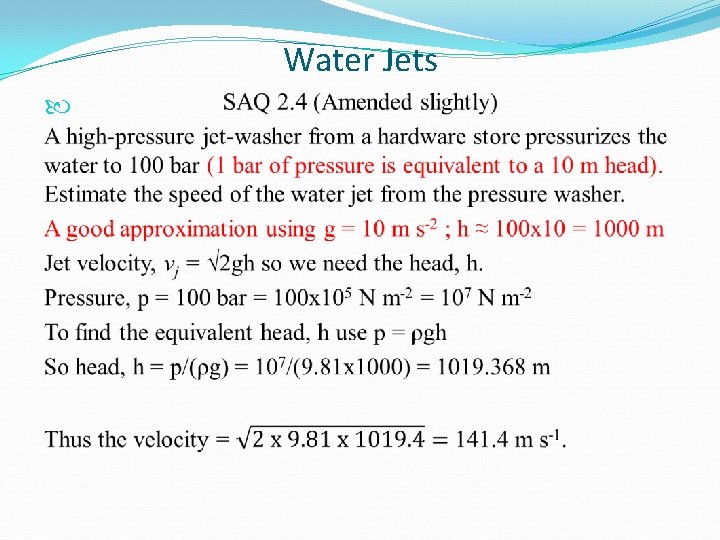
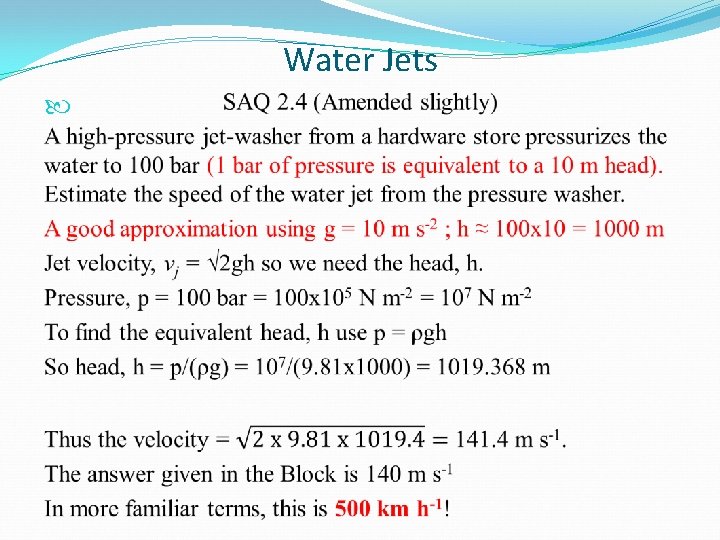
Water Jets SAQ 2. 4 (Amended slightly) A high-pressure jet-washer from a hardware store pressurizes the water to 100 bar (1 bar of pressure is equivalent to a 10 m head). Estimate the speed of the water jet from the pressure washer. A good approximation using g = 10 m s-2 ; h ≈ 100 x 10 = 1000 m Jet velocity, vj = √ 2 gh so we need the head, h.
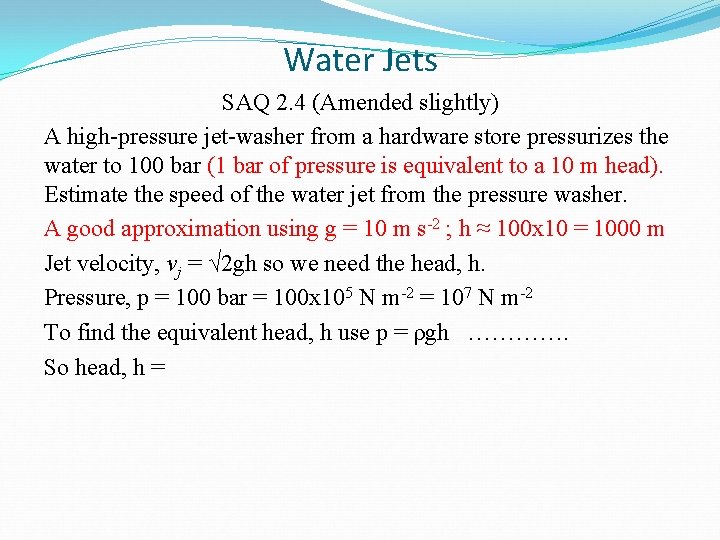
Water Jets SAQ 2. 4 (Amended slightly) A high-pressure jet-washer from a hardware store pressurizes the water to 100 bar (1 bar of pressure is equivalent to a 10 m head). Estimate the speed of the water jet from the pressure washer. A good approximation using g = 10 m s-2 ; h ≈ 100 x 10 = 1000 m Jet velocity, vj = √ 2 gh so we need the head, h. Pressure, p = 100 bar = 100 x 105 N m-2 = 107 N m-2 To find the equivalent head, h use p = ρgh …………. So head, h =
Water Jets
Water Jets

Lubrication and wear Lubrication is required to avoid wear There are 4 types of wear
Wear Lubrication is required to avoid wear There are 4 types of wear Abrasive wear – hard particles on one surface makes groves in a softer mating surface Avoided by selecting materials of similar hardness and cleanliness of sliding sections

Wear Lubrication is required to avoid wear There are 4 types of wear Adhesive wear – two mating surfaces effectively “weld” together by chemical bonding between atoms on the surfaces – can cause seizure Most wear occurs in softer material

Wear Lubrication is required to avoid wear There are 4 types of wear Fatigue wear – local stresses around asperities are high leading to crack growth and propagation Example – ball bearings with cyclically loading and unloading

Wear Lubrication is required to avoid wear There are 4 types of wear Chemical wear – associated with chemical reactions Example – oxidation layers being repeatedly formed and removed or acids in lubricants
Lubrication and viscosity Lubrication between surfaces ensure that they are separated and the aspirates don’t make contact. However, lubricants suffer from viscous effects, where energy is taken out of the system due to friction.
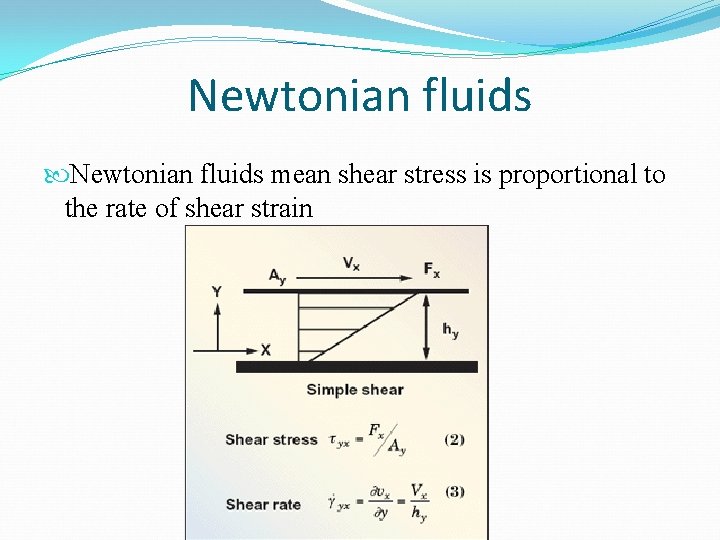
Newtonian fluids mean shear stress is proportional to the rate of shear strain
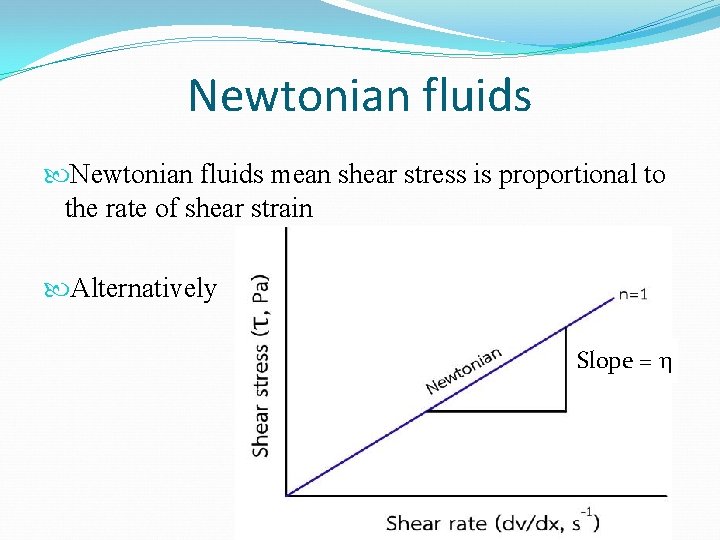
Newtonian fluids mean shear stress is proportional to the rate of shear strain Alternatively Slope =
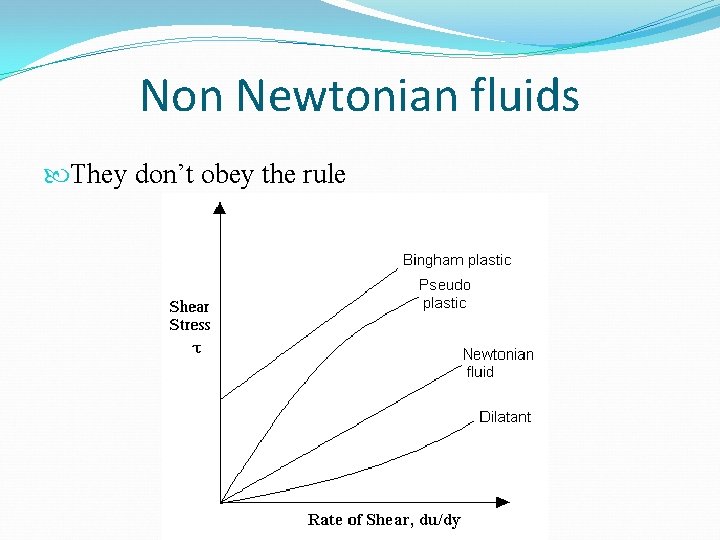
Non Newtonian fluids They don’t obey the rule
Two types of viscosity There are two types of viscosity Dynamic – the factor in the Newtonian equation. Be aware that in many other sources, it has the symbol Kinematic - - which is easier to measure (by timing how long it takes for a certain volume of lubricant to pass through an orifice. Oils have their 10 W 40 specification based on this
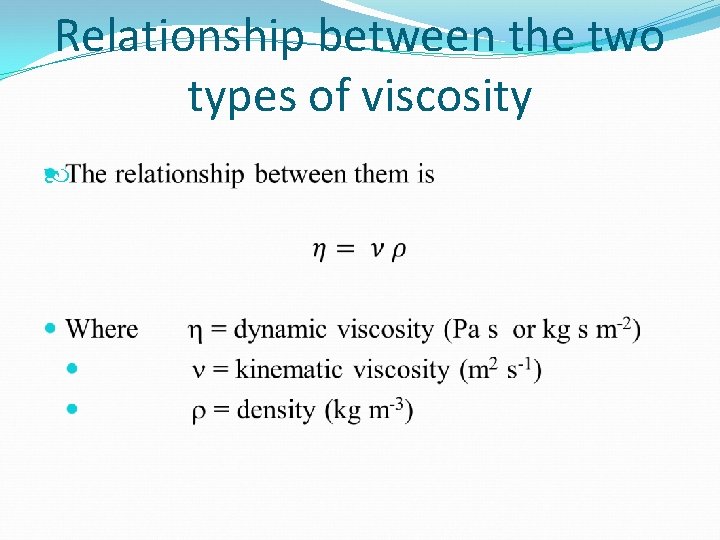
Relationship between the two types of viscosity

Alternative units for kinematic viscosity The old unit of stokes (St)or c. St is still common In the 2016 exam the examiner didn’t give the conversion factor!!!! A lot of students were very upset! 1 c. St = 1 x 10 -6 m 2 s-1
Hydrodynamic lubrication Also called fluid-film, thick-film, or flooded lubrication A thick film of lubricant is interposed between the surfaces of bodies in relative motion There has to be pressure buildup in the film due to relative motion of the surfaces Fluid friction is substituted for sliding friction Coefficient of friction is decreased Prevalent in journal and thrust bearings
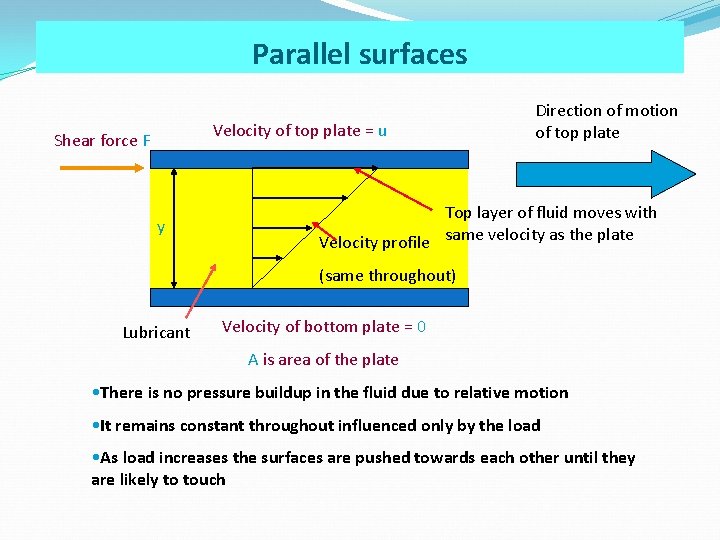
Parallel surfaces Velocity of top plate = u Shear force F y Direction of motion of top plate Top layer of fluid moves with Velocity profile same velocity as the plate (same throughout) Lubricant Velocity of bottom plate = 0 A is area of the plate • There is no pressure buildup in the fluid due to relative motion • It remains constant throughout influenced only by the load • As load increases the surfaces are pushed towards each other until they are likely to touch
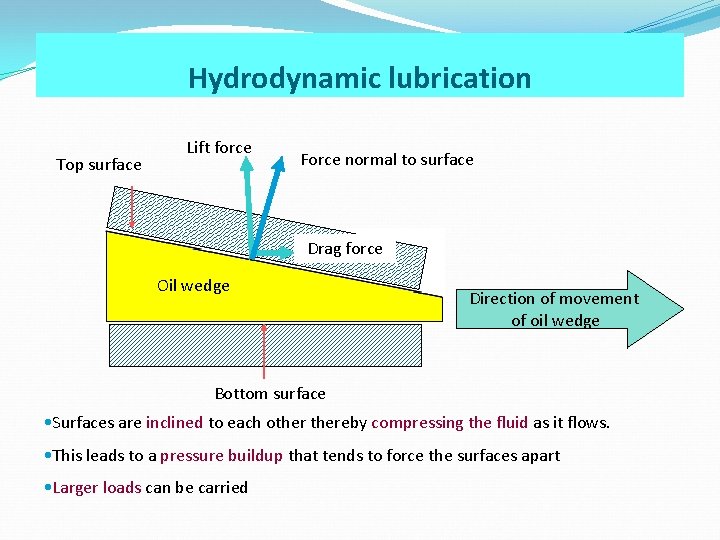
Hydrodynamic lubrication Top surface Lift force Force normal to surface Drag force Oil wedge Direction of movement of oil wedge Bottom surface • Surfaces are inclined to each othereby compressing the fluid as it flows. • This leads to a pressure buildup that tends to force the surfaces apart • Larger loads can be carried
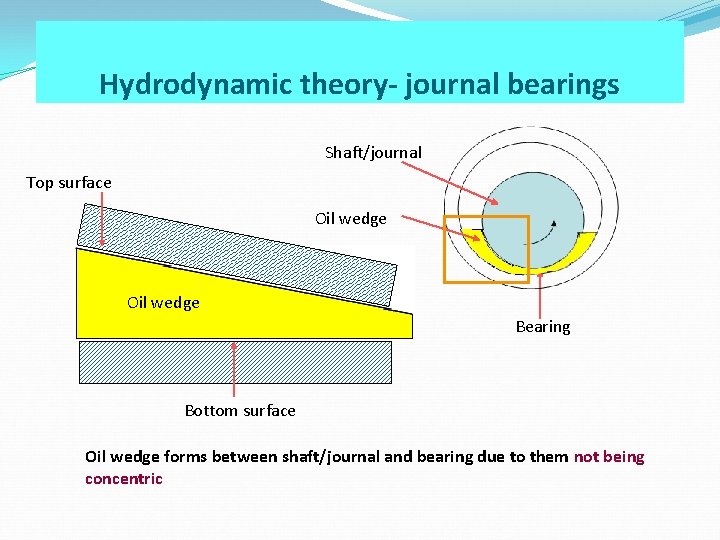
Hydrodynamic theory- journal bearings Shaft/journal Top surface Oil wedge Bearing Bottom surface Oil wedge forms between shaft/journal and bearing due to them not being concentric
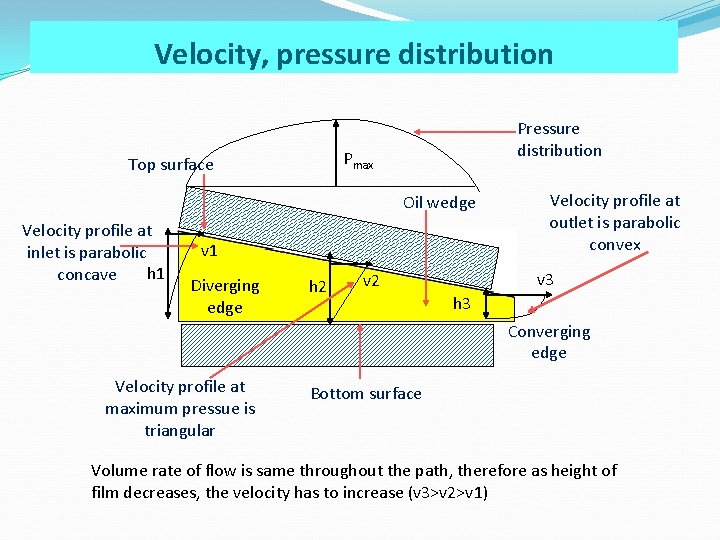
Velocity, pressure distribution Pmax Top surface Oil wedge Velocity profile at inlet is parabolic h 1 concave v 1 Diverging edge h 2 Velocity profile at outlet is parabolic convex v 3 v 2 h 3 Converging edge Velocity profile at maximum pressue is triangular Bottom surface Volume rate of flow is same throughout the path, therefore as height of film decreases, the velocity has to increase (v 3>v 2>v 1)

Journal bearing- process at startup e = eccentricity Shaft/journal Bearing Stationary journal Instant of starting (tends to While running (slips due to loss climb up the bearing) of traction and settles eccentric to bearing) Because of the eccentricity, the wedge is maintained (lack of concentricity)
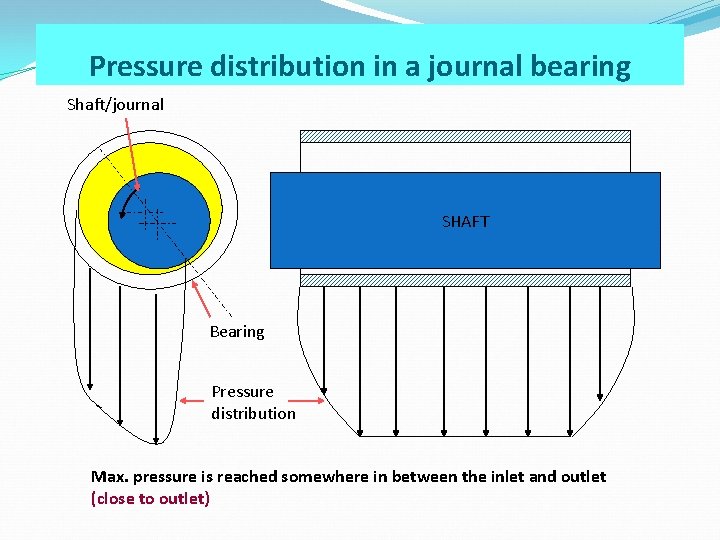
Pressure distribution in a journal bearing Shaft/journal SHAFT Bearing Pressure distribution Max. pressure is reached somewhere in between the inlet and outlet (close to outlet)
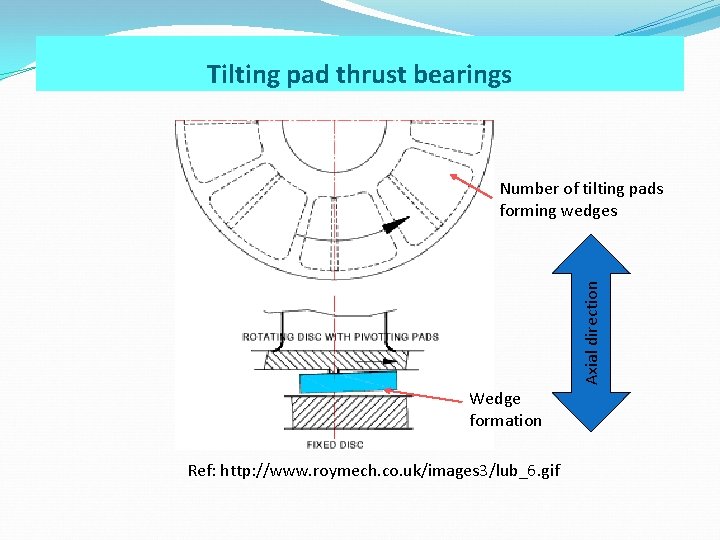
Tilting pad thrust bearings Axial direction Number of tilting pads forming wedges Wedge formation Ref: http: //www. roymech. co. uk/images 3/lub_6. gif
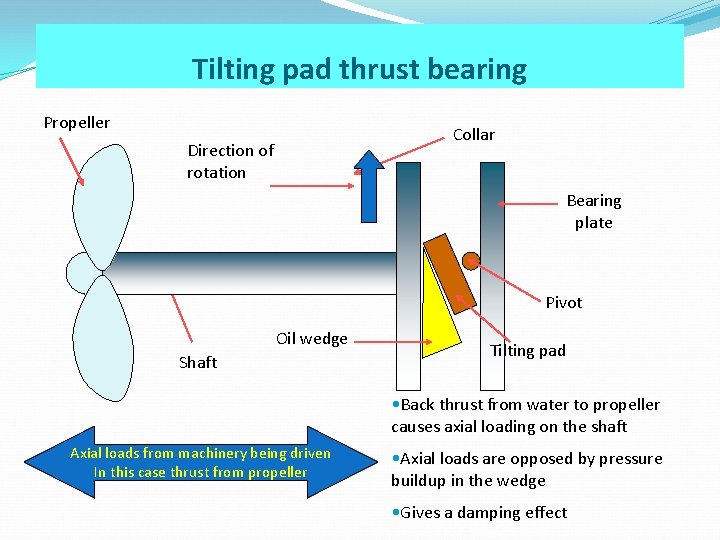
Tilting pad thrust bearing Propeller Collar Direction of rotation Bearing plate Pivot Oil wedge Shaft Tilting pad • Back thrust from water to propeller causes axial loading on the shaft Axial loads from machinery being driven In this case thrust from propeller • Axial loads are opposed by pressure buildup in the wedge • Gives a damping effect
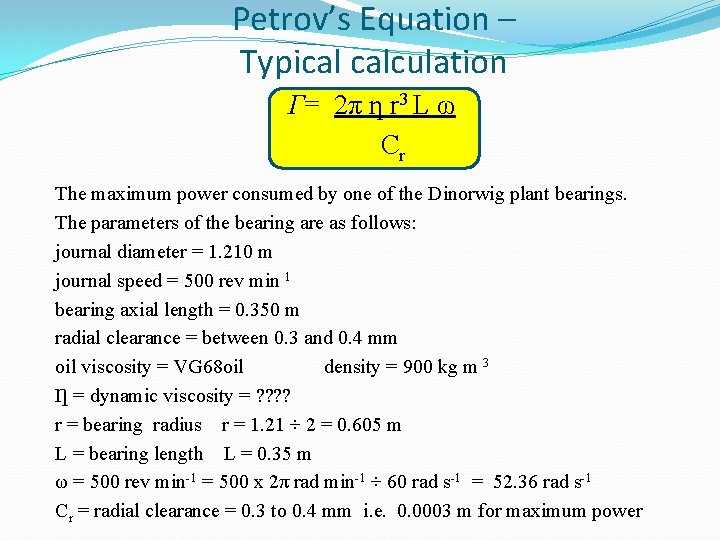
Petrov’s Equation – Typical calculation Γ= 2π ƞ r 3 L ω Cr The maximum power consumed by one of the Dinorwig plant bearings. The parameters of the bearing are as follows: journal diameter = 1. 210 m journal speed = 500 rev min 1 bearing axial length = 0. 350 m radial clearance = between 0. 3 and 0. 4 mm oil viscosity = VG 68 oil density = 900 kg m 3 Ƞ = dynamic viscosity = ? ? r = bearing radius r = 1. 21 ÷ 2 = 0. 605 m L = bearing length L = 0. 35 m ω = 500 rev min-1 = 500 x 2π rad min-1 ÷ 60 rad s-1 = 52. 36 rad s-1 Cr = radial clearance = 0. 3 to 0. 4 mm i. e. 0. 0003 m for maximum power
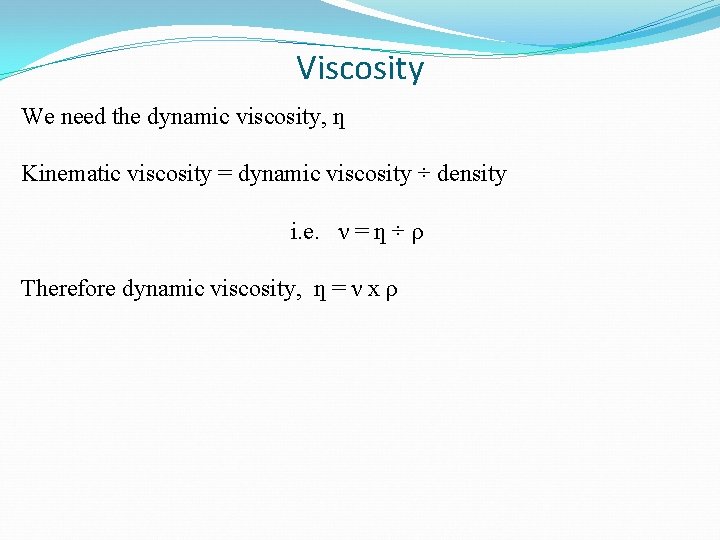
Viscosity We need the dynamic viscosity, ƞ Kinematic viscosity = dynamic viscosity ÷ density i. e. ν = ƞ ÷ ρ Therefore dynamic viscosity, ƞ = ν x ρ
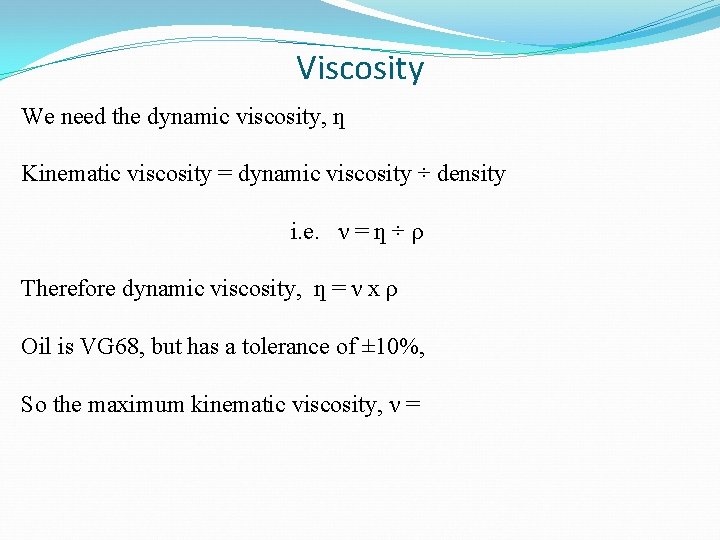
Viscosity We need the dynamic viscosity, ƞ Kinematic viscosity = dynamic viscosity ÷ density i. e. ν = ƞ ÷ ρ Therefore dynamic viscosity, ƞ = ν x ρ Oil is VG 68, but has a tolerance of ± 10%, So the maximum kinematic viscosity, ν =

Viscosity We need the dynamic viscosity, ƞ Kinematic viscosity = dynamic viscosity ÷ density i. e. ν = ƞ ÷ ρ Therefore dynamic viscosity, ƞ = ν x ρ Oil is VG 68, but has a tolerance of ± 10%, So the maximum kinematic viscosity, ν =68 + 68/10
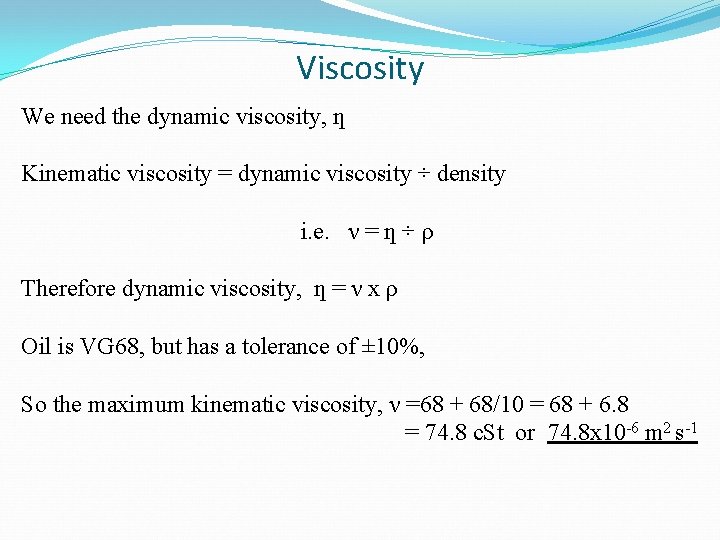
Viscosity We need the dynamic viscosity, ƞ Kinematic viscosity = dynamic viscosity ÷ density i. e. ν = ƞ ÷ ρ Therefore dynamic viscosity, ƞ = ν x ρ Oil is VG 68, but has a tolerance of ± 10%, So the maximum kinematic viscosity, ν =68 + 68/10 = 68 + 6. 8 = 74. 8 c. St or 74. 8 x 10 -6 m 2 s-1
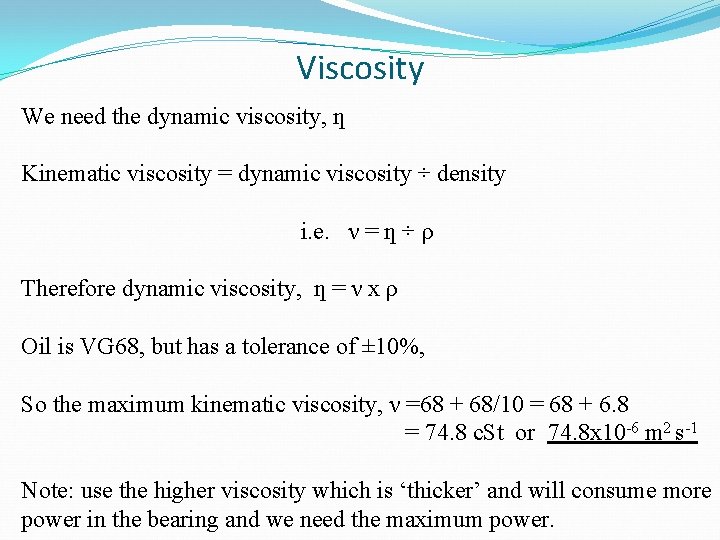
Viscosity We need the dynamic viscosity, ƞ Kinematic viscosity = dynamic viscosity ÷ density i. e. ν = ƞ ÷ ρ Therefore dynamic viscosity, ƞ = ν x ρ Oil is VG 68, but has a tolerance of ± 10%, So the maximum kinematic viscosity, ν =68 + 68/10 = 68 + 6. 8 = 74. 8 c. St or 74. 8 x 10 -6 m 2 s-1 Note: use the higher viscosity which is ‘thicker’ and will consume more power in the bearing and we need the maximum power.
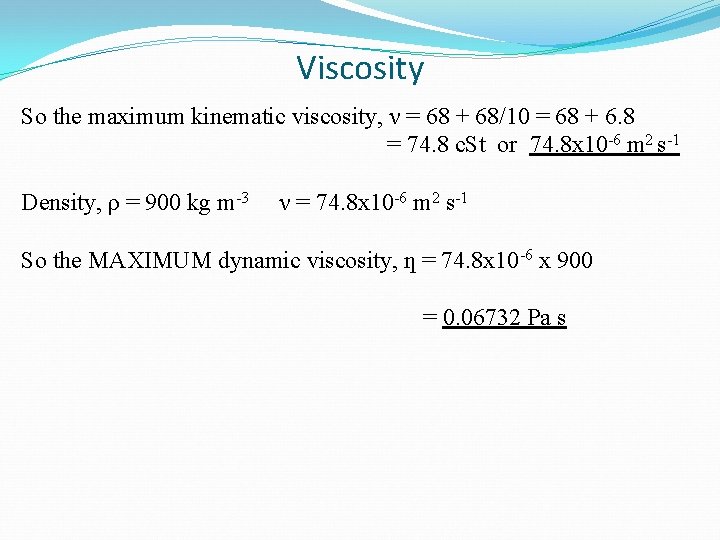
Viscosity So the maximum kinematic viscosity, ν = 68 + 68/10 = 68 + 6. 8 = 74. 8 c. St or 74. 8 x 10 -6 m 2 s-1 Density, ρ = 900 kg m-3 ν = 74. 8 x 10 -6 m 2 s-1 So the MAXIMUM dynamic viscosity, ƞ = 74. 8 x 10 -6 x 900 = 0. 06732 Pa s

Bearing Power Γ = 2π ƞ r 3 L ω Cr Petrov’s equation gives the maximum torque for a Dinorwig plant bearing. Oil viscosity = VG 68 oil (68± 10% c. St) density, ρ = 900 kg m 3 dynamic viscosity, Ƞ = 0. 06732 Pa s Bearing radius, r = 0. 605 m Bearing length, L = 0. 35 m Angular velocity, ω = 52. 36 rad s-1 Minimum radial clearance, Cr = 0. 0003 m (for maximum power) Substituting into Petrov’s equation, Γ = 2π x 0. 06732 x 0. 6053 x 0. 35 x 52. 36 0. 0003
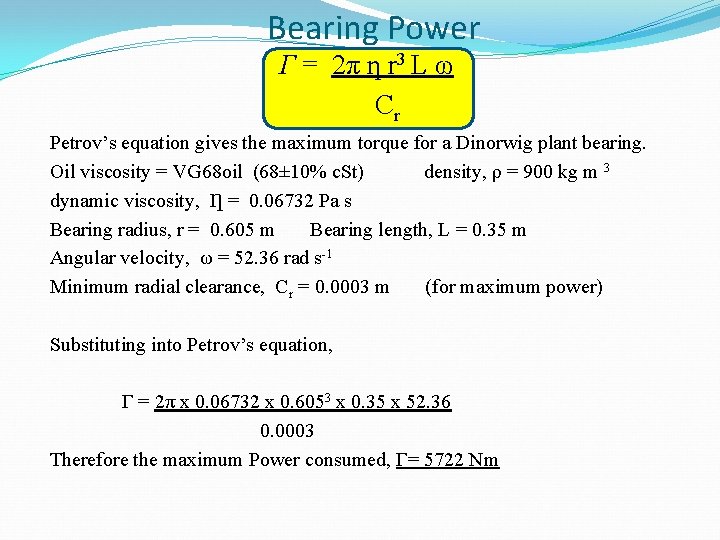
Bearing Power Γ = 2π ƞ r 3 L ω Cr Petrov’s equation gives the maximum torque for a Dinorwig plant bearing. Oil viscosity = VG 68 oil (68± 10% c. St) density, ρ = 900 kg m 3 dynamic viscosity, Ƞ = 0. 06732 Pa s Bearing radius, r = 0. 605 m Bearing length, L = 0. 35 m Angular velocity, ω = 52. 36 rad s-1 Minimum radial clearance, Cr = 0. 0003 m (for maximum power) Substituting into Petrov’s equation, Γ = 2π x 0. 06732 x 0. 6053 x 0. 35 x 52. 36 0. 0003 Therefore the maximum Power consumed, Γ= 5722 Nm
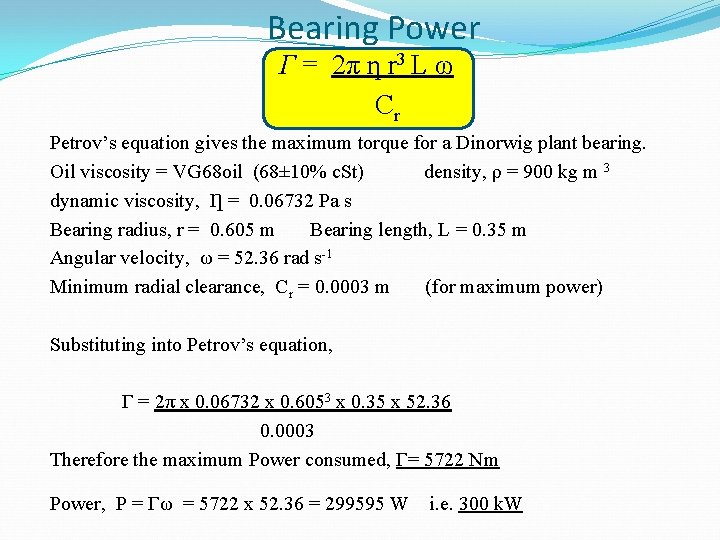
Bearing Power Γ = 2π ƞ r 3 L ω Cr Petrov’s equation gives the maximum torque for a Dinorwig plant bearing. Oil viscosity = VG 68 oil (68± 10% c. St) density, ρ = 900 kg m 3 dynamic viscosity, Ƞ = 0. 06732 Pa s Bearing radius, r = 0. 605 m Bearing length, L = 0. 35 m Angular velocity, ω = 52. 36 rad s-1 Minimum radial clearance, Cr = 0. 0003 m (for maximum power) Substituting into Petrov’s equation, Γ = 2π x 0. 06732 x 0. 6053 x 0. 35 x 52. 36 0. 0003 Therefore the maximum Power consumed, Γ= 5722 Nm Power, P = Γω = 5722 x 52. 36 = 299595 W i. e. 300 k. W
- Slides: 58