Video Why was there a Communist revolution in


- Slides: 30
Video Why was there a Communist revolution in Russia in 1917?
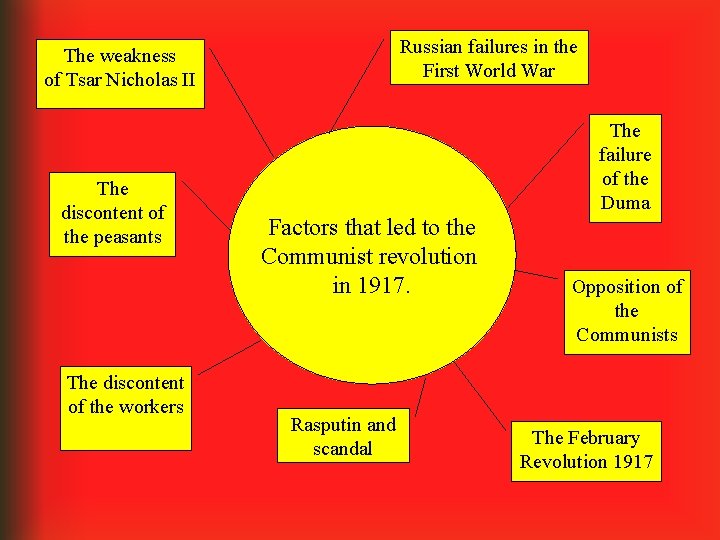
The weakness of Tsar Nicholas II The discontent of the peasants The discontent of the workers Russian failures in the First World War The failure of the Duma Factors that led to the Communist revolution in 1917. Rasputin and scandal Opposition of the Communists The February Revolution 1917
The discontent of the Peasants • Until 1861 the peasants had belonged to their masters, who could buy and sell them like animals. • When the peasants were freed in 1861 they were given small amounts of land for which they had to pay back the government. Farmers were in absolute poverty. • The agricultural methods of the country could not produce enough to feed the population. Very often the peasants do not have enough allotment land. They cannot feed themselves, clothe themselves, heat their homes, keep their tools and livestock, secure seed for sowing and lastly pay their taxes. Police report into country conditions 1905
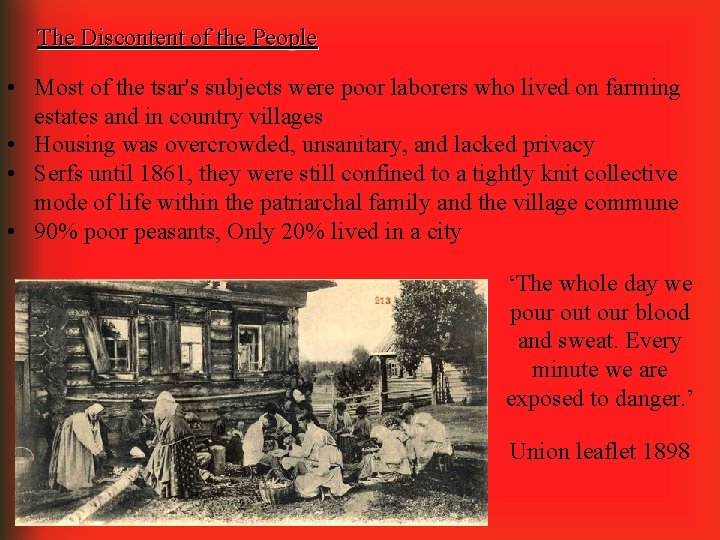
The Discontent of the People • Most of the tsar's subjects were poor laborers who lived on farming estates and in country villages • Housing was overcrowded, unsanitary, and lacked privacy • Serfs until 1861, they were still confined to a tightly knit collective mode of life within the patriarchal family and the village commune • 90% poor peasants, Only 20% lived in a city ‘The whole day we pour out our blood and sweat. Every minute we are exposed to danger. ’ Union leaflet 1898
Play Video Here: Stop at 2: 00 when he starts talking about 1905 Revolution Video: https: //www. youtube. com/watch? v=utr 3 ot. Flqp 8
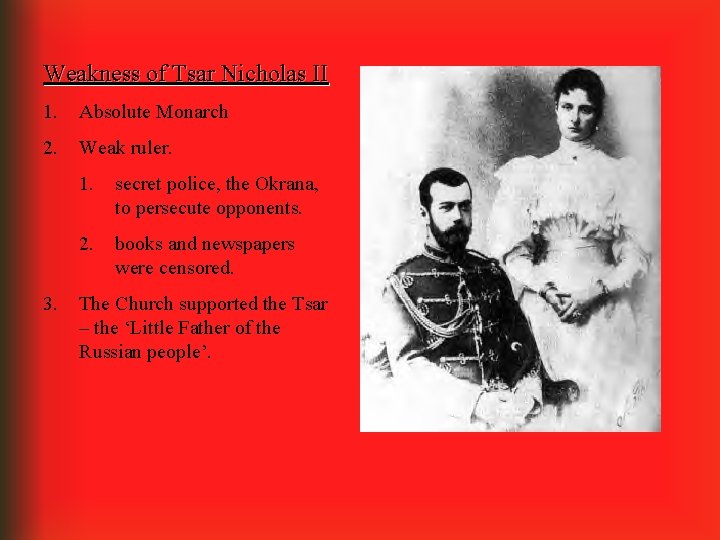
Weakness of Tsar Nicholas II 1. Absolute Monarch 2. Weak ruler. 3. 1. secret police, the Okrana, to persecute opponents. 2. books and newspapers were censored. The Church supported the Tsar – the ‘Little Father of the Russian people’.
Play Video Here: Start at 2: 00 where he starts talking about Revolution of 1905 Video: https: //www. youtube. com/watch? v=utr 3 ot. Flqp 8
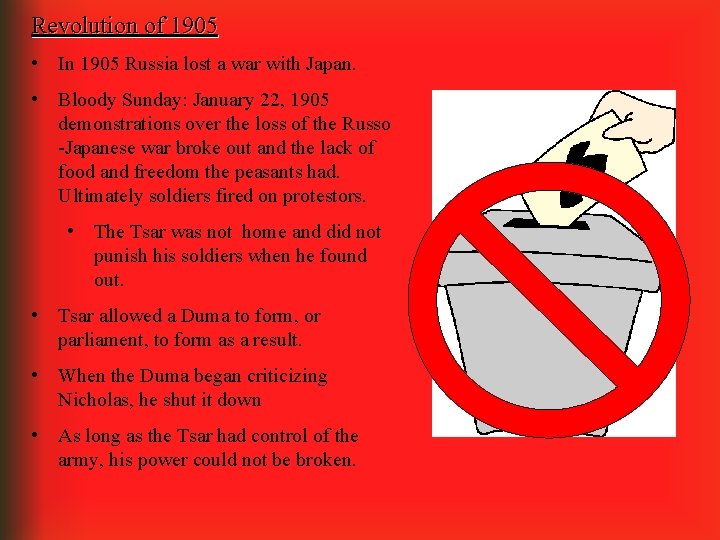
Revolution of 1905 • In 1905 Russia lost a war with Japan. • Bloody Sunday: January 22, 1905 demonstrations over the loss of the Russo -Japanese war broke out and the lack of food and freedom the peasants had. Ultimately soldiers fired on protestors. • The Tsar was not home and did not punish his soldiers when he found out. • Tsar allowed a Duma to form, or parliament, to form as a result. • When the Duma began criticizing Nicholas, he shut it down • As long as the Tsar had control of the army, his power could not be broken.
Stop at 4: 15 when he goes and looks for another cause of the Russian Revolution. Review with students the following Vocab: Bloody Sunday Duma
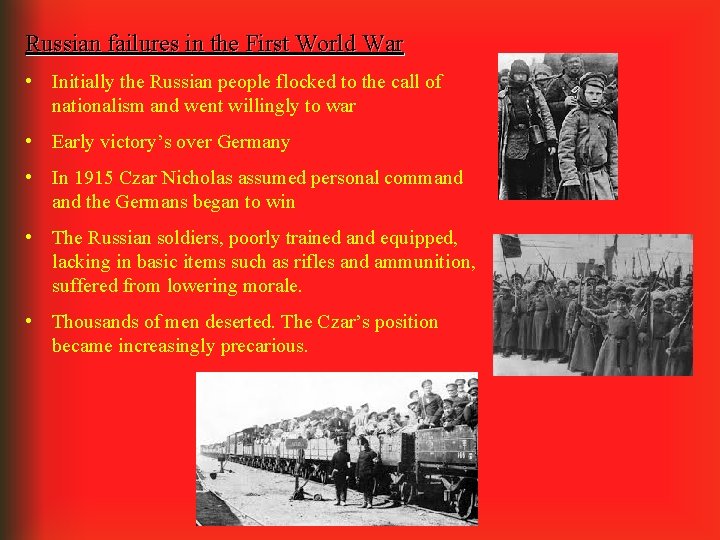
Russian failures in the First World War • Initially the Russian people flocked to the call of nationalism and went willingly to war • Early victory’s over Germany • In 1915 Czar Nicholas assumed personal command the Germans began to win • The Russian soldiers, poorly trained and equipped, lacking in basic items such as rifles and ammunition, suffered from lowering morale. • Thousands of men deserted. The Czar’s position became increasingly precarious.
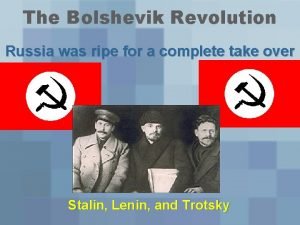
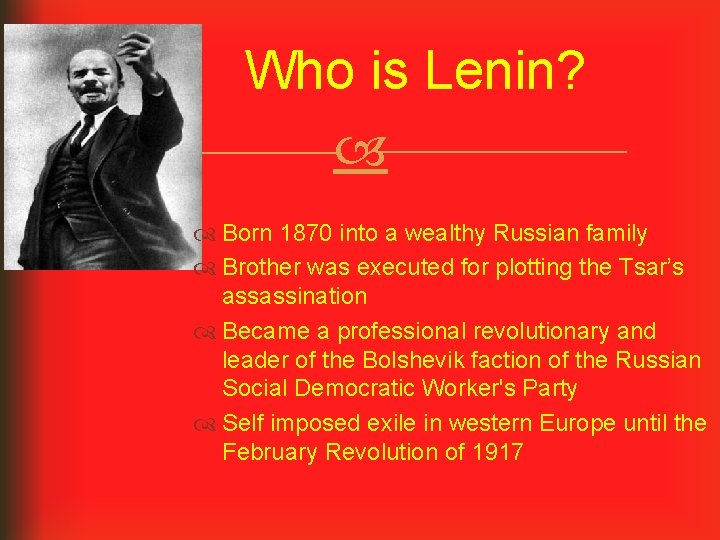
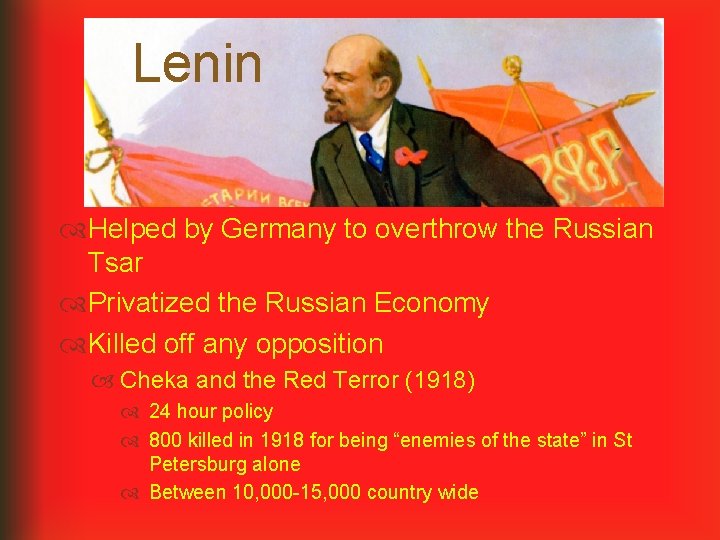
Who is Lenin? Born 1870 into a wealthy Russian family Brother was executed for plotting the Tsar’s assassination Became a professional revolutionary and leader of the Bolshevik faction of the Russian Social Democratic Worker's Party Self imposed exile in western Europe until the February Revolution of 1917
Lenin Helped by Germany to overthrow the Russian Tsar Privatized the Russian Economy Killed off any opposition Cheka and the Red Terror (1918) 24 hour policy 800 killed in 1918 for being “enemies of the state” in St Petersburg alone Between 10, 000 -15, 000 country wide
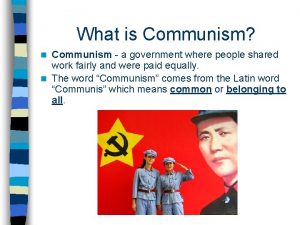
Marxism Proletariat- (Workers) Those who work but don’t own what they make. Instead they work for wages Bourgeoisie- (Owners) Those who own the stuff that the workers make. Communism- A stateless system of Utopia “From each according to his ability to each according to his need. ” Lenin Marxism Dictatorship of the Proletariat- What is needed is a political party supported by the military to force communism to happen faster than Marx predicted. “Marx With A Gun”
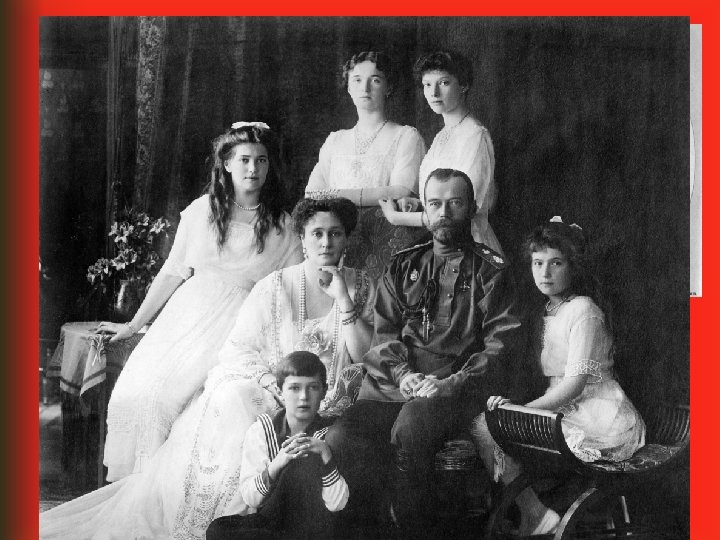
Tsarina Alexandra • Granddaughter of Britain’s Queen Victoria • Marriage was political, she disliked Russia • Had 4 daughters and a son, Alexis who had hemophilia • Unswervingly loyal to debauched holy man Rasputin, who “cured” her son through hypnosis. • Believed in absolute monarchy and her husbands power over his people • Commonly dismissed her husbands advisors when they disagreed with his policies
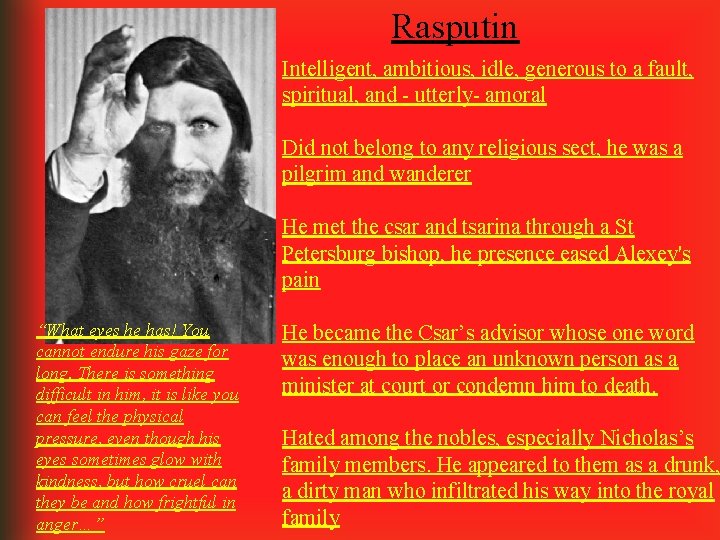
Rasputin Intelligent, ambitious, idle, generous to a fault, spiritual, and - utterly- amoral Did not belong to any religious sect, he was a pilgrim and wanderer He met the csar and tsarina through a St Petersburg bishop, he presence eased Alexey's pain “What eyes he has! You cannot endure his gaze for long. There is something difficult in him, it is like you can feel the physical pressure, even though his eyes sometimes glow with kindness, but how cruel can they be and how frightful in anger…” He became the Csar’s advisor whose one word was enough to place an unknown person as a minister at court or condemn him to death. Hated among the nobles, especially Nicholas’s family members. He appeared to them as a drunk, a dirty man who infiltrated his way into the royal family
Rasputin’s Prediction “I feel that I shall leave life before January 1 st. I wish to make known to the Russian people, to Papa (the Tsar), to the Russian Mother (the Tsarina) and to the Children what they must understand. But if I am murdered by boyars, nobles, and if they shed my blood, their hands will remain soiled with my blood for twenty-five years and they will leave Russia. Brothers will kill brothers, and they will kill each other and hate each other, and for twenty-five years there will be no peace in the country. If it was your relations who have wrought my death, then none of your children will remain alive for more than two years. And if they do, they will beg for death as they will see the defeat of Russia, see the Antichrist coming, plague, poverty, destroyed churches, and desecrated sanctuaries where everyone is dead. The Russian Tsar, you will be killed by the Russian people and the people will be cursed and will serve as the devil’s weapon killing each other everywhere. Three times for 25 years they will destroy the Russian people and the orthodox faith and the Russian land will die. ”
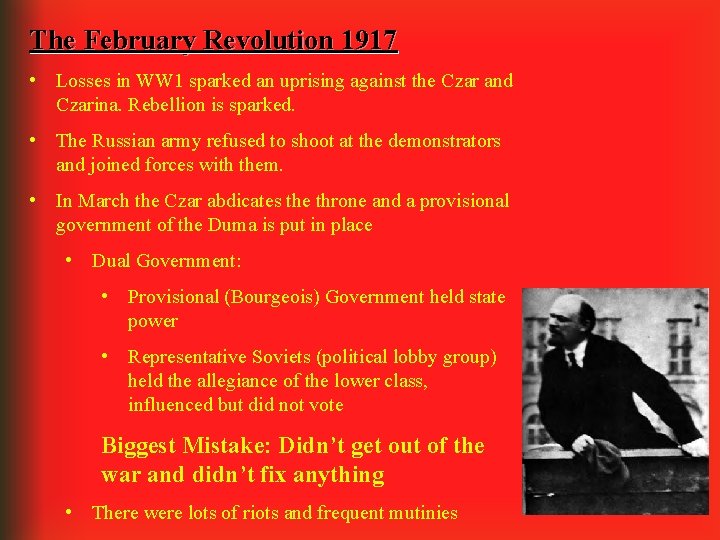
The February Revolution 1917 • Losses in WW 1 sparked an uprising against the Czar and Czarina. Rebellion is sparked. • The Russian army refused to shoot at the demonstrators and joined forces with them. • In March the Czar abdicates the throne and a provisional government of the Duma is put in place • Dual Government: • Provisional (Bourgeois) Government held state power • Representative Soviets (political lobby group) held the allegiance of the lower class, influenced but did not vote Biggest Mistake: Didn’t get out of the war and didn’t fix anything • There were lots of riots and frequent mutinies
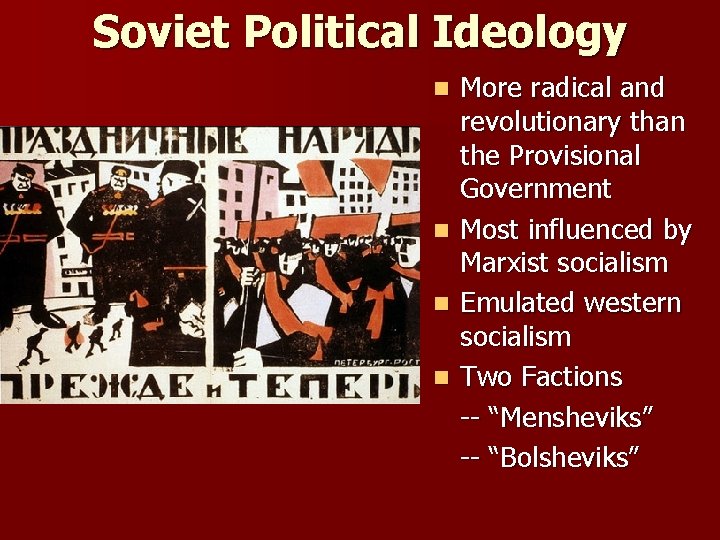
Soviet Political Ideology More radical and revolutionary than the Provisional Government n Most influenced by Marxist socialism n Emulated western socialism n Two Factions -- “Mensheviks” -- “Bolsheviks” n
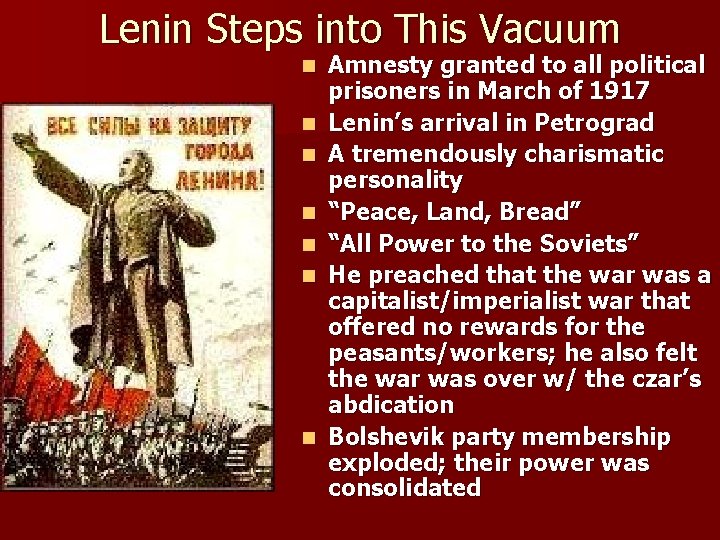
Lenin Steps into This Vacuum n n n n Amnesty granted to all political prisoners in March of 1917 Lenin’s arrival in Petrograd A tremendously charismatic personality “Peace, Land, Bread” “All Power to the Soviets” He preached that the war was a capitalist/imperialist war that offered no rewards for the peasants/workers; he also felt the war was over w/ the czar’s abdication Bolshevik party membership exploded; their power was consolidated
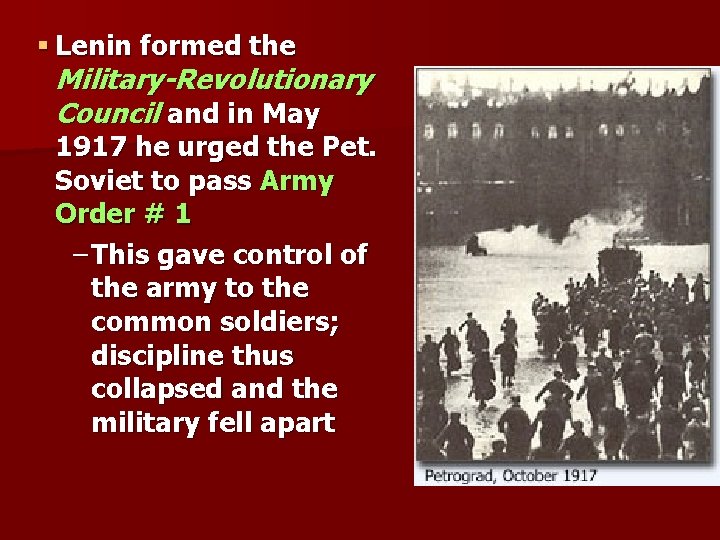
§ Lenin formed the Military-Revolutionary Council and in May 1917 he urged the Pet. Soviet to pass Army Order # 1 – This gave control of the army to the common soldiers; discipline thus collapsed and the military fell apart
Play Video n Start Video at 10: 32 , Stop video at 14: 25 (when he talks about the mistake of not getting out of WW 1) n Describe: – How the Provisional Government came to be? – The Provisional Government and the two bodies that make it up? – What mistakes did the Provisional Government make?
Video Questions n Can you answer the following questions after listening to the video – What is a dictatorship of the proletariat? – How did the Bolsheviks eventually get in charge?
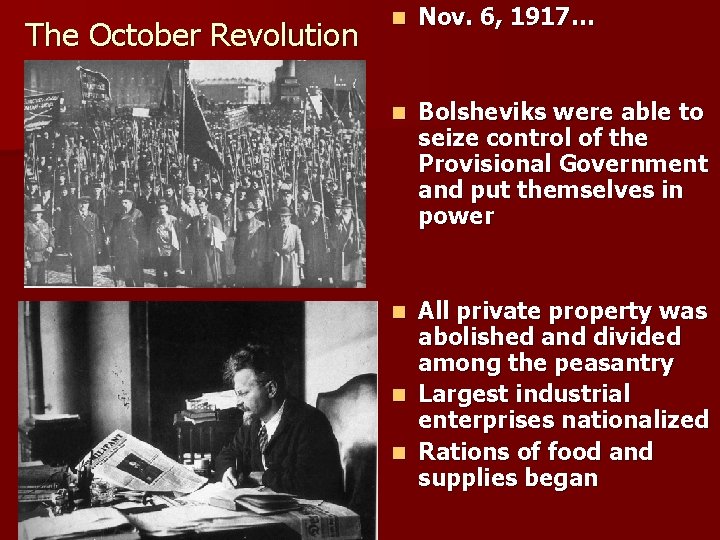
The October Revolution n Nov. 6, 1917… n Bolsheviks were able to seize control of the Provisional Government and put themselves in power All private property was abolished and divided among the peasantry n Largest industrial enterprises nationalized n Rations of food and supplies began n
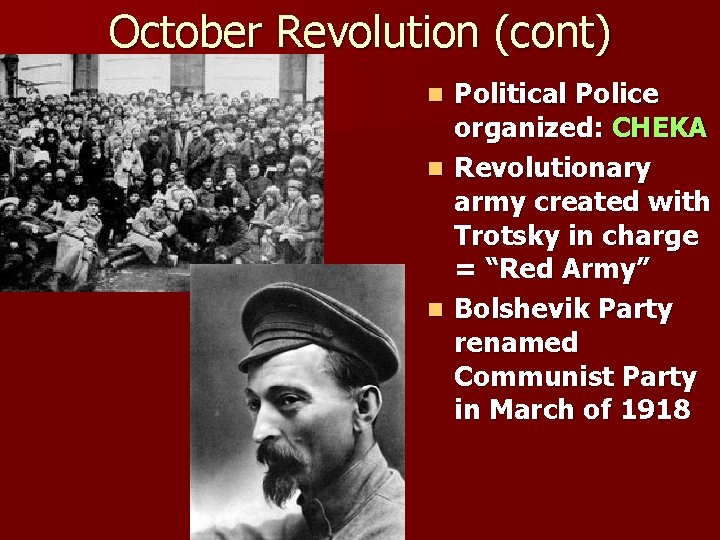
October Revolution (cont) Political Police organized: CHEKA n Revolutionary army created with Trotsky in charge = “Red Army” n Bolshevik Party renamed Communist Party in March of 1918 n
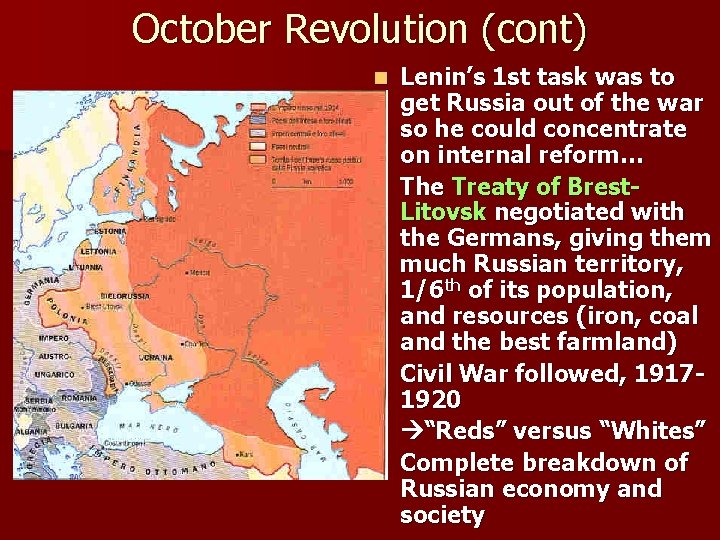
October Revolution (cont) Lenin’s 1 st task was to get Russia out of the war so he could concentrate on internal reform… n The Treaty of Brest. Litovsk negotiated with the Germans, giving them much Russian territory, 1/6 th of its population, and resources (iron, coal and the best farmland) n Civil War followed, 19171920 “Reds” versus “Whites” n Complete breakdown of Russian economy and society n
Lenin’s War Communism To be successful: • The state took control of the factories • Work was hard and long, • Food was rationed to only those who worked and trade unions were banned. • The Cheka seized all surplus grain from the peasants. • The peasants hid food or preferred to grow less rather than give it away free to feed the towns. • Drought and famine hit Russia in 1921 – over 4 million people died. Food?
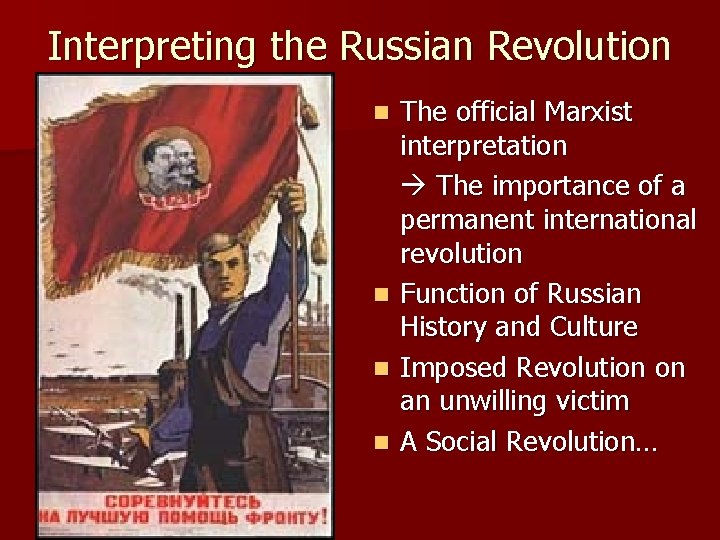
Interpreting the Russian Revolution The official Marxist interpretation The importance of a permanent international revolution n Function of Russian History and Culture n Imposed Revolution on an unwilling victim n A Social Revolution… n
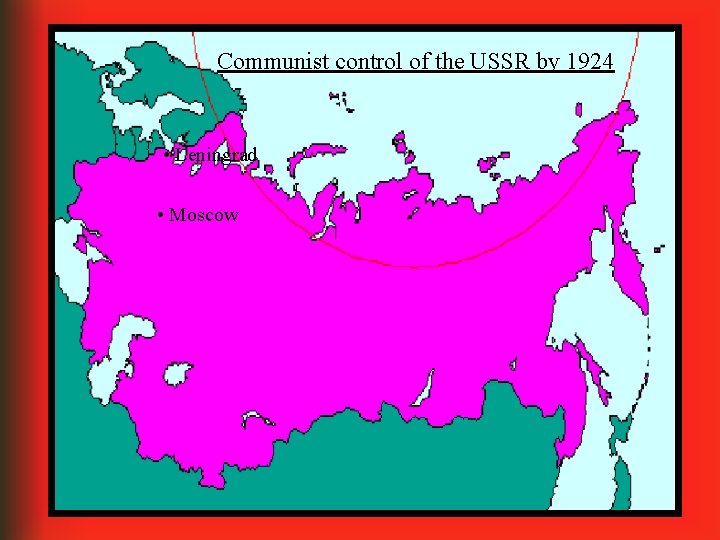
Communist control of the USSR by 1924 • Leningrad • Moscow
Final Activity: Document Questions Document 4 1) Why did Czar Nicholas’s regime fail? 2) Why was socialism necessary? 3) Why would socialism not produce the results the Bolsheviks wanted? Document 5 1) What were the problems facing the Russian Empire? 2) How did Czar Nicholas II place himself in “double jeopardy” 3) Why did the Bolsheviks resort to terror?