Venture Capital Communities Sanjiv Das Santa Clara University

- Slides: 24
Venture Capital Communities Sanjiv Das Santa Clara University Full Paper: http: //algo. scu. edu/~sanjivdas/vccomm. pdf (Joint work with Amit Bubna, Indian School of Business, and N. R. Prabhala, Univ. of Maryland) R User Group: Dec 2011 1
Communities: Multi-Disciplinary Applications q Biology o o o Metabolic networks of cellular organisms (Duch and Arenas, 2005) Community structure of the human brain (Wu et al, 2011) Compartmentalization of food chain webs (Dunne, 2006) q Political Science o Political preferences through voting patterns (Porter et al, 2007) q Social interaction o o Mobile phone and online networks (Porter et al, 2009) Collaboration between scientists (Newman, 2001) 2
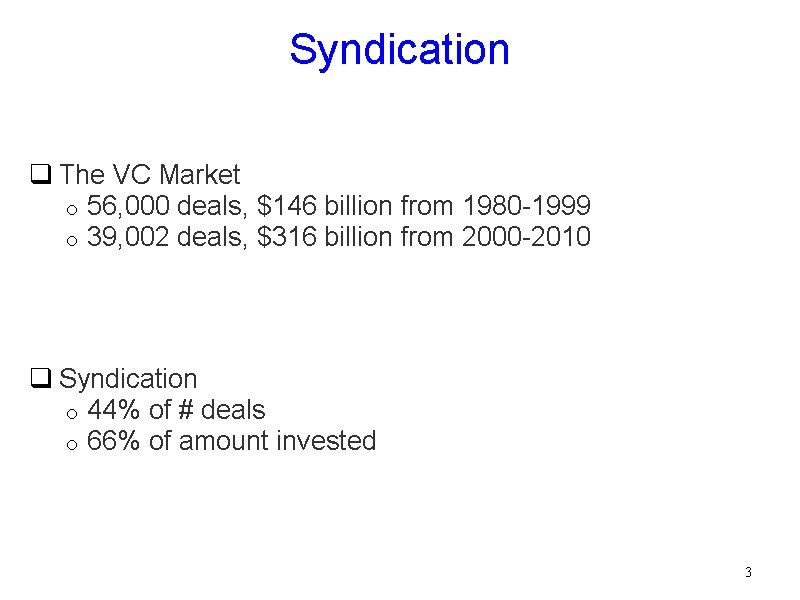
Syndication q The VC Market o 56, 000 deals, $146 billion from 1980 -1999 o 39, 002 deals, $316 billion from 2000 -2010 q Syndication o 44% of # deals o 66% of amount invested 3
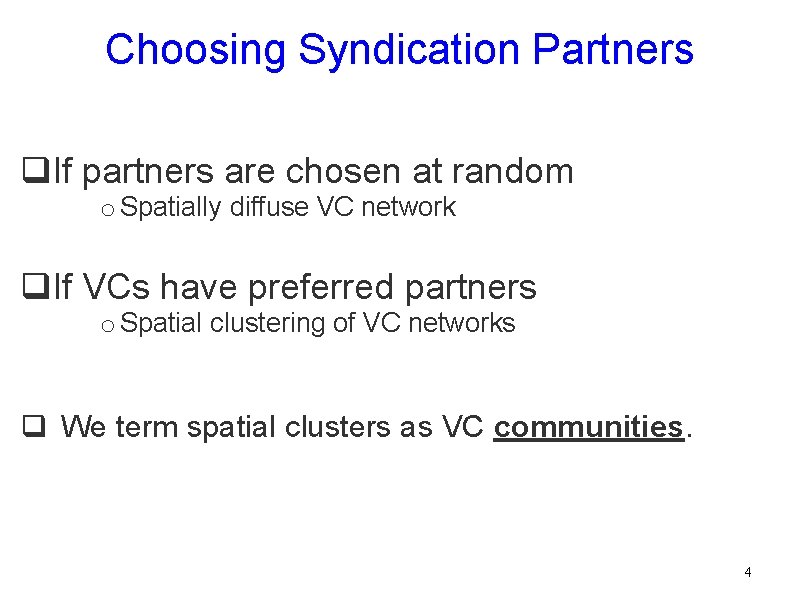
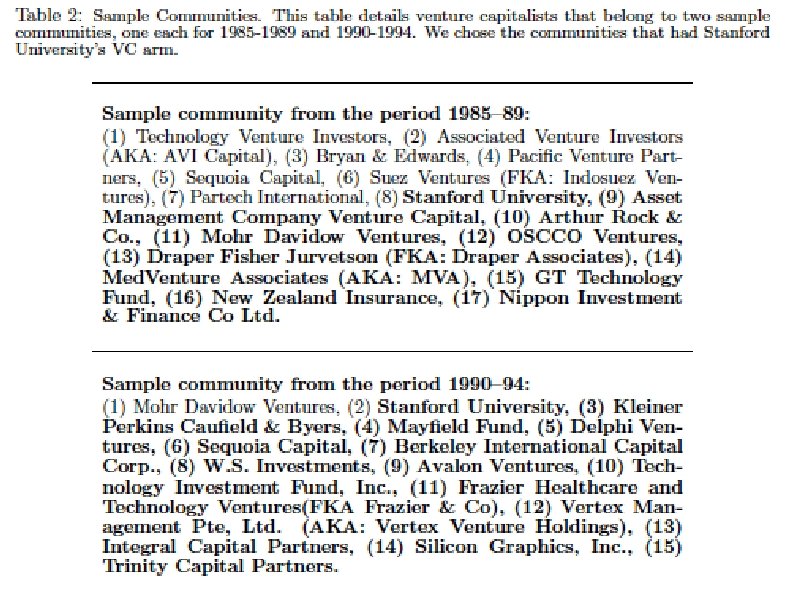
Choosing Syndication Partners q. If partners are chosen at random o Spatially diffuse VC network q. If VCs have preferred partners o Spatial clustering of VC networks q We term spatial clusters as VC communities. 4
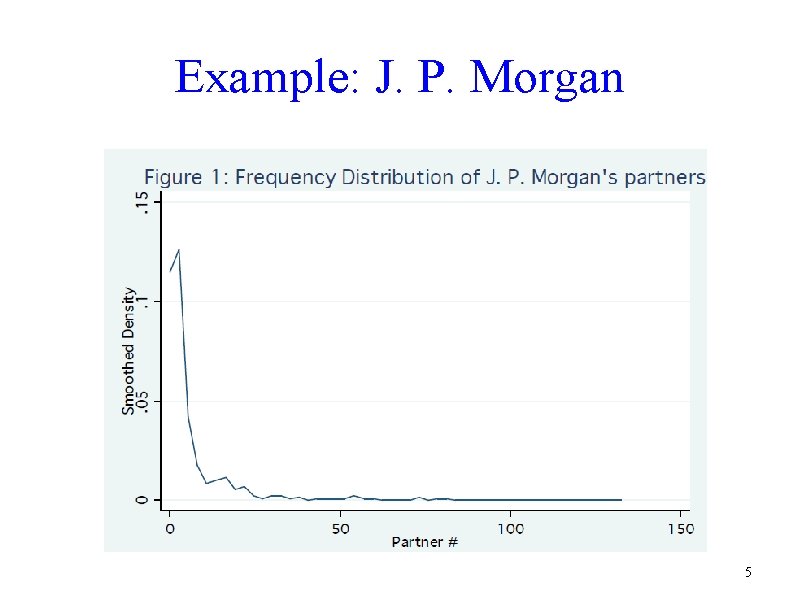
Example: J. P. Morgan 5
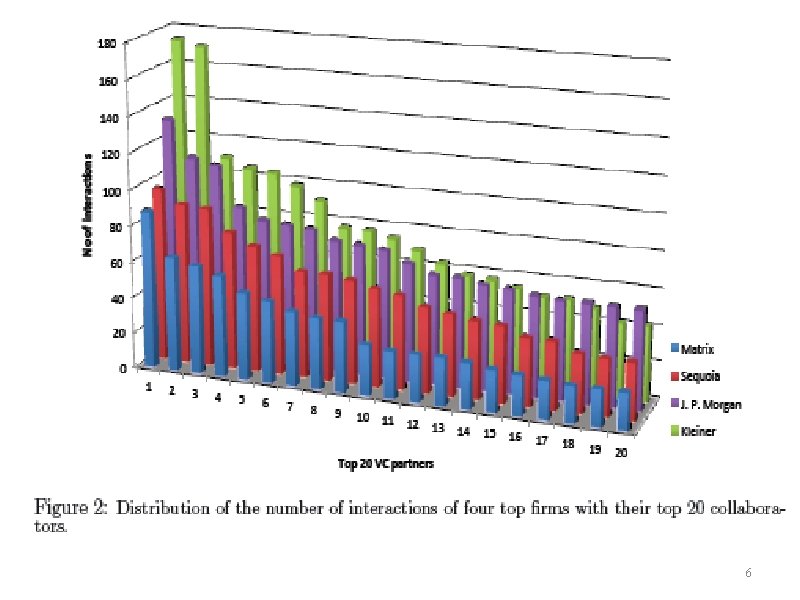
6
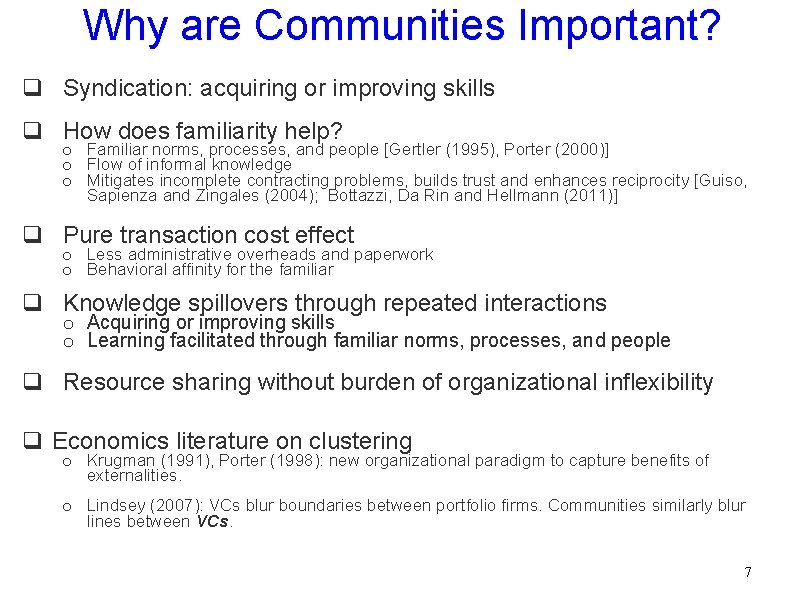
Why are Communities Important? q Syndication: acquiring or improving skills q How does familiarity help? o Familiar norms, processes, and people [Gertler (1995), Porter (2000)] o Flow of informal knowledge o Mitigates incomplete contracting problems, builds trust and enhances reciprocity [Guiso, Sapienza and Zingales (2004); Bottazzi, Da Rin and Hellmann (2011)] q Pure transaction cost effect o Less administrative overheads and paperwork o Behavioral affinity for the familiar q Knowledge spillovers through repeated interactions o Acquiring or improving skills o Learning facilitated through familiar norms, processes, and people q Resource sharing without burden of organizational inflexibility q Economics literature on clustering o Krugman (1991), Porter (1998): new organizational paradigm to capture benefits of externalities. o Lindsey (2007): VCs blur boundaries between portfolio firms. Communities similarly blur lines between VCs. 7
Detecting Communities q Community identification should o o Accommodate large number of players Not pre-specify the # of communities Allow for VC communities of varying sizes Permit fuzzy boundaries between communities q This is a computationally hard clustering problem. q Modularity optimization o o Modularity – strength of internal ties compared to ties outside (Girvan and Newman, 2003) We implement an agglomerative algorithm o “Walktrap” algorithm (Pons and Latapy, 2005) 8
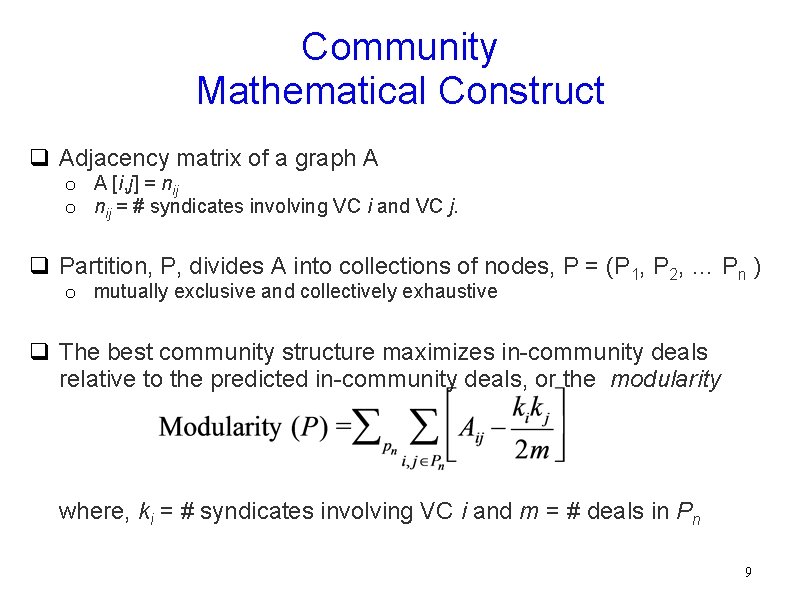
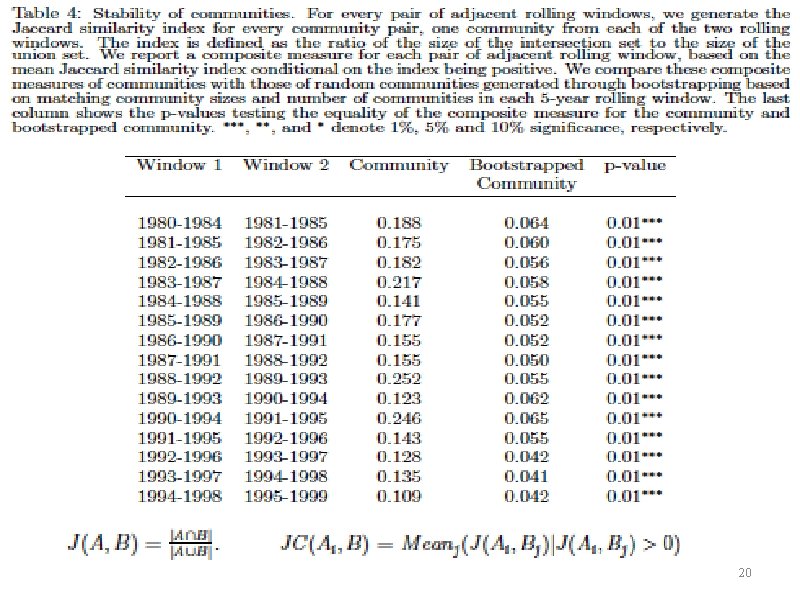
Community Mathematical Construct q Adjacency matrix of a graph A o A [i, j] = nij o nij = # syndicates involving VC i and VC j. q Partition, P, divides A into collections of nodes, P = (P 1, P 2, … Pn ) o mutually exclusive and collectively exhaustive q The best community structure maximizes in-community deals relative to the predicted in-community deals, or the modularity where, ki = # syndicates involving VC i and m = # deals in Pn 9
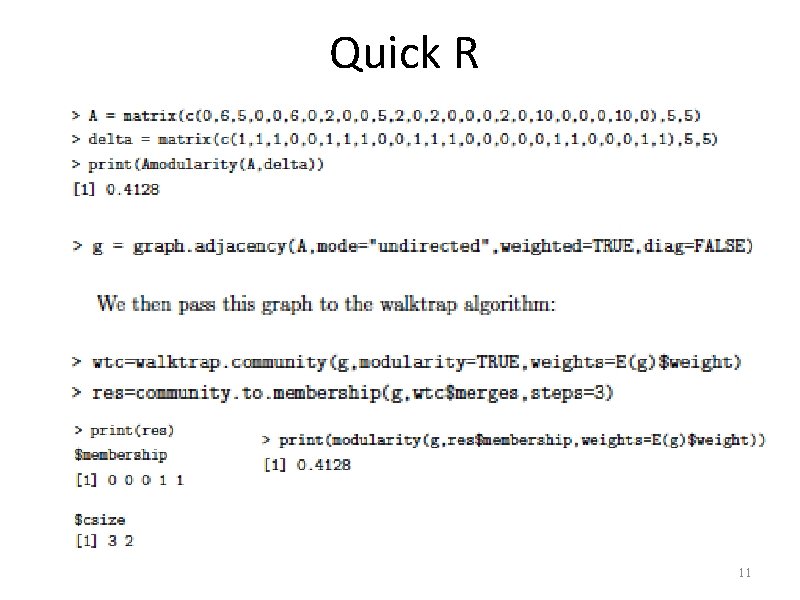
Example 10
Quick R 11
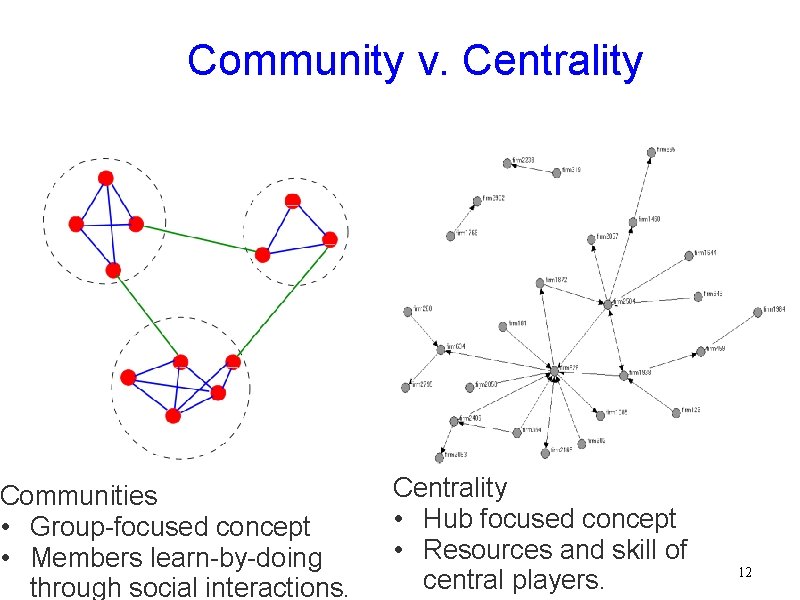
Community v. Centrality Communities • Group-focused concept • Members learn-by-doing through social interactions. Centrality • Hub focused concept • Resources and skill of central players. 12
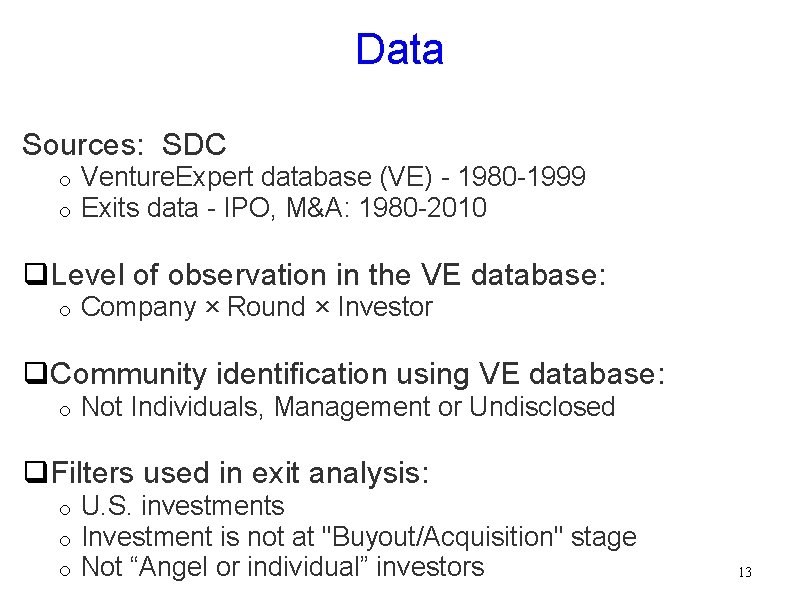
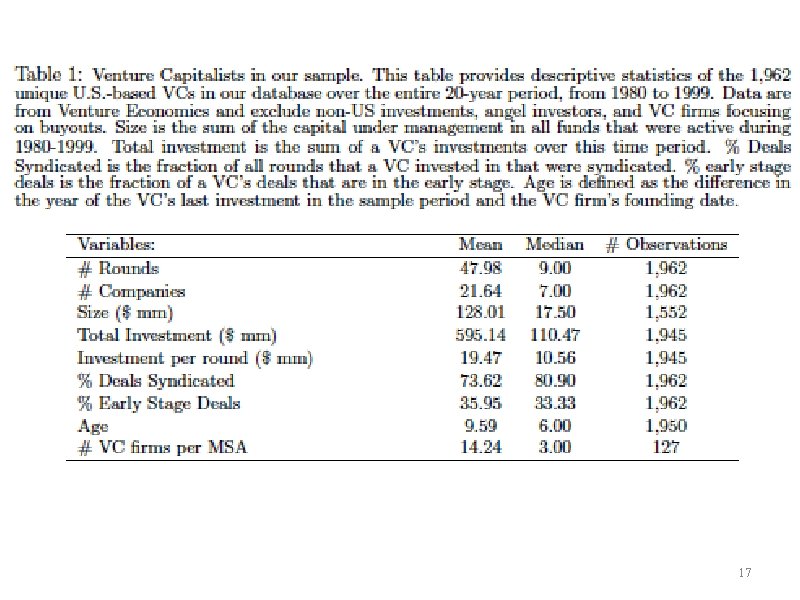
Data Sources: SDC o o Venture. Expert database (VE) - 1980 -1999 Exits data - IPO, M&A: 1980 -2010 q. Level of observation in the VE database: o Company × Round × Investor q. Community identification using VE database: o Not Individuals, Management or Undisclosed q. Filters used in exit analysis: o o o U. S. investments Investment is not at "Buyout/Acquisition" stage Not “Angel or individual” investors 13
14
15
16
17
18
19
20
21
22
23
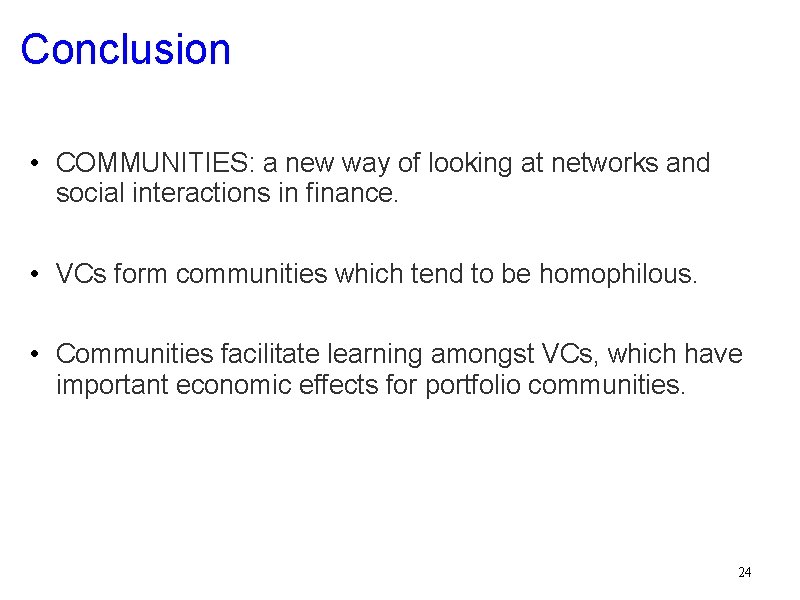
Conclusion • COMMUNITIES: a new way of looking at networks and social interactions in finance. • VCs form communities which tend to be homophilous. • Communities facilitate learning amongst VCs, which have important economic effects for portfolio communities. 24