USING ESCO IN SKILLS DEMAND SKILLS MISMATCH RESEARCH



- Slides: 23
USING ESCO IN SKILLS DEMAND SKILLS MISMATCH RESEARCH Robert Pater
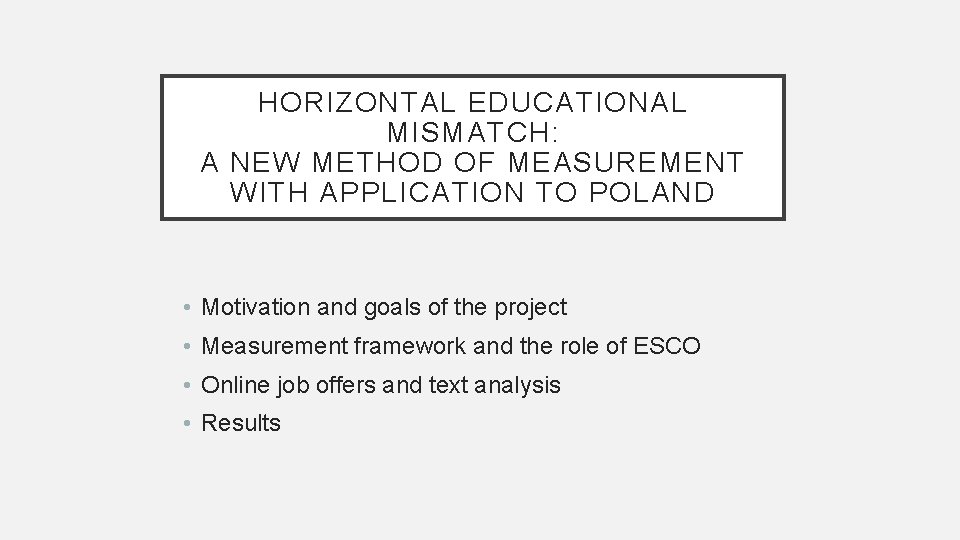
HORIZONTAL EDUCATIONAL MISMATCH: A NEW METHOD OF MEASUREMENT WITH APPLICATION TO POLAND • Motivation and goals of the project • Measurement framework and the role of ESCO • Online job offers and text analysis • Results
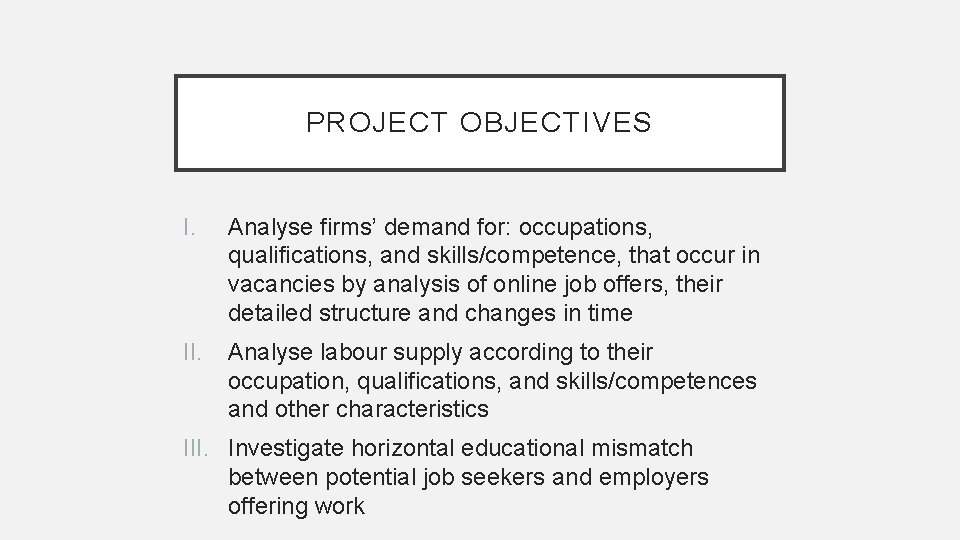
PROJECT OBJECTIVES I. Analyse firms’ demand for: occupations, qualifications, and skills/competence, that occur in vacancies by analysis of online job offers, their detailed structure and changes in time II. Analyse labour supply according to their occupation, qualifications, and skills/competences and other characteristics III. Investigate horizontal educational mismatch between potential job seekers and employers offering work
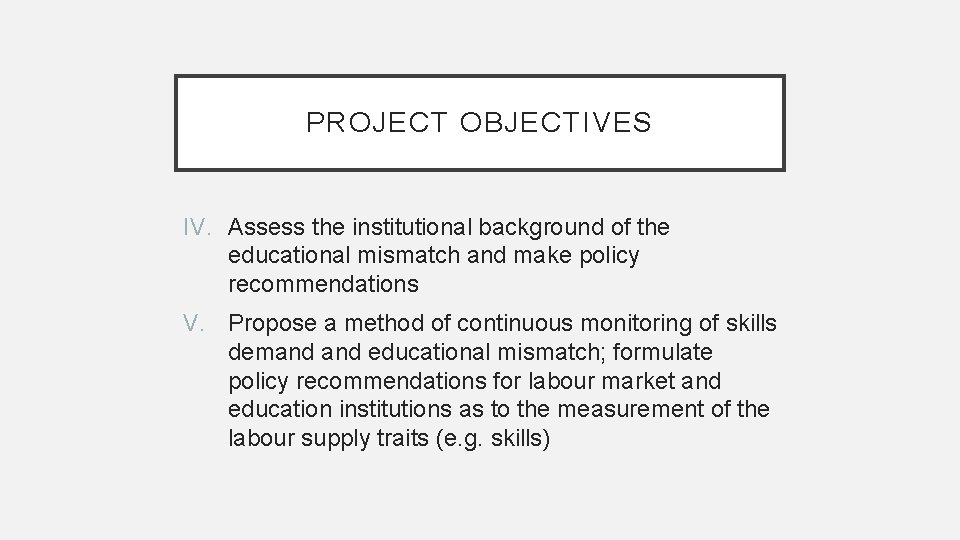
PROJECT OBJECTIVES IV. Assess the institutional background of the educational mismatch and make policy recommendations V. Propose a method of continuous monitoring of skills demand educational mismatch; formulate policy recommendations for labour market and education institutions as to the measurement of the labour supply traits (e. g. skills)
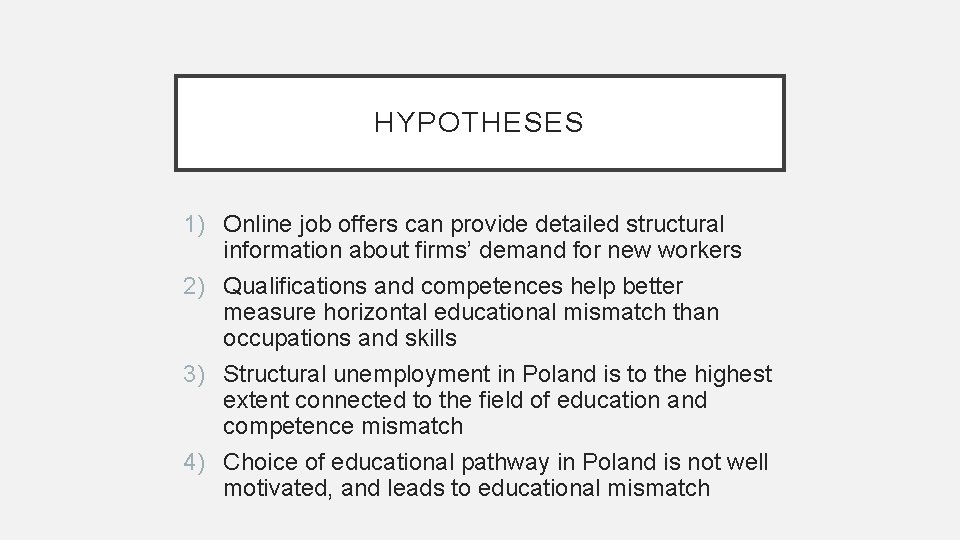
HYPOTHESES 1) Online job offers can provide detailed structural information about firms’ demand for new workers 2) Qualifications and competences help better measure horizontal educational mismatch than occupations and skills 3) Structural unemployment in Poland is to the highest extent connected to the field of education and competence mismatch 4) Choice of educational pathway in Poland is not well motivated, and leads to educational mismatch
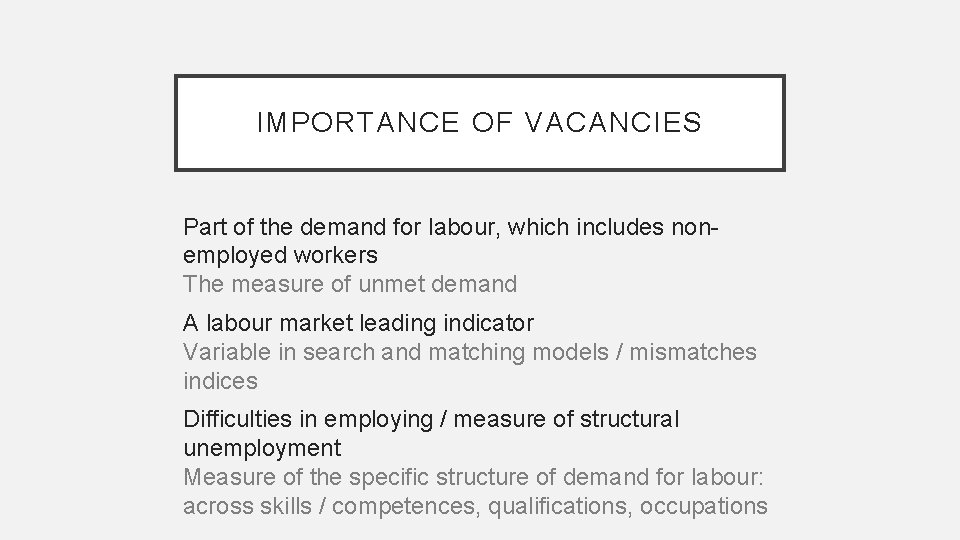
IMPORTANCE OF VACANCIES Part of the demand for labour, which includes nonemployed workers The measure of unmet demand A labour market leading indicator Variable in search and matching models / mismatches indices Difficulties in employing / measure of structural unemployment Measure of the specific structure of demand for labour: across skills / competences, qualifications, occupations
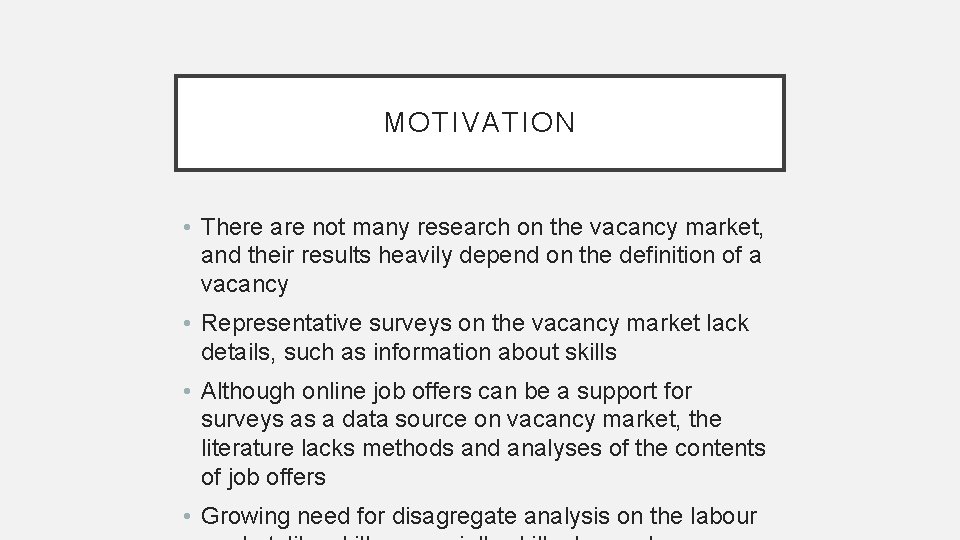
MOTIVATION • There are not many research on the vacancy market, and their results heavily depend on the definition of a vacancy • Representative surveys on the vacancy market lack details, such as information about skills • Although online job offers can be a support for surveys as a data source on vacancy market, the literature lacks methods and analyses of the contents of job offers • Growing need for disagregate analysis on the labour
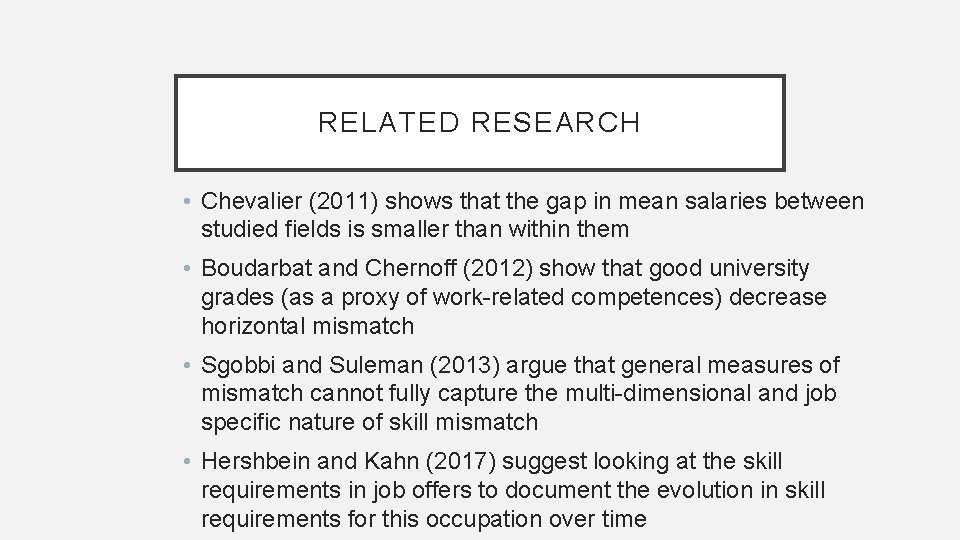
RELATED RESEARCH • Chevalier (2011) shows that the gap in mean salaries between studied fields is smaller than within them • Boudarbat and Chernoff (2012) show that good university grades (as a proxy of work-related competences) decrease horizontal mismatch • Sgobbi and Suleman (2013) argue that general measures of mismatch cannot fully capture the multi-dimensional and job specific nature of skill mismatch • Hershbein and Kahn (2017) suggest looking at the skill requirements in job offers to document the evolution in skill requirements for this occupation over time
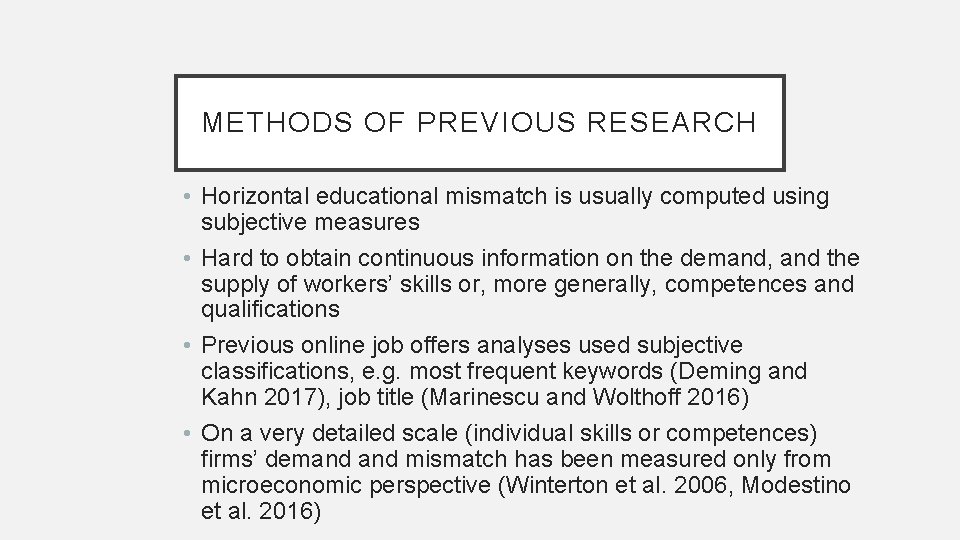
METHODS OF PREVIOUS RESEARCH • Horizontal educational mismatch is usually computed using subjective measures • Hard to obtain continuous information on the demand, and the supply of workers’ skills or, more generally, competences and qualifications • Previous online job offers analyses used subjective classifications, e. g. most frequent keywords (Deming and Kahn 2017), job title (Marinescu and Wolthoff 2016) • On a very detailed scale (individual skills or competences) firms’ demand mismatch has been measured only from microeconomic perspective (Winterton et al. 2006, Modestino et al. 2016)
GENERIC SKILLS CLASSIFICATIONS 1. General groupings: KSAO, Spencer and Spencer (1993), Winterton et al. (2006), United Nations Industrial Development Organization (2002) 2. PIAAC and PISA: not for demand 3. ISCO-08: proxy of skills levels 4. O*Net: six categories, covering between one and 11 skills (35 skills) https: //www. onetonline. org/find/descriptor/browse/Skills/ 1. Human Capital Study: 11 categories … but which social skills are imporant?
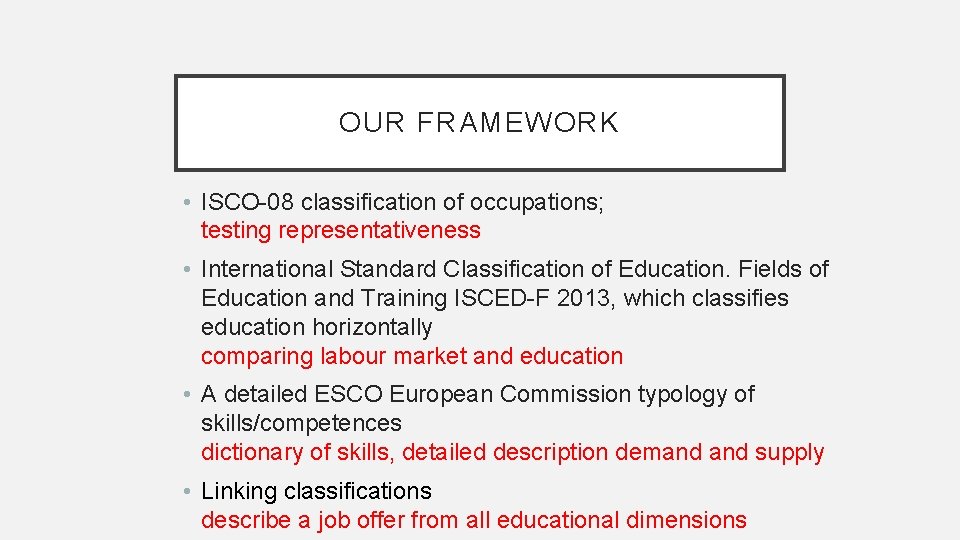
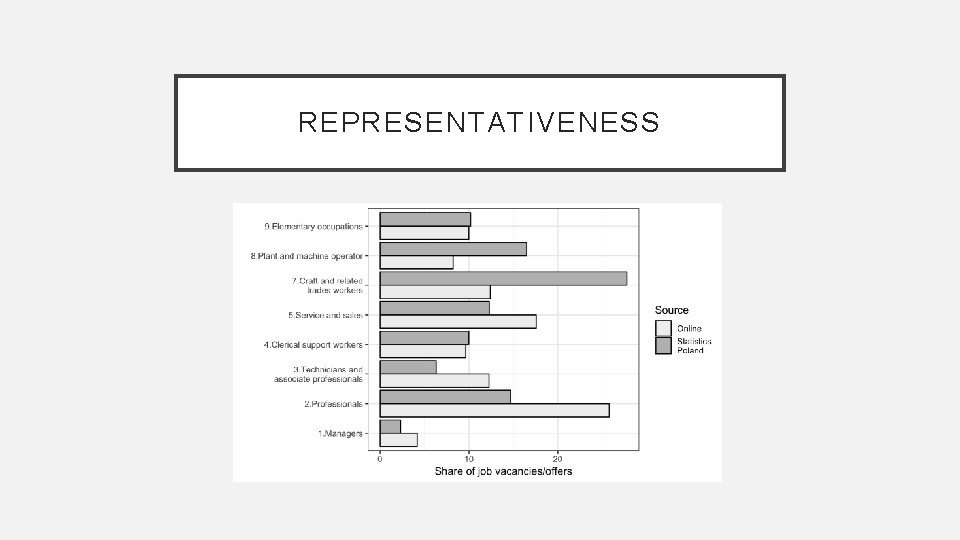
OUR FRAMEWORK • ISCO-08 classification of occupations; testing representativeness • International Standard Classification of Education. Fields of Education and Training ISCED-F 2013, which classifies education horizontally comparing labour market and education • A detailed ESCO European Commission typology of skills/competences dictionary of skills, detailed description demand supply • Linking classifications describe a job offer from all educational dimensions
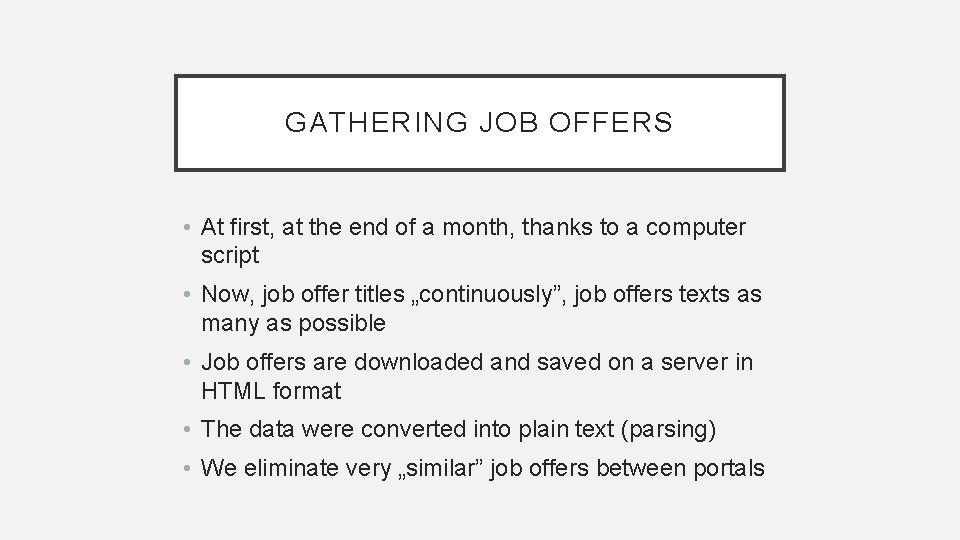
GATHERING JOB OFFERS • At first, at the end of a month, thanks to a computer script • Now, job offer titles „continuously”, job offers texts as many as possible • Job offers are downloaded and saved on a server in HTML format • The data were converted into plain text (parsing) • We eliminate very „similar” job offers between portals
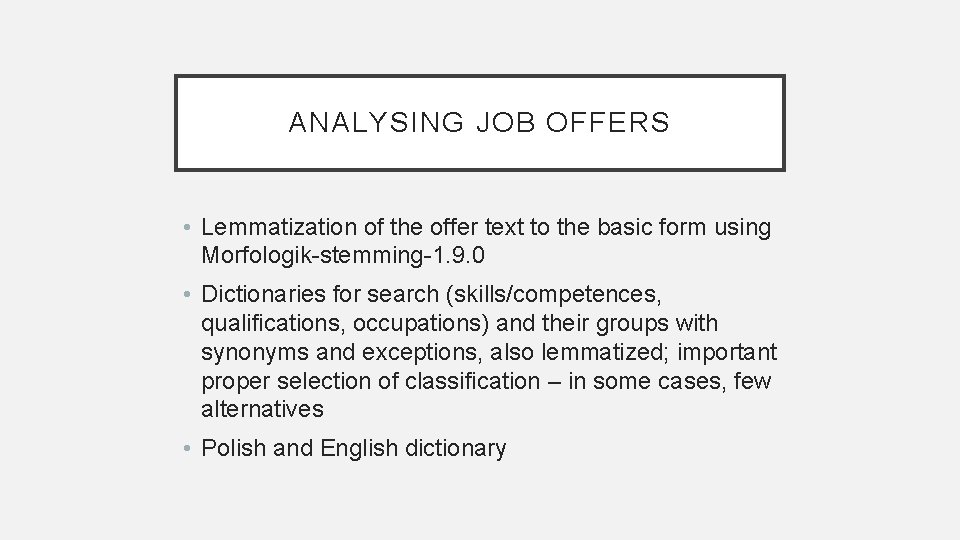
ANALYSING JOB OFFERS • Lemmatization of the offer text to the basic form using Morfologik-stemming-1. 9. 0 • Dictionaries for search (skills/competences, qualifications, occupations) and their groups with synonyms and exceptions, also lemmatized; important proper selection of classification – in some cases, few alternatives • Polish and English dictionary
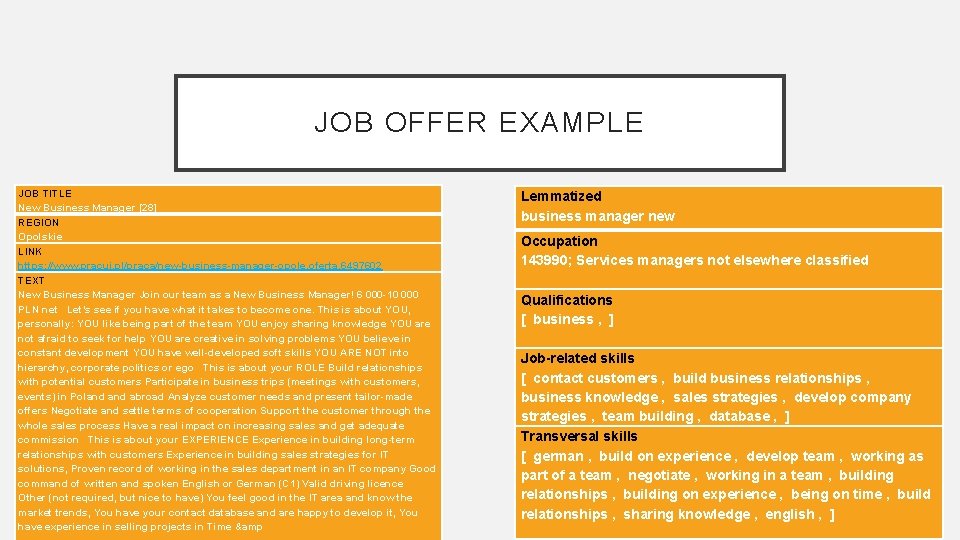
JOB OFFER EXAMPLE JOB TITLE New Business Manager [28] REGION Opolskie LINK https: //www. pracuj. pl/praca/new-business-manager-opole, oferta, 6497602 TEXT New Business Manager Join our team as a New Business Manager! 6 000 -10 000 PLN net Let’s see if you have what it takes to become one. This is about YOU, personally: YOU like being part of the team YOU enjoy sharing knowledge YOU are not afraid to seek for help YOU are creative in solving problems YOU believe in constant development YOU have well-developed soft skills YOU ARE NOT into hierarchy, corporate politics or ego This is about your ROLE Build relationships with potential customers Participate in business trips (meetings with customers, events) in Poland abroad Analyze customer needs and present tailor-made offers Negotiate and settle terms of cooperation Support the customer through the whole sales process Have a real impact on increasing sales and get adequate commission This is about your EXPERIENCE Experience in building long-term relationships with customers Experience in building sales strategies for IT solutions, Proven record of working in the sales department in an IT company Good command of written and spoken English or German (C 1) Valid driving licence Other (not required, but nice to have) You feel good in the IT area and know the market trends, You have your contact database and are happy to develop it, You have experience in selling projects in Time & Lemmatized business manager new Occupation 143990; Services managers not elsewhere classified Qualifications [ business , ] Job-related skills [ contact customers , build business relationships , business knowledge , sales strategies , develop company strategies , team building , database , ] Transversal skills [ german , build on experience , develop team , working as part of a team , negotiate , working in a team , building relationships , building on experience , being on time , build relationships , sharing knowledge , english , ]
REPRESENTATIVENESS
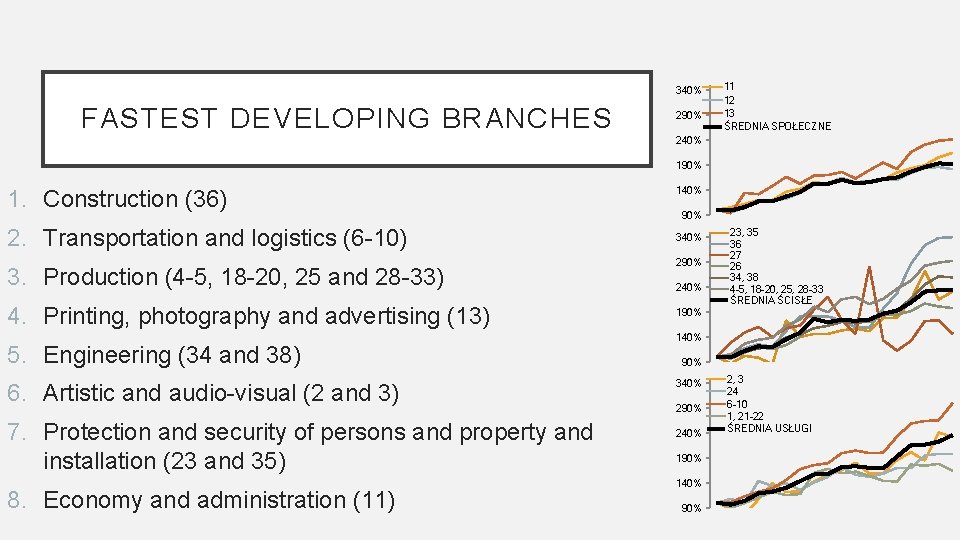
340% FASTEST DEVELOPING BRANCHES 290% 11 12 13 ŚREDNIA SPOŁECZNE 240% 190% 1. Construction (36) 2. Transportation and logistics (6 -10) 3. Production (4 -5, 18 -20, 25 and 28 -33) 4. Printing, photography and advertising (13) 5. Engineering (34 and 38) 6. Artistic and audio-visual (2 and 3) 7. Protection and security of persons and property and installation (23 and 35) 8. Economy and administration (11) 140% 90% 340% 290% 240% 23, 35 36 27 26 34, 38 4 -5, 18 -20, 25, 28 -33 ŚREDNIA ŚCISŁE 190% 140% 90% 340% 290% 240% 190% 140% 90% 2, 3 24 6 -10 1, 21 -22 ŚREDNIA USŁUGI
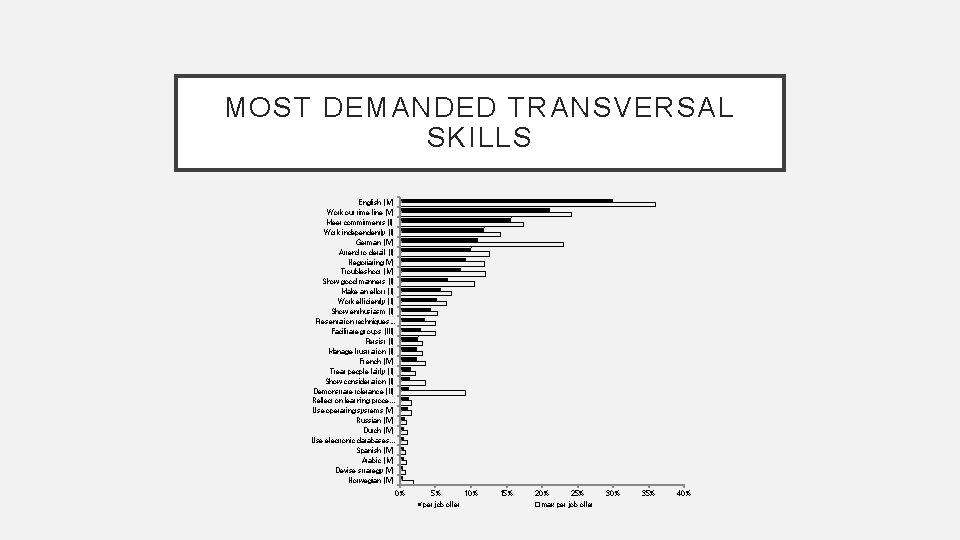
TRANSVERSAL SKILLS PER JOB OFFER Category Competences Mean Min Max First Last I Attitudes and values at work 0. 93 0. 72 1. 03 0. 72 0. 95 II Application of knowledge 0. 05 0. 04 0. 06 0. 04 0. 05 0. 30 0. 21 0. 35 0. 21 0. 32 0. 99 0. 77 1. 10 0. 77 1. 00 0. 60 0. 46 0. 67 0. 46 0. 62 Social skills and III competences Language and IV communication Thinking skills and V competences
MOST DEMANDED TRANSVERSAL SKILLS English (IV) Work out time line (V) Meet commitments (I) Work independently (I) German (IV) Attend to detail (I) Negotiating IV) Troubleshoot (IV) Show good manners (I) Make an effort (I) Work efficiently (I) Show enthusiasm (I) Presentation techniques. . . Facilitate groups (III) Persist (I) Manage frustration (I) French (IV) Treat people fairly (I) Show consideration (I) Demonstrate tolerance (II) Reflect on learning proce. . . Use operating systems (V) Russian (IV) Dutch (IV) Use electronic databases. . . Spanish (IV) Arabic (IV) Devise strategy (V) Norwegian (IV) 0% 5% per job offer 10% 15% 20% 25% max per job offer 30% 35% 40%
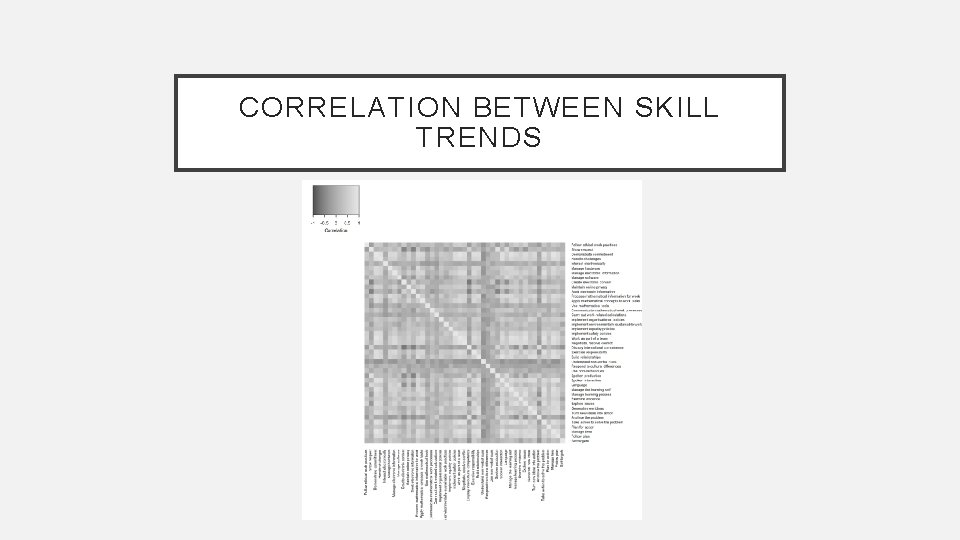
CORRELATION BETWEEN SKILL TRENDS
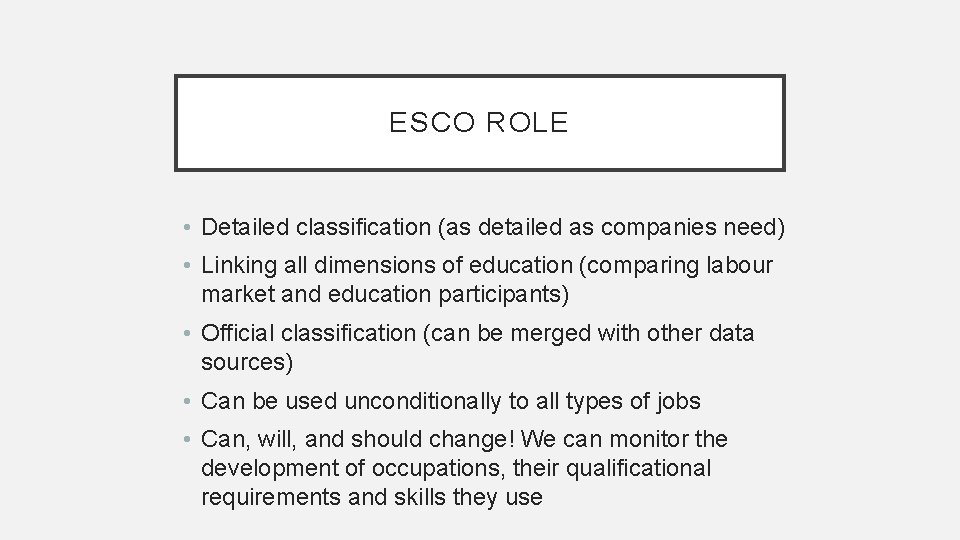
ESCO ROLE • Detailed classification (as detailed as companies need) • Linking all dimensions of education (comparing labour market and education participants) • Official classification (can be merged with other data sources) • Can be used unconditionally to all types of jobs • Can, will, and should change! We can monitor the development of occupations, their qualificational requirements and skills they use
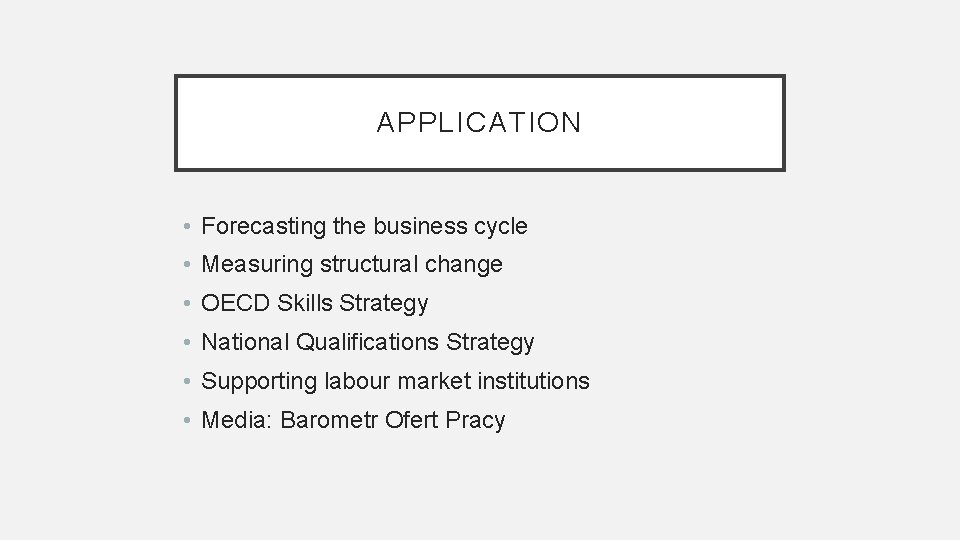
APPLICATION • Forecasting the business cycle • Measuring structural change • OECD Skills Strategy • National Qualifications Strategy • Supporting labour market institutions • Media: Barometr Ofert Pracy
THANK YOU Presenter: Robert Pater Institution: Wyższa Szkoła Informatyki i Zarządzania w Rzeszowie Instytut Badań Edukacyjnych w Warszawie e-mail: rpater@wsiz. rzeszow. pl r. pater@ibe. edu. pl
REFERENCES 1. Boudarbat, B. , & Chernoff, V. (2012). Education–job match among recent Canadian university graduates. Applied Economics Letters , 19(18), 1923– 1926, doi: 10. 1080/13504851. 2012. 676730. 2. Chevalier, A. (2011). Subject Choice and Earnings of UK Graduates. Economics of Education Review, 30(6), 1187– 1201. 3. Deming, D. , & Kahn, L. (2017). Skill requirements across firms and labor markets: evidence from job postings for professionals. NBER Working Paper 23328. http: //www. nber. org/papers/w 23328. Accessed 20 June 2018. 4. Hershbein, B. , & Kahn, L. (2017). Do recessions accelerate routine-biased technological change? Evidence from vacancy posting. Employment Research, 24(4), 1 -4. 5. Marinescu, I. , & Wolthoff, R. (2016). Opening the Black Box of the Matching Function: the Power of Words. NBER Working Paper 22508. http: //www. nber. org/papers/w 22508. pdf. Accessed 20 June 2018. 6. Modestino, A. , Shoag, D. , & Ballance, J. (2016). Downskilling: Changes in Employer Skill Requirements Over the Business Cycle. Labour Economics, 41, 333– 347. 7. Sgobbi, F. , Suleman, F. (2013). A Methodological Contribution to Measuring Skill (Mis)Match. The Manchester School, 81(3), 420– 39. 8. Spencer, L. M. , Spencer, S. M. (1993). Competence at Work. Models for Superior Performance. New York: John Wiley & Sons. 9. United Nations Industrial Development Organization (2002). Competencies. Part 1. Vienna: United Nations Industrial Development Organization. https: //www. unido. org/fileadmin/media/documents/pdf/Employment/UNIDO-Competency. Model. Part 1. pdf. Accessed 20 June 2018. 10. Winterton, J. , Delamare Le Deist, F. , & Stringfellow, E. (2006). Typology of knowledge, skills and competences: clarification of the concept and prototype. Cedefop Reference Series 64. Luxembourg: Office for Official Publications of the European Communities. http: //www. cedefop. europa. eu/en/publications-and-resources/publications/3048. Accessed 20 June 2018.